


National Mathematics Olympiad 2026 – Registration, Exam Dates, Eligibility, Syllabus & Pattern
The Mathematics Research Foundation is organising the National Mathematics Olympiad 2026 for school students across India. Students from Classes 1 to 12 can participate in the National Maths Olympiad (NMO) 2026. The registration fee for NMO is INR 150/-. All schools under the CBSE/ICSE/State Boards can participate in this Olympiad. Questions will be MCQ-based in Round 1 and problem-solving-based in Round 2.
This Story also Contains
- Highlights of the National Mathematics 2026 Olympiad
- NMO 2026 Important Dates
- National Mathematics Olympiad 2026 Registration
- NMO Exam Pattern 2026
- National Mathematics Olympiad 2026 Syllabus
NMO is an annual competition that provides students with opportunities to examine their knowledge analytically and logically. It provides a platform for candidates to get recognition at the national level. Students will get a chance to interact with leading Indian mathematicians who are currently working with IITs, IIITs, IIMs, NITs, and IISc, and leading global universities. International Winners of the NMO will be awarded with “The Aryabhata Award”. Read the article to learn more about the National Mathematics Olympiad 2026.
Highlights of the National Mathematics 2026 Olympiad
Particulars | Details |
|---|---|
Exam name | National Mathematics Olympiad 2026 |
Conducting body | Mathematics Research Foundation (MRF) |
Curriculum | National Council of Educational Research and Training (NCERT) |
Who is eligible? | Students from Classes 1 to 12 |
Registration fees | INR 150/- |
Number of levels | Two levels -
|
Number of rounds | Two rounds -
|
Types of questions |
|
Awards |
|
Official website | mathsolympiad.in |
NMO 2026 Important Dates
The National Mathematics Olympiad will be conducted in two phases, pre and mains. Pre-exam will be held for Classes 1 to 12, whereas mains will be conducted for Classes 6 to 12. Check out the following table to learn more about the important dates.
Particulars | Exam Dates | Last date for registration |
|---|---|---|
Prelims (Classes 1 to 12) | August 24, 2026 | July 31, 2026 |
September 23, 2026 | August 31, 2026 | |
October 28, 2026 | September 30, 2026 | |
November 25, 2026 | October 31, 2026 | |
Mains (only for Classes 6 to 12) | Date & Venue will be notified to the schools | |
Important note: Viva will also be conducted by a senior professor (Mathematics), if required, to determine the ranking.
National Maths Olympiad 2026 Eligibility Criteria
Students who want to participate in the NMO 2026 can check out the eligibility criteria below.
Candidates from Classes 1 to 12 are eligible to participate in the National Maths Olympiad.
NMO is a one-level competition for Classes 1 & 2, whereas it is a two-level competition for Classes 3 to 12.
All schools under the CBSE/ICSE/state boards can participate in this Olympiad.
All students will be awarded participation certificates.
Confused between CGPA and Percentage?
Get your results instantly with our calculator!
National Mathematics Olympiad 2026 Registration
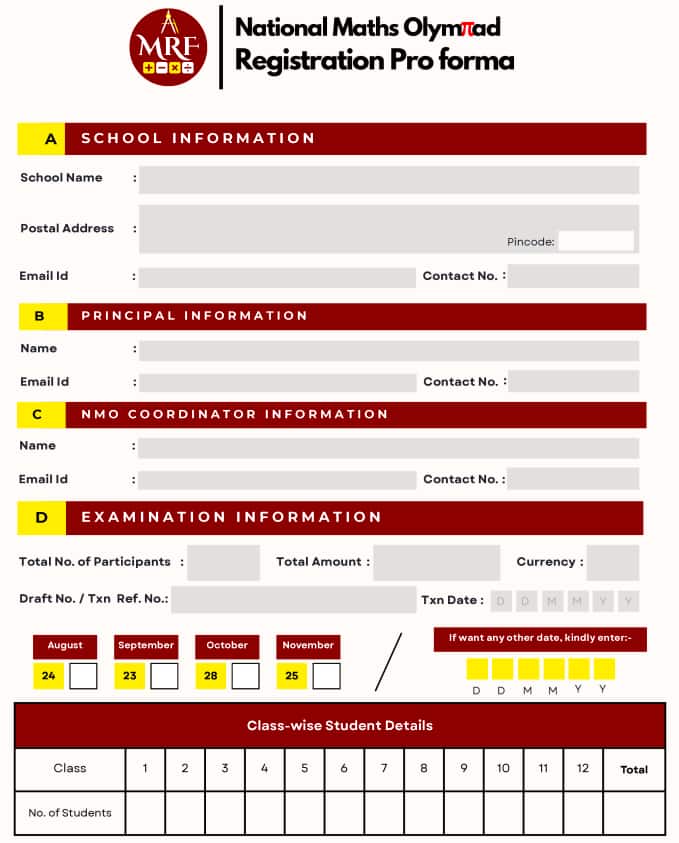
Candidates from Classes 1 to 12 can register and participate in the National Maths Olympiad. To register for NMO 2026, each participant must pay INR 150 as a registration fee. From the total fee amount, the school will keep INR 25 per student as an honorarium towards the exam conduction and to cover other expenses. Schools must send the NMO registration 2026 details to the headquarters of the Mathematics Research Foundation (NMO Cell), 20 days before the opted examination date. Participants can pay the NMO 2026 registration fees through UPI, DD, or NEFT/RTGS.
NMO Registration 2026 Details
Particulars | Details |
|---|---|
Registration fee | INR 150/- per student |
Schools to keep | INR 25 per student |
Registration details to be sent | To NMO Cell 20 days before the opted exam date |
Payable through | Demand Draft (DD), UPI, NEFT/RTGS |
NMO 2026 Registration Proforma
NMO Exam Pattern 2026
Candidates can check out the National Maths Olympiad 2026 exam pattern below.
Particulars | Details |
|---|---|
Types of questions |
|
Exam mode | Offline mode (Round 1) within the school premises |
Qualification for round 2 | Students scoring more than or equal to 70% in round 1 will be qualified for the round 2 exam (for classes 3 to 12) |
Students will be provided | OMR sheet/answer sheet |
Exam duration | 1 hour |
Exam types |
|
National Mathematics Olympiad 2026 Syllabus
Students can check out the table below to get the class-wise syllabus topics from Classes 1 to 12. They can go through the syllabus of their respective classes and prepare for the NMO 2026 examination.
Particulars | Syllabus topics |
|---|---|
Class 1 | Shapes and space, number names (1-50), addition, subtraction (two digits), data handling, time, measurement, patterns, calendar, grouping, how many, odd one out, spatial understanding, money, lengths, weights, and comparison. |
Higher-Order Thinking Skills (HOTS) Questions | |
General Aptitude & Logical Reasoning | |
Class 2 | Numbers name (1-100), addition, subtraction (two digits), counting in groups, multiplication, division, data handling, geometrical shapes, measurement, patterns, grouping, how many, odd one out, spatial understanding, money, time & calendar, temperature, pictographs, lengths, weights and comparison, capacity, etc. |
Higher-Order Thinking Skills (HOTS) Questions | |
General Aptitude & Logical Reasoning | |
Class 3 | Geometrical shapes, numerals, number names and number sense (4-digit numbers), computation operations - addition, subtraction, multiplication and division (3 digits), fractions, length, weight, capacity, temperature, time, money, calendar, geometry, data handling, etc. |
Higher-Order Thinking Skills (HOTS) Questions | |
General Aptitude & Logical Reasoning | |
Class 4 | Numerals and number names, number sense (more than 4-digit numbers), computation operations, fractions, length, weight, capacity, time operations, money, geometry, perimeter of various shapes, area of triangle, rectangle and square, symmetry, conversions, data handling, etc. |
Higher-Order Thinking Skills (HOTS) Questions | |
General Aptitude & Logical Reasoning | |
Class 5 | Numerals, number names and number sense (7 and 8 digit numbers), computation operations, fractions and decimals, measurement of length, weight, capacity, time, temperature and money, conversions, geometrical shapes and solids, angles, perimeter of various shapes, area of rectangle, square, rhombus, trapezium, calendar symmetry, data handling, decoding reasoning, etc. |
Higher-Order Thinking Skills (HOTS) Questions | |
General Aptitude & Logical Reasoning | |
Class 6 | Knowing our numbers, whole numbers, HCF and LCM, Parallel lines, Angles (Supplementary/Complementary, Linear Pair), under-standing elementary shapes, integers, fractions, decimals, data handling, conjecture - Brocard, Collatz Numbers - Kaprekar number, Kaprekar constant, Self Number, Triangular to Hexagonal number, Virhanka Number, mensuration, algebra, ratio and proportion, symmetry, practical geometry, etc. |
Higher-Order Thinking Skills (HOTS) Questions | |
General Aptitude & Logical Reasoning | |
Class 7 | Integers, fractions and decimals, exponents and powers, algebraic expressions, arithmetic expression, Palindrome and Ramanujan - Hardy Number, simple linear equations, lines and angles, Polygons, Triangle and quadrialteral property, triangle inequality, comparing quantities, the triangle and its properties, symmetry, congruence of triangles, rational numbers, perimeter and area, data handling, Polygon, visualising solid shapes, Prime and Composite numbers, SI and CI, practical geometry, etc. |
Higher-Order Thinking Skills (HOTS) Questions | |
General Aptitude & Logical Reasoning | |
Class 8 | Rational numbers, squares and square roots, cubes and cube roots, exponents and powers, comparing quantities, algebraic expressions and identities, linear equations in one variable, Factorization, understanding quadrilaterals, constructions, mensuration, visualising solid shapes, Races and Games, Alphametics or Cryptarithmetics, data handling, direct and inverse variations, factorisation, introduction to graphs, and Three dimension geometry - Cube, Cuboid, Cylinder, Sphere, Cone, Time and distance, Divisibility rule - Wilson and Fermat Little Theorem, Time and Work, etc. |
Higher-Order Thinking Skills (HOTS) Questions | |
General Aptitude & Logical Reasoning | |
Class 9 | Real numbers, polynomials, linear equations in two variables, Factorisation, Cyclic Factorisation, Remainder and Factor Theorem, coordinate geometry, geometry, lines and angles, triangles, quadrilaterals, circles, area, surface area and volumes, statistics, and probability. Apollonius and Stewart Theorem, Circle Theorem, Brahmagupta's cyclic quadrilateral theorem, Midpoint theorem, Butterfly theorem, Centroid, Orthocentre and Circumcentre, etc. |
Higher-Order Thinking Skills (HOTS) Questions | |
General Aptitude & Logical Reasoning | |
Class 10 | Real numbers, polynomials, pair of linear equations in two variables, quadratic equation, arithmetic progressions, coordinate geometry, geometry, triangles, Principle of inclusion and exclusion, Pigeon hole principle, Greatest integer and least integer functions, introduction to trigonometry, trigonometric identities, height and distances (angle of elevation, angle of depression), area related to circles, surface area and volumes of 3D figure including Pyramid and Prism statistics, and probability, Alternate Segment Theorem, Tangent Theorem, Inequation, Ceva Theorem, Internal and External bisector theorem, etc. |
Higher-Order Thinking Skills (HOTS) Questions | |
General Aptitude & Logical Reasoning | |
Class 11 | Sets, relations and functions, trigonometric functions, principle of mathematical induction, complex numbers and quadratic equations, linear inequalities, permutations and combinations, binomial theorem, sequences and series, straight lines and pairs of straight lines, conic sections, introduction to three-dimensional geometry, limits and derivatives, mathematical reasoning, statistics, and probability. Pigeon Hole principle, Logarithm, Diophantine Equation, etc. |
Higher-Order Thinking Skills (HOTS) Questions | |
General Aptitude & Logical Reasoning | |
Class 12 | Relations and functions, inverse trigonometric functions, matrices, determinants, continuity and differentiability, applications of derivatives, integrals, application of integrals, differential equations, vector triple product and dot product, three-dimensional geometry, linear programming, and probability, Counting techniques, Theorem and Paradox, etc. |
Higher-Order Thinking Skills (HOTS) Questions | |
General Aptitude & Logical Reasoning |
Frequently Asked Questions (FAQs)
Students who want to participate in the NMO 2026 must pay the registration fee of INR 150/-.
The Mathematics Research Foundation will conduct the NMO in two rounds. Round 1 will be prelims conducted at the school level, and round 2 will be mains held at the national level.
The NMO 2026 will be conducted for 1 hour.

Questions related to CBSE Class 10th
On Question asked by student community
Hello student!
You can refer to the CBSE Class 10 Mathematics Question Paper 2026 to practise questions and prepare for the Mathematics examination.
https://school.careers360.com/boards/cbse/cbse-class-10-maths-question-paper-2026
Hope it helps!
Hi Smriti Lama
The CBSE Class 10 Board Exam 2026-27 question paper pattern includes the latest exam structure, subject-wise marking scheme and question types. You can check the detailed pattern on Careers360:
Hi Somshiv Rath
If you mean a CBSE Class 8 Science question paper, Careers360 has a sample paper section where you can check the available Class 8 papers.
https://learn.careers360.com/school/cbse-8-class-preparation-material/
Hey there,
If you mean CBSE Class 10 rechecking/re-evaluation results 2026, CBSE has already completed the main post-result process for 2026. The Class X second-board results were declared on 18 July 2026, and CBSE has also issued the post-result facilities notice.
For verification/re-evaluation, CBSE says the result/status is uploaded online
Please mention important details like your school board, exam, and class to get the exact papers.
You can explore the useful resources here: