
Search Colleges, Exams, Schools & more


Login
CBSE Class 11 Biology Syllabus 2026-27 PDF Download, Chapter-Wise Topics & Marking Scheme
Central Board of Secondary Education (CBSE) has released the Class 11 Biology syllabus on the official website. The official CBSE Class 11 Biology syllabus for the academic year 2026-27 contains a total of 70 marks for the theory paper and 30 marks for the practical assessment. In the CBSE Class 11 Biology unit-wise distribution of marks, Human Physiology is the most important section in the Biology theory examination, carrying 18 marks, which accounts for about 25.7% of the total theory paper. Students should therefore give special attention to topics related to human body systems and their functions.
Direct Link: Download CBSE Class 11 Biology syllabus PDF from here
This Story also Contains
- CBSE 11th Biology Syllabus Marking Scheme (Theory)
- Unit-Wise Chapter Details
- Practical Examination Scheme (30 Marks)
- Is there any chapter deleted in the CBSE 11th Biology Syllabus 2026?
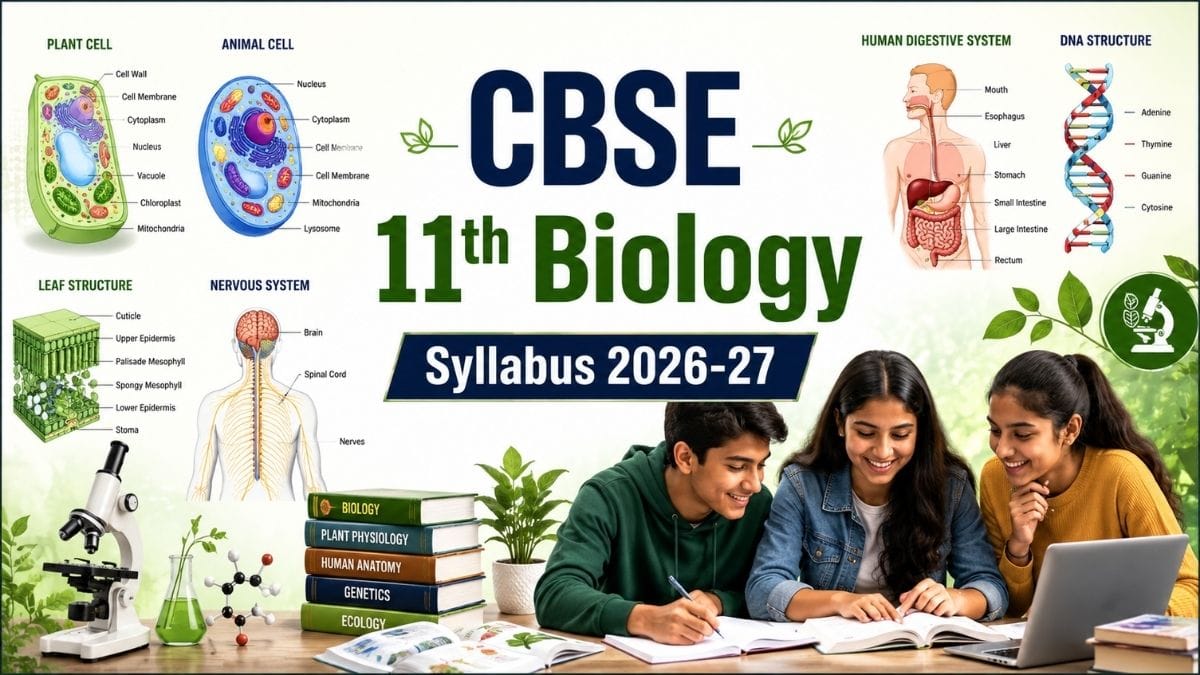
Students aiming for high scores should prioritise Human Physiology, followed by Diversity of Living Organisms and Cell: Structure and Function, as these three units together account for 48 out of 70 marks (68.6%) of the CBSE 11th Biology theory examination. Students can also download the CBSE 11th Biology syllabus PDF directly from the link provided above.
Also, check CBSE 11th syllabus for other subjects
CBSE 11th Biology Syllabus Marking Scheme (Theory)
The Biology theory paper is divided into five units. Unit I, Diversity of Living Organisms, carries 15 marks, while Unit II, Structural Organisation in Plants and Animals, is allotted 10 marks. Unit III, Cell: Structure and Function, has a weightage of 15 marks. Unit IV, Plant Physiology, carries 12 marks, and Unit V, Human Physiology, has the highest weightage with 18 marks.
Unit No. | Unit Name | Marks Weightage |
I | Diversity of Living Organisms | 15 Marks |
II | Structural Organisation in Plants and Animals | 10 Marks |
III | Cell: Structure and Function | 15 Marks |
IV | Plant Physiology | 12 Marks |
V | Human Physiology | 18 Marks |
Total Theory | 70 Marks |
Check the CBSE syllabus for other classes too
Also, check
CBSE Class 11 Admission
CBSE Class 11 Date Sheet
CBSE Private Candidate Form 2027
Unit-Wise Chapter Details
Two units, Diversity of Living Organisms and Cell: Structure and Function, are one of important chapters, with 15 marks each. Together, these units contribute 30 marks, making up nearly 43% of the theory examination. A strong understanding of classification, biodiversity, cell structure, and cellular processes can help students secure a substantial portion of the marks.
Plant Physiology carries 12 marks, representing around 17.1% of the paper. This unit focuses on important physiological processes in plants and remains a key scoring area.
The least-weighted unit is Structural Organisation in Plants and Animals, which carries 10 marks or about 14.3% of the total theory marks. However, it has the lowest weightage; students should not neglect it, as it still contributes a significant portion to the final score.
Unit I: Diversity of Living Organisms
This unit covers the foundational principles of biology, biodiversity, and how various life forms are classified.
Chapter 1: The Living World: Biodiversity; Need for classification; three domains of life; taxonomy and systematics; concept of species and taxonomical hierarchy; binomial nomenclature.
Chapter 2: Biological Classification: Five kingdom classification; Salient features and classification of Monera, Protista and Fungi into major groups; Lichens, Viruses and Viroids.
Chapter 3: Plant Kingdom: Classification of plants into major groups; Salient and distinguishing features, and a few examples of Algae, Bryophyta, Pteridophyta, Gymnospermae and Angiosperms
Chapter 4: Animal Kingdom: Salient features and classification of animals, non-chordates up to phyla level and chordates upto class level (salient features and a few examples of each category). (No live animals or specimens should be displayed.)
Unit II: Structural Organisation in Plants and Animals
Focuses on the structural and functional anatomy of plants and animals.
Chapter 5: Morphology of Flowering Plants: Morphology of different parts of flowering plants: root, stem, leaf, inflorescence, flower, fruit and seed. Description of the family Solanaceae
Chapter 6: Anatomy of Flowering Plants: Anatomy and functions of tissue systems in dicots and monocots.
Chapter 7: Morphology, Anatomy and functions of different systems (digestive, circulatory, respiratory, nervous and reproductive) of the frog
Unit III: Cell: Structure and Function
Explores life at the microscopic level, highlighting the building blocks of organisms.
Chapter 8: Cell: Cell theory and cell as the basic unit of life, structure of prokaryotic and eukaryotic cells; Plant cell and animal cell; cell envelope; cell membrane, cell wall; cell organelles - structure and function; endomembrane system, endoplasmic reticulum, golgi bodies, lysosomes, vacuoles, mitochondria, ribosomes, plastids, microbodies; cytoskeleton, cilia, flagella, centrioles (ultrastructure and function); nucleus.
Chapter 9: Biomolecules Chemical constituents of living cells: biomolecules, structure and function of proteins, carbohydrates, lipids, and nucleic acids; Enzyme types, properties, enzyme action. (Topics excluded: Nature of Bond Linking Monomers in a Polymer, Dynamic State of Body Constituents, Concept of Metabolism, Metabolic Basis of Living, The Living State)
Chapter 10: Cell Cycle and Cell Division: Cell cycle, mitosis, meiosis and their significance
Unit IV: Plant Physiology
Covers the metabolic and biochemical processes that keep plants functioning.
Chapter 11: Photosynthesis in Higher Plants: Photosynthesis as a means of autotrophic nutrition; site of photosynthesis, pigments involved in photosynthesis (elementary idea); photochemical and biosynthetic phases of photosynthesis; cyclic and non-cyclic photophosphorylation; chemiosmotic hypothesis; photorespiration; C3 and C4 pathways; factors affecting photosynthesis
Chapter 12: Respiration in Plants: Exchange of gases; cellular respiration - glycolysis, fermentation (anaerobic), TCA cycle and electron transport system (aerobic); energy relations - number of ATP molecules generated; amphibolic pathways; respiratory quotient.
Chapter 13: Seed germination; phases of plant growth and plant growth rate; conditions of growth; differentiation, dedifferentiation and redifferentiation; sequence of developmental processes in a plant cell; plant growth regulators - auxin, gibberellin, cytokinin, ethylene, ABA.
Unit V: Human Physiology
Chapter 14: Respiratory organs in animals (recall only); Respiratory system in humans; mechanism of breathing and its regulation in humans - exchange of gases, transport of gases and regulation of respiration, respiratory volume; disorders related to respiration - asthma, emphysema, occupational respiratory disorders.
Chapter 15: Body Fluids and Circulation: Composition of blood, blood groups, coagulation of blood; composition of lymph and its function; human circulatory system - Structure of human heart and blood vessels; cardiac cycle, cardiac output, ECG; double circulation; regulation of cardiac activity; disorders of circulatory system - hypertension, coronary artery disease, angina pectoris, heart failure.
Chapter 16: Modes of excretion - ammonotelism, ureotelism, uricotelism; human excretory system – structure and function; urine formation, osmoregulation; regulation of kidney function - renin - angiotensin, atrial natriuretic factor, ADH and diabetes insipidus; role of other organs in excretion; disorders - uremia, renal failure, renal calculi, nephritis; dialysis and artificial kidney, kidney transplant.
Chapter 17: Types of movement - ciliary, flagellar, muscular; skeletal muscle, contractile proteins and muscle contraction; skeletal system and its functions; joints; disorders of muscular and skeletal systems - myasthenia gravis, tetany, muscular dystrophy, arthritis, osteoporosis, gout.
Chapter 18: Neuron and nerves; Nervous system in humans - central nervous system; peripheral nervous system and visceral nervous system; generation and conduction of nerve impulse
Chapter 19: Endocrine glands and hormones; human endocrine system - hypothalamus, pituitary, pineal, thyroid, parathyroid, adrenal, pancreas, gonads; mechanism of hormone action (elementary idea); role of hormones as messengers and regulators, hypo and hyperactivity and related disorders; dwarfism, acromegaly, cretinism, goiter, exophthalmic goitre, diabetes, Addison's disease.
Confused between CGPA and Percentage?
Get your results instantly with our calculator!
💡 Conversion Formula used is: CGPA = Percentage / 9.5
Practical Examination Scheme (30 Marks)
The practical evaluation tests your laboratory skills, observation capabilities, and project work:
Evaluation Scheme | Marks |
|---|---|
One Major Experiment Part A (Experiment No. 1, 3, 7, 8) | 5 Marks |
One Minor Experiment Part A (Experiment No. 6, 9, 10, 11, 12, 13) | 4 Marks |
Slide Preparation Part A (Experiment No. 2, 4, 5) | 5 Marks |
Spotting Part B | 7 Marks |
Practical Record + Viva Voce (Credit to the student’s work over the academic session may be given) | 4 Marks |
Project Record + Viva Voce | 5 Marks |
Total | 30 Marks |
Tip for Prep: Focus deeply on the NCERT textbook text and diagrams. CBSE has shifted its focus heavily toward competency-based learning, meaning analytical and conceptual questions will carry greater weight than rote-memorised definitions.
Is there any chapter deleted in the CBSE 11th Biology Syllabus 2026?
The major part of the CBSE 11th syllabus was deleted a couple of years ago when several chapters (like Transport in Plants, Mineral Nutrition, and Digestion and Absorption) were permanently removed. For the 2025-26 and 2026-27 academic sessions, the education board has chosen to maintain complete stability with no further deletions or additions.
Students can safely use their 2026-27 preparation materials, notes, and reference books for the 2026-27 academic year.
Check CBSE Class 11 Subject-wise Syllabus
| Subject | Link |
| CBSE Class 11 Physics Syllabus 2027 | Click here |
| CBSE Class 11 English Syllabus 2027 | Click here |
| CBSE Class 11 Chemistry Syllabus 2027 | Click here |
| CBSE Class 11 Maths Syllabus 2027 | Click here |
| CBSE Class 11 Commerce Syllabus 2027 | Click here |
| CBSE Class 11 Economics Syllabus 2027 | Click here |
Upcoming School Exams

Certifications By Top Providers
Explore Top Universities Across Globe

Applications for Admissions are open.
Get Job Ready in Healthcare | Employability-Focused Programs
News and Notifications
Never miss update
Get timely updates directly to your inbox. Stay informed!