
Search Colleges, Exams, Schools & more


Login
CBSE 11th Business Studies Syllabus 2026-27 PDF Download - Subject Code 054
The Central Board of Secondary Education (CBSE) has released the Class 11 Business Studies syllabus 2026-27 online. The CBSE Class 11 Business Studies syllabus (Subject Code: 054) is structured into two main theoretical parts and a practical project component. The CBSE Class 11 Business Studies syllabus is divided into three parts: Foundations of Business (Part A), Finance and Trade (Part B), and Project Work (Part C), carrying a total of 100 marks. The theory paper accounts for 80 marks, while 20 marks are allotted to practical project work. Part A and Part B of the CBSE Class 11 Business Studies syllabus are equally important, with each section carrying 40 marks in the theory examination.
Direct Link: Download CBSE Class 11 Business Studies Syllabus 2026-27 Here
This Story also Contains
- CBSE Class 11 Business Studies Syllabus 2026
- Detailed CBSE Class 11 Business Studies Syllabus
- Part A: Foundations of Business
- Part B: Finance and Trade
- Part C: Project Work (20 Marks)
- Section-wise CBSE 11th Business Studies Weightage
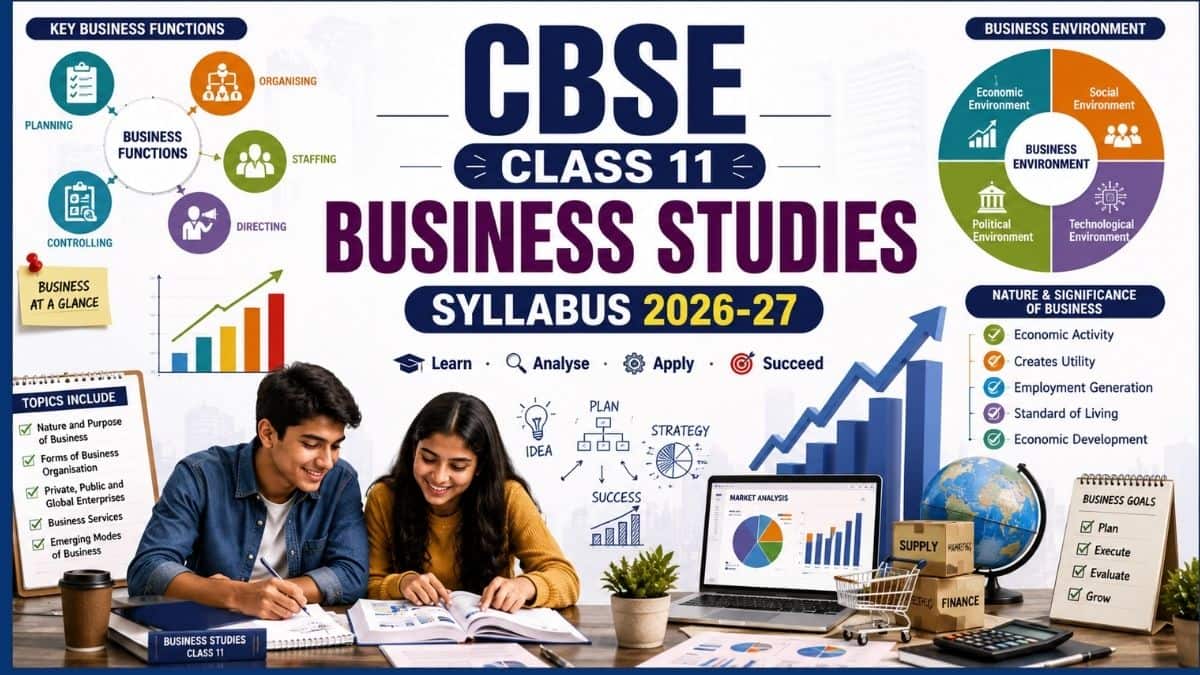
CBSE Class 11 Business Studies Syllabus 2026
Units 7 to 10, which cover Finance and Trade, together account for 40 marks and are considered highly scoring due to their practical relevance and real-world applications. Within Part A, Units 1 and 2 have the highest combined weightage of 16 marks, making them key areas for preparation. In addition to the theory paper, the 20-mark project work offers students an excellent opportunity to improve their overall score. As the marks are distributed fairly evenly across the BS 11th syllabus, students should adopt a balanced study approach and give adequate attention to all units.
Part | Unit | Unit Name | Marks |
Part A: Foundations of Business | 1 | Nature and Purpose of Business | 16 Marks (Combined with Unit 2) |
2 | Forms of Business Organisations | ||
3 | Public, Private, and Global Enterprises | 14 Marks (Combined with Unit 4) | |
4 | Business Services | ||
5 | Emerging Modes of Business | 10 Marks (Combined with Unit 6) | |
6 | Social Responsibility of Business and Business Ethics | ||
Total Part A | 40 Marks | ||
Part B: Finance and Trade | 7 | Sources of Business Finance | 20 Marks (Combined with Unit 8) |
8 | Small Business and Enterprises | ||
9 | Internal Trade | 20 Marks (Combined with Unit 10) | |
10 | International Trade | ||
Total Part B | 40 Marks | ||
Part C: Practical | 11 | Project Work (One guide-based project) | 20 Marks |
Grand Total | 100 Marks |
Also, check CBSE 11th syllabus of other classes
Detailed CBSE Class 11 Business Studies Syllabus
CBSE Class 11 Business Studies covers the history of trade and commerce in India (indigenous banking systems, trading communities, major trade centres), the core concept and characteristics of business, differences between business, profession, and employment, business risk, and the classification of business activities (Industry vs. Commerce).
Concept includes meaning and features
Confused between CGPA and Percentage?
Get your results instantly with our calculator!
💡 Conversion Formula used is: CGPA = Percentage / 9.5
Part A: Foundations of Business
CBSE 11th BS Part A contributes 50% of the theory examination and focuses on the fundamental concepts of business. The highest weightage within this section is assigned to Units 1 and 2 (Nature and Purpose of Business; Forms of Business Organisations), which together carry 16 marks. Units 3 and 4 (Public, Private and Global Enterprises; Business Services) account for 14 marks, while Units 5 and 6 (Emerging Modes of Business; Social Responsibility of Business and Business Ethics) contribute 10 marks.
Unit 1: Evolution and Fundamentals of Business:
Content | Learning Outcomes (After going through this unit, the student/learner would be able to:) |
History of Trade and Commerce in India: Indigenous Banking System, Rise of Intermediaries, Transport, Trading Communities, Merchant Corporations, Major Trade Centres, Major Imports and Exports, Position of Indian Sub-Continent in the World Economy | • Acquaint themselves with the history of trade and commerce in India. |
Business - Meaning and Characteristics | • Understand the meaning of business with special reference to economic and non-economic activities.• Discuss the characteristics of business. |
Business, Profession and Employment -Concept | • Understand the concept of business, profession and employment.• Differentiate between business, profession and employment. |
Objectives of Business | • Appreciate the economic and social objectives of business.• Examine the role of profit in business. |
Classification of Business Activities - Industry and Commerce | • Understand the broad categories of business activities: industry and commerce. |
Industry - Types: Primary, Secondary and Tertiary (Meaning and Subgroups) | • Describe the various types of industries. |
Commerce -Trade (Internal, External, Wholesale and Retail) and Auxiliaries to Trade (Banking, Insurance, Transportation, Warehousing, Communication and Advertising) | • Discuss the meaning of commerce, trade and auxiliaries to trade.• Discuss the meaning of different types of trade and auxiliaries to trade.• Examine the role of commerce, trade and auxiliaries to trade. |
Business Risk - Concept | • Understand the concept of risk as a special characteristic of business.• Examine the nature and causes of business risks. |
Unit 2: Forms of Business Organisations
Content | Learning Outcomes (After going through this unit, the student/learner would be able to:) |
Sole Proprietorship - Concept, Merits and Limitations | • List the different forms of business organisations and understand their meaning.• Identify and explain the concept, merits and limitations of Sole Proprietorship. |
Partnership - Concept, Types, Merits and Limitations; Registration of a Partnership Firm; Partnership Deed; Types of Partners | • Identify and explain the concept, merits and limitations of a Partnership firm.• Understand the types of partnerships on the basis of duration and liability.• State the need for registration of a partnership firm.• Discuss types of partners such as active, sleeping, secret, nominal and partner by estoppel. |
Hindu Undivided Family (HUF) Business - Concept | • Understand the concept of Hindu Undivided Family Business. |
Cooperative Societies -Concept, Merits and Limitations | • Identify and explain the concept, merits and limitations of Cooperative Societies.• Understand the concept of consumer, producer, marketing, farmer, credit and housing cooperatives. |
Company – Concept, Merits and Limitations; Types: Private Company, Public Company and One Person Company (OPC) | • Identify and explain the concept, merits and limitations of private and public companies.• Understand the meaning of One Person Company (OPC).• Distinguish between a private company and a public company. |
Formation of a Company – Stages and Important Documents | • Highlight the stages involved in the formation of a company.• Discuss the important documents used at various stages of company formation. |
Choice of Form of Business Organization | • Distinguish between the various forms of business organizations.• Explain the factors that influence the choice of a suitable form of business organisation |
Unit 3: Public, Private, and Global Enterprises:
Content | Learning Outcomes (After going through this unit, the student/learner would be able to:) |
Public Sector and Private Sector Enterprises – Concept | • Develop an understanding of public sector and private sector enterprises. |
Forms of Public Sector Enterprises: Departmental Undertakings, Statutory Corporations and Government Companies | • Identify and explain the features, merits and limitations of different forms of public sector enterprises. |
Global Enterprises - Features | • Develop an understanding of global enterprises by studying their meaning and features. |
Joint Venture | • Understand the concept and characteristics of joint ventures. |
Public-Private Partnership (PPP) - Concept | • Develop an understanding of public-private partnerships by studying their meaning and features. |
Unit 4: Business Services
Content | Learning Outcomes (After going through this unit, the student/learner would be able to:) |
Business Services -Meaning and Types | • Understand the meaning and types of business services.• Discuss the meaning and various types of business services. |
Banking: Types of Bank Accounts - Savings, Current, Recurring Deposit, Fixed Deposit and Multiple Option Deposit Account | • Develop an understanding of different types of bank accounts. |
Banking Services: Bank Draft, Bank Overdraft and Cash Credit | • Develop an understanding of the different services provided by banks. |
E-Banking - Meaning and Types of Digital Payments | • Understand the concept of e-banking and various modes of digital payments. |
Insurance - Principles and Types (Life, Health, Fire and Marine Insurance) | • Recall the concept of insurance.• Understand the principles of insurance, including Utmost Good Faith, Insurable Interest, Indemnity, Contribution, Doctrine of Subrogation and Causa Proxima.• Discuss the meaning of different types of insurance: life, health, fire and marine insurance. |
Postal Services -Mail, Registered Post, Parcel, Speed Post and Courier (Meaning) | • Understand the utility and significance of different postal and communication services. |
Unit 5: Emerging Modes of Business:
Content | Learning Outcomes (After going through this unit, the student/learner would be able to:) |
E-Business: Concept, Scope and Benefits | • Give the meaning of e-business.• Discuss the scope of e-business.• Appreciate the benefits of e-business.• Distinguish e-business from traditional business. |
Unit 6: Social Responsibility of Business and Business Ethics
Content | Learning Outcomes (After going through this unit, the student/learner would be able to:) |
Concept of Social Responsibility | • State the concept of social responsibility. |
Case for Social Responsibility | • Examine the case for social responsibility. |
Responsibility Towards Owners, Investors, Consumers, Employees, Government and Community | • Identify the social responsibility towards different interest groups. |
Role of Business in Environment Protection | • Appreciate the role of business in environment protection. |
Business Ethics - Concept and Elements | • State the concept of business ethics.• Describe the elements of business ethics. |
Also, check CBSE syllabus for other classes
Part B: Finance and Trade
CBSE Class 11Part B also carries 40 marks, making it equally important as Part A. The section is divided into two major blocks. Units 7 and 8 (Sources of Business Finance; Small Business and Enterprises) together carry 20 marks, while Units 9 and 10 (Internal Trade; International Trade) account for the remaining 20 marks. This balanced distribution indicates that students should devote equal attention to finance-related topics and trade-related concepts.
Unit 7: Sources of Business Finance:
Content | Learning Outcomes (After going through this unit, the student/learner would be able to:) |
Concept of Business Finance | • State the meaning, nature and importance of business finance. |
Owners’ Funds - Equity Shares, Preference Shares and Retained Earnings | • Classify the various sources of funds into owners’ funds.• State the meaning of owners’ funds. |
Borrowed Funds - Debentures and Bonds, Loans from Financial Institutions and Commercial Banks, Public Deposits, Trade Credit and Inter-Corporate Deposits (ICD) | • State the meaning of borrowed funds.• Discuss the concept of debentures, bonds, loans from financial institutions and commercial banks, trade credit and inter-corporate deposits.• Distinguish between owners’ funds and borrowed funds. |
Unit 8: Small Business and Enterprises:
Content | Learning Outcomes (After going through this unit, the student/learner would be able to:) |
Entrepreneurship Development (ED): Concept, Characteristics and Need | • Understand the concept, characteristics and need for Entrepreneurship Development (ED). |
Process of Entrepreneurship Development: Start-up India Scheme, Ways to Fund Start-ups, Intellectual Property Rights (IPR) and Entrepreneurship | • Understand the process of entrepreneurship development.• Gain knowledge about the Start-up India Scheme and various funding options for start-ups.• Understand the concept of Intellectual Property Rights (IPR) and its importance in entrepreneurship. |
Small Scale Enterprise as Defined by the MSMED Act, 2006 (Micro, Small and Medium Enterprises Development Act) | • Understand the meaning and classification of small businesses under the MSMED Act, 2006. |
Role of Small Business in India with Special Reference to Rural Areas | • Discuss the role and significance of small businesses in India's economy, particularly in rural areas. |
Government Schemes and Agencies for Small-Scale Industries: National Small Industries Corporation (NSIC) and District Industries Centre (DIC) | • Appreciate the various government schemes and agencies supporting the development of small-scale industries.• Understand the role of NSIC and DIC, especially in promoting industrial growth in rural and backward areas. |
Unit 9: Internal Trade
Content | Learning Outcomes (After going through this unit, the student/learner would be able to:) |
Internal Trade - Meaning and Types; Services Rendered by a Wholesaler and a Retailer | • State the meaning and types of internal trade.• Appreciate the services provided by wholesalers and retailers. |
Types of Retail Trade - Itinerant and Small-Scale Fixed Shop Retailers | • Explain the different types of retail trade. |
Large-Scale Retailers - Departmental Stores and Chain Stores (Concept) | • Highlight the distinctive features of departmental stores and chain stores. |
GST (Goods and Services Tax)- Concept and Key Features | • Understand the concept and key features of GST. |
Also, check
CBSE Class 11 Admission
CBSE Class 11 Date Sheet
CBSE Private Candidate Form 2027
Unit 10: International Trade
Content | Learning Outcomes (After going through this unit, the student/learner would be able to:) |
International Trade - Concept and Benefits | • Understand the concept of international trade.• Describe the scope and benefits of international trade for the nation and business firms. |
Export Trade - Meaning and Procedure | • State the meaning and objectives of export trade.• Explain the important steps involved in executing export trade. |
Import Trade - Meaning and Procedure | • State the meaning and objectives of import trade.• Discuss the important steps involved in executing import trade. |
Documents Involved in International Trade - Indent, Letter of Credit, Shipping Order, Shipping Bill, Mate’s Receipt, Documents Against Acceptance (DA) and Documents Against Payment (DP) | • Develop an understanding of the various documents used in international trade.• Identify the specimen formats of the various documents used in international trade.• Highlight the importance of documents required for international trade transactions. |
World Trade Organisation (WTO) - Meaning and Objectives | • State the meaning of the World Trade Organisation (WTO).• Discuss the objectives of the WTO in promoting international trade. |
Part C: Project Work (20 Marks)
The practical component consists of one guide-based project, carrying 20 marks. This section contributes 20% of the overall score and can significantly improve a student's final performance if completed carefully.
Section-wise CBSE 11th Business Studies Weightage
Section | Marks | Percentage of Total Marks |
Part A: Foundations of Business | 40 | 40% |
Part B: Finance and Trade | 40 | 40% |
Part C: Project Work | 20 | 20% |
Total | 100 | 100% |
Check CBSE Class 11 Subject-wise Syllabus
| Subject | Link |
| CBSE Class 11 Physics Syllabus 2027 | Click here |
| CBSE Class 11 English Syllabus 2027 | Click here |
| CBSE Class 11 Chemistry Syllabus 2027 | Click here |
| CBSE Class 11 Maths Syllabus 2027 | Click here |
| CBSE Class 11 Commerce Syllabus 2027 | Click here |
| CBSE Class 11 Economics Syllabus 2027 | Click here |
| CBSE Class 11 Biology Syllabus | Click here |
Articles
Related Stories
|
Upcoming School Exams

Certifications By Top Providers
Explore Top Universities Across Globe
Questions related to CBSE Class 10th
On Question asked by student community
Have a question related to CBSE Class 10th ?
Hello student!
You can refer to the CBSE Class 10 Mathematics Question Paper 2026 to practise questions and prepare for the Mathematics examination.
https://school.careers360.com/boards/cbse/cbse-class-10-maths-question-paper-2026
Hope it helps!
Hi Smriti Lama
The CBSE Class 10 Board Exam 2026-27 question paper pattern includes the latest exam structure, subject-wise marking scheme and question types. You can check the detailed pattern on Careers360:
Hi Somshiv Rath
If you mean a CBSE Class 8 Science question paper, Careers360 has a sample paper section where you can check the available Class 8 papers.
https://learn.careers360.com/school/cbse-8-class-preparation-material/
Hey there,
If you mean CBSE Class 10 rechecking/re-evaluation results 2026, CBSE has already completed the main post-result process for 2026. The Class X second-board results were declared on 18 July 2026, and CBSE has also issued the post-result facilities notice.
For verification/re-evaluation, CBSE says the result/status is uploaded online
Please mention important details like your school board, exam, and class to get the exact papers.
You can explore the useful resources here:

Applications for Admissions are open.
Get Job Ready in Healthcare | Employability-Focused Programs
CBSE Class 10th Notifications
Never miss CBSE Class 10th update
Get timely CBSE Class 10th updates directly to your inbox. Stay informed!