Emversity
Get Job Ready in Healthcare | Employability-Focused Programs


Every year, the CBSE conducts the CBSE Class 10 Mathematics exam. For CBSE Class 10 Maths board exam students should look for what more previous important questions should have been asked in recognising the exam format and trends, and thus can direct themselves toward practising important and previously asked questions for the upcoming CBSE Class 10 Maths board exam 2026. The CBSE Class 10 Mathematics paper consists of sections classified as MCQs, as well as short answer questions, and long answer types carrying 1, 2, 3, 4, and 5 marks.
This Story also Contains
In this article, we have compiled for you important Maths questions and answers from previous years' papers. Answering these questions will enable one to identify important topics with much higher weighted marks, know what questions are asked in the board examination, and prepare better for the final examination.
Section A of the CBSE Mathematics paper Class 10 had 18 multiple-choice questions, which carried a weightage of 1 mark each. 2 assertion-reason based questions were also asked for 1 mark. Below, we have listed questions for students' reference:
Q1. The prime factorisation of the natural number 288 is:
24 x 33
24 x 32
25 x 32
25 x 31
Get Job Ready in Healthcare | Employability-Focused Programs
Q2. If 2cosθ= 1, then the value of θ is
45∘
60∘
30∘
90∘
Q3. A card is drawn at random from a well-shuffled deck of 52 cards. The probability of getting a red card is:
1/26
1/13
1/ 4
1/2
Q4. The discriminant of the quadratic equation 2x2−5x−3=0 is
1
49
7
19
Q5. The distance between the points (3, 0) and (0, -3) is
23 units
6 units
3 units
32 units
Q6. The seventh term of an A.P. whose first term is 28 and common difference
- 4, is
0
4
52
56
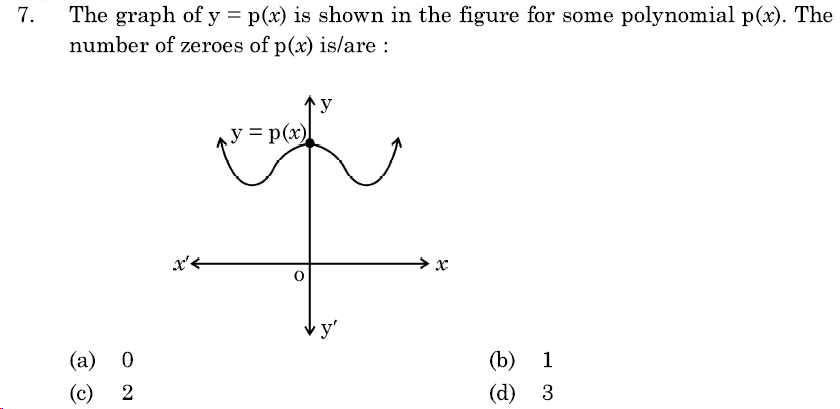
Q8. The sides of two similar triangles are in the ratio 4: 7. The ratio of their
perimeters are:
4: 7
12: 21
16: 49
7: 4
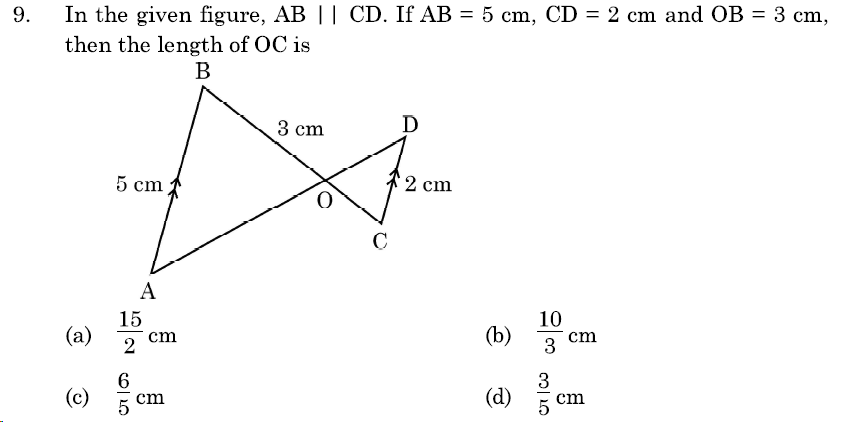
Q10. The sum and the product of zeroes of the polynomial p(x) =x2+5x+6 are
respectively
5, -6
-5, 6
2, 3
-2, -3
Q11. A die is thrown once. Find the probability of getting a number less than 7.
5/6
1
1/6
0
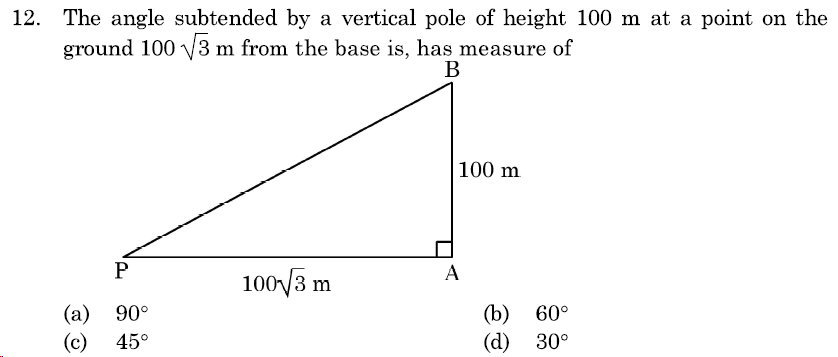
Q13. The volume of a cone of radius ‘r' and height '3r' is :
1/3πr2
3πr3
9πr3
πr3
Q14. The distance between two parallel tangents of a circle of diameter 7 cm is:
7 cm
14 cm
7/2 cm
28 cm
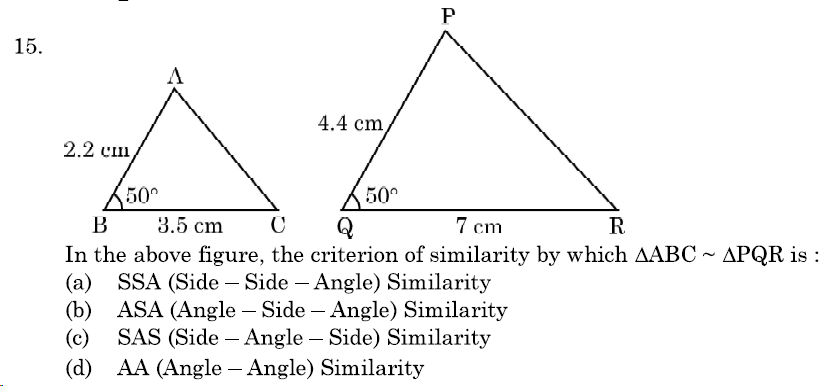
Q16. The larger of the two supplementary angles exceeds the smaller by 18 degrees. What is the measure of the larger angle?
81∘
99∘
36∘
54∘
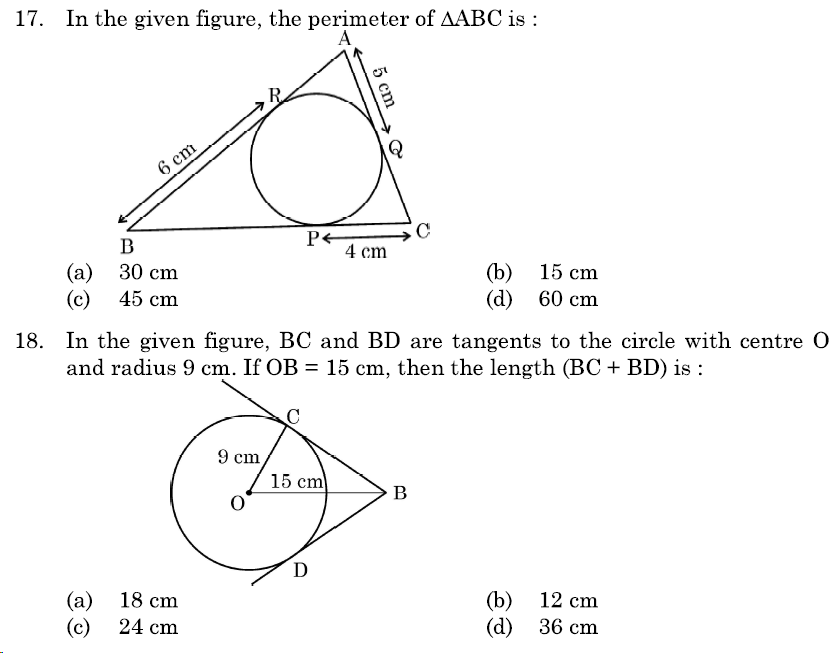
Directions for Q.19 & Q.20 - In question numbers 19 and 20, a statement of Assertion (A) is followed by a statement of Reason (R). Choose the correct option:
Both Assertion (A) and Reason (R) are true, and Reason (R) is the
correct explanation of Assertion (A).
b) Both Assertion (A) and Reason (R) are true, but Reason (R) is not the
correct explanation of Assertion (A).
c) Assertion (A) is true, but Reason (R) is false.
d) Assertion (A) is false, but Reason (R) is true.
Q19. Assertion (A): A tangent to a circle is perpendicular to the radius
through the point of contact.
Reason (R): The lengths of tangents drawn from the external point to a
circles are equal.
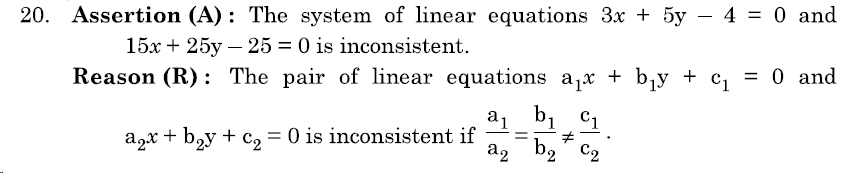
Section B of the Mathematics paper CBSE 10th Class consists of short answer questions carrying a weightage of 2 marks each. Students are required to attempt 5 questions from this section. Below, we have listed questions that were given in the CBSE 10th Maths previous year PDF:
Q21. a) Find the coordinates of the point which divides the line segment
joining the points (7, -1) and (-3, 4) internally in the ratio 2: 3.
OR
(b) Find the value(s) of y for which the distance between the points
A(3, -1) and B(11, y) is 10 units.
Q22. Evaluate :tan260∘−2cosec230∘−2tan230∘
Q23. Find the LCM and HCF of 92 and 510, using prime factorisation.
Q 24. (a) Solve for x and y : x + y = 6, 2x - 3y = 4.
OR
(b) Find out whether the following pair of linear equations is
consistent or inconsistent:
5x - 3y = 11, 10x + 6y = 22
Get your results instantly with our calculator!
Section C of the Mathematics paper CBSE 10th Class consisted of short answer questions carrying a weightage of 3 marks each. Students are required to attempt 6 questions from this section. Below are the questions have been mentioned which were a part of the CBSE Maths Class 10 exam.
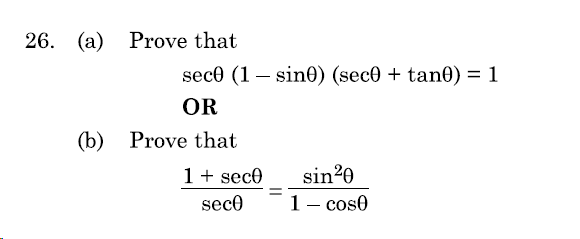
Q27. Show that the points A(1, 7), B(4, 2) C(-1, -1) and D(- 4, 4) are vertices of the square ABCD.
Q28. Prove that the tangents drawn from an external point to a circle are equal
in length.
Q29. If α, β are zeroes of the quadratic polynomial x2+3x+2, find a quadratic
polynomial whose zeroes are α+1, β+1.
Q30. Prove that 3+72 is an irrational number, given that 2 is an irrational
number.
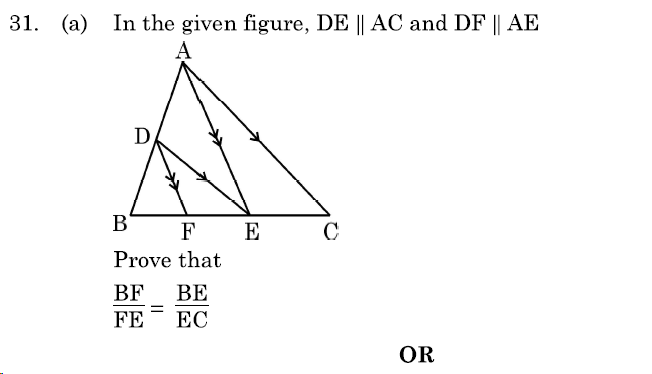
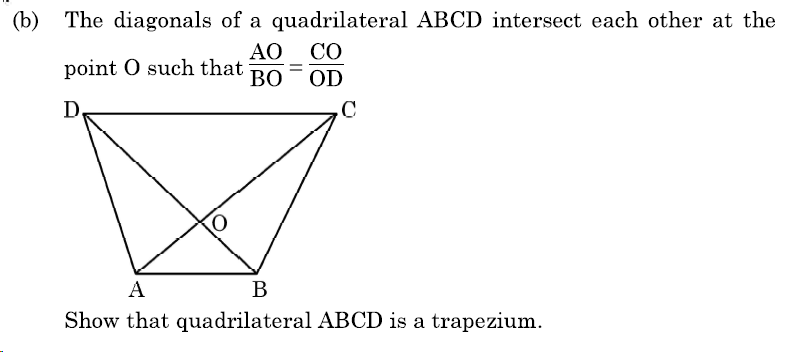
Section D of the CBSE 10th Maths paper consists of long-answer type questions that each carry 5 marks. Students have to attempt 4 questions from this section. Below, we have listed the questions that were asked in the previous year's CBSE Maths paper:
Q32. (a) The diagonal of a rectangular field is 60 m more than the shorter side. If the longer side is 80 m more than the shorter side, find the length of the sides of the field.
OR
(b) The sum of the ages of a father and his son is 45 years. Five years ago, the product of their ages (in years) was 124. Determine their present age.
Q33. A vessel is in the form of a hemispherical bowl surmounted by a hollow cylinder of the same diameter. The diameter of the hemispherical bowl is 14 cm, and the total height of the vessel is 13 cm. Find the inner surface area of the vessel. Also, find the volume of the vessel.
Q34. The table given below shows the daily expenditure on food of 25 households in a locality:
Daily Expenditure | 100-150 | 150-200 | 200-250 | 250-300 | 300-350 |
No. of households | 4 | 5 | 12 | 2 | 2 |
Find the mean daily expenditure on food. Also, find the mode of the data.
Q35. (a) A TV tower stands vertically on the bank of a canal. From a point on the other bank directly opposite the tower, the angle of elevation of the top of the tower is 60°. From another point 20 m away from the point on the line joining this point to the foot of the tower, the angle
of elevation of the top of the tower is 30∘. Find the height of the tower.
OR
(b) An aeroplane, when flying at a height of 4000 m from the ground, passes vertically above another aeroplane at an instant when the angles of elevation of the two planes from the same point on the ground are 60∘ and 45∘ , respectively. Find the vertical distance between the aeroplanes at that instant. (Use 3 = 1.73)
Section E of the CBSE 10th Maths exam paper consists of 3 source-based/Case-based/passage-based/integrated units of assessment (4 marks each) with sub-parts of the values of 1, 1, and 2 marks each, respectively. Below, we have mentioned the questions that were asked in the CBSE Class 10 Maths paper:
Q36. Aahan, being a plant lover, decides to convert her balcony into a beautiful garden full of plants. She bought a few plants with pots for her balcony. She placed the pots in such a way that the number of pots in the first row is 2, second row is 5. The third row is 8 and so on.
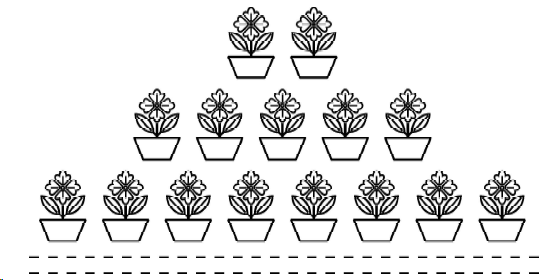
Based on the above information, answer the following questions :
(i)Find the number of pots placed in the 10th row.
(ii) Find the difference in the number of pots placed in the 5th row and the 2nd row.
(iii) If Aahana wants to place 100 pots in total, then find the total number of rows formed in the arrangement.
OR
(iii) If Aahana has sufficient space for 12 rows, then how many total number of pots are placed by her with the same arrangement?
Q37. The Interschool Rangoli Competition was organized by one of the reputed
schools of Odisha. The theme of the Rangoli Competition was Diwali celebrations, where students were supposed to make mathematical designs. Students from various schools participated and made beautiful Rangoli designs. One such design is given below:
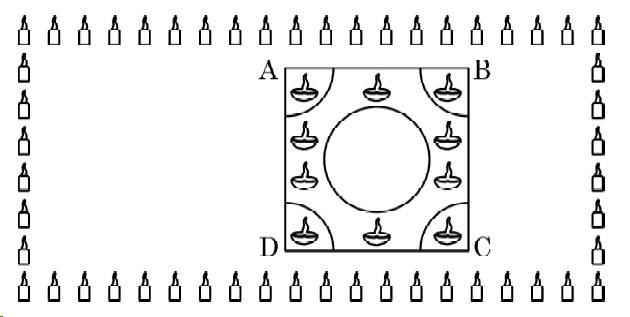
Rangoli is in the shape of a square marked as ABCD, the side of the square being 40 cm. At each corner of a square, a quadrant of a circle of radius 10 cm is drawn (in which diyas are kept). Also, a circle of diameter 20 cm is drawn inside the square.
(i) What is the area of square ABCD?
(ii) Find the area of the circle.
(iii) If the circle and the four quadrants are cut off from the square ABCD
and removed, then find the area of the remaining portion of square ABCD.
OR
(iii) Find the combined area of 4 quadrants and the circle, removed.
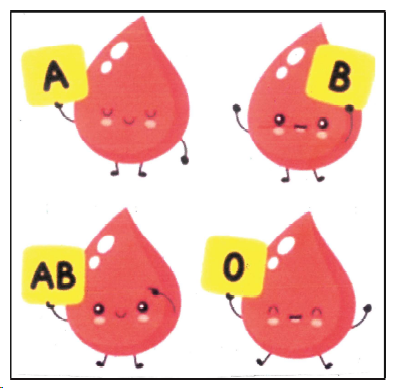
Q38. Blood group describes the type of blood a person has. It is a classification of blood based on the presence or absence of inherited antigenic substances on the surface of red blood cells. Blood types predict whether a serious reaction will occur in a blood transfusion.
In a sample of 50 people, 21 had type O blood, 22 had type A, 5 had type B, and the rest had type AB blood group.
Based on the above, answer the following questions:
(i) What is the probability that a person chosen at random has type O blood?
(ii) What is the probability that a person chosen at random has type AB blood group?
(iii) What is the probability that a person chosen at random has neither type A nor type B blood group?
OR
(iii) What is the probability that a person chosen at random has either type A or type B, or type O blood group?
There are numerous benefits of referring to and solving previous years’ Maths question papers of CBSE 10th class. Below, we have listed a few pros of solving the CBSE 10th Maths question paper:
Solving last year's CBSE Class 10 Mathematics board exam question paper helps students understand the exam pattern and question paper format.
By solving past papers, students can identify the topics that are frequently asked and prioritize their study accordingly.
Practising with the previous year's Maths papers CBSE 10th enables students to manage their time effectively during the actual exam, as they get accustomed to the allotted time for answering the paper.
Successfully solving CBSE Class 10 Maths previous year paper boosts students' confidence as they get a sense of accomplishment and readiness for the upcoming 2026 board exam.
Analysing previous year's papers also helps students understand the marking scheme and allocate time and effort accordingly to high-scoring sections.
By reviewing their answers, students can identify and rectify common mistakes, improving their overall accuracy.
Regular practice with CBSE 10th Maths past year papers enhances students' problem-solving abilities and equips them with strategies to tackle complex problems.
Solving the CBSE 10th Maths exam paper serves as a comprehensive revision tool, allowing students to consolidate their understanding of concepts and formulas.
Also, Check:
Frequently Asked Questions (FAQs)
The Central Board of Secondary Education (CBSE) has scheduled the Class 10 Mathematics board examinations for 2026 on February 17, 2026.
No, calculators are generally not allowed in the CBSE 10th class Maths exam. Students are expected to perform calculations manually.
The CBSE 10th Maths theory paper carries a weightage of 80 marks, while 20 marks are reserved for internal assessment/project.
Allocate time wisely to each section based on the number of questions and difficulty level. Start with easier questions to build confidence and manage time effectively for the more challenging ones.

On Question asked by student community
Hello student!
You can refer to the CBSE Class 10 Mathematics Question Paper 2026 to practise questions and prepare for the Mathematics examination.
https://school.careers360.com/boards/cbse/cbse-class-10-maths-question-paper-2026
Hope it helps!
Hi Smriti Lama
The CBSE Class 10 Board Exam 2026-27 question paper pattern includes the latest exam structure, subject-wise marking scheme and question types. You can check the detailed pattern on Careers360:
Hi Somshiv Rath
If you mean a CBSE Class 8 Science question paper, Careers360 has a sample paper section where you can check the available Class 8 papers.
https://learn.careers360.com/school/cbse-8-class-preparation-material/
Hey there,
If you mean CBSE Class 10 rechecking/re-evaluation results 2026, CBSE has already completed the main post-result process for 2026. The Class X second-board results were declared on 18 July 2026, and CBSE has also issued the post-result facilities notice.
For verification/re-evaluation, CBSE says the result/status is uploaded online
Please mention important details like your school board, exam, and class to get the exact papers.
You can explore the useful resources here:

Get Job Ready in Healthcare | Employability-Focused Programs