
Search Colleges, Exams, Schools & more


Login
CBSE 12th Physics Syllabus 2026-27 (042): Download PDF, Marks Distribution & Chapters
The Central Board of Secondary Education (CBSE) has released the Class 12 Physics syllabus 2026-27 online. The CBSE Class 12 Physics theory paper (Subject Code: 042) carries 70 marks and is divided into nine units. The marks distribution shows that Electromagnetic Waves and Optics (Units V and VI) form the most important section of the syllabus, carrying 18 marks, which is nearly 26% of the theory paper. Optics is often considered a high-scoring topic with conceptual and numerical questions; students should devote significant preparation time to these chapters.
Direct Link: Download CBSE Class 12 Physics Syllabus 2026-27 Here
This Story also Contains
- CBSE Class 12 Physics Syllabus 2026
- Detailed CBSE Class 12 Physics Syllabus 2026-27
- Internal Practical Evaluation (30 Marks)
- CBSE Class 12 Physics Syllabus 2026 Weightage
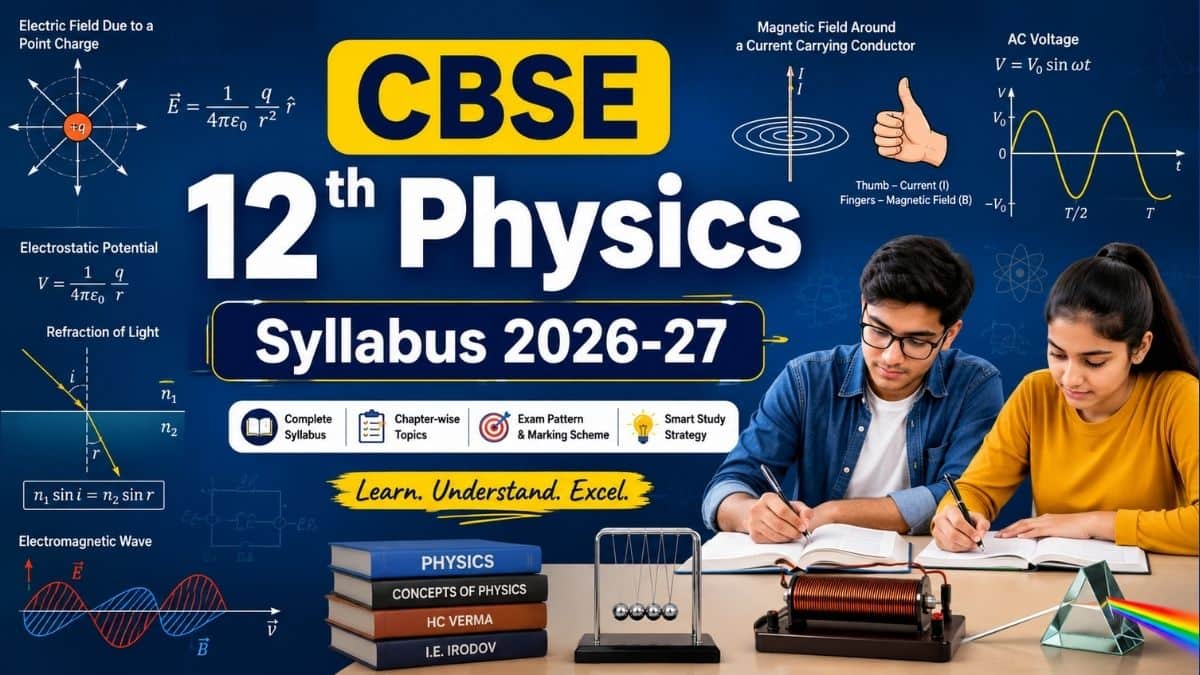
The second-highest weightage of CBSE 12th syllabus is assigned to Magnetic Effects of Current and Magnetism (Unit III), along with Electromagnetic Induction and Alternating Current (Unit IV), which together account for 17 marks. These units are crucial as they contain important derivations, numerical problems, and conceptual applications.
CBSE Class 12 Physics Syllabus 2026
The chapters are grouped into overarching unit segments that carry combined mark allocations. Electrostatics (Unit I) and Current Electricity (Unit II) together carry 16 marks, making them another major portion of the syllabus. A strong understanding of electric fields, potential, capacitance, and current electricity can help students secure a substantial number of marks:
Unit | Unit Name & Chapters Included | Marks |
Unit I Unit II | Electrostatics • Chapter 1: Electric Charges and Fields • Chapter 2: Electrostatic Potential and Capacitance Current Electricity • Chapter 3: Current Electricity | 16 Marks |
Unit III Unit IV | Magnetic Effects of Current and Magnetism • Chapter 4: Moving Charges and Magnetism • Chapter 5: Magnetism and Matter Electromagnetic Induction & Alternating Currents • Chapter 6: Electromagnetic Induction • Chapter 7: Alternating Current | 17 Marks |
Unit V Unit VI | Electromagnetic Waves • Chapter 8: Electromagnetic Waves Optics • Chapter 9: Ray Optics and Optical Instruments • Chapter 10: Wave Optics | 18 Marks |
Unit VII Unit VIII | Dual Nature of Radiation and Matter • Chapter 11: Dual Nature of Radiation and Matter Atoms and Nuclei • Chapter 12: Atoms • Chapter 13: Nuclei | 12 Marks |
Unit IX | Electronic Devices • Chapter 14: Semiconductor Electronics: Materials, Devices & Simple Circuits | 07 Marks |
Total | Theory Paper Evaluation | 70 Marks |
Also, check the
- CBSE syllabus
- CBSE class 12 Physics Preparation Tips 2027
- CBSE Date Sheet
- How to improve marks to 75% or above in CBSE
- Best reference books for class 12 CBSE Physics 2027
Best Courses After 10th Class
Explore the best courses after 10th across science, commerce, arts, and vocational streams. Find the right path based on your interests and build a strong career foundation.
Download EBookDetailed CBSE Class 12 Physics Syllabus 2026-27
The lowest weightage is assigned to Dual Nature of Radiation and Matter (Unit VII), Atoms and Nuclei (Unit VIII), and Electronic Devices (Unit IX), which together contribute 12 marks. Although these units carry fewer marks, they are generally considered scoring due to their theory-based and direct-question format.
Unit I: Electrostatics
Chapter 1: Electric Charges and Fields: Electric charges, Conservation of charge, Coulomb's law-force between two- point charges, forces between multiple charges; superposition principle and continuous charge distribution. Electric field, electric field due to a point charge, electric field lines, electric dipole, electric field due to a dipole, torque on a dipole in a uniform electric field. Electric flux, statement of Gauss's theorem and its applications to find the field due to an infinitely long straight wire, a uniformly charged infinite plane sheet and a uniformly charged thin spherical shell (field inside and outside).
Chapter 2: Electrostatic Potential and Capacitance: Electric potential, potential difference, electric potential due to a point charge, a dipole and a system of charges; equipotential surfaces, electrical potential energy of a system of two-point charges and of an electric dipole in an electrostatic field. Conductors and insulators, free charges and bound charges inside a conductor. Dielectrics and electric polarisation, capacitors and capacitance, combination of capacitors in series and in parallel, capacitance of a parallel plate capacitor with and without a dielectric medium between the plates, energy stored in a capacitor (no derivation, formulae only).
Unit II: Current Electricity
Chapter 3: Current Electricity: Electric current, flow of electric charges in a metallic conductor, drift velocity, mobility and their relation with electric current; Ohm's law, V-I characteristics (linear and non-linear), electrical energy and power, electrical resistivity and conductivity, temperature dependence of resistance, Internal resistance of a cell, potential difference and emf of a cell, combination of cells in series and in parallel, Kirchhoff's rules, Wheatstone bridge.
Unit III: Magnetic Effects of Current and Magnetism
Chapter 4: Concept of magnetic field, Oersted's experiment. Biot - Savart law and its application to current carrying circular loop. Ampere's law and its applications to infinitely long straight wire. Straight solenoid (only qualitative treatment), force on a moving charge in uniform magnetic and electric fields. Force on a current-carrying conductor in a uniform magnetic field, force between two parallel current-carrying conductors-definition of ampere, torque experienced by a current loop in uniform magnetic field; Current loop as a magnetic dipole and its magnetic dipole moment, moving coil galvanometer- its current sensitivity and conversion to ammeter and voltmeter.
Chapter 5: Magnetism and Matter: Bar magnet, bar magnet as an equivalent solenoid (qualitative treatment only), magnetic field intensity due to a magnetic dipole (bar magnet) along its axis and perpendicular to its axis (qualitative treatment only), torque on a magnetic dipole (bar magnet) in a uniform magnetic field (qualitative treatment only), magnetic field lines. Magnetic properties of materials- Para-, dia- and ferro – magnetic substances with examples, Magnetisation of materials, effect of temperature on magnetic properties.
Unit IV: Electromagnetic Induction and Alternating Currents
Chapter 6: Electromagnetic induction; Faraday's laws, induced EMF and current; Lenz's Law, Self and mutual induction.
Chapter 7: Alternating currents, peak and RMS value of alternating current/voltage; reactance and impedance; LCR series circuit (phasors only), resonance, power in AC circuits, power factor, wattless current. AC generator, Transformer
Unit V: Electromagnetic Waves
Chapter 8: Electromagnetic Waves: Basic idea of displacement current, Electromagnetic waves, their characteristics, their transverse nature (qualitative idea only). Electromagnetic spectrum (radio waves, microwaves, infrared, visible, ultraviolet, X-rays, gamma rays), including elementary facts about their uses.
Unit VI: Optics
Chapter 9: Ray Optics and Optical Instruments: Reflection of light, spherical mirrors, mirror formula, refraction of light, total internal reflection and optical fibers, refraction at spherical surfaces, lenses, thin lens formula, lens maker’s formula, magnification, power of a lens, combination of thin lenses in contact, refraction of light through a prism. Optical instruments: Microscopes and astronomical telescopes (reflecting and refracting) and their magnifying powers
Chapter 10: Wave Optics: Wave front and Huygen’s principle, reflection and refraction of plane wave at a plane surface using wave fronts. Proof of laws of reflection and refraction using Huygen’s principle. Interference, Young's double slit experiment and expression for fringe width (No derivation final expression only), coherent sources and sustained interference of light, diffraction due to a single slit, width of central maxima (qualitative treatment only).
Unit VII: Dual Nature of Radiation and Matter
Chapter 11: Dual Nature of Radiation and Matter: Dual nature of radiation, Photoelectric effect, Hertz and Lenard's observations; Einstein's photoelectric equation-particle nature of light. Experimental study of photoelectric effect Matter waves-wave nature of particles, de-Broglie relation.
Unit VIII: Atoms and Nuclei
Chapter 12: Atoms: Alpha-particle scattering experiment; Rutherford's model of atom; Bohr model of hydrogen atom, Expression for radius of nth possible orbit, velocity and energy of electron in nth orbit, hydrogen line spectra (qualitative treatment only).
Chapter 13: Nuclei: Composition and size of nucleus, nuclear force, mass-energy relation, mass defect; binding energy per nucleon and its variation with mass number; nuclear fission, nuclear fusion.
Unit IX: Electronic Devices
Chapter 14: Semiconductor Electronics: Energy bands in conductors, semiconductors and insulators (qualitative ideas only) Intrinsic and extrinsic semiconductors- p and n type, p-n junction Semiconductor diode - I-V characteristics in forward and reverse bias, application of junction diode -diode as a rectifier.
Confused between CGPA and Percentage?
Get your results instantly with our calculator!
💡 Conversion Formula used is: CGPA = Percentage / 9.5
Internal Practical Evaluation (30 Marks)
The practical exam pattern splits marks across distinct hands-on metrics:
Two Experiments: 14 Marks (7 marks per experiment, one chosen from Section A and one from Section B)
Practical Record File: 5 Marks (A minimum of 6 experiments and 3 activities per section must be recorded)
One Activity Demonstration: 3 Marks (From any section)
Investigatory Project File: 3 Marks
Viva Voce: 5 Marks (Based on experiments, activities, and the project)
CBSE Class 12 Physics Syllabus 2026 Weightage
Units V and VI (Electromagnetic Waves and Optics) carry the highest weightage of 18 marks.
Units III and IV contribute 17 marks, making Magnetism and Electromagnetic Induction another high-priority area.
Units I and II account for 16 marks and form the foundation for several numerical and conceptual questions.
Units VII, VIII and IX carry 12 marks and are often considered scoring because of their relatively straightforward concepts.
Nearly 51 marks out of 70 (about 73%) come from Units I to VI, making these topics the most critical for exam preparation.
Students should focus on numerical problem-solving, derivations, ray diagrams, and conceptual understanding to maximise their scores in Physics.
Also, check
Articles
Related Stories
|
Upcoming School Exams

Certifications By Top Providers
Explore Top Universities Across Globe
Questions related to CBSE Class 10th
On Question asked by student community
Have a question related to CBSE Class 10th ?
Hello student!
You can refer to the CBSE Class 10 Mathematics Question Paper 2026 to practise questions and prepare for the Mathematics examination.
https://school.careers360.com/boards/cbse/cbse-class-10-maths-question-paper-2026
Hope it helps!
Hi Smriti Lama
The CBSE Class 10 Board Exam 2026-27 question paper pattern includes the latest exam structure, subject-wise marking scheme and question types. You can check the detailed pattern on Careers360:
Hi Somshiv Rath
If you mean a CBSE Class 8 Science question paper, Careers360 has a sample paper section where you can check the available Class 8 papers.
https://learn.careers360.com/school/cbse-8-class-preparation-material/
Hey there,
If you mean CBSE Class 10 rechecking/re-evaluation results 2026, CBSE has already completed the main post-result process for 2026. The Class X second-board results were declared on 18 July 2026, and CBSE has also issued the post-result facilities notice.
For verification/re-evaluation, CBSE says the result/status is uploaded online
Please mention important details like your school board, exam, and class to get the exact papers.
You can explore the useful resources here:

Applications for Admissions are open.
Get Job Ready in Healthcare | Employability-Focused Programs
CBSE Class 10th Notifications
Never miss CBSE Class 10th update
Get timely CBSE Class 10th updates directly to your inbox. Stay informed!