
Search Colleges, Exams, Schools & more


Login
CBSE Class 11 Maths Syllabus 2026-27 Out PDF Download: Pattern, Unit-wise Topics & Marking Scheme
The Central Board of Secondary Education (CBSE) has released the CBSE Class 11th syllabus 2026-27 on cbseacademic.nic.in. Mathematics is one of the most important subjects for students in the Science stream. It carries a significant weightage in the examination. According to the latest pattern, the CBSE Class 11 Maths syllabus 2026-27 is divided into 5 units. The written paper will consist of 80 marks, while 20 marks are allotted for the internal assessment. Read below to know more about the CBSE Class 11 Maths syllabus 2026-27.
This Story also Contains
- CBSE Class 10 Maths Syllabus 2026-27- Topic-Wise Marking Scheme
- Unit-Wise Syllabus Breakdown: Important Chapters and Topics
- Typology of Questions and Weightage
- CBSE Class 11 Maths Recommended Books & Sources
CBSE Class 10 Maths Syllabus 2026-27- Topic-Wise Marking Scheme
The CBSE Class 10 Mathematics paper is divided into two categories: the theory examination and the Internal assessment. The theory paper will consist of 80 marks, while the internal assessment will consist of 20 marks. Look at the table below to see the unit-wise syllabus for the Maths theory paper and internal assessment.
Units | Unit name | Marks |
|---|---|---|
I | Sets and Functions | 23 |
II | Algebra | 25 |
III | Coordinate Geometry | 12 |
IV | Calculus | 8 |
V | Statistics and Probability | 12 |
Total | 80 | |
Internal assessment | 20 | |
Grand Total | 100 |
Unit-Wise Syllabus Breakdown: Important Chapters and Topics
Unit I: Sets and Functions
Sets
Sets and their representations, Empty set, Finite and Infinite sets, Equal sets, Subsets, Subsets of a set of real numbers, especially intervals (with notations). Universal set. Venn diagrams. Union and Intersection of Sets. Difference of sets. Complement of a set. Properties of Complement.
2. Relations & Functions
Ordered pairs. Cartesian product of sets. Number of elements in the Cartesian product of two finite sets. Cartesian product of the set of reals with itself (up to R x R x R). Definition of relation, pictorial diagrams, domain, co-domain and range of a relation. A function is a special type of relation. Pictorial representation of a function, domain, co-domain and range of a function. Real-valued functions, domain and range of these functions, constant, identity, polynomial, rational, modulus, signum, exponential, logarithmic and greatest integer functions, with their graphs. Sum, difference, product and quotients of functions.
3. Trigonometric Functions
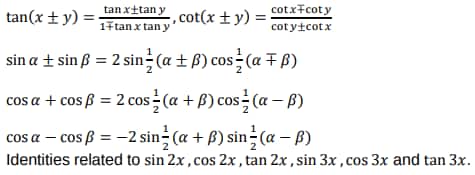
Positive and negative angles. Measuring angles in radians and in degrees, and conversion from one measure to another. Definition of trigonometric functions with the help of the unit circle. Truth of the identity sin2x + cos2x = 1, for all x. Signs of trigonometric functions. Domain and range of trigonometric functions and their graphs. Expressing sin (x±y) and cos (x±y) in terms of sinx, siny, cosx & cosy and their simple applications. Deducing identities like the following:
Unit-II: Algebra
1. Complex Numbers and Quadratic Equations
The need for complex numbers, especially √−1, is motivated by the inability to solve some of the quadratic equations. Algebraic properties of complex numbers. Argand plane.
2. Linear Inequalities
Linear inequalities. Algebraic solutions of linear inequalities in one variable and their representation on the number line.
3. Permutations and Combinations
Fundamental principle of counting. Factorial n. (n!) Permutations and combinations, derivation of Formulae for n Pr, nCr and their connections, simple applications.
4. Binomial Theorem
Historical perspective, statement and proof of the binomial theorem for positive integral indices.
5. Sequence and Series
Sequence and Series. Arithmetic Mean (A.M.) Geometric Progression (G.P.), general term of a G.P., sum of n terms of a G.P., infinite G.P. and its sum, geometric mean (G.M.), relation between A.M. and G.M
Unit-III: Coordinate Geometry
1. Straight Lines
Brief recall of two-dimensional geometry from earlier classes. Slope of a line and angle between two lines. Various forms of equations of a line: parallel to the axis, point -slope form, slope-intercept form, two-point form, and intercept form. Distance of a point from a line.
2. Conic Sections
Sections of a cone: circles, ellipses, parabolas, hyperbolas, a point, a straight line and a pair of intersecting lines as a degenerate case of a conic section. Standard equations and simple properties of parabola, ellipse and hyperbola. Standard equation of a circle.
3. Introduction to Three-dimensional Geometry
Coordinate axes and coordinate planes in three dimensions. Coordinates of a point. Distance between two points.
Unit-IV: Calculus
1. Limits and Derivatives
Derivative introduced as the rate of change, both as that of the distance function and geometrically. Intuitive idea of limit. Limits of polynomials and rational functions, trigonometric, exponential and logarithmic functions. Definition of a derivative relates it to the slope of the tangent to the curve; the derivative of the sum, difference, product and quotient of functions of polynomial and trigonometric functions.
Unit-V Statistics and Probability
1. Statistics
Measures of Dispersion: Range, Mean deviation, variance and standard deviation of ungrouped/grouped data.
2. Probability
Events: occurrence of events, ‘not’, ‘and’ and ‘or’ events, exhaustive events, mutually exclusive events, Axiomatic (set theoretic) probability, connections with other theories of earlier classes. Probability of an event, probability of ‘not’, ‘and’ and ‘or’ events.
Also check: CBSE Class 11 Syllabus PDF 2026-27
Confused between CGPA and Percentage?
Get your results instantly with our calculator!
💡 Conversion Formula used is: CGPA = Percentage / 9.5
Typology of Questions and Weightage
Typology of Questions | Total Marks | Weightage percentage |
Remembering: Exhibit memory of previously learned material by recalling facts, terms, basic concepts, and answers. Understanding: Demonstrate understanding of facts and ideas by organising, comparing, translating, interpreting, giving descriptions, and stating main ideas | 44 | 55 |
Applying: Solve problems in new situations by applying acquired knowledge, facts, techniques and rules in a different way. | 28 | 25 |
Analysing: Examine and break information into parts by identifying motives or causes. Make inferences and find evidence to support generalisations. Evaluating: Present and defend opinions by making judgments about information, the validity of ideas, or the quality of work based on a set of criteria. Creating: Compile information together in a different way by combining elements in a new pattern or proposing alternative solutions | 16 | 20 |
Total | 80 | 100 |
Note: There will be no overall choice in the question paper. However, 33% internal choices will be given in all the sections.
CBSE Class 11 Maths Recommended Books & Sources
Students should refer to the following CBSE Class 11 Maths books to prepare well for the examination:
Mathematics Textbook for Class XI, NCERT Publications
Mathematics Exemplar Problems for Class XI, Published by NCERT
Mathematics Lab Manual, Class XI, published by NCERT
Also check:
- CBSE Class 11 English Core Syllabus 2026-27
- CBSE Class 11 Accountancy Syllabus 2026-27
- CBSE Class 11 Physical Education Syllabus 2026-27
- CBSE Class 11 Hindi Core Syllabus 2026-27
- CBSE Class 11 Physics Syllabus 2026-27
- CBSE Class 11 Biology Syllabus 2026-27
- CBSE Class 11 Chemistry Syllabus 2026-27
- CBSE Class 11 Business Studies Syllabus 2026-27
Best Courses After 10th Class
Explore the best courses after 10th across science, commerce, arts, and vocational streams. Find the right path based on your interests and build a strong career foundation.
Download EBookArticles
Related Stories
|
Upcoming School Exams

Certifications By Top Providers
Explore Top Universities Across Globe
Questions related to CBSE Class 10th
On Question asked by student community
Have a question related to CBSE Class 10th ?
Hello student!
You can refer to the CBSE Class 10 Mathematics Question Paper 2026 to practise questions and prepare for the Mathematics examination.
https://school.careers360.com/boards/cbse/cbse-class-10-maths-question-paper-2026
Hope it helps!
Hi Smriti Lama
The CBSE Class 10 Board Exam 2026-27 question paper pattern includes the latest exam structure, subject-wise marking scheme and question types. You can check the detailed pattern on Careers360:
Hi Somshiv Rath
If you mean a CBSE Class 8 Science question paper, Careers360 has a sample paper section where you can check the available Class 8 papers.
https://learn.careers360.com/school/cbse-8-class-preparation-material/
Hey there,
If you mean CBSE Class 10 rechecking/re-evaluation results 2026, CBSE has already completed the main post-result process for 2026. The Class X second-board results were declared on 18 July 2026, and CBSE has also issued the post-result facilities notice.
For verification/re-evaluation, CBSE says the result/status is uploaded online
Please mention important details like your school board, exam, and class to get the exact papers.
You can explore the useful resources here:

Applications for Admissions are open.
Get Job Ready in Healthcare | Employability-Focused Programs
CBSE Class 10th Notifications
Never miss CBSE Class 10th update
Get timely CBSE Class 10th updates directly to your inbox. Stay informed!