
Search Colleges, Exams, Schools & more


Login
UP Board Class 10 Science Syllabus 2026-27 PDF - Topics, Marks & Exam Pattern
The Uttar Pradesh Madhyamik Shiksha Parishad (UPMSP) has released the UP Board Class 10 Science syllabus for 2026-27 on its official website, covering both theory and practical examinations. Students can download the UP Board Class 10 Science syllabus 2026 from upmsp.edu.in to understand the important topics and prepare well for the Science examination. The UP Board Class 10 Science paper consists of 100 marks, out of which 70 marks are for the theory paper and 30 marks are for the practical paper. Read the detailed UP Board Class 10 Science syllabus 2026 and marks distribution.
This Story also Contains
- Download UPMSP Class 10 Science Syllabus 2026 PDF
- UP Board Class 10 Science Theory Paper Marks Distribution 2026-27
- Detailed UP Board Class 10 Science Syllabus 2026-27: Unit-Wise Topics
- UP Board Class 10 Science Practical Exam Marks Distribution 2026-27
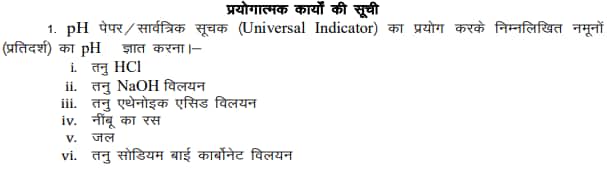
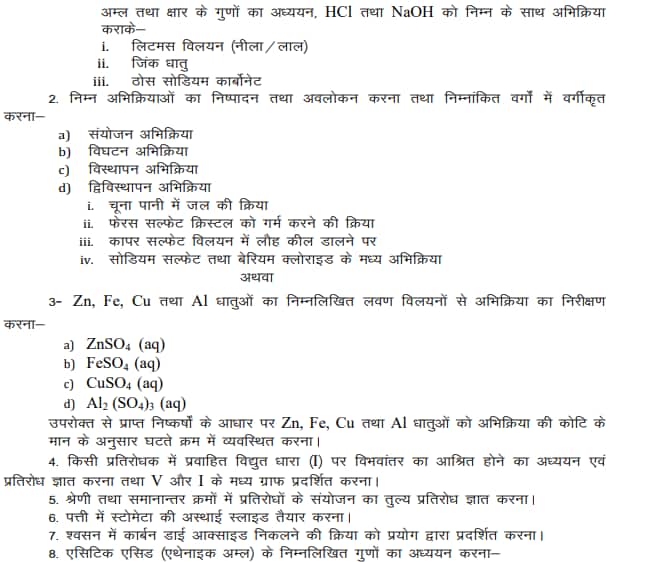
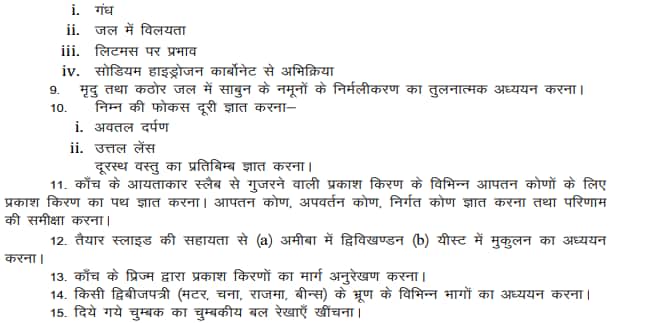
- UP Board 10th Science Practical Exam Detailed Syllabus 2026-27
Download UPMSP Class 10 Science Syllabus 2026 PDF
Title | Download Link |
UP Board Class 10 Science syllabus 2026 |
UP Board Class 10 Science Theory Paper Marks Distribution 2026-27
Students appearing for the UP Board Class 10th exam must know the detailed marking pattern for the UP Board 10th Science theory examination mentioned below.
Unit | Marks |
Chemical Substances – Nature and Behaviour | 20 |
Living World | 20 |
Natural Phenomena | 12 |
Effects of Current | 13 |
Natural Resources | 05 |
Total | 70 |
Confused between CGPA and Percentage?
Get your results instantly with our calculator!
💡 Conversion Formula used is: CGPA = Percentage / 9.5
Detailed UP Board Class 10 Science Syllabus 2026-27: Unit-Wise Topics
Students are advised to go through the Class 10th detailed Science syllabus 2026 to score well in the exam. Look at the table below to know the unit-wise topics covered in the UP Board Class 10 Science Syllabus 2026.
Unit no. | Unit name | Chapters and topics covered |
1 | Chemical Substances – Nature and Behaviour | Chemical Reactions and Equations: Balanced chemical equations, implications of a balanced chemical equation, types of chemical reactions: combination reaction, decomposition reaction, displacement reaction, double displacement reaction, precipitation reaction, neutralisation, oxidation, and reduction reactions. |
Acids, Bases, and Salts: Definitions of acids, bases, and salts based on $H^+$ and $OH^-$ ions, general properties, examples, and uses; concept of the pH scale (definition relating to logarithms is not required), importance of pH in everyday life; preparation and uses of Sodium Hydroxide, Bleaching Powder, Baking Soda, Washing Soda, and Plaster of Paris. | ||
Metals and Non-Metals: Properties of metals and non-metals; formation and properties of ionic compounds; reactivity series, basic metallurgical processes, corrosion, and its prevention. | ||
Carbon and its Compounds: Covalent bonding in carbon compounds, versatile nature of carbon, homologous series, nomenclature of carbon compounds containing functional groups (halogens, alcohol, ketone, aldehyde, alkane, alkyne), difference between saturated and unsaturated hydrocarbons; chemical properties of carbon compounds (combustion, oxidation, addition, and substitution reactions), Ethanol and Ethanoic acid (properties and uses only), soaps, and detergents. | ||
2 | Living World | Life Processes: Basic concept of 'living', nutrition, respiration, transport, and excretion in plants and animals. |
Control and Coordination: Tropic movements in plants, introduction to plant hormones; control and coordination in animals: nervous system, voluntary muscles, involuntary muscles, reflex action; chemical coordination: hormones in animals. | ||
How do Organisms Reproduce?: Reproduction in animals and plants (sexual and asexual); reproductive health: need and methods of family planning, safe sex vs. HIV/AIDS, childbearing, and women's health. | ||
Heredity: Heredity, Mendel's contribution: laws for inheritance of traits, sex determination (brief introduction). | ||
3 | Natural Phenomena | Light - Reflection and Refraction: Reflection of light by curved surfaces, image formation by spherical mirrors, centre of curvature, principal axis, principal focus, focal length, mirror formula (derivation not required), magnification. Refraction: Laws of refraction, refractive index, refraction of light by spherical lenses, image formation by spherical lenses, rules for image formation by lenses, lens formula (derivation not required), magnification, power of a lens. |
Human Eye and Colourful World: Functioning of a lens in the human eye, defects of vision and their correction, applications of spherical mirrors and lenses. Refraction of light through a prism, dispersion of light, scattering of light, and its applications in daily life. | ||
4 | Effects of Current | Electricity: Electric current, potential difference, Ohm's law, resistance, resistivity, factors on which the resistance of a conductor depends. Series and parallel combination of resistors and its applications in daily life, heating effect of electric current and its applications in daily life, electric power, interrelation between P, V, I and R. |
Magnetic Effects of Electric Current: Magnetic field, field lines, magnetic field due to a current-carrying conductor, magnetic field due to current in a solenoid; force on a current-carrying conductor in a magnetic field, Fleming's Left-Hand Rule, domestic electric circuits, Right-Hand Thumb Rule, magnetic field due to a current-carrying circular loop. | ||
5 | Natural Resources | Our Environment: Ecosystem, environmental problems, ozone layer depletion, waste production and their solutions, biodegradable and non-biodegradable substances. |
UP Board Class 10 Science Practical Exam Marks Distribution 2026-27
The UP Board Class 10 practical examination consists of 30 marks, out of which 15 marks are evaluated by an external examiner and 15 marks are evaluated by an internal examiner.
For the External Examiner:
Component | Marks |
Three Experiments (One each from Physics, Chemistry, and Biology) | Physics: 04 |
Viva-Voice | 03 |
Total marks | 15 |
For the Internal Examiner:
Component | Marks |
Project Work (One each from Physics, Chemistry, and Biology) | 09 |
Sessional/Class works | 06 |
Total marks | 15 |
UP Board 10th Science Practical Exam Detailed Syllabus 2026-27
Also check: UP Board 10th Syllabus 2026-27
Articles
Related Stories
|
Upcoming School Exams

Certifications By Top Providers
Explore Top Universities Across Globe
Questions related to UP Board 10th
On Question asked by student community
Have a question related to UP Board 10th ?
Hi Ananya Gupta
For UP Board Class 10 Sample Papers 2026-27, you can download subject-wise model papers and use them for 2027 board exam preparation. Check the link given below:
https://school.careers360.com/boards/upmsp/up-board-10th-model-papers
https://school.careers360.com/hi/articles/up-board-10th-model-papers
Hi Student!
Given below is the link to access the UP Board Class 10 Question Paper:
https://school.careers360.com/boards/upmsp/up-board-10th-question-paper-2026-pdf-with-solutions
You can check the link below,apply relevant filters, find suitable resources:
https://school.careers360.com/download/ebooks-and-sample-papers
Hi!
Given below is the link to access the Class 10th UP Board Question Papers:
Hi Rohit!
Given below are the links for UP Board Class 10th Previous Year Question Papers:
https://school.careers360.com/boards/upmsp/up-board-class-10-last-5-year-question-paper
Hope it helps!
Hello Student,
You can refer to the UP Board Class 9 Half-Yearly Sample/Question Papers 2025-26 from the link given below. Subject-wise papers are available for Maths, Science, Social Science, Hindi and English.
https://school.careers360.com/boards/upmsp/up-board-class-9-half-yearly-exam-question-paper-2025-26

Applications for Admissions are open.
Get Job Ready in Healthcare | Employability-Focused Programs
UP Board 10th Notifications
Never miss UP Board 10th update
Get timely UP Board 10th updates directly to your inbox. Stay informed!