
Search Colleges, Exams, Schools & more


Login
CBSE 12th Physical Education Syllabus 2026-27 PDF Download - Subject Code: 048
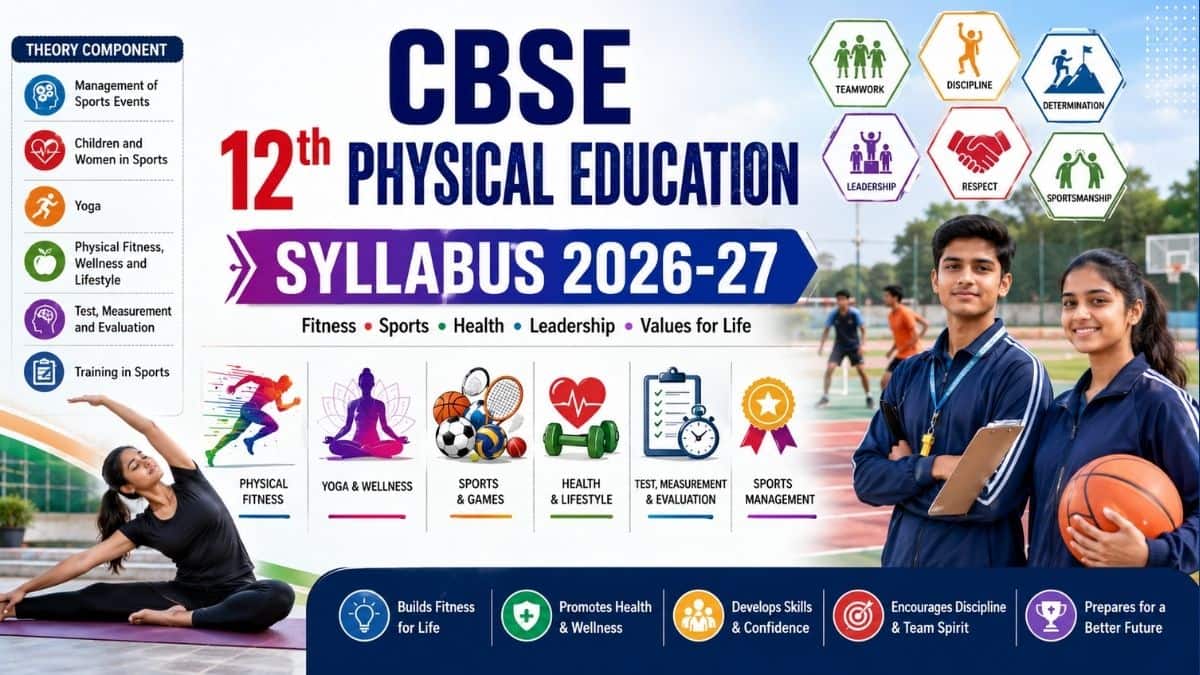
Central Board of Secondary Education has released the Class 12 physical education 2026-27 online on official website. The CBSE Class 12 Physical Education syllabus (Subject Code: 048) combines health education, sports psychology, biomechanics, and competitive sports management. The CBSE Class 12 Physical Education syllabus carries a total of 100 marks, comprising 70 marks for theory and 30 marks for practical assessment. The theory section is divided into 10 units, covering topics related to sports management, health, fitness, psychology, biomechanics, and training.
Direct Link: Download CBSE 12th Physical Education Syllabus PDF Here
This Story also Contains
- CBSE Class 12 Physical Education Syllabus 2026
- Detailed Unit CBSE 12th Physical Education 2026
- CBSE 12th Physical Education Practical Evaluation (30 Marks)
- CBSE 12th Physical Education Syllabus Analysis
Among all units, Biomechanics and Sports (Unit 8) has the highest weightage of 10 marks, making it the most important chapter in the theory examination. This unit focuses on concepts such as Newton's Laws of Motion, levers, equilibrium, friction, and projectile motion, which have significant applications in sports performance. The next most important unit is Training in Sports (Unit 10), carrying 9 marks. It covers talent identification, training cycles, and methods of developing strength, endurance, speed, flexibility, and coordinative abilities.
Also, download CBSE Class 12 syllabus of other subjects
CBSE Class 12 Physical Education Syllabus 2026
Test and Measurement in Sports (Unit 6) contributes 8 marks, emphasising fitness tests, BMR calculation, and senior citizen fitness assessment. Children and Women in Sports (Unit 2), Sports and Nutrition (Unit 5), and Psychology and Sports (Unit 9) carry 7 marks each, making them equally important scoring areas.
The theory paper comprises 10 units, evenly distributed across the testing blueprint:
Unit No. | Unit Name | Weightage (Marks) |
Unit 1 | Management of Sporting Events | 05 + 04 b* |
Unit 2 | Children and Women in Sports | 07 |
Unit 3 | Yoga as a Preventive Measure for Lifestyle Diseases | 06 + 01 b* |
Unit 4 | Physical Education and Sports for CWSN (Children With Special Needs) | 04 + 04 b* |
Unit 5 | Sports and Nutrition | 07 |
Unit 6 | Test and Measurement in Sports | 08 |
Unit 7 | Physiology and Injuries in Sports | 04 + 04 b* |
Unit 8 | Biomechanics and Sports | 10 |
Unit 9 | Psychology and Sports | 07 |
Unit 10 | Training in Sports | 09 |
Practical (Lab) | Including 3 Practical Activities | 30 |
Total Theory | Units 1–10 | 70 |
Grand Total | Theory + Practical | 100 |
Units 1, 3, 4, and 7 include concept-based questions marked as b*, such as tactile diagrams, data interpretation, and case-study-based questions designed for visually impaired students.
Detailed Unit CBSE 12th Physical Education 2026
Prioritise Biomechanics, Training in Sports, and Test & Measurement in Sports, while also allocating sufficient time to practical activities, as together they contribute a major share of the overall marks.
Unit No. | Unit Name & Topics |
Unit 1 | Management of Sporting Events• Functions of Sports Event Management• Committees and Responsibilities• Fixtures and Tournament Procedures• Intramural & Extramural Tournaments• Community Sports Programmes |
Unit 2 | Children and Women in Sports• WHO Exercise Guidelines• Postural Deformities & Corrective Measures• Women's Participation in Sports• Menarche & Menstrual Dysfunction• Female Athlete Triad |
Unit 3 | Yoga as Preventive Measure for Lifestyle Diseases• Yoga for Obesity• Yoga for Diabetes• Yoga for Asthma• Yoga for Hypertension• Yoga for Back Pain & Arthritis |
Unit 4 | Physical Education and Sports for CWSN (Children with Special Needs)• Disability Sports Organisations• Classification & Divisioning in Sports• Inclusion in Sports• Benefits of Physical Activities• Accessibility Strategies |
Unit 5 | Sports and Nutrition• Balanced Diet & Nutrition• Macro & Micro Nutrients• Nutritive & Non-Nutritive Components• Weight Control & Dieting• Diet Requirements in Sports |
Unit 6 | Test and Measurement in Sports• SAI Khelo India Fitness Test• Harvard Step Test• Basal Metabolic Rate (BMR)• Rikli & Jones Senior Citizen Fitness Test• Johnson-Metheny Test of Motor Educability |
Unit 7 | Physiology and Injuries in Sports• Physiological Factors of Fitness• Effects of Exercise on Muscular System• Effects on Cardio-Respiratory System• Physiological Changes Due to Ageing• Sports Injuries and Management |
Unit 8 | Biomechanics and Sports• Newton's Laws of Motion• Levers in Sports• Equilibrium & Centre of Gravity• Friction in Sports• Projectile Motion |
Unit 9 | Psychology and Sports• Personality Theories• Motivation and Techniques• Exercise Adherence• Aggression in Sports• Psychological Attributes in Sports |
Unit 10 | Training in Sports• Talent Identification & Development• Training Cycles (Micro, Meso, Macro)• Strength, Endurance & Speed Training• Flexibility & Coordinative Ability Training• Circuit Training |
Also, check the
- CBSE syllabus
- CBSE Class 12 Physical Education Sample Paper
- CBSE Date Sheet
- How to improve marks to 75% or above in CBSE
Best Courses After 10th Class
Explore the best courses after 10th across science, commerce, arts, and vocational streams. Find the right path based on your interests and build a strong career foundation.
Download EBookConfused between CGPA and Percentage?
Get your results instantly with our calculator!
💡 Conversion Formula used is: CGPA = Percentage / 9.5
CBSE 12th Physical Education Practical Evaluation (30 Marks)
The practical component evaluates physical fitness, domain expertise, and project documentation:
Physical Fitness Test (SAI Fitness Test): 6 Marks
Proficiency in Games & Sports: 7 Marks (Performance evaluation in any one chosen team game/sport from the CBSE-approved list)
Yogic Practices Demonstration: 7 Marks (Performance of listed asanas based on lifestyle diseases)
Practical Record File: 5 Marks (Must contain physical fitness test tracking, 5 asanas with illustrations, and a detailed guide profile of one selected sport)
Viva Voce: 5 Marks (Based on the practical records, game rules, and yogic asanas)
CBSE 12th Physical Education Syllabus Analysis
Biomechanics and Sports is the highest-weighted unit with 10 marks.
Training in sports follows closely with 9 marks, making it another high-priority area.
Test and Measurement in Sports carries 8 marks and is important for understanding fitness evaluation techniques.
Children and women in sports, sports and nutrition, and psychology and sports contribute 7 marks each, offering good scoring opportunities.
The 30-mark practical component accounts for nearly one-third of the total score and can significantly boost overall performance.
Students should focus on both theoretical concepts and practical applications, as Physical Education combines scientific principles, health awareness, sports training, and performance assessment.
Units featuring concept-based (b) questions* require special attention to case studies, diagrams, and application-oriented learning.
Also, check here
Articles
Related Stories
|
Upcoming School Exams

Certifications By Top Providers
Explore Top Universities Across Globe
Questions related to CBSE Class 10th
On Question asked by student community
Have a question related to CBSE Class 10th ?
Hello student!
You can refer to the CBSE Class 10 Mathematics Question Paper 2026 to practise questions and prepare for the Mathematics examination.
https://school.careers360.com/boards/cbse/cbse-class-10-maths-question-paper-2026
Hope it helps!
Hi Smriti Lama
The CBSE Class 10 Board Exam 2026-27 question paper pattern includes the latest exam structure, subject-wise marking scheme and question types. You can check the detailed pattern on Careers360:
Hi Somshiv Rath
If you mean a CBSE Class 8 Science question paper, Careers360 has a sample paper section where you can check the available Class 8 papers.
https://learn.careers360.com/school/cbse-8-class-preparation-material/
Hey there,
If you mean CBSE Class 10 rechecking/re-evaluation results 2026, CBSE has already completed the main post-result process for 2026. The Class X second-board results were declared on 18 July 2026, and CBSE has also issued the post-result facilities notice.
For verification/re-evaluation, CBSE says the result/status is uploaded online
Please mention important details like your school board, exam, and class to get the exact papers.
You can explore the useful resources here:

Applications for Admissions are open.
Get Job Ready in Healthcare | Employability-Focused Programs
CBSE Class 10th Notifications
Never miss CBSE Class 10th update
Get timely CBSE Class 10th updates directly to your inbox. Stay informed!