


CBSE Class 10 Science Lab Manual 2027 – PDF Download, Experiments, Activities

CBSE Class 10 Science experiments let students observe important scientific concepts in action and understand how they work in real situations. The CBSE Class 10 Science Lab Manual 2027 supports this practical approach by providing experiments, activities, observations, and project work based on the CBSE Class 10 Science curriculum.
This Story also Contains
- Download CBSE Class 10 Science Lab Manual 2027 PDFs
- CBSE Class 10 Science Lab Manual 2027: What Will Students Find?
- Important CBSE Class 10 Science Experiments for 2027
- Examples of Activities for CBSE 10th Science Lab Practicals
- Tips to Score Well in CBSE Board Exam Class 10 Science Practicals 2027
Using the CBSE Class 10 Science Lab Manual 2026-27, students can become familiar with the experiments they have to perform in the laboratory and learn how to record observations and results correctly. It is also useful while preparing for final CBSE Class X Science practical assessments and completing laboratory records.
Download CBSE Class 10 Science Lab Manual 2027 PDFs
The table below lists all the units and experiments in the CBSE Class X Science Lab Manual 2026-27. Students can click on the free PDF download links to access them:
Particulars | Download Link |
|---|---|
Materials | |
The World of Living | |
The Natural Phenomenon | |
How Things Work | |
Project Work |
CBSE Class 10 Science Lab Manual 2027: What Will Students Find?
The Class 10 Science lab manual CBSE provides practical work across different branches of Science. Instead of learning every concept theoretically, students get opportunities to observe changes, handle apparatus, collect information, and interpret experimental results.
The Class 10 CBSE Science manual covers practical work under the following areas:
Materials: Experiments that help students explore the properties, reactions, and behaviour of different substances.
The World of Living: Activities connected with biological processes, structures, and observations related to living organisms.
The Natural Phenomenon: Practical exploration of scientific phenomena such as light and related concepts.
How Things Work: Experiments that demonstrate the working of scientific principles, including concepts involving electricity and other physical processes.
Project Work: Application-based work that encourages students to investigate a topic and present their findings systematically.
Confused between CGPA and Percentage?
Get your results instantly with our calculator!
Important CBSE Class 10 Science Experiments for 2027
Students should refer to the CBSE Class 10th Science lab manual for the exact procedure and requirements of each experiment. While participating in conducting experiments, students should pay attention to the apparatus used, the steps followed, the changes observed, and the conclusion obtained. Some practical areas students should be familiar with include:
Chemical reactions and properties of substances
Acids, bases, and related observations
Biological structures and processes
Light-related experiments involving mirrors and lenses
Electrical circuits and components
Recording experimental observations
Drawing and labelling experimental diagrams
Analysing results and writing appropriate conclusions
Examples of Activities for CBSE 10th Science Lab Practicals
In the article above, we have provided free PDF download links to CBSE 10th Science lab manual activities and projects. An example of practical work is given below for students’ reference on what they will find in those links:
Aim
To show that carbon dioxide is essential for photosynthesis.
Materials Required
A de-starched herbaceous long-leaved potted plant (such as Tecoma, balsam, Amaranthus or Salvia), two boiling tubes, a split cork, KOH solution (caustic potash), alcohol, iodine solution, petroleum jelly, beakers, a petri dish, forceps, a burner (or a spirit lamp), a tripod stand, a wire gauge, and a laboratory stand with a clamp.
Procedure
Take a de-starched potted plant (from the list given above).
Fill one-fifth of the boiling tube with KOH solution.
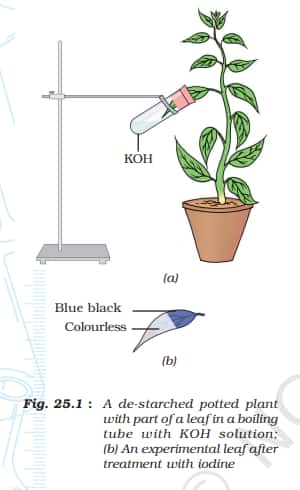
Insert one half of an intact leaf of the de-starched plant into the boiling tube through a split cork as shown in Fig. 25.1. Ensure that the leaf does not touch the solution.
Fix the tube to the stand with a clamp. Make the boiling tube airtight by applying a thin smear of petroleum jelly.
Keep the set-up in bright sunlight for about one and a half hours.
Take about 150 mL of water in a beaker and boil it.
Detach the experimental leaf from the parent potted plant and boil it in water in a beaker for some time. Stop heating the water. Remove the beaker from the tripod stand. Allow it to cool to about 60 °C. Transfer the leaf to alcohol taken in another boiling tube.
Place the boiling tube (containing the experimental leaf in alcohol) in the beaker containing hot water. The leaf will also become warm. Keep the boiling tube in the beaker till the leaf becomes colourless.
Take some iodine solution in a petri dish.
Wash the leaf in water and dip it in iodine solution in the petri dish.
After about five minutes, remove the leaf from the iodine solution, wash it with water and observe.
Tips to Score Well in CBSE Board Exam Class 10 Science Practicals 2027
Good performance in CBSE Class 10 Science practicals is not only about getting the expected CBSE 10th result. Students should also demonstrate that they understand what they are doing. Some of the important points to keep in mind are listed below:
Read the experiment before entering the laboratory.
Remember important apparatus and their uses.
Follow instructions in the correct order.
Handle laboratory equipment carefully.
Record readings and observations accurately.
Avoid overwriting or making unnecessary changes in the practical record.
Practise frequently asked viva questions.
Keep diagrams clean, properly labelled, and easy to understand.
Revise the Science concepts connected with each experiment.
Frequently Asked Questions (FAQs)
The manual is organised into sections such as Materials, The World of Living, The Natural Phenomenon, How Things Work, and Project Work.
It helps students become familiar with experiments, procedures, observations, apparatus, diagrams, and results. Going through the manual before practical examinations can make laboratory work more organised and easier to revise.

Questions related to CBSE Class 10th
On Question asked by student community
Hello Simi,
Please mention the class for which you need the PYQ. I am providing similar resources below.
Hello Student,
We don't have the ALLEN TALLENTEX Class 10 mock test available right now. However, you can practise using the following resources:
ALLEN TALLENTEX Sample Papers: https://school.careers360.com/articles/allen-tallentex-sample-paper
ALLEN TALLENTEX Previous Year Question Papers: https://school.careers360.com/articles/allen-tallentex-previous-year-question-paper
Hello Student,
Could you mention your class? Check the useful resources given below:
https://school.careers360.com/boards/cbse/cbse-class-10th-question-bank
https://school.careers360.com/boards/cbse/cbse-class-10-maths-important-questions-and-answers
https://school.careers360.com/boards/cbse/cbse-class-10-science-most-repeated-questions-pdf
Hope it helps!
Hello student!
You can refer to the CBSE Class 10 Mathematics Question Paper 2026 to practise questions and prepare for the Mathematics examination.
https://school.careers360.com/boards/cbse/cbse-class-10-maths-question-paper-2026
Hope it helps!
Hi Smriti Lama
The CBSE Class 10 Board Exam 2026-27 question paper pattern includes the latest exam structure, subject-wise marking scheme and question types. You can check the detailed pattern on Careers360: