
Search Colleges, Exams, Schools & more


Login
AHSEC Class 12 Chemistry Syllabus 2026-27 Download PDF @ahsec.assam.gov.in
The Assam Higher Secondary Education Council has released the AHSEC Chemistry Syllabus 2026-27 on the official website for Class 12 students. The syllabus PDF will help students understand the chapters in detail and the distribution of marks for the Class 12 Chemistry examination. They must go through the detailed Chemistry syllabus and prepare the important topics to complete the course on time. They can download the AHSEC Chemistry Syllabus 2026-27 from the official website at ahsec.assam.gov.in. The Assam Board Class 12 Chemistry paper consists of 100 marks, out of which the theory paper carries 70 marks and the practical exam carries 30 marks. Read the complete article to learn the detailed topic-wise syllabus and marks distribution for the Assam Board Class 12 Chemistry paper.
This Story also Contains
- AHSEC Chemistry Syllabus 2026-27: Theory Paper Marks Distribution
- Detailed AHSEC Chemistry Syllabus 2026-27: Unit-Wise Topics
- AHSEC Chemistry Practical Exam Marks Distribution 2026-27
- Detailed AHSEC Chemistry Practical Exam Syllabus 2026-27
- Recommended Books for AHSEC Chemistry Syllabus 2026-27
AHSEC Chemistry Syllabus 2026-27: Theory Paper Marks Distribution
The mark distribution for the Chemistry theory paper examination across all units is shown below.
| Serial No | Unit Title | Marks |
|---|---|---|
1 | Solutions | 7 |
2 | Electrochemistry | 9 |
3 | Chemical Kinetics | 7 |
4 | d -and f -Block Elements | 7 |
5 | Coordination Compounds | 7 |
6 | Haloalkanes and Haloarenes | 6 |
7 | Alcohols, Phenols and Ethers | 6 |
8 | Aldehydes, Ketones and Carboxylic Acids | 8 |
9 | Amines | 6 |
10 | Biomolecules | 7 |
Total Marks | 70 |
Detailed AHSEC Chemistry Syllabus 2026-27: Unit-Wise Topics
Students preparing for the AHSEC Class 12 Chemistry examination can go through the detailed Chemistry syllabus 2026-27 to score well in the exam. The detailed unit-wise topics for the AHSEC Chemistry syllabus are given below.
Unit No. | Unit Name | Topics Covered |
Unit 1 | Solutions | Types of solutions, expression of concentration of solutions of solids in liquids, solubility of gases in liquids, solid solutions, Raoult's law, colligative properties - relative lowering of vapour pressure, elevation of boiling point, depression of freezing point, osmotic pressure, determination of molecular masses using colligative properties, abnormal molecular mass, Van't Hoff factor |
Unit 2 | Electrochemistry | Redox reactions, EMF of a cell, standard electrode potential, Nernst equation and its application to chemical cells, Relation between Gibbs energy change and EMF of a cell, conductance in electrolytic solutions, specific and molar conductivity, variations of conductivity with concentration, Kohlrausch's Law, electrolysis and law of electrolysis (elementary idea), dry cell-electrolytic cells and Galvanic cells, lead accumulator, fuel cells, corrosion. |
Unit 3 | Chemical Kinetics | Rate of a reaction (Average and instantaneous), factors affecting rate of reaction: concentration, temperature, catalyst; order and molecularity of a reaction, rate law and specific rate constant, integrated rate equations and half-life (only for zero and first order reactions), concept of collision theory (elementary idea, no mathematical treatment), activation energy, Arrhenius equation. |
Unit 4 | d -and f -Block Elements | General introduction, electronic configuration, occurrence and characteristics of transition metals, general trends in properties of the first row transition metals – metallic character, ionisation enthalpy, oxidation states, ionic radii, colour, catalytic property, magnetic properties, interstitial compounds, alloy formation, preparation and properties of K2Cr2O7 and KMnO4. Lanthanoids - Electronic configuration, oxidation states, chemical reactivity and lanthanoid contraction and its consequences. Actinoids- Electronic configuration, oxidation states and comparison with lanthanoids. |
Unit 5 | Coordination Compounds | Coordination compounds - Introduction, ligands, coordination number, colour, magnetic properties and shapes, IUPAC nomenclature of mononuclear coordination compounds. Bonding, Werner's theory, VBT, and CFT; structure and stereoisomerism, importance of coordination compounds (in qualitative analysis, extraction of metals and biological system). |
Unit 6 | Haloalkanes and Haloarenes | Haloalkanes: Nomenclature, nature of C–X bond, physical and chemical properties, optical rotation mechanism of substitution reactions. Haloarenes: Nature of C–X bond, substitution reactions (Directive influence of halogen in monosubstituted compounds only). Uses and environmental effects of dichloromethane, trichloromethane, tetrachloromethane, iodoform, freons, DDT. |
Unit 7 | Alcohols, Phenols and Ethers | Alcohols: Nomenclature, methods of preparation, physical and chemical properties (of primary alcohols only), identification of primary, secondary and tertiary alcohols, mechanism of dehydration, uses with special reference to methanol and ethanol. Phenols: Nomenclature, methods of preparation, physical and chemical properties, acidic nature of phenol, electrophilic substitution reactions, uses of phenols. Ethers: Nomenclature, methods of preparation, physical and chemical properties, uses. |
Unit 8 | Aldehydes, Ketones and Carboxylic Acids | Aldehydes and Ketones: Nomenclature, nature of carbonyl group, methods of preparation, physical and chemical properties, mechanism of nucleophilic addition, reactivity of alpha hydrogen in aldehydes, uses. Carboxylic Acids: Nomenclature, acidic nature, methods of preparation, physical and chemical properties; uses. |
Unit 9 | Amines | Amines: Nomenclature, classification, structure, methods of preparation, physical and chemical properties, uses, identification of primary, secondary and tertiary amines. Diazonium salts: Preparation, chemical reactions and importance in synthetic organic chemistry. |
Unit 10 | Biomolecules | Carbohydrates - Classification (aldoses and ketoses), monosaccharides (glucose and fructose), D-L configuration, oligosaccharides (sucrose, lactose, maltose), polysaccharides (starch, cellulose, glycogen); Importance of carbohydrates. Proteins-Elementary idea of amino acids, peptide bond, polypeptides, proteins, structure of proteins - primary, secondary, tertiary structure and quaternary structures(qualitative idea only), denaturation of proteins; enzymes. Hormones - Elementary idea excluding structure. Vitamins- Classification and functions. Nucleic Acids: DNA and RNA. |
Confused between CGPA and Percentage?
Get your results instantly with our calculator!
💡 Conversion Formula used is: CGPA = Percentage / 9.5
AHSEC Chemistry Practical Exam Marks Distribution 2026-27
Evaluation Scheme for Examination | Marks |
Volumetric Analysis | 06 |
Salt Analysis | 12 |
Content-Based Experiment | 04 |
Project Work | 04 |
Class record and viva | 04 |
Total | 30 |
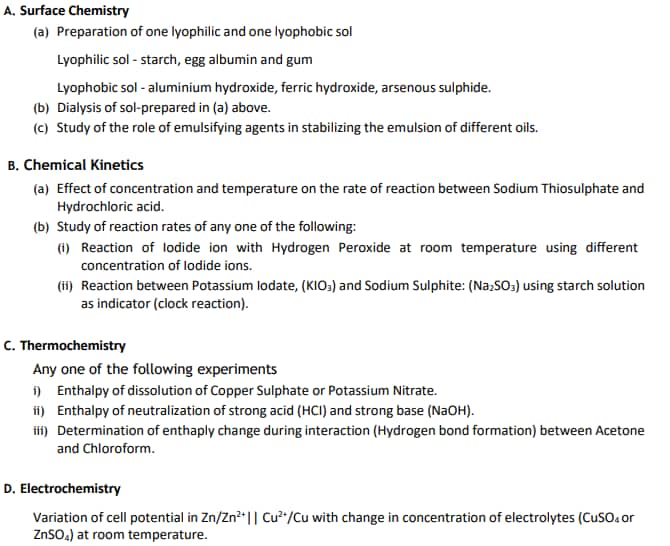
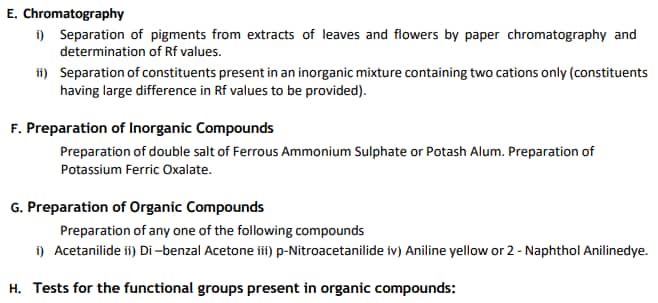
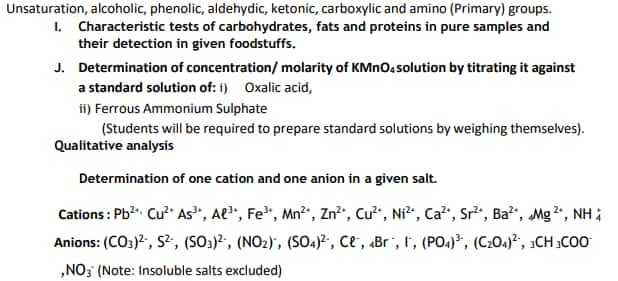
Detailed AHSEC Chemistry Practical Exam Syllabus 2026-27
Recommended Books for AHSEC Chemistry Syllabus 2026-27
Chemistry Part-I, (English) Published by NCERT.
Chemistry Part-II, (English) Published by NCERT.
Laboratory Manual of Chemistry, Class XI, (English) Published by NCERT
Rasayan Part-I, (Assamese) Published by ASSEB DIV-II.
Rasayan Part-II, (Assamese) Published by ASSEB DIV-II
Articles
Related Stories
|
Upcoming School Exams

Certifications By Top Providers
Explore Top Universities Across Globe
Questions related to Assam AHSEC
On Question asked by student community
Have a question related to Assam AHSEC ?
Dear Student,
Please refer to the link provided below: https://school.careers360.com/boards/ahsec/assam-class-12-half-yearly-english-question-paper-2026-27
Dear Student,
Please refer to the link provided below for the question papers:
https://school.careers360.com/boards/ahsec/assam-hs-class-12-half-yearly-exam-2025-question-paper
Hi Student
You can click on the link below to get the Assam Board Class 11 science final exam syllabus.
Hello,
You can get Assam Half-Yearly Question Papers from this link : Assam Class 12th Half-Yearly Question Papers
Hope it helps !
Hello,
You can get the paper from this link : Assam Board Class 10th Half-Yearly Question Paper 2025-26
Hope it helps !

Applications for Admissions are open.
Get Job Ready in Healthcare | Employability-Focused Programs
Assam AHSEC Notifications
Never miss Assam AHSEC update
Get timely Assam AHSEC updates directly to your inbox. Stay informed!