Chemotrophic organisms are those organisms that can prepare their own food or energy using chemicals. They obtain energy by oxidizing inorganic substances like ammonia, iron, or sulfur instead of using sunlight. This process is called chemosynthesis and is common in some bacteria.

Search Colleges, Exams, Schools & more


Login
NCERT Solutions for Class 10 Science Chapter 5 Life Processes
Do you know the difference between arteries and veins? Double circulation with a flow chart? Role of the glomerulus in urine formation? All these answers are given in the Life Processes Class 10 Science. The NCERT Solutions Chapter 5 explains four essential life processes like nutrition, respiration, transportation, and excretion. This article includes experts curated step-by-step explanation of Chapter 5 Class 10 NCERT Solutions PDF based on the latest CBSE guidelines (2026-27).
This Story also Contains
- NCERT Solutions for Class 10 Science Chapter 5 Life Processes Download PDF
- Class 10 Science NCERT Chapter 5 Life Processes - Question Answer
- NCERT Chapter-end Exercise Class 10 Science Life Processes Question Answer
- How to Solve Life Processes Class 10 Question Answer?
- Important Topics of NCERT Science Chapter 5 Life Processes Class 10
- Important Questions from NCERT Chapter 5 Life Processes Class 10
- Chapter 5 Life Processes Class 10 Science CBSE PYQs
- Why are Class 10 Science Chapter 5 Life Processes NCERT Solutions Important?
- Chapter Summary
- Expert Review
- NCERT Solutions for Class 10 Science Chapter-wise
The Life Processes NCERT Solutions for Class 10 Science PDF covers in-text questions and chapter-end exercises with clear step-wise answers. It includes high-yield topics such as the human digestive system, double circulation, excretion in plants and animals, and arteries vs veins, explained in a simple exam-oriented way, as asked in CBSE PYQs. These NCERT Solutions for Chapter 5 Life Processes are helpful for scoring good marks in board exams and for competitive exams like NEET.
NCERT Solutions for Class 10 Science Chapter 5 Life Processes Download PDF
Given below is the PDF for easy access to all the questions given in the textbook. Various processes that living organisms carry out are included in the Life Processes Class 10 questions and answers PDF. The NCERT Solutions for Class 10 Science are prepared by subject experts to make learning easier.
Also Read:
Class 10 Science NCERT Chapter 5 Life Processes - Question Answer
The exercise NCERT Solutions are one of the most important parts of understanding the topics. So, given below are the detailed Class 10 Science Chapter 5 Life Processes question answers.
Topic 5.1 - What are life processes?
Q.1. Why is diffusion insufficient to meet the oxygen requirements of multicellular organisms like humans?
Answer:
Multicellular Organisms have complex organ systems, each assigned to a specific task. These systems comprise tissues that are made up of millions of cells that require a continuous supply of oxygen to meet the functional requirements. Since not all these cells are in direct contact with the environment around the organism, diffusion is insufficient to meet the oxygen requirements of multicellular organisms.
Q.2. What criteria do we use to decide whether something is alive?
Answer:
The presence of a cellular structure and processes like respiration, excretion, reproduction, and growth are criteria we use to decide whether something is alive or not. In some cases, movement can also be the criterion for the same.
Q.3. What are the outside raw materials used by an organism?
Answer:
The outside raw materials used by an organism are:
1. Carbon-based compounds, e.g., carbohydrates, fats, proteins, etc., which provide energy for cellular processes.
2. Water is the medium for all intracellular reactions and the medium in which all of the transportation of materials takes place.
3. Oxygen, which is used for aerobic respiration.
4. Some other minerals are also taken from outside as raw materials, like iron, nitrogen, sodium, phosphorus, etc.
Q.4. What processes would you consider essential for maintaining life?
Answer:
Processes that are essential for maintaining life are respiration, nutrition, transportation, excretion, reproduction, and control and coordination.
Topic 5.2 Nutrition
Q.1. What are the differences between autotrophic nutrition and heterotrophic nutrition?
Answer:
The differences between autotrophic nutrition and heterotrophic nutrition are given below:
Autotrophic Nutrition | Heterotrophic Nutrition |
(i) Food or a source of energy is synthesised by the organism itself by using the energy from sunlight, using simple molecules like H2O and CO2. | (i) The organism is dependent on other organisms for food or a source of energy, as Heterotrophic organisms cannot prepare their food. |
(ii) A green pigment called chlorophyll is necessary as it entraps the energy from sunlight. | (ii) Chlorophyll pigment is not required in this mode of nutrition. |
(iii) All green plants and bacteria have this mode of nutrition. | (iii) All animals and some fungi have this mode of nutrition. |
Q.2. Where do plants get each of the raw materials required for photosynthesis?
Answer:
Plants require several raw materials and energy for photosynthesis.
(i) Plants take CO2 from the atmosphere using stomata.
(ii) Plants absorb H2O from the soil using their roots.
(iii) The energy required for photosynthesis is obtained from sunlight.
(iv) Chlorophyll is present in the chloroplast, which is found in the green parts of the plants, but especially in the leaves.
Q.3. What is the role of the acid in our stomach?
Answer:
The Hydrochloric acid present in our stomach has 3 main roles.
(i) It dissolves bits of food that have been chewed.
(ii) Provides an acidic medium, which is essential for the activation of the enzyme pepsin, which is essential for digestion.
(iii) The acid kills bacteria present in the stomach.
Q.4. What is the function of digestive enzymes?
Answer:
The food we eat consists of very complex molecules that cannot be used directly by the body to take up energy. Therefore, these molecules have to be broken down into simple molecules.
The process of breaking down these molecules is a very complex chemical process and requires a very long time, and this is where the digestive enzymes come in. They act as bio-catalysts and speed up the chemical reactions involving the breakdown of these molecules so that they can be absorbed by the cells, and energy can be derived from them.
Q.5. How is the small intestine designed to absorb digested food?
Answer:
The design of the small intestine is such that it provides the maximum area for the absorption of digested food and its transportation to different parts of our body through blood vessels.
For these purposes, the inner lining of the small intestine has finger-like projections called villi, providing a large surface area for absorption, and the small intestine is supplied richly with blood vessels for the efficient transportation of the absorbed food.
Topic 5.3 Respiration
Q.1. What advantage over an aquatic organism does a terrestrial organism have in obtaining oxygen for respiration?
Answer:
Terrestrial organisms breathe in oxygen for respiration directly from the environment, as opposed to aquatic organisms, which have to use oxygen dissolved in water.
The concentration of dissolved oxygen in water is much lower than that present in the air, and therefore, aquatic organisms have to have a much faster breathing rate than terrestrial organisms for a sufficient supply of oxygen.
In the course of evolution, aquatic organisms have also developed special body parts for the efficient absorption of oxygen dissolved in water.
Q.2. What are the different ways in which glucose is oxidised to provide energy in various organisms?
Answer:
The glucose is broken down into a 3-carbon molecule called Pyruvate in the cytoplasm of the cell in a process called glycolysis.
The process can further proceed using three different pathways depending on the amount of oxygen present.
In the presence of sufficient oxygen, pyruvate molecules are broken down into water and carbon dioxide, and energy is released. This process is called aerobic respiration and takes place in mitochondria.
In the lack of oxygen, Pyruvate molecules are converted into lactic acid, and energy is released. This process is called lactic acid fermentation. It takes place in our muscles, especially while exercising. The lactic acid thus produced causes cramps in our muscles.
In the total absence of Oxygen, Pyruvate molecules are broken down into Ethanol and Carbon dioxide, and Energy is released. This process is called anaerobic respiration and takes place in yeast cells.
Q.3. How are oxygen and carbon dioxide transported in human beings?
Answer:
The process through which oxygen and carbon dioxide are transported by human beings is:
(i) The transportation of oxygen from the lungs to other body parts takes place through our blood vessels. Oxygen has low solubility and therefore cannot be transported directly in plasma. The red blood cells contain a pigment called Haemoglobin with which the Oxygen molecules stick once they are absorbed through our lungs. These red blood cells carry the oxygen to the oxygen-deficient parts and then release it to be used for respiration.
(ii) Carbon dioxide, produced as a waste product, is highly soluble and is transported mainly in the plasma as bicarbonates. A small amount is also carried by haemoglobin. It is then released in the lungs and exhaled.
Q.4. How are the lungs designed in human beings to maximise the area for the exchange of gases?
Answer:
The air passages in our lungs are divided into several smaller passages called bronchi.
These bronchi further divide into even smaller passages called bronchioles, which terminate into very small balloon-like structures called Alveoli. Each lung consists of a million alveoli, as they are very small in size.
These alveoli have a very soft lining, optimum for absorption of Oxygen through vessels, and their large number provides a very large surface area for the absorption of oxygen.
Topic 5.4 Transportation
Q.1. What are the components of the transport system in human beings? What are the functions of these components?
Answer:
The transport/circulatory system in human beings consists of the following three parts:
(i) Blood: The blood is the medium for transportation of all kinds of materials like oxygen, carbon dioxide, digested food, and waste material from one part of the body to the other.
(ii) Blood Vessels: The intricate network of blood vessels, consisting of arteries, veins, and capillaries, runs through the entire body, and the transportation of materials like oxygen, carbon dioxide, digested food, and waste material from one part of the body to the other takes place through the blood vessels only.
(iii) Heart:
The heart pumps deoxygenated blood from the body to the lungs through the pulmonary artery (not a vein). Arteries always carry blood away from the heart.
The heart pumps oxygenated blood from the lungs to the rest of the body through the aorta and other arteries (not veins). Veins typically carry blood to the heart. The vessel that carries oxygenated blood from the lungs to the heart is the pulmonary vein.
Q.2. Why is it necessary to separate oxygenated and deoxygenated blood in mammals and birds?
Answer:
Mammals and birds are warm-blooded (endothermic) animals that continuously require oxygen in all body parts for the process of aerobic respiration to take place, so that heat is continuously generated to maintain the body temperature required.
To efficiently facilitate this process by ensuring that only oxygen-rich blood is delivered to the body tissues, it is necessary to separate oxygenated and deoxygenated blood in mammals and birds.
Q.3. What are the components of the transport system in highly organised plants?
Answer:
In highly organised plants, the transport system consists of the following two components.
(i) Xylem: The xylem consists of a network of vessels and elongated cells called tracheids. The xylem tissues transport the water and other minerals absorbed from the soil by the roots to different parts of the plant.
(ii) Phloem: The Phloem tissue transports the soluble organic compounds (food) synthesised during photosynthesis from the leaves to other parts of the plant.
Q.4. How are water and minerals transported in plants?
Answer:
The roots of a plant have hair-like structures called root hairs. The root hair provides a large area for the absorption of water and other dissolved minerals from the soil into the roots through osmosis and active transport..
The absorbed water and minerals travel from xylem vessels, which provide the continuous pathway, and reach the root xylem. From the root xylem, water is transported into the stem xylem. The branched xylem network from the stem leaves through the stalk of the leaf, and through this network of xylem tissue, water and minerals are transported in plants.
Q.5. How is food transported in plants?
Answer:
The transportation of food material in plants takes place through the phloem tissue. This transportation of food material in plants requires energy, which is obtained by using ATP. This release of energy causes a different rise in the osmotic pressure in the tissues surrounding the phloem and causes water to move into the phloem tissue through osmosis.
This further increases the osmotic pressure in the phloem and drives the circulation of water-containing food material to all parts of the plant through the phloem tissue.
Topic 5.5 Excretion
Q.1. Describe the structure and functioning of nephrons.
Answer:
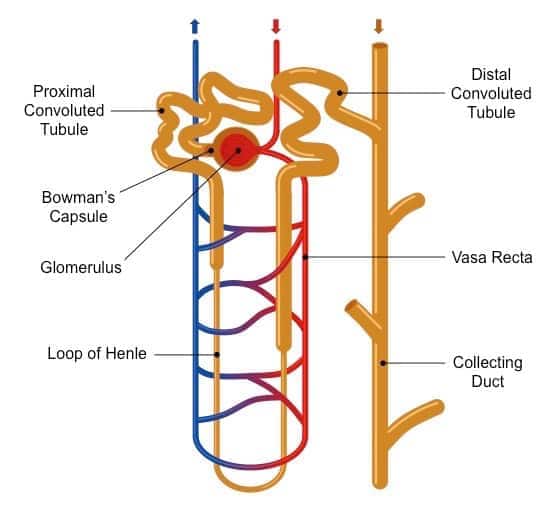
The nephrons are the basic filtering unit of our excretion system.
Each nephron has a Bowman's capsule, which is a cup-shaped bag having a bundle of vessels called the glomerulus. Impure blood from all parts of our body enters the glomerulus through the renal artery, and the impurities are filtered. The rest of the nephron is coiled. And their sugars, amino acids, excess water, etc., which are important for the body, are reabsorbed. The filtrate left is urine containing all the waste generated in the body, e.g, urea. This urine is excreted through the urethra.
Q.2. What are the methods used by plants to get rid of excretory products?
Answer:
The following methods are used by plants to get rid of excretory products.
(i) Gaseous wastes are released in the atmosphere through the stomata in leaves and lenticels in stems.
(ii) Solid and liquid wastes are excreted by leaves shedding, bark peeling off, and through fruits.
(iii) Waste products are excreted by releasing them through gums and resins.
(iv) Some waste products are directly released into the soil by the roots
Q.3. How is the amount of urine produced regulated?
Answer:
The amount of urine produced depends on the following:
(i) Amount of water ingested. If a large amount of water is ingested regularly, large amounts of dilute urine will be produced. In case sufficient water is not ingested, the urine produced will be less, but it will have a high concentration of nitrogenous wastes, and this is harmful to the excretory system and the body.
(ii) The amount of waste produced in the body decides how much urine is to be excreted.
(iii) The release of some hormones also regulates the amount of urine produced.
Confused between CGPA and Percentage?
Get your results instantly with our calculator!
💡 Conversion Formula used is: CGPA = Percentage / 9.5
NCERT Chapter-end Exercise Class 10 Science Life Processes Question Answer
Solving the exercise is a good habit, as it makes you more confident and also decreases stress. So, here we will cover all questions with their proper solution.
Q.1. The kidneys in human beings are a part of the system for
(a) nutrition. (c) excretion.
(b) respiration. (d) transportation.
Answer: (c) excretion
Explanation: Kidneys help in removing waste from the body. They clean the blood and make urine, which throws out extra water and harmful substances. This whole process is called excretion. So kidneys are not linked with food, breathing, or transport. Their job is to throw out waste, which is why they come under the excretion system.
Hence, the correct answer is Option (c) excretion.
Q.2 The xylem in plants is responsible for
(a) the transport of water. (c) transport of amino acids.
(b) transport of food. (d) transport of oxygen.
Answer: (a) the transport of water
Explanation: Xylem is the part of plants that takes water from the roots and sends it to other parts, like the stem and leaves. It doesn’t carry food or anything else, only water and minerals. That’s the main work of xylem. Other things, like food, are carried by phloem.
Hence, the correct answer is Option (a) the transport of water.
Q.3. The autotrophic mode of nutrition requires
(a) carbon dioxide and water. (c) sunlight.
(b) chlorophyll. (d) all of the above.
Answer: (d) all of the above
Explanation: In autotrophic nutrition, the plant makes its food on its own. It needs carbon dioxide, water, sunlight, and also chlorophyll to do that. Chlorophyll helps to catch sunlight. This whole process is called photosynthesis. If any one of these is missing, the plant can’t make food. So it needs all of them together.
Hence, the correct answer is Option (d) all of the above.
Q.4. The breakdown of pyruvate to give carbon dioxide, water, and energy takes place in
(a) cytoplasm. (c) chloroplast.
(b) mitochondria. (d) nucleus.
Answer: (b) mitochondria
Explanation: Pyruvate is a product that comes after food is broken down in cells. This pyruvate goes to mitochondria, where it is broken down into carbon dioxide and water, and gives energy. Mitochondria are also called the powerhouse of the cell because they give energy. This doesn’t happen in the nucleus or cytoplasm.
Hence, the correct answer is Option (b) mitochondria.
Q.5. How are fats digested in our bodies? Where does this process take place?
Answer:
Digestion of fat takes place in the small intestine. Fat reaches the small intestine in the form of large globules.
The liver releases bile juice, which emulsifies the fat, i.e., it breaks down the large globules into smaller globules, thus increasing the area on which pancreatic juice, called lipase, acts and breaks down the globules into molecules. Pancreatic lipase and intestinal enzymes convert these fat molecules into fatty acids and glycerol, which can be used by the body.
Q.6. What is the role of saliva in the digestion of food?
Answer:
Saliva contains an enzyme called salivary amylase that starts the process of digestion in the mouth itself by breaking down starch into sugar molecules like maltose.
Saliva helps in keeping the mouth clean, moistened, and lubricated, thus aiding in chewing food so that large pieces are broken down into small bits.
Q.7. What are the necessary conditions for autotrophic nutrition, and what are its byproducts?
Answer:
The necessary conditions for autotrophic nutrition are the following:
(i) Supply of carbon dioxide, which is the raw material for this mode of nutrition.
(ii) Presence of sunlight, which is the source of energy.
(iii) Presence of chlorophyll in the leaves, which entraps the energy from sunlight.
(iv) Supply of water.
The byproduct of autotrophic nutrition is Oxygen.
Q.8. What are the differences between aerobic and anaerobic respiration? Name some organisms that use the anaerobic mode of respiration.
Answer:
Differences between aerobic and anaerobic respiration are mentioned below:
Aerobic Respiration | Anaerobic Respiration |
(i) It takes place in the presence of Oxygen. | (i) It takes place in the absence of Oxygen. |
(ii) It involves the exchange of gases between organisms and their surroundings. | (ii) It does not involve the exchange of gases between organisms and their surroundings |
(iii) The end products are always Carbon dioxide and water. | (iii) The end products vary. |
(iv) Complete breakdown of glucose molecules takes place. | (iv) Partial breakdown of glucose molecules takes place. |
(v) More energy is produced per molecule of glucose broken down. | (v) Less energy is produced per molecule of glucose broken down. |
(vi) Takes place in the cytoplasm and mitochondria. | (vi) Takes place only in the cytoplasm. |
Anaerobic respiration takes place in some muscle cells during oxygen shortage, in water-logged plants, in yeast, and in some bacteria like Clostridium.
Q.9. How are the alveoli designed to maximise the exchange of gases?
Answer: Alveoli are thin-walled and are richly supplied with blood vessels to maximise the exchange of gases.
The alveoli have a balloon-like structure, thus providing a large surface area available for the exchange of gases.
Q.10. What would be the consequences of a deficiency of haemoglobin in our bodies?
Answer:
The job of haemoglobin is to carry oxygen from the lungs to the body tissues. So if there’s a lack of haemoglobin, the oxygen level in the body goes down. This means the body can’t make enough energy, and the person feels tired most of the time. It also affects immunity, so the person can easily get sick.
Q.11. Describe the double circulation of blood in human beings. Why is it necessary?
Answer:
Deoxygenated blood rich in carbon dioxide and deficient in oxygen reaches the heart through a network of veins, enters the network through the vena cava, and is brought into the right atrium. From the right atrium, the deoxygenated blood goes to the right ventricle, from where it is pumped to the lungs through the pulmonary artery, where carbon dioxide is released into the environment and oxygen is absorbed in the blood. From the lungs, the oxygenated blood enters the left atrium through the pulmonary vein. From the left atrium, the blood enters the left ventricle, from where it is pumped to all parts of the body to facilitate the supply of oxygen.
This double circulation in human beings helps maintain high oxygen levels in the blood, which facilitates sufficient aerobic respiration for the generation of sufficient heat to maintain body temperature.
Q.12. What are the differences between the transport of materials in the xylem and phloem?
Xylem | Phloem |
(i) In Xylem, water and minerals absorbed from the soil by the roots are transported to other parts of the plant. | (i) In Phloem, food synthesized through photosynthesis is transported from the leaves to other parts of the plant. |
(ii) In Xylem, transport of material takes place through vessels and tracheids, which are dead tissue. | (ii) In Phloem transport of material takes place through sieve tubes and companion cells, which are living cells. |
(iii) In the xylem, upward movement of water is produced by transpirational pull occurring due to the evaporation of water from the leaves | (iii) In Phloem, material is transported by translocation, which requires energy from ATP. |
Q.13 Compare the functioning of alveoli in the lungs and nephrons in the kidneys concerning their structure and functioning
Answer:
Alveoli | Nephron |
(i) The alveoli are the functional unit of the lungs. | (i) Nephron is the functional unit of the Kidneys. |
(ii) A lung has about 300 million alveoli. | (ii) A kidney has about a million nephrons. |
(iii) Alveoli provide a very large surface for the efficient diffusion of gases. | (iii) The surface area of nephrons is large enough to allow effective filtration and reabsorption, though not as large as alveoli.” |
(iv) The exchange of carbon dioxide and oxygen takes place through alveoli. | (iv) The absorption of water, amino acids, sugar molecules, etc., takes place in the Nephron. |
How to Solve Life Processes Class 10 Question Answer?
The student should start by understanding the concepts of nutrition, transportation, and excretion in living organisms.
Students can break down each process into stages or steps. Each process, like nutrition and excretion, is well-explained in the Class 10 Science Chapter 5 Life Processes question answer.
They have to practice labelled diagrams and flow charts, which help in revising.
Prepare short notes or some flash cards for quick recall of the process during the exam.
They can also revise exemplar questions, as they give an advanced approach to the chapter.
Try solving previous years' questions and NCERT Solutions for Class 10 to know how questions are asked in exams.
Important Topics of NCERT Science Chapter 5 Life Processes Class 10
Life Processes teaches about the various life processes that occur in animals and plants. Given below are the important topics from this chapter. Students understand these topics by using the NCERT Solutions for Class 10 Science Chapter 5 Life Processes.
What are Life Processes?
The topic focuses on important concepts such as nutrition, respiration, transportation, and excretion.
Understanding these processes helps in explaining how organisms grow and maintain homeostasis.
Nutrition
Nutrition is divided into autotrophic nutrition (organisms that make their food) and heterotrophic nutrition (organisms that obtain their food from the environment).
Maintaining proper nutrition is important for health and survival.
Respiration
Respiration is divided into aerobic (using oxygen) and anaerobic (without using oxygen) respiration.
The process helps in producing ATP, which helps to power various life activities in the organism.
Transportation
Transportation in plants occurs through xylem (for water) and phloem (for food).
Animals, on the other hand, have a circulatory system that helps to transport water, food, and other things throughout the body.
Excretion
Waste materials in plants are removed by stomata, lenticels, and through leaf shedding.
Waste elimination in animals is done by the kidneys, lungs, and skin.
The process helps prevent toxicity and maintains homeostasis.
Also, check NCERT Books and NCERT Syllabus here:
Important Questions from NCERT Chapter 5 Life Processes Class 10
Below is a solved practice question, along with the detailed answer for the Life Processes chapter. Solving questions given in the NCERT Solutions for Class 10 Science Chapter 5 Life Processes increases confidence during exams.
Question 1. What is the difference between autotrophic and heterotrophic nutrition?
A. Autotrophic organisms depend on others for food, while heterotrophic organisms make their own food through photosynthesis.
B. Autotrophic organisms make their own food, for example, plants through photosynthesis, while heterotrophic organisms depend on others for food, for example, animals.
C. Both autotrophic and heterotrophic organisms make their own food.
D. Heterotrophic organisms make their own food, while autotrophic organisms depend on others for food.
Correct Answer: B
Explanation:
An autotrophic organism makes its own food. It uses simple things like carbon dioxide, water, and sunlight. This process is called photosynthesis. Heterotrophic nutrition is the opposite. The organism can’t make its own food, so it depends on others. They eat plants or animals to get energy.
So the main difference is that autotrophs make their food by themselves and heterotrophs take food from others.
Hence, the correct answer is Option B.
Question 2: Unicellular organisms like Amoeba and Paramecium show
A. autotrophic mode of nutrition
B. Holozoic mode of nutrition
C. chemoautotrophic mode of nutrition
D. heteroautotrophic mode of nutrition
Correct Answer: B
Explanation:
Unicellular organisms like Amoeba and Paramecium, and Multicellular organisms like humans, show a Holozoic mode of nutrition.
Hence, the correct answer is Option B.
Question 3: The classic feature of chlorophyll is the presence of
A. plastids
B. vacuole
C. mitochondria
D. lysosomes
Correct Answer: A
Explanation:
Chloroplasts are green plastids present in green parts of plants like leaves, stems, etc. They are responsible for photosynthesis, the process by which plants make their own food using sunlight.
Hence, the correct answer is Option A.
Question 4: Chemotrophic organisms are those
A. can prepare their own food via photosynthesis
B. cannot prepare their own food via photosynthesis
C. can prepare their own food using chemical components
D. cannot prepare their own food using chemical components.
Correct Answer: C
Explanation:
Hence, the correct answer is Option C.
Question 5: Stomata are present on the ___ surface of broad leaves and on __ the surfaces of narrow leaves
A. lower, both
B. upper, both
C. lower, lower
D. upper, lower
Correct Answer: B
Explanation:
Stomata are tiny openings on the leaf surface that help in the exchange of gases like oxygen, carbon dioxide, and water vapor. In broad leaves, they are mostly on the upper surface to maximise photosynthesis, while in narrow leaves, they are present on both surfaces to efficiently regulate gas exchange and transpiration.
Hence, the correct answer is Option B.
Question 6: An instrument used to measure blood pressure is
A. Stethoscope
B. Sphygmomanometer
C. ECG
D. Stemoscope
Correct Answer: B
Explanation: Doctors measure blood pressure with an instrument called a sphygmomanometer. Hence, the correct option is (b).
Hence, the correct answer is Option B.
Question 7: Bleeding can be stopped with the help of
A. Plugging the leaks
B. Plugging the arteries
C. Plugging the veins
D. Plugging the Lymph
Correct Answer: A
Explanation: Platelets can act by clotting the blood at the points of injury by plugging the leaks and thus, stop bleeding. Hence, the correct option is (a).
Hence, the correct answer is Option A.
Question 8: ___ helps to prevent the clotting of blood.
A. WBCs
B. RBCs
C. Platelets
D. Lymph
Correct Answer: C
Explanation:
Platelets are the tiny blood cells that are present in the blood. During an injury, they act to minimize the bleeding naturally. Hence, the correct option is (c).
Hence, the correct answer is Option C.
Question 9: The oxygenated blood is carried to _________ from the right side of the heart through ________.
A. Lungs, pulmonary artery
B. Heart, pulmonary artery
C. Lungs, pulmonary vein
D. Heart, pulmonary vein
Correct Answer: A
Explanation:
The pulmonary artery collects the blood from the right ventricle and carries it to the lungs for oxygenation. Hence, the correct option is (a).
Hence, the correct answer is Option A.
Chapter 5 Life Processes Class 10 Science CBSE PYQs
These Life Processes Class 10 CBSE Board PYQs focus on double circulation, kidney filtration, nitrogenous waste removal, and arterial functions. They strengthen concepts from the NCERT Solutions Class 10 Science Chapter 5 Life Processes and are frequently asked in board exams.
Question: Why is blood circulation in vertebrates known as "double circulation"? Trace its path in the form of a flow chart.
Answer: In vertebrates, blood flows through the heart twice in one full cycle. The first time is for oxygenation (pulmonary circulation), and the second time is to feed the body (systemic circulation). This keeps oxygen-rich and oxygen-poor blood separate so that they can be moved more efficiently.
A flow chart of double circulation:
1. Deoxygenated Blood Flow:
Body → Right Atrium → Right Ventricle → Pulmonary Artery → Lungs
2. Oxygenated Blood Flow:
Lungs → Pulmonary Vein → Left Atrium → Left Ventricle → Aorta →→ Body
Question: Name the capillary cluster formed by the branch of the renal artery in the Bowman's capsule.
Answer: The glomerulus is a capillary network within the Bowman's capsule that is supplied with blood from the renal artery. It is the primary filtration unit of the kidney. Because of the high pressure within these capillaries, water, glucose, salts, and nitrogenous wastes such as urea filter through the thin walls of the glomerulus into the Bowman's capsule. Still bigger molecules, like proteins and blood cells, are not able to pass through and remain in the bloodstream. It is known as ultrafiltration and is the first step towards urine formation. It helps the body eliminate dangerous substances while keeping useful ones.
Question: Enlist any two nitrogenous waste products removed from the blood of the human kidney.
Answer: Two nitrogenous waste products removed from the blood by the human kidney are:
Urea
Uric acid
These wastes are produced when the body breaks down proteins (which form urea) and nucleic acids (which form uric acid). The kidneys filter these harmful substances from the blood and excrete them out of the body through urine, helping to keep the body clean and healthy.
Question: State the main function of arteries. Why do they have thick and elastic walls?
Answer: The main function of arteries is to take oxygenated blood from the heart to different parts of the body. The pulmonary artery, on the other hand, carries blood that is low in oxygen. The walls of arteries need to be thick and stretchy because they have to keep up with the high pressure of the blood that the heart pumps. They can handle this pressure because their walls are thick and stretchy, which lets them grow and shrink as blood moves through them.
Why are Class 10 Science Chapter 5 Life Processes NCERT Solutions Important?
The Life Processes chapter explains how living organisms carry out important functions to stay alive. Different processes like nutrition, respiration, transportation, and excretion are included.
Class 10 Science Chapter 5 Life Processes NCERT Solutions are important as they allow students to learn about different modes of nutrition in plants and animals.
The solutions also explain the process of respiration and how energy is released from food in living organisms.
Topics of the life processes chapter are important for Class 11 and 12 topics in Human Physiology, Biotechnology, and Plant Biology.
Transportation of materials in plants and animals, helping understand the circulatory and vascular systems, is also covered in the solutions.
Questions related to these processes are frequently asked in the NEET and other competitive exams.
Chapter Summary
The Life Process chapter explains the basic functions carried out by living organisms to maintain life. By going through these solutions, students will learn many interesting facts, which are given below:
Class 10 Science Life Processes question answer, explain the concepts of nutrition, respiration, transportation, and excretion in a systematic way.
Students will learn the different types of respiration and how energy is released in cells.
The transportation of food, water, and oxygen in plants and animals is also included.
Students will also understand how all these life processes work together to keep an organism alive.
They will explore the process of excretion and removal of wastes in humans and plants through the Life Processes Class 10 question answer.
Expert Review
Below are expert understandings of the NCERT Solutions for Class 10 Science Chapter 5 Life Processes:
- These NCERT Solutions curated by Carrers 360 experts as per the latest CBSE 2026-27 syllabus.
- Each solution is written in step-by-step exam-ready points, easily explaining complex topics such as double circulation, glomerulus functions, etc.
- Topics like respiratory pathways, nephron structure, build strong fundamentals for competitive entrance exams like NEET.
- The NCERT Chapter 5 question answers PDF given is important for board exam preparation, quick revision and exam readiness.
NCERT Solutions for Class 10 Science Chapter-wise
Given below are the links to chapter-wise solutions included in the class 10 science, which improve performance in exams.
Frequently Asked Questions (FAQs)
Q: What is the role of glomerulus in urine formation Class 10 NCERT?
A:
The glomerulus is a capillary cluster inside Bowman’s capsule. It filters water, salts, glucose, and urea from blood under high pressure. This process, called ultrafiltration, is the first step in urine formation.
Q: What is difference between arteries and veins Class 10 Science?
A:
Arteries carry blood away from the heart under high pressure with thick, elastic walls. Veins carry blood towards the heart under low pressure with thin walls and valves to prevent backflow.
Q: What is the difference between autotrophic and heterotrophic nutrition?
A:
Autotrophic nutrition is where organisms make their own food from simple substances like sunlight (photosynthesis), while heterotrophic nutrition involves organisms obtaining food by consuming other organisms or organic matter.
Q: What are the four life processes in Class 10 Science Chapter 5?
A:
The four life processes covered in the NCERT Solutions for Class 10 Science Chapter 5 Life Processes are:
- Nutrition – The process of obtaining and utilising food for energy and growth (autotrophic in plants and heterotrophic in animals).
- Respiration – The breakdown of glucose to release energy, either aerobically (with oxygen) or anaerobically (without oxygen).
- Transportation – The movement of nutrients, gases, and waste products within the body (circulatory system in animals, xylem and phloem in plants).
- Excretion – The removal of metabolic waste products (e.g., kidneys in humans remove urea, while plants excrete through stomata and resins).
Q: What is the process of nutrition in plants and animals?
A:
Nutrition in Plants: Plants exhibit autotrophic nutrition, wherein they synthesize their own food by the process of photosynthesis using sunlight, carbon dioxide, and water. It takes place in chloroplasts and yields glucose and oxygen.
Nutrition in Animals: Animals exhibit heterotrophic nutrition, wherein they take in other organisms as food. The process involves ingestion, digestion, absorption, assimilation, and egestion to acquire and utilize the nutrients.
Articles
Related Stories
|
Upcoming School Exams

Certifications By Top Providers
Explore Top Universities Across Globe
Questions related to CBSE Class 10th
On Question asked by student community
Have a question related to CBSE Class 10th ?
Hello student!
You can refer to the CBSE Class 10 Mathematics Question Paper 2026 to practise questions and prepare for the Mathematics examination.
https://school.careers360.com/boards/cbse/cbse-class-10-maths-question-paper-2026
Hope it helps!
Hi Smriti Lama
The CBSE Class 10 Board Exam 2026-27 question paper pattern includes the latest exam structure, subject-wise marking scheme and question types. You can check the detailed pattern on Careers360:
Hi Somshiv Rath
If you mean a CBSE Class 8 Science question paper, Careers360 has a sample paper section where you can check the available Class 8 papers.
https://learn.careers360.com/school/cbse-8-class-preparation-material/
Hey there,
If you mean CBSE Class 10 rechecking/re-evaluation results 2026, CBSE has already completed the main post-result process for 2026. The Class X second-board results were declared on 18 July 2026, and CBSE has also issued the post-result facilities notice.
For verification/re-evaluation, CBSE says the result/status is uploaded online
Please mention important details like your school board, exam, and class to get the exact papers.
You can explore the useful resources here:
Popular CBSE Class 10th Questions
A block of mass 0.50 kg is moving with a speed of 2.00 ms-1 on a smooth surface. It strikes another mass of 1.00 kg and then they move together as a single body. The energy loss during the collision is
| Option 1)
|
Option 2)
|
| Option 3)
|
Option 4)
|
An athlete in the olympic games covers a distance of 100 m in 10 s. His kinetic energy can be estimated to be in the range
| Option 1)
|
Option 2)
|
| Option 3)
|
Option 4)
|
A particle is projected at 600 to the horizontal with a kinetic energy . The kinetic energy at the highest point
| Option 1)
|
Option 2)
|
| Option 3)
|
Option 4)
|
In the reaction,
| Option 1)
|
Option 2)
|
| Option 3)
|
Option 4)
|
How many moles of magnesium phosphate, will contain 0.25 mole of oxygen atoms?
| Option 1)
0.02 |
Option 2)
3.125 × 10⁻² |
| Option 3)
1.25 × 10⁻² |
Option 4)
2.5 × 10⁻² |
Colleges After 12th

Applications for Admissions are open.
Get Job Ready in Healthcare | Employability-Focused Programs
CBSE Class 10th Notifications
Never miss CBSE Class 10th update
Get timely CBSE Class 10th updates directly to your inbox. Stay informed!