


CBSE Class 10 Sanskrit Question Paper 2026 PDF Download (Feb 28)
The 2026 CBSE Class 10 Sanskrit Exam was conducted on February 28, 2026, from 10:30 AM to 1:30 PM. Students can download all editions of the CBSE 10th Sanskrit Question Paper 2026 PDF from this page, as the examination is now finished. The question paper followed the latest CBSE exam pattern and included questions from the prescribed NCERT syllabus. Students can use the question paper to review the types of questions asked in the exam and analyse the overall difficulty level.
This Story also Contains
- CBSE Class 10 Sanskrit Exam Overview 2026
- CBSE Class 10 Sanskrit Question Paper 2026 PDF
- CBSE Class 10 Sanskrit Answer Key 2026 PDF
- CBSE Class 10 Sanskrit Exam Analysis 2026: Difficulty Level, Question Paper Review
- CBSE Class 10 Sanskrit Exam Tips
.jpg)
Sanskrit holds equal importance to Mathematics and Science in the CBSE Class 10 because it serves as one of the essential language subjects. Students who plan to take the exam next year must study this question paper because it shows them the examination structure, question types and their corresponding difficulty levels and marking scheme.
CBSE Class 10 Sanskrit Exam Overview 2026
Check the important details of the CBSE 10th Sanskrit exam 2026.
|
Particulars |
Details |
|
Conducting Board |
Central Board of Secondary Education |
|
Exam Name |
CBSE Class 10 Sanskrit Board Exam 2026 |
|
Exam Date |
February 28, 2026 |
|
Exam Time |
10:30 AM - 1:30 PM |
|
Duration |
3 Hours |
|
Subject Name |
Sanskrit |
|
Subject Code |
122 / 322 |
|
Theory Marks |
80 Marks |
|
Internal Assessment |
20 Marks |
|
Total Marks |
100 Marks |
|
Exam Mode |
Offline (Pen & Paper) |
|
Question Paper Availability |
PDF available after exam conclusion |
CBSE Class 10 Sanskrit Question Paper 2026 PDF
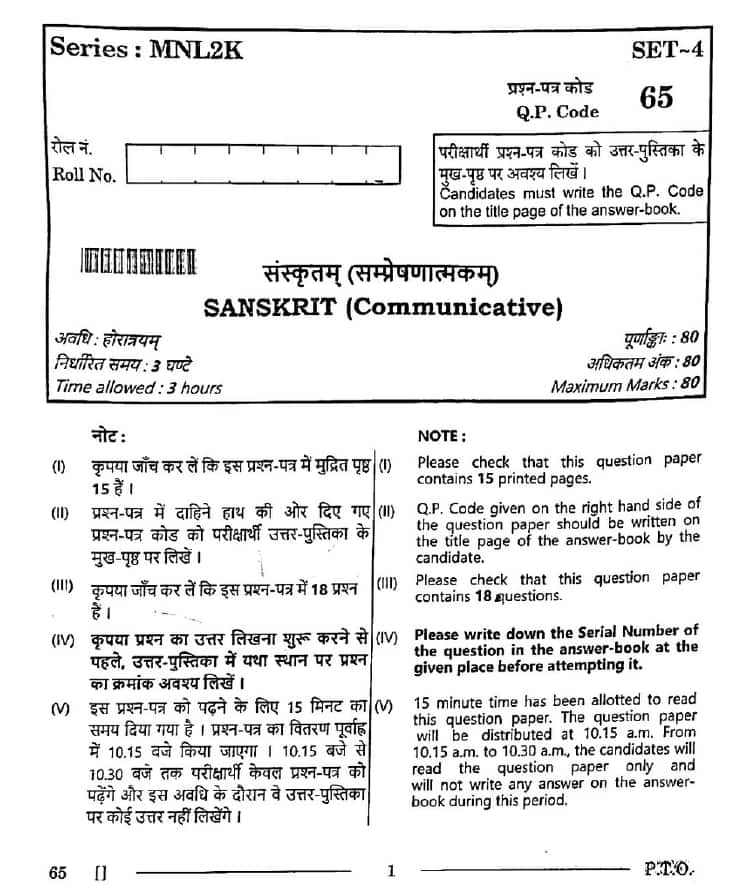
Students can now download the CBSE Class 10 Sanskrit Question Paper 2026 PDF, as the examination conducted by the Central Board of Secondary Education has now concluded. The question paper helps students understand the exam pattern, question types, and difficulty level for better preparation
|
CBSE Class 10 Sanskrit Question Paper 2026 |
Confused between CGPA and Percentage?
Get your results instantly with our calculator!
CBSE Class 10 Sanskrit Answer Key 2026 PDF
The CBSE Class 10 Sanskrit Answer Key 2026 PDF will be available shortly, as the exam has ended, and experts at Careers360 are currently working on it. Students can use the answer key to check their responses, calculate expected scores, and analyse their performance.
|
CBSE Class 10 Sanskrit Answer Key 2026 |
Coming Soon |
(अ) एकपदेन उत्तरत :
(i) भारतदेश: कृषिप्रधान:।
(ii) अन्नदाता।
(iii) मेघानाम्।
(आ) पूर्णवाक्येन उत्तरत :
(i) अतिवृष्ट्या, अनावृष्ट्या, न्यूनमूल्यलाभेन ऋणभार: च कृषकान् दु:खेन पीडयति।
(ii) बीजानि आरोप्य भूमे: सम्यक् कर्षणं कृत्वा कृषका: सिञ्चनकार्ये संलग्ना: भवन्ति।
(iii) वयं कृषकाणां श्रमस्य, त्यागभावनाया: धैर्यस्य च सम्मानं कुर्याम।
(इ) उपयुक्तं शीर्षकम् :
कृषकस्य महत्त्वम्
(ई) यथानिर्देशम् उत्तरत :
(i) (C) यापयति
(ii) (B) परिश्रमं
(iii) (A) वृष्टि:
(iv) (B) ते
Find the rest of the answers in the above PDF.
CBSE Class 10 Sanskrit Exam Analysis 2026: Difficulty Level, Question Paper Review
The CBSE Class 10 Sanskrit Exam 2026 was balanced and strictly based on the NCERT syllabus. The paper featured a mix of grammar, literature, and writing questions, with an overall easy-to-moderate difficulty level. Experts considered it a student-friendly and scoring examination.
-
Equal weightage was given to the Applied Grammar and Literature sections.
-
Students with strong concepts in Sandhi and Samasa found the paper easier.
-
Reading comprehension and translation questions were straightforward but required grammatical accuracy.
-
The writing section demanded proper application of grammar, not rote learning.
-
The letter-writing question was slightly new, as students had to write independently instead of filling in blanks.
-
Literature questions were predictable and textbook-oriented, benefiting well-prepared students
CBSE Class 10 Sanskrit Exam Tips
1. Understand the Syllabus
The complete syllabus needs to be studied, while grammar (Vyakaran) and translation activities and literature chapters require special attention.
2. Practice Grammar Daily
The student needs to practice Sandhi and Samas and Karak and Shabd Roop and Dhatu Roop daily to maintain their correct understanding of the concepts.
3. Prepare the NCERT Textbook Thoroughly
The NCERT textbook serves as the basis for most examination questions. The student needs to study all prose and poetry chapters in detail.
4. Solve Previous Year Papers
The student needs to practice with previous year question papers to learn about the exam structure while developing their skill to manage time effectively.
5. Write Neatly & Manage Time
The student needs to attempt all exam questions while providing clear answers that follow correct Sanskrit writing standards, leaving 10 to 15 minutes for final review.
6. Focus on Scoring Sections
Students should study grammar and unseen passages because they will achieve good scores if they dedicate enough study time to both areas.
Regular practice combined with consistent revision will enable you to achieve high marks in Sanskrit.
Also read,
