
Search Colleges, Exams, Schools & more


Login
NCERT Solutions For Class 10 Science Chapter 11 Electricity
Electricity is one of the most interesting chapters in class 10 science. This chapter describes how electric current flows in a circuit and the different electrical devices. It also has some important formulas and numerical problems that are asked frequently in board exams. So students need to focus more on understanding concepts, rather than simply memorising formulas. As per the new CBSE syllabus, Chapter 11 – Electricity includes electric current, electric potential, potential difference, resistance, Ohm’s law, combination of resistors in series and parallel, electrical power, and the heating effect of electric current. Students can use the NCERT Solution for Class 10 th as well, for making concepts easy. With the help of NCERT Solutions, they will get step-wise solutions to all questions simply given in the CBSE books. It is also provided with a downloadable PDF format, important formulas, extra HOTS (Higher Order Thinking Skills) questions, and real-life uses of electricity, making it fully prepared
This Story also Contains
- Electricity NCERT Solutions: Download Solution PDF and Important Formulas
- Class 10 Science Chapter 11 - Electricity: Intext Questions Solution
- Class 10 Science Chapter 11 - Electricity Solutions: Exercise Questions
- Class 10 Physics NCERT Chapter 11: Higher Order Thinking Skills (HOTS) Questions
- NCERT Solutions for Class 10 Science Chapter 11: Important Topics
- NCERT Solutions for Class 10 Science Chapter 11: Important Formulae
- Approach to Solve Questions of Class 10 Science Chapter 11 - Electricity
- Benefits of NCERT Solutions Class 10 Chapter 11: Electricity
- What You Will Learn from NCERT Solutions for Class 10 Science Chapter 11: Electricity?
- Chapter Summary of NCERT Solutions for Class 10 Science Chapter 11– Electricity
- Expert Review of NCERT Solutions for Class 10 Science Chapter 11 – Electricity
- NCERT Solutions for Class 10 Science: Chapter Wise
- NCERT Solutions for Class 10: Subject Wise
- NCERT Notes for Class 10: Subject Wise
- NCERT Books and Syllabus

Practice of NCERT Science Solutions for Class 10 Science gives clarity to concepts, helps in revision of formulas, and practice numerical for the exam point of view. Regular practice will boost confidence and improve performance. It will also help in building concepts for higher classes.
Electricity NCERT Solutions: Download Solution PDF and Important Formulas
The Class 10 Science Chapter 11 - Electricity question answers provide step-wise as well as clear explanations to all the textbook questions, and thus make the concepts of electricity fundamental to the students easy to grasp. All these class 10 science chapter 11 Electricity question answers are provided in PDF format so that one can download all solutions and read them conveniently offline.Download Solution PDF
Download the chapter-wise formula of NCERT class 10 science by clicking on the link given in the box.
Class 10 Science Chapter 11 - Electricity: Intext Questions Solution
Electricity Class 10 question answers give a clear and detailed explanation of the answers to all in-text questions present in the NCERT textbook. Through these class 10 science chapter 11 Electricity question answers, the students will be able to grasp some important concepts without prior knowledge of electric currents, potential differences, resistance, and Ohm’s law in a sequential manner, guaranteeing efficient board preparation.
Class 10 Science Chapter 11 ncert Solutions - Topic:11.1
Q.1 What does an electric circuit mean?
Answer:
A closed and continuous path of electric current is known as an electric circuit. It consists of electric circuit elements like batteries, resistors, etc, and electric devices like a switch and measuring devices like ammeters, etc.
Q.2 Define the unit of current.
Answer: Ampere(A)
Explanation:
Ampere(A) is a unit of current. 1A is the flow of 1C of charge through a wire in 1s of time.
current $I=\frac{q}{t}$
$
1 A=\frac{1 C}{1 \sec }
$
Q.3 Calculate the number of electrons constituting one coulomb of charge.
Answer: $6 \times 10^{18}$ electrons.
Explanation:
Given: Q=1C
We know that the charge of an electron $e=1.6 \times 10^{-19} \mathrm{C}$
$
\begin{aligned}
& Q=n e \\
& \Rightarrow n=\frac{Q}{e} \\
& \Rightarrow n=\frac{1}{1.6 \times 10^{-19}}=6.25 \times 10^{18}
\end{aligned}
$
Thus, the number of electrons constituting one coulomb of charge is $6 \times 10^{18}$ electrons.
Class 10 Science Chapter 11 ncert Solutions - Topic 11.2
Q.1 Name a device that helps to maintain a potential difference across a conductor.
Answer:
A battery, cell or power supply source helps to maintain a potential difference across a conductor.
Q.2 What is meant by saying that the potential difference between two points is 1 V?
Answer:
The potential difference between two points is 1 V means 1 J of work is required to move a charge of 1C from one point to another.
Q.3 How much energy is given to each coulomb of charge passing through a 6 V battery?
Answer: 6J energy
Explanation:
Given: potential difference = 6V and charge =1C.
$
\begin{aligned}
& \text { Potential difference }=\frac{\text { work done }}{\text { charge }} \\
& \Rightarrow 6=\frac{\text { work done }}{1} \\
& \Rightarrow \text { work done }=6 \times 1=6 \mathrm{~J}
\end{aligned}
$
Thus, 6J energy is given to each coulomb of charge passing through a 6V battery.
NCERT solutions for class 10 science chapter 11 Electricity: Topic 11.5
Q.1 On what factors does the resistance of a conductor depend?
Answer:
The resistance of a conductor depends on :
1. Cross-sectional area of the conductor.
2. Length of conductor
3. The temperature of the conductor.
4. Nature of the material of the conductor.
Q.2 Will current flow more easily through a thick wire or a thin wire of the same material when connected to the same source? Why?
Answer:
We know that resistance is given as
$
R=\frac{\rho l}{A}
$remain
$\mathrm{R}=$ resistance
$\rho=$ resistivity
$l$=length of wire
$A=$ area of cross-section
Resistance is inversely proportional to the area of the cross-section.
The thicker the wire, the more cross-sectional area, resulting in less resistance, resulting in more current flow.
Q.3 Let the resistance of an electrical component remain constant while the potential difference across the two ends of the component decreases to half of its former value. What change will occur in the current through it?
Answer:
By Ohm's law,
$
\begin{aligned}
& \mathrm{V}=\mathrm{IR} \\
& I=\frac{V}{R}
\end{aligned}
$
$\mathrm{V}=$ potential difference
I =current
$\mathrm{R}=$ resistance
Now, the potential difference is reduced to half, i.e.
$
V^{\prime}=\frac{V}{2}
$
$\mathrm{R}^{\prime}=\mathrm{R}=$ resistance
I' =current
$
I^{\prime}=\frac{\frac{V}{2}}{R}=\frac{V}{2 R}=\frac{I}{2}
$
Q.4 Why are coils of electric toasters and electric irons made of an alloy rather than a pure metal?
Answer:
The resistivity of an alloy is higher than that of pure metal, so the alloy does not melt at high temperatures. Thus, coils of electric toasters and electric irons are made of an alloy rather than a pure metal.
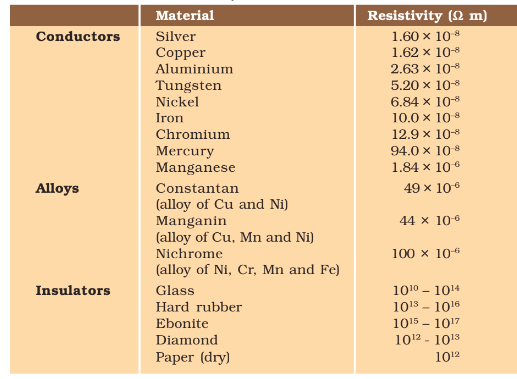
Q.5 Use the data in the Table to answer the following –
(a) Which among iron and mercury is a better conductor?
(b) Which material is the best conductor?
Answer:
The lower the value of resistivity, the lower the resistance for a material of given area and length. If resistance is low, current flow will be high when a potential difference is applied across the conductor.
(a) resistivity of iron $=10.0 \times 10^{-8} \Omega \mathrm{~m}$
the resistivity of mercury $=94 \times 10^{-8} \Omega \mathrm{~m}$
The resistivity of mercury is more than that of iron, so iron is a better conductor than mercury.
(b) From the table, we can observe that silver has the lowest resistivity, so it is the best conductor.
NCERT solutions for class 10 science chapter 11 Electricity: Topic 11.6
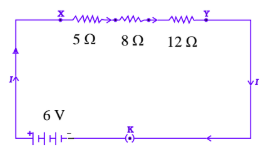
Q.1 Draw a schematic diagram of a circuit consisting of a battery of three cells of 2 V each, a $5 \Omega$ resistor, an $8 \Omega$ resistor, a $12 \Omega$ resistor, and a plug key, all connected in series.
Answer:
The schematic diagram of a circuit consisting of a battery of three cells of 2 V each, a $5 \Omega$ resistor, an $8 \Omega$ resistor, and a $12 \Omega$ resistor, and a plug key, all connected in series, is shown below :
Q.2 Redraw the circuit of Question 1, putting in an ammeter to measure the current through the resistors and a voltmeter to measure the potential difference across the $12 \Omega$ resistor. What would be the readings in the ammeter and the voltmeter?
Answer:
The diagram is as shown :
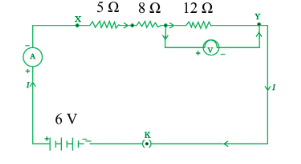
Resistance of circuit, R=5+8+12=25
Potential = 6V
$
\begin{aligned}
& V=I R \\
& \Rightarrow I=\frac{V}{R}=\frac{6}{25}=0.24 \mathrm{~A}
\end{aligned}
$
Now, for a 12 ohm resistor, current $=0.24 \mathrm{~A}$.
By Ohm's law,
$
V=I R=0.24 \times 12=2.88 \mathrm{~V}
$
The reading of the ammeter is 0.24 A, and the voltmeter is 2.88 V.
NCERT solutions for class 10 science chapter 11 Electricity Topic 11.6
Q.1 Judge the equivalent resistance when the following are connected in parallel (a) $1 \Omega$ and $10^6 \Omega$, (b) $1 \Omega$ and $10^3 \Omega$, and $10^6 \Omega$
Answer:
(a) $1 \Omega$ and $10^6 \Omega$
$R=$ Equivalent resistance
$
\begin{aligned}
& \frac{1}{R}=\frac{1}{R_1}+\frac{1}{R_2} \\
& \Rightarrow \frac{1}{R}=\frac{1}{1}+\frac{1}{10^6} \\
& \Rightarrow \frac{1}{R}=\frac{10^6+1}{10^6} \\
& \Rightarrow R=\frac{10^6}{10^6+1} \approx 1 \Omega
\end{aligned}
$
(b) $1 \Omega$ and $10^3 \Omega$, and $10^6 \Omega$,
$\mathrm{R}=$ Equivalent resistance
$
\frac{1}{R}=\frac{1}{R_1}+\frac{1}{R_2}+\frac{1}{R_3}
$
$\begin{aligned} & \Rightarrow \frac{1}{R}=\frac{1}{1}+\frac{1}{10^3}+\frac{1}{10^6} \\ & \Rightarrow \frac{1}{R}=\frac{10^6+10^3+1}{10^6} \\ & \Rightarrow R=\frac{10^6}{10^6+10^3+1}=0.999 \Omega \approx 1 \Omega\end{aligned}$
Q.2 An electric lamp of $100 \Omega$, a toaster of resistance $50 \Omega$ and a water filter of resistance $500 \Omega$ are connected in parallel to a 220 V source. What is the resistance of an electric iron connected to the same source that takes as much current as all three appliances, and what is the current through it?
Answer:
Given : $R_1=100 \Omega, R_2=50 \Omega, R_3=500 \Omega$
$\mathrm{R}=$ Equivalent resistance
$
\begin{aligned}
& \frac{1}{R}=\frac{1}{R_1}+\frac{1}{R_2}+\frac{1}{R_3} \\
& \Rightarrow \frac{1}{R}=\frac{1}{100}+\frac{1}{50}+\frac{1}{500} \\
& \Rightarrow \frac{1}{R}=\frac{5+10+1}{500}=\frac{16}{500} \\
& \Rightarrow R=\frac{500}{16}=31.25 \Omega
\end{aligned}
$
By Ohm's law,
$
I=\frac{V}{R}=\frac{220}{31.25}=7.04 A
$
Hence, the resistance of the electric iron is 31.25, and the current through it is 7.04 A.
Q.3 What are the advantages of connecting electrical devices in parallel with the battery instead of connecting them in series?
Answer:
In parallel, there is no division of voltage among the appliances, so the potential difference across all appliances is equal, and the total effective resistance of a circuit can be reduced. Hence, connecting electrical devices in parallel with the battery is beneficial instead of connecting them in series.
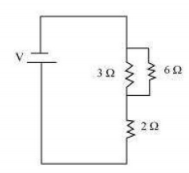
Q.4 How can three resistors of resistances $2 \Omega, 3 \Omega$, and $6 \Omega$ be connected to give a total resistance of (a) $4 \Omega,(b) 1 \Omega$?
Answer:
(a) $R_1=3, R_2=6, R_3=2$
$\mathrm{R}=$ Equivalent resistance
$
\begin{aligned}
& \frac{1}{R_{12}}=\frac{1}{R_1}+\frac{1}{R_2} \\
& \Rightarrow \frac{1}{R_{12}}=\frac{1}{3}+\frac{1}{6} \\
& \Rightarrow \frac{1}{R_{12}}=\frac{2+1}{6} \\
& \Rightarrow R_{12}=\frac{6}{3}=2 \\
& R=R_{12}+R_3=2+2=4
\end{aligned}
$
(b) 1 Ohm
R=Equivalent resistance
Connect all three resistors in parallel
$\begin{aligned} \frac{1}{R}= & \frac{1}{R_1}+\frac{1}{R_2}+\frac{1}{R_3} \\ & \Rightarrow \frac{1}{R}=\frac{1}{2}+\frac{1}{3}+\frac{1}{6} \\ & \Rightarrow \frac{1}{R}=\frac{6+3+1}{6} \\ & \Rightarrow R=\frac{16}{6}=1 \Omega\end{aligned}$
Q.5 (a) What is the highest total resistance that can be secured by combinations of four coils of resistance $4 \Omega, 8 \Omega, 12 \Omega, 24 \Omega ?$
Answer: 48 \Omega$
Explanation:
The highest total resistance is obtained when all the resistors are connected in a series
$4+8+12+24=48 \Omega$
Q.xplanation5 (b) What is the lowest total resistance that can be secured by combinations of four coils of resistance $4 \Omega, 8 \Omega, 12 \Omega, 24 \Omega ?$
Answer: 24 \Omega ?$
Explanation:
The lowest total resistance, R, is obtained when all the resistors are connected in parallel.
$\begin{aligned} & \frac{1}{R}=\frac{1}{4}+\frac{1}{8}+\frac{1}{12}+\frac{1}{24} \\ & \frac{1}{R}=\frac{6+3+2+1}{24}=\frac{12}{24} \\ & R=\frac{24}{12}=2\end{aligned}$
NCERT solutions for class 10 science chapter 11 Electricity topic 11.6
Q. 1. Why does the cord of an electric heater not glow while the heating element does?
Answer:
The heating element of an electric heater is a resistor.
The amount of heat production is given as $H=I^2 R t$.
The resistance of elements (alloys) of an electric heater is high. As current flows through this element, it becomes hot and glows red.
The resistance of the cord (metal like Cu or Al)of an electric heater is low. As current flows through this element, it does not become hot and does not glow red.
Q. 2. Compute the heat generated while transferring 96000 coulomb of charge in one hour through a potential difference of 50 V.
Answer: 4.8 \times 10^6 \mathrm{~J}\end{aligned}$
Explanation:
Given: potential difference = 50 V.
Charge = 9600 C
time = 1 hr=3600 s
$\begin{aligned} & \quad I=\frac{\text { charge }}{\text { time }(\text { seconds })}=\frac{9600}{3600}=\frac{80}{3} \mathrm{~A} \\ & \text { So, } H=\text { VIt } \\ & \Rightarrow H=50 \times \frac{80}{3} \times 3600 \\ & \Rightarrow H=4800000 \mathrm{~J}=4.8 \times 10^6 \mathrm{~J}\end{aligned}$
Q. 3 An electric iron of resistance $20 \Omega$ takes a current of 5 A. Calculate the heat developed in 30 s.
Answer:
Given : resistance $=\mathrm{R}=20 \Omega$, Time $=30$ s, current $=\mathrm{I}=5 \mathrm{~A}$
$
\begin{aligned}
& V=I R \\
& \Rightarrow V=5 \times 20=100 \mathrm{~V} \\
& \\
& \quad H=V I t \\
& \quad \Rightarrow H=100 \times 5 \times 30 \\
& \quad \Rightarrow H=15000 \mathrm{~J}=1.5 \times 10^4 \mathrm{~J}
\end{aligned}
$
NCERT solutions for class 10 science chapter 11 Electricity topic 11.8
Q.1 What determines the rate at which energy is delivered by a current?
Answer:
The rate at which energy is delivered by a current is power.
Power P = I²R, where I is the current and R is the resistance of the circuit/ appliance. Power depends on the current drawn by the appliance and the resistance of the appliance.
Q.2 An electric motor takes 5 A from a 220 V line. Determine the power of the motor and the energy consumed in 2 h.
Answer:
Given: I= 5 A and V= 220 V.
Power=P=VI
$P=220 \times 5=1100 \mathrm{~W}$
Time $=2 h r=2 \times 60 \times 60=7200 s$
The energy consumed $=$ power $\times$ time$=1100 \times 7200 \mathrm{~J}=7920000 \mathrm{~J}$
Power of motor $=1100 \mathrm{~W}$
Energy consumed by motor $=7920000 \mathrm{~J}$
Confused between CGPA and Percentage?
Get your results instantly with our calculator!
💡 Conversion Formula used is: CGPA = Percentage / 9.5
Class 10 Science Chapter 11 - Electricity Solutions: Exercise Questions
NCERT Solutions for Class 10 Science Chapter 11 - Electricity comprise the well-organised answers to all the exercises presented in the textbook, including key topics such as resistance, resistivity, electrical power, heating effects of current, etc. The Electricity class 10 question answers facilitate the solving of problems and enhance better exam preparations with proper explanations.
Q. 1. A piece of wire of resistance $R$ is cut into five equal parts. These parts are then connected in parallel. If the equivalent resistance of this combination is $R^{\prime}$ , then the ratio $R / R^{\prime}$ is –
(a) 1/25 (b) 1/5 (c) 5 (d) 25
Answer: (d) 25
Explanation:
Given: A piece of wire of resistance R is cut into five equal parts.
Resistance of each part is $\frac{R}{5}$.
$\frac{1}{R^{\prime}} =\frac{5}{R}+\frac{5}{R}+\frac{5}{R}+\frac{5}{R}+\frac{5}{R} \\$
$\frac{1}{R^{\prime}} =\frac{25}{R} \\$
$R^{\prime} =\frac{R}{25} \\$
$\text { Hence, } \frac{R}{R^{\prime}} =\frac{R}{\frac{R}{25}}=25$
Thus, option d is correct.
Q. 2. Which of the following terms does not represent electrical power in a circuit?
(a) $I^2 R(b) I R^2(c) V I(d) V^2 / R$
Answer: (b) I R^2
Explanation:
We know that power $=\mathrm{P}=\mathrm{VI}$-------------- (1)
Put, $\mathrm{V}=\mathrm{IR}$ in equation 1
$
P=I^2 R
$
Pur, $I=\frac{V}{R}$ in equation 1 ,
$
P=V \times \frac{V}{R}=\frac{V^2}{R}
$
$\mathrm{P}=$ power, $\mathrm{V}=$ potencial difference, $\mathrm{I}=$ current, $\mathrm{R}=$ resistance
P cannot be $I R^2$.
Thus, option b is correct.
Q. 3. An electric bulb is rated 220 V and 100 W. When it is operated on 110 V, the power consumed will be
(a) 100 W (b) 75 W (c) 50 W (d) 25 W
Answer: (d) 25 W
Explanation:
Given : $\mathrm{V}=220 \mathrm{~V}, \mathrm{P}=100 \mathrm{~W}$
$
P=\frac{V^2}{R}
$
The resistance of the bulb
$
\Rightarrow R=\frac{V^2}{P}=\frac{(220)^2}{100}=484 \Omega
$
If the bulb is operated on 110 V andthe resistance is the same, the power consumed will be $\mathrm{P}^{\prime}$
$
P^{\prime}=\frac{V^2}{R}=\frac{(110)^2}{484}=25 W
$
Hence, option d is correct.
Q. 4. Two conducting wires of the same material and of equal lengths and equal diameters are first connected in series and then parallel in a circuit across the same potential difference. The ratio of heat produced in series and parallel combinations would be
(a) 1:2 (b) 2:1 (c) 1:4 (d) 4:1
Answer: (c) 1:4
Explanation:
If resistors are connected in parallel, the net resistance is given as
$
\begin{aligned}
& \frac{1}{R_p}=\frac{1}{R_1}+\frac{1}{R_2} \\
& \Rightarrow \frac{1}{R_p}=\frac{1}{R}+\frac{1}{R} \\
& \Rightarrow \frac{1}{R_p}=\frac{2}{R} \\
& \Rightarrow R_p=\frac{R}{2}
\end{aligned}
$
If resistors are connected in series, the net resistance is given as
$
\Rightarrow R_s=R_1+R_2=R+R=2 R
$
Heat produced $=\mathrm{H}=\frac{V^2}{R} t$
$
\begin{aligned}
& \frac{H_s}{H_p}=\frac{\frac{V^2 t}{2 R}}{\frac{V^{2 t}}{\frac{R}{2}}} \\
& \Rightarrow \frac{H_s}{H_p}=\frac{1}{4} \\
& \Rightarrow H_s: H_p=1: 4
\end{aligned}
$
Thus, option c is correct.
Q. 5. How is a voltmeter connected in the circuit to measure the potential difference between two points?
Answer:
A voltmeter should be connected in parallel to measure the potential difference between two points.
Q. 6. A copper wire has a diameter of 0.5 mm and resistivity of $1.6 \times 10^{-8} \Omega$ m. What will be the length of this wire to make its resistance $10 \Omega$? How much does the resistance change if the diameter is doubled?
Answer:
Given : diameter $=\mathrm{d}=0.5 \mathrm{~mm}$ and resistivity $=\rho=1.6 \times 10^{-8} \Omega \mathrm{~m}$, resistance $=\mathrm{R}=10 \Omega$
Area $=A$
$
\begin{aligned}
& A=\frac{\pi d^2}{4}=\frac{3.14 \times 0.5 \times 0.5}{4} \\
& \Rightarrow A=0.000000019625 \mathrm{~m}^2
\end{aligned}
$
We know
$
\begin{aligned}
& R=\frac{\rho l}{A} \\
& \Rightarrow l=\frac{R A}{\rho}=\frac{10 \times 0.000000019625}{1.6 \times 10^{-8}} \\
& =122.72 \mathrm{~m}
\end{aligned}
$
If the diameter is doubled.
$
\mathrm{d}=1 \mathrm{~mm}
$
Area $=A^{\prime}$
$
\begin{aligned}
& A^{\prime}=\frac{\pi d^2}{4}=\frac{3.14 \times 1 \times 1}{4} \\
& \Rightarrow A=0.000000785 \mathrm{~m}^2
\end{aligned}
$
We know
$
\begin{aligned}
& R^{\prime}=\frac{\rho l}{A^{\prime}} \\
& \Rightarrow R^{\prime}=\frac{1.6 \times 10^{-8} \times 122.72}{0.000000785} \\
& \Rightarrow R^{\prime}=2.5 \Omega \\
& \frac{R^{\prime}}{R}=\frac{2.5}{10}=\frac{1}{4}
\end{aligned}
$
Hence, new resistance is $\frac{1}{4}$ of original resistance.
Q. 7. The values of current I flowing in a given resistor for the corresponding values of potential difference V across the resistor are given below –
I (amperes) 0.5 1.0 2.0 3.0 4.0
V (volts) 1.6 3.4 6.7 10.2 13.2
Plot a graph between V and I and calculate the resistance of that resistor
Answer:
The plot between voltage and current is as shown :
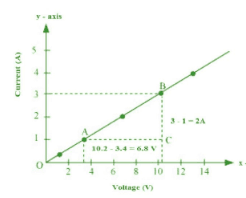
The slope of the line gives resistance (R)
$R=\frac{6.8}{2}=3.4 \Omega$
Q.8. When a 12 V battery is connected across an unknown resistor, there is a current of 2.5 mA in the circuit. Find the value of the resistance of the resistor.
Answer:
Given : V=12V , I = 2.5 mA = 0.0025 A
$R=\frac{12}{0.0025}=4800 \Omega=4.8 k \Omega$
Q.9. A battery of 9 V is connected in series with resistors of $02 \Omega$, $0.3 \Omega$, $0.4 \Omega$, $0.5 \Omega$ and $12 \Omega$ respectively. How much current would flow through the $12 \Omega$ resistor?
Answer: Total resistance $=\mathrm{R}$
$
R=0.2+0.3+0.4+0.5+12=13.4 \Omega
$
$
\begin{aligned}
& \mathrm{V}=9 \mathrm{~V} \\
& I=\frac{V}{R}=\frac{9}{13.4}=0.67 \mathrm{~A}
\end{aligned}
$
Hence, all resistors are in series, so 0.67 A current would flow through the $12 \Omega$ resistor.
Q.10. How many $176 \Omega$ resistors (in parallel) are required to carry 5 A on a 220 V line?
Answer: 44 Ohms.
Explanation:
Given: V=220V and I =5A
$
R=\frac{V}{I}=\frac{220}{5}=44 \Omega
$
Let $x$ number of resistors be connected in parallel to obtain 44 Ohm equivalent resistance.
Thus,
$
\begin{aligned}
& \frac{1}{R}=\frac{1}{176}+\frac{1}{176}+\ldots \ldots \ldots \ldots \ldots \ldots \ldots \text {............ } x \text { times } \\
& \Rightarrow \frac{1}{44}=\frac{x}{176} \\
& \Rightarrow x=\frac{176}{44}=4
\end{aligned}
$
Hence, 4 resistors of 176 Ohms are connected in parallel to obtain 44 Ohms.
Q.11. Show how you would connect three resistors, each of resistance $6 \Omega$, so that the combination has a resistance of (i) $92 \Omega$, (ii) $4 \Omega$.
Answer:
(i) $R_1=R_2=R_3=6$
$\mathrm{R}=$ Equivalent resistance
$
\begin{aligned}
\frac{1}{R_{12}} & =\frac{1}{R_1}+\frac{1}{R_2} \\
& \Rightarrow \frac{1}{R_{12}}=\frac{1}{6}+\frac{1}{6} \\
& \Rightarrow \frac{1}{R_{12}}=\frac{1+1}{6} \\
& \Rightarrow R_{12}=\frac{6}{2}=3 \\
& R=R_{12}+R_3=3+6=9 \Omega
\end{aligned}
$
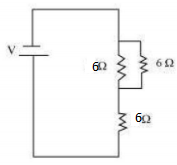
(ii)
$
R_1=R_2=R_3=6
$
$\mathrm{R}=$ Equivalent resistance
$
\begin{aligned}
& R_{12}=R_1+R_2=6+6=12 \Omega \\
& \frac{1}{R}=\frac{1}{R_{12}}+\frac{1}{R_3} \\
& \Rightarrow \frac{1}{R}=\frac{1}{12}+\frac{1}{6} \\
& \Rightarrow \frac{1}{R}=\frac{1+2}{12} \\
& \Rightarrow R=\frac{12}{3}=4
\end{aligned}
$
Q.12. Several electric bulbs designed to be used on a 220 V electric supply line are rated 10 W. How many lamps can be connected in parallel with each other across the two wires of the 220 V line if the maximum allowable current is 5 A?
Answer:
Given: $\mathrm{V}=220 \mathrm{~V}$ and $\mathrm{P}=10 \mathrm{~W}$
$
R=\frac{V^2}{P}=\frac{220^2}{10}=4840 \Omega
$
Let x be the number of bulbs.
$
\begin{aligned}
& \mathrm{I}=5 \mathrm{~A} \text { and } \mathrm{V}=220 \mathrm{~V} \\
& \qquad R=\frac{V}{I}=\frac{220}{5}=44 \Omega
\end{aligned}
$
For $x$ bulbs of resistance 4680 Ohm, are connected in parallel to obtain 44 Ohm equivalent resistance.
Thus,
$
\begin{aligned}
& \frac{1}{R}=\frac{1}{4840}+\frac{1}{4840}+\ldots \ldots \ldots \ldots \ldots \ldots . . . \text { to } x \text { times } \\
& \Rightarrow \frac{1}{44}=\frac{x}{4840} \\
& \Rightarrow x=\frac{4840}{44}=110
\end{aligned}
$
Hence, 110 bulbs of 4840 Ohms are connected in parallel to obtain 44 Ohms.
Q.13. A hot plate of an electric oven connected to a 220 V line has two resistance coils, A and B, each of $24 \Omega$ resistance, which may be used separately, in series, or in parallel. What are the currents in the three cases?
Answer:
Given : V=220V and Resistance of each coil=R =24A
When the coil is used separately, the current in the coil is
$
I=\frac{V}{R}=\frac{220}{24}=9.16 A
$
When two coils are connected in series, the net resistance is
$
R=R_1+R_2=24+24=48 \Omega
$
current in coil is I'
$
I^{\prime}=\frac{V}{R}=\frac{220}{48}=4.58 \mathrm{~A}
$
When two coils are connected in parallel, the net resistance is
$
\begin{aligned}
& \frac{1}{R}=\frac{1}{24}+\frac{1}{24}=\frac{2}{24} \\
& \Rightarrow R=12 \Omega
\end{aligned}
$
current in the coil is I"
$
I^{\prime \prime}=\frac{V}{R}=\frac{220}{12}=18.33 \mathrm{~A}
$
Q.14. Compare the power used in the $2 \Omega$ resistor in each of the following circuits:
(i) a 6 V battery in series with $1 \Omega$ and $2 \Omega$ resistors
(ii) a 4 V battery in parallel with $12 \Omega$ and $2 \Omega$ resistors.
Answer:
i) Given: V=6V
$\mathrm{R}=1+2=30 \mathrm{hm}$
$
I=\frac{V}{R}=\frac{6}{3}=2 A
$
In a series current is constant.
So, power $=P$
$
P=I^2 R=2^2 \times 2=8 W
$
ii) Given: $V=6 \mathrm{~V}, \mathrm{R}=2 \mathrm{Ohm}$
In a parallel combination, voltage in the circuit is constant.
So, power $=P$
$
P=\frac{V^2}{R}=\frac{4^2}{2}=8 W
$
Q.15. Two lamps, one rated 100 W at 220 V, and the other 60 W at 220 V, are connected in parallel to an electric mains supply. What current is drawn from the line if the supply voltage is 220 V?
Answer:
Given :
For lamp one: Power $=\mathrm{P_1} =100 \mathrm{~W}$ and $\mathrm{V}=220 \mathrm{~V}$
$
I_1=\frac{P_1}{V}=\frac{100}{220}=0.455 \mathrm{~A}
$
For lamp two: Power $=\mathrm{P_2} =60 \mathrm{~W}$ and $\mathrm{V}=220 \mathrm{~V}$
$
I_2=\frac{P_2}{V}=\frac{60}{220}=0.273 \mathrm{~A}
$
Thus, the net current drawn from the supply is $0.455+0.273=0.728 \mathrm{~A}$
Q.16. Which uses more energy, a 250 W TV set in 1 hr, or a 1200 W toaster in 10 minutes?
Answer:
For the TV set :
Given : Power $=250 \mathrm{~W}$ and time $=1 \mathrm{hr}=3600$ seconds
Energy consumed $=\mathrm{H}=\mathrm{PI}$
$
H=250 \times 3600=900000 J
$
For toaster :
Given : Power $=1200 \mathrm{~W}$ and time $=10$ minutes $=600$ seconds
Energy consumed $=\mathrm{H}=\mathrm{PI}$
$
H=1200 \times 600=720000 J
$
Thus, the TV set uses more energy than a toaster.
Q. 17. An electric heater of resistance $8 \Omega$ draws 15 A from the service mains for 2 hours. Calculate the rate at which heat is developed in the heater.
Answer: 1800 \mathrm{~J} / \mathrm{s}
Explanation:
Given: R=8 Ohm ,I=15A and t= 2hr
The heat developed in the heater is H.
The heat developed in the heater is H.
$
H=I^2 R t
$
The rate at which heat is developed is given as
$
\frac{I^2 R t}{t}=I^2 R=15^2 \times 8=1800 \mathrm{~J} / \mathrm{s}
$
Q.18(a). Explain the following: Why is tungsten used almost exclusively for the filament of electric lamps?
Answer:
Tungsten is used almost exclusively for the filament of electric lamps because the melting point of tungsten is very high. The bulb glows at a very high temperature. So tungsten filament does not melt when the bulb glows.
Q.18.(b) Explain the following: Why are the conductors of electric heating devices, such as bread-toasters and electric irons, made of an alloy rather than a pure metal?
Answer:
The conductors of electric heating devices, such as bread toasters and electric irons, are made of an alloy rather than a pure metal because the resistivity of the alloy is greater than that of a pure metal. So the resistance will be high, and the heating effect will be high.
Q.18.(c) Explain the following: Why is the series arrangement not used for domestic circuits?
Answer:
If any of the elements in the circuit get damaged, the entire circuit will be affected. If an element breaks, there will not be any current flow through the circuit. So the series circuit is not preferred in the domestic circuit.
Q.18.(d) Explain the following: How does the resistance of a wire vary with its area of cross-section?
Answer:
We know that
$\begin{aligned} & R=\frac{\rho l}{A} \\ & R \alpha \frac{1}{A}\end{aligned}$
Thus, the resistance of a wire is inversely proportional to its area of cross-section.
Q.18.(e) Explain the following: Why are copper and aluminium wires usually employed for electricity transmission?
Answer:
Copper and aluminium wires are usually employed for electricity transmission because they have low resistivity and are good conductors of electricity.
Class 10 Physics NCERT Chapter 11: Higher Order Thinking Skills (HOTS) Questions
The NCERT Class 10 Physics Chapter 11 Electricity HOTS (Higher Order Thinking Skills) questions aim at challenging high-order conceptual insight in topics such as Ohm's law, series and parallel circuits, and power consumption. These complicated questions lead to increased analytical thinking and problem-solving abilities, which also help the students in all types of competitive exams.
Q1:
If the electronic charge is $1.6 \times 10^{-19} \mathrm{C}$, then the number of electrons passing through a section of wire per second when the wire carries a current of 2 A, is
Answer:
Given : $\mathrm{e}=1.6 \times 1 \mathrm{o}^{-19} \mathrm{C}, I=2 \mathrm{A}, t=1 \mathrm{~s}$
Using $I=\frac{\text { ne }}{t}$
$\therefore$ Number of electrons $\mathrm{n}=\frac{\mathrm{It}}{\mathrm{e}}=\frac{2 \times 1}{1.6 \times 10^{-19}}=1.25 \times 10^{19}$ electrons
Q2:
When two bulbs of power 60 W and 40 W are connected in series, then the power of their combination will be:
Answer:
Given:- Power of two bulbs $P_1=60$ and $P_2=40 \mathrm{~W}$
To find the Power of their combination,
We know, Power $P=\frac{V^2}{R}$
where $V$ denotes voltage across bulb and $R$ denotes resistance of bulb.
So, Resistance of first bulb $\quad R_1=\frac{V^2}{p_1}=\frac{V^2}{60}....(1)$
Similarly,
Resistance of and bulb, $R_2=\frac{V^2}{P_2}=\frac{V^2}{40}......(2)$
Now, $R_1$ and $R_2$ are Joined in Series
then,
equivalent resistance $R_{e q}=R_1+R_2$
$
\begin{aligned}
& \frac{V^2}{P_{e q}}=\frac{V^2}{60}+\frac{V^2}{40} \\
& \frac{1}{P_{e q}}=\frac{1}{60}+\frac{1}{40} \\
& P_{e q}=\frac{60 \times 40}{60+40}=24 \mathrm{~W} \\
& P_{e q}=24 \mathrm{~W}
\end{aligned}
$
Q3:
At a constant potential difference, the resistance of any electric circuit is halved. The value of heat produced will be:
Answer:
We know,
The heat produced $=i^2 R t....(1)$
where $i$ is current, $R$ is resistance and is tee.
$
\begin{aligned}
\because \quad V & =i R \\
i & =V / R
\end{aligned}
$
putt in (1)
$
H=\left(\frac{V}{R}\right)^2 R t=\frac{V^2}{R} \cdot t
$
So, $V$ is constant
and $R$ is now $R / 2$ given.
and $t$ remains same
$
H=\frac{V^2}{R / 2} \cdot t=2 \frac{V^2}{R} \cdot t
$
$H=2 \frac{V^2}{R} \cdot t$
Hence, the heating produced will be doubled
Q4:
A wire of resistance $9 \Omega$ is bent to form an equilateral triangle. Then the equivalent resistance across any two vertices will be ____ ohm.
Answer:

$9 \Omega$ is the resistance of the whole wire
$\therefore$ resistance of each wire $=3 \Omega$.
$\therefore$ Equivalent resistance $=2 \Omega$
Q5:
A wire of resistance $R$ is bent into an equilateral triangle, and an identical wire is bent into a square. The ratio of resistance between the two endpoints of an edge of the triangle and that of the square is
Answer:
$\mathrm{R}=\frac{\rho \ell}{\mathrm{A}}$
So, $R \propto \ell$
Side length of the triangle is $1 / 3$ of the total length.

$\left(\mathrm{R}_{\mathrm{eq}}\right)_1=\frac{2 \mathrm{r} / 3 \times \mathrm{r} / 3}{2 \mathrm{r} / 3+\mathrm{r} / 3} = 2\mathrm{r}/9$
$\left(\mathrm{R}_{\mathrm{eq}}\right)_2=\frac{3 \mathrm{r} / 4 \times \mathrm{r} / 4}{3 \mathrm{r} / 4+\mathrm{r} / 4} = 3\mathrm{r}/16$
$\frac{\left(\mathrm{R}_{\mathrm{eq}}\right)_1}{\left(\mathrm{R}_{\mathrm{eq}}\right)_2}=\frac{2 \mathrm{r} / 9}{3 \mathrm{r}/16}=\frac{32}{27}$
Q6:
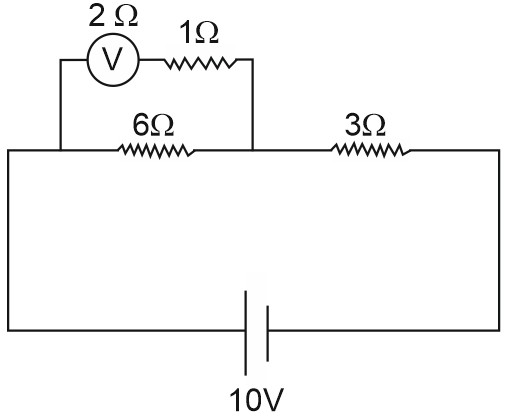
For the given circuit, reading of voltmeter is $\frac{2 P}{3}$, here $P$ is:
Answer:
$\begin{aligned} & 4 V=I(2)+I(1) \\ & I=\frac{4}{3} \\ & \text { Reading of voltmeter }=I \times 2=\frac{8}{3}\end{aligned}$
Hence, the answer is 4.
Q7:
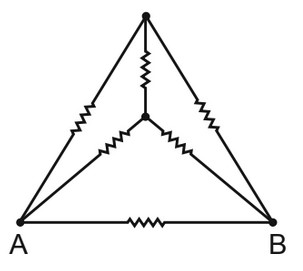
A wire of resistance $R$ is bent into a triangular pyramid as shown in the figure, with each segment having the same length. The resistance between points $A$ and $B$ is $R / n$. The value of $n$ is :
Answer:
As $r=\frac{R}{6}$
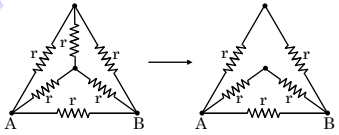
(As a balanced wheat stone bridge is formed)
Now, the equivalent resistance between A and B can be written as
$
\begin{aligned}
& \frac{1}{\mathrm{R}_{\mathrm{AB}}}=\frac{1}{2 \mathrm{r}}+\frac{1}{2 \mathrm{r}}+\frac{1}{\mathrm{r}}=\frac{2}{\mathrm{r}} \\
& \mathrm{R}_{\mathrm{AB}}=\frac{\mathrm{R}}{12}
\end{aligned}
$
NCERT Solutions for Class 10 Science Chapter 11: Important Topics
NCERT Solutions for Class 10 Science Chapter 11 Electricity cover all the important topics needed to understand how electric circuits work and how electrical quantities like current, voltage, resistance, and power are calculated. These topics are essential for both board exam preparation and real-life applications.
11.1 Electric Current And Circuit
11.2 Electric Potential And Potential Difference
11.3 Circuit Diagram
11.4 Ohm’s Law
11.5 Factors On Which The Resistance of A Conductor Depends
11.6 Resistance of A System Of Resistors
11.6.1 Resistors In Series
11.6.2 Resistors In Parallel
11.7 Heating Effect Of Electric Current
11.7.1 Practical Applications of the Heating Effect Of Electric Current
11.8 Electric Power
Also, students can refer to
NCERT Solutions for Class 10 Science Chapter 11: Important Formulae
The NCERT Solutions for Class 10 Science Chapter 11 Electricity provide all the important formulae related to current, voltage, resistance, power, and energy. These formulas make problem-solving easier, help in quick revision, and are essential for scoring well in board as well as competitive exams.
1. Ohm’s Law
$
V=I R
$
Where:
$V=$ potential difference (volts)
$I=$ current (amperes)
$R=$ resistance (ohms, $\Omega$)
2. Resistance of a Conductor
$
R=\rho \frac{l}{A}
$
Where:
$R=$ resistance
$\rho=$ resistivity of the material
$l=$ length of the conductor
$A=$ cross-sectional area
3. Resistance in Series
$R_{\text {total }}=R_1+R_2+R_3+\ldots$
4. Resistance in Parallel
$\frac{1}{R_{\text {total }}}=\frac{1}{R_1}+\frac{1}{R_2}+\frac{1}{R_3}+\ldots$
5. Electric Power
$
P=V I=I^2 R=\frac{V^2}{R}
$
Where:
$P=$ power (watts)
6. Electrical Energy
$
E=P t=V I t=I^2 R t=\frac{V^2 t}{R}
$
Where:
$E=$ electrical energy (in joules)
Approach to Solve Questions of Class 10 Science Chapter 11 - Electricity
The chapter Current Electricity helps the students to learn how the electric current works through a circuit and the connections among voltage, resistance and current. In order to be able to solve the questions that are related to this chapter effectively, the students will have to pay attention to the knowledge about Ohm's Law, series and parallel circuits, electric power, and resistivity. Conceptual and numerical problems of formulas, units and circuit diagrams are solved more accurately, based on a systematic approach.
-
Start by reading the question to see whether it is related to Ohm's Law, series or parallel circuit, resistor or numericals involving current, voltage and resistance.
-
Write down all the specified values (voltage (V), current (I), resistance (R), number of resistors and type of combination).
-
Use Ohm's Law formula (V=IR) when it is necessary to determine the relationship between voltage, current, and resistance.
-
Use the appropriate formula for series/parallel circuit arrangements:
$R_{\text {total }}=R_1+R_2+\ldots$
$\frac{1}{R_{\text {total }}}=\frac{1}{R_1}+\frac{1}{R_2}+......$
- For numericals, replace all the figures in SI units and solve step by step by stating the formula at each step.
- In conceptual questions, describe the main principles such as potential difference, conventional direction of current and the role of the ammeter or voltmeter.
- Draw neat circuit diagrams wherever required and label all components clearly.
- To calculate power, use $P=V I, P=I^2 R$, or $P=\frac{V^2}{R}$ using given data.
- Check the units and final answers twice, in order to be clear and logical.
Benefits of NCERT Solutions Class 10 Chapter 11: Electricity
NCERT Solutions of class 10 Science Chapter 11: Electricity guide students in getting the fundamental concepts of electric current, potential difference, resistance and electrical power in a simple and systematic manner. These Electricity class 10 question answers will lead a student to the solutions of the numerical problems by the use of the Ohm law and analysis of the circuit, which is easy to understand even in the difficult subjects. They also enhance conceptual understanding and problem-solving ability, which is needed in board exams and also in competitive exams such as NTSE and Olympiads.
- Concept Clarity: Uses simple yet step-by-step explanations of Ohm's laws, resistance, power, and electric energy, thereby making these concepts easier to understand.
- Exam-Oriented: Solutions are designed according to the CBSE syllabus and pattern, and this helps students prepare to appear in board examinations.
- Quick Revision: The entire chapter can be revised within a short period of time using important formulae and solved examples.
- Enhances Problem-Resolving Ability: Practising questions enhances problem-solving and helps in resolving both numerical and theoretical problems without fear.
- Helps in Competitive Exams and tests: Creates an excellent background towards entrance exams such as NTSE, Olympiads, NEET, and IIT-JEE.
What You Will Learn from NCERT Solutions for Class 10 Science Chapter 11: Electricity?
This chapter allows the students to clearly understand the electric current and its use in daily life. With the help of the NCERT Solutions of Class 10 Science Chapter 11 - Electricity, students will acquire the following main concepts:
- This chapter makes students aware of electric current, electric potential difference, and the conditions in which the current can flow in the electric circuit.
- The numerical problems and the given examples allow the students to study the Ohm Law and the connections between current, voltage, and resistance.
- Through these solutions, students are able to gain a good concept of electrical resistance, conditions that influence it, as well as the usage of resistors in series and parallel connection.
- The chapter describes electrical power and its units clearly and gives the calculation of electrical energy consumption.
- Students as well get to know about the heating effect of an electric current and its uses in day-to-day life, which helps them to correlate the theoretical knowledge with practical electrical appliances.
Chapter Summary of NCERT Solutions for Class 10 Science Chapter 11– Electricity
Electricity is one of the most essential chapters of CBSE Class 10 Science. This chapter gives an understanding of electric current, electric potential, potential difference, electrical resistance, Ohm's law, resistors, electrical power, and heating of electric current. This chapter involves both theoretical and numerical questions, so students should have a good understanding of the concepts and formulas. It contains seven exercises with a total of 41 questions. The questions in NCERT are formula-based, numerical-based, and concept application-based. The diagram and solved examples in this chapter help students understand the topics. Regular practice of all NCERT questions and formulas will surely help students to secure good marks in CBSE board exams and will develop an understanding of Physics.
Expert Review of NCERT Solutions for Class 10 Science Chapter 11 – Electricity
Electricity is one of the highest-scoring chapters of Class 10 Science according to subject experts. Concepts included in this chapter are important as they provide a strong base for learning advanced topics later. Physics chapters in Classes 11 and 12. Once a student has a thorough idea about Ohm’s law, resistance, electrical power, and combinations of circuits, physics becomes extremely easy for them. Subject experts suggest that students learn formulas very carefully, regularly go for revision, and attempt all NCERT exercise questions and numerical problems from this chapter. Mastery of this chapter is also highly beneficial for students preparing for competitive exams such as JEE/NEET, as it helps build a strong foundation. Although direct questions from Class 10 are not asked in these exams, the concepts learnt here are very useful.
NCERT Solutions for Class 10 Science: Chapter Wise
Chapter-wise NCERT solutions can make it extremely easy to prepare notes for the Class 10 Science exams. These solutions include explanations for all in-text and exercise questions, and they assist students in developing firm concepts and get along with their problem-solving abilities. These links serve as a comprehensive guide to studying all board exams and competitive tests with step-by-step explanations and relevant formulas.
NCERT Solutions for Class 10: Subject Wise
NCERT Solutions for Class 10 Maths and Science provide clear, accurate, and step-by-step answers to textbook questions based on the latest syllabus. These subject-wise solutions help students strengthen concepts, improve problem-solving skills, and prepare confidently for board examinations.
NCERT Notes for Class 10: Subject Wise
NCERT Notes for Class 10 Maths and Science offer concise and well-organised explanations of important concepts, formulas, and diagrams. These subject-wise notes help students revise quickly, improve conceptual clarity, and strengthen exam preparation.
NCERT Books and Syllabus
NCERT Books and the NCERT Syllabus for Class 10 form the core of the CBSE curriculum and ensure concept-based learning. Easy access to these links helps students follow the prescribed textbooks, understand the exam pattern, and prepare systematically for board examinations.
Frequently Asked Questions (FAQs)
Q: What is Chapter 11 of class 10 Science?
A:
Chapter 11 of Class 10 Science is Electricity, which includes details about electric current, resistance, Ohm's law, electrical power, etc.
Q: Is Chapter 11 Electricity essential for CBSE Board Exams?
A:
Yes, Chapter 11 Electricity is an essential chapter having numericals as well as theory questions.
Q: Which concepts are included in Chapter 11 Electricity?
A:
Electric current, potential difference, resistance, Ohm's law, resistance in series, resistance in parallel, electrical power, heating effect of electric current.
Q: What is Ohm's Law?
A:
It states that the current flowing through a wire or solenoid is directly proportional to the potential difference across the ends of the wire or the solenoid, provided temperature remains constant.
Q: Are numerical questions asked from Chapter 11?
A:
Numerical problems based on formulas are asked in exams from this chapter.
Q: Why students should study the NCERT Solutions for Chapter 11?
A:
The solutions are of value as they know the concepts well, and the answers to the textbook questions are given step-by-step.
Q: Is Electricity an easy chapter?
A:
Yes, while such a chapter is easy to score if students grasp the concepts and practice numerical problems regularly.
Q: How to score well in Chapter 11?
A:
Learn the formulas, practice questions from the NCERT, old papers, check your answers, and revise the chapter.
Q: Can I use Chapter 11 for competitive exams?
A:
Yes, the concepts of Electricity are needed in higher studies and competitive exams.
Q: What formulas are important for Chapter 11 Electricity?
A:
V=IRV=IRR=VIR= I P=I2RP=V2R= P=IR=VIR= I P=I2RP=V2R
Articles
Related Stories
|
Upcoming School Exams

Certifications By Top Providers
Explore Top Universities Across Globe
Questions related to CBSE Class 10th
On Question asked by student community
Have a question related to CBSE Class 10th ?
Hi Smriti Lama
The CBSE Class 10 Board Exam 2026-27 question paper pattern includes the latest exam structure, subject-wise marking scheme and question types. You can check the detailed pattern on Careers360:
Hi Somshiv Rath
If you mean a CBSE Class 8 Science question paper, Careers360 has a sample paper section where you can check the available Class 8 papers.
https://learn.careers360.com/school/cbse-8-class-preparation-material/
Hey there,
If you mean CBSE Class 10 rechecking/re-evaluation results 2026, CBSE has already completed the main post-result process for 2026. The Class X second-board results were declared on 18 July 2026, and CBSE has also issued the post-result facilities notice.
For verification/re-evaluation, CBSE says the result/status is uploaded online
Please mention important details like your school board, exam, and class to get the exact papers.
You can explore the useful resources here:
Hello Student, kya aap mujhe bata sakte hai ki Class 10 CBSE ke kis aspect ke baare mein information chahiye.
Popular CBSE Class 10th Questions
A block of mass 0.50 kg is moving with a speed of 2.00 ms-1 on a smooth surface. It strikes another mass of 1.00 kg and then they move together as a single body. The energy loss during the collision is
| Option 1)
|
Option 2)
|
| Option 3)
|
Option 4)
|
An athlete in the olympic games covers a distance of 100 m in 10 s. His kinetic energy can be estimated to be in the range
| Option 1)
|
Option 2)
|
| Option 3)
|
Option 4)
|
A particle is projected at 600 to the horizontal with a kinetic energy . The kinetic energy at the highest point
| Option 1)
|
Option 2)
|
| Option 3)
|
Option 4)
|
In the reaction,
| Option 1)
|
Option 2)
|
| Option 3)
|
Option 4)
|
How many moles of magnesium phosphate, will contain 0.25 mole of oxygen atoms?
| Option 1)
0.02 |
Option 2)
3.125 × 10⁻² |
| Option 3)
1.25 × 10⁻² |
Option 4)
2.5 × 10⁻² |
Colleges After 12th

Applications for Admissions are open.
Get Job Ready in Healthcare | Employability-Focused Programs
CBSE Class 10th Notifications
Never miss CBSE Class 10th update
Get timely CBSE Class 10th updates directly to your inbox. Stay informed!