


NCERT Solutions for Class 10 Maths Chapter 7 Exercise 7.1 - Coordinate Geometry
The fundamental understanding of point relationships within coordinate spaces is vital while studying geometry. Points positioned on one straight line are labelled as collinear points when there are three or more. The detection of collinearity requires using both distance formula computations and slope comparisons between segments that connect the points. The diagnostic tools enable verification of point position in graphs, which ultimately supports both proof building and analytical approaches. The development of this skill leads to better preparation when solving coordinate geometry problems.
This Story also Contains
- Download NCERT Solutions For Class 10 Maths Chapter 7 Exercise 7.1
- Access Solution of Coordinate Geometry Class 10 Chapter 7 Exercise: 7.1
- Topics covered in Chapter 7 Coordinate Geometry: Exercise 7.1
- NCERT Solutions of Class 10 Subject Wise
- NCERT Exemplar Solutions of Class 10 Subject Wise
This section of the NCERT Solutions for Class 10 Maths emphasises the practical application of the distance formula. The exercises require students to establish point-to-point distance measurements, along with confirming points lie on the same straight line and identifying various triangle and quadrilateral shapes through their side lengths. Students improve their mastery of coordinate geometry through the practice of Exercise 7.1 from the NCERT Books and develop critical analytical skills that will serve them in advanced mathematical learning.
Access Solution of Coordinate Geometry Class 10 Chapter 7 Exercise: 7.1
Coordinate Geometry Class 10 Chapter 7 Exercise: 7.1
Q1 (i) Find the distance between the following pairs of points : (2, 3), (4, 1)
Answer:
Given points: (2, 3), (4, 1)
Distance for the points $(x_{1},y_{1})\ and\ (x_{2},y_{2})$ will be as follows:
$D = \sqrt{(x_{2}-x_{1})^2+(y_{2}-y_{1})^2}$
After putting values, we get:
$D= \sqrt{(4-2)^2+(1-3)^2} = \sqrt{4+4} = 2\sqrt{2}$
Q1 (ii) Find the distance between the following pairs of points : (– 5, 7), (– 1, 3)
Answer:
Given points: (– 5, 7), (– 1, 3)
Distance for the points $(x_{1},y_{1})\ and\ (x_{2},y_{2})$ will be as follows:
$D = \sqrt{(x_{2}-x_{1})^2+(y_{2}-y_{1})^2}$
After putting values, we get:
$D= \sqrt{(-1+5)^2+(3-7)^2} = \sqrt{16+16} = 4\sqrt{2}$
Q1 (iii) Find the distance between the following pairs of points :(a, b), (– a, – b)
Answer:
Given points: (a, b), (– a, – b)
Distance for the points $(x_{1},y_{1})\ and\ (x_{2},y_{2})$ will be as follows:
$D = \sqrt{(x_{2}-x_{1})^2+(y_{2}-y_{1})^2}$
After putting values, we get:
$D= \sqrt{(-a-a)^2+(-b-b)^2} = \sqrt{4(a^2+b^2)} = 2\sqrt{a^2+b^2}$
Answer:
Given points: (0, 0) and (36, 15)
Distance for the points $(x_{1},y_{1})\ and\ (x_{2},y_{2})$ will be as follows:
$D = \sqrt{(x_{2}-x_{1})^2+(y_{2}-y_{1})^2}$
After putting values we get:
$D= \sqrt{(36-0)^2+(15-0)^2} =\sqrt{1296+225} = \sqrt{1521} = 39$
Therefore, the distance between the two towns A and B is, thus, 39 km for the given towns' location $(0,0)$ and $(36,15)$.
Q3 Determine if the points (1, 5), (2, 3), and (– 2, – 11) are collinear.
Answer:
Let the points (1, 5), (2, 3), and (– 2, – 11) represent the vertices A, B, and C of the given triangle, respectively.
$A = (1,5),\ B = (2,3),\ C = (-2,-11)$
To determine whether these points are collinear or not, we need to verify if the sum of the lengths of any two line segments is equal to the length of the third line segment.
Therefore,
$AB = \sqrt{(1-2)^2+(5-3)^2} = \sqrt{5}$
$BC = \sqrt{(2-(-2))^2+(3-(-11))^2} = \sqrt{4^2+14^2} = \sqrt{16+196} = \sqrt{212}$
$CA = \sqrt{(1-(-2))^2+(5-(-11))^2} = \sqrt{3^2+16^2} = \sqrt{9+256} = \sqrt{265}$
$AB+BC \neq CA$
$BA+AC \neq BC$
$BC+CA \neq BA$
Thus, the cases do not satisfy the condition for collinear points
Hence, the points are not collinear.
Q4. Check whether (5, – 2), (6, 4) and (7, – 2) are the vertices of an isosceles triangle.
Answer:
We know the isosceles triangle has two equal sides. So, we will check the distances between the points to verify whether it is an isosceles triangle or not.
The distance between two points $A(x_{1},y_{1})\ and\ B(x_{2},y_{2})$ is given by:
$D = \sqrt{(x_{2}-x_{1})^2+(y_{2}-y_{1})^2}$
So, we have the following points: (5, – 2), (6, 4) and (7, – 2), assuming them to be the vertices of triangle A, B, and C, respectively.
$AB = \sqrt{(5-6)^2+(-2-4)^2} = \sqrt{1+36} = \sqrt{37}$
$BC = \sqrt{(6-7)^2+(4+2)^2} = \sqrt{1+36} = \sqrt{37}$
$CA = \sqrt{(5-7)^2+(-2+2)^2} = \sqrt{4+0} = 2$
Therefore, AB = BC
Here two sides are equal in length.
Therefore, ABC is an isosceles triangle.
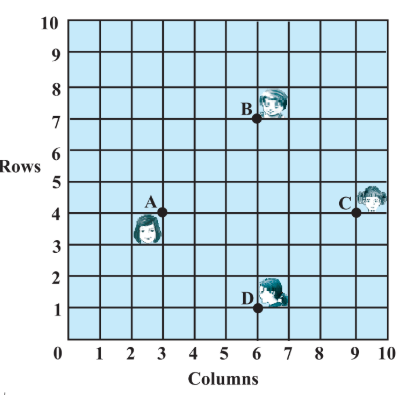
Answer:
The coordinates of the points:
$A(3,4),\ B(6,7),\ C(9,4),\ and\ D(6,1)$ are the positions of 4 friends.
The distance between two points $A(x_{1},y_{1}), \ and\ B(x_{2},y_{2})$ is given by:
$D = \sqrt{(x_{2}-x_{1})^2+(y_{2}-y_{1})^2}$
Hence,
$AB = \sqrt{(3-6)^2+(4-7)^2} = \sqrt{9+9} = \sqrt{18} = 3\sqrt2$
$BC = \sqrt{(6-9)^2+(7-4)^2} = \sqrt{9+9} = \sqrt{18} = 3\sqrt2$
$CD = \sqrt{(9-6)^2+(4-1)^2} = \sqrt{9+9} = \sqrt{18} = 3\sqrt2$
$AD= \sqrt{(3-6)^2+(4-1)^2} = \sqrt{9+9} = \sqrt{18} = 3\sqrt2$
And the lengths of diagonals:
$AC = \sqrt{(3-9)^2+(4-4)^2} =\sqrt{36+0} = 6$
$BD = \sqrt{(6-6)^2+(7-1)^2} =\sqrt{36+0} = 6$
So, here it can be seen that all sides of the quadrilateral ABCD are of the same length and the diagonals are also having the same length.
Therefore, quadrilateral ABCD is a square, and Champa is right.
Answer:
Let the given points $(-1,-2),\ (1,0),\ (-1,2),\ and\ (-3,0)$ represent the vertices A, B, C, and D of the given quadrilateral, respectively.
Apply the distance formula:
$D = \sqrt{(x_{2}-x_{1})^2+(y_{2}-y_{1})^2}$
After putting in the values, we get:
$AB= \sqrt{(-1-1)^2+(-2-0)^2} =\sqrt{4+4} = \sqrt{8} = 2\sqrt2$
$BC= \sqrt{(1+1)^2+(0-2)^2} =\sqrt{4+4} = \sqrt{8} = 2\sqrt2$
$CD= \sqrt{(-1+3)^2+(2-0)^2} =\sqrt{4+4} = \sqrt{8} = 2\sqrt2$
$AD= \sqrt{(-1+3)^2+(-2-0)^2} =\sqrt{4+4} = \sqrt{8} = 2\sqrt2$
Finding the length of the diagonals:
$AC= \sqrt{(-1+1)^2+(-2-2)^2} =\sqrt{0+16} = 4$
$BD= \sqrt{(1+3)^2+(0-0)^2} =\sqrt{16+0} = 4$
Thus, it is clear that all sides are of the same length, and also the diagonals have the same length.
Hence, the given quadrilateral is a square.
Q6 (ii) Name the type of quadrilateral formed, if any, by the following points, and give reasons for your answer: (–3, 5), (3, 1), (0, 3), (–1, – 4)
Answer:
Let the given points $(-3,5),\ (3,1),\ (0,3),\ and\ (-1,-4)$ represent the vertices A, B, C, and D of the given quadrilateral, respectively.
Apply the distance formula:
$D = \sqrt{(x_{2}-x_{1})^2+(y_{2}-y_{1})^2}$
After putting in the values, we get:
$AB= \sqrt{(-3-3)^2+(5-1)^2} =\sqrt{36+16} = \sqrt{52} = 2\sqrt{13}$
$BC= \sqrt{(3-0)^2+(1-3)^2} =\sqrt{9+4} = \sqrt{13}$
$CD= \sqrt{(0+1)^2+(3+4)^2} =\sqrt{1+49} = \sqrt{50} = 5\sqrt2$
$AD= \sqrt{(-3+1)^2+(5+4)^2} =\sqrt{4+81} = \sqrt{85}$
All the sides of the given quadrilateral have different lengths.
Therefore, it is only a general quadrilateral and not a specific one like a square, rectangle, etc.
Q6 (iii) Name the type of quadrilateral formed, if any, by the following points, and give reasons for your answer: (4, 5), (7, 6), (4, 3), (1, 2)
Answer:
Let the given points $(4,5),\ (7,6),\ (4,3),\ (1,2)$ represent the vertices A, B, C, and D of the given quadrilateral, respectively.
Apply the distance formula:
$D = \sqrt{(x_{2}-x_{1})^2+(y_{2}-y_{1})^2}$
After putting in the values, we get:
$AB= \sqrt{(4-7)^2+(5-6)^2} =\sqrt{9+1} = \sqrt{10}$
$BC= \sqrt{(7-4)^2+(6-3)^2} =\sqrt{9+9} = \sqrt{18}$
$CD= \sqrt{(4-1)^2+(3-2)^2} =\sqrt{9+1} = \sqrt{10}$
$AD= \sqrt{(4-1)^2+(5-2)^2} =\sqrt{9+9} = \sqrt{18}$
And the diagonals:
$AC =\sqrt{(4-4)^2+(5-3)^2} = \sqrt{0+4} = 2$
$BD =\sqrt{(7-1)^2+(6-2)^2} = \sqrt{36+16} = \sqrt{52} = 2\sqrt{13}$
Here we can observe that the opposite sides of this quadrilateral are of the same length.
However, the diagonals are of different lengths.
Therefore, the given points are the vertices of a parallelogram.
Q7 Find the point on the x-axis which is equidistant from (2, -5) and (–2, 9).
Answer:
Let the point which is equidistant from $A(2,-5)\ and \ B(-2,9)$ be $X(x,0)$ as it lies on X-axis.
Then, we have
Distance AX: $= \sqrt{(x-2)^2+(0+5)^2}$ and Distance BX $= \sqrt{(x+2)^2+(0+9)^2}$
According to the question, these distances are of equal length.
Hence, we have,
$\sqrt{(x-2)^2+(0+5)^2}$ $= \sqrt{(x+2)^2+(0+9)^2}$
Solving this to get the required coordinates.
Squaring both sides, we get,
$(x-2)^2+25 = (x+2)^2+81$
$\Rightarrow (x-2+x+2)(x-2-x-2)= 81 - 25 = 56$
$\Rightarrow (-8x)= 56$
Or, $\Rightarrow x = -7$
Hence, the point is $X(-7,0)$.
Q8 Find the values of y for which the distance between the points P(2, – 3) and Q(10, y) is 10 units.
Answer:
Given the distance between the points $P(2,-3)$ and $Q(10,y)$ is 10 units.
The distance formula :
$D = \sqrt{(x_{2}-x_{1})^2+(y_{2}-y_{1})^2}$
So, given $PQ = 10\ units$
$PQ= \sqrt{(10-2)^2+(y-(-3))^2} = 10$
After squaring both sides
$\Rightarrow (10-2)^2+(y-(-3))^2 = 100$
$\Rightarrow (y+3)^2 = 100 - 64$
$\Rightarrow y+3 = \pm 6$
$\Rightarrow y = 6 - 3\ or\ y = -6-3$
Therefore, the values are $y = 3\ or -9$.
Answer:
Given $Q(0,1)$ is equidistant from $P(5,-3)$ and $R(x,6)$ .
Then, the distances $PQ = RQ$.
Distance $PQ = \sqrt{(5-0)^2+(-3-1)^2} = \sqrt{25+16} = \sqrt{41}$
Distance $RQ = \sqrt{(x-0)^2+(6-1)^2} = \sqrt{x^2+25}$
$\Rightarrow \sqrt{x^2+25} = \sqrt{41}$
Squaring both sides, we get
$\Rightarrow x^2 = 16$
$\Rightarrow x = \pm 4$
The points are: $R(4,6)\ or\ R(-4,6.)$
CASE I: when R is $(4,6)$
The distances QR and PR.
$QR = \sqrt{(0-4)^2+(1-6)^2} = \sqrt{16+25} = \sqrt{41}$
$PR = \sqrt{(5-4)^2+(-3-6)^2} = \sqrt{1^2+(-9)^2} = \sqrt{1+81} = \sqrt{82}$
CASE II: when R is $(-4,6)$
The distances QR and PR.
$QR = \sqrt{(0-(-4))^2+(1-6)^2} = \sqrt{16+25} = \sqrt{41}$
$PR = \sqrt{(5-(-4))^2+(-3-6)^2} = \sqrt{9^2+(-9)^2} = \sqrt{81+81} = 9\sqrt{2}$
Answer:
Let the point $P(x,y )$ is equidistant from $A(3,6)$ and $B(-3,4)$ .
Then, the distances $AP =BP$
$AP = \sqrt{(x-3)^2+(y-6)^2}$ and $BP = \sqrt{(x-(-3))^2+(y-4)^2}$
$\Rightarrow \sqrt{(x-3)^2+(y-6)^2} = \sqrt{(x-(-3))^2+(y-4)^2}$
Squaring both sides: we obtain
$\Rightarrow (x-3)^2+(y-6)^2= (x+3)^2+(y-4)^2$
$\Rightarrow (2x)(-6)+(2y-10)(-2)= 0$ $\left [\because a^2-b^2 = (a+b)(a-b) \right ]$
$\Rightarrow -12x-4y+20 = 0$
$\Rightarrow 3x+y-5 = 0$
Thus, the relation is $3x+y-5 = 0$ between x and y.
Also Read-
Confused between CGPA and Percentage?
Get your results instantly with our calculator!
Topics covered in Chapter 7 Coordinate Geometry: Exercise 7.1
1. Distance Formula: The distance formula enables users to find the distance between points by analysing their position through coordinates.
2. Collinearity of Points: The evaluation of straight-line coexistence for three or more points represents Collinearity of Points.
3. Classification of Triangles: The identification process for triangles focuses on determining their three types (equilateral, isosceles, or scalene) through analysing side length measurements.
4. Classification of Quadrilaterals: The classification of quadrilaterals detects the specific shape among square, rectangle, rhombus and other four-point formed shapes.
5. Real-Life Applications: The distance formula finds use in solving practical distance problems that emerge throughout different settings.
Check Out-
NCERT Solutions of Class 10 Subject Wise
Students must check the NCERT solutions for class 10 of Mathematics and Science Subjects.
NCERT Exemplar Solutions of Class 10 Subject Wise
Students must check the NCERT Exemplar solutions for class 10 of Mathematics and Science Subjects.
Frequently Asked Questions (FAQs)
We assume that the line between two coordinates is hypotenuse so with the help x axis and y axis we will find perpendicular and base and by applying pythagoras theorem we will find hypotenuse .
H =square root of [(P)²+(B)²]
In the above formula, H is the hypotenuse, P is perpendicular and B is base
Collinear points are set of three or more points which is on exact same line
The distance formula is used in NCERT solutions for Class 10 Maths exercise 7.1 to find area of triangle length of vertices of different types of triangles such as an isosceles triangle.
Set of points all at equal distance from each other.
Before the Class 10 Mathematics chapter 7 activity 7.1, there are five key questions that must be answered.
There are 10 questions in Class 10 Maths chapter exercise 7.1. Question 1 consists of three subparts.
Question 1 and question 2 is very basic coordinates are given and we have to find the distance then we have question 3 based on collinear point question 4 on finding vertices of an isosceles triangle then we have question 5 based on real-life scenario and then we have some question of equidistant point

Questions related to CBSE Class 10th
On Question asked by student community
Hello Student,
Could you mention your class? Check the useful resources given below:
https://school.careers360.com/boards/cbse/cbse-class-10th-question-bank
https://school.careers360.com/boards/cbse/cbse-class-10-maths-important-questions-and-answers
https://school.careers360.com/boards/cbse/cbse-class-10-science-most-repeated-questions-pdf
Hope it helps!
Hello student!
You can refer to the CBSE Class 10 Mathematics Question Paper 2026 to practise questions and prepare for the Mathematics examination.
https://school.careers360.com/boards/cbse/cbse-class-10-maths-question-paper-2026
Hope it helps!
Hi Smriti Lama
The CBSE Class 10 Board Exam 2026-27 question paper pattern includes the latest exam structure, subject-wise marking scheme and question types. You can check the detailed pattern on Careers360:
Hi Somshiv Rath
If you mean a CBSE Class 8 Science question paper, Careers360 has a sample paper section where you can check the available Class 8 papers.
https://learn.careers360.com/school/cbse-8-class-preparation-material/
Hey there,
If you mean CBSE Class 10 rechecking/re-evaluation results 2026, CBSE has already completed the main post-result process for 2026. The Class X second-board results were declared on 18 July 2026, and CBSE has also issued the post-result facilities notice.
For verification/re-evaluation, CBSE says the result/status is uploaded online
Popular CBSE Class 10th Questions
A block of mass 0.50 kg is moving with a speed of 2.00 ms-1 on a smooth surface. It strikes another mass of 1.00 kg and then they move together as a single body. The energy loss during the collision is
| Option 1)
|
Option 2)
|
| Option 3)
|
Option 4)
|
An athlete in the olympic games covers a distance of 100 m in 10 s. His kinetic energy can be estimated to be in the range
| Option 1)
|
Option 2)
|
| Option 3)
|
Option 4)
|
A particle is projected at 600 to the horizontal with a kinetic energy . The kinetic energy at the highest point
| Option 1)
|
Option 2)
|
| Option 3)
|
Option 4)
|
In the reaction,
| Option 1)
|
Option 2)
|
| Option 3)
|
Option 4)
|
How many moles of magnesium phosphate, will contain 0.25 mole of oxygen atoms?
| Option 1)
0.02 |
Option 2)
3.125 × 10⁻² |
| Option 3)
1.25 × 10⁻² |
Option 4)
2.5 × 10⁻² |