


NCERT Solutions for Class 12 Maths Chapter 10 Exercise 10.1 - Vector Algebra
Imagine you are flying a drone it is not enough to say it moved 5 meters; you also need to know where it went (like north or upward). That is exactly what vectors help with In Class 12 maths exercise 10.1 solutions, you will learn how to represent such directional movements, which are useful in fields like navigation, physics, and engineering. This is an important chapter for both board exams and competitive exam like JEE ,NEET etc.
NCERT Solutions for Class 12 Maths Chapter 10 Exercise 10.1 is not just for boards; it also builds a strong base for JEE Main and even helps with NEET Physics topics involving vectors. This NCERT solution for Class 12 Maths step-by-step solutions are made by faculty experts to match student needs, making complex problems easier to understand. Regular practice boosts your concept clarity, speed, and confidence.
This Story also Contains
- Class 12 Maths Chapter 10 Exercise 10.1 Solutions: Download PDF
- NCERT Solutions Class 12 Maths Chapter 10: Exercise 10.1
- Topics Covered in Chapter 10 Vector Algebra: Exercise 10.1
- NCERT Solutions Subject Wise
- Subject Wise NCERT Exemplar Solutions
Class 12 Maths Chapter 10 Exercise 10.1 Solutions: Download PDF
Download the PDF of Class 12 Maths Chapter 10 Exercise 10.1 solutions of NCERT for easy, offline revision anytime, anywhere. NCERT solution for Class 12 is super helpful for building a strong base in vectors and great for both board exams and JEE prep.
NCERT Solutions Class 12 Maths Chapter 10: Exercise 10.1
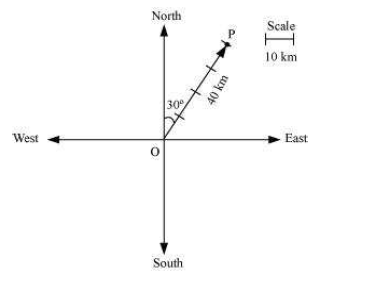
Question 1: Represent graphically a displacement of 40 km, $30 ^\circ$ east of north.
Answer:
Represent graphically a displacement of 40 km, $30 ^\circ$ east of north.
N,S,E,W are all 4 direction north,south,east,west respectively.
$\underset{OP}{\rightarrow}$ is displacement vector which $\left | \underset{OP}{\rightarrow} \right |$
= 40 km.
$\underset{OP}{\rightarrow}$ makes an angle of 30 degrees east of north as shown in the figure.
Question 2 (1): Classify the following measures as scalars and vectors.
10Kg
Answer:
10kg is a scalar quantity as it has only magnitude.
Question 2 (2): Classify the following measures as scalars and vectors. 2 meters north west
Answer:
This is a vector quantity as it has both magnitude and direction.
Question 2 (3): Classify the following measures as scalars and vectors. $40 ^\circ$
Answer:
This is a scalar quantity as it has only magnitude.
Question 2 (4): Classify the following measures as scalars and vectors. 40 watt
Answer:
This is a scalar quantity as it has only magnitude.
Question 2 (5): Classify the following measures as scalars and vectors. $10 ^{-19} \: \: coulomb$
Answer:
This is a scalar quantity as it has only magnitude.
Question 2 (6): Classify the following measures as scalars and vectors. $20 m/s^2$
Answer:
This is a Vector quantity as it has magnitude as well as direction.by looking at the unit, we conclude that measure is acceleration which is a vector.
Question 3: Classify the following as scalar and vector quantities.
(1) time period
Answer:
This is a scalar quantity as it has only magnitude.
Question 3: Classify the following as scalar and vector quantities.
(2) distance
Answer:
Distance is a scalar quantity as it has only magnitude.
Question 3: Classify the following as scalar and vector quantities.
(3) force
Answer:
Force is a vector quantity as it has both magnitudes as well as direction.
Question 3: Classify the following as scalar and vector quantities.
(4) velocity
Answer:
Velocity is a vector quantity as it has both magnitude and direction.
Question 3: Classify the following as scalar and vector quantities.
(5) work done
Answer:
work done is a scalar quantity, as it is the product of two vectors.
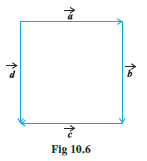
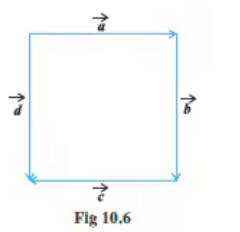
Question 4: In Fig 10.6 (a square), identify the following vectors.
(1) Coinitial
Answer:
Since vector $\vec{a}$ and vector $\vec{d}$ are starting from the same point, they are coinitial.
Question 4: In Fig 10.6 (a square), identify the following vectors.
(2) Equal
Answer:
Since Vector $\vec{b}$ and Vector $\vec{d}$ both have the same magnitude and same direction, they are equal.
Question 4: In Fig 10.6 (a square), identify the following vectors.
(3) Collinear but not equal
Answer:
Since vector $\vec{a}$ and vector $\vec{c}$ have the same magnitude but different direction, they are colinear and not equal.
Question 5: Answer the following as true or false.
(1) $\vec a$ and $-\vec a$ are collinear.
Answer:
True, $\vec a$ and $-\vec a$ are collinear. they both are parallel to one line hence they are colinear.
Question 5: Answer the following as true or false.
(2) Two collinear vectors are always equal in magnitude.
Answer:
False, because colinear means they are parallel to the same line but their magnitude can be anything and hence this is a false statement.
Question 5: Answer the following as true or false.
(3) Two vectors having same magnitude are collinear.
Answer:
False, because any two non-colinear vectors can have the same magnitude.
Question 5: Answer the following as true or false.
(4) Two collinear vectors having the same magnitude are equal.
Answer:
False, because two collinear vectors with the same magnitude can have opposite direction
Confused between CGPA and Percentage?
Get your results instantly with our calculator!
Topics Covered in Chapter 10 Vector Algebra: Exercise 10.1
Some Basic Concepts
- Position Vector: It indicates the location of a point in space in terms of the origin.
- Direction Cosines: These are the cosines of the angles a vector makes with the x, y, and z axes.
Types of Vectors
- Zero Vector: A vector with zero length and no definite direction.
- Unit Vector:A vector of unit magnitude, representing direction alone.
- Coinitial Vectors: Vectors which have the same initial point.
- Collinear Vectors: Vectors that are along the same line or parallel lines.
- Equal Vectors: Vectors of the same magnitude and direction, but no regard for starting point.
- Negative of a Vector: A vector of the same magnitude but opposite direction.
Also Read
- Vector Algebra Exercise 10.2
- Vector Algebra Exercise 10.3
- Vector Algebra Exercise 10.4
- Vector Algebra Miscellaneous Exercise
Also see-
NCERT Solutions Subject Wise
- NCERT Solutions Class 12 Chemistry
- NCERT Solutions for Class 12 Physics
- NCERT Solutions for Class 12 Biology
- NCERT Solutions for Class 12 Mathematics
Subject Wise NCERT Exemplar Solutions
Frequently Asked Questions (FAQs)
The unit of the quantity is given. The given unit meter per second square represents acceleration. And acceleration is a vector quantity. The concepts of acceleration are covered in the high school Class and also in Class11.
If the given vectors have the same magnitude and point towards the same directions then these vectors are equal
Yes, two collinear vectors can be in the same direction or in opposite directions.
No, collinear vectors can have different magnitudes.
The unit of force is Newton and is represented by N.
No, power is a scalar quantity. Power has magnitude but no direction
There may be questions to identify collinear and equal vectors and also to classify the given quantity as scalars and vectors.
The question asks to represent a vector from a reference. Here the reference direction is north and the vector is lying 30 degrees clockwise to the north(towards east). The magnitude of the vector is represented by choosing a scale. For example 1unit=10Km, then 40Km=4 units.

Questions related to CBSE Class 12th
On Question asked by student community
Hi Teena,
You can check the Hindi class 12th question paper .
if you need more resources please let us know.
Hi Lalit,
Here you can check the question paper.
https://school.careers360.com/boards/cbse/cbse-class-12-economics-question-paper-2026
if you need any other resources please let us know.
Hi Kanha,
You can download all subjects class 12th question paper from the given link .
https://school.careers360.com/boards/cbse/cbse-class-12-question-paper-2026
if you need any other resources please let us know.
Dear Student,
Please refer to the link provided below for the question papers in Hindi :|
https://school.careers360.com/hi/articles/cbse-previous-year-question-papers-class-12
If you need any other resource, do let us know.
Hi Lavkush,
Here is the link of question paper
https://school.careers360.com/boards/cbse/cbse-class-12-political-science-question-paper-2026
if you need any other resources please let us know.
Popular CBSE Class 12th Questions
A block of mass 0.50 kg is moving with a speed of 2.00 ms-1 on a smooth surface. It strikes another mass of 1.00 kg and then they move together as a single body. The energy loss during the collision is
| Option 1)
|
Option 2)
|
| Option 3)
|
Option 4)
|
An athlete in the olympic games covers a distance of 100 m in 10 s. His kinetic energy can be estimated to be in the range
| Option 1)
|
Option 2)
|
| Option 3)
|
Option 4)
|
A particle is projected at 600 to the horizontal with a kinetic energy . The kinetic energy at the highest point
| Option 1)
|
Option 2)
|
| Option 3)
|
Option 4)
|
In the reaction,
| Option 1)
|
Option 2)
|
| Option 3)
|
Option 4)
|
How many moles of magnesium phosphate, will contain 0.25 mole of oxygen atoms?
| Option 1)
0.02 |
Option 2)
3.125 × 10⁻² |
| Option 3)
1.25 × 10⁻² |
Option 4)
2.5 × 10⁻² |