KCC Institute of Legal and Higher Education, Greater Noida
Law Admissions 2026 Open | Avail Merit-Based Scholarships


Do you know why only Earth supports life? How do the air we breathe, the water we drink, the land we live in, and living organisms work together to maintain balance on Earth? What makes the sun the primary source of energy for our planet, and how the small change in one sphere can effect entire system on Earth? The answer to all these questions lies in the NCERT Solutions for Class 9 Science Chapter 13 Earth as a System: Energy, Matter and Life. Using these NCERT solutions, students will learn about the Uneven Heating of the Earth, Latitude and Earth’s shape, Role of the atmosphere, Wind and Ocean Currents, Biogeochemical Cycles and Human Impact on Earth’s Processes.
This Story also Contains
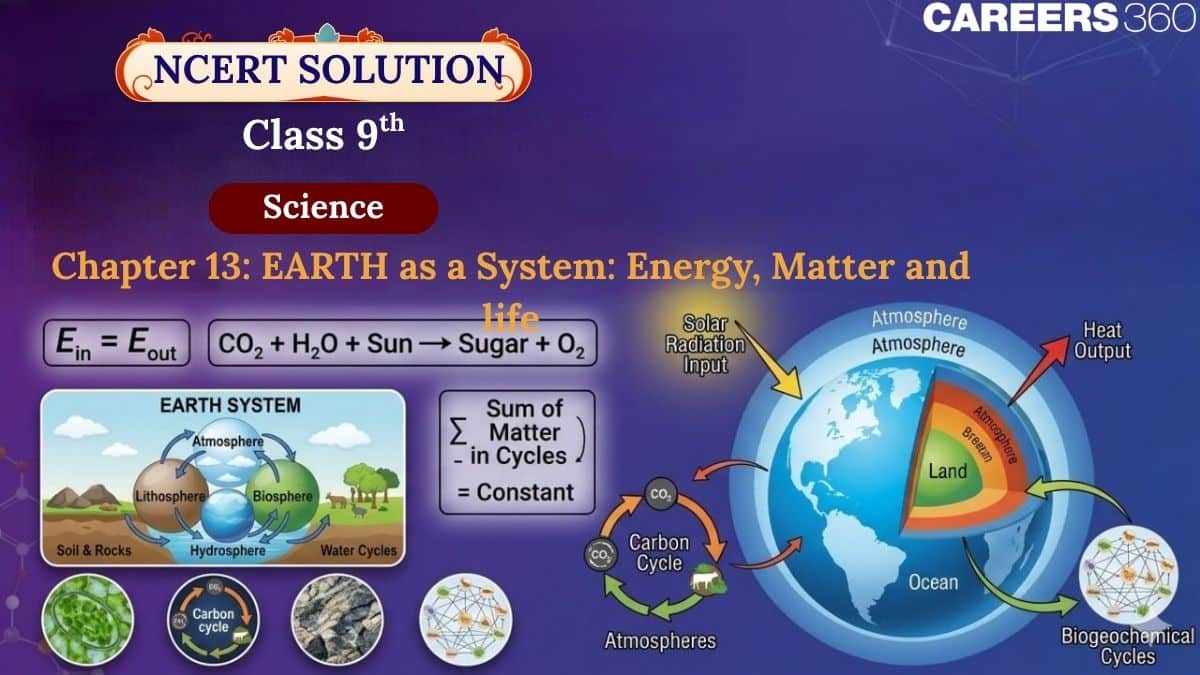
These NCERT Solutions for Class 9 are designed to help students understand the concepts easily and prepare effectively for exams. These solutions are prepared by experts in a very comprehensive manner so that students can learn concepts easily. All the in-text and end-of-exercise questions are covered in these solutions. These solutions help students to prepare effectively for school and competitive exams like JEE and NEET. Students can also download NCERT Solutions for Class 9 Science Chapter 13 Earth as a System: Energy, Matter and Life PDF from the button given below. Scroll down to learn more.
Students can refer to the button given below to download the NCERT Solutions for Class 9 Science chapter 13 Earth as a System: Energy, Matter and Life Questions and Answers PDF. Students should download this PDF and prepare effectively for their exams using these NCERT Solutions for Class 9 Science.
Below are the detailed Class 9 Science NCERT Solutions Chapter 13 Earth as a System: Energy, Matter and Life. These NCERT Solutions help students understand the concepts easily.
Refer to the detailed Think it over questions of NCERT Class 9 Science Chapter 13 Earth as a System: Energy, Matter and Life.
Page- 252
Question: How does the warming of Arabian Sea water affect the southwest monsoon in India?
Answer:
Due to the warming of the Arabian Sea, water evaporation increases, which adds more moisture to monsoon winds. Due to this, the southwest monsoon in India experiences heavy rainfall, cyclones, and irregular distribution of rain.
Question: If a large forest is cleared, how can that affect the flow of a river in that area?
Answer:
The forest plays an important role in maintaining the flow of the river. Because the clearance of forests leads the river to flow irregularly. Forests help in absorbing rainwater without forests, more water flows into rivers, causing floods during rain and reducing water flow during the dry season.
Question: What might happen to coastal cities in India if glaciers and polar ice keep melting faster?
Answer:
If Glaciers and polar ice keep melting faster, then the sea level will rise.
Effects on coastal areas:
1. Melting of glaciers and ice caps leads to flooding in coastal areas
2. Damage to land and infrastructure
3. Coastal areas may face heavy storms
4. Salt water can enter fresh water sources
Question: How would increasing carbon dioxide levels in the atmosphere affect the ocean plankton?
Answer:
Due to an increase in the carbon dioxide level in the atmosphere, the oceans are becoming more acidic, which restricts the growth and survival of plankton.
Below are detailed pause and ponder questions from the Class 9 Science NCERT Chapter 13. They are prepared by experts to help students understand the concepts easily.
Page-258
Question 1: Visit the website given below and study the effect of the concentration of greenhouse gas on surface temperature, https://phet.colorado. edu/en/simulations/ greenhouse-effect
Answer:
By studying the content given in the PhET Greenhouse effect simulation, the increase in the concentration of greenhouse gases is leading to an increase in Earth's temperature. Greenhouse gases trap more heat in the atmosphere, and the Earth becomes warmer.
Page-261
Question 2: How does the cool mountain breeze benefit agriculture activity, particularly the crops and soil?
Answer:
Cool mountain breeze helps in lowering the temperature and reducing evaporation from the soil. Due to which moisture is retained for a longer duration in the soil, and protects the crop from heat, and supports growth.
Question 3: What happens to the warm surface of water from the equator as it travels toward the poles? What impact does this movement have on the area?
Answer:
Water gradually cools when it travels from the equator towards the poles because of this movement, heat transfers to colder regions, leading to the moderation of the climate in coastal areas.
Page- 263
Question 4: The
Answer:
Due to an increase in global temperature, the balance of dissolved carbon dioxide in the ocean gets disturbed, making ocean water warmer and more acidic. This can harm marine life by reducing their growth and survival.
Page-265
Question 5: What would happen to plants and animals on Earth if the biogeochemical cycles were disrupted and stopped? Explain by giving a few examples.
Answer:
Biogeochemical cycles help plants and animals to get essential nutrients and gases needed for survival. Disruption of the biochemical cycle leads ecosystems to collapse and seriously affects life on Earth.
Example
1. Plants would not get enough carbon dioxide for photosynthesis due to the disruption of the biochemical cycle
2. The nitrogen cycle provides essential nutrients for plant growth. If the cycle stops, then the soil would lose nutrients.
3. This also affects rainfall and causes situations like drought.
Page-266
Question 6: Discuss how human activities increase the concentration of greenhouse gases in the atmosphere. What would you do as an individual to reduce the emission of greenhouse gas?
Answer:
Human activities like deforestation, burning of fossil fuels, use of vehicles, etc increases the greenhouse gases like carbon dioxide and methane in the atmosphere. Burning of fossil fuels releases a large amount of carbon dioxide into the atmosphere, and deforestation reduces the number of plants, leading to less absorption of carbon dioxide. Factories and the burning of waste release greenhouse gases. All these gases lead to global warming.
As an individual, things I can do to reduce the emission of greenhouse gas are:
1. Use public transport
2. Saving electricity
3. Planting more trees
Get your results instantly with our calculator!
Students can refer to the detailed solutions given below for end chapter exercise questions of NCERT Class 9 Science Chapter 13 Earth as a System
Question 1: Choose the most appropriate option to describe the role of biogeochemical cycles in an ecosystem.
(i) To provide food directly to all organisms.
(ii) To recycle essential nutrients between biotic and abiotic components.
(iii) To create new elements for use by living things.
(iv) To remove pollutants and toxins from the organism.
Answer:
To recycle essential nutrients between biotic and abiotic components is correct option because biogeochemical cycle helps in movement and recycling of nutrients like carbon, nitrogen, and oxygen between living organisms and the environment. This cycle is important because it helps in balancing the nutrients in nature and supports life.
Hence, the correct answer is option (ii)
Question 2: Which of the following is primarily responsible for warming of the Earth?
(i) Solar radiation is immediately absorbed by carbon dioxide, which then releases it as heat.
(ii) The atmosphere’s tiny particles absorb incoming solar radiation, which directly heats the Earth.
(iii) The Earth’s surface absorbs solar radiation, which is then re-radiated and trapped by greenhouse gases.
(iv) The Earth’s environment is heated only by the solar radiation reflected by the clouds.
Answer:
The Earth’s surface absorbs solar radiation, which is then re-radiated and trapped by greenhouse gases is correct and primarily responsible for warming of the earth. Rays from sun warms earth surface and then redirected towards atmosphere where gases like carbon dioxide and methane absorb the heat causing warming of the earth.
Hence, the correct answer is option (3).
Question 3: Explain how climate change affects the water cycle. Illustrate with examples.
Answer:
The water cycle is affected by changes in climate. Increases in the Earth's temperature make changes in the patterns of evaporation, rainfall, and water availability. Hot climate increases the movement of water through the water cycle and makes weather events more extreme.
The Effects of Climate Change on the Water Cycle are given below:
1. Evaporation increases due to increase in temperature which leads to increase in the amount of water vapour in the atmosphere.
2. Due to climate change, rainfall becomes irregular. Some regions receive very heavy rainfall and floods, while others face less rainfall and droughts.
3. Rise in temperature leads glaciers and ice caps to melt, which in turn increases the water level in oceans.
4. Changes in climate increase the frequency of floods, storms, cyclones, and other natural disasters.
Examples:
It is observed that due to climate changes some parts of country receives more rainfall cause floods while others receive less rainfall causing droughts.
Question 4: Describe how albedo affects the Earth’s surface temperature and its climate.
Answer:
The measurement of amount of sunlight that is reflected back to space by surface is albedo. Surfaces like snow, ice, and clouds are high albedo surfaces because they reflect most of the sunlight, while surfaces like forests, oceans, and dark soil are low albedo surfaces because they absorb more sunlight.
Law Admissions 2026 Open | Avail Merit-Based Scholarships
BBA/MBA/PGDM Early Bird Applications Deadline 19th Oct '26. Apply now using coupon code CAREER250 and get ₹250 off the application fee
Question 5: How are mountain and valley breezes formed? Suppose there are two mountains, one covered with grass and another covered with barren rocks; would the temperature of the two mountain breezes be different? If so, how?
Answer:
Valley Breeze is a daytime breeze, it is formed due to the heating of mountain slopes during the day. The air above the slopes becomes warm and rises upward. Cooler air from the valley moves up the slopes to replace it. Movement of air from the valley towards the mountain is a valley breeze.
Mountain Breeze is a nighttime breeze; it is formed due to the cooling of mountains during the night. The air above the slopes becomes cool and dense, so it flows downward. This movement of cool air from the mountains to the valley is called a mountain breeze.
Yes, the temperature of the breezes would be different for both mountains because the mountain covered with barren rocks would heat up faster during the day and cool down faster at night because rocks absorb and lose heat quickly while the mountain covered with grass would remain relatively cooler during the day and warmer at night because grass retains moisture and heat for longer.
Question 6: You have witnessed weather phenomena, such as winds, storms, rainfall, etc. Which atmospheric layer is mainly responsible for such phenomena and what is the primary reason for its occurrence?
Answer:
The lowest layer of atmosphere, i.e., troposphere, is mainly responsible for weather phenomena like winds, storms, rainfall, clouds, and thunderstorms
Reason for occurrences of the phenomenon in this layer:
Question 7: Explain the processes involved in the nitrogen cycle. How would life on Earth be affected if nitrogen were not cycled?
Answer:
Movement of nitrogen between the atmosphere, soil, plants, animals, and microorganisms is the nitrogen cycle. Due to this cycle, nitrogen becomes available to living organisms in useful form
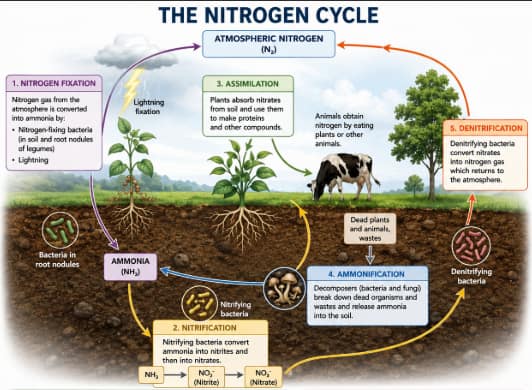
Nitrogen Cycle:
1. Nitrogen Fixation
Most organisms cannot use atmospheric nitrogen directly. Certain bacteria and lightning convert nitrogen gas into ammonia or nitrates that plants can absorb.
2. Nitrification
Ammonia is converted into nitrites and then into nitrates by bacteria present in soil.
3. Assimilation
Nitrates from the soil are absorbed by plants and used to make proteins and other important compounds.
4. Ammonification
Decomposers break down the remains of dead plants and animals and release ammonia back into the soil.
5. Denitrification
Nitrates in the soil are converted back into nitrogen gas by some bacteria, which returns to the atmosphere and completes the cycle.
If nitrogen were not recycled, then plants would not get enough nitrogen to grow properly, which leads to a decrease in crop production. Humans and animals would not get enough nitrogen and waster of dead plants and animals would accmulated.
Question 8: What are the impacts of deforestation on the Earth’s oxygen and carbon cycles? What are the other consequences of deforestation?
Answer:
Trees plays an important role in balancing the oxygen and carbon cycle. Due to deforestation number of trees decreases which will impact oxygen and carbon cycle.
Impact on Oxygen Cycle
Due to deforestation, forests are cut down, and less oxygen is produced because trees release oxygen during photosynthesis. The balance of oxygen in the atmosphere disturbs and affects respiration in living organisms.
Impact on Carbon Cycle
Due to deforestation, forests are cut down, and the number of trees has decreased. Trees absorb carbon dioxide from the atmosphere and store carbon.Burning and cutting trees also release stored carbon back into the atmosphere.
Consequences of Deforestation
1. Loss of Biodiversity
2. Soil Erosion
3. Disturbance in the Water Cycle
4. Increase in Floods and Landslides
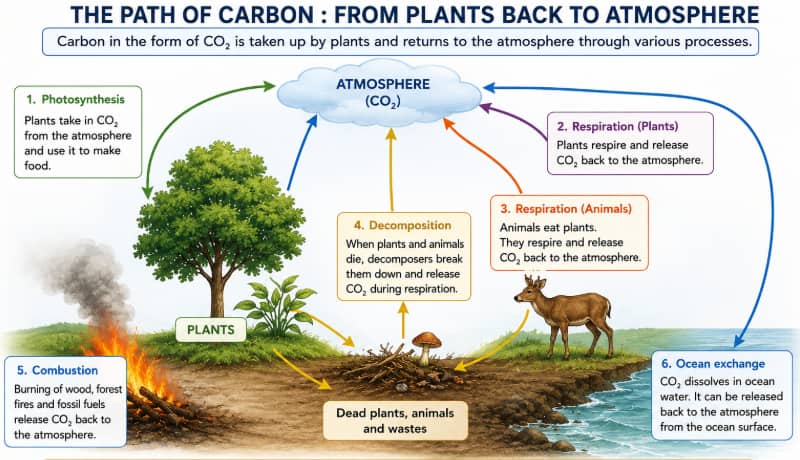
Question 9: Explain with suitable diagram the path that carbon takes to go back to the atmosphere. You may start from plants using
Answer:
During photosynthesis plants use carbon dioxide from the atmosphere to make food.
Path that carbon takes to go back to the atmosphere
1. Plants and animals release carbon dioxide through respiration
2. Bacteria and fungi brakes down dead body parts of plants and animals. During decomposition carbon compounds converted into carbon dioxide and released to atmosphere.
3. Burning of fossil fule releases carbon dioxide in atmosphere.
Question 10: Why is an excess of
Answer:
Plants require carbon dioxide for photosynthesis but excess of carbon dioxide in atmosphere produces green house effect and global warming. Which increase temperature of earth surface and leads to climate changes.
Question 11: How is heat lost from the surface of the Earth? What is its significance?
Answer:
Earth becomes warmer by absorbing heat from sun, this warm surface emits heat back in atmosphere in the form of infrared rays, some heat is escape in space while remaining is trapped by greenhouse gases. This lost in heat helps in maintaining earth temperature, prevents overheating, and supports climate and weather.
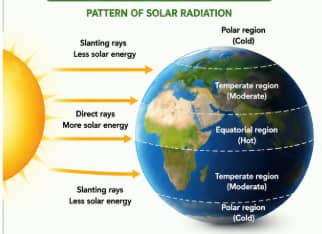
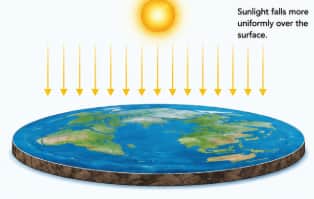
Question 12: If the Earth were a flat disc instead of a sphere, how would the patterns of solar radiation and temperature be different?
Answer:
Instead of a sphere, if the Earth were a flat disc, then the pattern of solar radiation and temperature would be different. Due to the spherical shape of earth sunligh falls at different angles, but if earth was flat, then sunlight would fall more evenly on the surface, leading to a decrease in the difference in temperature between regions and tropical, temperate, and polar climate zones would not form properly. Seasons, wind patterns, rainfall, and ocean currents would also affect.
Question 13: Suppose there is a rise in atmospheric temperature on Earth. How would this affect the cryosphere, hydrosphere, and biosphere?
Answer:
Rise in atmospheric temperature would affect the cryosphere, hydrosphere, and biosphere.
1. Cryosphere
Due to an increase in temperature, glaciers, polar ice caps, and snow areas melt faster, which will increase sea levels.
2. Hydrosphere
The water cycle gets disturbed because of the melting of ice, and evaporation increases.
3. Biosphere
Rise in atmospheric temperature leads Animals, Plants and humans to face changes.
Question 14: Explain how the Earth’s atmosphere helps in maintaining a suitable temperature for life to survive on the Earth.
Answer:
With the help of green house effect earth atmosphere maintains a suitable temperature. During the day earth surface absorbs sunlight and becomes warm. At night, heat is released from the Earth's surface in the form of infrared radiation, but greenhouse gases like methane, carbon dioxide, and water vapour trap some heat and prevents complete escaping of heat in the space. This process maintains balance and prevents extreme weather conditions.
Question 15: Describe the interrelationship between different spheres of the Earth. Illustrate with example how these spheres function in a delicate balance.
Answer:
There are 4 major spheres of earth:
1. Atmosphere
2. Hydrosphere
3. Lithosphere
4. Biosphere
All spheres are interconnected and depend on one another to maintain balance on Earth.
The atmosphere provides gases needed by living organisms, the hydrosphere provides water, the lithosphere provides land, soil, minerals, and the biosphere includes all living organisms that interact with the other spheres. Plants in the biosphere absorb water from the hydrosphere and minerals from the lithosphere, while taking carbon dioxide from the atmosphere for photosynthesis. In return, plants release oxygen into the atmosphere and help maintain the carbon and oxygen cycles.
Given below are all the topics and subtopics that are covered in Earth as a System: Energy, Matter, and Life Class 9 Science Chapter 13 NCERT:
13.1 Uneven Heating of the Earth
13.2 Uneven Heating Causes Wind and Ocean Currents
13.3 Biogeochemical Cycles
13.4 Human Impact on Earth’s Processes
Also Check
Refer to the links given below for detailed solutions of NCERT Class 9 Science. These solutions are prepared by subject experts to help you understand the chapters well and prepare effectively for exams using NCERT.
Frequently Asked Questions (FAQs)
Class 9 Science Chapter 13 Earth as a System: Energy, Matter, and Life Solutions are detailed answers to all the in text and end of exercise NCERT textbook questions.
NCERT Solutions for Class 9 are chapterwise solutions prepared to help students understand the basic concepts of chapters and prepared effectively for exams with the help of detailed solutions.
Students can download these solutions from the download button given above in the article. These solutions are prepared by expers in a very clear and comprehensive manner.

A block of mass 0.50 kg is moving with a speed of 2.00 ms-1 on a smooth surface. It strikes another mass of 1.00 kg and then they move together as a single body. The energy loss during the collision is
| Option 1)
|
Option 2)
|
| Option 3)
|
Option 4)
|
An athlete in the olympic games covers a distance of 100 m in 10 s. His kinetic energy can be estimated to be in the range
| Option 1)
|
Option 2)
|
| Option 3)
|
Option 4)
|
A particle is projected at 600 to the horizontal with a kinetic energy . The kinetic energy at the highest point
| Option 1)
|
Option 2)
|
| Option 3)
|
Option 4)
|
In the reaction,
| Option 1)
|
Option 2)
|
| Option 3)
|
Option 4)
|
How many moles of magnesium phosphate, will contain 0.25 mole of oxygen atoms?
| Option 1)
0.02 |
Option 2)
3.125 × 10⁻² |
| Option 3)
1.25 × 10⁻² |
Option 4)
2.5 × 10⁻² |

Law Admissions 2026 Open | Avail Merit-Based Scholarships
BBA/MBA/PGDM Early Bird Applications Deadline 19th Oct '26. Apply now using coupon code CAREER250 and get ₹250 off the application fee
Ranked #36 amongst institutions in Management by NIRF | 100% Placement
Globally Recognized by AACSB (US) & AMBA (UK) | 18 LPA Avg. CTC for PGPM 2026
Leading Design College | 95% Placement Record | Merit-cum-Means Scholarships for Deserving Students
NEET PG All India & State College Predictor with Admission Process Guide