


NCERT Solutions for Class 9 Maths Chapter 6 - Measuring Space: Perimeter and Area
Have you ever asked yourself how we measure the space inside a playground or the boundary around a garden? Or ever thought why measurement is important in construction and design? These NCERT Solutions for Class 9 Mathematics Chapter 6 Measuring Space: Perimeter and Area will clear all your doubts and make you familiar with a very important chapter. We know that perimeter measures the boundary whereas area measures the space within and together they help us understand shapes completely. The primary aim of the NCERT Solutions for Class 9 Maths is to strengthen the foundation of area and perimeter so that students can solve complex problems in classes 9 and 10 and beyond.
This Story also Contains
- Measuring Space: Perimeter and Area Class 9 Questions and Answers PDF Free Download
- NCERT Solutions for Class 9 Maths Chapter 6 Measuring Space: Perimeter and Area: Exercise Questions
- Measuring Space: Perimeter and Area Class 9 Chapter 6: Topics
- Class 9 Maths NCERT Chapter 6 Solutions: Extra Questions
- NCERT Solutions for Class 9 Maths Chapter Wise
- NCERT Class 9 Books & Syllabus
Everywhere in real life, from building houses to designing parks, we use perimeter and area. These NCERT solutions for class 9 are student-friendly and these solutions explain the concepts in step by step manner to understand well. Our experienced faculty at Careers360 has prepared these solutions. Many students refer to these NCERT solutions to get confidence in solving the textbook exercises on their own.
Measuring Space: Perimeter and Area Class 9 Questions and Answers PDF Free Download
Students can download the Class 9 Maths Chapter 6 Measuring Space: Perimeter and Area PDF by clicking the link provided below.
NCERT Solutions for Class 9 Maths Chapter 6 Measuring Space: Perimeter and Area: Exercise Questions
Below, you will find the NCERT Class 9 Maths Chapter 6 Measuring Space: Perimeter and Area question answers explained step by step.
Think and Reflect (Page 118)
Question: In my school, the playground is too small to have a 400 m track, so the school constructed a 200 m track instead. Does this mean that we need a smaller stagger for the race tracks in my school (i.e., smaller than the stagger used in the Olympics), for the same 4 × 100 m relay race?
$\textbf{Answer:}$
No.
For a $4 \times 100 \mathrm{~m}$ relay, the stagger depends on the difference in distances travelled by runners in different lanes, not on the total length of the track.
Suppose the lanes are $w$ metres wide.
The radius of lane 2 is $w$ metres larger than that of lane 1.
For one complete circle, the extra distance in lane 2 $=2 \pi(R+w)-2 \pi R=2 \pi w $
For a 400 m track, the first runner runs one full bend (a semicircle),
so the required stagger is $\frac{1}{2}(2 \pi w)=\pi w$
Now consider a 200 m track. The bends are tighter, but the first runner in a $4 \times 100 \mathrm{~m}$ relay still runs around one semicircular bend before entering the straight.
The extra distance between adjacent lanes on a semicircle is still $\pi w$.
Therefore, if the lane widths are the same, the stagger for the relay is the same on a 200 m track as on a 400 m track.
Measuring Space: Perimeter and Area Class 9 Questions and AnswersExercise Set 6.1 |
Unless stated otherwise, use the approximation $\frac{22}{7}$ for $\pi$.
Question 1. The perimeter of a circle is 44 cm. What is its radius?
$\textbf{Answer:}$
We know that perimeter of a circle = $2\pi r$, where $r$ is the radius
According to the question,
$2\pi r =44$
$2\times\frac{22}7\times r = 44$
$\therefore r=7$ cm
Hence, the radius of the circle is 7 cm.
Question 2. Calculate, correct to 3 significant figures, the circumference of a circle with:
(i) radius 7 cm
(ii) radius 10 cm
(iii) radius 12 cm.
$\textbf{Answer:}$
We know that perimeter of a circle = $2\pi r$, where $r$ is the radius
(i) When $r=7$ cm,
Perimeter $=2\times\frac{22}7\times7=44$ cm
(ii) When $r=10$ cm,
Perimeter $=2\times\frac{22}7\times10=\frac{440}{7}=62.86$ cm
(iii) When $r=12$ cm,
Perimeter $=2\times\frac{22}7\times12=\frac{528}7=75.43$ cm
Question 3. Calculate the length of the arc of a circle if:
(i) the radius is 3.5 cm and the angle at the centre is $60^{\circ}$,
and (ii) the radius is 6.3 m and the angle at the centre is $120^{\circ}$.
$\textbf{Answer:}$
We know that Arc length of a circle $=\frac{\theta}{360^{\circ}} \times 2 \pi r$, where $\theta$ is the cental angle and $r$ is the radius
(i) Here, $r=3.5$ and $\theta=60^\circ$
So, the arc length of the circle
$=\frac{60}{360} \times 2 \times \frac{22}{7} \times 3.5$
$=\frac{11}3=3.67$ cm
(ii) Here, $r=6.3$ and $\theta=120^\circ$
So, the arc length of the circle
$=\frac{120}{360} \times 2 \times \frac{22}{7} \times 6.3$
$=13.2$ cm
Question 4. Find the perimeter of a sector (i.e., the curved portion as well as the two straight portions) of a circle of radius 14 cm and sector angle $75^{\circ}$.
$\textbf{Answer:}$
We know that Arc length of a circle $=\frac{\theta}{360^{\circ}} \times 2 \pi r$, where $\theta$ is the central angle and $r$ is the radius
Here, $r=14$ and $\theta=75^\circ$
So, the arc length of the circle
$=\frac{75}{360} \times 2 \times \frac{22}{7} \times 14$
$=\frac{55}3$ cm
Perimeter of the sector
= Arc length + 2 × Radius
$=\frac{55}3+2\times14$
$=\frac{55+84}{3}$
$=\frac{139}3$
$=46.33$ cm
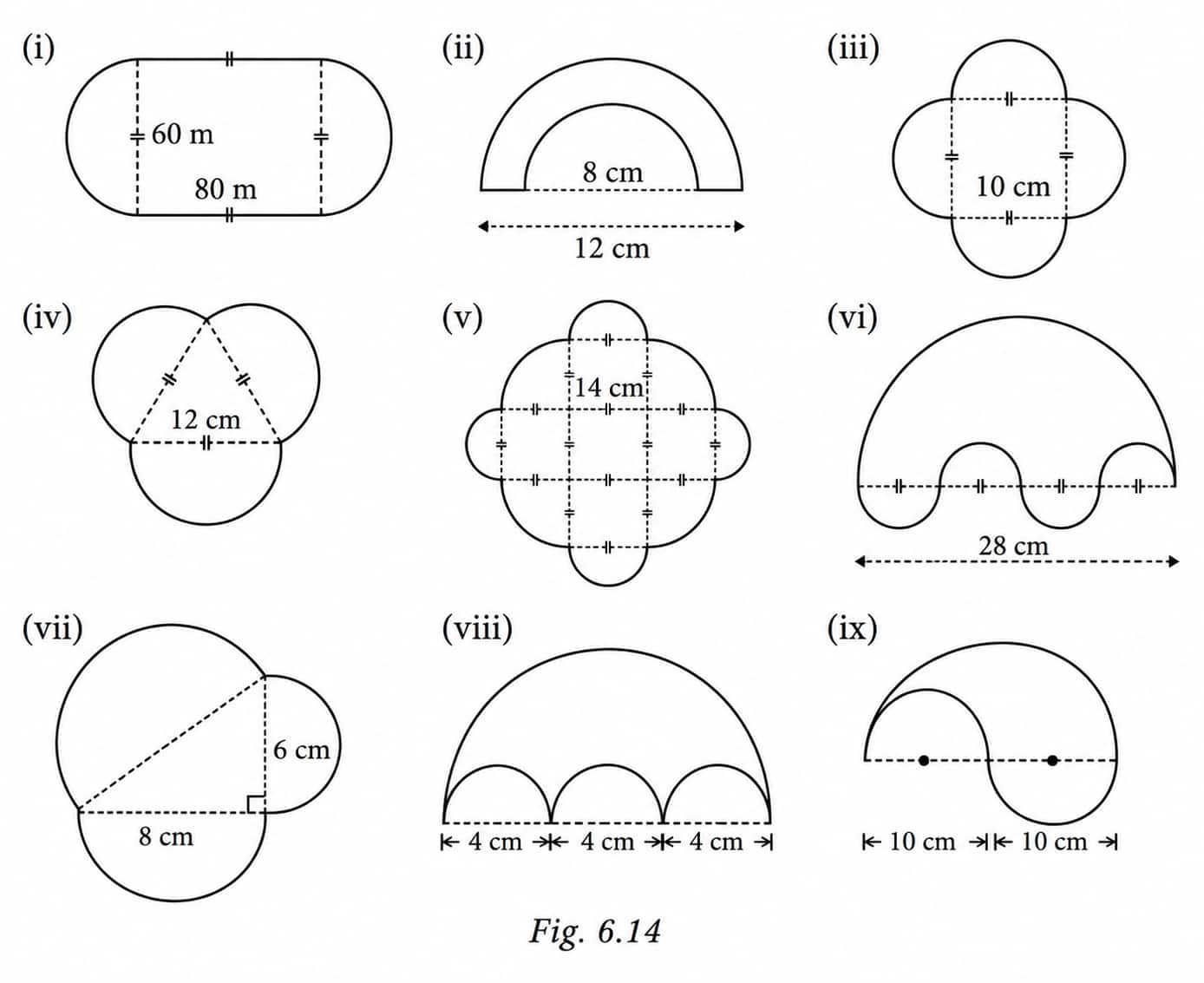
Question 5. Find the perimeters of the following shapes (taking the arcs to be quarter or half or three-quarters of a circle, as appropriate) (Fig. 6.14i to 6.14ix):
$\textbf{Answer:}$
(i)
This shape consists of:
- two straight portions of 80 m each
- two semicircles of diameter 60 m.
The two semicircles together form one complete circle.
Circumference of the circle = $2\pi r=\frac{22}7\times 60=\frac{1320}7$
Now, Perimeter
= Two straight portions of 80 m + Circumference of the circle
$= 80+80+\frac{1320}7=\frac{2440}7=348.57$ cm
(ii)
Outer semicircle diameter $=12 \mathrm{~cm}$
Outer radius $=6 \mathrm{~cm}$
Inner semicircle diameter $=8 \mathrm{~cm}$
Inner radius $=4 \mathrm{~cm}$
Two straight side parts: $=2 \mathrm{~cm}+2 \mathrm{~cm}=4 \mathrm{~cm}$
Perimeter
= outer semicircle + inner semicircle + straight parts
= $\frac12\times2\pi\times6+\frac12\times2\pi\times4+4$
$=6\pi+4\pi+4$
$=10\pi+4$
$=10 \times \frac{22}{7}+4$
$=\frac{248}7$
$=35.43$ cm
(iii)
The figure has four semicircles, each of diameter 10 cm.
So, radius of the semicircle = $\frac{10}2=5$ cm
Total perimeter
= 4 × Semi-circle length
$=4\times\frac12\times2\times\frac{22}7\times5$
$=\frac{440}7=62.86$ cm
(iv)
The dashed triangle is equilateral with a side of 12 cm.
Each side is the diameter of a semicircle.
So, radius of a semicircle = $\frac{12}2=6$ cm
Perimeter consists of 3 semicircular arcs.
So, total perimeter
= 3 × Semi-circle length
$=3\times\frac12\times2\times\frac{22}7\times6$
$=56.57$ cm
(v)
The figure has 4 semicircles, each with a diameter of 14 cm and 4 quarter circles, each with a radius of 14 cm.
Radius of each semicircle $=7 \mathrm{~cm}$
Total Perimeter
= $4 \times$ semicircle length + $4 \times$ quarter circle length
$=(4\times\frac12\times2\pi\times7)+(4\times\frac12\times 2\pi\times 7)$
$=28\pi+28\pi$
$=56\pi$
$=56\times\frac{22}7$
$=176$ cm
(vi)
The total base width is 28 cm, which serves as the diameter for the large semicircle ( $R=14 \mathrm{~cm}$ ). The four smaller semicircles evenly split the 28 cm baseline, so each has a diameter of $\frac{28}{4}=7 \mathrm{~cm}$ (radius $r=3.5 \mathrm{~cm}$ ).
Perimeter $=$ Arc of large semicircle $+4 \times$ Arc of small semicircle
⇒ Perimeter $=\pi R+4(\pi r)$
⇒ Perimeter $=\pi(14)+4 \pi(3.5)$
⇒ Perimeter $=14 \pi+14 \pi=28 \pi$
Using $\pi \approx \frac{22}{7}$
⇒ Perimeter $\approx 28\left(\frac{22}{7}\right)=88$
Hence, the correct answer is 88 cm.
(vii)
Given: The shape consists of two partial circular arcs intersecting along a right-angled triangle with sides 6 cm and 8 cm.
By Pythagoras' theorem, the hypotenuse is $\sqrt{6^2+8^2}=10 \mathrm{~cm}$.
So, $r_3=\frac{10}2=5$ cm
The larger arc is a three-quarter circle with radius $r_1=\frac82=4 \mathrm{~cm}$, and the smaller arc is a semicircle with diameter $d= 6 \mathrm{~cm}\left(r_2=3 \mathrm{~cm}\right)$.
So, Total perimeter $=\pi r_1+\pi r_2+\pi r_3=\pi\left(r_1+r_2+r_3\right) $
$ =\frac{22}{7} \times(3+4+5) $
$ =\frac{22}{7} \times 12=37.71$ cm
Hence, the correct answer is $37.71 \mathrm{~cm}$.
(viii)
The total width is $4+4+4=12 \mathrm{~cm}$, which is the diameter of the large semicircle ( $R=6 \mathrm{~cm}$ ).
Each of the three small semicircles has a diameter of 4 cm ( $r=2 \mathrm{~cm}$ ).
Perimeter $=$ Arc of large semicircle $+3 \times$ Arc of small semicircle
⇒ Perimeter $=\pi R+3(\pi r)$
⇒ Perimeter $=\pi(6)+3 \pi(2)$
⇒ Perimeter $=6 \pi+6 \pi=12 \pi$
Using $\pi \approx \frac{22}{7}$
⇒ Perimeter $\approx 12\left(\frac{22}{7}\right)=\frac{264}{7} \approx 37.71$
Hence, the correct answer is $37.71\mathrm{~cm}$.
(ix)
The shape is bounded by a large upper semicircle with a diameter of $10+10=20 \mathrm{~cm}(R=10 \mathrm{~cm})$.
The inner boundary consists of two matching, adjacent semicircles, each having a diameter of $10 \mathrm{~cm}(r=5 \mathrm{~cm})$.
Perimeter $=$ Arc of large semicircle $+2 \times$ Arc of small semicircle
⇒ Perimeter $=\pi R+2(\pi r)$
⇒ Perimeter $=\pi(10)+2 \pi(5)$
⇒ Perimeter $=10 \pi+10 \pi=20 \pi$
Using $\pi \approx \frac{22}{7}$
⇒ Perimeter $\approx 20\left(\frac{22}{7}\right)=\frac{440}{7} \approx 62.86$
Hence, the correct answer is $62.86 \mathrm{~cm}$.
Question 6. If the diameter of a car tyre is 56 cm, then:
(i) How far does the car need to travel for the tyre to complete one revolution?
(ii) How many revolutions does the tyre make if the car travels 10 km
$\textbf{Answer:}$
(i)
The distance travelled in one revolution is equal to the circumference of the tyre.
We know that perimeter of a circle = $2\pi r$, where $r$ is the radius
Diameter of a car tyre, $d$ = 56
So, $2\pi r=56\times\frac{22}7=176$ cm [As $d=2r$]
Hence, the car needs to travel 176 cm for the tyre to complete one revolution.
(ii)
$10 \mathrm{~km}=10 \times 1000 \times 100 =1000000 \mathrm{~cm}$
Number of revolutions
$=\frac{\text { Total distance }}{\text { Circumference }}$
$\begin{aligned} & =\frac{1,000,000}{176} \\ & =5681.818 \ldots\end{aligned}$
$\approx 5682$
Hence, after 5682 revolutions, the tyre makes the car travel 10 km.
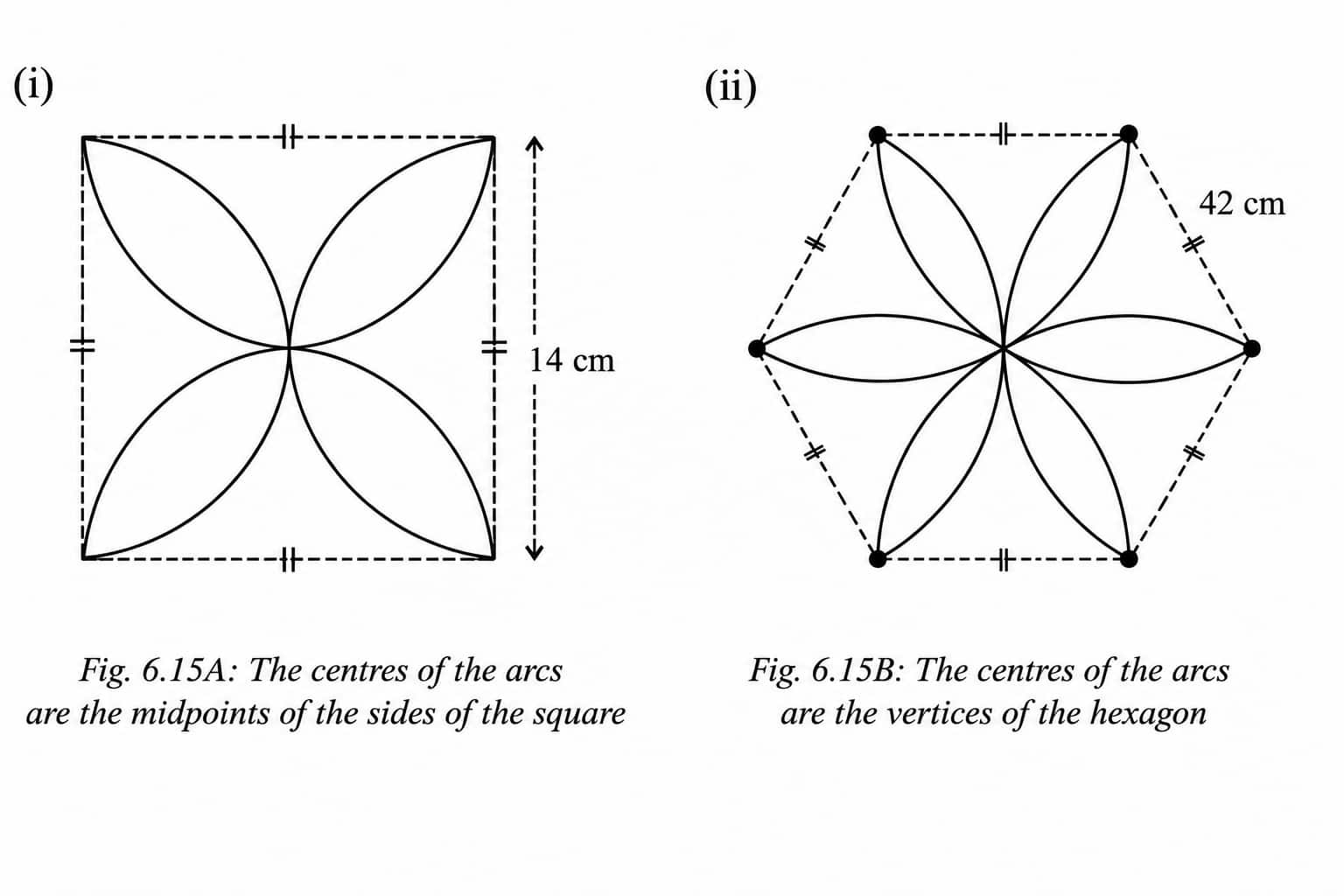
Question 7. Find the total perimeter of all the petals in each of the given flowers.
$\textbf{Answer:}$
For Flower (i) in Fig. 6.15A
The side length of the square is 14 cm. The centres of the circular arcs are the midpoints of the sides, which means each side of length 14 cm forms the diameter of a semicircle.
The radius of each semicircle is $r=\frac{14}{2}=7 \mathrm{~cm}$.
The 4-petalled flower is formed by the boundary arcs of four semicircles. Each petal is bounded by two curves, making the total outer perimeter of all the petals exactly equal to the total boundary length of the 4 semicircles combined.
Perimeter of one semicircular arc $=\pi r$
⇒ Total perimeter of all petals $=4 \times(\pi r)$
⇒ Total perimeter $=4 \times\left(\frac{22}{7} \times 7\right)$
⇒ Total perimeter $=4 \times 22$
⇒ Total perimeter = 88
Hence, the correct answer is 88 cm.
For Flower (ii) in Fig. 6.15B
The side length of the regular hexagon is 42 cm.
The centres of the circular arcs are the vertices of the hexagon, and each arc passes through adjacent vertices, meaning the radius of each circular sector is $r=42 \mathrm{~cm}$.
The interior angle of a regular hexagon is $\theta=\frac{(6-2) \times 180^{\circ}}{6}=120^{\circ}$.
The 6-petalled flower is composed of arcs belonging to 6 identical circular sectors centred at each of the 6 vertices. Since each petal is shared between adjacent sectors, the boundary edges of all the 6 petals combined correspond to the 6 sector arcs.
Length of one sector arc $=\frac{\theta}{360^{\circ}} \times 2 \pi r$
⇒ Length of one sector arc $=\frac{120^{\circ}}{360^{\circ}} \times 2 \pi r=\frac{1}{3} \times 2 \pi r$
⇒ Total perimeter of all petals $=6 \times\left(\frac{1}{3} \times 2 \pi r\right)$
⇒ Total perimeter $=4 \pi r$
⇒ Total perimeter $=4 \times \frac{22}{7} \times 42$
⇒ Total perimeter $=4 \times 22 \times 6$
⇒ Total perimeter = 528
Hence, the correct answer is 528 cm.
Question 8. The ratio of the perimeters of two circles is 5:4. What is the ratio of their radii?
$\textbf{Answer:}$
We know that perimeter of a circle = $2\pi r$, where $r$ is the radius
Let the radii of two circles be $r_1$ and $r_2$, respectively,
According to the question,
$\frac{2\pi r_1}{2\pi r_2}=\frac54$
$⇒\frac{r_1}{r_2}=\frac54$
$\therefore r_1:r_2=5:4$
Hence, the ratio of their radii is 5 : 4.
Measuring Space: Perimeter and Area Class 9 Questions and AnswersExercise Set 6.2 |
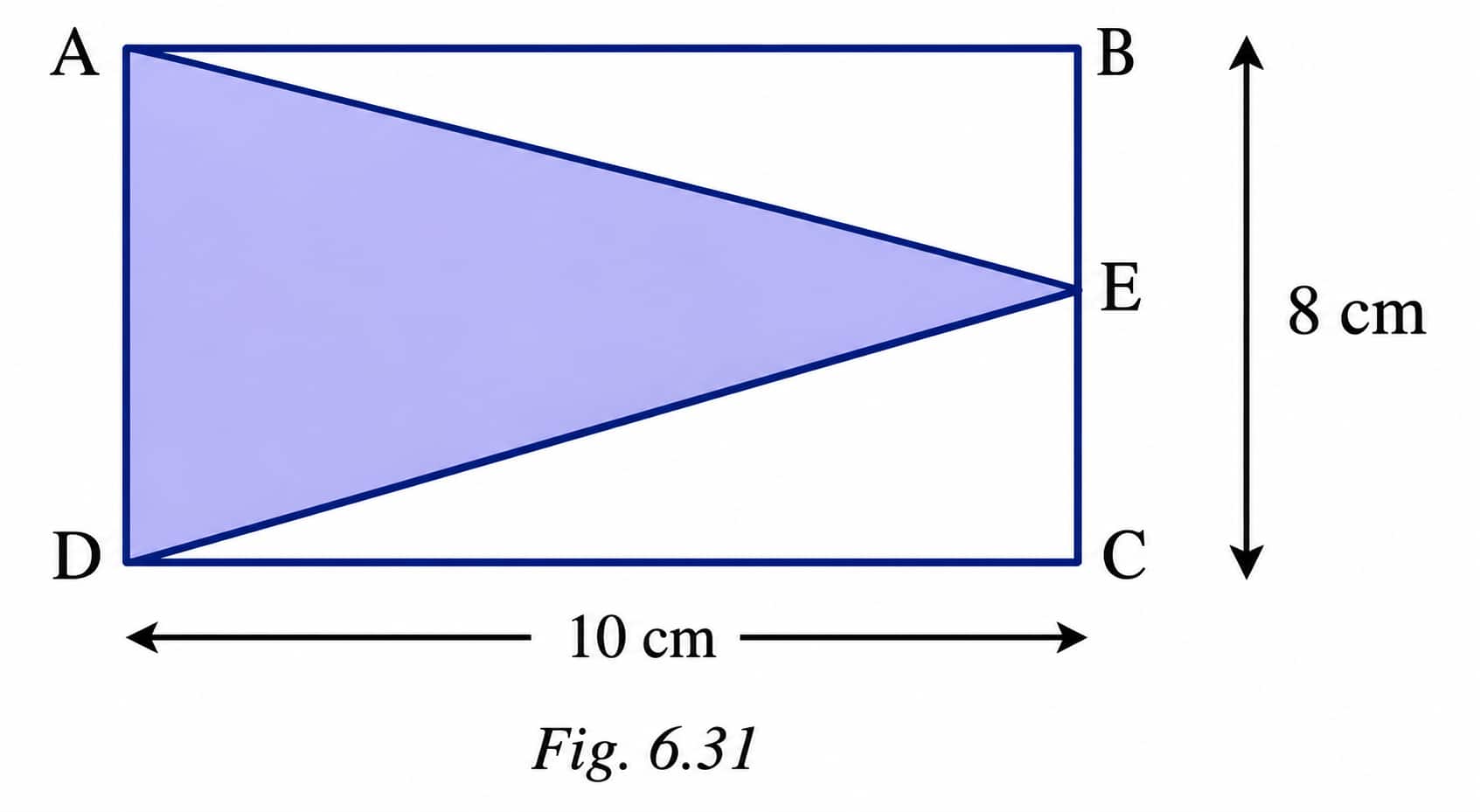
Question 1. Find the area of triangle ADE in Fig. 6.31.
$\textbf{Answer:}$
BC = AD = 8 cm
DC = AB = 10 cm
If we draw an altitude of the triangle ADE, it will be equal to DC or AB, i.e., 10 cm
We know that, Area of a triangle = $\frac 12\times$ Base $\times$ Altitude
Here, Base = 8 cm, Altitude = 10 cm
So, area of triangle ADE = $\frac 12\times8\times10=40\ \text{cm}^2$
Question 2. The parallel sides of a trapezium are 40 cm and 20 cm. If its non-parallel sides are both equal, each being 26 cm, find the area of the trapezium.
$\textbf{Answer:}$
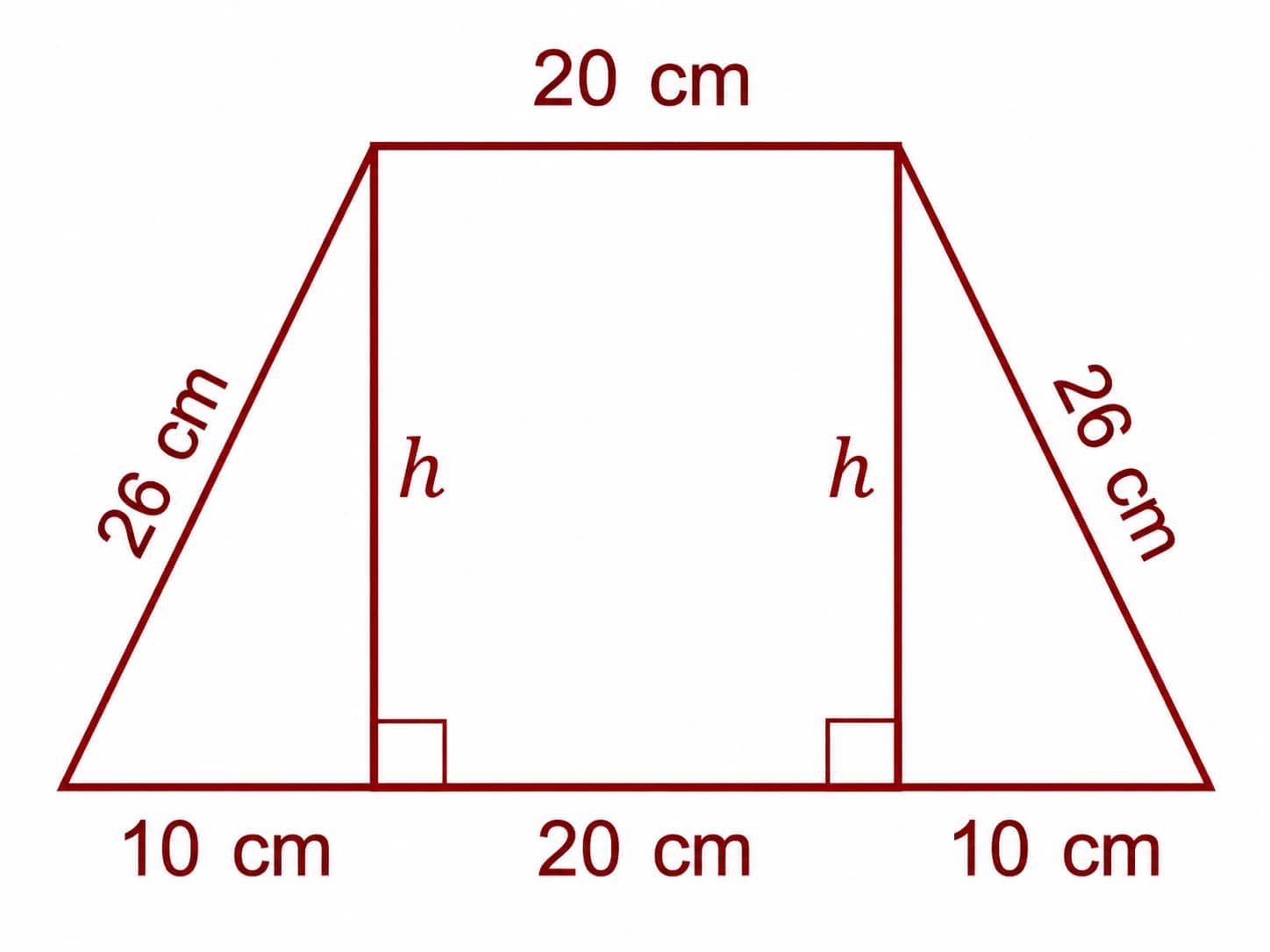
The parallel sides of a trapezium are 40 cm and 20 cm.
Its non-parallel sides are both equal, each being 26 cm.
Difference of parallel sides = 40 - 20 = 20 cm
Since the trapezium is isosceles, this difference is divided equally on both sides.
So, $\frac{20}2=10$ cm each on both sides
Let the height be $h$.
Using Pythagoras' theorem on any right triangle formed on both sides, we get,
$\begin{aligned} & h^2+10^2=26^2 \\ & h^2+100=676\end{aligned}$
$h^2=576$
$\therefore h=24$ cm
We know that
area of a trapezium
= $\frac12\times$ Sum of lengths of the parallel sides $\times$ Perpendicular height between the parallel sides
= $\frac12\times(40+20)\times24$
= $30\times24$
= $720\ \text{cm}^2$
Hence, the area of the trapezium is $720\ \text{cm}^2$.
Question 3. Find the area of a triangle, given that its sides are 8 cm and 11 cm long, and its perimeter is 32 cm.
$\textbf{Answer:}$
We know that the perimeter of a triangle is the sum of the lengths of all three sides.
Given: Two sides are 8 cm and 11 cm long
Third side = Perimeter - two sides = 32 - 8 - 11 = 13 cm
Semiperimeter, $s$ = $\frac{8+11+13}2=16$ cm
Using Heron’s formula, we get,
Area of the triangle
$=\sqrt{s(s-a)(s-b)(s-c)}$, where $a,b$ and $c$ are side lengths
$=\sqrt{16(16-8)(16-11)(16-13)}$
$=\sqrt{16\times8\times5\times3}$
$=\sqrt{1920}$
$=8\sqrt{30}\ \text{cm}^2$
Question 4. The sides of a triangular plot are in the ratio $3: 5: 7$; its perimeter is 300 m. Find its area.
$\textbf{Answer:}$
The sides of a triangular plot are in the ratio $3: 5: 7$.
Let the sides be $3x,5x$ and $7x$.
Its perimeter is 300 m.
So, $3x+5x+7x=300$
$15x=300$
$x=20$
So, the sides are:
$3x=3\times20=60$
$5x=5\times20=100$
$7x=7\times20=140$
Semiperimeter, $s$ = $\frac{300}2=150$ m
Using Heron’s formula, we get,
Area of the triangle
$=\sqrt{s(s-a)(s-b)(s-c)}$, where $a,b$ and $c$ are side lengths
$=\sqrt{150(150-60)(150-100)(150-140)}$
$=\sqrt{150 \times 90 \times 50 \times 10}$
$ =\sqrt{6750000} $
$ =1500 \sqrt{3}\ \text{m}^2$
Hence, its area is $1500 \sqrt{3}\ \text{m}^2$.
Question 5. One diagonal of a rhombus is twice as long as the other diagonal. If the rhombus has area $128 \mathrm{~cm}^2$, find the length of the shorter diagonal.
$\textbf{Answer:}$
Let the length of the shorter diagonal be $d_1=x \mathrm{~cm}$.
According to the given condition, the longer diagonal is twice as long as the shorter one:
$\Rightarrow d_2=2 x \mathrm{~cm}$
We know that, the area of a rhombus $=\frac{1}{2} \times d_1 \times d_2$, where $d_1$ and $d_2$ are diagonals
$ \Rightarrow 128=\frac{1}{2} \times x \times 2 x $
$ \Rightarrow 128=x^2$
$ \Rightarrow x=\sqrt{128}=\sqrt{64 \times 2}$
$ \Rightarrow x=8 \sqrt{2} \mathrm{~cm}$
Hence, the length of the shorter diagonal is $8 \sqrt{2} \mathrm{~cm}$.
Question 6. ABCD is a parallelogram. P and Q are any two points on side AB. What can you say about the ratio area ( $\triangle \mathrm{PCD}$ ): area ( $\triangle \mathrm{QCD}$ )?
$\textbf{Answer:}$
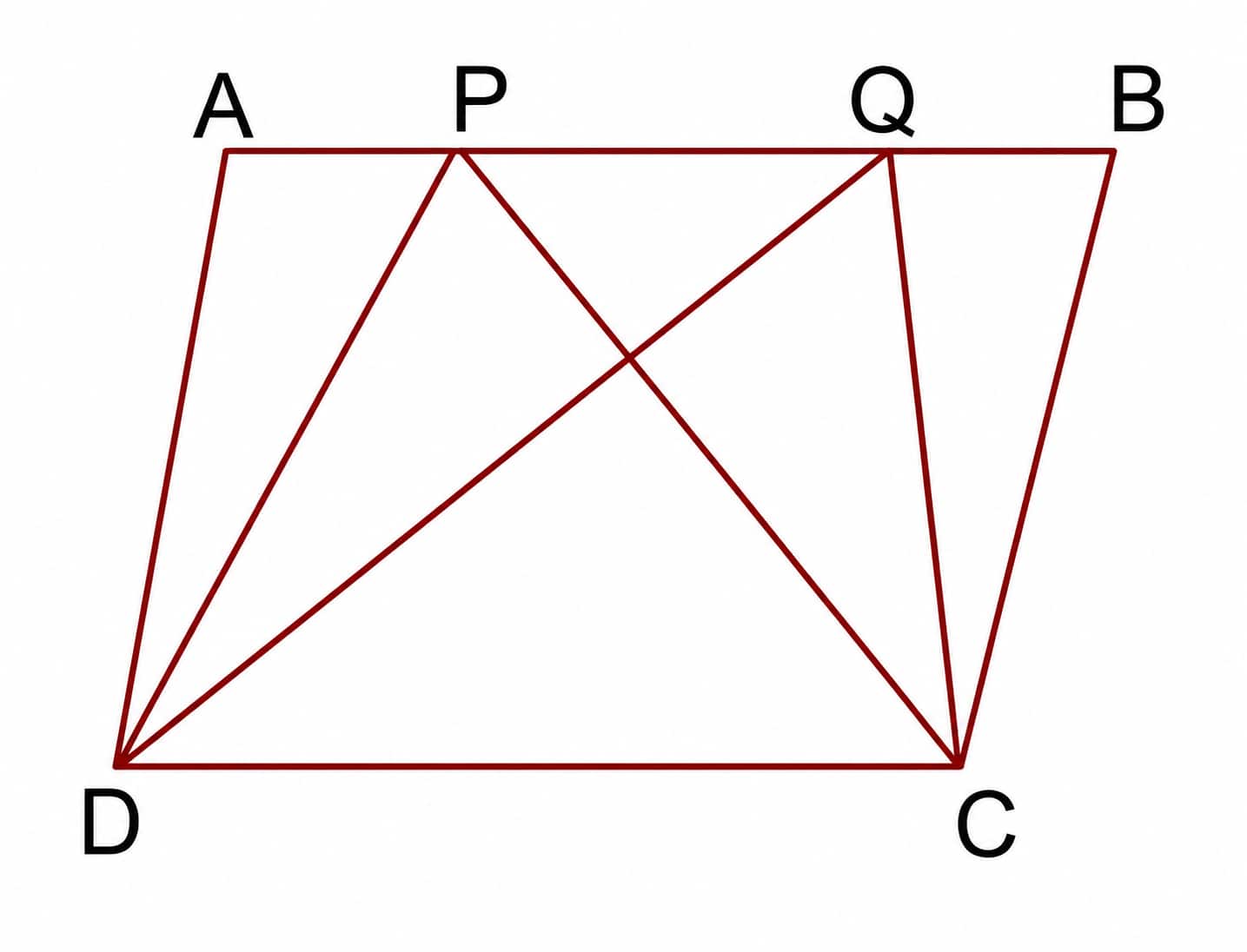
In triangles $\triangle \mathrm{PCD}$ and $\triangle \mathrm{QCD}$,
- Same base CD
- their opposite vertices $P$ and $Q$ both lie on the line $A B$.
Since $A B C D$ is a parallelogram, the line $A B$ is parallel to $C D(A B \| C D)$.
We know that triangles on the same base and between the same parallel lines are equal in area.
So,
$\operatorname{Area}(\triangle \mathrm{PCD})=\operatorname{Area}(\triangle \mathrm{QCD})$
$
\Rightarrow \frac{\operatorname{Area}(\triangle \mathrm{PCD})}{\operatorname{Area}(\triangle \mathrm{QCD})}=\frac{1}{1}=1: 1
$
Hence, the ratio of their areas is $1: 1$.
Question 7. O is any point on the diagonal PR of a parallelogram PQRS. Prove that the areas of triangles PSO and PQO are equal.
$\textbf{Answer:}$
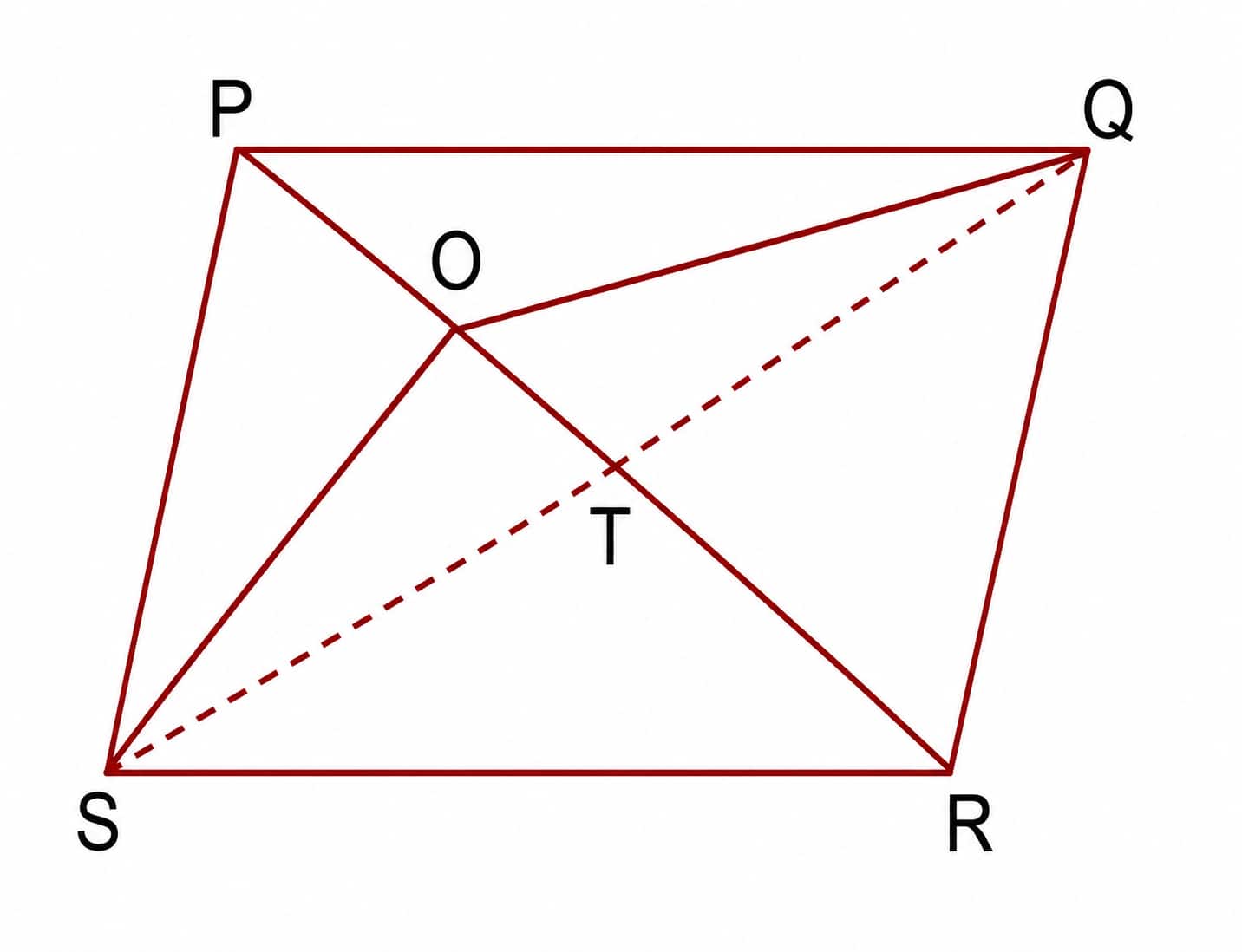
Question 8. If the mid-points of the sides of a 4-gon (also known as a quadrilateral, but we prefer to call it a '4-gon') are joined in order, prove that the area of the parallelogram thus formed will be half of the area of the given 4-gon.
(You may wonder whether the 4-gon thus formed is always a parallelogram, and if so, why? These questions will be tackled and answered in the chapter on quadrilaterals.)
$\textbf{Answer:}$
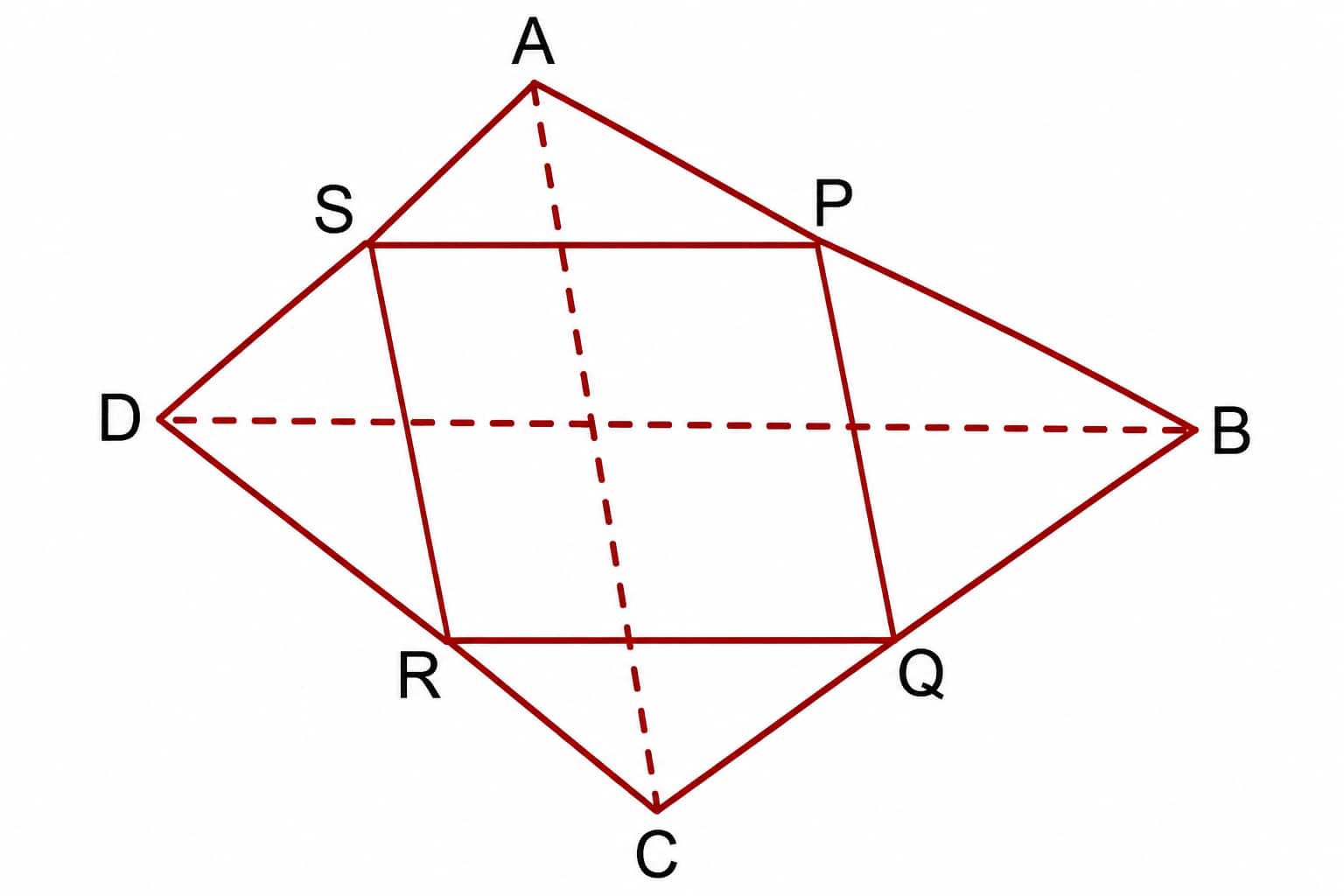
Let the quadrilateral be $A B C D$, and let $S, P, Q, R$ be the midpoints of $A D, A B, B C$, and $C D$ respectively.
We have to prove: $\operatorname{Area}(S P Q R)=\frac{1}{2} \operatorname{Area}(A B C D)$
In $\triangle A D B$,
$S$ is the midpoint of $A D$, and $P$ is the midpoint of $A B$.
By the Midpoint Theorem, $S P \| D B, S P=\frac{1}{2} D B$
Similarly, in $\triangle D C B$,
$R$ and $Q$ are the midpoints of $D C$ and $C B$,
so, $R Q \| D B, R Q=\frac{1}{2} D B$
Hence, $S P \| R Q, S P=R Q$
We know that a quadrilateral having one pair of opposite sides equal and parallel is a parallelogram.
Therefore, SPQR is a parallelogram.
Now, the four corner triangles are $\triangle \mathrm{APS}, \triangle \mathrm{BPQ}, \triangle \mathrm{CQR}$ and $\triangle \mathrm{DRS}$.
Each of these triangles has half the base and half the height of the corresponding triangle into which the 4-gon is divided.
So, the total area of the four corner triangles is half the area of the original 4-gon.
Therefore, the remaining middle parallelogram PQRS has the other half of the area.
Hence, Area(parallelogram SPQR ) $=\frac12 \times \operatorname{Area}(4$-gon ABCD$)$
Hence proved.
Question 9. In $\triangle \mathrm{ABC}$, the midpoint of BC is D (Fig. 6.32). Median AD is drawn. P is any point on $A D$. Show that area $(\triangle A B P)=$ area $(\triangle A C P)$.
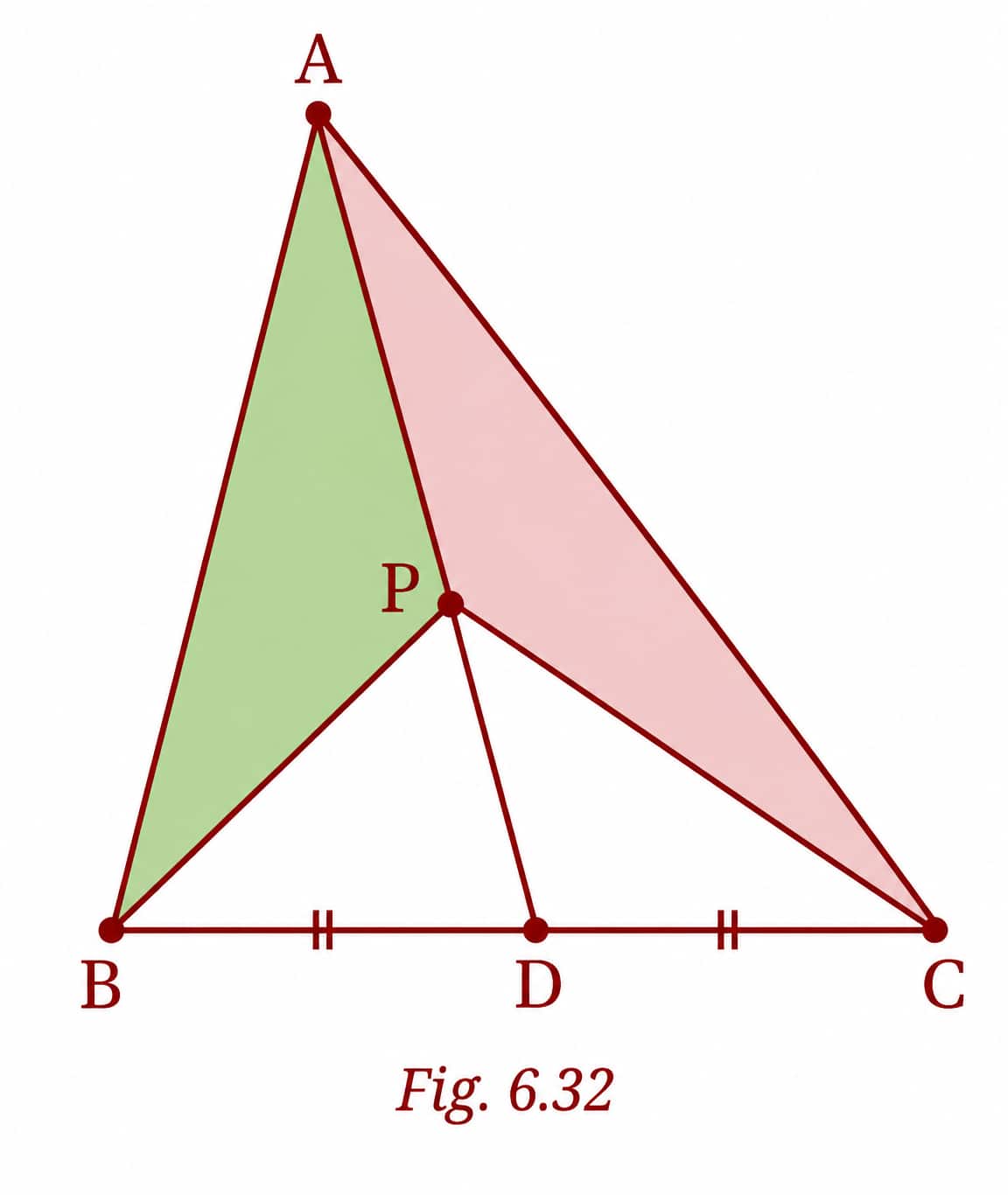
$\textbf{Answer:}$
Since $D$ is the midpoint of $B C, A D$ is a median of $\triangle A B C$.
Therefore, $\operatorname{Area}(\triangle A B D)=\operatorname{Area}(\triangle A C D)$
$\because$ Both triangles have the same altitude from $A$ to $B C$ and equal bases $B D=D C$
Point $P$ lies on AD.
Consider $\triangle A B P$ and $\triangle B D P$. Both have the same altitude from $B$ to the line $A D$.
Hence, $\frac{\operatorname{Area}(\triangle A B P)}{\operatorname{Area}(\triangle B D P)}=\frac{A P}{D P}
$
Similarly, $\frac{\operatorname{Area}(\triangle A C P)}{\operatorname{Area}(\triangle C D P)}=\frac{A P}{D P} $
Thus,
$
\frac{\operatorname{Area}(\triangle A B P)}{\operatorname{Area}(\triangle B D P)}=\frac{\operatorname{Area}(\triangle A C P)}{\operatorname{Area}(\triangle C D P)}
$
Also,
$\operatorname{Area}(\triangle B D P)=\operatorname{Area}(\triangle C D P),$
since they have the same altitude from $P$ to $B C$ and equal bases $B D=D C$.
Therefore, $\operatorname{Area}(\triangle A B P)=\operatorname{Area}(\triangle A C P) $
Hence, proved.
Question 10. Given a square ABCD, let P be a point within it. Join $\mathrm{PA}, \mathrm{PB}, \mathrm{PC}, \mathrm{PD}$ (Fig. 6.33). What is the ratio of the areas of the red region ( $\triangle \mathrm{PAB}$ and $\triangle \mathrm{PCD}$ ) and the green region ( $\triangle \mathrm{PBC}$ and $\triangle \mathrm{PDA}$ )?
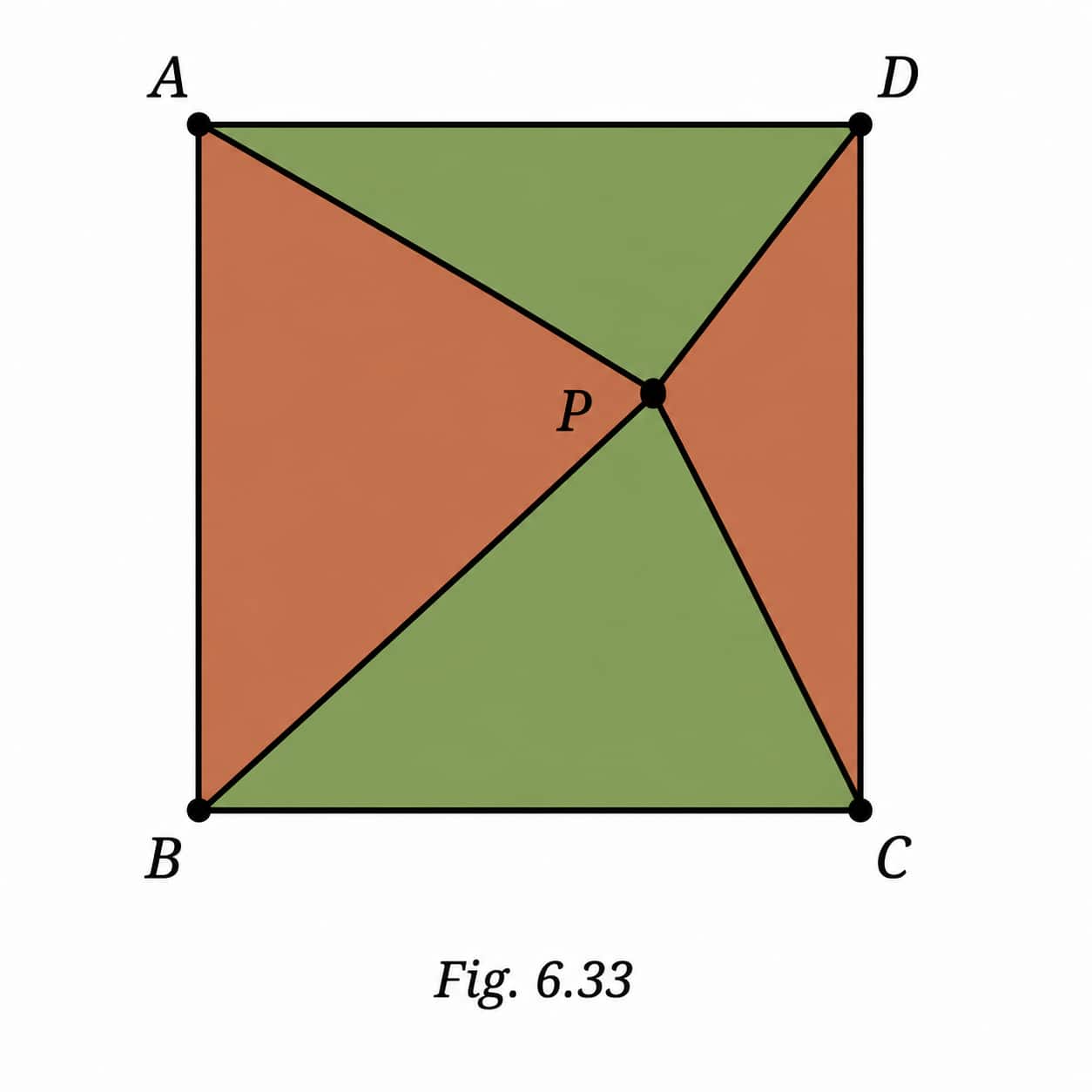
$\textbf{Answer:}$
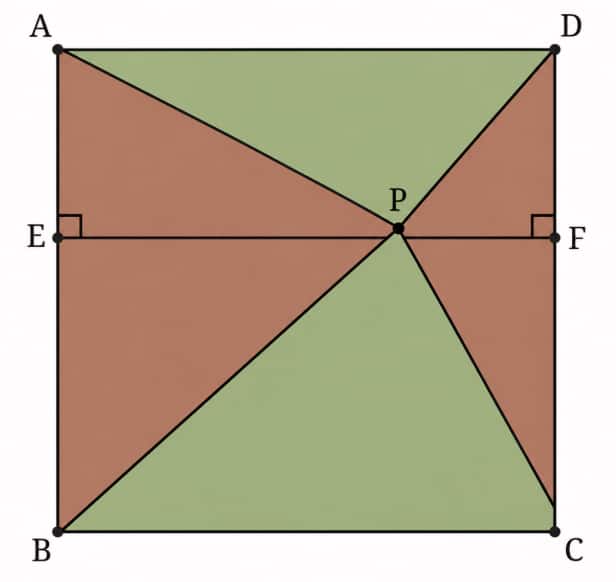
Let the side of the square be $a$.
Also, PE $\perp$ AB and PF $\perp$ CD
Let the length of PE be $x$.
So, the length of PF is $(a-x)$
$\operatorname{Area}(\triangle P A B)=\frac{1}{2} \times A B \times PE=\frac12ax$
Similarly, $\operatorname{Area}(\triangle P C D)=\frac{1}{2} a \times(a-x)$
$\therefore$ Total Red Area $=\frac{1}{2} a x+\frac{1}{2} a(a-x)=\frac{1}{2} a^2$.
Similarly, the $y$ is the distance from BC,
Then $\operatorname{Area}(\triangle P B C)=\frac{1}{2} a y$
Also, $\operatorname{Area}(\triangle P D A)=\frac{1}{2} a(a-y)$
$\therefore$ Total Green Area $=\frac{1}{2} a y+\frac{1}{2} a(a-y)=\frac{1}{2} a^2$
Hence, Red Area : Green Area $=\frac{1}{2} a^2: \frac{1}{2} a^2=1: 1$.
Question 11. In $\triangle A B C, D$ is the midpoint of $A B . P$ is any point on $B C$, and $Q$ is a point on AB such that $\mathrm{CQ} \| \mathrm{PD} . \mathrm{PQ}$ is joined (Fig. 6.34). Prove that Area $(\triangle B P Q)=\frac{1}{2}$ Area $(\triangle A B C)$.
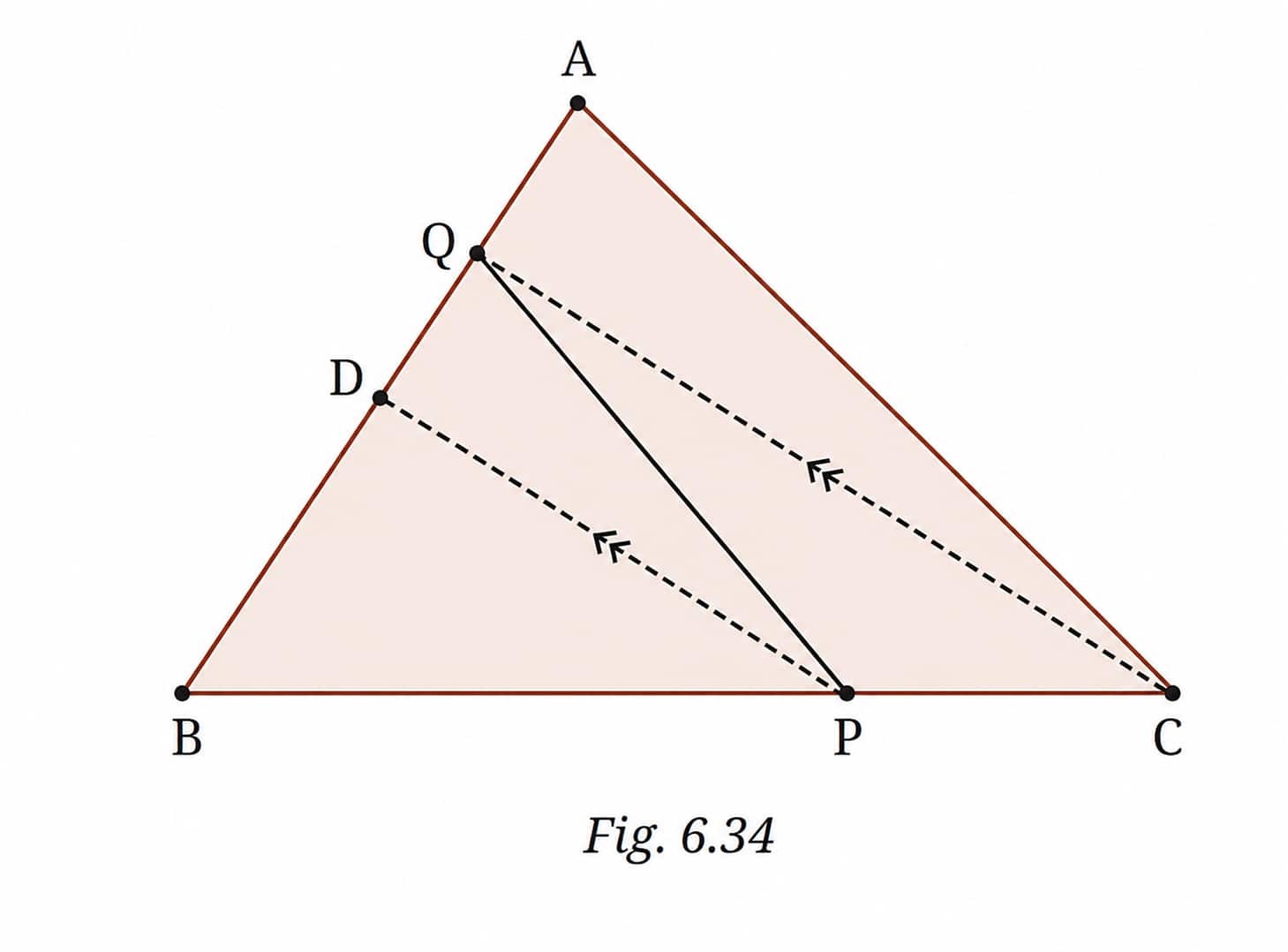
$\textbf{Answer:}$
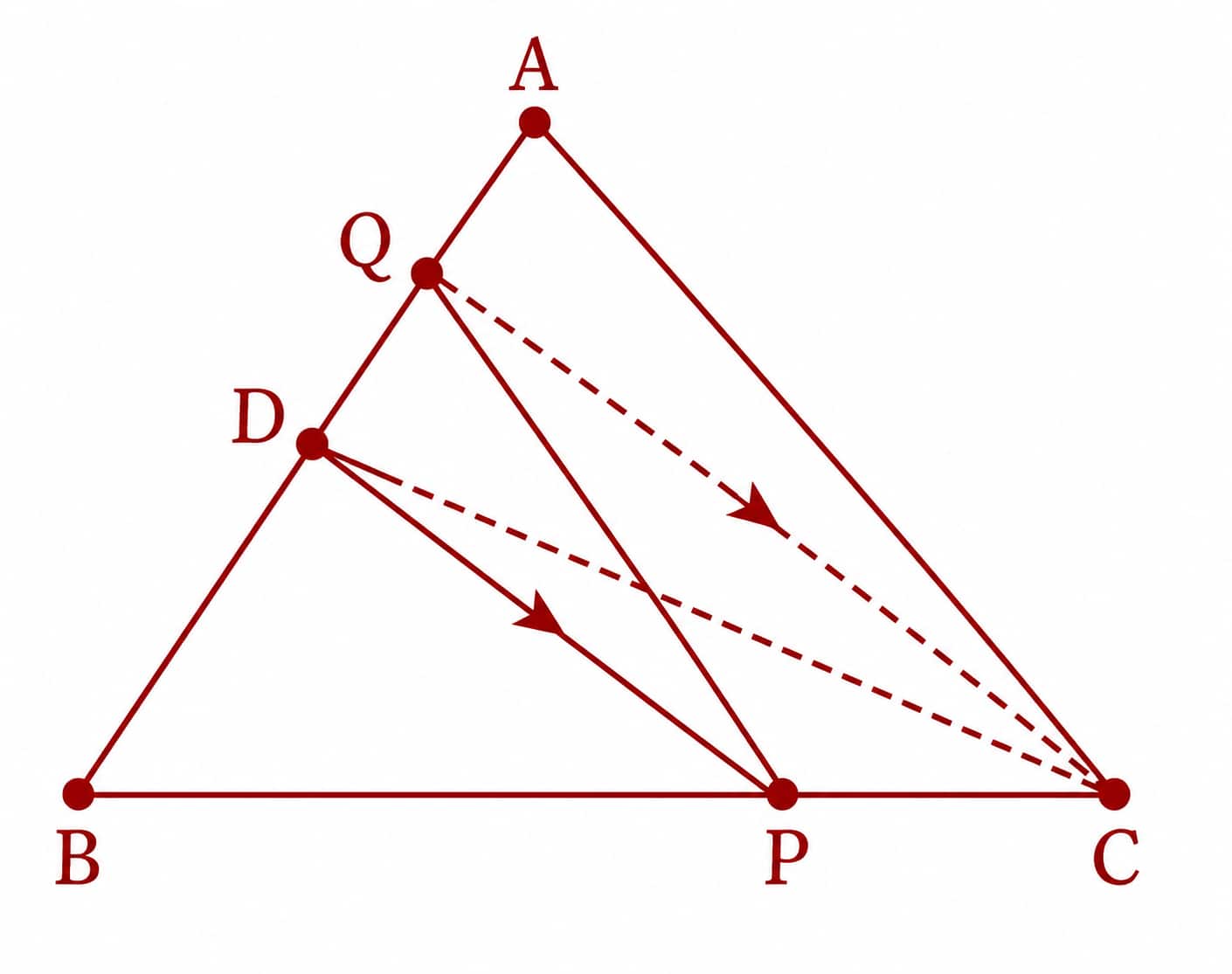
Given that in $\triangle A B C, D$ is the midpoint of $A B$.
Therefore, $A D=B D=\frac{1}{2} A B$.
We are also given that $C Q \| P D$.
Consider $\triangle D P Q$ and $\triangle D P C$. Both triangles stand on the common base $P D$ and lie between the same parallel lines $P D$ and $C Q$.
Using the geometric property that triangles on the same base and between the same parallels are equal in area:
$\Rightarrow \operatorname{Area}(\triangle D P Q)=\operatorname{Area}(\triangle D P C)$
Now,
$\operatorname{Area}(\triangle B P Q)=\operatorname{Area}(\triangle B P D)+\operatorname{Area}(\triangle D P Q) $
$\Rightarrow \operatorname{Area}(\triangle B P Q)=\operatorname{Area}(\triangle B P D)+\operatorname{Area}(\triangle D P C)$
Combining the two adjacent triangles $\triangle B P D$ and $\triangle D P C$ along their shared boundary line $P D$ :
$\Rightarrow \operatorname{Area}(\triangle B P Q)=\operatorname{Area}(\triangle B C D)--(1)$
Since $D$ is the midpoint of $A B$, the line segment $C D$ is a median of $\triangle A B C$ originating from vertex $C$.
A median divides a triangle into two triangles of equal area.
$\Rightarrow \operatorname{Area}(\triangle B C D)=\frac{1}{2} \operatorname{Area}(\triangle A B C)--(2)$
Substituting equation (2) into equation (1):
$\Rightarrow \operatorname{Area}(\triangle B P Q)=\frac{1}{2} \operatorname{Area}(\triangle A B C)$
Hence, the statement is proved.
Measuring Space: Perimeter and Area Class 9 Questions and AnswersExercise Set 6.3 |
Unless stated otherwise, use the approximation $\frac{22}{7}$ for $\pi$.
Question 1. Find the area of a sector of a circle with radius 7 cm if the angle of the sector is $60^{\circ}$.
$\textbf{Answer:}$
Given:
Radius of the circle $(r)=7 \mathrm{~cm}$
Sector angle, $\theta=60^{\circ}$
We know that the area of a sector $=\frac{\theta}{360^{\circ}} \times \pi r^2$, where $r$ is radius and $\theta$ is the central angle
$\Rightarrow \text { Area }=\frac{60^{\circ}}{300^{\circ}} \times \frac{22}{7} \times 7 \times 7 $
$ \Rightarrow \text { Area }=\frac{1}{6} \times 22 \times 7$
$ \Rightarrow \text { Area }=\frac{154}{6} $
$ \Rightarrow \text { Area }=\frac{77}{3}=25.67 \mathrm{~cm}^2$
Hence, the area of the sector is $25.67 \mathrm{~cm}^2$.
Question 2. Find the area of a quadrant of a circle whose circumference is 44 cm.
$\textbf{Answer:}$
Circumference of the circle = 44
$⇒ 2\pi r=44$, where $r$ is the radius
$⇒2\times\frac{22}7\times r=44$
$⇒r=7$ cm
We know that a quadrant is a sector with an angle $\theta=90^{\circ}$, which is one-fourth of a circle.
So its area will also be one-fourth of the circle's area.
Area $=\frac{1}{4} \times \pi r^2=\frac14\times\frac{22}7\times7^2=\frac{77}2=38.5\ \text{cm}^2$
Hence, the area of the quadrant is $\frac{77}{2} \mathrm{~cm}^2$.
Question 3. The length of the minute hand of a clock is 7 cm. Find the area swept by the minute hand in 10 minutes.
$\textbf{Answer:}$
Given:
Length of the minute hand $=7 \mathrm{~cm}= $ radius $r$
A minute hand completes a full rotation, i.e., $360^{\circ}$ in 60 minutes.
⇒ Angle swept in 1 minute $=\frac{360^{\circ}}{60}=60^{\circ}$
⇒ Angle swept in 10 minutes $(\theta)=6^{\circ} \times 10=60^{\circ}$
We know that the area of a sector $=\frac{\theta}{360^{\circ}} \times \pi r^2$, where $r$ is radius and $\theta$ is the central angle
$=\frac{60}{360} \times \frac{22}{7} \times 7^2$
$=\frac{77}{3}=25.67 \mathrm{~cm}^2$
Hence, the area swept by the minute hand in 10 minutes is $25.67 \mathrm{~cm}^2$.
Question 4. A chord of a circle of radius 10 cm subtends $90^{\circ}$ at the centre. Find the area of the corresponding:
(i) minor sector (that subtends $90^{\circ}$ at the centre),
and (ii) major sector (that subtends $270^{\circ}$ at the centre). (Use $\pi \approx 3.14$.)
Given:
Radius, $r$ = 10 cm
So, area of the circle $=\pi r^2=3.14\times10^2=314\ \text{cm}^2$
We know that the area of a sector $=\frac{\theta}{360^{\circ}} \times \pi r^2$, where $r$ is radius and $\theta$ is the central angle
(i)
Minor sector = 90°
So, Area of the minor sector = $\frac{90}{360} \times 314=78.5\ \mathrm{~cm}^2$
(ii)
Major sector = 270°
So, Area of the major sector = $\frac{270}{360} \times 314=235.5\ \mathrm{~cm}^2$
Hence, the area of the minor sector is $78.5 \mathrm{~cm}^2$ and the area of the major sector is $235.5 \mathrm{~cm}^2$.
Question 5. A chord of a circle of radius 15 cm subtends an angle of $60^{\circ}$ at the centre of the circle. Find the areas of the corresponding minor and major segments of the circle. (Use $\pi \approx 3.14$ and $\sqrt{3} \approx 1.73$.
Given:
Radius, $r$ = 15 cm
So, area of the circle $=\pi r^2=3.14\times15^2=706.5\ \text{cm}^2$
We know that the area of a sector $=\frac{\theta}{360^{\circ}} \times \pi r^2$, where $r$ is radius and $\theta$ is the central angle
Minor sector = 60°
So, Area of the minor sector = $\frac{60}{360} \times 706.5=117.75\ \mathrm{~cm}^2$
Since the central angle is $60^{\circ}$ and the two containing sides are radii (15 cm), the triangle is equilateral. Area $_{\text {triangle }}=\frac{\sqrt{3}}{4} r^2$
$
\begin{aligned}
& \Rightarrow \text { Area }_{\text {triangle }}=\frac{1.73}{14} \times 15 \times 15 \\
& \Rightarrow \text { Area }_{\text {triangle }}=\frac{1.73 \times 2025}{4}=\frac{389.25}{4} \\
& \Rightarrow \text { Area }_{\text {triangle }}=97.3125 \mathrm{~cm}^2
\end{aligned}
$
Now, the area of the minor segment
= Area of minor sector - area of triangle
= $117.75-97.3125=20.4375\ \mathrm{~cm}^2$
Also, the area of the major segment
= Area of the circle - area of the minor segment
$\begin{aligned} & =706.5-20.4375 \\ &= 686.0625 \mathrm{~cm}^2\end{aligned}$
Hence, the area of the minor segment is $20.4375 \mathrm{~cm}^2$ and the area of the major segment is $686.0625 \mathrm{~cm}^2$.
Question 6. A car has two wipers which do not overlap. Each wiper has a blade of length 28 cm and sweeps through an angle of $120^{\circ}$. Find the total area cleaned at each sweep of the blades.
$\textbf{Answer:}$
The car has two identical, non-overlapping wipers. The area cleaned by each individual wiper blade forms a circular sector.
The radius of each sector is $r=28 \mathrm{~cm}$ and the sector angle is $\theta=120^{\circ}$.
Area of a circular sector $=\frac{\theta}{360^{\circ}} \cdot \pi r^2$
⇒ Area cleaned by one wiper $=\frac{120^{\circ}}{360^{\circ}} \cdot \pi \cdot 28^2$
⇒ Area cleaned by one wiper $=\frac{1}{3} \cdot \pi \cdot 784$
Using $\pi=\frac{22}{7}$ for calculation,
⇒ Area cleaned by one wiper $=\frac{1}{3} \cdot \frac{22}{7} \cdot 784$
⇒ Area cleaned by one wiper $=\frac{1}{3} \cdot 22 \cdot 112=\frac{2464}{3} \mathrm{~cm}^2$
The total area cleaned at each sweep is the sum of the areas cleaned by both wipers combined.
Total Area $=2 \times$ (Area cleaned by one wiper)
⇒ Total Area $=2 \times \frac{2464}{3}$
⇒ Total Area $=\frac{4928}{3}$
Hence, the correct answer is $\frac{4928}{3} \mathrm{~cm}^2$.
*Question 7. A chord of a circle of radius $r$ subtends an angle of $60^{\circ}$ at the centre of the circle. Show that the area of the corresponding minor segment of the circle is equal to $\pi r^2\left(\frac{1}{6}-\frac{\sqrt{3}}{4\pi}\right)$.
$\textbf{Answer:}$
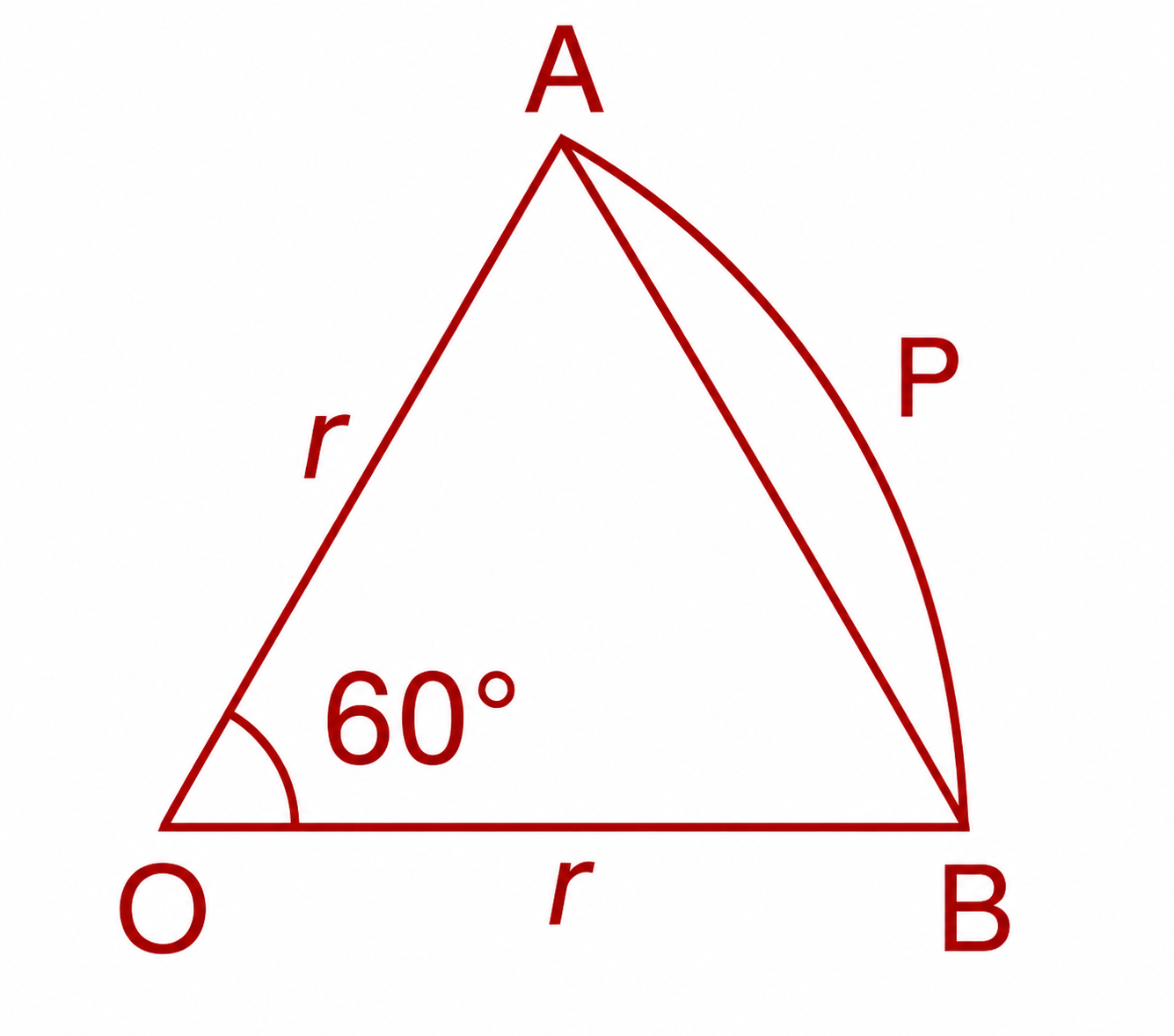
Since isosceles $\triangle \mathrm{OAB}$ has the vertical angle $60^{\circ}$,
So, base angle $O A B=$ angle $O B A$
$
\begin{aligned}
& =\frac{180^{\circ}-60^{\circ}}{2} =60^{\circ}
\end{aligned}
$
Thus, $\triangle \mathrm{OAB}$ is an equilateral triangle.
Area of the minor segment $\mathrm{APB}$
$=$ Area of the minor sector $\mathrm{OAPB}-$ Area of equilateral $\triangle \mathrm{OAB}$
$
\begin{aligned}
& =\frac{\theta}{360^{\circ}} \times \pi r^2-\frac{\sqrt{3}}{4} r^2 \\
& =\frac{60^{\circ}}{360^{\circ}} \times \pi r^2-\frac{\sqrt{3}}{4} \times r^2 \\
& =\pi r^2\left(\frac{1}{6}-\frac{\sqrt{3}}{4 \pi}\right)
\end{aligned}
$
Hence, proved.
*Question 8. An equilateral triangle is inscribed in a circle of radius $r$. Show that the ratio of the area of the triangle to the area of the circle is equal to $\frac{3 \sqrt{3}}{4 \pi} \approx 0.413$.
$\textbf{Answer:}$
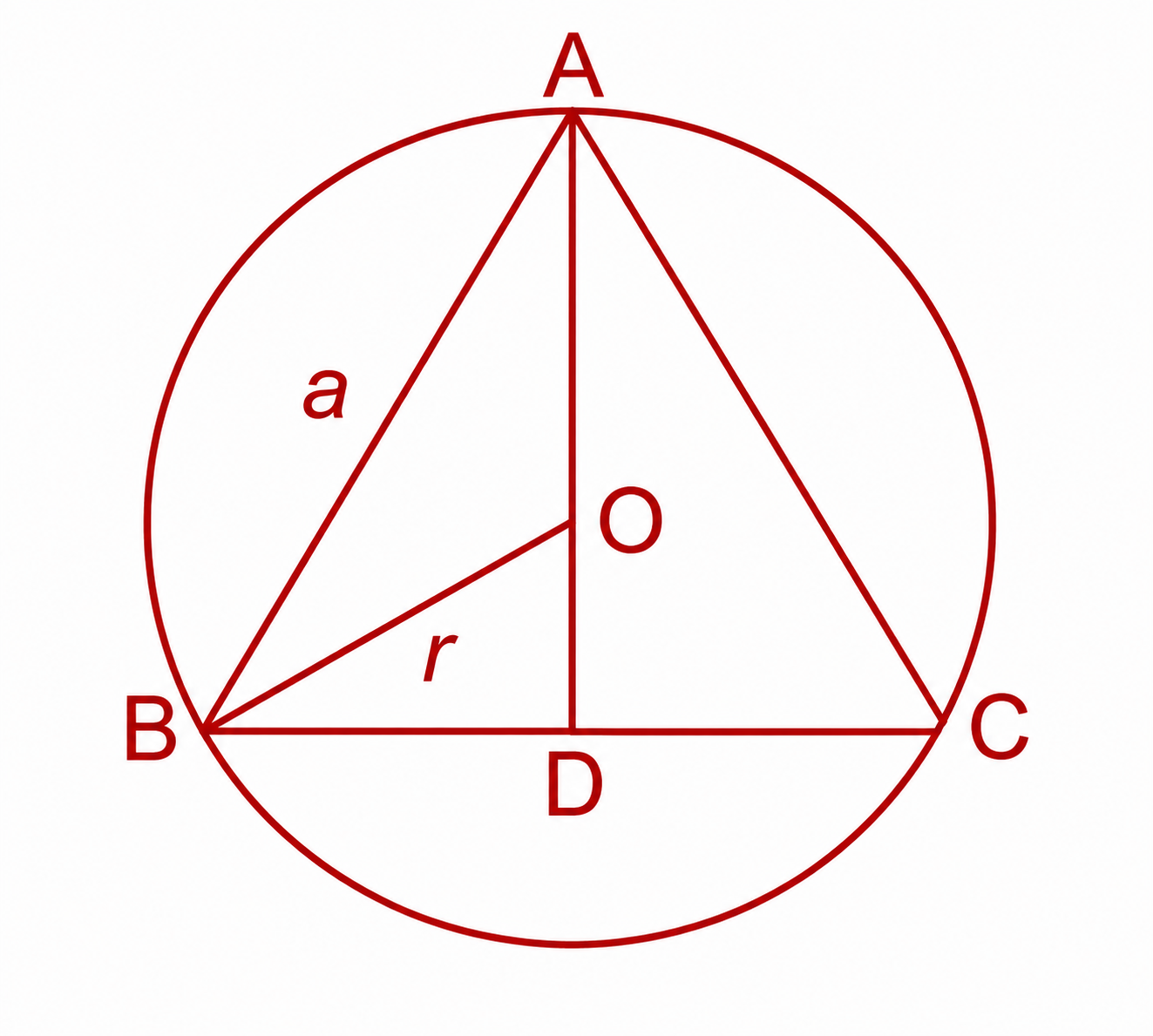
Let an equilateral triangle $ABC$ be inscribed in a circle with centre $O$ and radius $r$.
For an equilateral triangle, circumradius, $R=\frac {a}{\sqrt3}$
Since, here circumradius = radius, $r$,
So, $a=\sqrt3 r$
Also, the area of an equilateral triangle
$=\frac{\sqrt3}4 a^2$
$=\frac{\sqrt{3}}{4}(\sqrt{3} r)^2$
$ =\frac{3 \sqrt{3}}{4} r^2$
Area of the circle $=\pi r^2$
Hence, $\frac{\text { Area of triangle }}{\text { Area of circle }}=\frac{\frac{3 \sqrt{3}}{4} r^2}{\pi r^2}=\frac{3 \sqrt{3}}{4 \pi}\approx0.413$
Hence, proved.
*Question 9. A square is inscribed in a circle of radius $r$. Show that the ratio of the area of the square to the area of the circle is equal to $\frac{2}{\pi} \approx 0.637$.
$\textbf{Answer:}$
Let a square $ABCD$ be inscribed in a circle with centre $O$ and radius $r$.
The diagonal of the square equals the diameter of the circle.
So, diameter, $d=2r$
If the side of the square is $a$, then $\sqrt2 a=2r$
$⇒a=\sqrt2 r$
Now, the area of the square $=a^2=(\sqrt{2} r)^2=2 r^2$
Also, area of the circle $=\pi r^2$
Hence, $\frac{\text { Area of square }}{\text { Area of circle }}=\frac{2 r^2}{\pi r^2}=\frac{2}{\pi}\approx0.637$
Hence, proved.
*Question 10. A hexagon is inscribed in a circle of radius $r$. Show that the ratio of the area of the hexagon to the area of the circle is equal to $\frac{3 \sqrt{3}}{2 \pi} \approx 0.827$.
Can you see why the answer is exactly twice the answer to Question 8?
$\textbf{Answer:}$
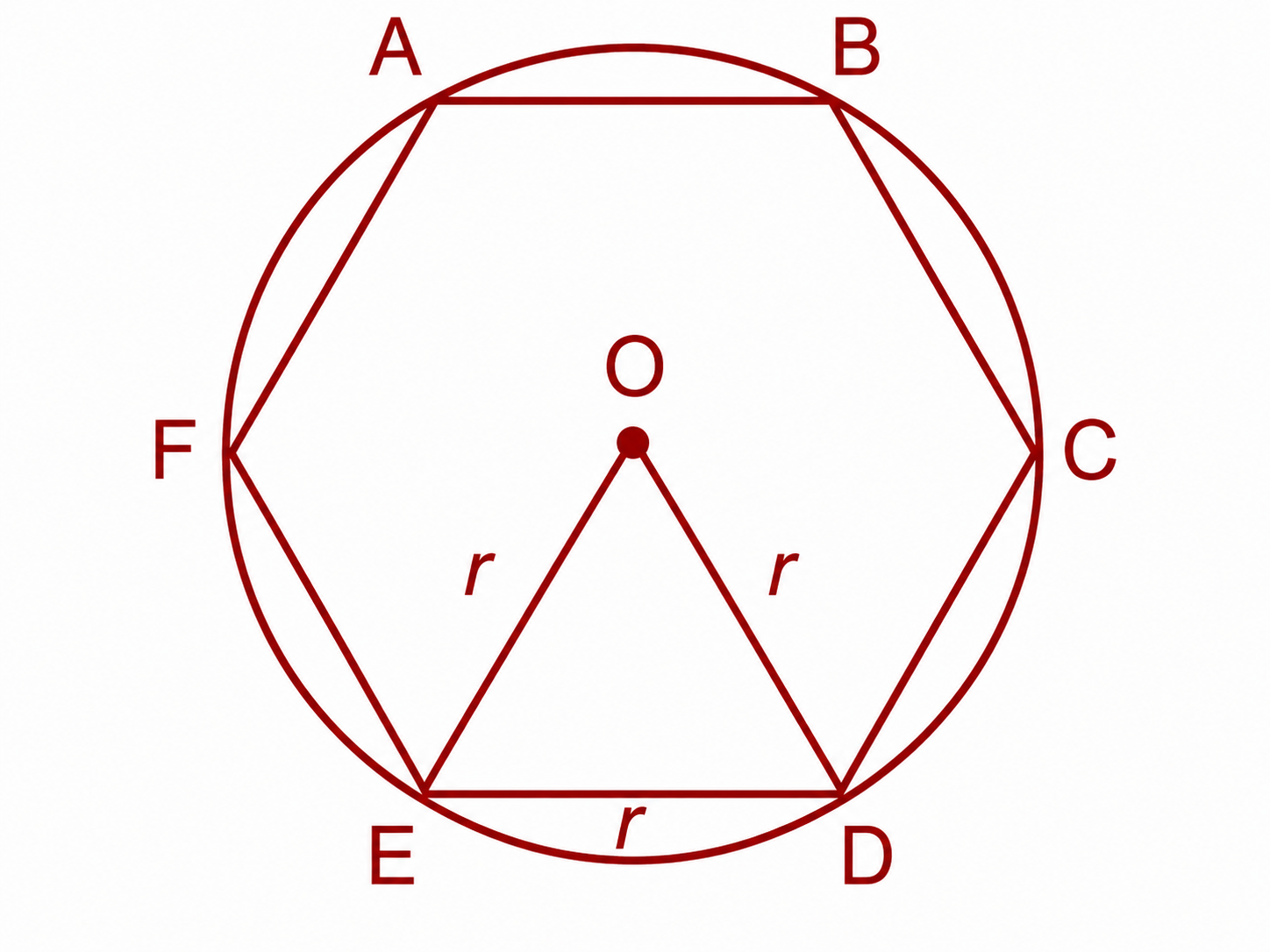
Let a regular hexagon ABCEDEF be inscribed in a circle with centre $O$ and radius $r$.
Joining the centre to all six vertices divides the hexagon into 6 congruent equilateral triangles of side $r$.
So, Area of one equilateral triangle $=\frac{\sqrt3}4 r^2$
So, Area of the hexagon $=6\times\frac{\sqrt3}4 r^2=\frac{3 \sqrt{3}}{2} r^2$
Also, area of the circle $=\pi r^2$
Therefore, $\frac{\text { Area of hexagon }}{\text { Area of circle }}=\frac{\frac{3 \sqrt{3}}{2} r^2}{\pi r^2}=\frac{3 \sqrt{3}}{2 \pi}\approx0.827$
In question 8, we get,
$\frac{\text { Area of equilateral triangle }}{\text { Area of circle }}=\frac{3 \sqrt{3}}{4 \pi}$
Now, $\frac{\text { Area of hexagon }}{\text { Area of circle }}=\frac{3 \sqrt{3}}{2 \pi}=2 \times\left(\frac{3 \sqrt{3}}{4 \pi}\right)$
This happens because the hexagon consists of 6 equilateral triangles, whereas the inscribed equilateral triangle consists of 3 such triangles (formed by joining the centre to its vertices).
Thus, the hexagon has exactly twice the area of the inscribed equilateral triangle, resulting in a ratio of twice the original.
Measuring Space: Perimeter and Area Class 9 Questions and AnswersEnd-of-Chapter Exercises |
In the problems below, unless stated otherwise, use the approximation $\frac{22}{7}$ for $\pi$.
Question 1. Identities in algebra can sometimes be shown as area relationships.
For example:
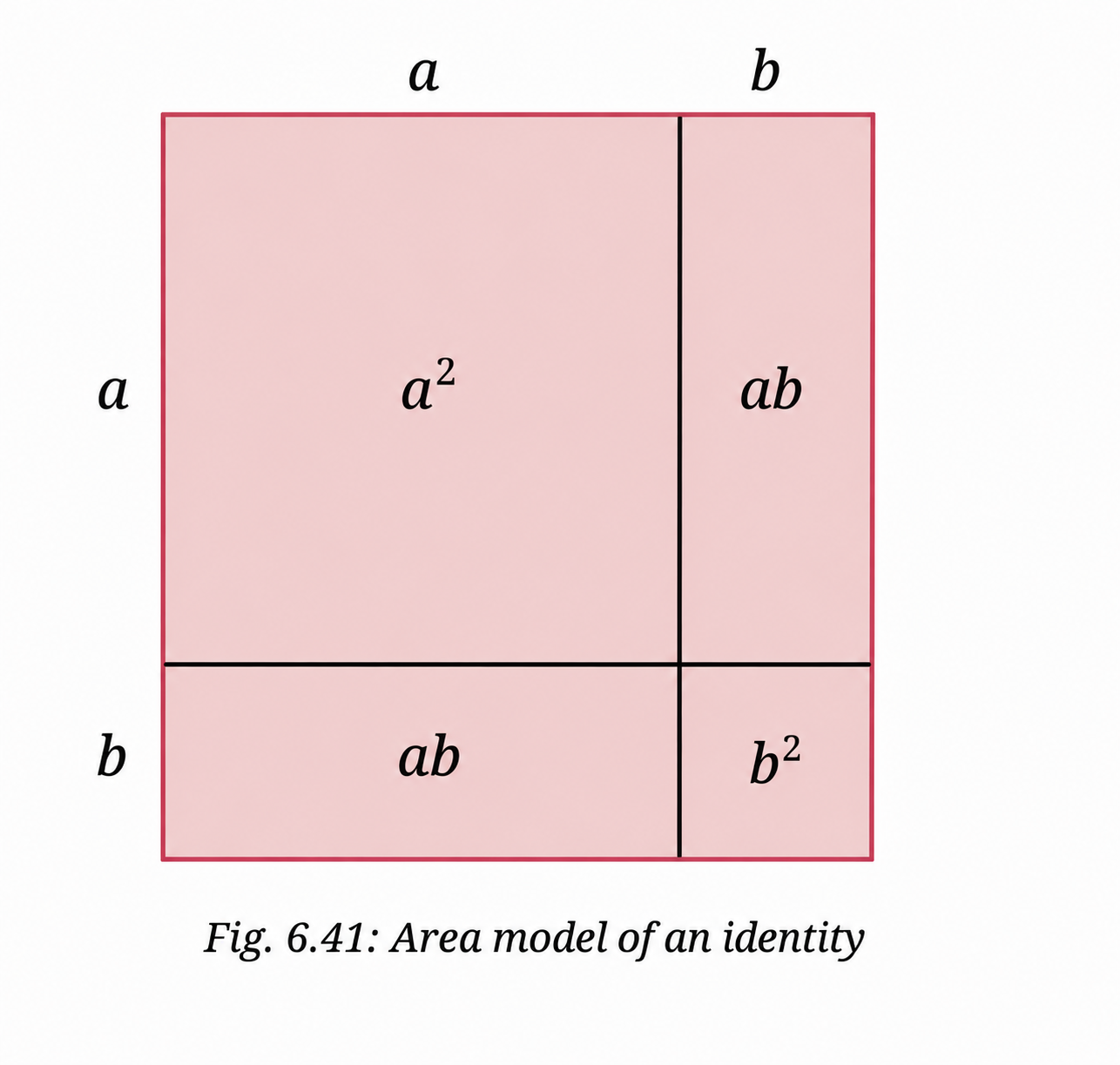
The figure shown corresponds to the identity
$(a+b)^2=a^2+2 a b+b^2 .$
Do you see how?
Draw figures corresponding to the identities $(a+b)(a-b)= a^2-b^2$ and $(a+b+c)^2=a^2+b^2+c^2+2 a b+2 b c+2 c a$.
$\textbf{Answer:}$
In the given area model, a square of side $(a+b)$ has been divided into four parts, i.e., two squares of dimensions $\mathrm{a} \times \mathrm{a}$ and $\mathrm{b} \times \mathrm{b}$, and two rectangles of dimensions ax b.
Therefore, the area of the big square $=$ the sum of the areas of the four pieces, i.e., $(a+b)^2=a^2+b^2+a b+a b=a^2+2 a b+b^2$
For the identity $(\mathrm{a}+\mathrm{b})(\mathrm{a}-\mathrm{b})=\mathrm{a}^2-\mathrm{b}^2$, the figure can be a rectangle with dimensions $(\mathrm{a}+\mathrm{b})$ and $(\mathrm{a}-\mathrm{b})$.
Let us take a square of side $ a$ and remove a square of side $b$ from it.
Then split the remaining part into two trapeziums and rearrange them to form the required rectangle as shown below.
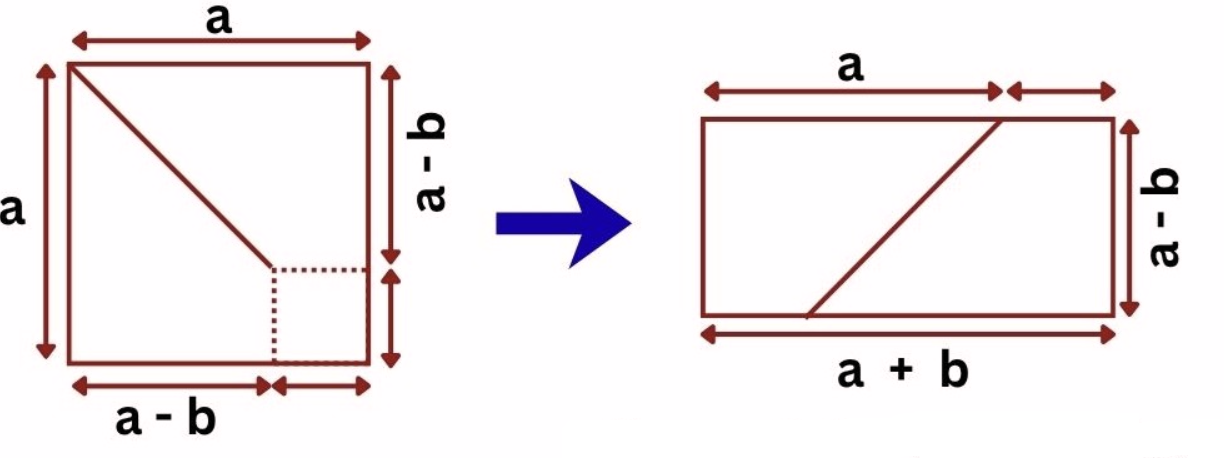
Area of the rectangle $=(a+b)(a-b)=a^2-b^2$
The identity $(a+b+c)^2=a^2+b^2+c^2+2 a b+2 a c+2 b c$ can be visualised as a larger square with side length $(a+b+c)$, divided into smaller squares and rectangles that represent the terms in the expanded form of the square.
$(a+b+c)^2=a^2+b^2+c^2+2 a b+2 b c+2 c a$
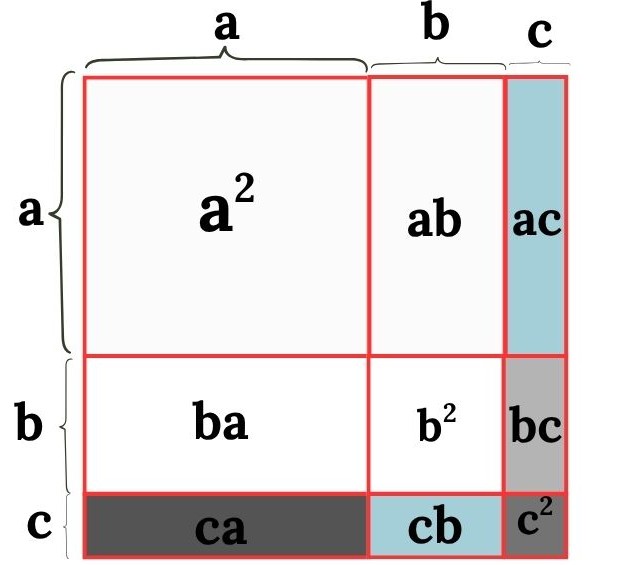
A square with side length $(a+b+c)$ is divided into nine parts.
Total area
$=a^2+b^2+c^2+a b+a b+a c+b c+a c+b c$
$=a^2+b^2+c^2+2 a b+2 b c+2 c a$
Question 2. An isosceles triangle has perimeter 40 cm; the equal sides are 15 cm each. Find the area of the triangle.
$\textbf{Answer:}$
Third side of the triangle or the base of the triangle
= Perimeter - Sum of the other two sides
= 40 - (15 + 15)
= 10 cm
Semiperimeter, $s$ = $\frac{40}2=20$ cm
Using Heron’s formula, we get,
Area of the triangle
$=\sqrt{s(s-a)(s-b)(s-c)}$, where $a,b$ and $c$ are side lengths
$=\sqrt{20(20-15)(20-15)(20-10)}$
$=\sqrt{20\times5\times5\times10}$
$=50\sqrt2\ \text{cm}^2$
Hence, the area of the triangle is $50\sqrt2\ \text{cm}^2$.
Question 3. An isosceles triangle has base 10 cm, and its area is $60 \mathrm{~cm}^2$. What are the lengths of the equal sides?
$\textbf{Answer:}$
Let the height of the triangle be $h$.
We know that area of a triangle $=\frac{1}{2} \times$ base × height
$⇒60=\frac12\times10\times h$
In an isosceles triangle, the altitude from the vertex bisects the base.
So, using Pythagoras' theorem on either triangle, we get,
$\text{equal side}^2=12^2+(\frac{10}2)^2=144+25=169$
$\therefore \text{equal side}=13$ cm
Hence, the lengths of the equal sides are 13 cm.
Question 4. The area of a right-angled triangle is $54\ \mathrm{sq} . \mathrm{cm}$. One of its legs has length 12 cm. Find its perimeter.
$\textbf{Answer:}$
Let the base of the triangle be $b$.
We know that area of a triangle $=\frac{1}{2} \times$ base × height
$⇒54=\frac12\times b \times12$
$\therefore b=9$ cm
Let the hypotenuse of the triangle be $h$.
Using Pythagoras's theorem, we get,
$h^2=9^2+12^2$
$⇒h^2=81+144=225$
$\therefore h=15$
So, the perimeter of the triangle $=9+15+12=36$ cm
Hence, the perimeter of the triangle is 36 cm.
Question 5. The sides of a triangle are in the ratio $2: 3: 4$, and its perimeter is 45 cm. Find its area.
$\textbf{Answer:}$
The sides of a triangular plot are in the ratio $2: 3: 4$.
Let the sides be $2x,3x$ and $4x$.
Its perimeter is 45 cm.
So, $2x+3x+4x=45$
$9x=45$
$x=5$
So, the sides are:
$2x=2\times5=10$
$3x=3\times5=15$
$4x=4\times5=20$
Semiperimeter, $s$ = $\frac{45}2=22.5$ m
Using Heron’s formula, we get,
Area of the triangle
$=\sqrt{s(s-a)(s-b)(s-c)}$, where $a,b$ and $c$ are side lengths
$=\sqrt{22.5(22.5-10)(22.5-15)(22.5-20)}$
$=\sqrt{22.5 \times 12.5 \times 7.5 \times 2.5}$
$ \approx \sqrt{5273} $
$ \approx72.62\ \text{m}^2$
Hence, its area is $72.62\ \text{m}^2$.
Question 6. The sides of a triangle have lengths $7 \mathrm{~cm}, 24 \mathrm{~cm}, 25 \mathrm{~cm}$. Find the area of the triangle in two different ways.
$\textbf{Answer:}$
Given: The sides of a triangle have lengths $7 \mathrm{~cm}, 24 \mathrm{~cm}, 25 \mathrm{~cm}$
Method 1:
Since $7^2+24^2=25^2$, the sides form a Pythagorean triplet. This means the triangle is a right-angled triangle where the longest side ( 25 cm ) is the hypotenuse, and the other two sides ( 7 cm and 24 cm ) are the base and height.
We know the area of a triangle
$=\frac{1}{2} \times$ base × height
$=\frac12\times7\times24=84 \ \text{cm}^2$
Method 2:
Now, semiperimeter $=\frac{7+24+25}2=28$ cm
Using Heron’s formula, we get,
Area of the triangle
$=\sqrt{s(s-a)(s-b)(s-c)}$, where $a,b$ and $c$ are side lengths
$=\sqrt{28(28-7)(28-24)(28-25)}$
$=\sqrt{28\times21\times4\times3}$
$=84\ \text{cm}^2$
Hence, the area of the triangle is $84 \mathrm{~cm}^2$.
Question 7. If the wheel of a bicycle has a diameter of 60 cm, find how far a cyclist will have travelled after the wheel has rotated 100 times.
$\textbf{Answer:}$
We know that the distance covered in one full rotation is equal to the circumference of the circle.
Diameter = 60 cm
So, radius, $r=\frac{60}2=30$ cm
Circumference of the circle $=2\pi r=2\times\frac{22}7\times30=\frac{1320}7$ cm
Total Distance
= Circumference × Number of rotations
= $\frac{1320}7\times100$
$\approx 18857.14\text{ cm}$ = 188.57 meters
Hence, the cyclist will have travelled approximately 188.57 meters.
Question 8. Find the area of a quadrant of a circle whose circumference is 66 cm.
$\textbf{Answer:}$
Circumference of the circle = 66
$⇒ 2\pi r=66$, where $r$ is the radius
$⇒2\times\frac{22}7\times r=66$
$⇒r=10.5$ cm
We know that a quadrant is a sector with an angle $\theta=90^{\circ}$, which is one-fourth of a circle.
So its area will also be one-fourth of the circle's area.
Area $=\frac{1}{4} \times \pi r^2=\frac14\times\frac{22}7\times10.5^2=\frac{2425.5}{28}=86.625\ \text{cm}^2$
Hence, the area of the quadrant is $86.625 \mathrm{~cm}^2$.
Question 9. The wheel of a car has an outer radius of 28 cm. Calculate how far the car travels after one complete turn of the wheel, and how many times the wheel turns during a journey of 1 km.
$\textbf{Answer:}$
We know that the distance covered by a car in one full rotation of the wheel is equal to the circumference of the circle.
Radius, $r$ = 28 cm
Circumference of the circle $=2\pi r=2\times\frac{22}7\times28=176$ cm
1 km = 100000 cm
Number of turns $=\frac{\text { Total Distance }}{\text { Distance in } 1 \text { turn }}=\frac{1000000}{176}\approx568$
Hence, the car travels 176 cm in one complete turn, and the wheel turns approximately 568 times during a journey of 1 km.
*Question 10. Two rectangles have the same area and the same perimeter. Does this mean that they are congruent to each other?
$\textbf{Answer:}$
Let the sides of the first rectangle be $a$ and $b$, and the sides of the second rectangle be $c$ and $ d$.
Since the rectangles have the same perimeter,
$2(a+b)=2(c+d)$
$⇒a+b=c+d$
Also, as they have the same areas, so $ab=cd$
Now consider the quadratic equations
$x^2-(a+b) x+a b=0$ and $x^2-(c+d) x+c d=0$
Because $a+b=c+d$ and $a b=c d$, these two equations are identical.
Therefore, they have the same roots.
Hence, $\{a,b \}= \{c,d \}$
So the two rectangles have the same pair of side lengths (possibly in a different order).
Therefore, one rectangle can be exactly superposed on the other, and hence they are congruent.
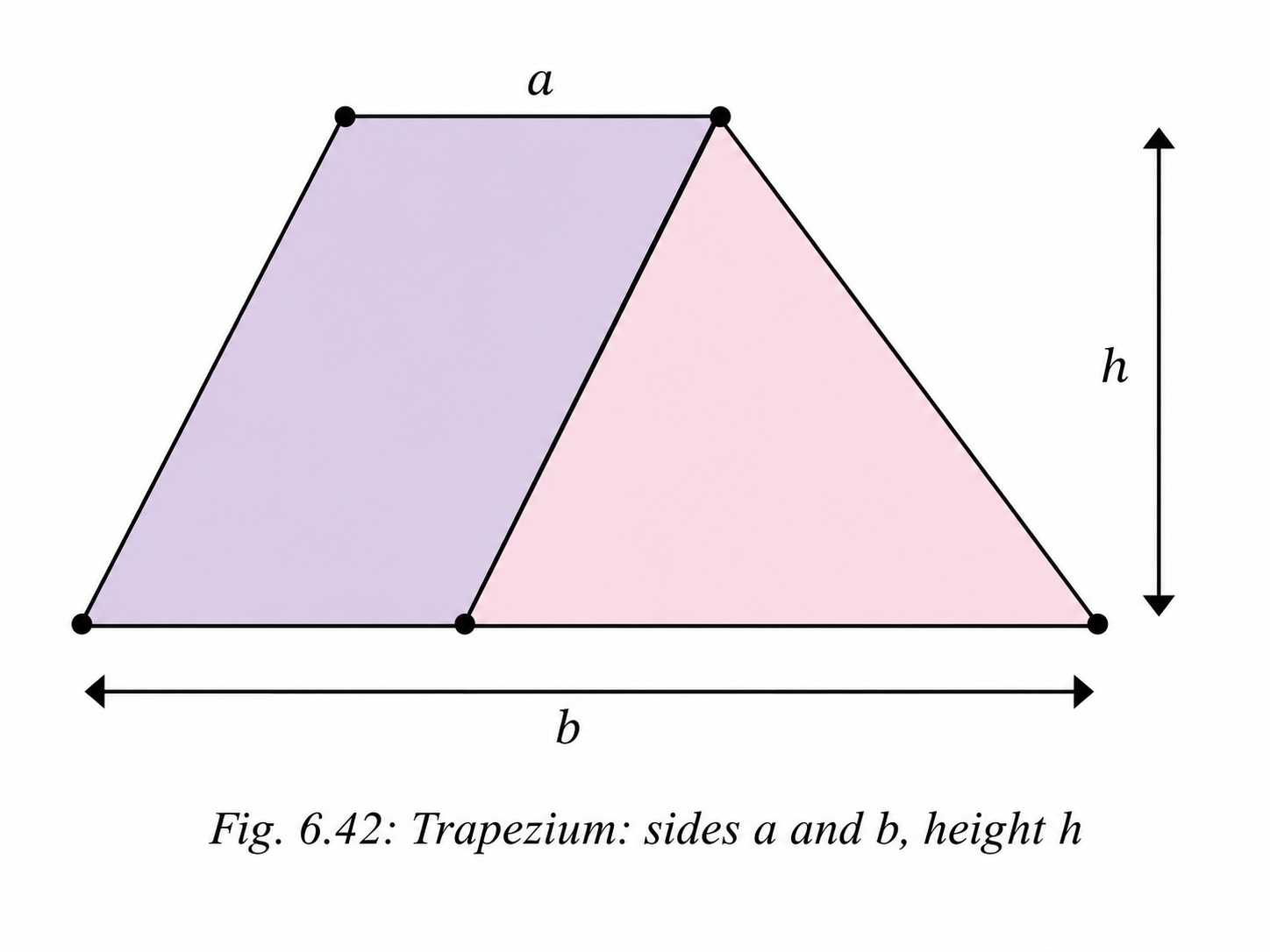
Question 11. You know that the area of a parallelogram is base × height. Using this and the figure, show that the area of a trapezium is half the sum of the parallel sides × height, i.e., $\frac{1}{2}(a+b) h$.
$\textbf{Answer:}$
Let the trapezium have parallel sides $a$ and $b$, and height $h$.
In the figure, the trapezium is divided into a parallelogram on the left side and a triangle on the right side.
The base of the parallelogram is $a$, and its height is $h$.
$\therefore$ Area of parallelogram $=a h$
Therefore, the base of the triangle is $b-a$, and its height is $h$.
Hence, $\text { Area of triangle }=\frac{1}{2}(b-a) h$
So, Area of the trapezium
$ =a h+\frac{1}{2}(b-a) h $
$=\frac{1}{2}(2 a+b-a) h $
$ =\frac{1}{2}(a+b) h$
Therefore,
Area of a trapezium = $\frac12\times$ (Sum of parallel sides $\times$ Height
⇒ Area of a trapezium = $\frac12(a+b)h$
Hence, proved.
Question 12. By dividing a trapezium into two triangles show that its area is, half the sum of the parallel sides multiplied by the height (the same formula as the one given above).
$\textbf{Answer:}$
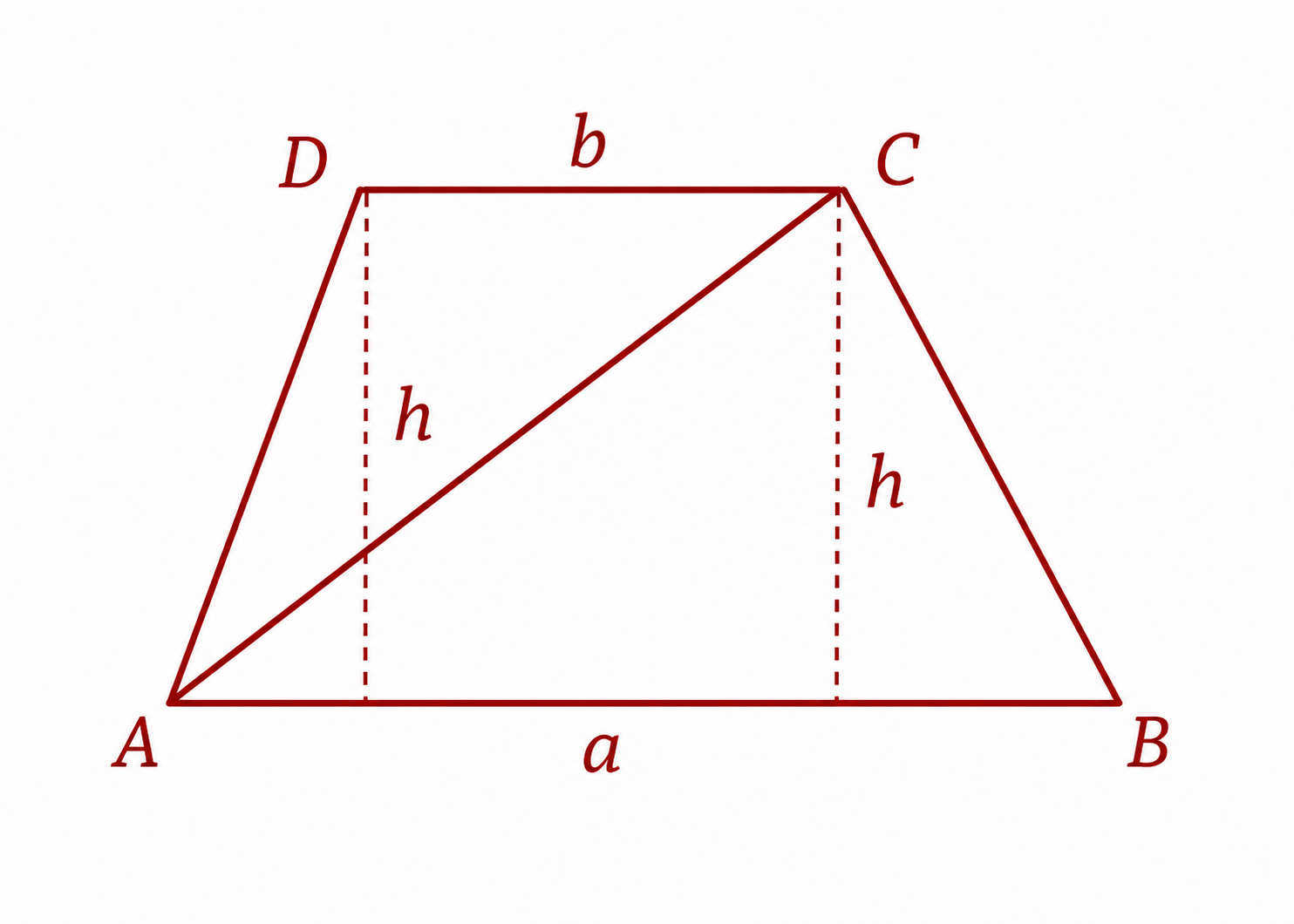
Let $A B C D$ be a trapezium with $A B \| C D$, where $A B=a, C D=b, \text { height }=h $
Draw the diagonal $A C$, dividing the trapezium into triangles $A B C$ and $A C D$.
Since $A B \| C D$, the perpendicular distance between them is $h$.
Therefore, $\operatorname{Area}(\triangle A B C)=\frac{1}{2} a h$
and $\operatorname{Area}(\triangle A C D)=\frac{1}{2} b h .$
Hence,
$\text { Area of trapezium } $
$=\operatorname{Area}(\triangle A B C)+\operatorname{Area}(\triangle A C D) $
$ =\frac{1}{2} a h+\frac{1}{2} b h $
$ =\frac{1}{2}(a+b) h$
Question 13. Show how we can use two identical copies of a trapezium to make a parallelogram. How will this give us the formula for the area of a trapezium?
$\textbf{Answer:}$
Take two identical trapeziums and rotate one of them through $180^{\circ}$.
We fit them together so that their non-parallel sides coincide.
The resulting figure is a parallelogram.
Its base is the sum of the parallel sides: $a+b$
Its height is the same as the height of the trapezium: $h$
Therefore, $\text {Area of parallelogram}=(a+b) h$
Since the parallelogram consists of two identical trapeziums,
$2 \times(\text { Area of trapezium })=(a+b) h$
Hence, $\text { Area of trapezium }=\frac{1}{2}(a+b) h$
Question 14. Show that the area of a kite is half the product of its diagonals.
Show this: (i) using algebra, and (ii) using geometry.
$\textbf{Answer:}$
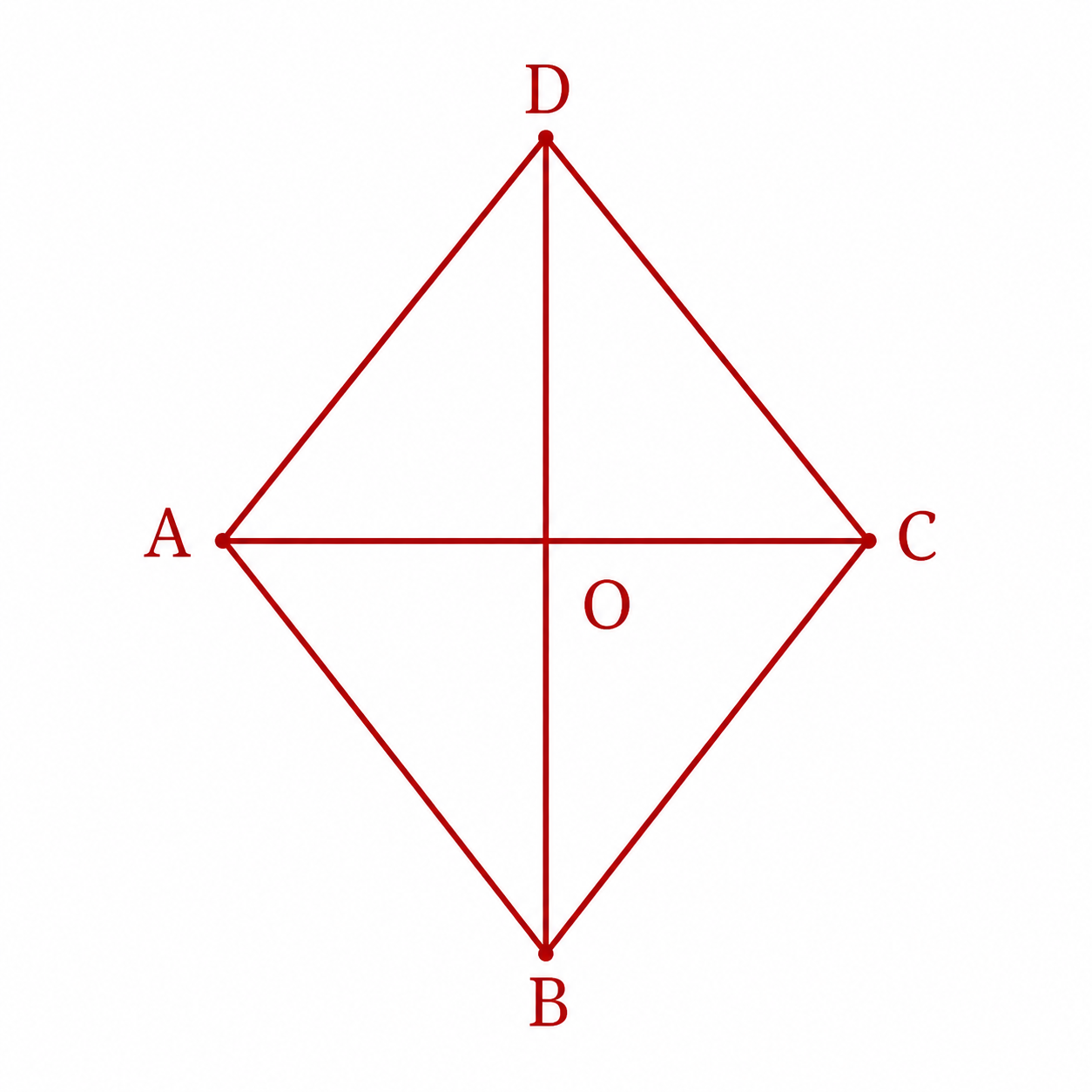
We have to prove that the area of a kite is half the product of its diagonals.
Let the diagonals of a kite be $A C$ and $B D$, intersecting at $O$.
Let the length of AC be $d_1$, and BD be $d_2$.
(i) Using algebra
A kite can be divided into four triangles by its diagonals.
In a kite, one diagonal bisects the other at right angles.
Suppose $A C$ bisects $B D$, so $B O=O D=\frac{d_2}{2}$
The total area is the sum of the areas of the four right triangles.
$ =\frac{1}{2}(A O)(B O)+\frac{1}{2}(A O)(O D) +\frac{1}{2}(C O)(B O)+\frac{1}{2}(C O)(O D)$
$=\frac{1}{2}(A O+C O)(B O+O D)$
Since $A O+C O=A C=d_1$ and $B O+O D=B D=d_2$,
we get, $\text {Area of the kite}=\frac{1}{2} d_1 d_2$
(ii) Using geometry
The diagonals of a kite are perpendicular, and one diagonal bisects the other.
The diagonals divide the kite into four right triangles.
The combined area of these four triangles is
$\frac{1}{2} \times A C \times B D$
Thus, if $d_1$ and $d_2$ are the lengths of the diagonals,
$\text { Area of a kite }=\frac{1}{2} d_1 d_2$
Hence, the area of a kite is half the product of its diagonals.
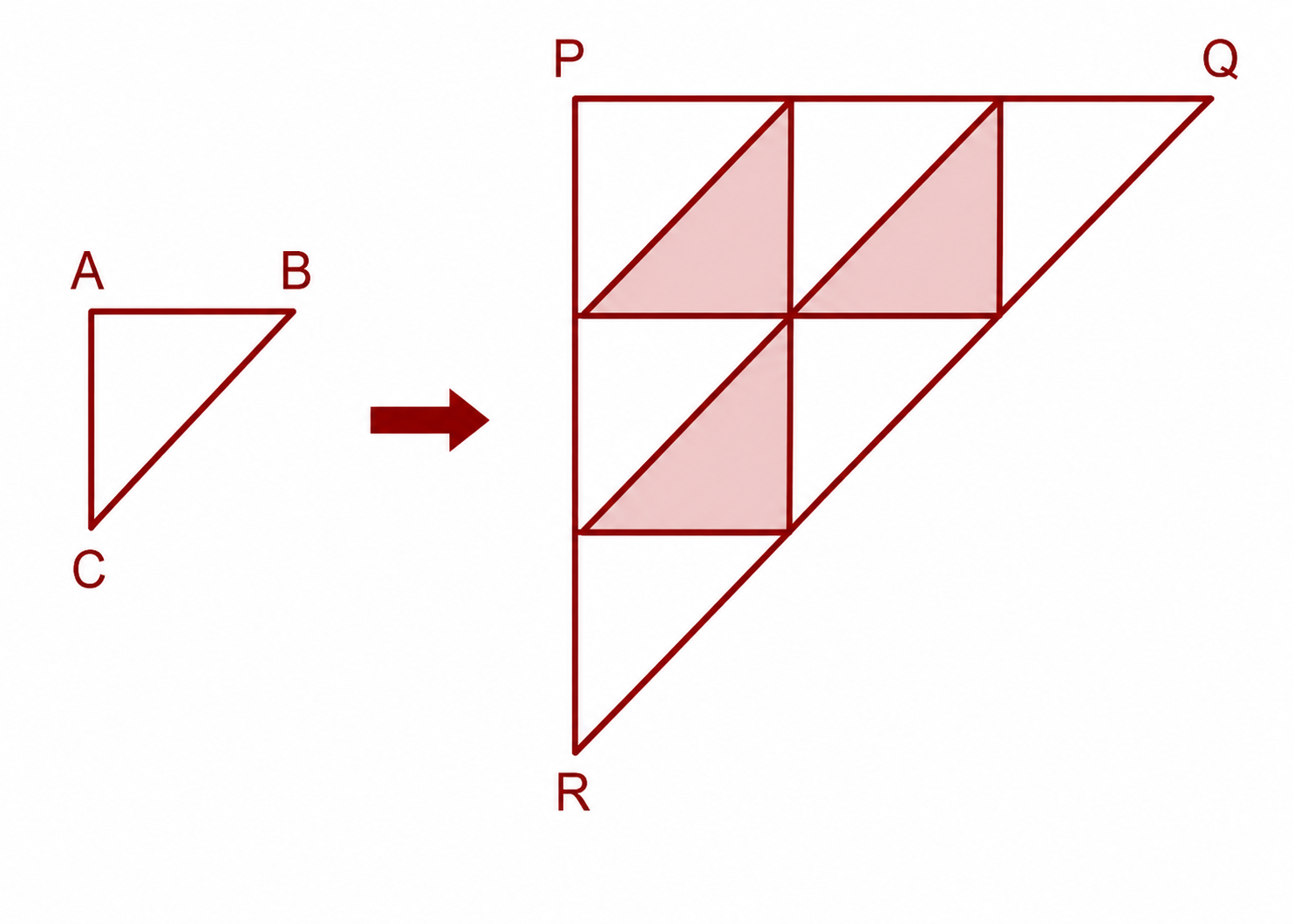
Question 15. Three problems about fitting congruent shapes together:
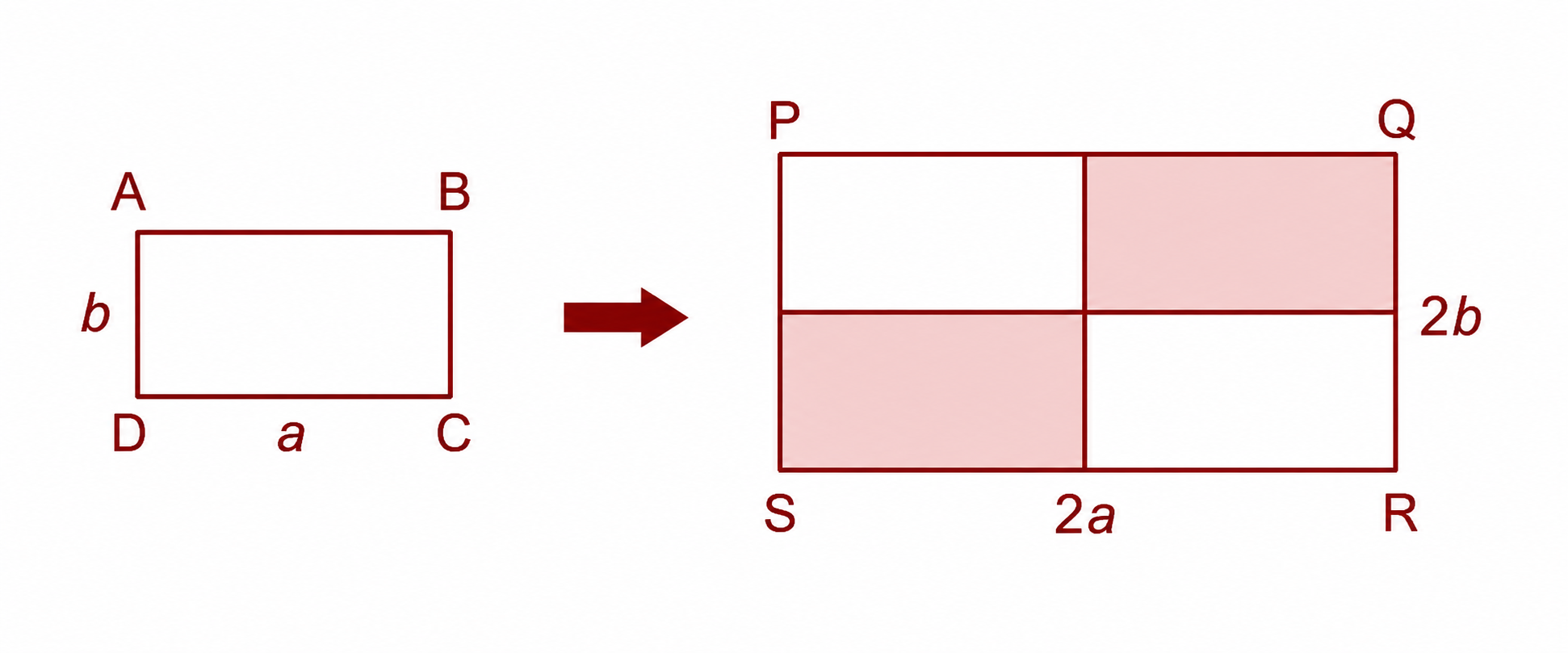
(i) Rectangle ABCD has sides $a, b$, and rectangle PQRS has sides $2 a, 2 b$. Show that PQRS has 4 times the area of ABCD. Does this mean that 4 copies of rectangle ABCD will fit into rectangle PQRS? Check and see!
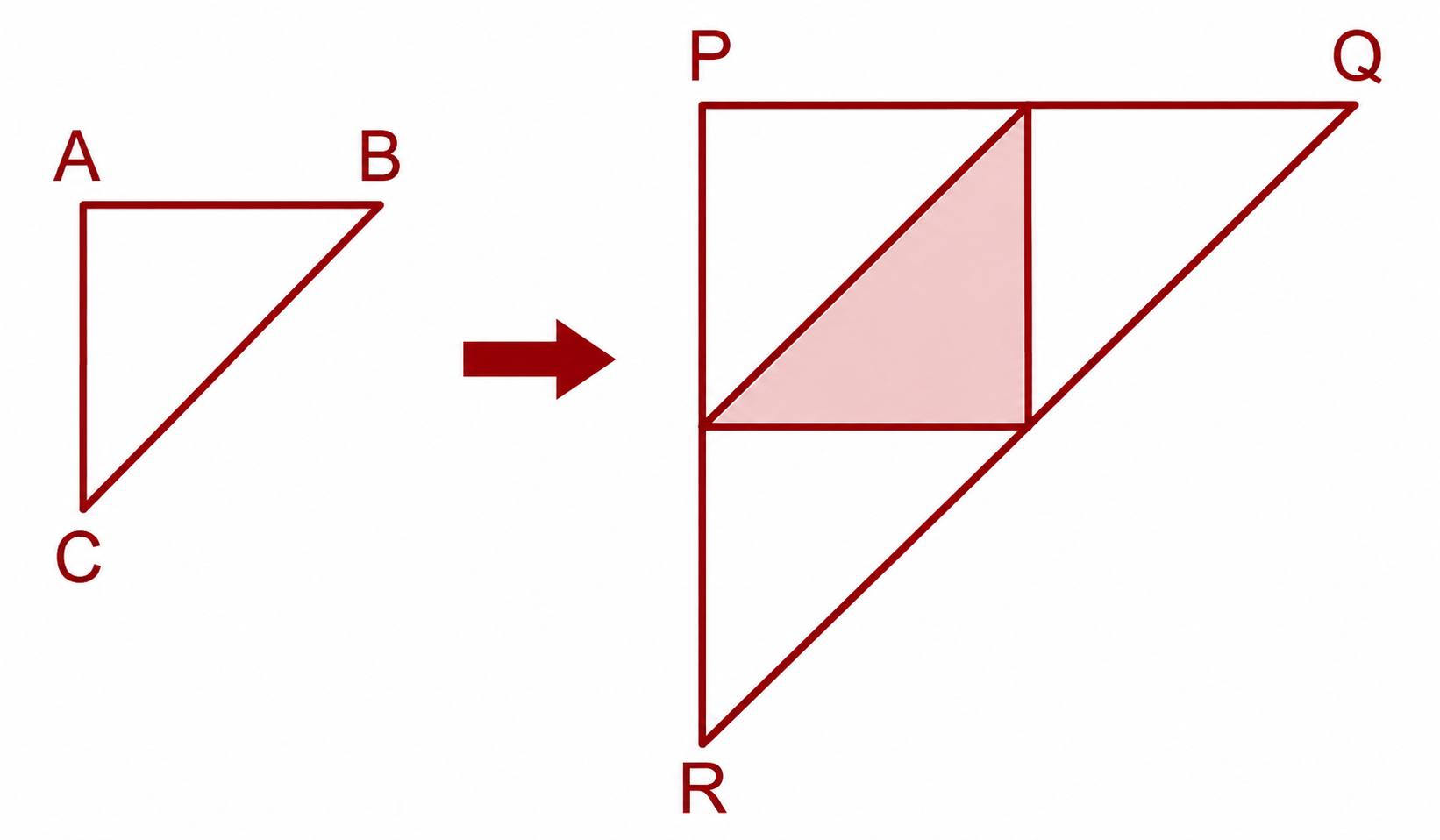
(ii) $\triangle \mathrm{ABC}$ has sides $a, b, c$, and $\triangle \mathrm{PQR}$ has sides $2 a, 2 b, 2 c$. Show that $\triangle P Q R$ has 4 times the area of $\triangle A B C$. Does this mean that 4 copies of $\triangle \mathrm{ABC}$ will fit into $\triangle \mathrm{PQR}$ ? Check and see!
(iii) $\triangle \mathrm{ABC}$ has sides $a, b, c$, and $\triangle \mathrm{PQR}$ has sides $3 a, 3 b, 3 c$. Show that $\triangle P Q R$ has 9 times the area of $\triangle A B C$. Does this mean that 9 copies of $\triangle \mathrm{ABC}$ will fit into $\triangle \mathrm{PQR}$ ? Check and see!
$\textbf{Answer:}$
(i)
Area of rectangle $A B C D=a \times b$
⇒ Area of rectangle $P Q R S=2 a \times 2 b=4ab$
Using the area formulas, the ratio of their areas is $\frac{4 a b}{a b}=4$
⇒ Area of $P Q R S=4 \times$ Area of $A B C D$
To check if 4 copies fit, place two rectangles side-by-side along the edge of length $2 a$, and stack two rows vertically to match the height $2 b$.
$\Rightarrow 4$ copies fit perfectly inside the rectangle $P Q R S$.
Hence, 4 copies of rectangle $A B C D$ will fit into rectangle $P Q R S$.
(ii)
Using Heron's formula, let $s=\frac{a+b+c}{2}$ be the semi-perimeter of $\triangle A B C$.
Area of $\triangle A B C=\sqrt{s(s-a)(s-b)(s-c)}$
⇒ Semi-perimeter of $\triangle P Q R=\frac{2 a+2 b+2 c}{2}=2 s$
⇒ Area of $\triangle P Q R=\sqrt{2 s(2 s-2 a)(2 s-2 b)(2 s-2 c)}$
⇒ Area of $\triangle P Q R=\sqrt{16 \times s(s-a)(s-b)(s-c)}=4 \times$ Area of $\triangle A B C$
To check if 4 copies fit, mark the midpoints of the three sides of $\triangle P Q R$. Connecting these midpoints creates 4 smaller, congruent triangles, each with side lengths $a, b$, and $c$.
$\Rightarrow 3$ triangles are oriented upright, and 1 central triangle is inverted.
Hence, 4 copies of $\triangle A B C$ will fit into $\triangle P Q R$.
(iii)
Using Heron's formula, let $s=\frac{a+b+c}{2}$ be the semi-perimeter of $\triangle A B C$.
Area of $\triangle A B C=\sqrt{s(s-a)(s-b)(s-c)}$
⇒ Semi-perimeter of $\triangle P Q R=\frac{3 a+3 b+3 c}{2}=3 s$
⇒ Area of $\triangle P Q R=\sqrt{3 s(3 s-3 a)(3 s-3 b)(3 s-3 c)}$
⇒ Area of $\triangle P Q R=\sqrt{81 \times s(s-a)(s-b)(s-c)}=9 \times$ Area of $\triangle A B C$
To check if 9 copies fit, divide each side of $\triangle P Q R$ into 3 equal segments of lengths $a, b$, and $c$, then draw lines parallel to the three outer sides through these trisection points. This grid splits the large triangle into rows containing 1,3, and 5 small triangles from top to bottom.
⇒ Total matching copies $=1+3+5=9$
Hence, 9 copies of $\triangle A B C$ will fit into $\triangle P Q R$.
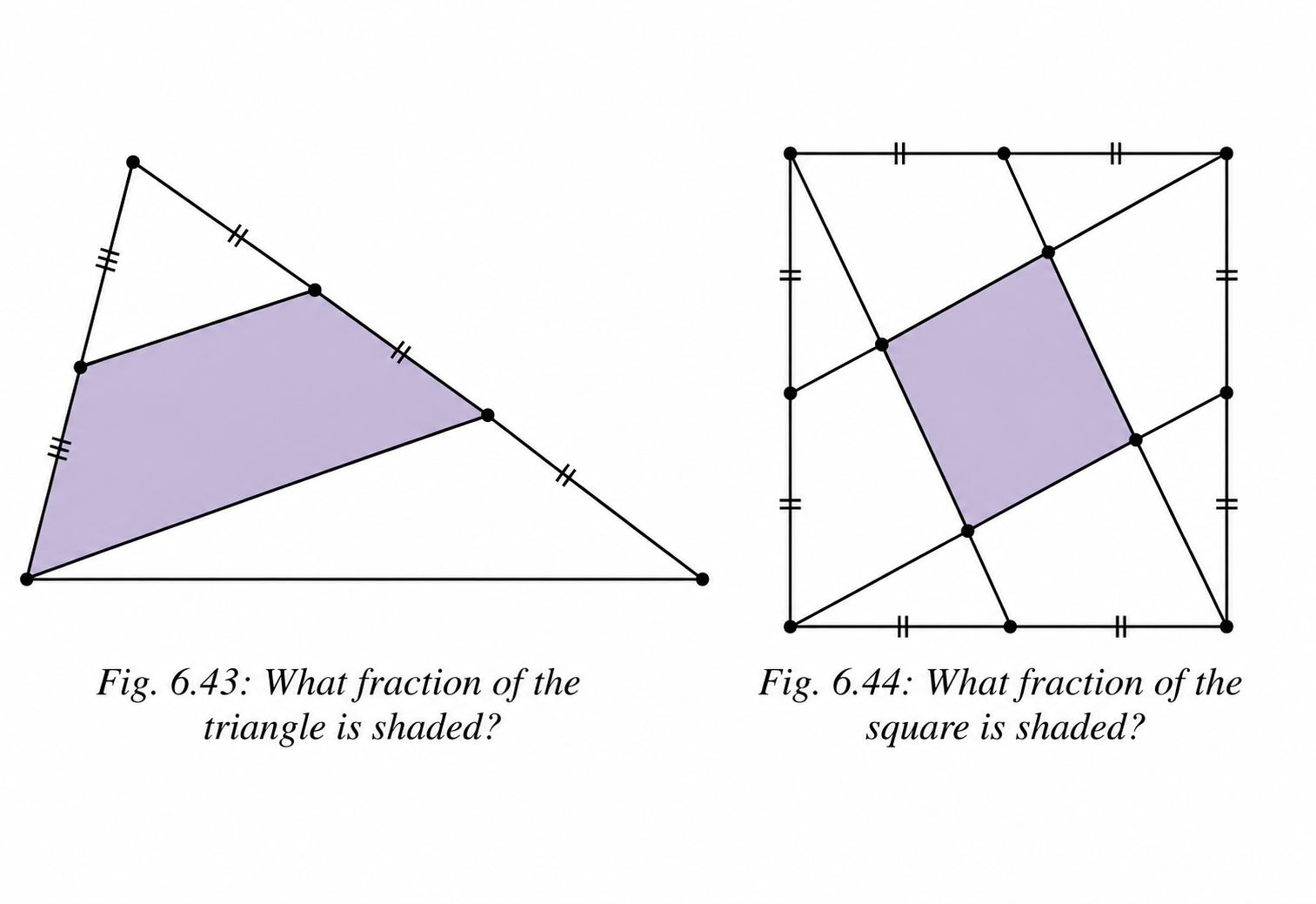
*Question 16.
$\textbf{Answer:}$
For Fig. 6.43
Let $ T$ denote the total area of the main large triangle.
We can see that the left side is divided into 3 equal segments, and the right side into 4 equal segments. Also, the unshaded regions consist of three smaller triangles at the corners: the top triangle, the bottom-left corner triangle, and the bottom-right corner triangle.
Area of top triangle $=\frac{1}{3} \times \frac{2}{4} \times T=\frac{1}{6} T$
⇒ Area of bottom-left triangle $=\frac{1}{3} \times 1 \times T=\frac{1}{3} T$
⇒ Area of bottom-right triangle $=1 \times \frac{1}{4} \times T=\frac{1}{4} T$
Using these fractions, the total unshaded area is found by adding the three corner triangles together.
Total unshaded fraction $=\frac{1}{6}+\frac{1}{3}+\frac{1}{4}$
⇒ Total unshaded fraction $=\frac{2}{12}+\frac{4}{12}+\frac{3}{12}=\frac{9}{12}=\frac{3}{4}$
⇒ Shaded fraction $=1-\frac{3}{4}$
⇒ Shaded fraction $=\frac{1}{4}$
Hence, the correct answer is $\frac{1}{4}$ of the triangle is shaded.
For Fig. 6.44
Let the side length of the large outer square be 2 units, making its total area $2 \times 2=4$ sq. units.
By drawing lines connecting opposite midpoints, the large square is split into 4 smaller, identical squares, each having an area of 1 sq. unit.
Area of each corner right-angled triangle $=\frac{1}{2} \times$ base × height
⇒ Area of one large outer right-angled triangle $=\frac{1}{2} \times 1 \times 2=1$ sq. unit
⇒ Combined area of the 4 rotated outer triangles $=4 \times 1=4$ sq. units
Total number of identical small squares $=5$
⇒ Area of the shaded central square $=\frac{1}{5} \times$ Total Area
⇒ Shaded fraction $=\frac{1}{5}$
Hence, the correct answer is $\frac{1}{5}$ of the square is shaded.
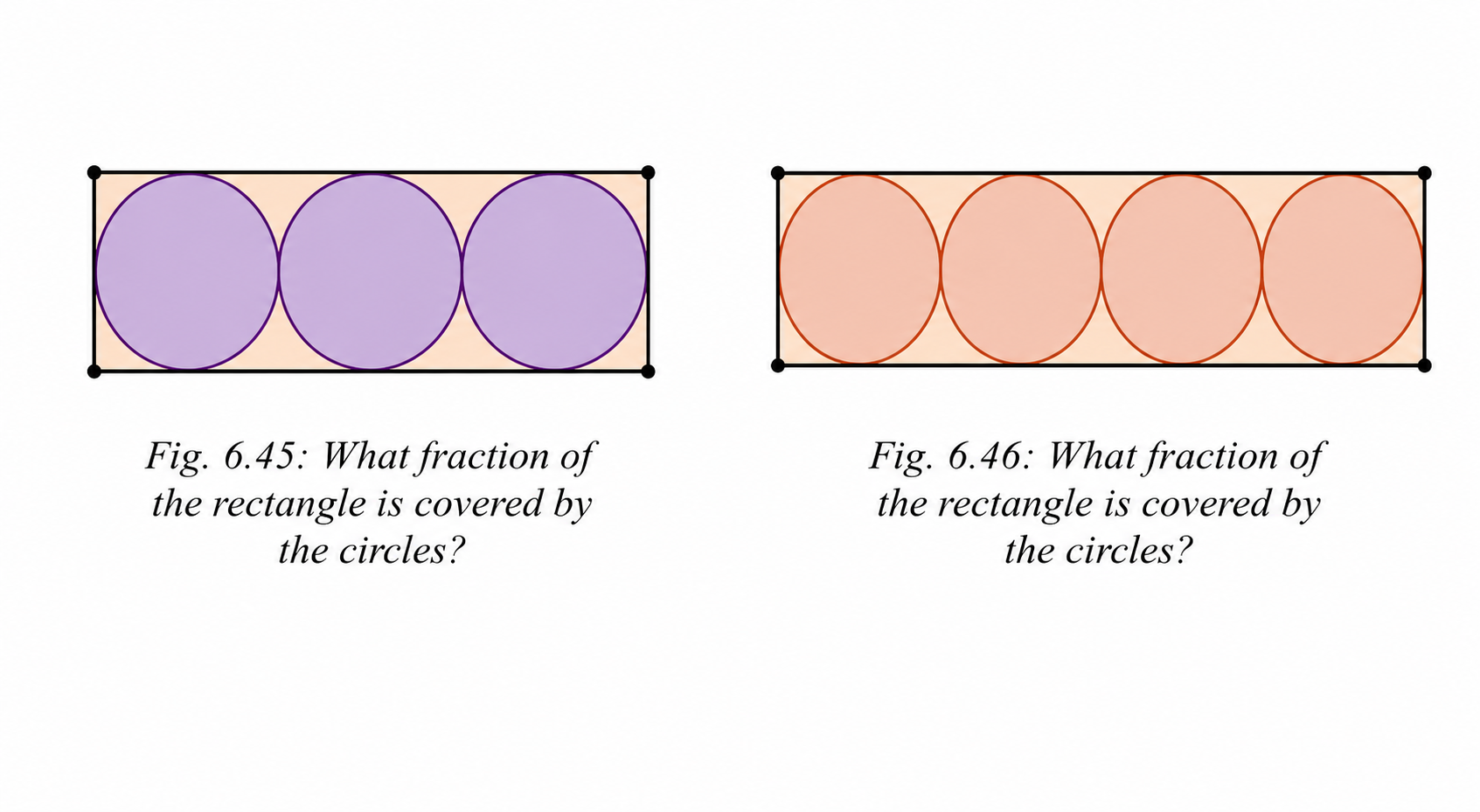
Question 17.
$\textbf{Answer:}$
(i)
There are 3 equal circles placed side by side in a rectangle.
Area of the circles $=3 \times \pi r^2=3 \pi r^2$, where $r$ is the radius of the circle.
In the rectangle, height $=2 r$ and Width $=3 \times 2 r=6 r$
Therefore, $\text { Area of rectangle }=(6 r)(2 r)=12 r^2 $
Hence,
$
\frac{\text { Area covered by circles }}{\text { Area of rectangle }}=\frac{3 \pi r^2}{12 r^2}=\frac{\pi}{4} \approx 0.785$
So, about $78.5 \%$ of the rectangle is covered by the circles.
(ii)
There are 4 equal circles placed side by side.
Area of the circles $=4 \pi r^2 $, where $r$ is the radius of the circle.
In the rectangle, Height $=2 r$ and Width $=4 \times 2 r=8 r$
Thus, $\text { Area of rectangle }=(8 r)(2 r)=16 r^2$
Therefore,
$
\frac{\text { Area covered by circles }}{\text { Area of rectangle }}=\frac{4 \pi r^2}{16 r^2}=\frac{\pi}{4} \approx 0.785$
So, about $78.5 \%$ of the rectangle is covered by the circles.
Question 18. Use the above to make a conjecture about the area occupied by circles fitted into a rectangle in the manner shown. Test your conjecture for particular cases: 10 circles; 20 circles; 50 circles. Then prove your conjecture!
$\textbf{Answer:}$
From Question 17, we get that:$\text { Fraction covered by circles }=\frac{\pi}{4}$
Now, the Conjecture is that:
If $n$ equal circles of radius $r$ are fitted side by side in a rectangle as shown, then the fraction of the rectangle occupied by the circles is always $\frac{\pi}{4}$, regardless of the number of circles.
For 10 circles:
Total area $=10\pi r^2$
Length of the rectangle $=10(2 r)=20 r, $ and Breadth of the rectangle $=2 r$.
Area of the rectangle $=20r\times 2r=40r^2$
Thus, $\frac{\text { Area of circles }}{\text { Area of rectangle }}=\frac{10 \pi r^2}{40 r^2}=\frac{\pi}{4} $
For 20 circles:
Total area $=20\pi r^2$
Length of the rectangle $=20(2 r)=40 r, $ and Breadth of the rectangle $=2 r$.
Area of the rectangle $=40r\times 2r=80r^2$
Thus, $\frac{\text { Area of circles }}{\text { Area of rectangle }}=\frac{20 \pi r^2}{40 r^2}=\frac{\pi}{4} $
For 50 circles:
Total area $=50\pi r^2$
Length of the rectangle $=50(2 r)=100 r, $ and Breadth of the rectangle $=2 r$.
Area of the rectangle $=100r\times 2r=200r^2$
Thus, $\frac{\text { Area of circles }}{\text { Area of rectangle }}=\frac{50 \pi r^2}{200 r^2}=\frac{\pi}{4} $
For $n$ circles:
Total area $=n\pi r^2$
Length of the rectangle $=n(2 r)=2n r, $ and Breadth of the rectangle $=2 r$.
Area of the rectangle $=2nr\times 2r=4nr^2$
Thus, $\frac{\text { Area of circles }}{\text { Area of rectangle }}=\frac{n \pi r^2}{4nr^2}=\frac{\pi}{4} $
Hence, proved.
*Question 19.
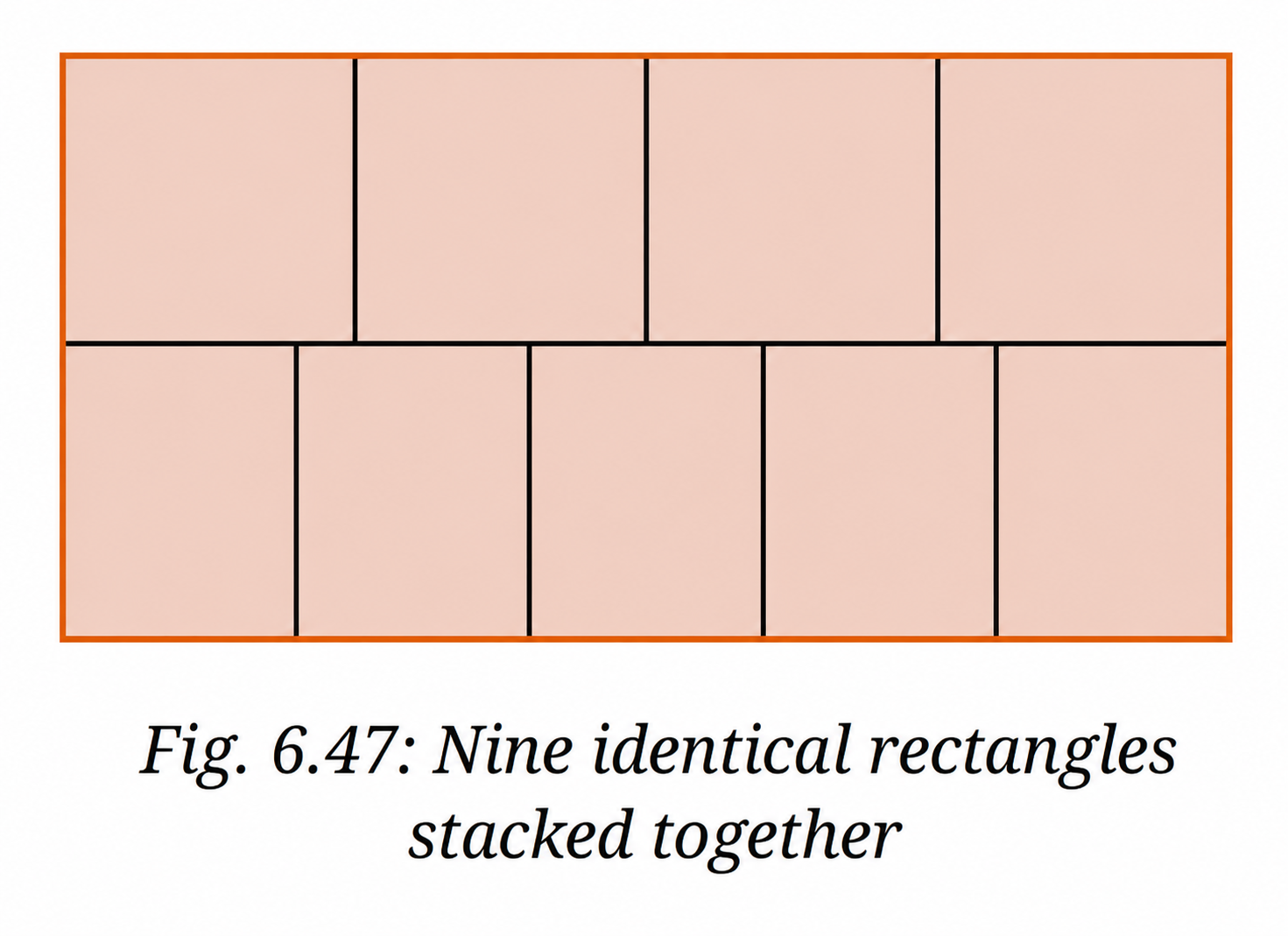
The figure shows nine identical rectangles fitted together to make a large rectangle whose area is 72 $\mathrm{cm}^2$. Find the perimeter of each small rectangle.
$\textbf{Answer:}$
Let the length and breadth of each identical smaller rectangle be $x$ and $y$, respectively.
From the given arrangement, the total length of 4 rectangles on the top equals the total length of 5 rectangles on the bottom.
$ \Rightarrow 4 x=5 y $
$ \Rightarrow x=\frac{5}{4} y$
The total area of the large outer rectangle is given as $72 \mathrm{~cm}^2$, which is equal to the sum of the areas of the 9 identical smaller rectangles.
So,
$ 9 x y=72$
$ \Rightarrow x y=8$
$\Rightarrow\left(\frac{5}{4} y\right) y=8 $
$ \Rightarrow y^2=\frac{32}{5}=6.4$
$ \Rightarrow y=\sqrt{6.4}$
$ \Rightarrow x=\frac{5}{4} \sqrt{6.4}=\sqrt{\frac{25}{16} \times 6.4}=\sqrt{10}$
Using the perimeter formula for a small rectangle
$=2(x+y)=2(\sqrt{10}+\sqrt{6.4})$ cm
*Question 20.
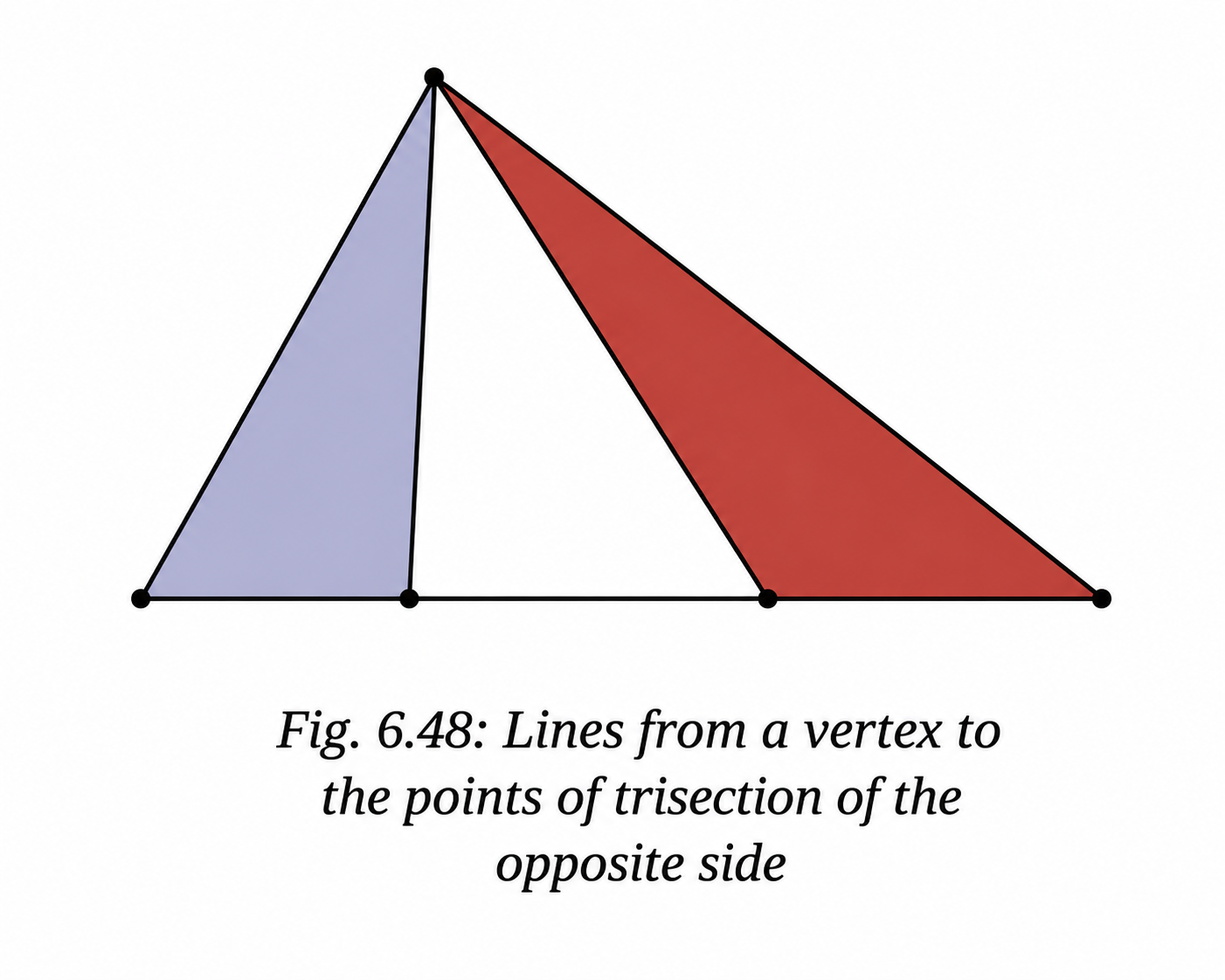
Show that the areas of the shaded blue triangle and the shaded red triangle are equal.
Find a way of cutting up the blue triangle into some number of pieces and rearranging the pieces to cover the red triangle.
$\textbf{Answer:}$
Let the main triangle have its top vertex denoted by $V$ and its base lying along a horizontal line. The base is divided into three equal segments by the points of trisection, so each segment has length $b$. The shaded blue triangle and the shaded red triangle share the same top vertex V, meaning they have the exact same perpendicular height, $h$.
Area of a triangle $=\frac{1}{2} \times$ base $\times$ height
⇒ Area of blue triangle $=\frac{1}{2} bh$
⇒ Area of red triangle $=\frac{1}{2} bh$
So, both triangles have equal areas.
⇒ Area of blue triangle $=$ Area of red triangle
To rearrange the blue triangle to cover the red triangle, drop a perpendicular line from vertex $V$ to the baseline. This vertical altitude cuts the blue triangle into two smaller right-angled triangles.
By translating these two pieces horizontally to the right along the base line so that their vertical edges align with the right-hand boundary lines of the red triangle's configuration, they perfectly recompose and cover the exact area of the red triangle.
*Question 21.
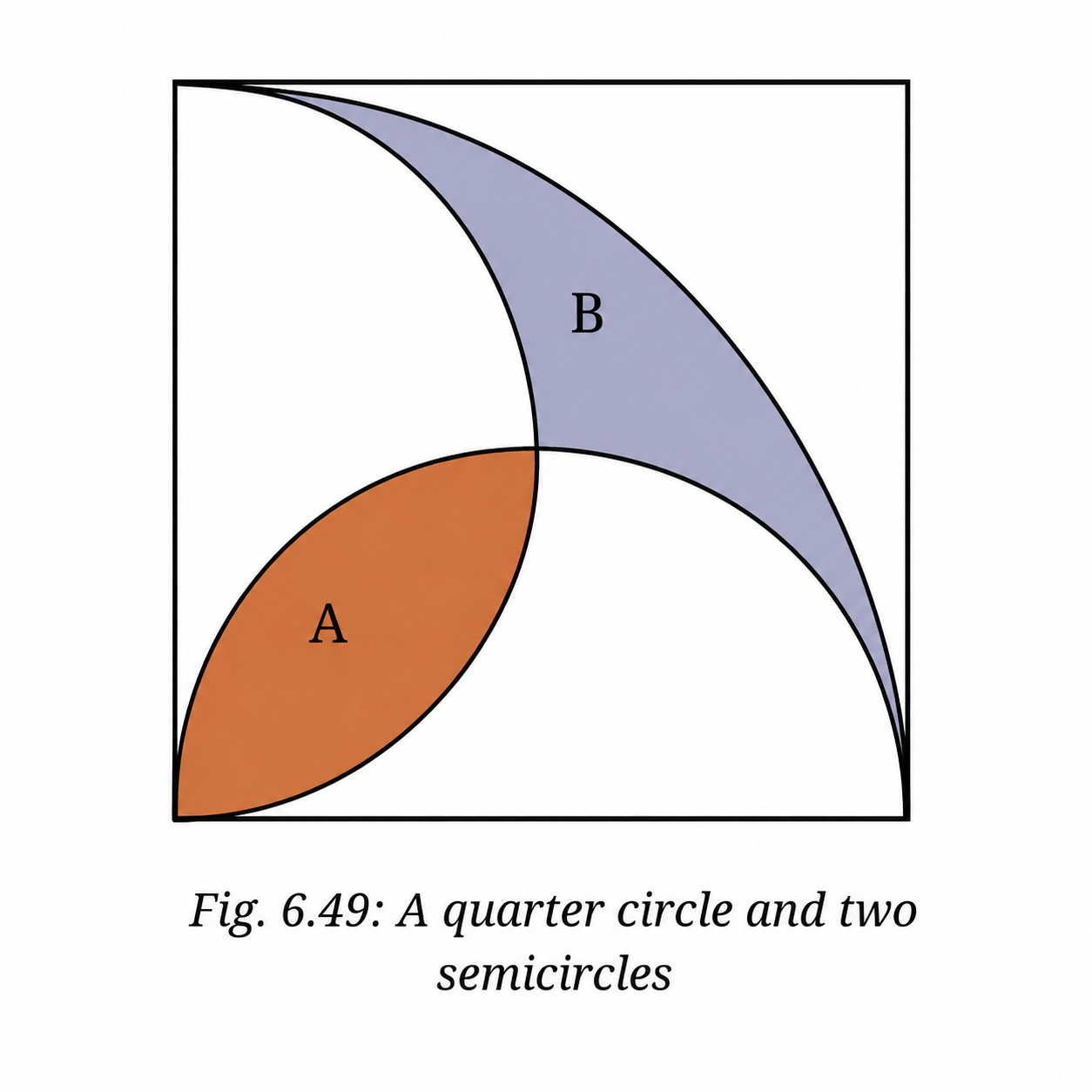
The figure shows a quarter circle in a square. Its centre is at one vertex, and it passes through two adjacent vertices. There are two semicircles on two adjacent sides as diameters. They create the shaded regions A and B. Show that A and B have equal area.
$\textbf{Answer:}$
Let the side length of the square be $s$.
The radius of the large quarter circle is also $s$,
and the radius of each semicircle is $r=\frac{s}{2}$.
The area of the square is divided into distinct, non-overlapping regions:
region $A$ (the intersection of the two semicircles), region $B$, and the remaining unshaded sections inside the square.
Area of a semicircle $=\frac{1}{2} \pi r^2=\frac{1}{2} \pi\left(\frac{s}{2}\right)^2=\frac{\pi s^2}{8}$
⇒ Area of both semicircles combined $=$ Area of Semicircle${ }_1+$ Area of Semicircle $_2- A$
⇒ Combined Semicircle Area $=\frac{\pi s^2}{8}+\frac{\pi s^2}{8}-A=\frac{\pi s^2}{4}-A$
The large quarter circle covers the exact same geometric space as the combination of the two semicircles, except it excludes the overlap region $A$ and includes region $B$.
Area of the quarter circle $=\frac{1}{4} \pi s^2$
⇒ Area of the quarter circle $=$ Combined Semicircle Area $+B$
$\Rightarrow \frac{\pi s^2}{4}=\left(\frac{\pi s^2}{4}-A\right)+B$
$
\begin{aligned}
& \Rightarrow 0=-A+B \\
& \Rightarrow A=B
\end{aligned}
$
Hence, proved.
*Question 22.
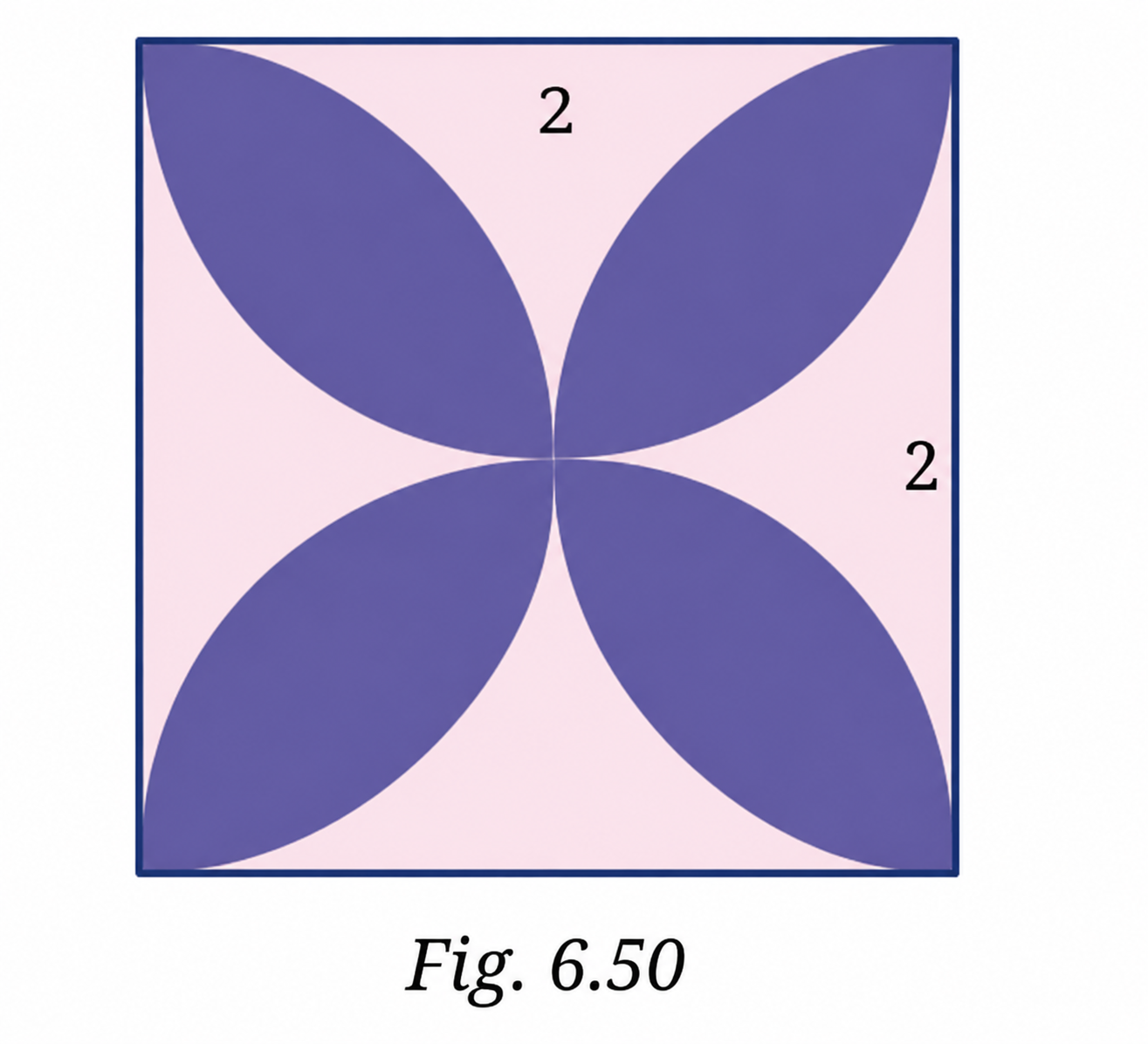
In Fig. 6.50, four semicircles have been drawn within the given square whose side is 2 units. The centres of these semicircles are the midpoints of the sides.
They create a 4-petalled flower (shown in blue). Find the perimeter and the area of this flower.
$\textbf{Answer:}$
Let the side length of the square, $s$, be 2.
Four semicircles are drawn with the sides of the square acting as diameters, so the radius of each semicircle is $r=\frac{s}{2}=\frac22=1$
The perimeter of the 4-petalled flower is formed by the boundary arcs of the four semicircles. Each petal consists of two arcs, meaning the entire boundary consists of four complete semicircular arcs.
Perimeter of flower $=4 \times$ (Perimeter of a semicircle)
$
\begin{aligned}
& \Rightarrow \text { Perimeter }=4 \times(\pi r) \\
& \Rightarrow \text { Perimeter }=4 \times(\pi \times1)=4 \pi
\end{aligned}
$
To find the area of the flower, consider the area of the four unshaded regions outside the petals.
Each pair of opposite unshaded corner regions is found by subtracting two full semicircles from the total area of the square.
Area of 4 unshaded corners $=2 \times$ (Area of square $-2 \times$ Area of a semicircle)
$
\begin{aligned}
& \Rightarrow \text { Unshaded Area }=2 \times\left(s^2-2 \times \frac{1}{2} \pi r^2\right) \\
& \Rightarrow \text { Unshaded Area }=2 \times\left(2^2-\pi \times 1^2\right)=2(4-\pi)=8-2 \pi
\end{aligned}
$
Area of flower $=$ Area of square - Unshaded Area
$
\begin{aligned}
& \Rightarrow \text { Area }=4-(8-2 \pi) \\
& \Rightarrow \text { Area }=2 \pi-4
\end{aligned}
$
Hence, the correct answer is a perimeter of $4 \pi$ units and an area of ( $2 \pi-4$ ) sq. units.
*Question 23.
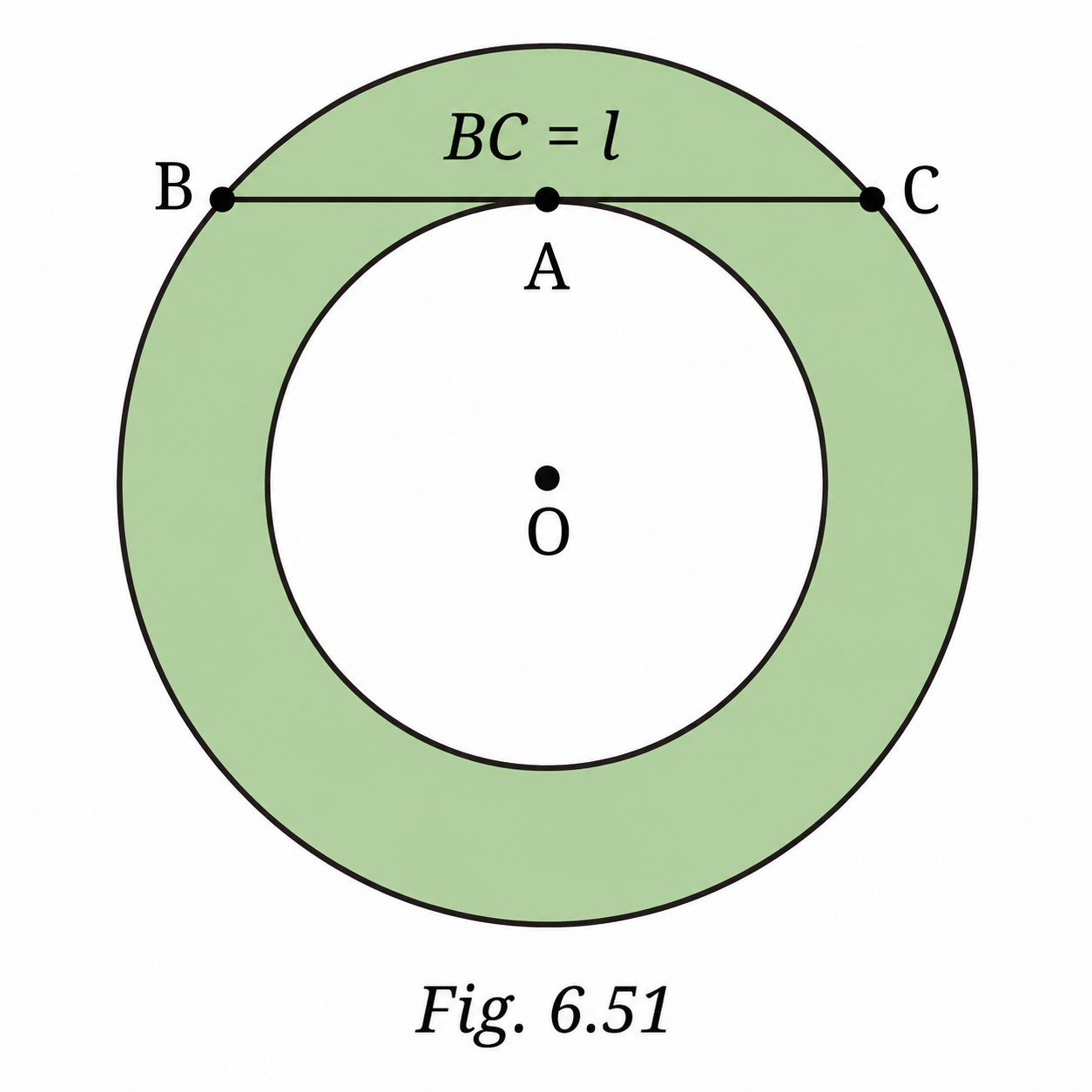
In Fig. 6.51 we see two concentric circles with a common centre O. A chord BC of the larger circle is drawn, touching the smaller circle at A. The length of BC is $l$. Show that the area of the green region enclosed between the two circles is $\frac{1}{4} \pi l^2$.
$\textbf{Answer:}$
Let the radius of the outer larger circle be $R$, and the radius of the inner smaller circle be $r$, with both sharing the common centre $O$.
The line segment $O A$ is a radius of the smaller circle drawn to the point of tangency $A$, making it perpendicular to the chord $B C\left(\angle O A B=\angle O A C=90^{\circ}\right)$.
The perpendicular line from the centre to a chord bisects the chord, meaning $A$ is the midpoint of $B C$.
$
\Rightarrow A B=A C=\frac{I}{2}
$
By Pythagoras' theorem in the right-angled triangle $\triangle O A B$, where the hypotenuse is $O B=R$,
$
\begin{aligned}
& \Rightarrow O B^2=O A^2+A B^2 \\
& \Rightarrow R^2=r^2+\left(\frac{l}{2}\right)^2 \\
& \Rightarrow R^2-r^2=\frac{l^2}{4}
\end{aligned}
$
The area of the green region is the difference between the areas of the outer and inner circles.
Area of green region $=\pi R^2-\pi r^2$
$
\begin{aligned}
& \Rightarrow \text { Area }=\pi\left(R^2-r^2\right) \\
& \Rightarrow \text { Area }=\pi\left(\frac{l^2}{4}\right) \\
& \Rightarrow \text { Area }=\frac{1}{4} \pi l^2
\end{aligned}
$
Hence, proved.
*Question 24. In Fig. 6.52, semicircles have been drawn on all the sides of a right-angled triangle as shown. Show that Area (A) + Area (B) = Area (C).
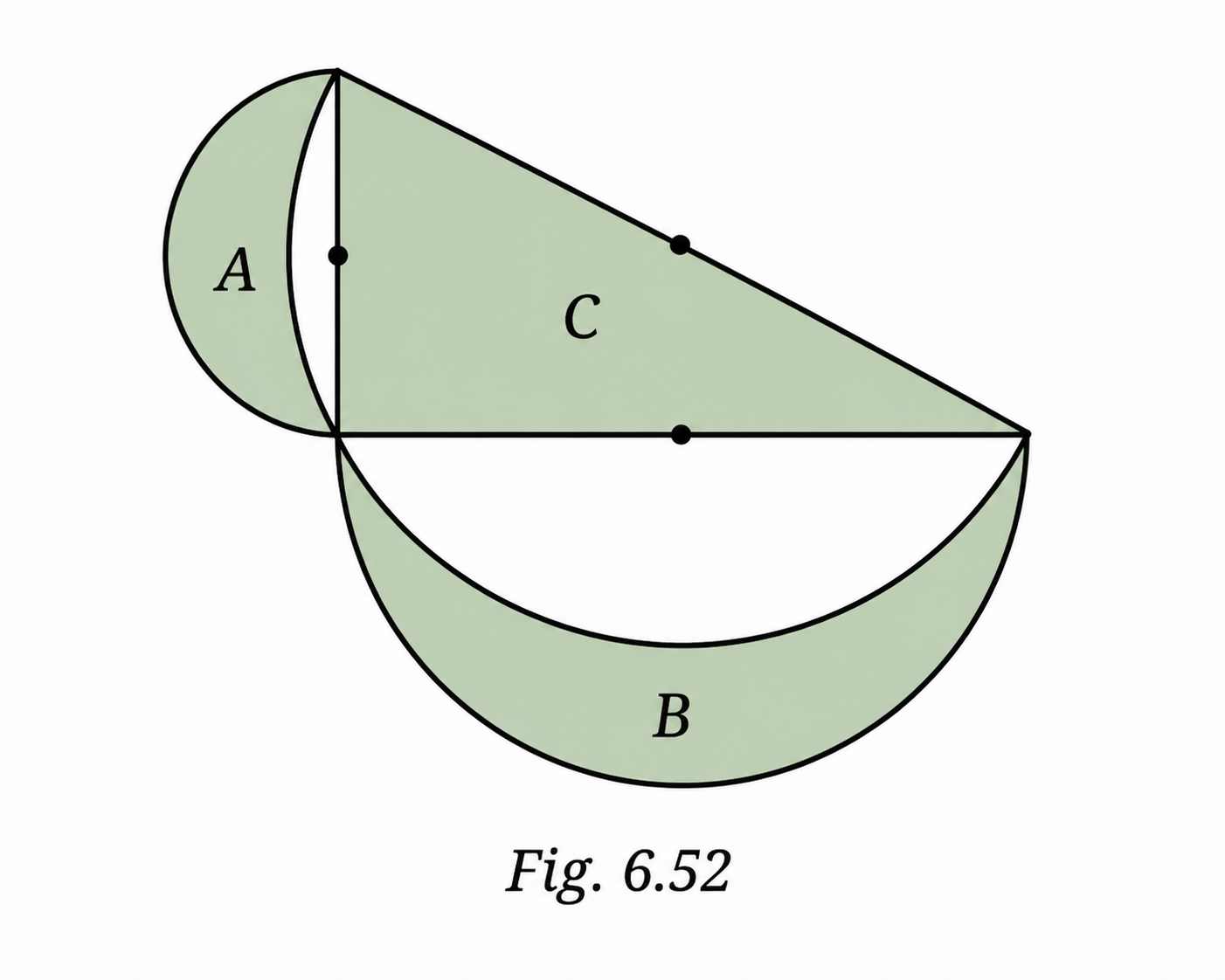
$\textbf{Answer:}$
Let the side lengths of the right-angled triangle $C$ opposite to the vertices be denoted as $a, b$, and $c$, where $c$ is the length of the hypotenuse, and $a$ and $b$ are the lengths of the perpendicular sides corresponding to the diameters of semicircles $B$ and $A$, respectively.
By Pythagoras' theorem for the right-angled triangle, the sum of the squares of the two shorter sides equals the square of the hypotenuse.
$\Rightarrow a^2+b^2=c^2$
The area of a semicircle with diameter $d$ is given by the formula $\frac{1}{2} \pi\left(\frac{d}{2}\right)^2=\frac{\pi d^2}{8}$
Area of semicircle on hypotenuse $c=\frac{\pi c^2}{8}$
⇒ Area $(A)+$ Area of segment on side $b=\frac{\pi b^2}{8_2}$
⇒ Area $(B)+$ Area of segment on side $a=\frac{\pi a^2}{8}$
Total areas of the semicircles built on sides $a$ and $b$
$
\begin{aligned}
& \Rightarrow \frac{\pi a^2}{8}+\frac{\pi b^2}{8}=\frac{\pi}{8}\left(a^2+b^2\right) \\
& \Rightarrow \frac{\pi a^2}{8}+\frac{\pi b^2}{8}=\frac{\pi c^2}{8}
\end{aligned}
$
Since the unshaded circular segments bound inside the large semicircle on hypotenuse $c$ subtract out equally from both sides of the total geometric composition, the remaining lune areas directly match the inner triangle's area.
$
\Rightarrow \operatorname{Area}(A)+\operatorname{Area}(B)=\operatorname{Area}(C)
$
Hence, proved.
*Question 25.
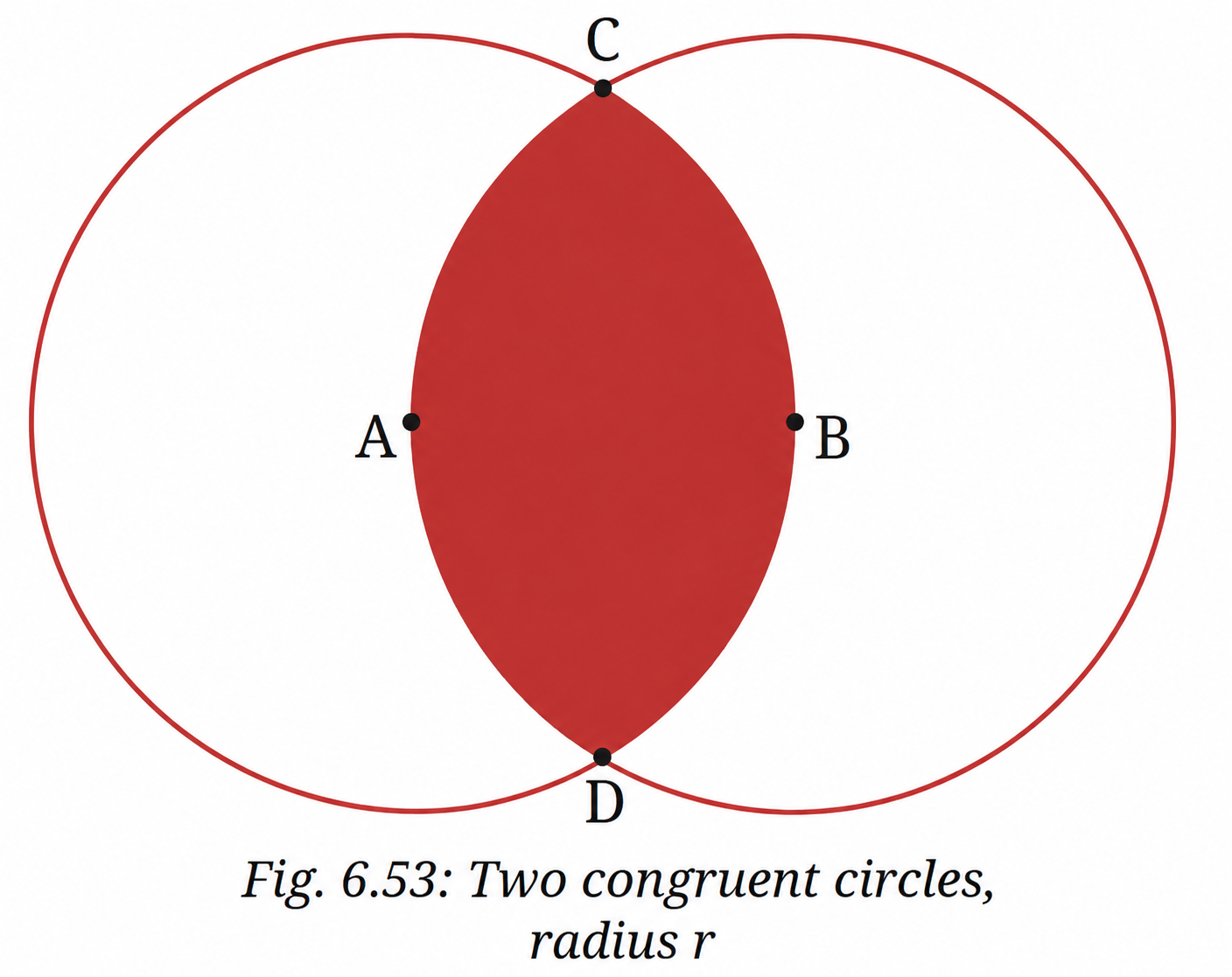
Fig. 6.53 shows two circles passing through each other’s centres. Find the area of the region enclosed by the two circles in terms of the common radius r.
$\textbf{Answer:}$
Let the centres of the two congruent circles be $A$ and $B$, both having a radius $r$. Since each circle passes through the other's centre, the distance between their centres is $A B=r$.
The intersection points of the two circles are $C$ and $D$.
Connecting the centres and intersection points forms two equilateral triangles, $\triangle A B C$ and $\triangle A B D$, because $A C=B C=A B=r$ and $A D=B D=A B=r$.
Area of an equilateral triangle $=\frac{\sqrt{3}}{4} r^2$
⇒ Area of $\triangle A B C=\frac{\sqrt{3}}{4} r^2$
The angle subtended by the arc $C B D$ at the center $A$ is $\angle C A D=\angle C A B+\angle D A B= 60^{\circ}+60^{\circ}=120^{\circ}$
Area of circular sector $A-C B D=\frac{120^{\circ}}{360^{\circ}}\times\pi r^2=\frac{1}{3} \pi r^2$
⇒ Area of circular segment $C B D=$ Area of sector $A-C B D-$ Area of $\triangle A C D$
⇒ Area of segment $C B D=\frac{1}{3} \pi r^2-2\left(\frac{\sqrt{3}}{4} r^2\right)=\frac{1}{3} \pi r^2-\frac{\sqrt{3}}{2} r^2$
Now,
Total Shaded Area $=2 \times($ Area of sector $A-C B D)-$ Area of rhombus $A C B D$
⇒ Total Shaded Area $=2\left(\frac{1}{3} \pi r^2\right)-2\left(\frac{\sqrt{3}}{4} r^2\right)$
⇒ Total Shaded Area $=\left(\frac{2 \pi}{3}-\frac{\sqrt{3}}{2}\right) r^2$
Hence, the correct answer is $\left(\frac{2 \pi}{3}-\frac{\sqrt{3}}{2}\right) r^2$ sq. units.
*Question 26.
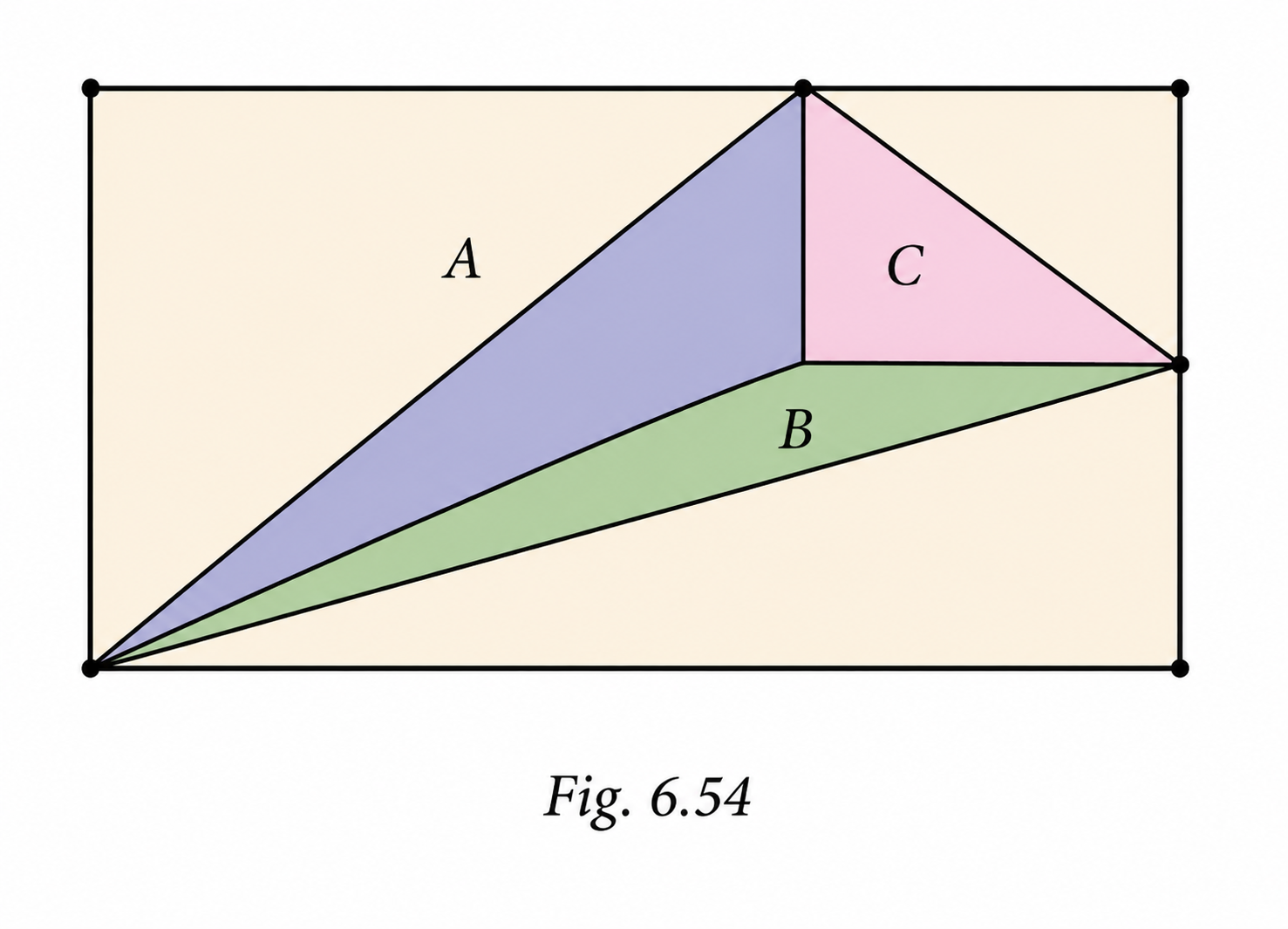
In Fig. 6.54, we see three triangles within a rectangle.
The areas of the triangles are $A, B, C$, as marked. Show that the area of the rectangle is $\frac{2(A+C)(B+C)}{C} .$
$\textbf{Answer:}$
Let the length of the rectangle be $L$, and its height be $H$.
The vertex shared by triangles $A, B$, and $C$ inside the rectangle is connected to the outer boundary edges by vertical and horizontal segments. Let the vertical segment separating the regions of triangle $A$ and triangle $C$ have a length of $h_1$, and let the horizontal segment separating the regions of triangle $B$ and triangle $C$ have a length of $l_1$.
The base of triangle $A$ is the vertical line segment $h_1$, and its perpendicular height relative to this base is the horizontal distance to the left edge of the rectangle, which is $\left(L-l_1\right)$.
Area of triangle $C=\frac{1}{2} \cdot l_1 \cdot h_1$
$
\begin{aligned}
& \Rightarrow C=\frac{1}{2} l_1 h_1 \\
& \Rightarrow \text { Area of triangle } A=\frac{1}{2} \cdot h_1 \cdot\left(L-l_1\right) \\
& \Rightarrow A=\frac{1}{2} L h_1-\frac{1}{2} l_1 h_1=\frac{1}{2} L h_1-C \\
& \Rightarrow A+C=\frac{1}{2} L h_1
\end{aligned}
$
Similarly, the base of triangle $B$ is the horizontal line segment $l_1$, and its perpendicular height relative to this base is the vertical distance to the bottom edge of the rectangle, which is $\left(H-h_1\right)$.
Area of triangle $B=\frac{1}{2} \cdot l_1 \cdot\left(H-h_1\right)$
$
\begin{aligned}
& \Rightarrow B=\frac{1}{2} l_1 H-\frac{1}{2} l_1 h_1=\frac{1}{2} l_1 H-C \\
& \Rightarrow B+C=\frac{1}{2} l_1 H
\end{aligned}
$
Now,
$
\begin{aligned}
& \Rightarrow(A+C)(B+C)=\left(\frac{1}{2} L h_1\right)\left(\frac{1}{2} l_1 H\right) \\
& \Rightarrow(A+C)(B+C)=\frac{1}{4} \cdot L \cdot H \cdot\left(l_1 h_1\right)
\end{aligned}
$
Since Area of rectangle $=L \cdot H$ and $C=\frac{1}{2} l_1 h_1 \Rightarrow l_1 h_1=2 C$,
$
\begin{aligned}
& \Rightarrow(A+C)(B+C)=\frac{1}{4} \cdot(\text { Area of rectangle }) \cdot(2 C) \\
& \Rightarrow(A+C)(B+C)=\frac{C}{2} \cdot(\text { Area of rectangle }) \\
& \Rightarrow \text { Area of rectangle }=\frac{2(A+C)(B+C)}{C}
\end{aligned}
$
Hence, proved.
*Question 27. In the figure we see two shaded regions formed by a quarter circle, a semicircle, and a triangle.
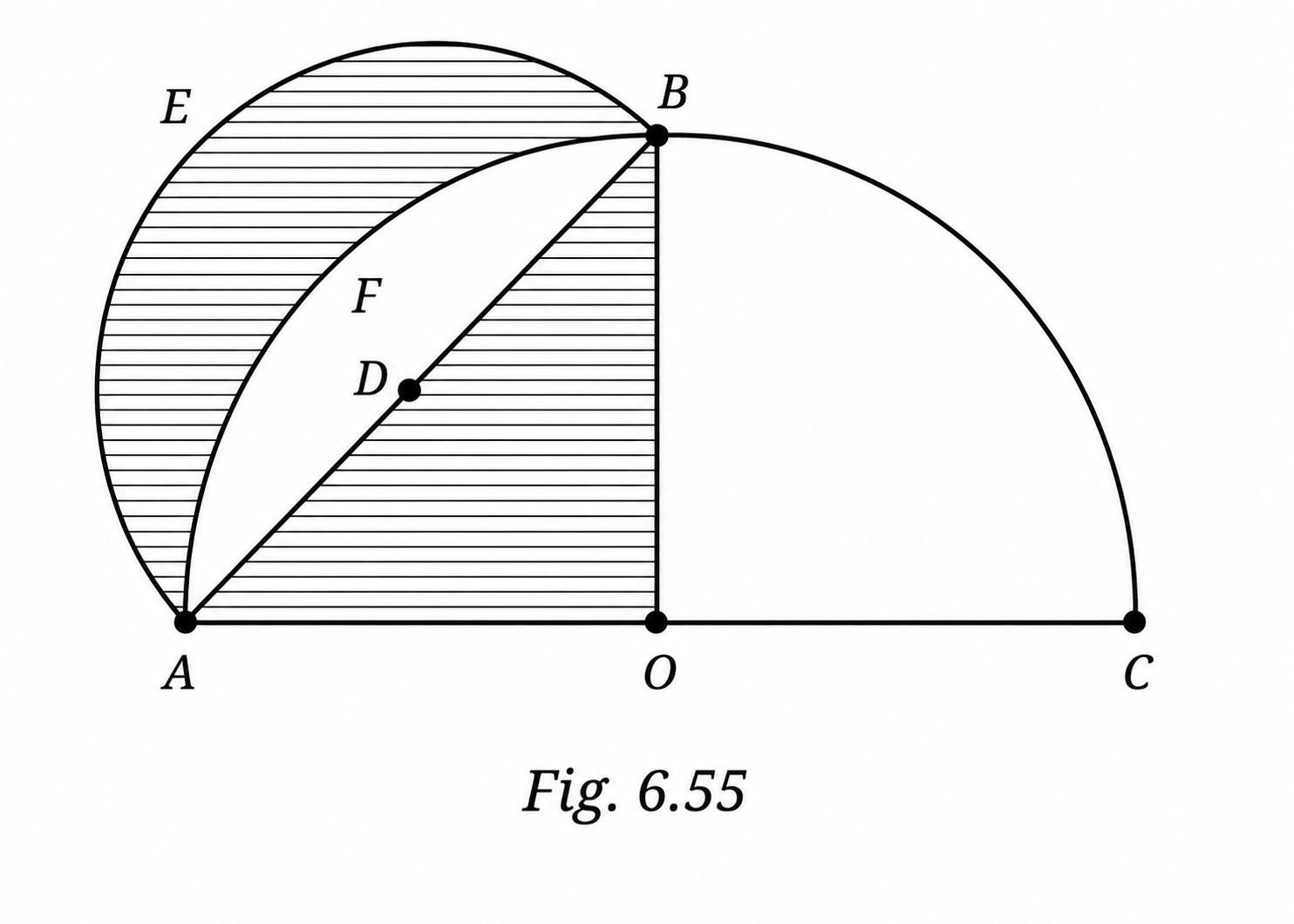
Show that the areas of the two shaded regions are equal.
$\textbf{Answer:}$
Let the radius of the large semicircle with diameter $A C$ and center $O$ be $R$, so $O A=O B= O C=R$.
The triangle $A O B$ is a right-angled triangle at $O$, and $A B$ is its hypotenuse.
By Pythagoras' theorem in $\triangle A O B$, the length of the hypotenuse $A B$ is the diameter of the smaller semicircle $A E B$.
$
\begin{aligned}
& \Rightarrow A B^2=O A^2+O B^2=R^2+R^2=2 R^2 \\
& \Rightarrow A B=\sqrt{2} R
\end{aligned}
$
Let the area of the shaded region near the triangle be $S_1$, and the area of the semicircle $A E B$ is $S_2$.
Area of sector $A O B=\frac{1}{4} \pi R^2$
⇒ Area of semicircle $A E B=\frac{1}{2} \pi\left(\frac{A B}{2}\right)^2=\frac{1}{2} \pi\left(\frac{2 R^2}{4}\right)=\frac{1}{4} \pi R^2$
Using the common unshaded segment $A F B$, we can express both shaded regions explicitly.
So, Area of $S_1$
= Area of sector $A O B$ - Area of segment $A F B$
$=\frac{1}{4} \pi R^2$ - Area of segment AFB
Also,
Area of $S_2$
= Area of semicircle $A E B-$ Area of segment $A F B$
$=\frac{1}{4} \pi R^2-$ Area of segment AFB
Hence, proved.
Confused between CGPA and Percentage?
Get your results instantly with our calculator!
Measuring Space: Perimeter and Area Class 9 Chapter 6: Topics
Topics you will learn in NCERT Class 9 Maths Chapter 6 Measuring Space: Perimeter and Area include:
- 6.1 Perimeter of a Shape
- 6.2 Perimeter of a Circle —The C/D Ratio
- 6.3 π Is Irrational
- 6.4 Length of an Arc of a Circle
- 6.5 Problems, Puzzles, and Paradoxes on Perimeter
- 6.6 Area of a Rectangle
- 6.7 Area of a Parallelogram
- 6.8 Area of a Triangle
- 6.8.1 Heron’s formula
- 6.9 Squaring a Rectangle
- 6.10 Area of a Circle
Class 9 Maths NCERT Chapter 6 Solutions: Extra Questions
Question 1: In quadrilateral ABCD, AB is parallel to CD, and $\angle$A = 70°, $\angle$D = 110°. Find $\angle$B and $\angle$C.
$\textbf{Answer:}$
We know that, in a quadrilateral with one pair of opposite sides parallel, adjacent angles on the same side of a transversal are supplementary.
Now, by the angle sum property of a quadrilateral:
$\angle$A+$\angle$B+$\angle$C+$\angle$D = 360°
70°+$\angle B+\angle C$ + 110° = 360°
$\angle$B + $\angle$C = 180°
As we are given that AB is parallel to CD
So, $\angle$B = $\angle$C (alternate interior angles)
Therefore, $\angle$B=$\angle$C = 90°
Question 2:
In a cyclic quadrilateral ${EFGH}, \angle {E}$ is opposite to $\angle{G}$. If $\angle{E}=95°$, then what is the value of $\angle {G}$?
$\textbf{Answer:}$
Given,
$\angle E = 95°$
EFGH is a cyclic quadrilateral
In a cyclic quadrilateral, the opposite angles are supplementary.
⇒ $\angle E + \angle G = 180°$
⇒ $95° + \angle G = 180°$
⇒ $\angle G = 180° - 95° = 85°$
Hence, the correct answer is 85°.
Question 3:
Sides of a triangle are represented in the ratio of 12 : 17 : 25 and its perimeter is 540 cm. Determine its area.
$\textbf{Answer:}$
Let the sides of the triangle be
$
\begin{aligned}
& a=12 z \mathrm{~cm} \\
& b=17 z \mathrm{~cm} \\
& c=25 z \mathrm{~cm}
\end{aligned}
$
Perimeter of the triangle $=540 \mathrm{~cm}$
Now, $12 z+17 z+25 z=540$
$
\begin{aligned}
& \Rightarrow 54 x=54 \\ & \Rightarrow z=10 \\
& \therefore a=(12 \times 10) \mathrm{cm}=120 \mathrm{~cm} \\
& b=(17 \times 10) \mathrm{cm}=170 \mathrm{~cm}
\end{aligned}
$
and $\mathrm{c}=(25 \times 10) \mathrm{cm}=250 \mathrm{~cm}$
Now, semi-perimeter, $\mathrm{s}=\frac{540 } 2 \mathrm{~cm}=270 \mathrm{~cm}$
$
\begin{aligned}
& \text { Area }=\sqrt{s(s-a)(s-b)(s-c)} \\
& =\sqrt{270(270-120)(270-170)(270-250)} \\
& =\sqrt{270 \times 100 \times 150 \times 20} \\
& =\sqrt{10^2 \times 10^2 \times 3^2 \times 3^2 \times 5^2 \times 2^2} \\
& =\left(10 × 10×3×3× 5× 2\right) \mathrm{cm}^2 \\
& =9,000 \mathrm{~cm}^2
\end{aligned}
$
Hence, the correct answer is $9,000 \mathrm{~cm}^2$.
Question 4:
A triangle and a parallelogram have the same base and the same area. If the sides of the triangle are 26 cm, 28 cm and 30 cm, and the parallelogram stands on the base 28 cm, show the height of the parallelogram.
$\textbf{Answer:}$
For the given triangle, we have $\mathrm{a}=28 \mathrm{~cm}, \mathrm{~b}=30 \mathrm{~cm}, \mathrm{c}=26 \mathrm{~cm}$ Now, as the area of the triangle can be given by $=\sqrt{s(s-a)(s-b)(s-c)}$ After replacing the values $=\sqrt{42(42-28)(42-30)(42-26)} \mathrm{cm}^2$ Therefore, $\sqrt{42 \times 14 \times 12 \times 16} \mathrm{~cm}^2$
$
\begin{aligned}
& =\sqrt{112896} \mathrm{~cm}^2 \\
& =336 \mathrm{~cm}^2
\end{aligned}
$
Area of the given parallelogram $=$ Area of the given triangle
∴ Area of the parallelogram $=336 \mathrm{~cm}^2$
⇒ base $\times$ height $=336$
$\Rightarrow 28 \times h=336$, where ' $h$ ' is the height of the parallelogram.
$
\begin{aligned}
& \Rightarrow \mathrm{h}=33628 =12
\end{aligned}
$
Thus, the required height of the parallelogram = 12 cm
Question 5:
The perimeter of a parallelogram is 48 cm. If the height of the parallelogram is 6 cm and the length of the adjacent side is 8 cm. Find its area.
$\textbf{Answer:}$
We have,
The perimeter, height, and the adjacent side of a parallelogram are 48 cm, 6 cm, and 8 cm.
Perimeter of a parallelogram = 2 (Adjacent side + Base)
⇒ 48 = 2 (8 + Base)
Or, base = 16 cm
We know, Area = Base × Height
So, Area = 16 cm × 6 cm = 96 $\text{cm}^2$
So, the area of the parallelogram is 96 $\text{cm}^2$.
Hence, the correct answer is 96 $\text{cm}^2$.
NCERT Solutions for Class 9 Maths Chapter Wise
We at Careers360 compiled all the NCERT Class 9 Maths solutions in one place for easy student reference. The following links will allow you to access them.
NCERT Class 9 Books & Syllabus
Before the start of a new academic year, students should refer to the latest syllabus to determine the chapters they’ll be studying. Below are the updated syllabus links, along with some recommended reference books.
Frequently Asked Questions (FAQs)
An arc is a part of the circumference of a circle between two points on the circle.
An irrational number cannot be expressed as a fraction of two integers and has a non-terminating, non-repeating decimal expansion. Since π has these properties, it is irrational.
Free NCERT Measuring Space: Perimeter and Area Class 9 solutions are available on various educational websites and e-learning platforms such as Careers360, in both online and PDF formats, covering all exercises with step-by-step explanations.
A sector is the region enclosed by two radii and the arc between them.
A parallelogram can be cut and rearranged into a rectangle without changing its area. Therefore, both have an area equal to base × height.
Heron's formula is useful when the lengths of all three sides of a triangle are known, but its height is not known.

Popular Questions
A block of mass 0.50 kg is moving with a speed of 2.00 ms-1 on a smooth surface. It strikes another mass of 1.00 kg and then they move together as a single body. The energy loss during the collision is
| Option 1)
|
Option 2)
|
| Option 3)
|
Option 4)
|
An athlete in the olympic games covers a distance of 100 m in 10 s. His kinetic energy can be estimated to be in the range
| Option 1)
|
Option 2)
|
| Option 3)
|
Option 4)
|
A particle is projected at 600 to the horizontal with a kinetic energy . The kinetic energy at the highest point
| Option 1)
|
Option 2)
|
| Option 3)
|
Option 4)
|
In the reaction,
| Option 1)
|
Option 2)
|
| Option 3)
|
Option 4)
|
How many moles of magnesium phosphate, will contain 0.25 mole of oxygen atoms?
| Option 1)
0.02 |
Option 2)
3.125 × 10⁻² |
| Option 3)
1.25 × 10⁻² |
Option 4)
2.5 × 10⁻² |