


NCERT Solutions for Class 9 Maths Chapter 4 Linear Equations in Two Variables
Have you noticed that using a basic formula such as $(a + b)^2$ or $(a - b)^2$ will help save time while performing your mathematics calculations? Or, how can $(a+b)(a-b)$ help us to simplify difficult multiplications? Welcome to Algebra! Algebraic identities are very important in cutting short calculations and making them simple. Through these NCERT Solutions for Class 9 Maths Chapter 4 Exploring Algebraic Identities, you will get to know how Algebraic identities help in simplifying difficult calculations. Whether it is your classroom work or your daily life, the use of Algebraic Identities will help you get things done faster and more efficiently. Just like recipes in cooking, algebraic identities give us step by step formulas for solving expressions quickly. These NCERT Solutions for Class 9 will develop students’ understanding of Algebraic patterns and mathematical shortcuts.
This Story also Contains
- Exploring Algebraic Identities Class 9 Questions and Answers PDF Free Download
- NCERT Solutions for Class 9 Maths Chapter 4 Exploring Algebraic Identities: Exercise Questions
- Exploring Algebraic Identities Class 9 Chapter 4: Topics
- Class 9 Maths NCERT Chapter 4 Solutions: Extra Questions
- NCERT Solutions for Class 9 Maths Chapter Wise
- NCERT Class 9 Books & Syllabus
Algebraic identities are like the superheroes of algebra that turn long calculations into easy ones. The NCERT Solutions for Class 9 Maths are reliable and trustworthy because they are prepared by subject matter experts at Careers360 and are an important resource for exam preparation. The NCERT Solutions are used by many toppers as they are prepared as per the latest syllabus. In addition, this chapter not only helps us master Class 9 Mathematics, but also helps in most exams beyond higher classes, including JEE and beyond.
Exploring Algebraic Identities Class 9 Questions and Answers PDF Free Download
Students can download the Class 9 Maths Chapter 4 Exploring Algebraic Identities PDF by clicking the link provided below.
NCERT Solutions for Class 9 Maths Chapter 4 Exploring Algebraic Identities: Exercise Questions
Below, you will find the NCERT Class 9 Maths Chapter 4 Exploring Algebraic Identities question answers explained step by step.
Think and Reflect (Page 71)
Question 1. What can you say about $a$ and $b$ if $(a+b)^2<a^2+b^2$ ?
$\textbf{Answer:}$
$(a+b)^2<a^2+b^2$
$⇒a^2+2 a b+b^2<a^2+b^2$
$⇒2ab<0$
$⇒ab<0$
So, $a$ and $b$ have opposite signs (one positive and one negative).
Question 2. What can you say about $a$ and $b$ if $(a+b)^2>a^2+b^2$ ?
$\textbf{Answer:}$
$(a+b)^2>a^2+b^2$
$⇒a^2+2 a b+b^2>a^2+b^2$
$⇒2ab>0$
$⇒ab>0$
So, $a$ and $b$ have the same signs (both positive and both negative).
Question 3. When will $(a+b)^2$ be equal to $a^2+b^2$ ?
$\textbf{Answer:}$
If $(a+b)^2=a^2+b^2$
$⇒2ab=0$
$⇒ab=0$
So, either $a=0$ or $b=0$ (or both).
Did you observe that $(a+b)^2$ and $a^2+b^2$ are both positive? What term will decide which is larger? Use the expansion of $(a+b)^2$ to decide.
The deciding term is: $2ab$
So,
$2 a b>0 \Rightarrow(a+b)^2$ is larger
$2 a b<0 \Rightarrow a^2+b^2$ is larger
$2 a b=0 \Rightarrow$ both are equal
Exploring Algebraic Identities Class 9 Questions and AnswersExercise Set 4.1 |
Question 1. Using the identity $(a+b)^2=a^2+2 a b+b^2$, expand the following:
(i) $(7 x+4 y)^2$
(ii) $\left(\frac{7}{5} x+\frac{3}{2} y\right)^2$
(iii) $(2.5 p+1.5 q)^2$
(iv) $\left(\frac{3}{4} s+8 t\right)^2$
(v) $\left(x+\frac{1}{2 y}\right)^2$
(vi) $\left(\frac{1}{x}+\frac{1}{y}\right)^2$
$\textbf{Answer:}$
(i) $(7 x+4 y)^2$
$=(7 x)^2+2(7 x)(4 y)+(4 y)^2$
$=49x^2+56xy+16y^2$
(ii) $\left(\frac{7}{5} x+\frac{3}{2} y\right)^2$
$=\left(\frac{7}{5} x\right)^2+2\left(\frac{7}{5} x\right)\left(\frac{3}{2} y\right)+\left(\frac{3}{2} y\right)^2$
$=\frac{49}{25} x^2+\frac{21}{5} x y+\frac{9}{4} y^2$
(iii) $(2.5 p+1.5 q)^2$
$=(2.5 p)^2+2(2.5 p)(1.5 q)+(1.5 q)^2$
$=6.25p^2+7.5 pq+2.25q^2$
(iv) $\left(\frac{3}{4} s+8 t\right)^2$
$=\left(\frac{3}{4} s\right)^2+2\left(\frac{3}{4} s\right)(8 t)+(8 t)^2$
$=\frac{9}{16} s^2+12 s t+64 t^2$
(v) $\left(x+\frac{1}{2 y}\right)^2$
$=x^2+2(x)\left(\frac{1}{2 y}\right)+\left(\frac{1}{2 y}\right)^2$
$=x^2+\frac{x}{y}+\frac{1}{4 y^2}$
(vi) $\left(\frac{1}{x}+\frac{1}{y}\right)^2$
$=\left(\frac{1}{x}\right)^2+2\left(\frac{1}{x}\right)\left(\frac{1}{y}\right)+\left(\frac{1}{y}\right)^2$
$=\frac{1}{x^2}+\frac{2}{x y}+\frac{1}{y^2}$
Question 2. Using the same identity, find the values of the following:
(i) $(64)^2$
(ii) $(105)^2$
(iii) $(205)^2$
$\textbf{Answer:}$
(i) $(64)^2$
$=(60+4)^2$
$=60^2+2(60)(4)+4^2$
$=3600+480+16$
$=4096$
(ii) $(105)^2$
$=(100+5)^2$
$=100^2+2\times100\times5+5^2$
$=10000+1000+25$
$=11025$
(iii) $(205)^2$
$=(200+5)^2$
$=200^2+2\times200\times5+5^2$
$=40000+2000+25$
$=42025$
Think and Reflect (Page 73)
Question: What if we replace $b$ by $-b$ in $(a+b)^2=a^2+2 a b+b^2$ ?
$\textbf{Answer:}$
If we replace $b$ by $-b$ in $(a+b)^2=a^2+2 a b+b^2$, we get,
$(a+(-b))^2=a^2+2 a(-b)+(-b)^2$
$⇒(a-b)^2=a^2-2ab+b^2$
$\therefore$ Only the middle term changes sign.
Exploring Algebraic Identities Class 9 Questions and AnswersExercise Set 4.2 |
Question 1. Factor completely:
(i) $9 x^2+24 x y+16 y^2$
(ii) $4 s^2+20 s t+25 t^2$
(iii) $49 x^2+28 x y+4 y^2$
(iv) $64 p^2+\frac{32}{3} p q+\frac{4}{9} q^2$
*(v) $ 3 a^2+4 a b+\frac{4}{3} b^2$
*(vi) $ \frac{9}{5} s^2+6 s v+5 v^2$
(Hint: 2 was taken out as a common factor in Example 7. Is it possible to do something similar in Exercises (v) and (vi) above?)
$\textbf{Answer:}$
(i) $9 x^2+24 x y+16 y^2$
$=(3 x)^2+2(3 x)(4 y)+(4 y)^2$
$=(3x+4y)^2$
(ii) $4 s^2+20 s t+25 t^2$
$=(2 s)^2+2(2 s)(5 t)+(5 t)^2$
$=(2s+5t)^2$
(iii) $49 x^2+28 x y+4 y^2$
$=(7 x)^2+2(7 x)(2 y)+(2 y)^2$
$=(7x+2y)^2$
(iv) $64 p^2+\frac{32}{3} p q+\frac{4}{9} q^2$
$=(8 p)^2+2(8 p)\left(\frac{2}{3} q\right)+\left(\frac{2}{3} q\right)^2$
$=(8p+\frac23q)^2$
*(v) $ 3 a^2+4 a b+\frac{4}{3} b^2$
$=3\left(a^2+\frac{4}{3} a b+\frac{4}{9} b^2\right)$
$=3(a^2+\frac{4}{3} a b+\frac{4}{9} b^2)$
$=3\left(a+\frac{2}{3} b\right)^2$
*(vi) $ \frac{9}{5} s^2+6 s v+5 v^2$
$=\frac{1}{5}\left(9 s^2+30 s v+25 v^2\right)$
$=\frac15(9 s^2+30 s v+25 v^2)$
$=\frac15(3 s+5 v)^2$
Question 2. Find the values of the following using the identity $(a-b)^2=a^2-2 a b+b^2$.
(i) $(79)^2$
(ii) $(193)^2$
(iii) $(299)^2$
$\textbf{Answer:}$
(i) $(79)^2$
$=(80-1)^2$
$=80^2-2(80)(1)+1^2$
$=6400-160+1$
$=6241$
(ii) $(193)^2$
$=(200-7)^2$
$=200^2-2\times200\times7+7^2$
$=40000-2800+49$
$=37249$
(iii) $(299)^2$
$=(300-1)^2$
$=300^2-2\times300\times1+1^2$
$=90000-600+1$
$=89401$
Exploring Algebraic Identities Class 9 Questions and AnswersExercise Set 4.3 |
Question 1. Find the following squares using one of the above identities. Determine which of these identities will make these calculations easier.
(i) $117^2$
(ii) $78^2$
(iii) $198^2$
(iv) $214^2$
(v) $1104^2$
(vi) $1120^2$
$\textbf{Answer:}$
We will use the following identities to make the squaring process easier.
$\begin{aligned} & (a+b)^2=a^2+2 a b+b^2 \\ & (a-b)^2=a^2-2 a b+b^2\end{aligned}$
(i) $117^2$
$=(100+17)^2$
$=100^2+2\times100\times17+17^2$
$=10000+3400+289$
$=13689$
(ii) $78^2$
$=(80-2)^2$
$=80^2-2\times80\times2+2^2$
$=6400-320+4$
$=6084$
(iii) $198^2$
$=(200-2)^2$
$=200^2-2\times200\times2+2^2$
$=40000-800+4$
$=39204$
(iv) $214^2$
$=(200+14)^2$
$=200^2+2\times200\times14+14^2$
$=40000+5600+196$
$=45796$
(v) $1104^2$
$=(1100+4)^2$
$=1100^2+2\times1100\times4+4^2$
$=1210000+8800+16$
$=1218816$
(vi) $1120^2$
$=(1100+20)^2$
$=1100^2+2\times1100\times20+20^2$
$=1210000+44000+400$
$=1254400$
Question 2. Factor using suitable identities:
(i) $16 y^2-24 y+9$
(ii) $\frac{9}{4} s^2+6 s t+4 t^2$
(iii) $\frac{m^2}{9}+\frac{m k}{3}+\frac{k^2}{4}+3 n k+2 m n+9 n^2$
(iv) $\frac{p^2}{16}-2+\frac{16}{p^2}$
(v) $9 a^2+4 b^2+c^2-12 a b+6 a c-4 b c$
$\textbf{Answer:}$
(i) $16 y^2-24 y+9$
$=(4 y)^2-2(4 y)(3)+3^2$
$=(4y-3)^2$
(ii) $\frac{9}{4} s^2+6 s t+4 t^2$
$=\left(\frac{3}{2} s\right)^2+2\left(\frac{3}{2} s\right)(2 t)+(2 t)^2$
$=(\frac32s+2t)^2$
(iii) $\frac{m^2}{9}+\frac{m k}{3}+\frac{k^2}{4}+3 n k+2 m n+9 n^2$
We know that $(a+b+c)^2=a^2+b^2+c^2+2 a b+2 b c+2 c a$
We will convert the equation into the form of the above identity.
$\frac{m^2}{9}+\frac{k^2}{4}+9 n^2+\frac{m k}{3}+3 n k+2 m n$
$=(\frac m3)^2+(\frac k2)^2+(3n)^2+2\left(\frac{m}{3}\right)\left(\frac{k}{2}\right)+2\left(\frac{k}{2}\right)(3 n)+2(3 n)\left(\frac{m}{3}\right)$
$=\left(\frac{m}{3}+\frac{k}{2}+3 n\right)^2$
(iv) $\frac{p^2}{16}-2+\frac{16}{p^2}$
$=\left(\frac{p}{4}\right)^2-2\left(\frac{p}{4}\right)\left(\frac{4}{p}\right)+\left(\frac{4}{p}\right)^2$
$=(\frac p4-\frac 4p)^2$
(v) $9 a^2+4 b^2+c^2-12 a b+6 a c-4 b c$
We know that $(a+b+c)^2=a^2+b^2+c^2+2 a b+2 b c+2 c a$
We will convert the equation into the form of the above identity.
$9 a^2+4 b^2+c^2-12 a b+6 a c-4 b c$
$=(3 a)^2+(-2 b)^2+c^2+2(3 a)(-2 b)+2(3 a)(c)+2(-2 b)(c)$
$=(3a-2b+c)^2$
Question 3. Expand the following using the identity
$(a+b+c)^2=a^2+b^2+c^2+2 a b+2 b c+2 c a$ :
(i) $(p+3 q+7 r)^2$
(ii) $(3 x-2 y+4 z)^2$
$\textbf{Answer:}$
We know that $(a+b+c)^2=a^2+b^2+c^2+2 a b+2 b c+2 c a$
(i) $(p+3 q+7 r)^2$
$=p^2+(3 q)^2+(7 r)^2+2(p)(3 q)+2(3 q)(7 r)+2(7 r)(p)$
$=p^2+9 q^2+49 r^2+6 p q+42 q r+14 p r$
(ii) $(3 x-2 y+4 z)^2$
$=(3 x)^2+(-2 y)^2+(4 z)^2+2(3 x)(-2 y)+2(-2 y)(4 z)+2(4 z)(3 x)$
$=9 x^2+4 y^2+16 z^2-12 x y-16 y z+24 x z$
Question 4. Is this an identity?
$(a+b-c)^2+(a-b+c)^2+(a-b-c)^2=2 a^2+2 b^2+2 c^2$
$\textbf{Answer:}$
LHS
$=(a+b-c)^2+(a-b+c)^2+(a-b-c)^2$
$=a^2+b^2+c^2a^2+b^2+c^2+2 a b-2 b c-2 a c-2ab-2bc$
$+2ac+a^2+b^2+c^2-2ab+2bc-2ac$
$=3 a^2+3 b^2+3 c^2-2 a b-2 b c-2 a c$
$\neq$ RHS
So, it is not an identity.
Think and Reflect (Page 78)
Question 1. Try to evaluate the following using a suitable identity:
(i) $35^2$
(ii) $65^2$
(iii) $85^2$
(iv) $105^2$
Do you observe any interesting pattern?
$\textbf{Answer:}$
(i)
$
\begin{aligned}
& 35^2=(30+5)^2 \\
& \Rightarrow 35^2=30^2+2(30)(5)+5^2 \\
& \Rightarrow 35^2=900+300+25 \\
& \Rightarrow 35^2=1225
\end{aligned}
$
Hence, the correct answer is 1225.
(ii)
$
\begin{aligned}
& 65^2=(60+5)^2 \\
& \Rightarrow 65^2=60^2+2(60)(5)+5^2 \\
& \Rightarrow 65^2=3600+600+25 \\
& \Rightarrow 65^2=4225
\end{aligned}
$
Hence, the correct answer is 4225.
(iii)
$
\begin{aligned}
& 85^2=(80+5)^2 \\
& \Rightarrow 85^2=80^2+2(80)(5)+5^2 \\
& \Rightarrow 85^2=6400+800+25 \\
& \Rightarrow 85^2=7225
\end{aligned}
$
Hence, the correct answer is 7225.
(iv)
$
\begin{aligned}
& 105^2=(100+5)^2 \\
& \Rightarrow 105^2=100^2+2(100)(5)+5^2 \\
& \Rightarrow 105^2=10000+1000+25 \\
& \Rightarrow 105^2=11025
\end{aligned}
$
Hence, the correct answer is 11025.
There is a pattern for squaring any number ending in 5.
For any number of the form $10 n+5$ (where $n$ is the part of the number before the 5):
- The last two digits of the result are always 25.
- The preceding digits are calculated by multiplying $n$ with its successor, ( $n+1$ ).
$(10 n+5)^2=n(n+1) \times 100+25$
Question 2. Observe the two rows of figures below. They represent an algebraic identity. Try to identify it.
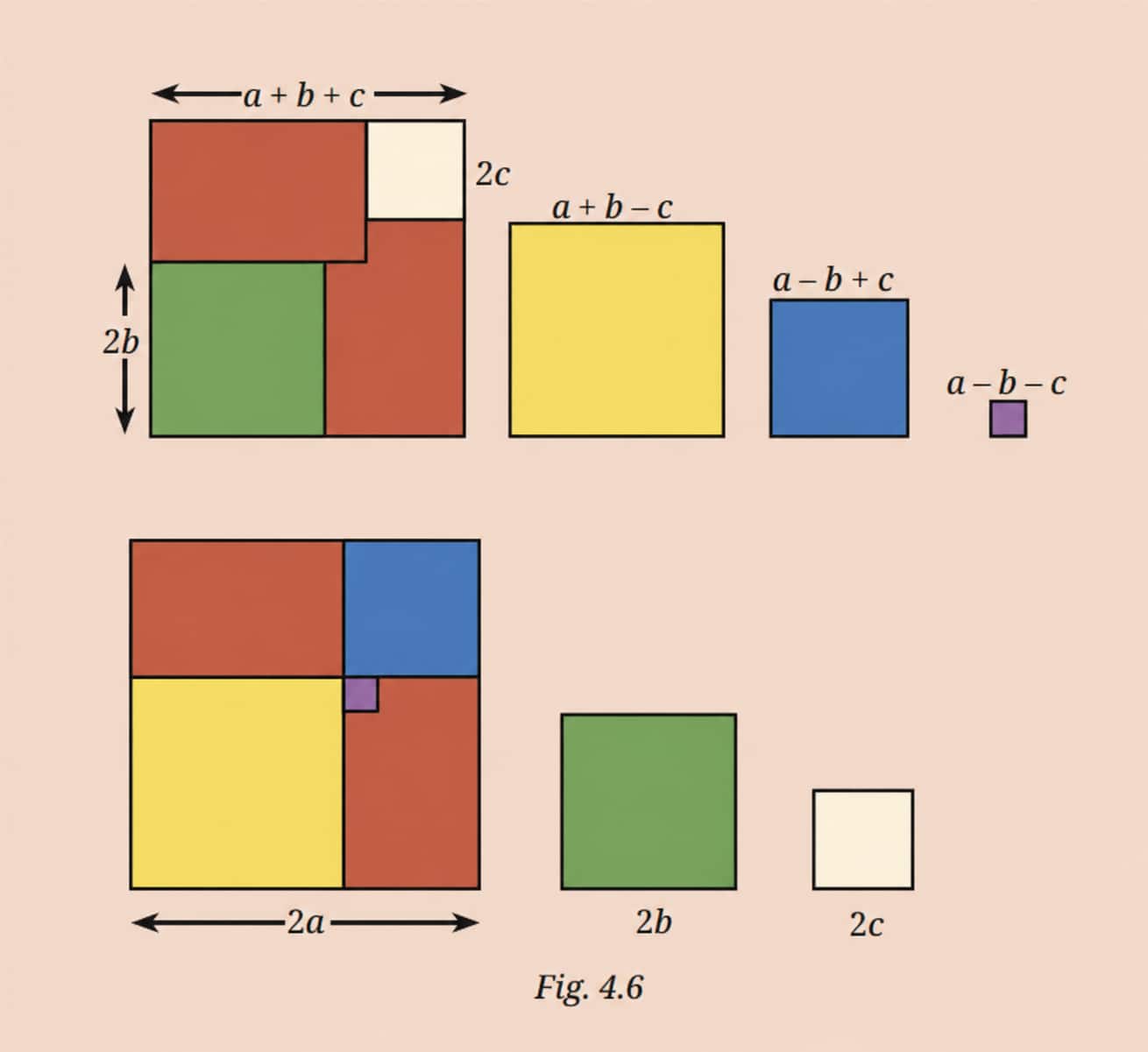
$\textbf{Answer:}$
Top Row Shapes:
- A large composite shape with an outer boundary side length of ( $a+b+c$ ), containing a green square of side $2 b$, a white square of side $2 c$, and two red regions.
- A yellow square with side length $(a+b-c) \Rightarrow$ Area $=(a+b-c)^2$
- A blue square with side length $(a-b+c) \Rightarrow \operatorname{Area}=(a-b+c)^2$
- A purple square with side length $(a-b-c) \Rightarrow$ Area $=(a-b-c)^2$
Bottom Row Shapes:
- A large composite square with a side length of 2a, perfectly reassembled using the two red regions, the yellow square, the blue square, and the purple square ⇒ Area $=(2 a)^2$
- The green square with side length $2 b \Rightarrow$ Area $=(2 b)^2$
- The white square with side length $2 c \Rightarrow \operatorname{Area}=(2 c)^2$
Exploring Algebraic Identities Class 9 Questions and AnswersExercise Set 4.4 |
Question 1. Fill in the blanks to complete the following identities:
(i) $s^2-11 s+24=($ $\_\_\_\_$ ) ( $\_\_\_\_$ )
(ii) $($ $\_\_\_\_$ $(x+1)=\left(3 x^2-4 x-7\right)$
(iii) $10 x^2-11 x-6=(2 x-$ $\_\_\_\_$ ) ( $\_\_\_\_$ + 2)
(iv) $6 x^2+7 x+2=($ $\_\_\_\_$ ) ( $\_\_\_\_$ )
$\textbf{Answer:}$
(i)
$s^2-11 s+24$
$=s^2-3s-8s+24$
$=(s-3)(s-8)$
So, $s^2-11 s+24=(s-3)(s-8)$
(ii)
RHS
$=3 x^2-4 x-7$
$=3 x^2+3 x-7 x-7$
$=(3 x-7)(x+1)$
So, blank space is $(3x-7)$.
(iii)
$10 x^2-15 x+4 x-6 $
$=5 x(2 x-3)+2(2 x-3) $
$=(2 x-3)(5 x+2)$
So, $10 x^2-11 x-6=(2 x-3)(5 x+2)$
$\therefore$ Missing numbers are 3 and $5x$
(iv)
$6 x^2+3 x+4 x+2 $
$=3 x(2 x+1)+2(2 x+1) $
$ =(3 x+2)(2 x+1)$
Question 2. Select and use the identity that will help you to find the following products without multiplying directly:
(i) $(41)^2$
(ii) $(27)^2$
(iii) $(23 \times 17)$
(iv) $(135)^2$
(v) $(97)^2$
(vi) $(18 \times 29)$
(vii) $(34 \times 43)$
(viii) $(205)^2$
$\textbf{Answer:}$
(i) $(41)^2$
$=(40+1)^2$
$=40^2+2\times40\times1+1^2$
$=1600+80+1$
$=1681$
(ii) $(27)^2$
$=(30-3)^2$
$=30^2-2\times30\times3+3^2$
$=900-180+9$
$=729$
(iii) $(23 \times 17)$
We know that $(a+b)(a-b)=a^2-b^2$
$(23 \times 17)=(20+3)(20-3)=20^2-3^2=400-9=391$
(iv) $(135)^2$
$=(100+35)^2$
$=100^2+2\times100\times35+35^2$
$=10000+7000+1225$
$=18225$
(v) $(97)^2$
$=(100-3)^2$
$=100^2-2\times100\times3+3^2$
$=10000-600+9$
$=9409$
(vi) $(18 \times 29)$
$=18\times(30-1)$
$=540-18$
$=522$
(vii) $(34 \times 43)$
We know that $(a+b)(a-b)=a^2-b^2$
$=(38.5-4.5)(38.5+4.5)$
$=38.5^2-4.5^2$
$=1482.25-20.25$
$=1462$
(viii) $(205)^2$
$=(200+5)^2$
$=200^2+2\times200\times5+5^2$
$=40000+2000+25$
$=42025$
Question 3. Factor the following:
(i) $9 a^2+b^2+4 c^2-6 a b+12 a c-4 b c$
(ii) $16 s^2+25 t^2-40 s t$
(iii) $r^2-r-42$
(iv) $49 g^2+14 g h+h^2$
(v) $64 u^2+121 v^2+4 w^2-176 u v-32 u w+44 v w$
$\textbf{Answer:}$
(i) $9 a^2+b^2+4 c^2-6 a b+12 a c-4 b c$
We know that $(a+b+c)^2=a^2+b^2+c^2+2 a b+2 b c+2 c a$
$=(3a)^2+b^2+(2c)^2+ 2(3 a)(-b) + 2(-b)(2 c) +2(2 c)(3 a)$
$=(3 a-b+2 c)^2$
(ii) $16 s^2+25 t^2-40 s t$
$=(4 s)^2+(5 t)^2-2(4 s)(5 t)$
$ =(4 s-5 t)^2$
(iii) $r^2-r-42$
$r^2-7 r+6 r-42 $
$ =r(r-7)+6(r-7) $
$ =(r-7)(r+6)$
(iv) $49 g^2+14 g h+h^2$
$=(7 g)^2+2(7 g)(h)+h^2$
$=(7 g+h)^2$
(v) $64 u^2+121 v^2+4 w^2-176 u v-32 u w+44 v w$
We know that $(a+b+c)^2=a^2+b^2+c^2+2 a b+2 b c+2 c a$
$=(8 u)^2+(-11 v)^2+(-2 w)^2+2(8 u)(-11 v)+2(-11 v)(-2 w)+2(-2 w)(8 u)$
$=(8 u-11 v-2 w)^2$
Think and Reflect (Page 82)
Question: James and Reshma were talking about algebraic identities they learnt in school.
James: $(a-b)^2(a+b)=\left(a^2-2 a b+b^2\right)(a+b)$
Reshma: I have a different idea. $(a-b)^2(a+b)=(a-b)[(a-b)(a+b)]$
$=(a-b)\left(a^2-b^2\right)$
I will find this product to get the answer.
According to you, who is correct and why?
Try to combine more such identities and find new results.
$\textbf{Answer:}$
James expands the squared term first:
$
\begin{aligned}
& (a-b)^2(a+b)=\left(a^2-2 a b+b^2\right)(a+b) \\
& \Rightarrow(a-b)^2(a+b)=a\left(a^2-2 a b+b^2\right)+b\left(a^2-2 a b+b^2\right) \\
& \Rightarrow(a-b)^2(a+b)=a^3-2 a^2 b+a b^2+a^2 b-2 a b^2+b^3 \\
& \Rightarrow(a-b)^2(a+b)=a^3-a^2 b-a b^2+b^3
\end{aligned}
$
Hence, James's method is correct.
Reshma regrouped the factors using the associative property to create a difference of squares:
$
\begin{aligned}
& (a-b)^2(a+b)=(a-b)[(a-b)(a+b)] \\
& \Rightarrow(a-b)^2(a+b)=(a-b)\left(a^2-b^2\right) \\
& \Rightarrow(a-b)^2(a+b)=a\left(a^2-b^2\right)-b\left(a^2-b^2\right) \\
& \Rightarrow(a-b)^2(a+b)=a^3-a b^2-a^2 b+b^3 \\
& \Rightarrow(a-b)^2(a+b)=a^3-a^2 b-a b^2+b^3
\end{aligned}
$
Hence, Reshma's method is also correct and yields the exact same final polynomial.
Let's add the expansions of $(a+b)^2$ and $(a-b)^2$ :
$
\begin{aligned}
& (a+b)^2+(a-b)^2=\left(a^2+2 a b+b^2\right)+\left(a^2-2 a b+b^2\right) \\
& \Rightarrow(a+b)^2+(a-b)^2=2 a^2+2 b^2 \\
& \Rightarrow(a+b)^2+(a-b)^2=2\left(a^2+b^2\right)
\end{aligned}
$
Hence, we get a new identity for the sum of squares.
Let's evaluate the product of a sum and difference of cubes, $\left(a^3-b^3\right)\left(a^3+b^3\right)$, using the difference of squares identity $x^2-y^2=(x-y)(x+y)$ :
Let $x=a^3$ and $y=b^3$.
$
\begin{aligned}
& \left(a^3-b^3\right)\left(a^3+b^3\right)=\left(a^3\right)^2-\left(b^3\right)^2 \\
& \Rightarrow\left(a^3-b^3\right)\left(a^3+b^3\right)=a^6-b^6
\end{aligned}
$
Hence, the product simplifies to a difference of sixth powers.
Exploring Algebraic Identities Class 9 Questions and AnswersExercise Set 4.5 |
Question 1. Simplify the following rational expressions assuming that the expressions in the denominators are not equal to zero:
(i) $\frac{3 p^2-3 p q-18 q^2}{p^2+3 p q-10 q^2}$
(ii) $\frac{n^3-3 n^2 m+3 n m^2-m^3}{5 m^2-10 m n+5 n^2}$
(iii) $\frac{w^3-v^3+x^3+3 w v x}{w^2+v^2+x^2-2 w v-2 v x+2 w x}$
(iv) $\frac{4 y^2-20 y z+25 z^2}{\left(25 z^2-4 y^2\right)}$
(v) $\frac{\left(x^2+x-6\right)\left(x^2-7 x+12\right)}{\left(x^2-6 x+8\right)\left(x^2-9\right)}$
(vi) $\frac{p^4-16}{p^2-4 p+4}$
$\textbf{Answer:}$
(i) $\frac{3 p^2-3 p q-18 q^2}{p^2+3 p q-10 q^2}$
$=\frac{3( p^2- p q-6 q^2)}{p^2+3 p q-10 q^2}$
$=\frac{3( p^2- 3p q+2pq-6 q^2)}{p^2+5 p q-2pq-10 q^2}$
$=\frac{3(p-3 q)(p+2 q)}{(p+5q)(p-2q)}$
(ii) $\frac{n^3-3 n^2 m+3 n m^2-m^3}{5 m^2-10 m n+5 n^2}$
$=\frac{(n-m)^3}{5\left(m^2-2 m n+n^2\right)} $
$ =\frac{(n-m)^3}{5(m-n)^2} $
$ =\frac{(n-m)^3}{5(n-m)^2} $
$ =\frac{n-m}{5}$
(iii) $\frac{w^3-v^3+x^3+3 w v x}{w^2+v^2+x^2-2 w v-2 v x+2 w x}$
We know that $a^3+b^3+c^3-3 a b c=(a+b+c)\left(a^2+b^2+c^2-a b-b c-c a\right)$
$=\frac{w^3+(-v)^3+x^3-3 w (-v) x}{w^2+v^2+x^2-2 w v-2 v x+2 w x}$
$=\frac{(w+x-v)\left(w^2+x^2+v^2-w x+v x+w v\right)}{w^2+v^2+x^2-2 w v-2 v x+2 w x}$
Also, $w^2+v^2+x^2-2 w v-2 v x+2 w x=(w-v+x)^2 $
$=\frac{(w-v+x)\left(w^2+x^2+v^2-w x+v x+w v\right)}{(w-v+x)^2}$
$=\frac{w^2+x^2+v^2-w x+v x+w v}{w-v+x}$
(iv) $\frac{4 y^2-20 y z+25 z^2}{\left(25 z^2-4 y^2\right)}$
$=\frac{(2 y)^2-2(2 y)(5 z)+(5 z)^2}{(5 z)^2-(2 y)^2} $
$ =\frac{(2 y-5 z)^2}{(5 z-2 y)(5 z+2 y)} $
$ =\frac{(5 z-2 y)^2}{(5 z-2 y)(5 z+2 y)} $
$=\frac{5 z-2 y}{5 z+2 y}$
(v) $\frac{\left(x^2+x-6\right)\left(x^2-7 x+12\right)}{\left(x^2-6 x+8\right)\left(x^2-9\right)}$
$=\frac{(x+3)(x-2)(x-3)(x-4)}{(x-2)(x-4)(x-3)(x+3)}$
$=1$
(vi) $\frac{p^4-16}{p^2-4 p+4}$
$ =\frac{\left(p^2\right)^2-4^2}{p^2-4 p+4} $
$= \frac{\left(p^2-4\right)\left(p^2+4\right)}{(p-2)^2} $
$= \frac{(p-2)(p+2)\left(p^2+4\right)}{(p-2)^2} $
$= \frac{(p+2)\left(p^2+4\right)}{p-2}$
Exploring Algebraic Identities Class 9 Questions and AnswersEnd-of-Chapter Exercises |
Question 1. Use suitable identities to find the following products:
(i) $(-3 x+4)^2$
(ii) $(2 s+7)(2 s-7)$
(iii) $\left(p^2+\frac{1}{2}\right)\left(p^2-\frac{1}{2}\right)$
(iv) $(2 n+7)(2 n-7)$
(v) $(s-2 t)\left(s^2+2 s t+4 t^2\right)$
(vi) $\left(\frac{1}{2 r}-4 r\right)^2$
(vii) $(-3 m+4 k-l)^2$
(viii) $\left(x-\frac{1}{3} y\right)^3$
(ix) $\left(\frac{7}{2} k-\frac{2}{3} m\right)^3$
$\textbf{Answer:}$
(i) $(-3 x+4)^2$
$=(-3 x)^2+2(-3 x)(4)+4^2 $
$=9 x^2-24 x+16$
(ii) $(2 s+7)(2 s-7)$
$=(2s)^2-7^2$
$=4s^2-49$
(iii) $\left(p^2+\frac{1}{2}\right)\left(p^2-\frac{1}{2}\right)$
$=(p^2)^2-(\frac12)^2$
$=p^4-\frac14$
(iv) $(2 n+7)(2 n-7)$
$=(2n)^2-7^2$
$=4n^2-49$
(v) $(s-2 t)\left(s^2+2 s t+4 t^2\right)$
We know, $(a-b)\left(a^2+a b+b^2\right)=a^3-b^3$
$=s^3-(2 t)^3 $
$ =s^3-8 t^3$
(vi) $\left(\frac{1}{2 r}-4 r\right)^2$
$=\left(\frac{1}{2 r}\right)^2-2\left(\frac{1}{2 r}\right)(4 r)+(4 r)^2$
$ =\frac{1}{4 r^2}-4+16 r^2$
(vii) $(-3 m+4 k-l)^2$
We know that $(a+b+c)^2=a^2+b^2+c^2+2 a b+2 b c+2 c a$
$=(-3 m)^2+(4 k)^2+(-l)^2+2(-3 m)(4 k)+2(4 k)(-l)+2(-l)(-3 m) $
$ =9 m^2+16 k^2+l^2-24 m k-8 k l+6 m l$
(viii) $\left(x-\frac{1}{3} y\right)^3$
We know that $(a-b)^3=a^3-3 a^2 b+3 a b^2-b^3$
$=x^3-3 x^2\left(\frac{1}{3} y\right)+3 x\left(\frac{1}{3} y\right)^2-\left(\frac{1}{3} y\right)^3 $
$ =x^3-x^2 y+\frac{1}{3} x y^2-\frac{1}{27} y^3$
(ix) $\left(\frac{7}{2} k-\frac{2}{3} m\right)^3$
We know that $(a-b)^3=a^3-3 a^2 b+3 a b^2-b^3$
$=\left(\frac{7}{2} k\right)^3-3\left(\frac{7}{2} k\right)^2\left(\frac{2}{3} m\right)+3\left(\frac{7}{2} k\right)\left(\frac{2}{3} m\right)^2-\left(\frac{2}{3} m\right)^3 $
$=\frac{343}{8} k^3-\frac{49}{2} k^2 m+\frac{14}{3} k m^2-\frac{8}{27} m^3$
Question 2. Find the values using suitable identities:
(i) $17 \times 21$
(ii) $104 \times 96$
(iii) $24 \times 16$
(iv) $147^3$
(v) $199^3$
(vi) $127^3$
(vii) $(-107)^3$
(viii) $(-299)^3$
$\textbf{Answer:}$
(i) $17 \times 21$
$=(19-2)(19+2)$
$=19^2-3^2$
$=361-9$
$=352$
(ii) $104 \times 96$
$=(100+4)(100-4)$
$=100^2-4^2$
$=10000-16$
$=9984$
(iii) $24 \times 16$
$=(20+4)(20-4)$
$=20^2-4^2$
$=400-16$
$=384$
(iv) $147^3$
$=(150-3)^3$
$=150^3-3(150)^2(3)+3(150)(3)^2-3^3$
$ =3375000-202500+4050-27 $
$ =3176523$
(v) $199^3$
$=(200-1)^3$
$=200^3-3\times200^2\times1+3\times200\times1^2-1^3$
$=8000000-120000+600-1$
$=7880599$
(vi) $127^3$
$=(100+27)^3$
$=100^3+3\times100^2\times3+3\times100\times3^2+3^3$
$=1000000+810000+218700+19683$
$=2048383$
(vii) $(-107)^3$
$=-(100+7)^3$
$=-(1000000+210000+14700+343) $
$ =-1225043$
(viii) $(-299)^3$
$=(300-1)^3$
$=-(27000000-270000+900-1) $
$ =-26730901$
Question 3. Factor the following algebraic expressions:
(i) $4 y^2+1+\frac{1}{16 y^2}$
(ii) $9 m^2-\frac{1}{25 n^2}$
(iii) $ 27 b^3-\frac{1}{64 b^3}$
(iv) $x^2+\frac{5 x}{6}+\frac{1}{6}$
(v) $27 u^3-\frac{1}{125}-\frac{27 u^2}{5}+\frac{9 u}{25}$
(vi) $64 y^3+\frac{1}{125} z^3$
(vii) $p^3+27 q^3+r^3-9 p q r$
(viii) $9 m^2-12 m+4$
(ix) $9 x^3-\frac{8}{3} y^3+\frac{z^3}{3}+6 x y z$
(x) $4 x^2+9 y^2+36 z^2+12 x z+36 y z+24 x y$
(xi) $27 u^3-\frac{1}{216}-\frac{9 u^2}{2}+\frac{u}{4}$
$\textbf{Answer:}$
(i) $4 y^2+1+\frac{1}{16 y^2}$
$=(2 y)^2+2(2 y)\left(\frac{1}{4 y}\right)+\left(\frac{1}{4 y}\right)^2 $
$=\left(2 y+\frac{1}{4 y}\right)^2$
(ii) $9 m^2-\frac{1}{25 n^2}$
$=(3 m)^2-\left(\frac{1}{5 n}\right)^2 $
$=\left(3 m-\frac{1}{5 n}\right)\left(3 m+\frac{1}{5 n}\right)$
(iii) $27 b^3-\frac{1}{64 b^3}$
$=(3 b)^3-\left(\frac{1}{4 b}\right)^3$
$=\left(3 b-\frac{1}{4 b}\right)\left(9 b^2+\frac{3}{4}+\frac{1}{16 b^2}\right)$
(iv) $x^2+\frac{5 x}{6}+\frac{1}{6}$
$=x^2+\frac{2 x}{3}+\frac{x}{6}+\frac{1}{6}$
$=x\left(x+\frac{2}{3}\right)+\frac{1}{6}(x+1)$
$ =\left(x+\frac{1}{2}\right)\left(x+\frac{1}{3}\right)$
(v) $27 u^3-\frac{1}{125}-\frac{27 u^2}{5}+\frac{9 u}{25}$
$=(3 u)^3-\left(\frac{1}{5}\right)^3-3(3 u)^2\left(\frac{1}{5}\right)+3(3 u)\left(\frac{1}{5}\right)^2 $
$=\left(3 u-\frac{1}{5}\right)^3$
(vi) $64 y^3+\frac{1}{125} z^3$
$=(4 y)^3+\left(\frac{z}{5}\right)^3 $
$=\left(4 y+\frac{z}{5}\right)\left(16 y^2-\frac{4 y z}{5}+\frac{z^2}{25}\right)$
(vii) $p^3+27 q^3+r^3-9 p q r$
$=p^3+(3 q)^3+r^3-3(p)(3 q)(r) $
$=(p+3 q+r)\left(p^2+9 q^2+r^2-3 p q-3 q r-p r\right)$
(viii) $9 m^2-12 m+4$
$=(3 m)^2-2(3 m)(2)+2^2 $
$=(3 m-2)^2$
(ix) $9 x^3-\frac{8}{3} y^3+\frac{z^3}{3}+6 x y z$
$=\frac13\left[9 x^3-8 y^3+z^3+18 x y z\right] $
$ =\frac13\left[(3 x)^3+(-2 y)^3+z^3-3(3 x)(-2 y) z\right] $
$=\frac13(3 x-2 y+z)\left[(3 x)^2+(-2 y)^2+z^2-(3 x)(-2 y)-(-2 y)(z)-(z)(3 x)\right] $ Using $\left.a^3+b^3+c^3-3 a b c=(a+b+c)\left(a^2+b^2+c^2-a b-b c-c a\right)\right]$, we get,
$ =\frac13(3 x-2 y+z)\left[9 x^2+4 y^2+z^2+6 x y+2 y z-3 z x\right]$
(x) $4 x^2+9 y^2+36 z^2+12 x z+36 y z+24 x y$
$=(2 x)^2+(3 y)^2+(6 z)^2+2(2 x)(3 y)+2(3 y)(6 z)+2(6 z)(2 x) $
$=(2 x+3 y+6 z)^2$
(xi) $27 u^3-\frac{1}{216}-\frac{9 u^2}{2}+\frac{u}{4}$
$=(3 u)^3-\left(\frac{1}{6}\right)^3-3(3 u)^2\left(\frac{1}{6}\right)+3(3 u)\left(\frac{1}{6}\right)^2 $
$ =\left(3 u-\frac{1}{6}\right)^3$
Question 4. Simplify the following:
(i) $\frac{4 x^2+4 x+1}{4 x^2-1}$
(ii) $\frac{9\left(3 a^3-24 b^3\right)}{9 a^2-36 b^2}$
(iii) $\frac{s^3+125 t^3}{s^2-2 s t-35 t^2}$
Note: Assume that the denominators are not equal to 0.
$\textbf{Answer:}$
(i) $\frac{4 x^2+4 x+1}{4 x^2-1}$
$=\frac{(2 x+1)^2}{(2 x-1)(2 x+1)} $
$ =\frac{2 x+1}{2 x-1}$
(ii) $\frac{9\left(3 a^3-24 b^3\right)}{9 a^2-36 b^2}$
$=\frac{27\left(a^3-8 b^3\right)}{9\left(a^2-4 b^2\right)}$
$=\frac{27(a-2 b)\left(a^2+2 a b+4 b^2\right)}{9(a-2 b)(a+2 b)} $
$=\frac{3\left(a^2+2 a b+4 b^2\right)}{a+2 b}$
(iii) $\frac{s^3+125 t^3}{s^2-2 s t-35 t^2}$
$=\frac{(s+5 t)\left(s^2-5 s t+25 t^2\right)}{(s-7 t)(s+5 t)}$
$=\frac{s^2-5 s t+25 t^2}{s-7 t}$
Question 5. Find possible expressions for the length and breadth of each of the following rectangles whose areas are given by the following expressions in square units.
(i) $25 a^2-30 a b+9 b^2$
(ii) $36 s^2-49 t^2$
$\textbf{Answer:}$
(i) $25 a^2-30 a b+9 b^2$
$=(5a-3b)^2$
So, Possible length and breadth are $(5a-3b)$ and $(5a-3b)$.
(ii) $36 s^2-49 t^2$
$=(6s)^2-(7t)^2$
$=(6s+7t)(6s-7t)$
So, Possible length and breadth are $(6s+7t)$ and $(6s-7t)$
Question 6. Find possible expressions for the length, breadth, and heights of each of the following cuboids whose volumes are given by the following expressions in cubic units.
(i) $6 a^2-24 b^2$
(ii) $3 p s^2-15 p s+12 p$
$\textbf{Answer:}$
(i) $6 a^2-24 b^2$
$=6\left(a^2-4 b^2\right) $
$ =6(a-2 b)(a+2 b)$
So, possible dimensions of the cuboid are $6, (a-2 b)$ and $(a+2 b)$.
(ii) $3 p s^2-15 p s+12 p$
$\begin{aligned} & =3 p\left(s^2-5 s+4\right) \\ & =3 p(s-1)(s-4)\end{aligned}$
So, possible dimensions of the cuboid are $3, p(s-1)$ and $(s-4)$.
Question 7. The village playground is shaped as a square of side 40 metres. A path of width $s$ metres is created around the playground for people to walk. Find an expression for the area of the path in terms of $s$.
$\textbf{Answer:}$
The village playground is shaped as a square of side 40 metres.
So, the area of the playground is $40^2=1600$ square metres
A path of width $s$ metres is created around the playground for people to walk.
So, outer side length $=(40+s)$
Outer area of the playground with the path $=(40+s)^2$
So, the area of the path
= Outer area of the playground with the path - area of the playground
$ =(40+s)^2-1600$
$=1600+160 s+4 s^2-1600 $
$=4 s^2+160 s$
Hence, the area of the path is $(4 s^2+160 s)$.
Question 8. If a number plus its reciprocal equals $\frac{10}{3}$, find the number.
$\textbf{Answer:}$
Let the number be $x$.
According to the question,
$x+\frac1x=\frac{10}3$
$⇒\frac{x^2+1}x=\frac{10}3$
$⇒3 x^2+3=10 x $
$⇒3 x^2-10 x+3=0$
$⇒3 x^2-9 x-x+3=0 $
$⇒ 3 x(x-3)-1(x-3)=0 $
$ ⇒(3 x-1)(x-3)=0$
$⇒x=\frac13,3$
Hence, the number is either $\frac13$ or 3.
Question 9. A rectangular pool has area $2 x^2+7 x+3$ square hastas. If its width is $2 x+1$ hastas, find its length. Hasta was a unit used to measure length.
$\textbf{Answer:}$
We know, Area of a rectangle = Length × width
$⇒2 x^2+7 x+3=$ Length × $2 x+1$
$\therefore$ Length $=\frac{2 x^2+7 x+3}{2 x+1}=\frac{(2 x+1)(x+3)}{2 x+1}=(x+3)$
So, the length is $(x+3)$ hastas.
*Question 10. If both $x-2$ and $x-\frac{1}{2}$ are factors of $p x^2+5 x+r$, show that $p=r$.
$\textbf{Answer:}$
$p x^2+5 x+r=(x-2)\left(x-\frac{1}{2}\right) k$
Since the polynomial is quadratic, let the leading coefficient be $p$.
$p x^2+5 x+r=p(x-2)\left(x-\frac{1}{2}\right) $
$=p\left(x^2-\frac{x}{2}-2 x+1\right) $
$ =p\left(x^2-\frac{5 x}{2}+1\right) $
$=p x^2-\frac{5 p}{2} x+p$
Comparing with $p x^2+5 x+r$, we get $r=p$
Hence, $p=r$.
*Question 11. If $a+b+c=5$ and $a b+b c+c a=10$, then prove that $a^3+b^3+c^3-3 a b c=-25$.
$\textbf{Answer:}$
Given: $a+b+c=5$ and $a b+b c+c a=10$
We know that $a^3+b^3+c^3-3 a b c=(a+b+c)\left(a^2+b^2+c^2-a b-b c-c a\right)$
Also,
$a^2+b^2+c^2$
$=(a+b+c)^2-2(a b+b c+c a) =5^2-2(10) =25-20 =5$
So, $a^2+b^2+c^2-a b-b c-c a=5-10=-5$
Therefore, $a^3+b^3+c^3-3 a b c=(5)(-5)=-25$
Hence proved.
*Question 12. By factoring the expression, check that $n^3-n$ is always divisible by 6 for all natural numbers $n$. Give reasons.
$\textbf{Answer:}$
Given: $n^3-n$
$
\begin{aligned}
& =\mathrm{n}\left(\mathrm{n}^2-1\right) \\
& =\mathrm{n}(\mathrm{n}-1)(\mathrm{n}+1)
\end{aligned}
$
So, $\mathrm{n}^3-\mathrm{n}=\mathrm{n}(\mathrm{n}-1)(\mathrm{n}+1)$
Thus, $\mathrm{n}^3-\mathrm{n}$ is the product of three consecutive natural numbers: $(\mathrm{n}-1), \mathrm{n},(\mathrm{n}+1)$
Among any three consecutive natural numbers:
- one is always divisible by 3
- at least one is always even, so divisible by 2
Therefore, their product is always divisible by: $2 \times 3=6$
Hence, $n^3-n$ is always divisible by 6 for all natural numbers $n$.
*Question 13. Find the value of
(i) $x^3+y^3-12 x y+64$, when $x+y=-4$
(ii) $x^3-8 y^3-36 x y-216$, when $x=2 y+6$
$\textbf{Answer:}$
(i) Given: $x+y=-4$
We know that $x^3+y^3=(x+y)^3-3 x y(x+y)$
So, $ x^3+y^3 =(-4)^3-3 x y(-4) =-64+12 x y$
Now,
$x^3+y^3-12 x y+64 $
$=(-64+12 x y)-12 x y+64 $
$ =0$
(ii)
Given that $x=2 y+6$
$\Rightarrow x-2 y-6=0$
Using the algebraic identity where if $a+b+c=0$, then $a^3+b^3+c^3=3 a b c$.
Let $a=x, b=-2 y$, and $c=-6$.
$\Rightarrow x^3+(-2 y)^3+(-6)^3=3(x)(-2 y)(-6)$
$ \Rightarrow x^3-8 y^3-216=36 x y $
$ \Rightarrow x^3-8 y^3-36 x y-216=0$
Hence, the correct answer is 0.
Confused between CGPA and Percentage?
Get your results instantly with our calculator!
Exploring Algebraic Identities Class 9 Chapter 4: Topics
Topics you will learn in NCERT Class 9 Maths Chapter 4 Exploring Algebraic Identities include:
- 4.1 Introduction
- 4.2 Visualising Identities
- 4.3 Factorisation of Algebraic Expressions Using Identities
- 4.4. More Identities
- 4.5 Factorisation Using Algebra Tiles
- 4.6 Factorisation Without Using Algebra Tiles
- 4.7 Finding New Identities
- 4.8 Simplifying Rational Expressions
Class 9 Maths NCERT Chapter 4 Solutions: Extra Questions
Question 1:
The sum of the squares of 3 consecutive positive numbers is 365. The sum of the numbers is:
$\textbf{Answer:}$
Let the consecutive numbers be ( $\mathrm{x}-1$ ), x and ( $\mathrm{x}+1$ ).
According to the question,
$
\begin{aligned}
& (x-1)^2+x^2+(x+1)^2=365 \\
& \Rightarrow\left(x^2-2 x+1\right)+x^2+\left(x^2+2 x+1\right)=365 \\
& \Rightarrow 3 x^2=365-2 \\
& \Rightarrow 3 x^2=363 \\
& \Rightarrow x^2=121 \\
& \Rightarrow x=11
\end{aligned}
$
So, the numbers are 10, 11 and 12.
The sum of the numbers $=10+11+12=33$
Hence, the correct answer is 33.
Question 2:
If ' $a$ ' and ' $b$ ' are positive integers such that $a^2-b^2=19$, then the value of ' $a$ ' is:
$\textbf{Answer:}$
$
\begin{aligned}
& a^2-b^2=19 \\
& \Rightarrow(a+b)(a-b)=19 \times 1
\end{aligned}
$
Since ' $a$ ' and ' $b$ ' are positive integers,
$
\begin{aligned}
& \Rightarrow a+b=19 \\
& \text { and } a-b=1
\end{aligned}
$
Adding equations (i) and (ii), we get, $2 \mathrm{a}=20 \Rightarrow \mathrm{a}=10$
Hence, the correct answer is 10.
Question 3:
If $x^2+\frac{1}{x^2}=7$, then what is the value of $x^3+\frac{1}{x^3}$?
$\textbf{Answer:}$
$x^2+\frac{1}{x^2}=7$
Adding 2 on both sides, we get,
⇒ $(x+\frac{1}{x})^2 - 2 × x × \frac{1}{x} = 7+2$
⇒ $(x+\frac{1}{x})^2 = 9$
⇒ $x+\frac{1}{x} = 3$
cubing on both sides, we get,
⇒ $(x+\frac{1}{x})^3 = 3^3$
⇒ $x^3 + \frac{1}{x^3} + 3 × x × \frac{1}{x}(x+\frac{1}{x}) = 27$
⇒ $x^3 + \frac{1}{x^3} + 3 × 3 = 27$
$\therefore x^3 + \frac{1}{x^3} =18$
Hence, the correct answer is 18.
Question 4:
If $a + b + c = 6$ and $a^2+b^2+c^2=40$, then what is the value of $a^3+b^3+c^3-3abc$?
$\textbf{Answer:}$
Given that $a + b + c = 6$ and $a^2+b^2+c^2=40$,
$(a+b+c)^2 = a^2 + b^2 + c^2 + 2(ab+bc+ac)$.
$⇒6^2 = 40 + 2(ab+bc+ac)$
$⇒ab+bc+ac = -2$
$a^3+b^3+c^3-3abc=(a+b+c)(a^2+b^2+c^2-ab-bc-ac)$
$⇒a^3+b^3+c^3-3abc=6 \times (40 +2)$
$⇒a^3+b^3+c^3-3abc=6 \times 42 $
$⇒a^3+b^3+c^3-3abc=252 $
Hence, the correct answer is 252.
Question 5:
What is the value of $\frac{(a+b)^2-(a-b)^2}{a b}$?
$\textbf{Answer:}$
$(a + b)^2 - (a - b)^2$
$= (a^2 + 2ab + b^2) - (a^2 – 2ab + b^2)$
$= 4ab$
So, $\frac{(a+b)^2-(a-b)^2}{a b}$
$=\frac{4ab}{ab}$
$=4$
Hence, the correct answer is 4.
NCERT Solutions for Class 9 Maths Chapter Wise
We at Careers360 compiled all the NCERT Class 9 Maths solutions in one place for easy student reference. The following links will allow you to access them.
NCERT Class 9 Books & Syllabus
Before the start of a new academic year, students should refer to the latest syllabus to determine the chapters they’ll be studying. Below are the updated syllabus links, along with some recommended reference books.
Frequently Asked Questions (FAQs)
An equation is true only for specific values of variables, while an identity is true for every value of the variables.
Algebraic identities help in:
Faster calculations
Polynomial factorisation
Expanding expressions
Simplifying rational expressions
Solving equations easily
A wrong sign changes the whole expression. Students should carefully observe positive and negative terms while expanding or factorising.
NCERT solutions are provided in a very detailed manner, which will give the conceptual clarity to the students. Also, students can take help from these solutions if they are not able to solve it on their own.
Free NCERT Class 9 Maths Chapter 4 Exploring Algebraic Identities solutions are available on many online educational platforms, such as Careers360 and can be accessed in both web and PDF formats for easy practice.
Yes. Cube identities are widely used later in algebra, coordinate geometry, calculus, and competitive exams.
Expand the RHS or LHS and simplify both sides. If both become identical, the identity is verified.

Popular Questions
A block of mass 0.50 kg is moving with a speed of 2.00 ms-1 on a smooth surface. It strikes another mass of 1.00 kg and then they move together as a single body. The energy loss during the collision is
| Option 1)
|
Option 2)
|
| Option 3)
|
Option 4)
|
An athlete in the olympic games covers a distance of 100 m in 10 s. His kinetic energy can be estimated to be in the range
| Option 1)
|
Option 2)
|
| Option 3)
|
Option 4)
|
A particle is projected at 600 to the horizontal with a kinetic energy . The kinetic energy at the highest point
| Option 1)
|
Option 2)
|
| Option 3)
|
Option 4)
|
In the reaction,
| Option 1)
|
Option 2)
|
| Option 3)
|
Option 4)
|
How many moles of magnesium phosphate, will contain 0.25 mole of oxygen atoms?
| Option 1)
0.02 |
Option 2)
3.125 × 10⁻² |
| Option 3)
1.25 × 10⁻² |
Option 4)
2.5 × 10⁻² |