


NCERT Solutions for Class 9 Mathematics Chapter 3 - The World of Numbers
Numbers are used everywhere from clocks to calendars to jerseys and even in your favourite video games. Without the existence of numbers, time would not exist, money would lose its meaning and science would come to a dead-end. Do you ever think about what it would be like if there were no numerical system, i.e., a day without numbers? These NCERT Solutions for Class 9 Mathematics Chapter 3 The World of Numbers cover various kinds of numbers (such as real numbers, rational numbers, irrational numbers, whole numbers) and how to work with them.
This Story also Contains
- The World of Numbers Class 9 Questions and Answers PDF Free Download
- NCERT Solutions for Class 9 Maths Chapter 3 The World of Numbers: Exercise Questions
- The World of Numbers Class 9 Chapter 3: Topics
- Class 9 Maths NCERT Chapter 3 Solutions: Extra Questions
- NCERT Solutions for Class 9 Maths Chapter Wise
- NCERT Class 9 Books & Syllabus
Pythagoras once said that numbers rule the universe and it is true indeed. Our team of experts at Careers360 has prepared the NCERT Solutions for Class 9 Maths based on their extensive experience and knowledge in order to help students practice these types of problems on their own. These NCERT Solutions for Class 9 have been created to carefully present the core concepts of numbers in simple language and to help make learning quicker and easier.
The World of Numbers Class 9 Questions and Answers PDF Free Download
Students can download the Class 9 Maths Chapter 3 The World of Numbers PDF by clicking the link provided below.
NCERT Solutions for Class 9 Maths Chapter 3 The World of Numbers: Exercise Questions
Below, you will find the NCERT Class 9 Maths Chapter 3 The World of Numbers question answers explained step by step.
The World of Numbers Class 9 Questions and AnswersExercise Set 3.1 |
Question 1. A merchant in the port city of Lothal is exchanging bags of spices for copper ingots. He receives 15 ingots for every 2 bags of spices. If he brings 12 bags of spices to the market, how many copper ingots will he leave with?
$\text{Answer:}$
The merchant receives 15 ingots for every 2 bags of spices.
He has 12 bags of spices.
$\therefore$ He will have: $\frac{15}{2}\times12=90$ ingots
So, the merchant will leave with 90 copper ingots.
Question 2. Look at the sequence of numbers on one column of the Ishango bone: 11, 13, 17, 19. What do these numbers have in common? List the next three numbers that fit this pattern.
$\text{Answer:}$
A prime number is a whole number greater than \(1\) that can only be divided evenly by \(1\) and itself.
11, 13, 17, and 19 are all prime numbers.
Next three prime numbers after 19 are: 23, 29, 31
Question 3. We know that Natural Numbers are closed under addition (the sum of any two natural numbers is always a natural number). Are they closed under subtraction? Provide a couple of examples to justify your answer.
$\text{Answer:}$
Natural numbers are not closed under subtraction because subtracting two natural numbers does not always give another natural number.
For example, 6 and 7 are two natural numbers.
Now, 7 - 6 = 1, a natural number
6 - 7 = -1, not a natural number
Hence, subtraction is not always possible within natural numbers, which means they are not closed under subtraction.
*Question 4. Ancient Indians used the joints of their fingers to count, a practice still seen today. Each finger has 3 joints, and the thumb is used to count them. How many can you count on one hand? How does this relate to the ancient base-12 counting systems?
$\text{Answer:}$
Given: Each finger has 3 joints, and there are 4 fingers excluding the thumb.
So, total joints counted by the thumb = 4 × 3 = 12
Hence, on one hand, we can count up to 12.
This is related to the ancient base-12 system because people could naturally count in groups of 12 using their finger joints. This is one reason why the number 12 became important in ancient counting systems, time measurement, such as 12 months, 12 hours, and trade.
The World of Numbers Class 9 Questions and AnswersExercise Set 3.2 |
Question 1. The temperature in the high-altitude desert of Ladakh is recorded as $4^{\circ} \mathrm{C}$ at noon. By midnight, it drops by $15^{\circ} \mathrm{C}$. What is the midnight temperature?
$\text{Answer:}$
The temperature in the high-altitude desert of Ladakh is recorded as $4^{\circ} \mathrm{C}$ at noon.
But at midnight, it drops by $15^{\circ} \mathrm{C}$.
So, the temperature at midnight = $4-15=-11°\mathrm{C}$
Question 2. A spice trader takes a loan (debt) of ₹850. The next day, he makes a profit (fortune) of ₹1,200. The following week, he incurs a loss of ₹450. Write this sequence as an equation using integers and calculate his final financial standing.
$\text{Answer:}$
A loan or loss is represented by a negative integer.
Loan = -850
Profit = +1200
Loss = -450
So, his final financial standing = -850 + 1200 - 450 = -100
This means the trader is still in debt of ₹100.
Question 3. Calculate the following using Brahmagupta's laws:
(i) $(-12) \times 5$
(ii) $(-8) \times(-7)$
(iii) $0-(-14)$
(iv) $(-20) \div 4$
$\text{Answer:}$
Using Brahmagupta’s laws, we get,
(i) $(-12) \times 5=-60$
(ii) $(-8) \times(-7)=+56$
(iii) $0-(-14)=+14$
(iv) $(-20) \div 4=-5$
Question 4. Explain, using a real-world example of debt, why subtracting a negative number is the same as adding a positive number (e.g., $10-(-5)=15$ ).
$\text{Answer:}$
Suppose you have 8 chocolates, but you owe your friend 3 chocolates.
This can be written as -3.
Now, if he says, " You don’t have to return the 3 chocolates.”
Then, it can be written as $8-(-3)$
Removing the debt gives you 3 extra chocolates, so $8-(-3)=11$
So, subtracting a negative number is the same as adding a positive number because removing a debt increases what you have.
The World of Numbers Class 9 Questions and AnswersExercise Set 3.3 |
Question 1. Prove that the following rational numbers are equal:
(i) $\frac{2}{3}$ and $\frac{4}{6}$
(ii) $\frac{5}{4}$ and $\frac{10}{8}$
(iii) $-\frac{3}{5}$ and $-\frac{6}{10}$
(iv) $\frac{9}{3}$ and 3
$\text{Answer:}$
We can check if rational numbers are equal by multiplying or dividing the numerator and denominator by the same number.
(i)
$\frac23=\frac{2\times2}{3\times2}=\frac46$
(ii)
$\frac54=\frac{5\times2}{4\times2}=\frac{10}8$
(iii)
$-\frac{3}{5}=-\frac{3\times2}{5\times2}=-\frac{6}{10}$
(iv)
$\frac{9}{3}=3$
Question 2. Find the sum:
(i) $\frac{2}{5}+\frac{3}{10}$
(ii) $\frac{7}{12}+\frac{5}{8}$
(iii) $-\frac{4}{7}+\frac{3}{14}$
$\text{Answer:}$
(i) $\frac{2}{5}+\frac{3}{10}=\frac{4+3}{10}=\frac{7}{10}$
(ii) $\frac{7}{12}+\frac{5}{8}=\frac{14+15}{24}=\frac{29}{24}$
(iii) $-\frac{4}{7}+\frac{3}{14}=\frac{-8+3}{14}=-\frac5{14}$
Question 3. Find the difference:
(i) $\frac{5}{6}-\frac{1}{4}$
(ii) $\frac{11}{8}-\frac{3}{4}$
(iii) $-\frac{7}{9}-\left(-\frac{2}{3}\right)$
$\text{Answer:}$
(i) $\frac{5}{6}-\frac{1}{4}=\frac{10-3}{12}=\frac7{12}$
(ii) $\frac{11}{8}-\frac{3}{4}=\frac{11-6}{8}=\frac58$
(iii) $-\frac{7}{9}-\left(-\frac{2}{3}\right)=-\frac79+\frac23=\frac{-7+6}9=-\frac19$
Question 4. Find the product:
(i) $\frac{2}{3} \times \frac{3}{10}$
(ii) $\frac{7}{11} \times \frac{5}{8}$
(iii) $-\frac{4}{7} \times \frac{5}{14}$
$\text{Answer:}$
(i) $\frac{2}{3} \times \frac{3}{10}=\frac{2 \times 3}{3 \times 10}=\frac{2}{10}=\frac{1}{5}$
(ii) $\frac{7}{11} \times \frac{5}{8}=\frac{35}{88}$
(iii) $-\frac{4}{7} \times \frac{5}{14}=\frac{-20}{98}=-\frac{10}{49}$
Question 5. Find the quotient:
(i) $\frac{2}{3} \div \frac{3}{10}$
(ii) $\frac{7}{11} \div \frac{5}{8}$
(iii) $-\frac{4}{7} \div \frac{5}{14}$
$\text{Answer:}$
(i) $\frac{2}{3} \div \frac{3}{10}=\frac{2}{3} \times \frac{10}{3}=\frac{20}{9}$
(ii) $\frac{7}{11} \div \frac{5}{8}=\frac{7}{11} \times \frac{8}{5}=\frac{56}{55}$
(iii) $-\frac{4}{7} \div \frac{5}{14}=-\frac{4}{7} \times \frac{14}{5}=-\frac{56}{35}=-\frac85$
Question 6. Show that: $\left(\frac{1}{2}+\frac{3}{4}\right) \times \frac{8}{3}=\frac{1}{2} \times \frac{8}{3}+\frac{3}{4} \times \frac{8}{3}$.
$\text{Answer:}$
LHS
$=\left(\frac{1}{2}+\frac{3}{4}\right) \times \frac{8}{3}$
$=(\frac{2+3}4)\times\frac83$
$=\frac54\times\frac83$
$=\frac{10}3$
RHS
$=\frac{1}{2} \times \frac{8}{3}+\frac{3}{4} \times \frac{8}{3}$
$=\frac43+2$
$=\frac{10}3$
Hence, LHS = RHS
Question 7. Simplify the following using the distributive property:
$\frac{7}{9}\left(\frac{6}{7}-\frac{3}{4}\right)$
$\text{Answer:}$
$\frac{7}{9}\left(\frac{6}{7}-\frac{3}{4}\right)$
$=\frac{7}{9} \times \frac{6}{7}-\frac{7}{9} \times \frac{3}{4}$
$=\frac23-\frac7{12}$
$=\frac{8-7}{12}$
$=\frac1{12}$
Question 8. Find the rational number $x$ such that: $\frac{5}{6}\left(x+\frac{3}{5}\right)=\frac{5}{6} x+\frac{1}{2}$.
$\text{Answer:}$
$\frac{5}{6}\left(x+\frac{3}{5}\right)=\frac{5}{6} x+\frac{1}{2}$
$⇒\frac{5}{6} x+\frac{5}{6} \times \frac{3}{5}=\frac{5}{6} x+\frac{1}{2}$ [Using the distributive property]
$⇒\frac{5}{6} x+\frac{1}{2}=\frac{5}{6} x+\frac{1}{2}$
Hence, both sides are equal for every value of $x$.
So, $x$ can be any rational number.
Think and Reflect (Page 51)
Question: Try and represent $\frac{8}{5}$ and $-\frac{7}{4}$ on a number line.
$\text{Answer:}$
$\frac{8}{5}=1 \frac{3}{5}=1.6$
So, $\frac{8}{5}$ lies between 1 and 2, at 1.6.
$-\frac{7}{4}=-1 \frac{3}{4}=-1.75$
So, $-\frac{7}{4}$ lies between -1 and -2, at -1.75.
The World of Numbers Class 9 Questions and AnswersExercise Set 3.4 |
Question 1. Represent the rational numbers $\frac{2}{3},-\frac{5}{4}$ and $1 \frac{1}{2}$ on a single number line.
$\text{Answer:}$
$\frac{2}{3}=0.67$, so it will be between 0 and 1
$-\frac{5}{4}=-1.25$, so it will be between -1 and -2
$1 \frac{1}{2}=\frac32=1.5$, so it will be between 1 and 2
.png)
Question 2. Find three distinct rational numbers that lie strictly between $-\frac{1}{2}$ and $\frac{1}{4}$.
$\text{Answer:}$
$-\frac{1}{2}$ can be written as $-\frac24$ and $\frac{1}{4}$
Now, the denominator is common.
One number must be 0.
Other two numbers are: $-\frac14,\frac18$
So, three rational numbers are: $-\frac{1}{4}, 0, \frac{1}{8}$
Question 3. Simplify the expression: $\left(-\frac{1}{4}\right)+\left(\frac{5}{12}\right)$.
$\text{Answer:}$
$\left(-\frac{1}{4}\right)+\left(\frac{5}{12}\right)$
$=-\frac14+\frac5{12}$
$=\frac{-3+5}{12}$
$=\frac2{12}$
$=\frac16$
Question 4. A tailor has $15 \frac{3}{4}$ metres of fine silk. If making one kurta requires $2 \frac{1}{4}$ metres of silk, exactly how many kurtas can he make?
$\text{Answer:}$
Total silk $=15 \frac{3}{4}=\frac{63}4$
Silk needed for one kurta $=2 \frac{1}{4}=\frac94$
Therefore, the number of kurtas can be made from that silk
$=\frac{63}4 \div \frac94$
$=\frac{63}4 \times \frac49$
$=7$
So, the tailor can make exactly 7 kurtas from that silk.
Question 5. Find three rational numbers between 3.1415 and 3.1416.
$\text{Answer:}$
Three rational numbers between 3.1415 and 3.1416 are:
3.14151, 3.14152, and 3.14153
Question 6. Can you think of other way(s) to find a rational number between any two rational numbers?
$\text{Answer:}$
Another way to find a rational number between two rational numbers is by taking their average.
Suppose $a$ and $b$ are two rational numbers.
Then $\frac{a+b}2$ lies between them.
For example, the average of 6 and 16 is 11, which lies between them.
Think and Reflect (Page 53)
Question: Can $\sqrt{2}$ be written as a rational number $\frac{p}{q}$?
$\text{Answer:}$
No, $\sqrt{2}$ cannot be written as a rational number $\frac{p}{q}$, where $p$ and $q$ are integers and $q \neq 0$.
So, $\sqrt{2}$ is an irrational number.
The World of Numbers Class 9 Questions and AnswersExercise Set 3.5 |
Question 1. Without performing long division, determine which of the following rational numbers will have terminating decimals and which will be repeating: $\frac{7}{20}, \frac{4}{15}$ and $\frac{13}{250}$.
Then check your answers by explicitly performing the long divisions and expressing these rational numbers as decimals.
$\text{Answer:}$
A rational number has a terminating decimal if, in simplest form, its denominator has only the prime factors 2 and/or 5.
(i)
$\frac{7}{20}$
Here, $20=2^2\times5$
Only 2 and 5 are present, so it is terminating.
Long division method:
$\frac{7}{20}=0.35$
(ii)
$\frac{4}{15}$
Here, $15=3\times5$
Factor 3 is present, so it is non-terminating.
Long division method:
$\frac{4}{15}=0.2666666...=0.2 \overline{6}$
(iii)
$\frac{13}{250}$
Here, $250=2\times5^3$
Only 2 and 5 are present, so it is terminating.
Long division method:
$\frac{13}{250}=0.052$
Question 2. Perform the long division for $\frac{1}{13}$. Identify the repeating block of digits. Does it show cyclic properties if you evaluate $\frac{2}{13}$?
Now compute $\frac{3}{13}, \frac{4}{13}$, etc. What do you notice?
$\text{Answer:}$
$\frac{1}{13}=0.076923076923 \ldots$
We can see that 076923 is repeating.
So, $\frac{1}{13}=0 . \overline{076923}$
$\frac{2}{13}=0.153846153846 \ldots$
We can see that 153846 is repeating.
So, $\frac{2}{13}=0 . \overline{153846}$
Similarly,
$\begin{aligned} & \frac{3}{13}=0 . \overline{230769} \\ & \frac{4}{13}=0 . \overline{307692} \\ & \frac{5}{13}=0 . \overline{384615}\end{aligned}$
The digits continue to cycle in the same order.
Question 3. Classify the following numbers as rational or irrational:
(i) $\sqrt{81}$
(ii) $\sqrt{12}$
(iii) $0.33333 \ldots$
(iv) $0.123451234512345 \ldots$
(v) $1.01001000100001 \ldots$ (Notice the pattern: Is it repeating a single block?)
(vi) $23.560185612239874790120$
Find the explicit fractions in case they are rational.
$\text{Answer:}$
(i) $\sqrt{81}=9$
9 can be represented as $\frac91$.
So, it is rational.
(ii) $\sqrt{12}=2\sqrt3$
$\sqrt3$ is irrational.
So, $\sqrt{12}$ is irrational.
(iii) $0.33333 \ldots=0 . \overline{3}=\frac{1}{3}$
It is rational.
(iv) $0.123451234512345 \ldots$
The numbers 12345 repeat in the same order.
Therefore, it is rational, as we know that any repeating decimal is rational.
(v) $1.01001000100001 \ldots$ (Notice the pattern: Is it repeating a single block?)
The zeros keep increasing, so there is no fixed repeating block.
Hence, it is irrational.
(vi) $23.560185612239874790120$
This is a terminating decimal.
Every terminating decimal is rational.
It can be written as:
$\frac{23560185612239874790120}{1000000000000000000000}$
So, it is rational.
Question 4. The number $0. \overline{9}$ (which means $0.99999 \ldots$ ) is a rational number. Using algebra (let $x=0 . \overline{9}$, multiply by 10 , and subtract), explain why $0 . \overline{9}$ is exactly equal to 1.
$\text{Answer:}$
Let $x=0 . \overline{9}$
After multiplying by 10, we get $10 x=9 . \overline{9}$
Now,
$10 x-x=9 . \overline{9}-0 . \overline{9} $
$⇒9 x=9 $
$⇒x=1$
But $x=0 . \overline{9}$.
Therefore, $0 . \overline{9}=1$
It is proven.
*Question 5. We have seen that the repeating block of $\frac{1}{7}$ is a cyclic number. Try to find more numbers ( $n$ ) whose reciprocals $\left(\frac{1}{n}\right)$ produce decimals with repeating blocks that are cyclic.
$\text{Answer:}$
Some reciprocals that produce cyclic repeating blocks are:
$
\begin{aligned}
& \frac{1}{7}= 0 . \overline{142857} \\
& \frac{1}{13}=0 . \overline{076923} \\
& \frac{1}{17}= 0 . \overline{0588235294117647}
\end{aligned}
$
These repeating blocks cycle when multiplied by numbers.
The World of Numbers Class 9 Questions and AnswersEnd-of-Chapter Exercises |
Question 1. Convert the following rational numbers in the form of a terminating decimal or non-terminating and repeating decimal, whichever the case may be, by the process of long division:
(i) $\frac{3}{50}$
(ii) $\frac{2}{9}$
$\text{Answer:}$
(i) $\frac{3}{50}=0.06$
So, it is a terminating decimal.
(ii) $\frac{2}{9}=0.22222....=0.\overline 2$
So, it is a non-terminating repeating decimal.
Question 2. Prove that $\sqrt{5}$ is an irrational number.
$\text{Answer:}$
Let's assume that $\sqrt{5 } $ is rational.
Then it can be written in the form of $\frac pq$ :
Let $\sqrt{ 5} =\frac pq$, where $p$ and $q$ are integers, $q \neq 0$ and where $p$ and $q$ have no common factor.
Squaring both sides, we get:
$5=\frac{\mathrm{p}^2 }{ \mathrm{q}^2}$
So, $\mathrm{p}^2=5 \mathrm{q}^2$
So $p^2$ is divisible by 5, hence $p$ is divisible by 5.
So let $\mathrm{p}=5 \mathrm{k}$, for some integer k .
Substitute into $\mathrm{p}^2=5 \mathrm{q}^2$, we get:
$
\begin{aligned}
& (5 \mathrm{k})^2=5 \mathrm{q}^2 \\
& \Rightarrow 25 \mathrm{k}^2=5 \mathrm{q}^2 \\
& \Rightarrow 5 \mathrm{k}^2=\mathrm{q}^2
\end{aligned}
$
This shows that $\mathrm{q}^2$ is divisible by 5.
Therefore, q is also divisible by 5.
Thus, both $p$ and $q$ have a common factor 5, contradicting the assumption.
Therefore, $\sqrt{ 5} $ is an irrational number.
Question 3. Convert the following decimal numbers in the form of $\frac{p}{q}$.
(i) 12.6
(ii) 0.0120
(iii) $3.0 \overline{52}$
(iv) $1.2 \overline{35}$
(v) $0 . \overline{23}$
(vi) $2.0 \overline{5}$
(vii) $2.12 \overline{5}$
(viii) $3.12 \overline{5}$
(ix) $2 . \overline{1625}$
$\text{Answer:}$
(i) $12.6=\frac{126}{10}=\frac{63}5 $
(ii) $0.0120=\frac{120}{10000}=\frac{3}{250}$
(iii) $3.0 \overline{52}$
Let $x=3.0525252 \ldots$
$⇒1000 x=3052.5252 \ldots $
$⇒10 x=30.5252 \ldots$
Subtracting, we get
$990 x=3022$
$⇒x=\frac{3022}{990}=\frac{1511}{495}$
(iv) $1.2 \overline{35}$
Let $\mathrm{x}=1.2353535 \ldots$
Then, $10 \mathrm{x}=12.353535.....$---------(1)
and $1000 \mathrm{x}=1235.353535 \ldots$------------------------- (2)
Subtract equation (1) from (2), we have:
$
\begin{aligned}
& 1000 x-10 x=1235.353535 \ldots-12.353535 \ldots \\
& \Rightarrow 990 x=1223 \\
& \Rightarrow x=\frac{1223 }{990}
\end{aligned}
$
Therefore, $1.2 \overline{35}=\frac{1223 }{990}$
(v) $0 . \overline{23}$
Let $\mathrm{x}=0.232323 \ldots$
Then, $100 \mathrm{x}=23.232323 \ldots$
Subtract: $100 \mathrm{x}-\mathrm{x}=23.232323 \ldots-0.232323 \ldots$
$\Rightarrow 99 x=23$
So, $\mathrm{x}=\frac{23 }{99}$
Therefore, $0 . \overline{23}=\frac{23 }{99}$
(vi) $2.0 \overline{5}$
Let $\mathrm{x}=2.05555 \ldots$
Then, $10 \mathrm{x}=20.5555 \ldots$
$100 x=205.5555 \ldots$
Subtract: $100 \mathrm{x}-10 \mathrm{x}=205.5555 \ldots-20.5555 \ldots$
$\Rightarrow 90 x=185$
So, $x=\frac{185}{ 90}=\frac{37}{18}$
Therefore, $2.0 \overline{5}=\frac{37}{18}$
(vii) $2.12 \overline{5}$
Let $\mathrm{x}=2.125555 \ldots$
Then, $100 \mathrm{x}=212.5555 \ldots$
$1000 x=2125.5555 \ldots$
Subtract: $1000 \mathrm{x}-100 \mathrm{x}=2125.5555 \ldots-212.5555 \ldots$
$\Rightarrow 900 x=1913$
So, $\mathrm{x}=\frac{1913 }{900}$
Therefore, $2.12 \overline{5}=\frac{1913 }{900}$
(viii) $3.12 \overline{5}$
Let $\mathrm{x}=3.125555 \ldots$
Then $100 \mathrm{x}=312.5555 \ldots$
Then, $1000 \mathrm{x}=3125.5555 \ldots$
Subtract: $1000 \mathrm{x}-100 \mathrm{x}=3125.5555 \ldots-312.5555 \ldots$
$\Rightarrow 900 x=2813$
So, $x=\frac{2813 }{900}$
Therefore, $3.12 \overline{5}=\frac{2813 }{900}$
(ix) $2 . \overline{1625}$
Let $\mathrm{x}=2.162516251625 \ldots$
Then, $10000 \mathrm{x}=21625.16251625 \ldots$
Subtract: $10000 \mathrm{x}-\mathrm{x}=21625.16251625 \ldots-2.16251625 \ldots$
$\Rightarrow 9999 x=21623$
So, $\mathrm{x}=\frac{21623 }{ 9999}$
Therefore, $2 . \overline{1625}=\frac{21623 }{ 9999}$
Question 4. Locate the following rational numbers on the number line.
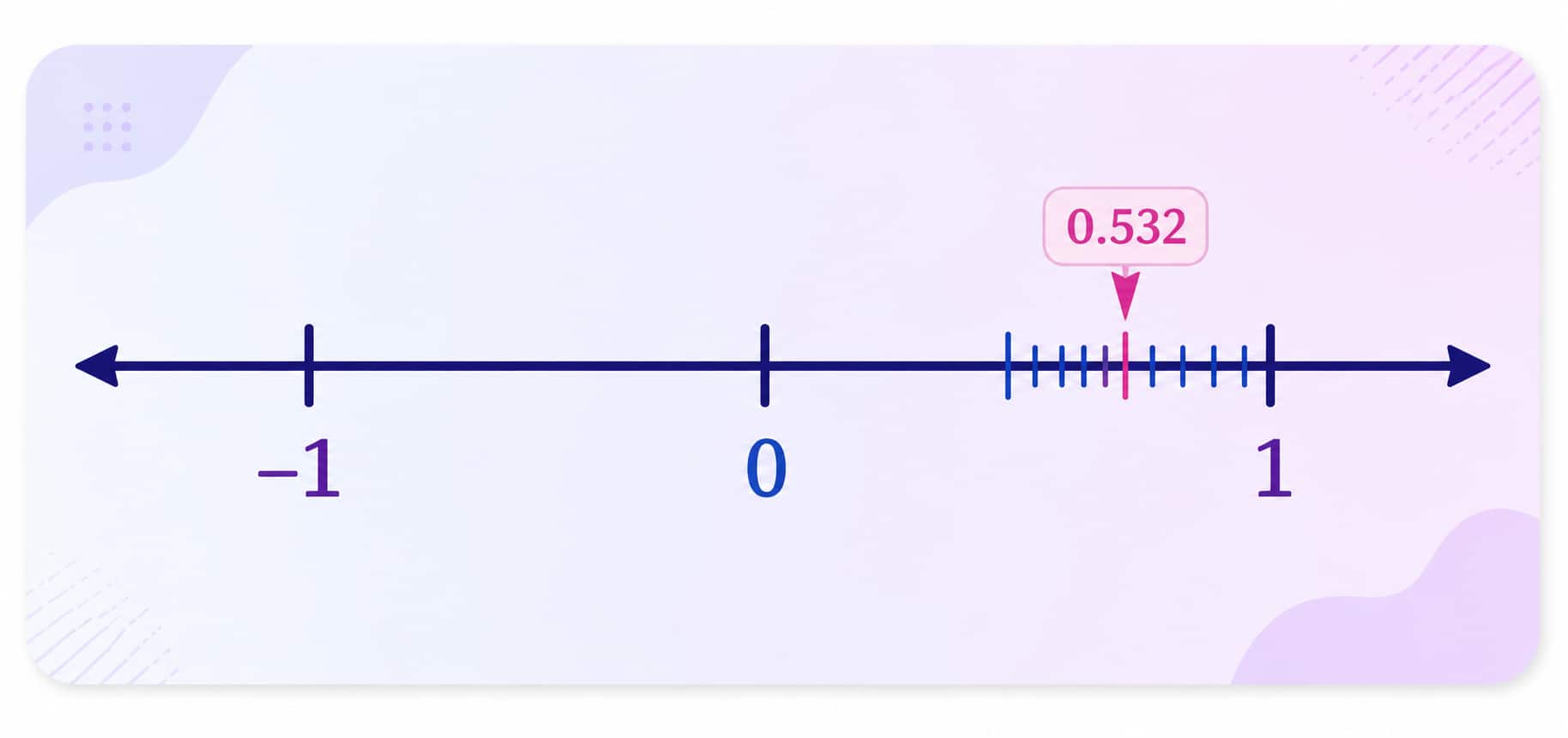
(i) 0.532
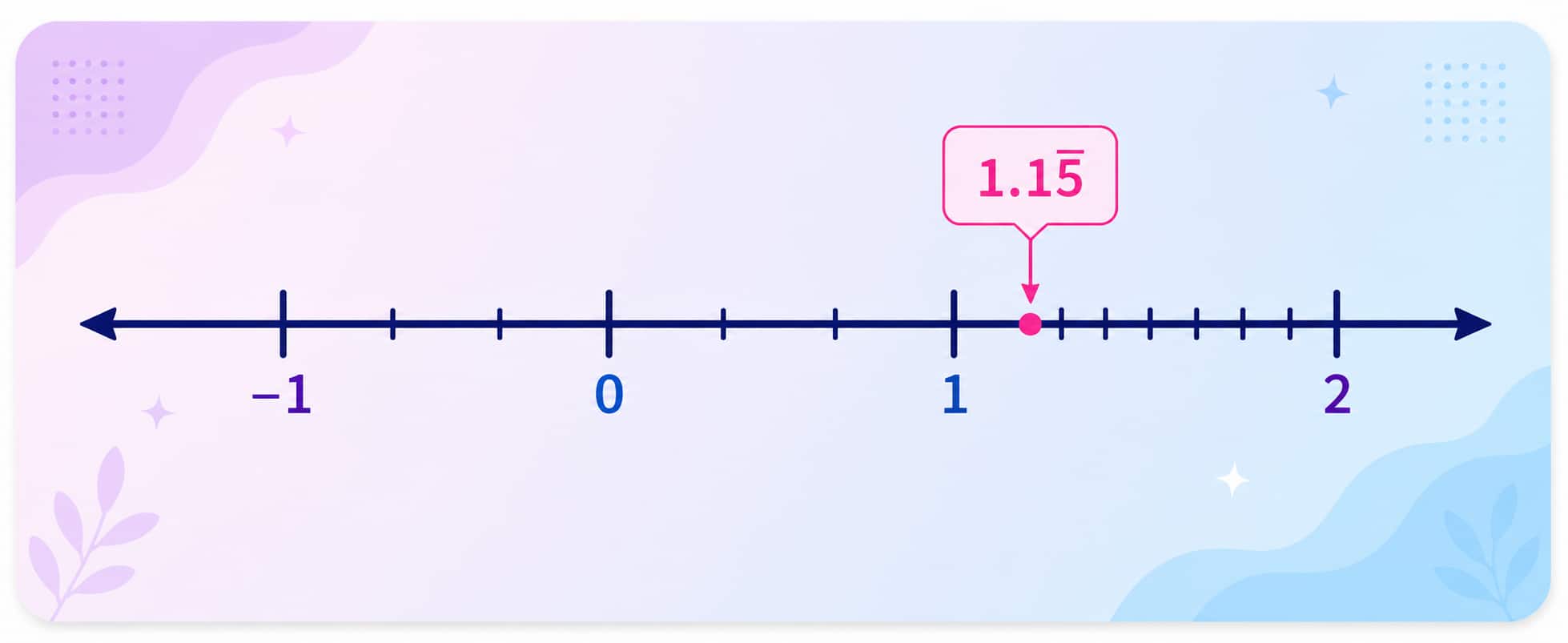
(ii) $1.1 \overline{5}$
$\text{Answer:}$
(i) $0.532=\frac{532}{1000}$
Therefore, it is located between 0 and 1, with a value near 0.5.
(ii) $1.1 \overline{5}=1.1555555555555....$
Therefore, it lies between 1.1 and 1.2, slightly after 1.15.
Question 5. Find 6 rational numbers between 3 and 4.
$\text{Answer:}$
Six rational numbers between 3 and 4:
$3.1$, which can be written as $\frac{31}{10}$, a rational number.
$3.2$, which can be written as $\frac{32}{10}$, a rational number.
$3.3$, which can be written as $\frac{33}{10}$, a rational number.
$3.4$, which can be written as $\frac{34}{10}$, a rational number.
$3.5$, which can be written as $\frac{35}{10}$, a rational number.
$3.6$, which can be written as $\frac{36}{10}$, a rational number.
Question 6. Find 5 rational numbers between $\frac{2}{5}$ and $\frac{3}{5}$.
$\text{Answer:}$
$\frac{2}{5}$ can be written as $\frac{2\times10}{5\times10}=\frac{20}{50}$
$\frac{3}{5}$ can be written as $\frac{3\times10}{5\times10}=\frac{30}{50}$
So, five rational numbers between them are:
$\frac{21}{50}, \frac{22}{50}, \frac{23}{50}, \frac{24}{50}$ and $\frac{25}{50}$.
Question 7. Find 5 rational numbers between $\frac{1}{6}$ and $\frac{2}{5}$.
$\text{Answer:}$
$\frac{1}{6}$ can be written as $\frac{1\times5}{6\times5}=\frac{5}{30}$
$\frac{2}{5}$ can be written as $\frac{2\times6}{5\times6}=\frac{12}{30}$
So, five rational numbers between them are:
$\frac{6}{30}, \frac{7}{30}, \frac{8}{30}, \frac{9}{30},$ and $ \frac{10}{30}$
Question 8. If $\frac{x}{3}+\frac{x}{5}=\frac{16}{15}$, find the rational number $x$.
$\text{Answer:}$
$\frac{x}{3}+\frac{x}{5}=\frac{16}{15}$
$⇒\frac{5 x+3 x}{15}=\frac{16}{15}$
$⇒8x=16$
$\therefore x=2$
Hence, the value of $x$ is 2.
Question 9. Let $a$ and $b$ be two non-zero rational numbers such that $a+\frac{1}{b}=0$. Without assigning any numerical values, determine whether $a b$ is positive or negative. Justify your answer.
$\text{Answer:}$
Given $a+\frac{1}{b}=0$
$⇒a=-\frac{1}{b}$
Multiplying $b$ with both sides, we get,
$⇒ab=-1$
Since $-1$ is negative, the value of $ab$ is negative.
Question 10. A rational number has a terminating decimal expansion whose last non-zero digit occurs in the 4th decimal place. Show that such a number can be written in the form $\frac{p}{10^4}$, where $p$ is an integer not divisible by 10.
Is it necessary that the denominator of this rational number, when written in the lowest form, is divisible by $2^4$ or $5^4$? Give reasons.
$\text{Answer:}$
If the last non-zero digit occurs in the 4th decimal place, then the number has the form $\frac{p}{10^4}$, where $p$ is an integer not divisible by 10.
For example, $0.1234=\frac{1234}{10000}$
The denominator in lowest form doesn't need to contain $2^4$ or $5^4$.
For example, $\frac{500}{1000}$ can be written as $\frac12$, where 2 is the lowest denominator
Question 11. Without performing division, determine whether the decimal expansion of $\frac{18}{125}$ is terminating or non-terminating. If it terminates, state the number of decimal places.
$\text{Answer:}$
$125=5^3$
In the denominator, only factor 5 occurs, so the decimal expansion terminates.
To find the number of decimal places, we have to make the denominator a power of 10.
$125 \times 8=1000$
So, $\frac{18}{125}=\frac{18\times8}{125\times8}=\frac{144 }{ 1000}=0.144$
Thus, it terminates with 3 decimal places.
Therefore, $\frac{18}{125}$ is a terminating decimal with 3 decimal places.
Question 12. A rational number in its lowest form has denominator $2^3 \times 5$. How many decimal places will its decimal expansion have? Explain your answer.
$\text{Answer:}$
$2^3 \times 5=8 \times 5=40$
To make the denominator 40 a power of 10, we have to multiply it by 25.
$40 \times 25=1000=10^3$
So, the decimal expansion has 3 decimal places.
*Question 13. Let $a=\frac{7}{12}$ and $b=\frac{5}{6}$. Express both $a$ and $b$ in the form $\frac{k_1}{m}$ and $\frac{k_2}{m}$ where $k_1, k_2$ and $m$ are integers and $k_2-k_1>6$. Using the same denominator $m$, write exactly five distinct rational numbers lying between $a$ and $b$ keeping an integer numerator.
Explain why the condition $k_2-k_1>n+1$ is necessary to find $n$ such rational numbers between the two rational numbers $a$ and $b$ using this method.
$\text{Answer:}$
Given: $a=\frac{7}{12}$ and $b=\frac{5}{6}$
$b=\frac{5}{6}=\frac{5\times2}{6\times2}=\frac{10}{12}$
Since after having the denominators are the same, the difference between between nominator is 3, which is not enough to find 5 rational numbers between them.
We have to multiply them further.
$\frac{7}{12}=\frac{7\times5}{12\times5}=\frac{35}{60}$
$\frac{10}{12}=\frac{10\times5}{12\times5}=\frac{50}{60}$
Now, $50-35=15>3$
Five rational numbers are:
$\frac{36}{60}, \frac{37}{60}, \frac{38}{60}, \frac{39}{60}, \frac{40}{60}$
Condition $k_2-k_1>n+1$ ensures enough integers exist between numerators to create $n$ rational numbers.
*Question 14. Three rational numbers $x, y, z$ satisfy $x+y+z=0$ and $x y+y z+z x=0$. Show that all the rational numbers $x, y, z$ must be simultaneously zero.
$\text{Answer:}$
Given: $x+y+z=0$ and $x y+y z+z x=0$
We know that, $(x+y+z)^2=x^2+y^2+z^2+2(x y+y z+z x)$
$⇒0=x^2+y^2+z^2+2\times0$
$⇒x^2+y^2+z^2=0$
$x^2+y^2+z^2=0$
Sum of squares is zero only when each square is zero.
Thus, $x=y=z=0$
So, all the rational numbers $\mathrm{x}, \mathrm{y}$ and z are simultaneously zero.
*Question 15. Show that the rational number $\frac{(a+b)}{2}$ lies between the rational numbers $a$ and $b$.
$\text{Answer:}$
Let us assume that $\mathrm{a}<\mathrm{b}$.
We have to show that: $a<\frac{(a+b)}{2}<b$
Since $\mathrm{a}<\mathrm{b}$,
$
\begin{aligned}
&⇒ a+a<a+b \\
& ⇒ 2 a<a+b
\end{aligned}
$
$⇒\mathrm{a}<\frac{(a+b)}{2}----------(1)$
Since $\mathrm{a}<\mathrm{b}$,
$
\begin{aligned}
& a+b<b+b \\
&⇒ a+b<2 b
\end{aligned}
$
$⇒\frac{(a+b)}{2}<\mathrm{b}-------(2)$
From equations 1 and 2, we get,
$a<\frac{(a+b)}{2}<b$
Therefore, the rational number $\frac{(a+b)}{2}$ lies between a and b.
If we have taken $b<a$, then we also have gotten similar results.
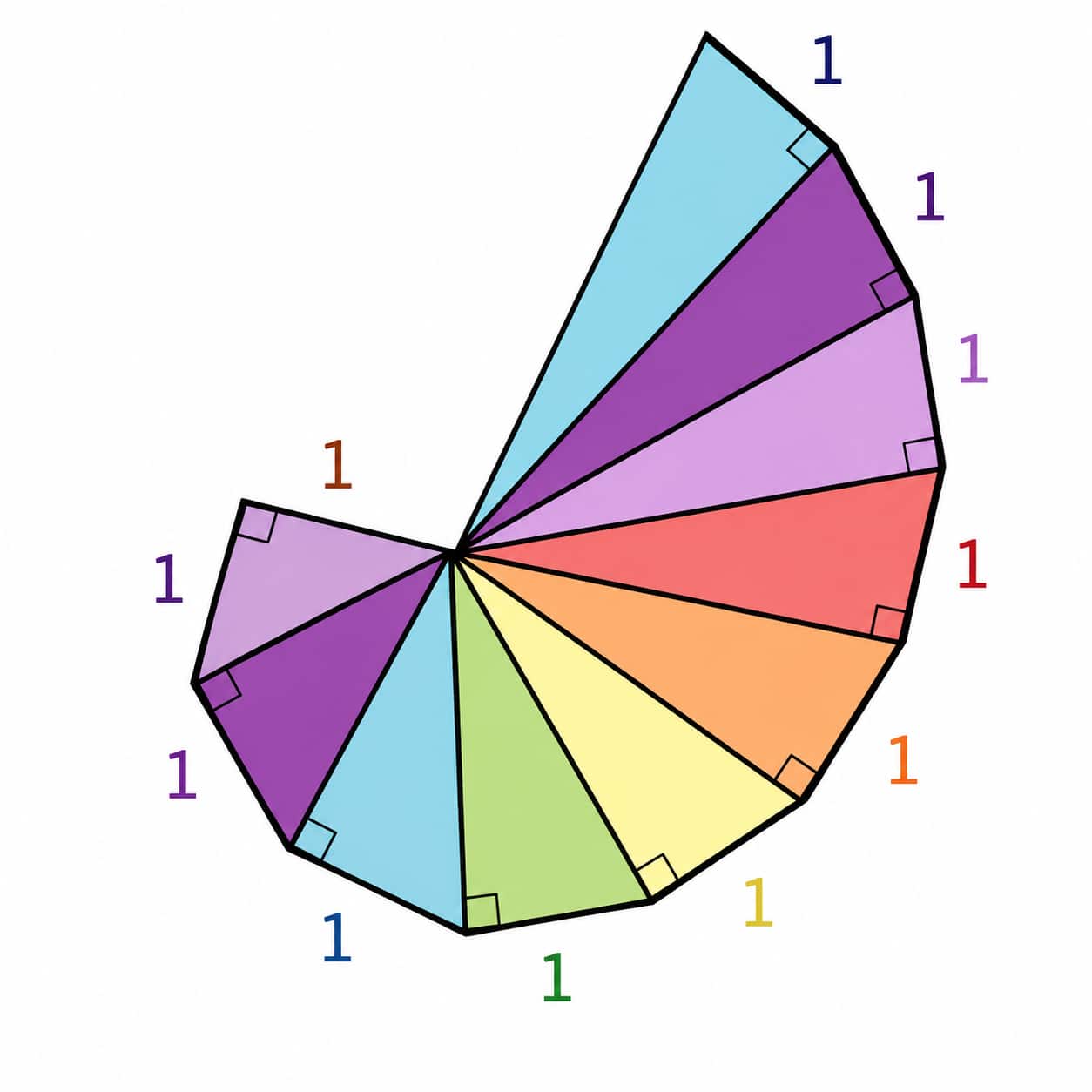
Question 16. Find the lengths of the hypotenuses of all the right triangles in Fig. 3.14 which is referred to as the square root spiral.
$\text{Answer:}$
This figure is the square root spiral, also called the Spiral of Theodorus.
Each triangle is a right triangle with:
- one leg = 1
- the other leg = previous hypotenuse
Using the Pythagorean theorem:
First triangle
Legs: 1, 1
$c=\sqrt{1^2+1^2}=\sqrt{2}$
Second triangle
Legs: $\sqrt{2}, 1$
$c=\sqrt{(\sqrt{2})^2+1^2}=\sqrt{2+1}=\sqrt{3}$
Third triangle
Legs: $\sqrt{3}, 1$
$c=\sqrt{3+1}=\sqrt{4}=2$
Continuing similarly:
$\sqrt{5}, \sqrt{6}, \sqrt{7}, \sqrt{8}, \sqrt{9}=3, \sqrt{10}, \ldots$
Thus, the lengths of the hypotenuses of the triangles in the square root spiral are: $\sqrt{2 } , \sqrt{3 } , \sqrt{4 } , \sqrt{5 } , \sqrt{6 } , \sqrt{ 7} , \sqrt{ 8} , \sqrt{9 } , \sqrt{10 } , \sqrt{11 } , \ldots$
Hence, in general, the hypotenuse lengths follow the pattern: $\sqrt{2 } , \sqrt{ 3} , \sqrt{ 4} , \sqrt{5 } , \sqrt{ 6} , \ldots$ up to as many triangles as drawn in the figure.
Confused between CGPA and Percentage?
Get your results instantly with our calculator!
The World of Numbers Class 9 Chapter 3: Topics
Students will explore the following topics in NCERT Class 9 Maths Chapter 3 The World of Numbers:
- 3.1. The Dawn of Mathematics: The Human Need to Count
- 3.2 The Revolution of Śhūnya: When Nothing Became Something
- 3.3 Integers: Expanding the Horizon
- 3.4 Filling the Spaces: Fractions and Rational Numbers
- 3.5 Irrational Numbers
- 3.6 Real Numbers: Decimals and Cyclic Patterns
- 3.7 Conclusion: The Never-Ending Journey
Class 9 Maths NCERT Chapter 3 Solutions: Extra Questions
Question 1:
Simplify the following expression.
25 + 12 – 2 + (4 + 2)
$\text{Answer:}$
Given: 25 + 12 – 2 + (4 + 2)
= 25 + 12 – 2 + 6
= 41
Hence, the correct answer is 41.
Question 2:
The value of $\frac{2}{3}$ of $\frac{5}{8}$ of $276-\sqrt{7056}$ is:
$\text{Answer:}$
$\frac{2}{3}$ of $\frac{5}{8}$ of $276-\sqrt{7056}$
$=(\frac{2}{3}\times\frac{5}{8}\times276)-\sqrt{7056}$
$=115-\sqrt{7056}$
$=115-84$
$=31$
Hence, the correct answer is 31.
Question 3:
What is the value of 0.0045 ÷ 4.5 × 100 – 45 ÷ 5?
$\text{Answer:}$
Given:
0.0045 ÷ 4.5 × 100 – 45 ÷ 5
= 0.001 × 100 – 9
= 0.1 – 9
= – 8.9
Hence, the correct answer is – 8.9.
Question 4:
The value of $(256)^{\frac{1}{2}}-(1331)^{\frac{1}{3}}+23 \times 13$ is:
$\text{Answer:}$
According to the question
$(256)^{\frac{1}{2}}-(1331)^{\frac{1}{3}}+23 \times 13$
= 16 - 11 + 23 ×13
= 16 - 11 + 299
= 5 + 299
= 304
Hence, the correct answer is 304.
Question 5:
If $\frac{2 x+3}{18 \div 3 \times 4+2}=\frac{12 \times 3+5}{2 \times 4 \div 2}$, then what is the value of $x$?
$\text{Answer:}$
Given: $\frac{2 x+3}{18 \div 3 \times 4+2}=\frac{12 \times 3+5}{2 \times 4 \div 2}$
⇒ $\frac{2 x+3}{\frac{18}{3} \times 4+2}=\frac{12 \times 3+5}{2 \times \frac{4}{2}}$
⇒ $\frac{2 x+3}{24+2}=\frac{36+5}{4}$
⇒ $\frac{2 x+3}{26}=\frac{41}{4}$
⇒ $8 x+12=1066$
⇒ $8x=1066-12$
⇒ $8x=1054$
⇒ $x=131.75$
Hence, the correct answer is 131.75.
NCERT Solutions for Class 9 Maths Chapter Wise
We at Careers360 compiled all the NCERT Class 9 Maths solutions in one place for easy student reference. The following links will allow you to access them.
NCERT Class 9 Books & Syllabus
Before the start of a new academic year, students should refer to the latest syllabus to determine the chapters they’ll be studying. Below are the updated syllabus links, along with some recommended reference books.
Frequently Asked Questions (FAQs)
Negative numbers help represent quantities below zero, such as debts, losses, and temperatures below 0 degrees Celsius.
The new name of the NCERT Class 9 Chapter 3 is “The World of Numbers”.
Free NCERT Solutions for Class 9 Maths Chapter 3 are available on many e-learning platforms and educational websites, such as Careers360, in both online and downloadable PDF formats.
A rational number has a terminating decimal expansion if the denominator in simplest form contains only the prime factors 2 and/or 5.
A decimal in which one digit or a group of digits repeats endlessly is called a repeating decimal.
Example: 0.123451234512345…..
Yes. Every point on the number line corresponds to a unique real number.

Popular Questions
A block of mass 0.50 kg is moving with a speed of 2.00 ms-1 on a smooth surface. It strikes another mass of 1.00 kg and then they move together as a single body. The energy loss during the collision is
| Option 1)
|
Option 2)
|
| Option 3)
|
Option 4)
|
An athlete in the olympic games covers a distance of 100 m in 10 s. His kinetic energy can be estimated to be in the range
| Option 1)
|
Option 2)
|
| Option 3)
|
Option 4)
|
A particle is projected at 600 to the horizontal with a kinetic energy . The kinetic energy at the highest point
| Option 1)
|
Option 2)
|
| Option 3)
|
Option 4)
|
In the reaction,
| Option 1)
|
Option 2)
|
| Option 3)
|
Option 4)
|
How many moles of magnesium phosphate, will contain 0.25 mole of oxygen atoms?
| Option 1)
0.02 |
Option 2)
3.125 × 10⁻² |
| Option 3)
1.25 × 10⁻² |
Option 4)
2.5 × 10⁻² |