KCC Institute of Legal and Higher Education, Greater Noida
Law Admissions 2026 Open | Avail Merit-Based Scholarships


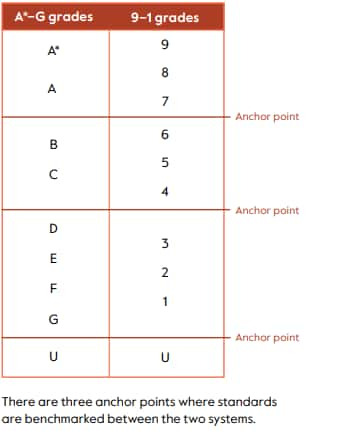
International General Certificate of Secondary Education (IGCSE) uses two types of grading systems: a numerical scale from 1 to 9 and an alphabetical scale from G to A*. In the numerical system, 9 indicates the highest grade, while 1 represents the lowest level of achievement. In the alphabetical system, A* is the highest grade and G is the lowest grade. In both systems, if the student fails to meet the minimum requirement, the IGCSE result is marked as "U" (Ungraded).

A candidate's grade is directly related to the number of marks obtained in the IGCSE examination. These grades are linked to approximate percentage ranges, from 90-100% for A* down to 20-29% for G and 0-19% for U. In certain regions, notably the UK, the 9-1 scale is also employed, particularly at higher achievement levels, where 9 signifies the top grade and 1 the lowest. Read further to learn in detail about the IGCSE grading system below.
The grade boundaries that fluctuate annually are important, reflecting exam difficulty and overall student performance. Additionally, students receive percentage uniform marks, providing a comparative measure of their performance.
Check exam-wise grade threshold tables for all subjects.
The A*-G grading system for IGCSE qualifications maintains a substantial global presence, being utilised in over 150 countries and within more than 6,000 schools worldwide. Cambridge Assessment International Education awards over one million A*-G grades annually. Notably, while England has largely transitioned to the 9-1 grading scale, students in Wales and Northern Ireland continue to receive A*-G GCSE grades, illustrating a mixed grading landscape across the United Kingdom.
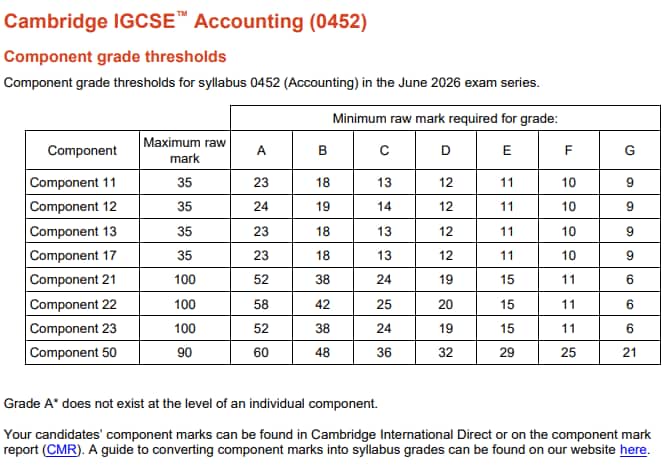
Cambridge sets annual grade thresholds to ensure fairness across exam sessions. These thresholds may vary year to year based on: Exam difficulty and overall candidate performance.
IGCSE students receive Percentage Uniform Marks to show how they performed compared to others in their grade (top, middle, or bottom). Refer to the table below for the mark ranges per grade.
IGCSE Grade to Percentage Conversion Table
| Grade | Percentage |
| A* | 90-100% |
| A | 80–89% |
| B | 70–79% |
| C | 60–69% |
| D | 50–59% |
| E | 40–49% |
| F | 30–39% |
| G | 20–29% |
| U | 0–19% |
Law Admissions 2026 Open | Avail Merit-Based Scholarships
BBA/MBA/PGDM Early Bird Applications Deadline 19th Oct '26. Apply now using coupon code CAREER250 and get ₹250 off the application fee
Adjustments might include lowering thresholds if the exam was harder and raising thresholds if the exam was easier. This ensures grade consistency and fairness across different years and sessions.
| Numerical grade | Percentage |
| 9 | exceptional (above A*) |
| 8 | roughly A* |
| 7 | A |
| 6 | high B |
| 5 | low B / high C |
| 4 | low C |
| 3 | D/E |
| 2 | F |
| 1 | G |
| U | ungraded |
Also, read:
Will students applying to university with A*-G IGCSE grades be treated differently from students with 9-1 grades? The answer is no.
Universities have stated that they will treat both grading systems equally. While some UK universities traditionally require a C grade in GCSE Maths and English, the transition to the 9-1 system has introduced some variation.
Some universities will recognise the new grade 5 as equivalent to the traditional C, while others will accept grade 4 as fulfilling the requirement. Therefore, students should consult the specific entry requirements of their chosen universities to clarify which 9-1 grade they receive as an equivalent to the traditional C.
Get your results instantly with our calculator!


Law Admissions 2026 Open | Avail Merit-Based Scholarships
BBA/MBA/PGDM Early Bird Applications Deadline 19th Oct '26. Apply now using coupon code CAREER250 and get ₹250 off the application fee
Ranked #36 amongst institutions in Management by NIRF | 100% Placement
Globally Recognized by AACSB (US) & AMBA (UK) | 18 LPA Avg. CTC for PGPM 2026
Leading Design College | 95% Placement Record | Merit-cum-Means Scholarships for Deserving Students
NEET PG All India & State College Predictor with Admission Process Guide