KCC Institute of Legal and Higher Education, Greater Noida
Law Admissions 2026 Open | Avail Merit-Based Scholarships


The NCERT Class 9 syllabus for the academic session 2026-27 has gone through some major changes under the National Education Policy 2020 (NEP 2020) and the National Curriculum Framework for School Education 2023 (NCF-SE 2023). NCERT has basically redesigned Mathematics and Science, with new chapter names, plus updated concepts and an activity-learning kind of approach that feels more hands-on. Instead of pure memorisation, the curriculum now leans into conceptual grasp, like understanding first, then remembering. A few old chapters have been removed, too, and several advanced, plus application-minded topics have been shifted earlier, so students get a stronger academic base from the start.
This Story also Contains
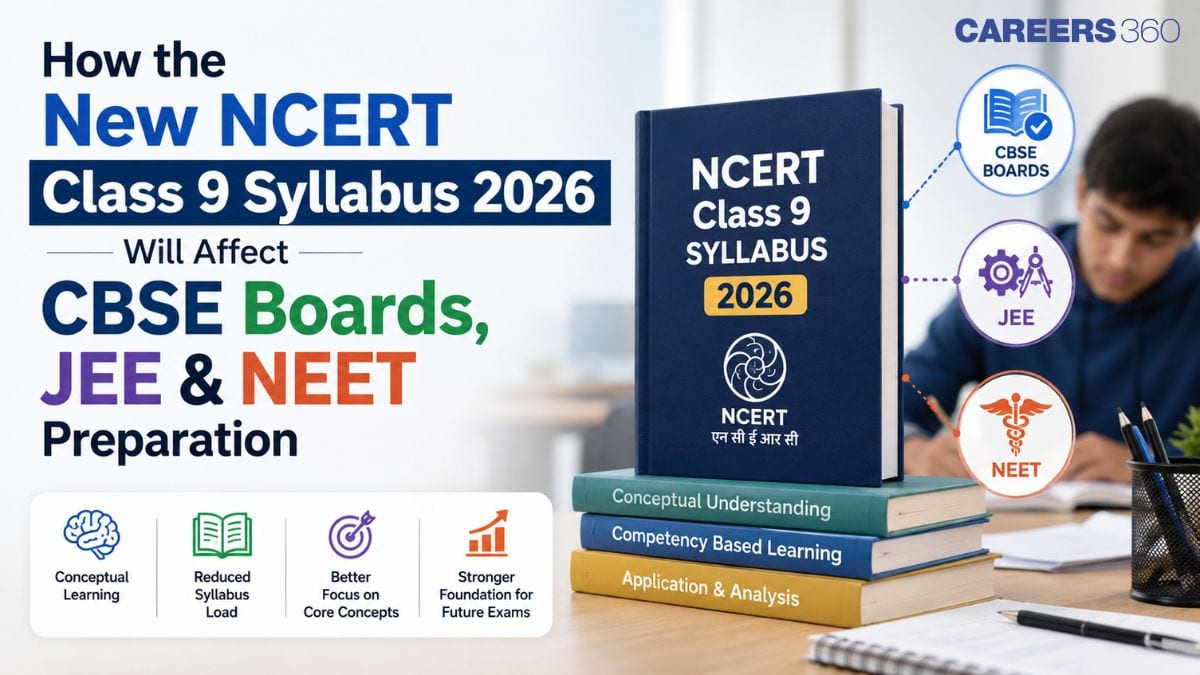
This updated plan will not just change how CBSE schools handle their board exams, but it will also end up shaping how students should prepare for competitive exams such as JEE Main and NEET in the coming years. The new books stress analytical thinking, experiments, question framing in case style, and more real-life usage, so learning becomes a lot more practical and skill-focused. From Class 9 itself, students can build better conceptual clarity, and that usually carries forward into higher classes as well as entrance exam preparation. Below is a subject-wise breakdown of what the new NCERT Class 9 syllabus really impacts for CBSE Boards, JEE and NEET prep.
NCERT Have recently changed the syllabus for class 9 maths and science according to the National Education Policy (NEP) 2020 and the National Curriculum Framework for School Education (NCF-SE) 2023. The subject-wise breakdown of changes is given below.
In accordance with the National Education Policy (NEP) 2020 and the National Curriculum Framework for School Education (NCF-SE) 2023, NCERT has changed all the chapters of Class 9 Mathematics compared to the last syllabus. In some of the chapters, concepts may be the same as before, but the names of the chapters have definitely changed and been made more student-friendly. Here are the names of the chapters according to the new NCERT Class 9 Syllabus.
Law Admissions 2026 Open | Avail Merit-Based Scholarships
BBA/MBA/PGDM Early Bird Applications Deadline 19th Oct '26. Apply now using coupon code CAREER250 and get ₹250 off the application fee
Chapter 1: Orienting Yourself: The Use of Coordinates
Chapter 2: Introduction to Linear Polynomials
Chapter 3: The World of Numbers
Chapter 4: Exploring Algebraic Identities
Chapter 5: I’m Up and Down, and Round and Round
Chapter 6: Measuring Space: Perimeter and Area
Chapter 7: The Mathematics of Maybe: Introduction to Probability
Chapter 8: Predicting What Comes Next: Exploring Sequences and Progressions
Previously, there were 12 chapters in the NCERT Class 9 Mathematics Syllabus. But this time, chapters have been reduced to 8 to simplify the learning for students. The following table will clear all the confusion of students about the new syllabus and the old syllabus.
Chapter No. | Old Syllabus | New Syllabus |
Chapter 1 | Number Systems | Orienting Yourself: The Use of Coordinates |
Chapter 2 | Polynomials | Introduction to Linear Polynomials |
Chapter 3 | Coordinate Geometry | The World of Numbers |
Chapter 4 | Linear Equations in Two Variables | Exploring Algebraic Identities |
Chapter 5 | Introduction to Euclid’s Geometry | I’m Up and Down, and Round and Round |
Chapter 6 | Lines and Angles | Measuring Space: Perimeter and Area |
Chapter 7 | Triangles | The Mathematics of Maybe: Introduction to Probability |
Chapter 8 | Quadrilaterals | Predicting What Comes Next: Exploring Sequences and Progressions |
Chapter 9 | Circles | - |
Chapter 10 | Heron's Formula | - |
Chapter 11 | Surface Areas and Volumes | - |
Chapter 12 | Statistics | - |
New Physics Chapters from Class 9 Science
Chapter 4: Describing Motion Around Us
Chapter 6: How Forces Affect Motion
Chapter 7: Work, Energy, and Simple Machines
Chapter 10: Sound Waves: Characteristics and Applications
Old Physics Chapters from Class 9 Science
Chapter 7: Motion
Chapter 8: Force and Laws of Motion
Chapter 9: Gravitation
Chapter 10: Work and Energy
Chapter 11: Sound
Get your results instantly with our calculator!
New Chapters | Old Chapters |
Chapter 4: Describing Motion Around Us | Chapter 7: Motion |
Chapter 6: How Forces Affect Motion | Chapter 8: Force and Laws of Motion |
Chapter 7: Work, Energy, and Simple Machines | Chapter 10: Work and Energy |
Chapter 10: Sound Waves: Characteristics and Applications | Chapter 11: Sound |
Chapter 9: Gravitation |
The Gravitation chapter is completely removed from the new NCERT Class 9 Physics syllabus.
In the new NCERT Class 9 books, physics topics are presented in a more interactive and integrated way.
The concepts are improved with better real-life examples and hands-on understanding.
The updated syllabus focuses more on experiments, observations, and strong conceptual learning.
In-text questions are now included in sections like “Think It Over,” “Think Like a Scientist,” and “Pause and Ponder” to improve critical thinking and deeper understanding.
The traditional exercise section has been replaced with “Revise, Reflect, Refine”, which helps students improve learning through practice, self-analysis, and conceptual clarity.
New Chemistry Chapters from Class 9 Science
Chapter 5: Exploring Mixtures and Their Separation
Chapter 8: Journey Inside the Atom
Chapter 9: Atomic Foundations of Matter
Chapter 13: Earth as a System: Energy, Matter, and Life
Old Chemistry Chapters from Class 9 Science
Chapter 1: Matter in our surroundings
Chapter 2: Is matter around us pure
Chapter 3: Atoms and Molecules
Chapter 4: Structure of the Atom
New Chapters | Old Chapters |
Chapter 5: Exploring Mixtures and Their Separation | Chapter 2: Is matter around us pure |
Chapter 8: Journey Inside the Atom | Chapter 4: Structure of the Atom |
Chapter 9: Atomic Foundations of Matter | Chapter 3: Atoms and Molecules |
Chapter 13: Earth as a System: Energy, Matter, and Life | No direct chapter |
Concepts integrated in mixtures and all | Chapter 1: Matter in our surroundings |
1. In the new NCERT Class 9 books, topics are given in a more activity-based and integrated manner.
2. Concepts are upgraded with more explanations and practices
3. The new syllabus puts more emphasis on observations, experiments, and conceptual understanding.
4. Simple language with more visuals and charts
5. The new book is competency-based and concept-oriented.
Chapter 2 - Cell: The Building Block of Life
Chapter 3 - Tissues in Action
Chapter 11 - Reproduction: How Life Continues
Chapter 12- Patterns in Life: Diversity and Classification
Biology Old NCERT vs New NCERT
What Changed?
The new NCERT 2026 Biology syllabus has significantly increased the conceptual depth and diagram-based learning compared to the old NCERT.
Several topics taught in higher classes now appear in Class 9
Overall, conceptual difficulty increased.
Included case-based questions in the new NCERT.
Old NCERT | New NCERT |
Chapter 5 - The Fundamental Unit of Life | Chapter 2 - Cell: The Building Block of Life |
Chapter 6 - Tissues | Chapter 3 - Tissues in Action |
Chapter 7 - Diversity in Living Organisms (removed in 2025-26 rationalisation) | Chapter 12- Patterns in Life: Diversity and Classification |
Chapter 13 - Why Do We Fall Ill? (removed in 2025-26 rationalisation) | Removed |
No equivalent chapter in the old book | Chapter 11 - Reproduction: How Life Continues |
Chapter 15 - Improvement in Food Resources (ch- 12 in 2025-26 rationalisation) | Some concepts are integrated into other chapters |
Mathematics is always a crucial chapter in the Class 10 board exam, and it should have a strong foundation laid in Class 9. This time, NCERT has focused more on important topics and learning through simplicity rather than stuffing chapters with more exercises. Unnecessary chapters, such as Euclid's Geometry and Heron’s formula, have been removed, as some of these concepts will be covered in the given chapters. So having different chapters makes no sense. Now, let's discuss chapter by chapter how they should impact our learning in Class 10 board exams.
Chapter 1 will help us learn coordinate geometry, which is an important chapter in Class 10. Also, in classes 11 and 12, it will help in chapters like Vectors and 3D geometry.
Chapter 2 is an important chapter of Algebra, as polynomials are also a part of the board exam.
Chapter 3 will introduce us to all the types of numbers, and class 10 already has the chapter name “Real numbers”. So students will get an extra advantage.
Chapter 4 will also help us with quadratic equations in Class 10.
Chapter 5 will teach us geometry and build a strong base for chapters such as mensuration and circles, which we will read in Class 10.
Chapter 6 will build a foundation for the Surface areas and volumes chapter in Class 10.
Chapter 7 Probability is an important part of Statistics, which is not only useful in Class 10 board exams but also in Class 11 and 12.
Chapter 8 will teach us different types of progressions and start the journey of learning Sequence and series concepts.
Exams will be based more on understanding concepts, not just memorising answers.
Questions will be application-based, so you need to know how to use concepts in real life.
You will see more case-based and thinking-type questions.
Activities and experiments will help you learn better and remember longer.
You need to focus on clear concepts and practice, not rote learning.
More application and concept-based questions will be asked in exams,
More importance is given to experiments and activities
Questions connecting concerts to real-life examples will be asked
Students need to understand concepts in depth
The new syllabus helps students prepare for competitive exams like JEE and NEET because it pushes students towards concept-based learning instead of rote learning
The new NCERT 2026 Biology syllabus is a major change in Class 9 Science in years.
It has shifted from a memory-based subject to more of a concept-heavy and application-based subject.
A major shift in question type changed.
Example - Old NCERT questions were predictable - Define connective tissue.
New NCERT Question - Why are bones considered connective tissues even though they are hard?
This will increase analytical biology questions, process-based explanation, and cause-and-effect reasoning of concepts in the book.
Introduction of chapter- Reproduction: How Life Continues is one of the biggest syllabus upgrades. This increased both the theoretical depth and the biological terminology.
More case-based questions and application MCQs were added. So, students must now explain concepts, not just definitions.
Though the chapter's name has been changed and some less important concepts have been removed, the base for the JEE exam will be prepared in this class, as before. Let's discuss which chapter helps with which concepts in the JEE exam.
Chapter 1 builds the foundation for JEE Chapters, such as Coordinate Geometry, Straight Lines, Vectors, and 3D Geometry.
Chapter 2 builds the foundation for JEE Chapters, such as Polynomials, Functions, Calculus, and Algebraic Equations.
Chapter 3 builds the foundation for JEE Chapters, such as Logarithms and Complex Numbers.
Chapter 4 builds the foundation for JEE Chapters, such as Quadratic Equations, Binomial Theorem, and Sequence & Series.
Chapter 5 builds the foundation for JEE Chapters, such as Conic sections, mainly circles.
Chapter 6 builds the foundation for JEE Chapters, such as Mensuration, Coordinate Geometry, and Integral Calculus.
Chapter 7 builds the foundation for JEE Chapters, such as Probability, Permutation & Combination, Statistics
Chapter 8 builds the foundation for JEE Chapters such as Sequences & Series, Binomial Expansion.
The new syllabus builds a strong foundation in topics like motion, force, laws of motion, work, energy, and sound, which are important for JEE preparation.
The new syllabus sort of helps in building strong basic concepts, which are important for the JEE foundation.
It leans more toward understanding and practical use, and that is useful for future competitive exams, too.
Because a few topics (like gravitation) are removed, students who are preparing for JEE foundation may have to cover those separately later, you know.
Also, the activity-based approach boosts concept clarity, which in turn helps with tackling simple numerical problems without much stress.
However, since this syllabus is only meant for the foundation level, advanced JEE- type problem practice is still needed in the higher classes.
The new syllabus is helpful for building a strong base for JEE, but students will need additional preparation in higher classes for complete JEE readiness.
Topics like atomic structure, atoms and molecules, and chemical reasoning are covered in Chapter 9, Atomic Foundations of Matter. These topics help students understand advanced JEE topics like the mole concept, atomic models, and chemical bonding.
Some concepts from higher classes are now added to the Class 9 syllabus to reduce the sudden burden faced by students in Class 11 during JEE preparation.
Class 9 Science new syllabus is based on competency educations this matches the pattern of JEE, which tests application and reasoning skills.
Ch 5 Exploring Mixtures and Their Separation helps develop problem-solving ability, which is essential for JEE Chemistry questions.
JEE Chapters | Class 9 New Chapters |
States of Matter, Purification Methods | Chapter 5: Exploring Mixtures and Their Separation |
Atomic structure | Chapter 8: Journey Inside the Atom |
Mole Concept and Atomic Theory | Chapter 9: Atomic Foundations of Matter |
The new syllabus helps you build strong basic concepts of motion, force, laws of motion (NLM), work, energy, and sound, which are important for NEET.
The new syllabus kind of helps you build strong basics in Physics, which are important for NEET.
It leans more on understanding ideas rather than rote memorising formulas, so you kind of get the concept.
Most topics are explained in a simple, practical sort of way, making them easier to pick up.
Since some things like gravitation are removed, you will need to revise that later for NEET.
Overall, it is good for starting your preparation, but in higher classes, you will still need advanced-level practice.
The new syllabus builds a strong Physics foundation for NEET, but complete preparation will happen in Classes 11 and 12.
Chemistry in NEET is mainly asked from the NCERT books. Class 9 new syllabus introduces students to atomic structure, matter, mixtures, and scientific reasoning, helping students prepare for advanced NEET topics.
Updated Class 9 NCERT Syllabus aligns with competitive exams, thinking, and skills. The new syllabus is beneficial for foundation students
NEET Chapters | Class 9 New Chapters |
States of Matter, Purification Methods | Chapter 5: Exploring Mixtures and Their Separation |
Atomic structure | Chapter 8: Journey Inside the Atom |
Mole Concept and Atomic Theory | Chapter 9: Atomic Foundations of Matter |
The new NCERT 2026 Biology syllabus is designed much closer to the style of modern NEET Biology. Students studying the new Class 9 syllabus will start learning NEET-oriented concepts 2-3 years earlier than previous batches.
Early introduction to the NEET concepts
Earlier, many important NEET concepts were introduced only in Classes 10 and 11. Now, several of them begin in Class 9 itself. This results in easier conceptual development and a smoother transition to NEET preparation
Cell Biology becomes stronger for NEET.
The new syllabus included the cell cycle, mitosis, apoptosis, cancer, and contact inhibition. These are foundational NEET concepts.
New chapter - Reproduction: How Life Continues added
Students entering Class 11-12 later may understand reproductive biology faster and retain concepts and diagrams more easily.
Reintroduced the Diversity in Living Organisms chapter
The restored diversity chapter introduces kingdoms, taxonomy, nomenclature, and adaptation studies. These are core NEET Biology areas
More diagrams added
NEET Biology heavily depends on labelled diagrams, visual memory, and process flowcharts. The new syllabus now includes joints, reproductive organs, tissues, fertilisation, and cell division diagrams.
Reduce pressure in Class 11 NEET Study
Many students struggle in Class 11 Biology because the terminology suddenly becomes difficult, concepts become abstract, memorisation load increases sharply. The new Class 9 syllabus reduces this transition shock by introducing advanced concepts earlier.
NEET Question style is becoming similar to the new CBSE pattern
The new NCERT also focuses on reasoning, analysis, concepts and real-life application. The gap between school Biology and NEET Biology is becoming smaller.
Class 9 Biology Chapter (2026-27) | Related NEET Biology Unit |
Chapter 2 - Cell: The Building Block of Life | Unit 3 - Cell Structure and Function |
Chapter 3 - Tissues in Action | Unit 2 - Structural Organisation in Animals and Plants + Unit 5 - Human Physiology |
Chapter 11 - Reproduction: How Life Continues | Unit 6 - Reproduction |
Chapter 12 - Patterns in Life: Diversity and Classification | Unit 1 - Diversity in the Living World |

A block of mass 0.50 kg is moving with a speed of 2.00 ms-1 on a smooth surface. It strikes another mass of 1.00 kg and then they move together as a single body. The energy loss during the collision is
| Option 1)
|
Option 2)
|
| Option 3)
|
Option 4)
|
An athlete in the olympic games covers a distance of 100 m in 10 s. His kinetic energy can be estimated to be in the range
| Option 1)
|
Option 2)
|
| Option 3)
|
Option 4)
|
A particle is projected at 600 to the horizontal with a kinetic energy . The kinetic energy at the highest point
| Option 1)
|
Option 2)
|
| Option 3)
|
Option 4)
|
In the reaction,
| Option 1)
|
Option 2)
|
| Option 3)
|
Option 4)
|
How many moles of magnesium phosphate, will contain 0.25 mole of oxygen atoms?
| Option 1)
0.02 |
Option 2)
3.125 × 10⁻² |
| Option 3)
1.25 × 10⁻² |
Option 4)
2.5 × 10⁻² |

Law Admissions 2026 Open | Avail Merit-Based Scholarships
BBA/MBA/PGDM Early Bird Applications Deadline 19th Oct '26. Apply now using coupon code CAREER250 and get ₹250 off the application fee
Ranked #36 amongst institutions in Management by NIRF | 100% Placement
Globally Recognized by AACSB (US) & AMBA (UK) | 18 LPA Avg. CTC for PGPM 2026
Leading Design College | 95% Placement Record | Merit-cum-Means Scholarships for Deserving Students
NEET PG All India & State College Predictor with Admission Process Guide