
Search Colleges, Exams, Schools & more


Login
NCERT Solutions for Exercise 10.1 Class 10 Maths Chapter 10 - Circles
The geometric definition of tangents to a circle provides the basic knowledge needed to study line interaction with curved shapes. The present exercise analyzes how tangents connect with circles at a single point while establishing their connection to radii together with chords and secants. The comprehension enables us to establish important properties through logical reasoning together with construction processes. Each question provides scenarios that require students to use triangle congruence and perpendicular lines together with the measured distance from a fixed point.
This Story also Contains
- NCERT Solutions Class 9 Maths Chapter 10: Exercise 10.1
- Topics covered in Chapter 10, Circles: Exercise 10.1
- NCERT Solutions of Class 10 Subject Wise
- NCERT Exemplar Solutions of Class 10 Subject Wise
Students benefit from the Exercise 10.1 NCERT Solutions from Class 10 Maths since these solutions help them effectively solve geometric problems. Core geometry abilities which form a foundation for advanced geometric methods become stronger through study of these fundamental characteristics in this field. The NCERT Books based exercise teaches students to identify the unique number of circle tangents together with the unique tangents from external points and their radius-tangent perpendicularity.
NCERT Solutions Class 9 Maths Chapter 10: Exercise 10.1
Q1 How many tangents can a circle have?
Answer:
Tangents are the lines that cross the circle precisely at a single point. There can be an endless number of tangents in a circle. This can be shown by the figures below: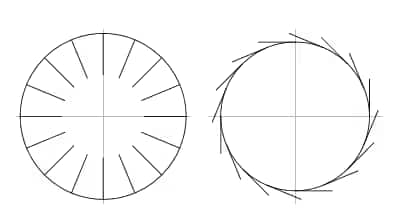
Answer:
(a) One
In a single point, a circle's tangent crosses the circle precisely.
(b) Secant
It is a line that intersects the circle at two points.
(c) Two,
There can be only two parallel tangents to a circle.
(d) Point of contact
The common point of a tangent and a circle.
(A) 12 cm
(B) 13 cm
(C) 8.5 cm
(D) $\sqrt { 119}$ cm.
Answer:
It is given that the radius of the circle is 5 cm. OQ = 12 cm
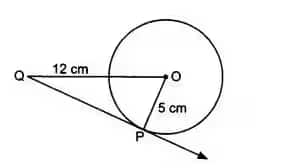
According to the question,
We know that $\angle QPO=90^0$
So, triangle OPQ is a right-angle triangle. By using Pythagoras' theorem,
$PQ =\sqrt{OQ^2-OP^2}=\sqrt{144-25}$
$=\sqrt{119}$ cm
Therefore, the correct option is (d) = $\sqrt { 119}$ cm
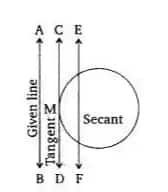
The supplied line is AB, and the line CD parallels the line AB and is the tangent to a circle at point M. A secant parallel to the AB is the line EF.
Also Read-
Topics covered in Chapter 10, Circles: Exercise 10.1
1. Concept and definition of a tangent to a circle: A straight line which touches a circle only at a single point without entering it makes up a tangent. At the point where a circle and the tangent line interact, there forms the point of contact while the tangent line remains at right angles to the radius drawn from this point.
2. Number of tangents a circle can have: A circle allows an infinite number of tangents to exist because one can create a tangent from every location on its circumference. A given point outside the circle permits only two possible tangents to touch it.
3. The condition of tangency (line touches the circle at only one point): A tangent maintains its extraordinary feature by never entering inside the circle while touching the circle exclusively at one point. Gas makes it unique from both secant and chord connections.
4. Use of Pythagoras' theorem in radius-tangent situations: A right triangle appears when drawing a tangent from outside the circle as the radius meets the line extending from the external point to the center. The tangent length becomes possible to calculate through the application of the Pythagoras theorem.
5. The length equality applies to tangents created when using any external point: Any two tangents originating from a common outside circle point share the identical length. The fundamental property proves useful throughout multiple geometric constructions along with multiple proofs.
6. Difference between secants and tangents: A secant connects two points on a circle and enters the interior while touching the circle only at one unique point. Identifying this distinction proves vital when resolving multiple geometric tasks related to circles.
Also see-
Confused between CGPA and Percentage?
Get your results instantly with our calculator!
💡 Conversion Formula used is: CGPA = Percentage / 9.5
NCERT Solutions of Class 10 Subject Wise
Students must check the NCERT solutions for class 10 of the Mathematics and Science Subjects.
NCERT Exemplar Solutions of Class 10 Subject Wise
Students must check the NCERT Exemplar solutions for class 10 of the Mathematics and Science Subjects.
Frequently Asked Questions (FAQs)
Q: What are the requirements for solving NCERT solutions for Class 10 Maths chapter 10 exercise 10.1?
A:
Concepts covered in Class 9 such as radius, centre, chord, segment and sector are prerequisite for NCERT solutions for Class 10 Maths chapter 10 exercise 10.1
Q: What is the tangent of a circle according to NCERT solutions for Class 10 Maths 10 exercise 10.1 ?
A:
A tangent is a line that intersects the circle at only one point
Q: How lines behave around a circle as specified in NCERT solutions for Class 10 Maths 10 exercise 10.1?
A:
Outside circle line does not touch any point, on circle line touches one point and in the circle, line touches two points
Q: How many theorems are covered till NCERT solutions for Class 10 Maths 10 exercise 10.1 ?
A:
Only one theorem is covered till NCERT solutions for Class 10 Maths 10 exercise 10.1
Q: Explain the theorem covered in NCERT solutions for Class 10 Maths 10 exercise 10.1?
A:
The tangent is perpendicular to the radius via the point of contact at any point on a circle.
Q: How many activities are covered till NCERT solutions for Class 10 Maths 10 exercise 10.1?
A:
Two activities are covered till NCERT solutions for Class 10 Maths 10 exercise 10.1
Q: How are activities useful for NCERT solutions for Class 10 Maths 10 exercise 10.1?
A:
Ncert activities help us to visualize the concepts of tangent and circle by applying them in real life
Q: In the NCERT solutions for Class 10 Maths chapter 10 exercise 10.1, how many questions are covered?
A:
There are 4 questions in Class 10 Maths chapter exercise 10.1. Question 2 consists of four fill in the blank Question 3 consists of 4 subparts.
Articles
Related Stories
|
Upcoming School Exams

Certifications By Top Providers
Explore Top Universities Across Globe
Questions related to CBSE Class 10th
On Question asked by student community
Have a question related to CBSE Class 10th ?
Hello student!
You can refer to the CBSE Class 10 Mathematics Question Paper 2026 to practise questions and prepare for the Mathematics examination.
https://school.careers360.com/boards/cbse/cbse-class-10-maths-question-paper-2026
Hope it helps!
Hi Smriti Lama
The CBSE Class 10 Board Exam 2026-27 question paper pattern includes the latest exam structure, subject-wise marking scheme and question types. You can check the detailed pattern on Careers360:
Hi Somshiv Rath
If you mean a CBSE Class 8 Science question paper, Careers360 has a sample paper section where you can check the available Class 8 papers.
https://learn.careers360.com/school/cbse-8-class-preparation-material/
Hey there,
If you mean CBSE Class 10 rechecking/re-evaluation results 2026, CBSE has already completed the main post-result process for 2026. The Class X second-board results were declared on 18 July 2026, and CBSE has also issued the post-result facilities notice.
For verification/re-evaluation, CBSE says the result/status is uploaded online
Please mention important details like your school board, exam, and class to get the exact papers.
You can explore the useful resources here:
Popular CBSE Class 10th Questions
A block of mass 0.50 kg is moving with a speed of 2.00 ms-1 on a smooth surface. It strikes another mass of 1.00 kg and then they move together as a single body. The energy loss during the collision is
| Option 1)
|
Option 2)
|
| Option 3)
|
Option 4)
|
An athlete in the olympic games covers a distance of 100 m in 10 s. His kinetic energy can be estimated to be in the range
| Option 1)
|
Option 2)
|
| Option 3)
|
Option 4)
|
A particle is projected at 600 to the horizontal with a kinetic energy . The kinetic energy at the highest point
| Option 1)
|
Option 2)
|
| Option 3)
|
Option 4)
|
In the reaction,
| Option 1)
|
Option 2)
|
| Option 3)
|
Option 4)
|
How many moles of magnesium phosphate, will contain 0.25 mole of oxygen atoms?
| Option 1)
0.02 |
Option 2)
3.125 × 10⁻² |
| Option 3)
1.25 × 10⁻² |
Option 4)
2.5 × 10⁻² |
Colleges After 12th

Applications for Admissions are open.
Get Job Ready in Healthcare | Employability-Focused Programs
CBSE Class 10th Notifications
Never miss CBSE Class 10th update
Get timely CBSE Class 10th updates directly to your inbox. Stay informed!