
Search Colleges, Exams, Schools & more


Login
NCERT Solutions for Exercise 10.2 Class 10 Maths Chapter 10 - Circles
A circle is a geometrical figure in which all the points are equidistant from the circle's centre. Some of the concepts related to the circle, like radius, diameter, and related theorems, have already been discussed in the previous exercise. In this exercise, the questions related to the tangent have been solved. A tangent is a line segment that touches the circle at exactly one point. A secant is a line segment that touches the circle at exactly two points. Some facts related to tangents are that a tangent can not pass through a point that lies inside the circle, there is only one tangent that passes through the point on the circle, and there are exactly two tangents that pass through the point and lie outside the circle.
This Story also Contains
- Download Free Pdf of NCERT Solutions for Class 10 Maths Chapter 10 Exercise 10.2
- Assess NCERT Solutions for Class 10 Maths Chapter 10 Exercise 10.2
- Topics covered in Chapter 10.2 Circles: Exercise 10.2
- NCERT Solutions Subject Wise
- Subject-Wise NCERT Exemplar Solutions
These NCERT solutions are created by our subject matter expert at Careers360, considering the latest syllabus and pattern of CBSE 2025-26. Class 10 maths ex 10.2, which is an exercise followed by exercise 10.1, includes the concept of circles. There are many numerical problems with the number of tangents from a point. This is an important part to cover when we talk about tests and exams. These concepts are easy to understand and can be worked on accordingly. Students can find NCERT Books here.NCERT solutions for exercise 10.2 Class 10 Maths chapter 10 Circles covers problems on the topics like the concept of finding radius and distance from one point on the circle and other points outside the circle. 10th class Maths exercise 10.2 answers are designed as per the student's demand, covering comprehensive, step-by-step solutions of every problem.
Download Free Pdf of NCERT Solutions for Class 10 Maths Chapter 10 Exercise 10.2
Assess NCERT Solutions for Class 10 Maths Chapter 10 Exercise 10.2
(A) 7 cm
(B) 12 cm
(C) 15 cm
(D) 24.5 cm
Answer:
The correct option is (A) = 7 cm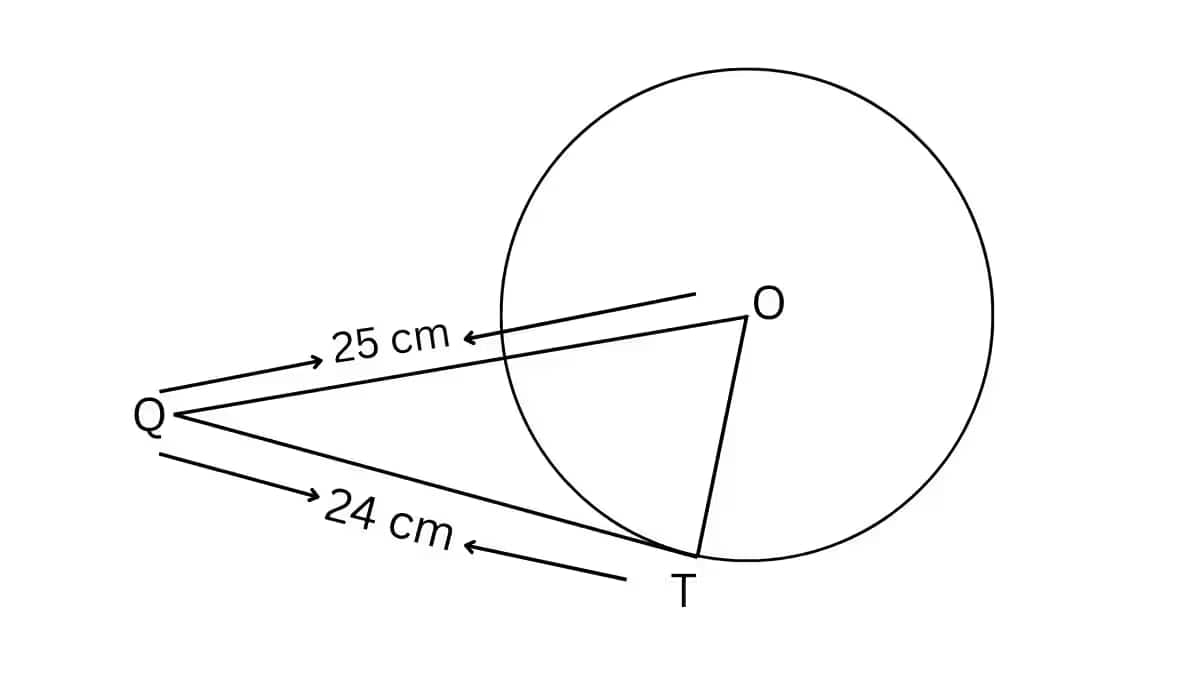
Given that,
The length of the tangent (QT) is 24 cm and the length of OQ is 25 cm.
Suppose the length of the radius OT be
We know that
OT = 7 cm
(A)
(B)
(C)
(D)
Answer:
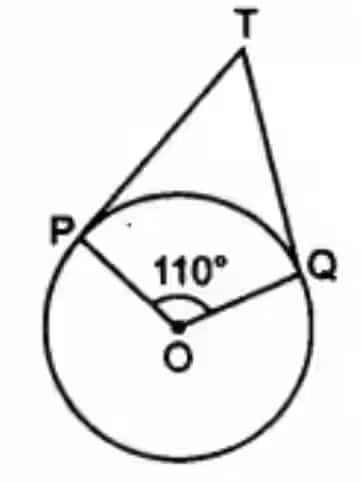
The correct option is (b)
In figure,
Since POQT is quadrilateral. Therefore, the sum of the opposite angles is
(A) 50°
(B) 60°
(C) 70°
(D) 80°
Answer:
The correct option is (A)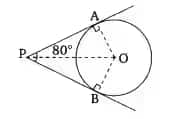

It is given that, tangents PA and PB from point P are inclined at
In triangle
OA =OB (radii of the circle)
PA = PB (tangents of the circle)
Therefore, by SAS congruence
By CPCT,
Now,
In
=
Q4 Prove that the tangents drawn at the ends of a diameter of a circle are parallel.
Answer: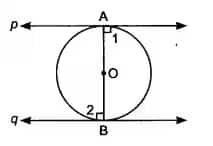
Let line
OA and OB are perpendicular to the tangents
Therefore,
Answer:
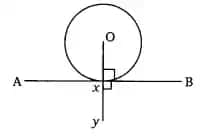
In the above figure, the line AXB is the tangent to a circle with centre O. Here, OX is the perpendicular to the tangent AXB (
Therefore, we have,
Answer:
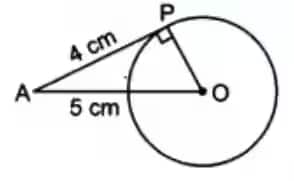
Given that,
The length of the tangent from the point A (AP) is 4 cm, and the length of OA is 5 cm.
Since
Therefore,
Answer:
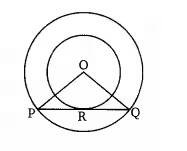
In the above figure, PQ is the chord to the larger circle, which is also tangent to a smaller circle at the point of contact R.
We have,
Radius of the larger circle OP = OQ = 5 cm
Radius of the small circle (OR) = 3 cm
OR
According to the question,
In
OR = OR {common}
OP = OQ {both radii}
By RHS congruence
So, by CPCT
PR = RQ
Now, In
By using Pythagoras' theorem,
PR = 4 cm
Hence, PQ = 2.PR = 8 cm
.jpg)
Answer:
To prove- AB + CD = AD + BC
Proof-
We have,
Since the lengths of the tangents drawn from an external point to a circle are equal
AP =AS .......(I)
BP = BQ.........(ii)
AS = AP...........(iii)
CR = CQ ...........(iv)
By adding all the equations, we get;
Hence proved.
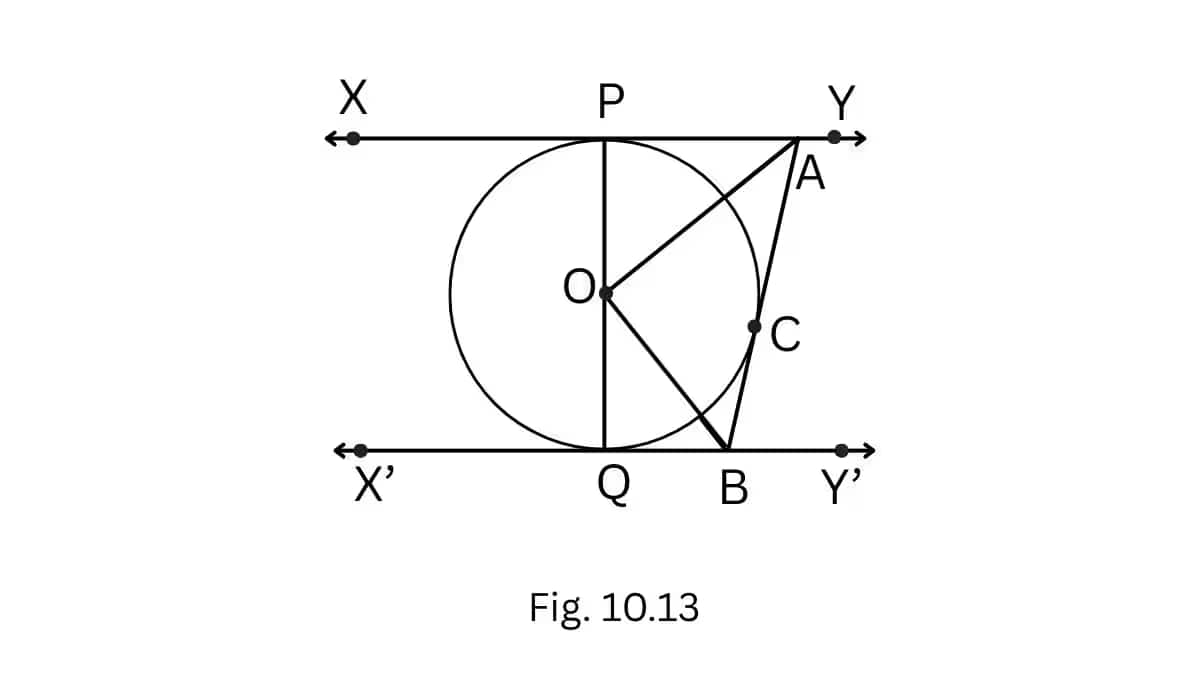
Answer:
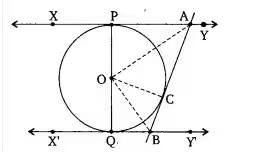
To prove-
Proof-
In
OA =OA [Common]
OP = OC [Both radii]
AP =AC [tangents from external point A]
Therefore by SSS congruence,
And by CPCT,
Similarly, from
Adding equations (1) and (2)
2(
(
Now, in
The sum of the interior angles is 1800.
So,
Hence proved.
Answer:
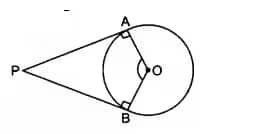
To prove -
Proof-
We have PA and PB are two tangents, and B and A are the points of contact of the tangents to a circle. And
According to the question,
In quadrilateral PAOB,
Hence proved.
Q11 Prove that the parallelogram circumscribing a circle is a rhombus.
Answer: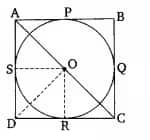
To prove - the parallelogram circumscribing a circle is a rhombus
Proof-
ABCD is a parallelogram that circumscribes a circle with centre O.
P, Q, R, and S are the points of contact on sides AB, BC, CD, and DA, respectively
AB = CD .and AD = BC...........(i)
It is known that tangents drawn from an external point are equal in length.
RD = DS ...........(ii)
RC = QC...........(iii)
BP = BQ...........(iv)
AP = AS .............(v)
By adding eq (ii) to eq (v) we get;
(RD + RC) + (BP + AP) = (DS + AS) + (BQ + QC)
CD + AB = AD + BC
Now, AB = AD and AB = CD
Hence, ABCD is a rhombus.
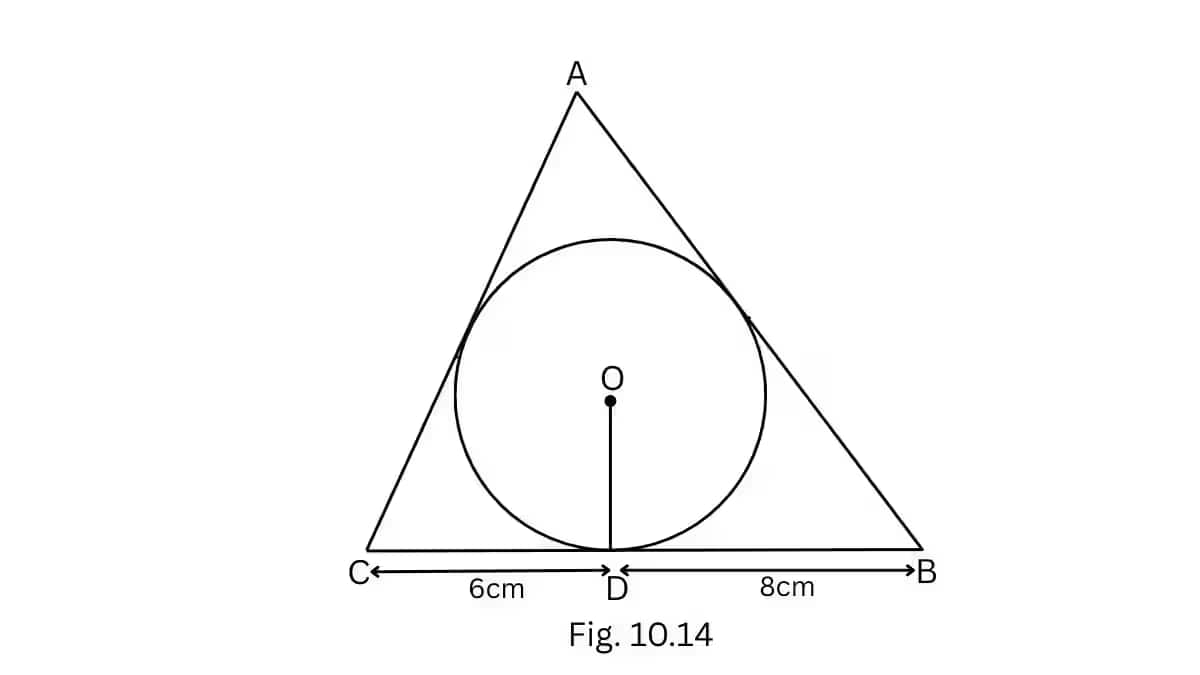
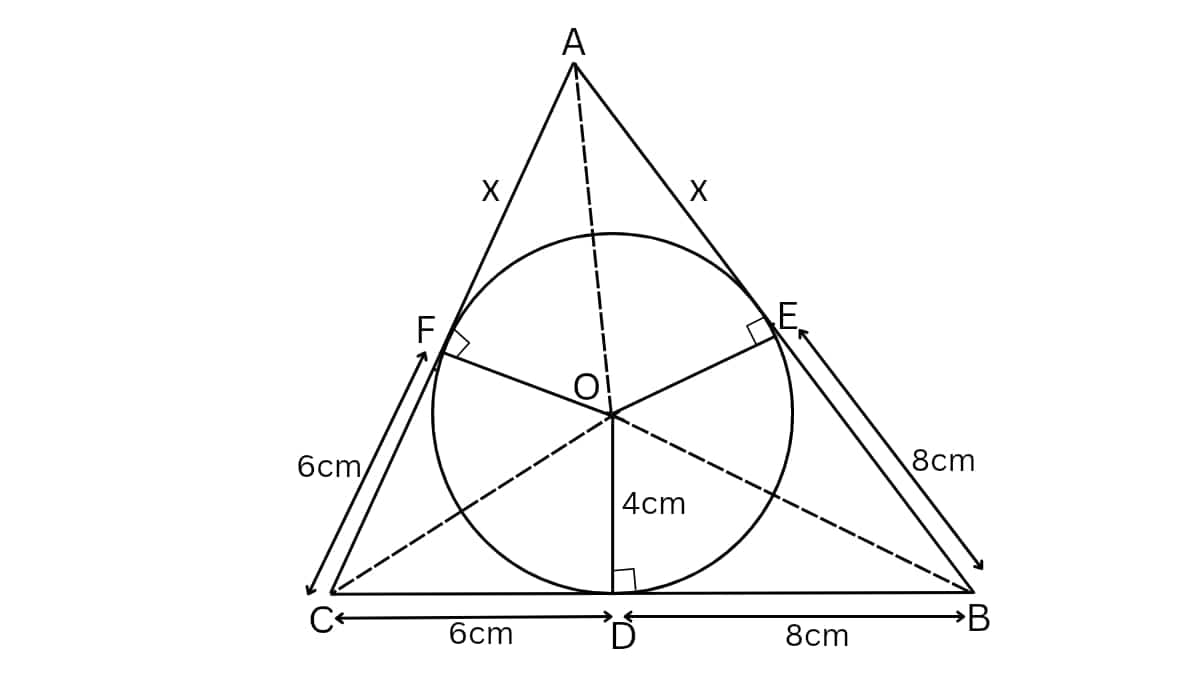
Consider the above figure. Assume centre O touches the sides AB and AC of the triangle at points E and F, respectively.
Let the length of AE is x.
Now in
Now, AB = AE + EB
Now,
Area of triangle
Now the area of
Area of
Area of
Now, Area of the
On squaring both sides, we get
Therefore,
Answer- AB = 15 and AC = 13
Answer: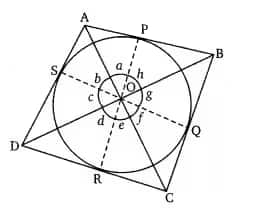
Given- ABCD is a quadrilateral circumscribing a circle. P, Q, R, and S are the points of contact on sides AB, BC, CD, and DA,
respectively.
To prove-
Proof -
Join OP, OQ, OR and OS
In triangle
OD =OD [common]
OS = OR [radii of same circle]
DR = DS [length of tangents drawn from an external point is equal ]
By SSS congruency,
and by CPCT,
Similarily,
SImilarily,
Hence proved.
Also Read
Confused between CGPA and Percentage?
Get your results instantly with our calculator!
💡 Conversion Formula used is: CGPA = Percentage / 9.5
Topics covered in Chapter 10.2 Circles: Exercise 10.2
This exercise contains basic questions to represent the problems of finding radii using the distance formula and Pythagoras' Theorem. End Questions of Class 10 Maths chapter 10 exercise 10.2 belongs to finding the distance between two tangents and the relation of line and circle. In the NCERT syllabus, Class 10 Maths chapter 10 exercise 10.2 also covers problems of co-centric circles and numerical problems related to chords and centres, and circumscribing a circle.
- Tangent to a Circle: Tangent is a line segment that touches or intersects the circle at only one point.
- Secant of a Circle: A secant is a line that intersects a circle at two distinct points.
- Chord of a Circle: A chord is a line segment whose endpoints are on the circumference of the circle.
- Point of Contact: A point where a tangent touches a circle is called the point of contact.
- Theorem: The length of the line segments of tangents drawn from an external point to a circle is equal.
- Number of Tangents: Some facts about the number of tangents are as follows -
- From a point inside the circle, no tangent can be drawn.
- From a point on the circle, one tangent can be drawn.
- From a point outside the circle, two tangents can be drawn.
Also see-
NCERT Solutions Subject Wise
Students must check the NCERT solutions for Class 10 Maths and Science given below:
Subject-Wise NCERT Exemplar Solutions
Students must check the NCERT exemplar solutions for Class 10 Maths and Science given below:
Frequently Asked Questions (FAQs)
Q: Define Circle?
A:
A curved line whose ends meet and all points on the line are at the same distance from the centre or a path that revolves around a central point or a group of items arranged is called a circle.
Q: What is the shortest distance between two parallel tangents of circle?
A:
The shortest distance between two parallel tangents of the circle is Diameter i.e. twice the radius of given circle
Q: From how many points a circle can be formed?
A:
a circle can be formed by three points but the condition is the points must be non-collinear non-parallel.
Q: What is the sum of Interior angles of a Quadrilateral ?
A:
The sum of interior angles of a quadrilateral is 360 degrees.
Q: What is the name of the polynomial with degree 3?
A:
The degree 3 polynomial is referred to as Cubic polynomials is a type of polynomial in which there are
Q: What is SSS Congruence in circle?
A:
If in a circle if two tangents are parallel and another tangent from parallel tangent one cuts parallel tangent 2 forming two triangles. If these triangles have three sides in common then these triangles are equal by sss congruence.
Q: What does the line intersecting circle at two points is called?
A:
The line intersecting circle at two points is called a Secant
Articles
Related Stories
|
Upcoming School Exams

Certifications By Top Providers
Explore Top Universities Across Globe
Questions related to CBSE Class 10th
On Question asked by student community
Have a question related to CBSE Class 10th ?
Hello student!
You can refer to the CBSE Class 10 Mathematics Question Paper 2026 to practise questions and prepare for the Mathematics examination.
https://school.careers360.com/boards/cbse/cbse-class-10-maths-question-paper-2026
Hope it helps!
Hi Smriti Lama
The CBSE Class 10 Board Exam 2026-27 question paper pattern includes the latest exam structure, subject-wise marking scheme and question types. You can check the detailed pattern on Careers360:
Hi Somshiv Rath
If you mean a CBSE Class 8 Science question paper, Careers360 has a sample paper section where you can check the available Class 8 papers.
https://learn.careers360.com/school/cbse-8-class-preparation-material/
Hey there,
If you mean CBSE Class 10 rechecking/re-evaluation results 2026, CBSE has already completed the main post-result process for 2026. The Class X second-board results were declared on 18 July 2026, and CBSE has also issued the post-result facilities notice.
For verification/re-evaluation, CBSE says the result/status is uploaded online
Please mention important details like your school board, exam, and class to get the exact papers.
You can explore the useful resources here:
Popular CBSE Class 10th Questions
A block of mass 0.50 kg is moving with a speed of 2.00 ms-1 on a smooth surface. It strikes another mass of 1.00 kg and then they move together as a single body. The energy loss during the collision is
| Option 1)
|
Option 2)
|
| Option 3)
|
Option 4)
|
An athlete in the olympic games covers a distance of 100 m in 10 s. His kinetic energy can be estimated to be in the range
| Option 1)
|
Option 2)
|
| Option 3)
|
Option 4)
|
A particle is projected at 600 to the horizontal with a kinetic energy . The kinetic energy at the highest point
| Option 1)
|
Option 2)
|
| Option 3)
|
Option 4)
|
In the reaction,
| Option 1)
|
Option 2)
|
| Option 3)
|
Option 4)
|
How many moles of magnesium phosphate, will contain 0.25 mole of oxygen atoms?
| Option 1)
0.02 |
Option 2)
3.125 × 10⁻² |
| Option 3)
1.25 × 10⁻² |
Option 4)
2.5 × 10⁻² |
Colleges After 12th

Applications for Admissions are open.
Get Job Ready in Healthcare | Employability-Focused Programs
CBSE Class 10th Notifications
Never miss CBSE Class 10th update
Get timely CBSE Class 10th updates directly to your inbox. Stay informed!