


NCERT Solutions for Class 9 Maths Chapter 7 Exercise 7.2 - Triangles
The exercise uses fundamental geometry principles to explore important characteristics of isosceles triangles. The tasks demand to validate statements regarding angle bisectors as well as altitudes and side lengths by using congruence rules including SAS, ASA and RHS. The problems enables to develop a stronger knowledge of triangle congruence alongside its features. All diagrams in the textbook along with their explanatory text assist us to understand how congruent parts function, reinforcing important geometric patterns and reasoning.
This Story also Contains
- NCERT Solutions for Class 9 Maths Chapter 7 – Triangles Exercise 7.2
- Access Solution of Triangles Class 9 Chapter 7 Exercise: 7.2
- Topics Covered in Chapter 7 Triangles: Exercise 7.2
- NCERT Solutions of Class 10 Subject Wise
- Subject Wise NCERT Exemplar Solutions

Students must establish equality between line segments or angles when they apply necessary conditions using logical reasoning and axioms. The practice problems serve multiple goals because they develop proficiency in proof writing while students learn advanced geometry connections. Regular use of NCERT Solutions for reinforcement purposes supports students in learning triangle concepts while NCERT Books provide complete understanding through practice.
Access Solution of Triangles Class 9 Chapter 7 Exercise: 7.2
Answer:
Given, AB = AC, and ABC is an isosceles triangle.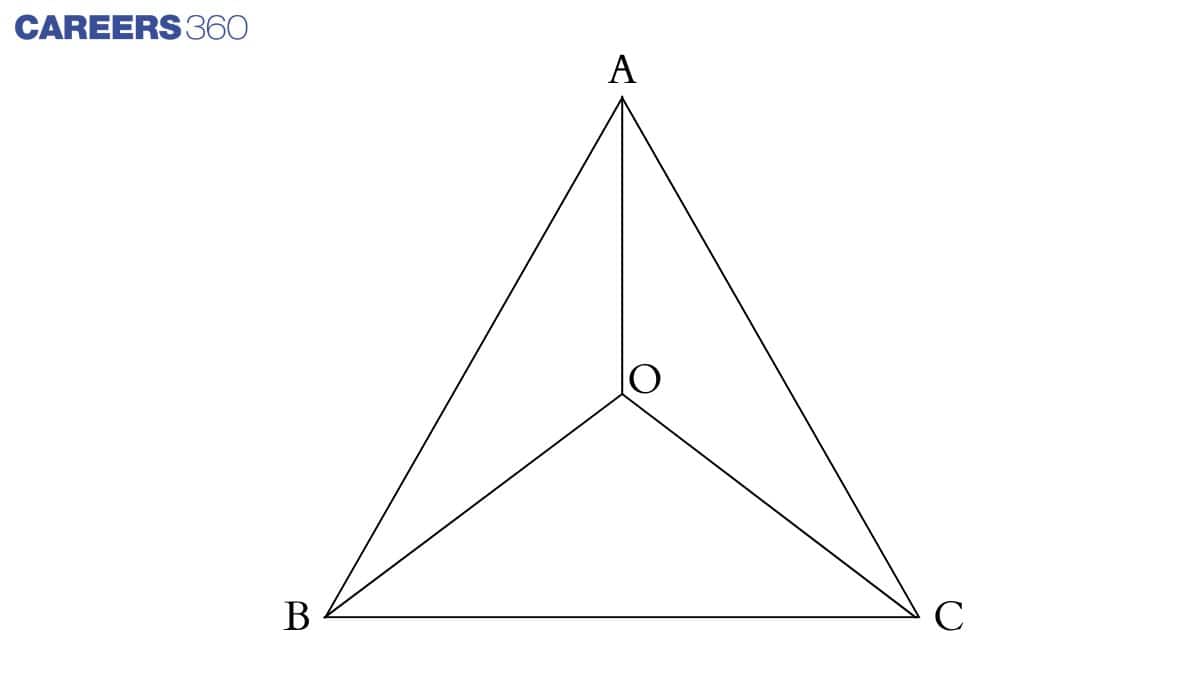
Therefore, it means ∠B=∠C
or 12∠B = 12∠C
Thus, ∠OBC = ∠OCB (Angles bisectors are equal)
Hence, OB=OC as sides opposite to equal are angles are also equal.
Answer:
Consider ΔAOB and ΔAOC ,
(i) AB = AC (Given)
(ii) AO = AO (Common in both the triangles)
(iii) OB = OC (Proved in previous part)
Therefore by SSS congruence rule, we can conclude that :
ΔAOB ≅ ΔAOC
Now, by c.p.c.t.,
∠BAO = ∠CAO
Hence AO bisects ∠A .
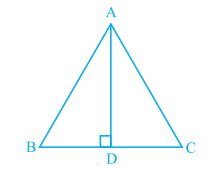
Answer:
Given: AD is perpendicular bisector of BC.
To Prove: AB = AC
Proof: Consider Δ ABD and Δ ADC,
(i) AD = AD (Common in both the triangles)
(ii) ∠ADB = ∠ADC (Right angle)
(iii) BD = CD ( as AD is perpendicular to side BC)
Therefore, by SAS congruence criteria:
ΔADB ≅ ΔADC
Thus, AB = AC ( by c.p.c.t )
Hence Proved
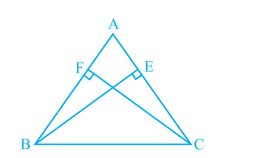
Answer:
Given: AC = AB and BE and CF are altitudes.
To Prove: BE = CF
Proof: Consider ΔAEB and ΔAFC ,
(i) ∠A is common in both the triangles.
(ii) ∠AEB = ∠AFC (Right angles)
(iii) AB = AC (Given)
Thus by AAS congruence axiom, we can conclude that :
ΔAEB ≅ΔAFC
Now, by c.p.c.t. we can say : BE = CF
Hence Proved
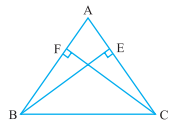
Answer:
Given: BE = CF
Consider ΔABE and ΔACF ,
(i) ∠A is common in both the triangles.
(ii) ∠AEB = ∠AFC (Right angles)
(iii) BE = CF (Given)
Thus by AAS congruence, we can say that :
ΔABE≅ΔACF
Hence Proved
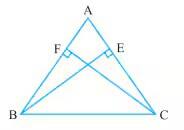
Answer:
From the prevoius part of the question we found out that : ΔABE ≅ΔACF
Now, by c.p.c.t. we can say that : AB = AC
Thus, Δ ABC is an isosceles triangle.
Hence Proved
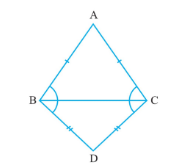
Q5 ABC and DBC are two isosceles triangles on the same base BC (see Fig.). Show that ∠ABD =∠ACD.
Answer:
Given: ABC and DBC are isosceles triangles and
To Prove: ∠ABD =∠ACD
Proof: Consider ΔABD and ΔACD,
(i) AD = AD (Common in both the triangles)
(ii) AB = AC (Sides of isosceles triangle)
(iii) BD = CD (Sides of isosceles triangle)
Thus by SSS congruency, we can conclude that:
△ABD ≅ triangleACD
Therefore, by c.p.c.t.,
∠ABD =∠ACD
Hence Proved
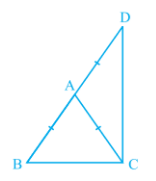
Answer:
Given: AB = AC and AD = AB
To Prove: ∠BCD is a right angle
Proof: Consider Δ ABC,
It is given that AB = AC
So, ∠ACB=∠ABC (Since angles opposite to the equal sides are equal.)
Similarly in Δ ACD, AD = AB and ∠ADC=∠ACD
So,
∠CAB+∠ACB+∠ABC=180∘
∠CAB + 2∠ACB=180∘
or ∠CAB =180∘ − 2∠ACB ...........................(i)
And in Δ ADC,
∠CAD =180∘ − 2∠ACD ..............................(ii)
Adding (i) and (ii), we get :
∠CAB + ∠CAD =360∘ − 2∠ACD − 2∠ACB
or 180∘ =360∘ − 2∠ACD − 2∠ACB
and ∠BCD = 90∘
Hence Proved
Q7 ABC is a right angled triangle in which ∠A=90∘ and AB=AC . Find ∠B and ∠C .
Answer:
Given: AB = AC and ∠A=90∘
We know that angles opposite to equal sides are also equal.
Therefore, ∠B = ∠C
Also, the sum of the interior angles of a triangle is 180∘ .
So, we have :
∠A + ∠B + ∠C = 180∘
or 90∘+ 2∠B = 180∘
or ∠B = 45∘
As, ∠B = ∠C
So, angleC =\ 45^{\circ}$
Q8 Show that the angles of an equilateral triangle are 60∘ each.
Answer:
Consider a triangle ABC which has all sides equal as shown in the figure.
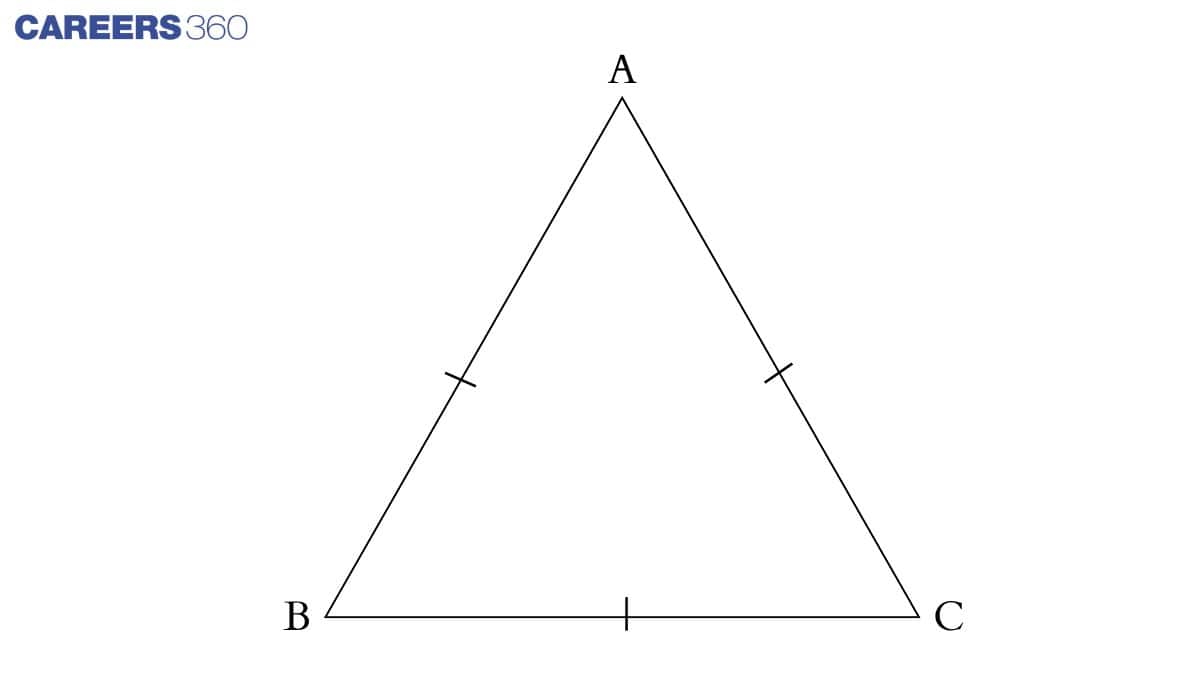
We know that angles opposite to equal sides are equal.
Therefore: ∠A = ∠B = ∠C
Also, the sum of the interior angles of a triangle is 180∘ .
Hence, ∠A + ∠B + ∠C = 180∘
or 3∠A = 180∘
or ∠A = 60∘
As, all the angles of the equilateral triangle are equal, thus ∠A = ∠B = ∠C = 60∘.
Also Read:
Confused between CGPA and Percentage?
Get your results instantly with our calculator!
Topics Covered in Chapter 7 Triangles: Exercise 7.2
- Congruence of triangles: Congruence refers to the exact matching of size and shape between two triangles. It allows us to prove that corresponding sides and angles are equal using specific rules.
- Properties of isosceles triangles: They exhibit two identical sides along with two congruent base angles. Geometric solutions and congruence proofs depend heavily on these characteristics of the isosceles triangle.
- Use of perpendicular bisectors, angle bisectors, and altitudes: Triangles can be divided into equal or right-angled pieces with the use of these line segments. They are helpful in establishing congruent pieces and building evidence.
- Application of RHS, SSS, and ASA congruence criteria: These rules—Side-Side-Side (SSS), Angle-Side-Angle (ASA), and Right Angle-Hypotenuse-Side (RHS)—are used to demonstrate that two triangles are congruent given the measurements.
Also, See
NCERT Solutions of Class 10 Subject Wise
Subject Wise NCERT Exemplar Solutions
Frequently Asked Questions (FAQs)
Yes, every equilateral triangle is an isosceles triangle, but every isosceles triangle is not an equilateral triangle.
The angle bisector of the vertex angle divides the base into 1:1 ratio which means into two equal parts i.e., it passes through the midpoint of the base.
An isosceles triangle is one with two equal sides. It has two equal angles as well.
An isosceles triangle has two sides and two angles equal to each other.

Popular Questions
A block of mass 0.50 kg is moving with a speed of 2.00 ms-1 on a smooth surface. It strikes another mass of 1.00 kg and then they move together as a single body. The energy loss during the collision is
| Option 1)
|
Option 2)
|
| Option 3)
|
Option 4)
|
An athlete in the olympic games covers a distance of 100 m in 10 s. His kinetic energy can be estimated to be in the range
| Option 1)
|
Option 2)
|
| Option 3)
|
Option 4)
|
A particle is projected at 600 to the horizontal with a kinetic energy . The kinetic energy at the highest point
| Option 1)
|
Option 2)
|
| Option 3)
|
Option 4)
|
In the reaction,
| Option 1)
|
Option 2)
|
| Option 3)
|
Option 4)
|
How many moles of magnesium phosphate, will contain 0.25 mole of oxygen atoms?
| Option 1)
0.02 |
Option 2)
3.125 × 10⁻² |
| Option 3)
1.25 × 10⁻² |
Option 4)
2.5 × 10⁻² |