KCC Institute of Legal and Higher Education, Greater Noida
Law Admissions 2026 Open | Avail Merit-Based Scholarships


Parallel lines are lines that are equidistant from each other. Parallel lines never intersect or meet each other at any point. A transversal line intersects two or more lines at distinct points. As shown in the figure, line l crosses lines m and n at P and Q, respectively. Line l is thus a transversal for lines m and n.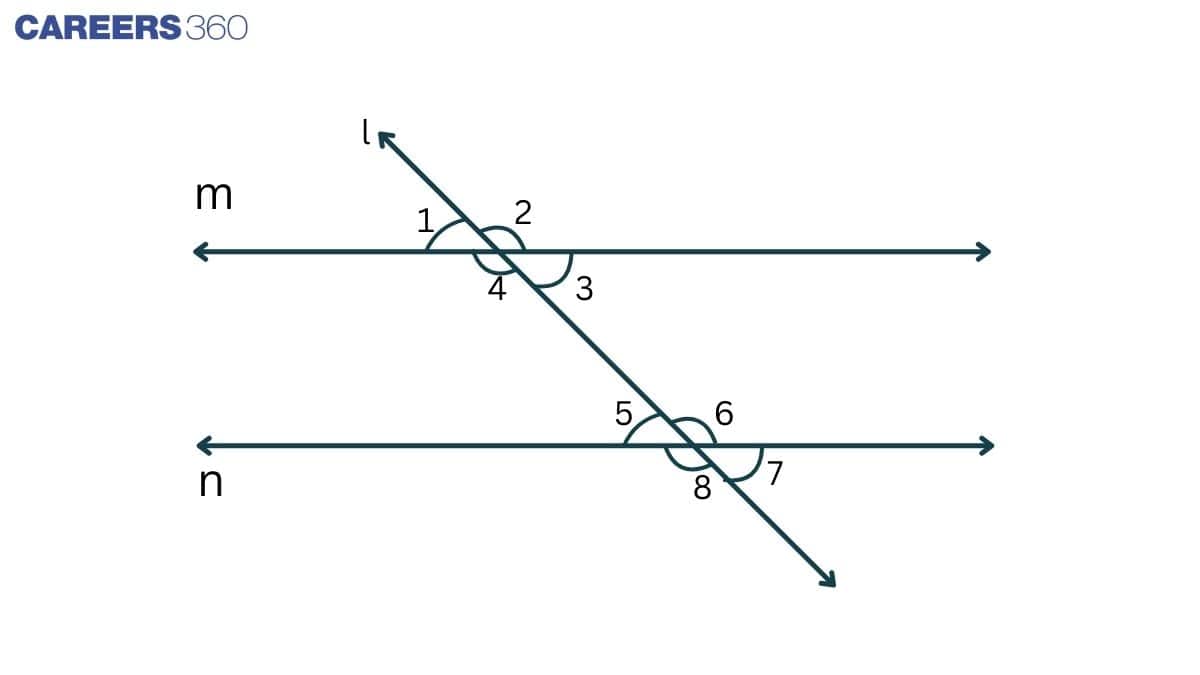
This Story also Contains
In this figure,
Consecutive interior angles, also known as associated angles or co-interior angles, are interior angles on the same side of the transversal. The corresponding angles are identical when a transversal connects two parallel lines. The two lines are parallel if a transversal intersects them so that a pair of corresponding angles are equal.
NCERT Solutions Class 9 Maths exercise 6.2 – this exercise includes some very important theorems from the examination point of view. So, the theorems and their proof given in the NCERT Books are:
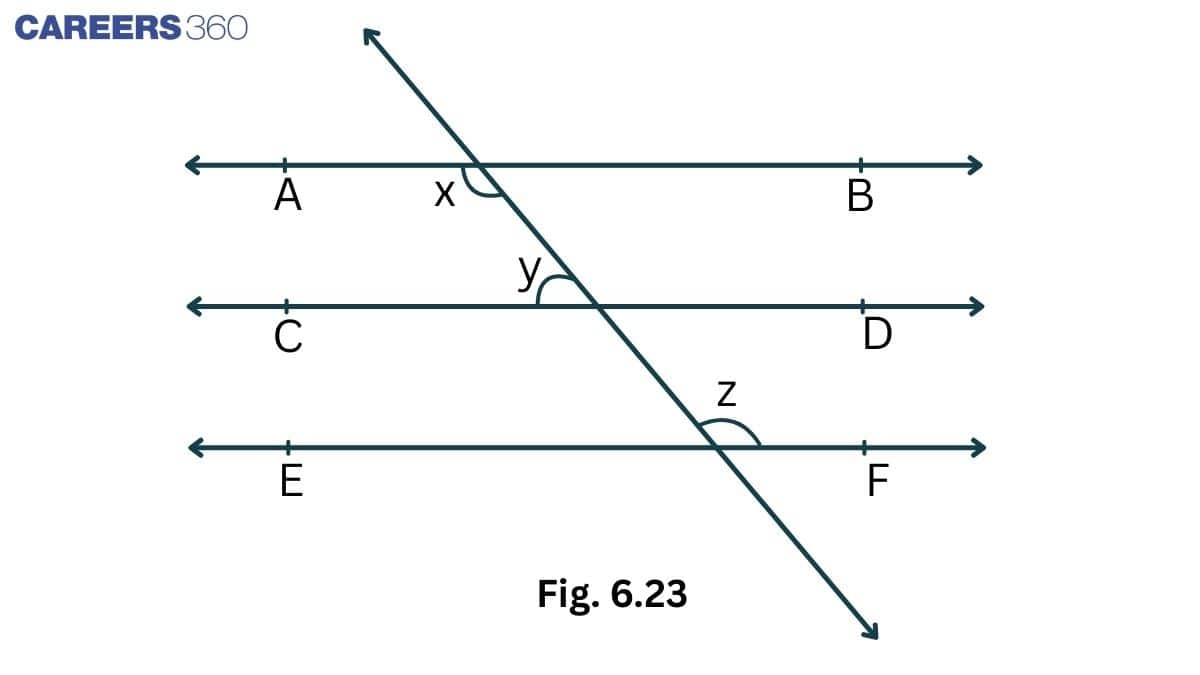
Q1. In Fig. 6.23, if AB $||$ CD, CD $||$ EF and y : z = 3 : 7 , find x .
Solution:
Given that,
AB || CD and CD || EF and $y:z = 3:7 \Rightarrow z = \frac{7}{3}y$
Therefore, AB || EF and $x =z$ (Alternate interior angles)..............(i)
Again, CD || AB
As the angles on the same side of a transversal sum is 180°
$\\\Rightarrow x+y =180^0$
$\\ \Rightarrow z+y =180^0$ .............(ii)
Putting the value of $z$ in equation (ii), we get
$\frac{10}{3}y =180^0 $
$\Rightarrow y =54^0$
Then $z=180^0-54^0=126^0$
By equation (i), we get the value of $x=126^0$
Solution: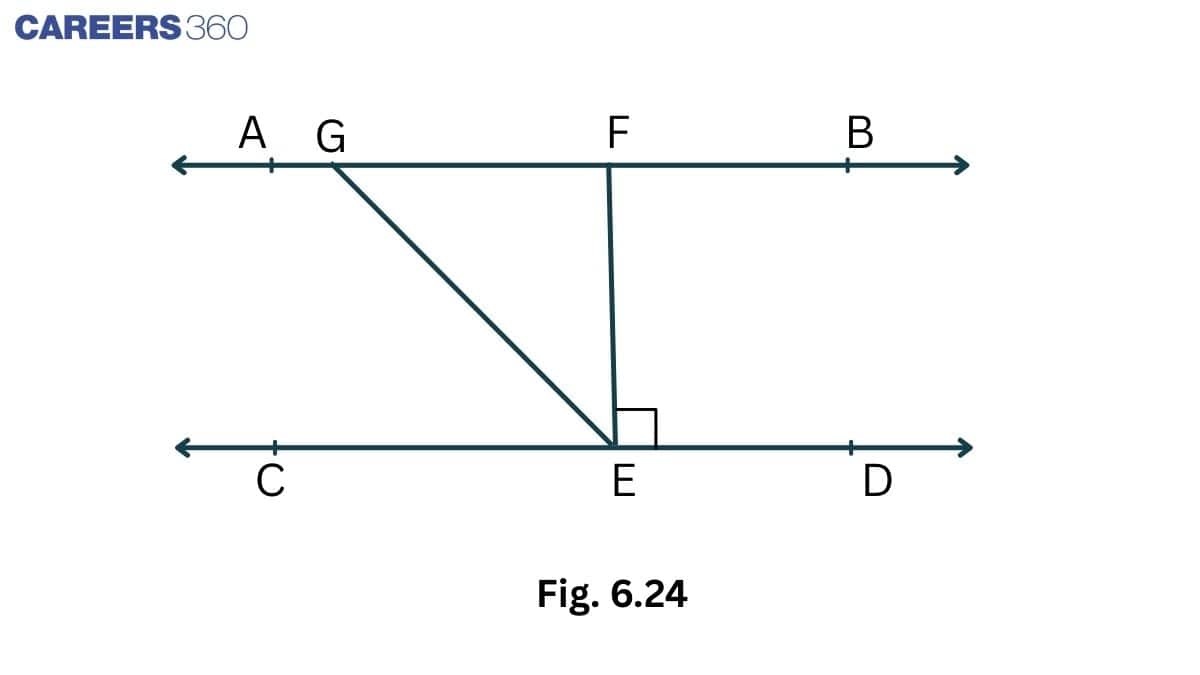
Given,
AB || CD, EF $\perp$ CD and $\angle$ GED = $126^0$
In the above figure,
GE is transversal. So, that $\angle$ AGE = $\angle$ GED = $126^0$ [Alternate interior angles]
Also, $\angle$ GEF = $\angle$ GED - $\angle$ FED
$\angle$ GEF = $126^0-90^0 = 36^0$
$\angle GEF = 36^0$
Since AB is a straight line
Therefore, $\angle$ AGE + $\angle$ FGE = $180^0$
So, $\angle$ FGE = $180^0-\angle AGE
$\angle$ FGE = 180^0 - 126^0$
$\Rightarrow \angle FGE =54^0$
Solution:
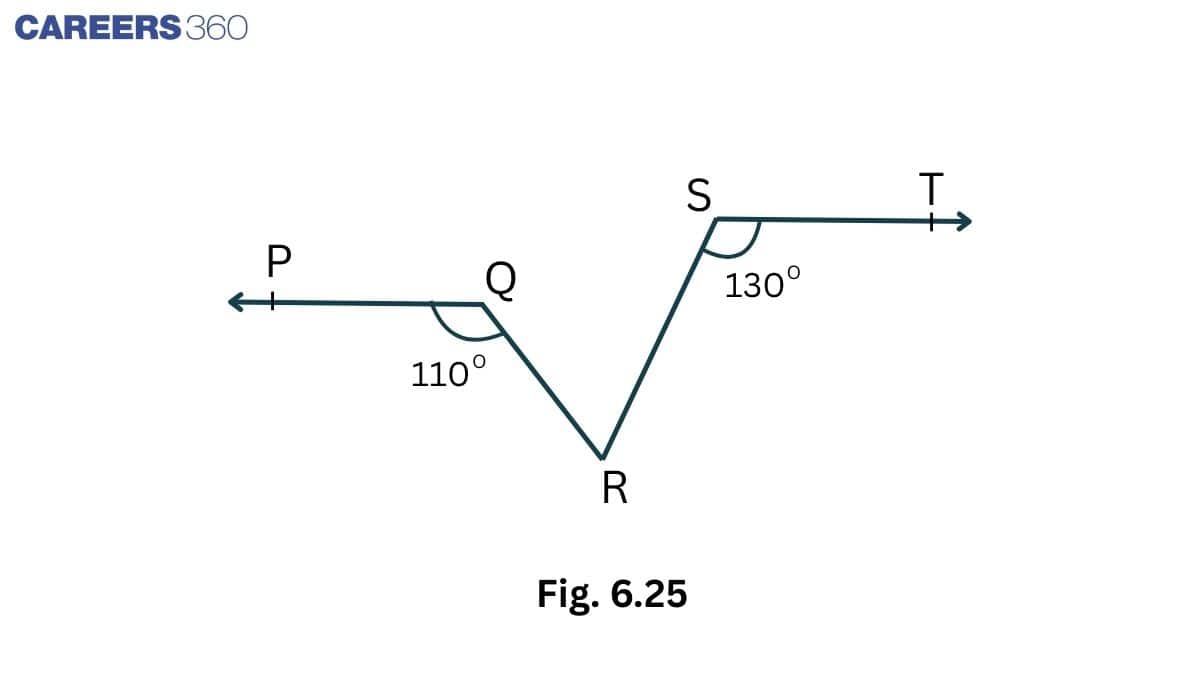
Draw a line EF parallel to the ST through R.
Since PQ || ST and ST || EF
$\Rightarrow$ EF || PQ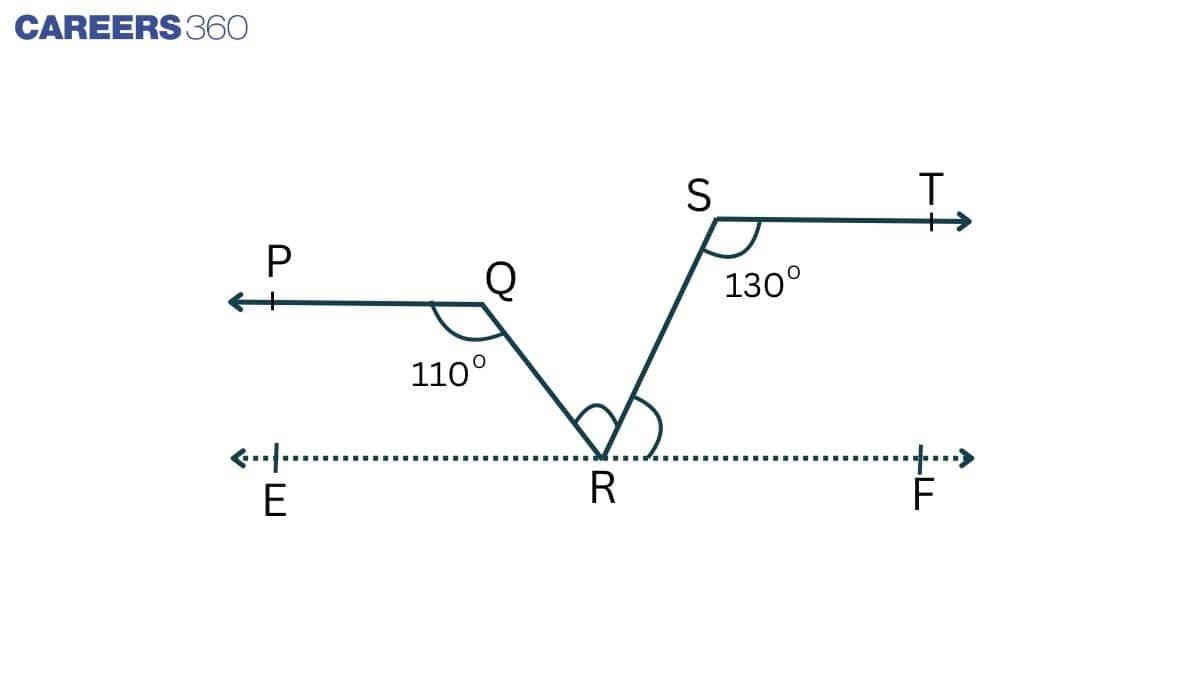
$\angle$ PQR = $\angle$ QRF = $110^0$ (Alternate interior angles)$\angle$ QRF = $\angle$ QRS + $\angle$ SRF .............(i)
Again, $\angle$ RST + $\angle$ SRF = $180^0$ (Interior angles of two parallels ST and RF)
$\Rightarrow \angle SRF =180^0-130^0 = 50^0$ ( $\angle$ RST = $130^0$ , given)
Thus, $\angle$ QRS = $110^0-50^0 = 60^0$ (From equation (i))
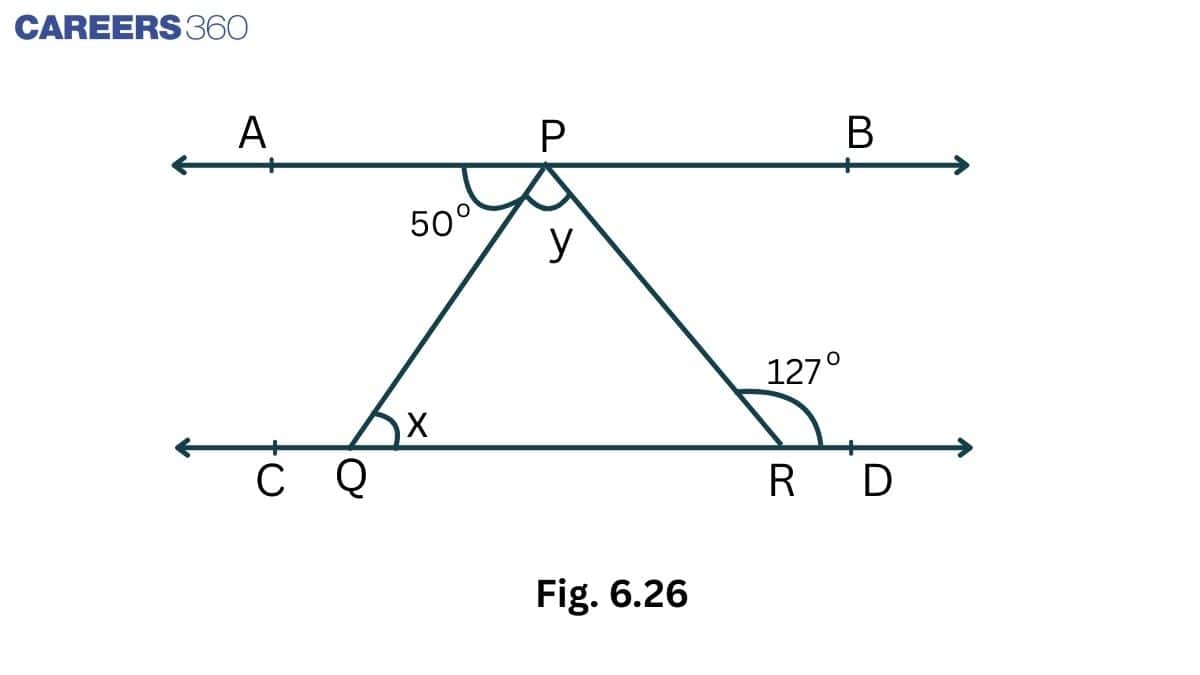
Q4. In Fig. 6.26, if AB $||$ CD, $\angle$ APQ = 50° and $\angle$ PRD = 127°, find x and y .
Solution:
Given,
AB || CD, $\angle$ APQ = $50^0$ and $\angle$ PRD = $127^0$
PQ is a transversal. So,
$\angle$ APQ = $\angle$ PQR= $50^0$ (Alternate interior angles)
$\therefore x = 50^0$
Again, PR is a transversal. So,
$\angle$ y + $50^0$ = $127^0$ (Alternate interior angles)
$\Rightarrow y = 77^0$
Solution:
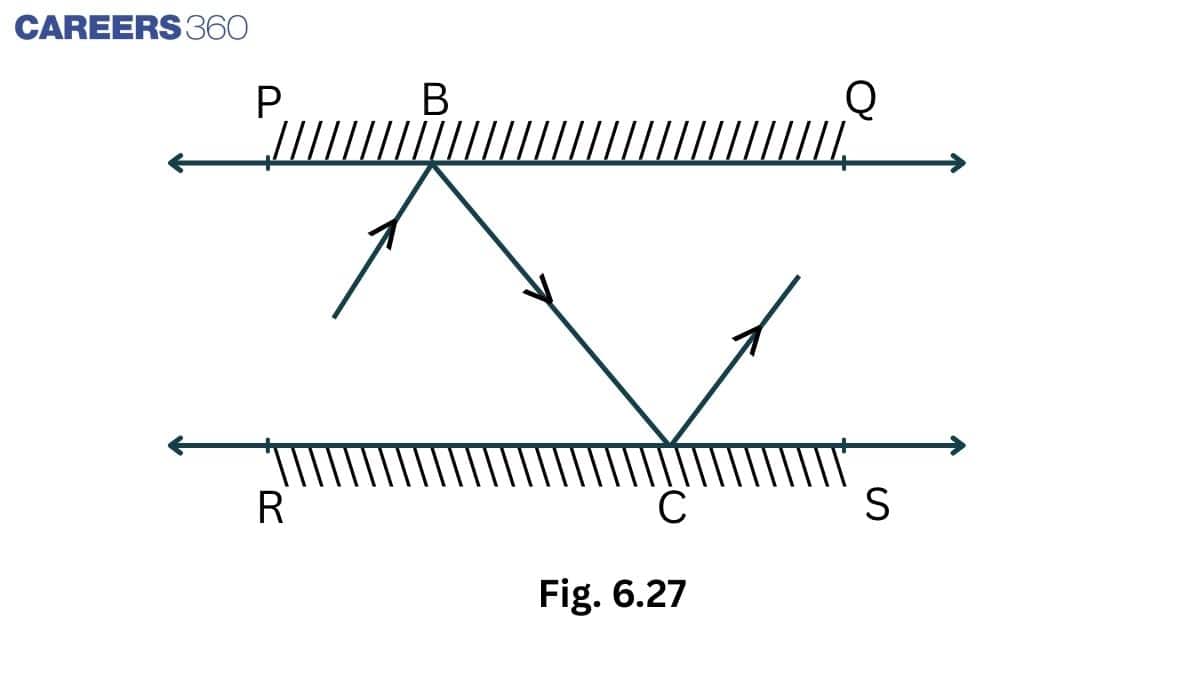
Draw a ray BL $\perp$ PQ and CM $\perp$ RSSince PQ || RS (Given)
So, BL || CM and BC is a transversal
$\therefore$ $\angle$ LBC = $\angle$ MCB (Alternate interior angles).............(i)
It is known that, angle of incidence = the angle of reflection
So, $\angle$ ABL = $\angle$ LBC and $\angle$ MCB = $\angle$ MCD
$\Rightarrow \angle ABL =\angle MCD$ ..................(ii)
Adding eq (i) and eq (ii), we get
$\angle$ ABC = $\angle$ DCB
Both the interior angles are equal
Hence AB || CD
Also Read
Lines and Angles Exercise 6.1
The following key concepts are covered in this exercise:
1. Corresponding angles - Angles that are on the same side and corresponding position of the traversal.
2. Alternate interior angles - Angles that are between two parallel lines and on opposite sides of the transversal.
3. Alternate exterior angles - Angles that are on the outside of the two parallel lines and opposite sides of the transversal.
4. Consecutive interior angles - Angles that are on the same side of the transversal and between the two parallel lines.
5. Lines parallel to the same line - If two lines are parallel to the same line, then these two lines are parallel to each other also.
Also See
Law Admissions 2026 Open | Avail Merit-Based Scholarships
BBA/MBA/PGDM Early Bird Applications Deadline 06th Nov'26. Apply now using coupon code CAREER250 and get ₹250 off the application fee
Get your results instantly with our calculator!
Students must check the NCERT solutions for Class 9 Maths and Science given below:
Students must check the NCERT exemplar solutions for Class 9 Maths and Science given below:
Frequently Asked Questions (FAQs)
This exercise is about Parallel Lines and a Transversal, types of angles like vertically opposite angles and axioms that are formed due to this intersection.
Parallel lines are coplanar straight lines that never intersect with each other at any point.
Consecutive angles are the angles formed by a transversal that intersects two parallel lines. Each angle forms a pair of consecutive angles which lies on each of the parallel lines on any one side of the transversal which can be either be interior or exterior.
Four angles are formed on each of the parallel lines. Thus, making the total sum eight.

A block of mass 0.50 kg is moving with a speed of 2.00 ms-1 on a smooth surface. It strikes another mass of 1.00 kg and then they move together as a single body. The energy loss during the collision is
| Option 1)
|
Option 2)
|
| Option 3)
|
Option 4)
|
An athlete in the olympic games covers a distance of 100 m in 10 s. His kinetic energy can be estimated to be in the range
| Option 1)
|
Option 2)
|
| Option 3)
|
Option 4)
|
A particle is projected at 600 to the horizontal with a kinetic energy . The kinetic energy at the highest point
| Option 1)
|
Option 2)
|
| Option 3)
|
Option 4)
|
In the reaction,
| Option 1)
|
Option 2)
|
| Option 3)
|
Option 4)
|
How many moles of magnesium phosphate, will contain 0.25 mole of oxygen atoms?
| Option 1)
0.02 |
Option 2)
3.125 × 10⁻² |
| Option 3)
1.25 × 10⁻² |
Option 4)
2.5 × 10⁻² |

Law Admissions 2026 Open | Avail Merit-Based Scholarships
BBA/MBA/PGDM Early Bird Applications Deadline 06th Nov'26. Apply now using coupon code CAREER250 and get ₹250 off the application fee
Ranked #36 amongst institutions in Management by NIRF | 100% Placement
Globally Recognized by AACSB (US) & AMBA (UK) | 18 LPA Avg. CTC for PGPM 2026
NEET PG All India & State College Predictor with Admission Process Guide
Top B-School: Ranked #9 in NIRF Management Rankings 2025.