


NCERT Solutions for Class 8 Maths Part 2 Chapter 6 - Algebra Play
One of the most high weightage chapters of mathematics is algebra. We already learned some things about algebra in previous classes as well as the class 8 part 1 book. According to the latest NCERT textbook, these NCERT Solutions for Class 8 Maths Part 2 Chapter 6 Algebra Play have introduced students to new concepts such as number pyramids, grids, and the Fibonacci sequence. Also, a very important concept, the divisibility rules, has also been discussed in this chapter. This latest NCERT textbook places greater emphasis on learning through visualisation, and in a fun way, so that students not only memorise them but also remember them for a long time.
This Story also Contains
- Class 8 Maths Part 2 Chapter 6 Solutions PDF Free Download - Ganita Prakash Book 2
- NCERT Solutions for Class 8 Maths Ganita Prakash Part 2 Chapter 6 Exercise Questions and Answers
- Key Concepts Explained in Algebra Play - Ganita Prakash Book 2
- Extra Questions for Class 8 Maths Part 2 Chapter 6 Algebra Play
- NCERT Solutions for Class 8 Maths Chapter Wise
- NCERT Books and NCERT Syllabus
- NCERT Solutions for Class 8 Maths Ganita Prakash Part 2 Chapter 6 - Chapter Summary
- NCERT Solutions for Class 8 Maths Part 2 Chapter 6 - Expert Review
These NCERT Solutions for class 8 are prepared by the experienced teachers at Careers360 keeping in mind the students' requirements. These NCERT Solutions are explained in detail in simple language and pictures are added wherever required for more visualisation. In this article, students can also access the PDF of solutions for offline study purposes.
Class 8 Maths Part 2 Chapter 6 Solutions PDF Free Download - Ganita Prakash Book 2
Students can download the NCERT Solutions for Class 8 Maths Part 2 Chapter 6 Algebra Play PDF by clicking the link provided below.
NCERT Solutions for Class 8 Maths Ganita Prakash Part 2 Chapter 6 Exercise Questions and Answers
Here are the NCERT Solutions for Class 8 Maths Part 2 Chapter 6 Algebra Play question answers with clear and detailed solutions.
Class 8 Maths Part 2 Chapter 6 Question Answers with Detailed Solutions
|
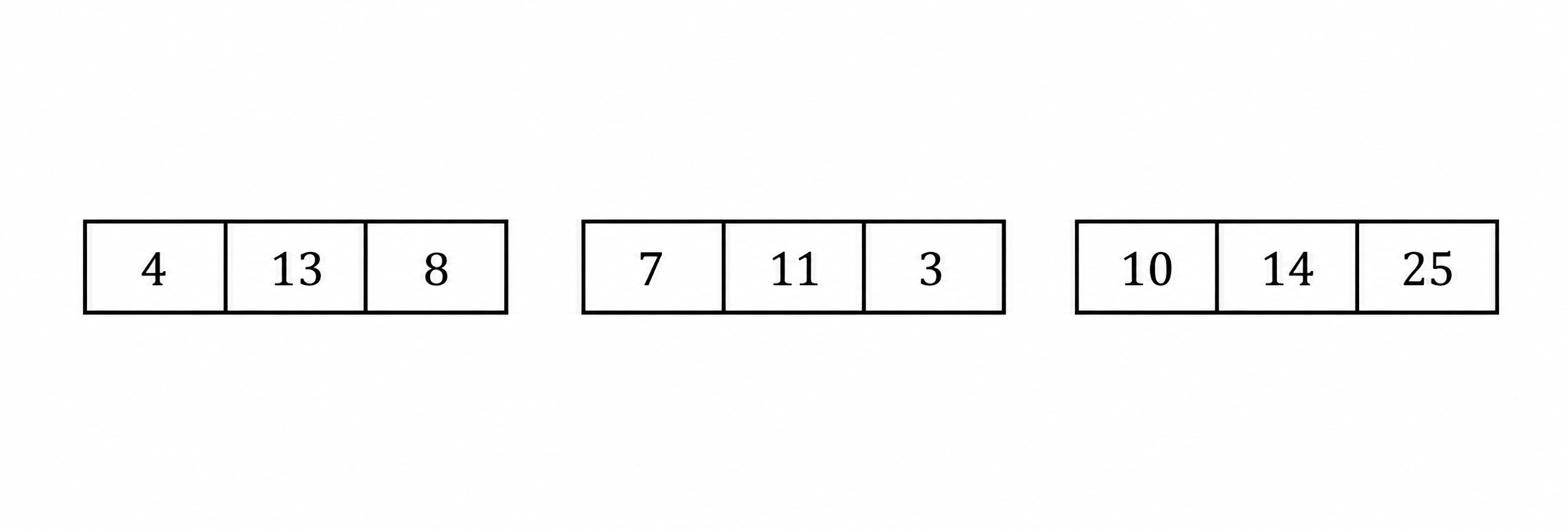
Question 1. Without building the entire pyramid, find the number in the topmost row given the bottom row in each of these cases.
$\textbf{Answer:}$
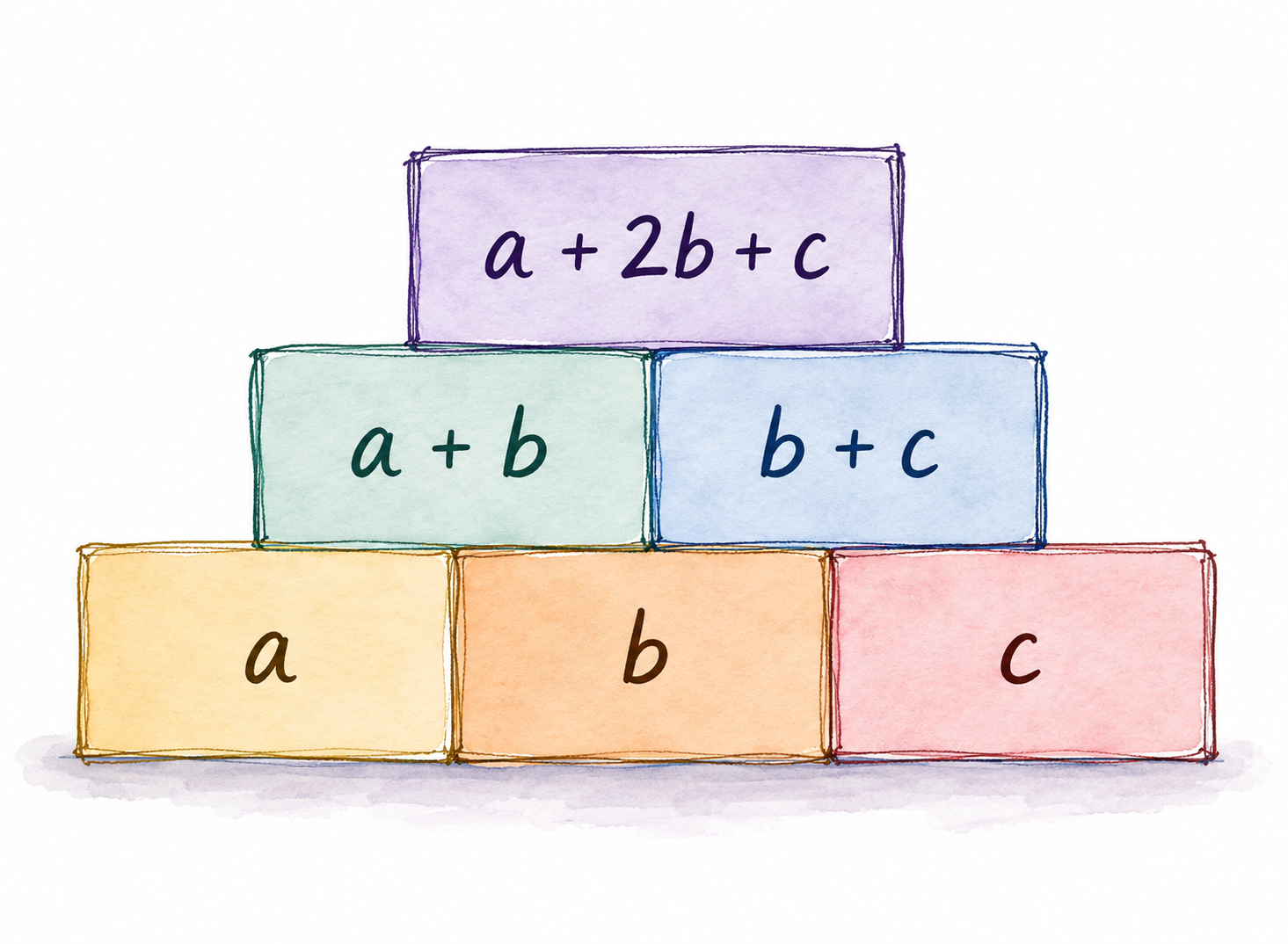
We know that, in a number pyramid, each number is the sum of the two numbers directly below it.
So the structure of the number pyramid is as follows.
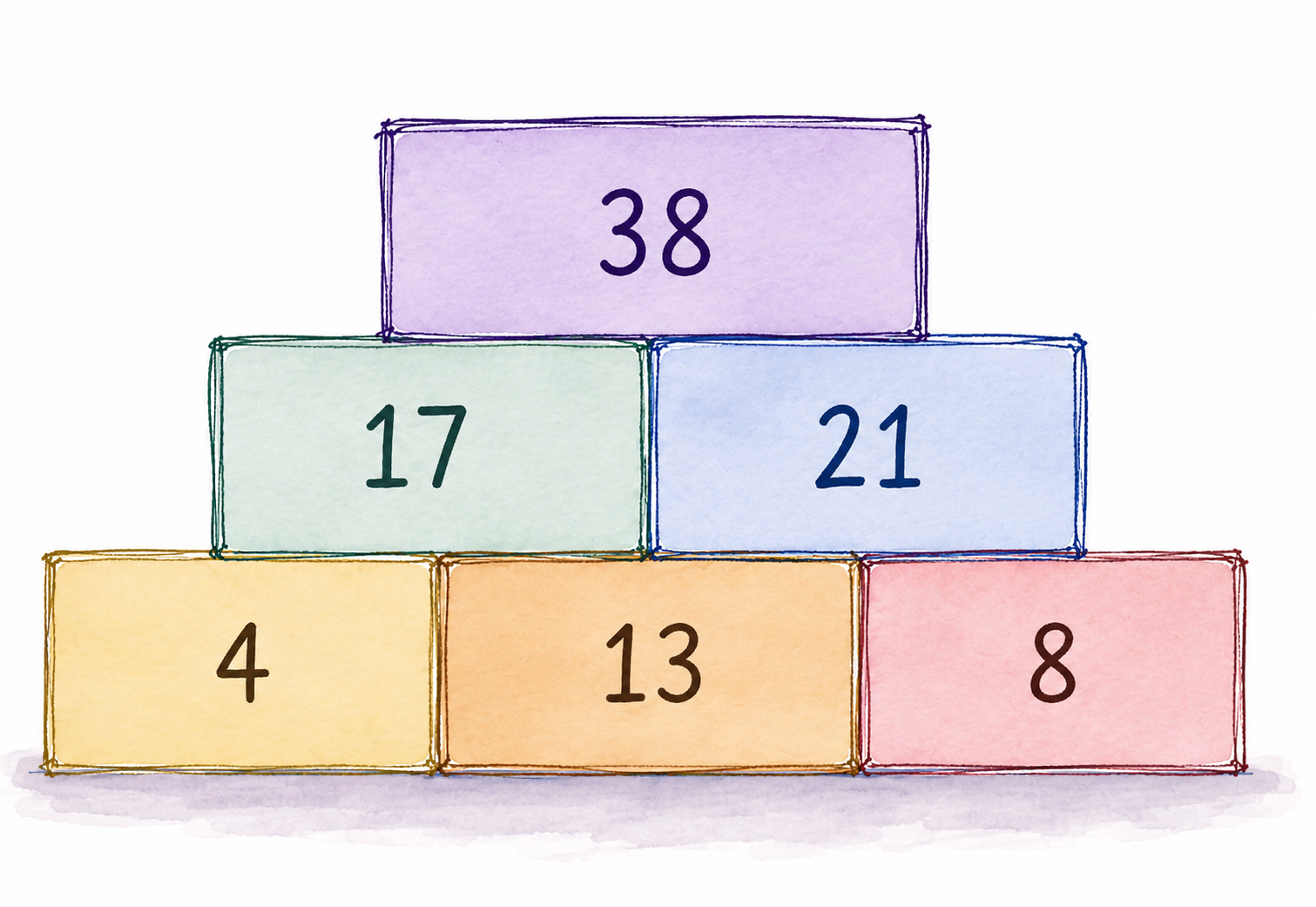
1 (i): 38
$\textbf{Explanation:}$
Bottom row =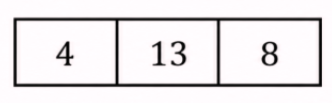
So, let a = 4, b = 13, and c = 8
Hence, the top most row = a + 2b + c = 4 + (13 × 2) + 8 = 38
The full number pyramid will look like the following.
1(ii): 32
$\textbf{Explanation:}$
Bottom row = 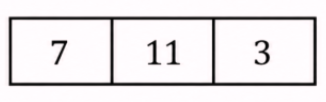
So, let a = 7, b = 11, and c = 3
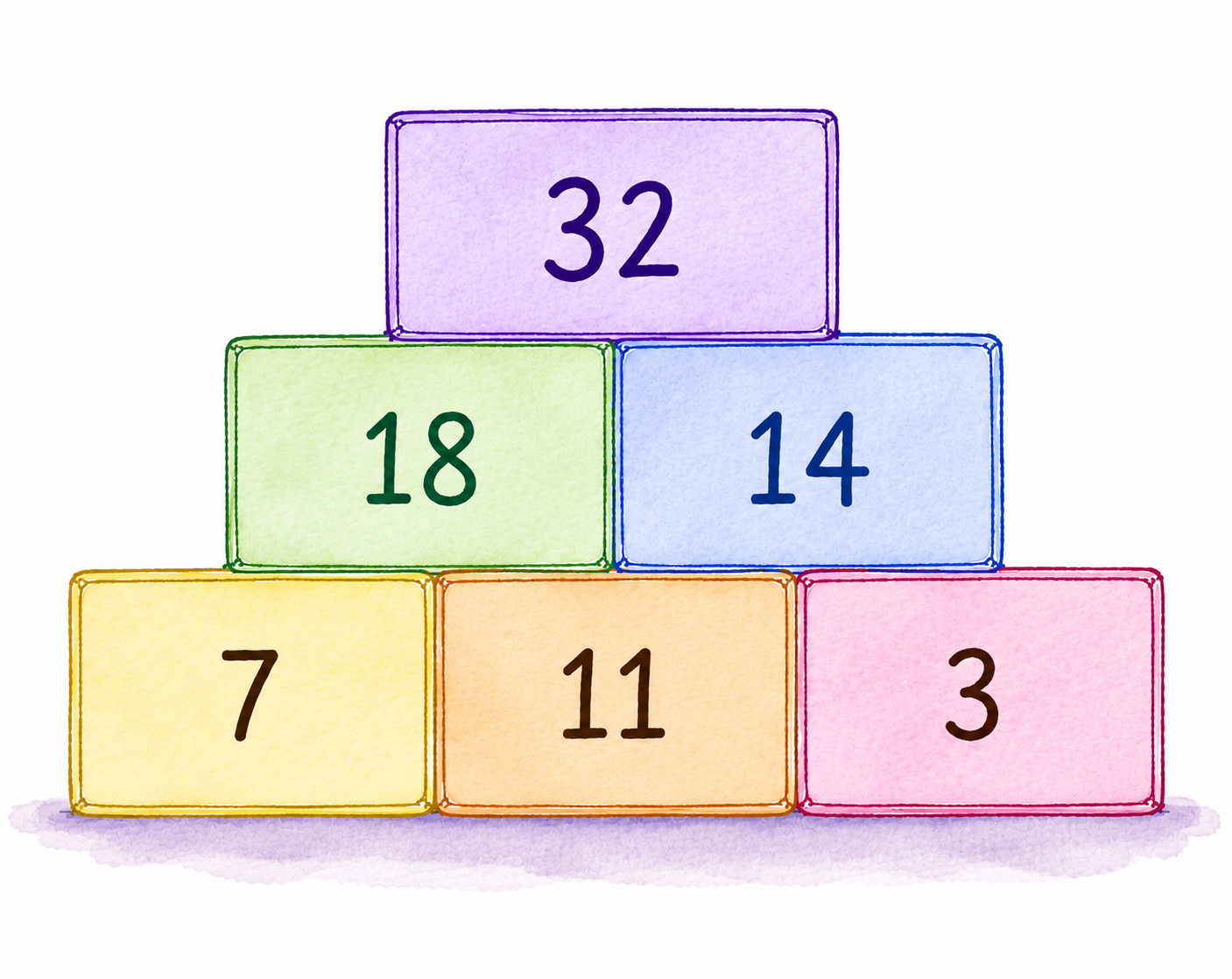
Hence, the top most row = a + 2b + c = 7 + (11 × 2) + 3 = 32
The full number pyramid will look like the following.
1(iii): 63
$\textbf{Explanation:}$
Bottom row =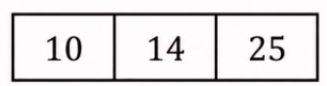
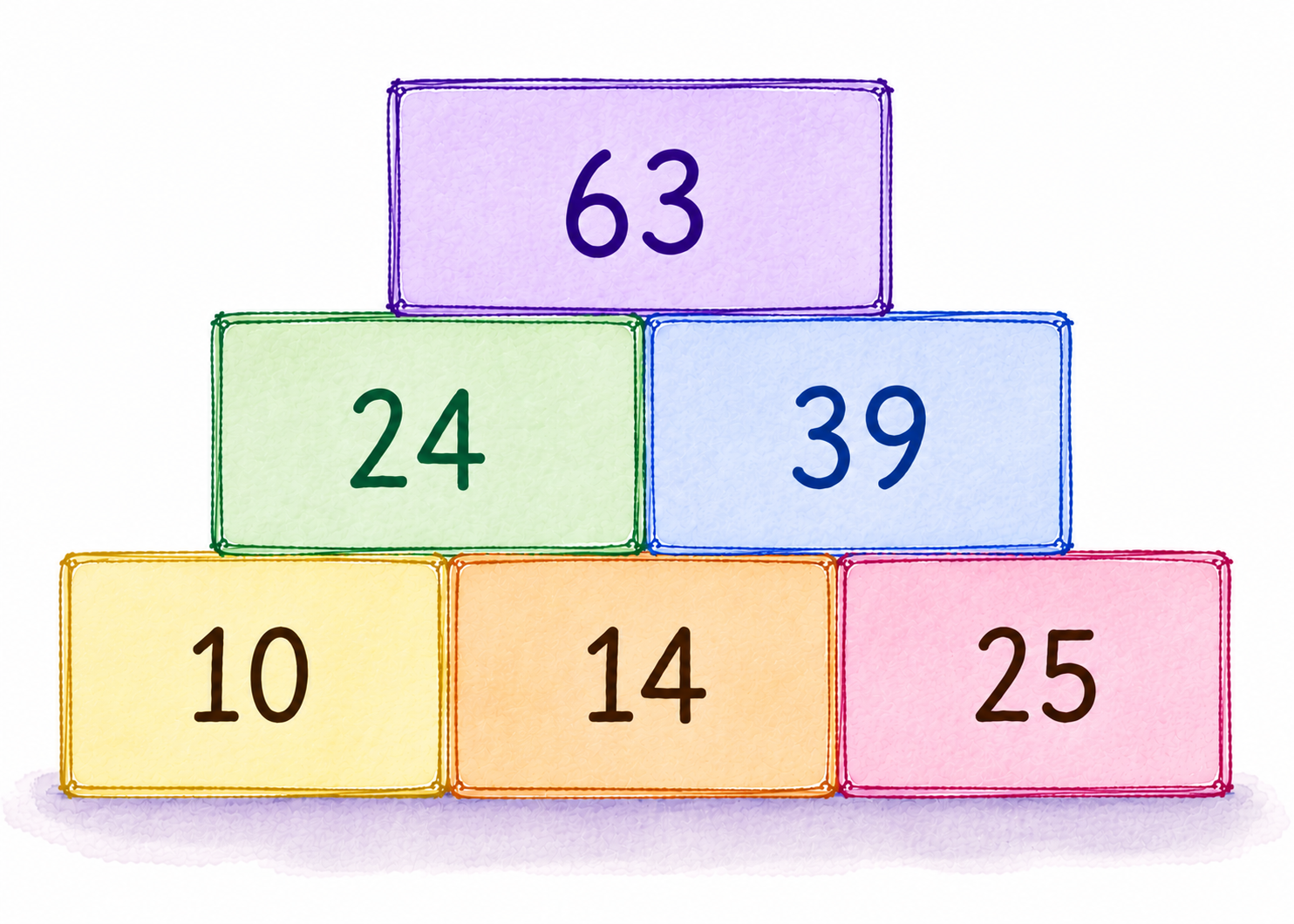
So, let a = 10, b = 14, and c = 25
Hence, the top most row = a + 2b + c = 10 + (14 × 2) + 25 = 63
The full number pyramid will look like the following.
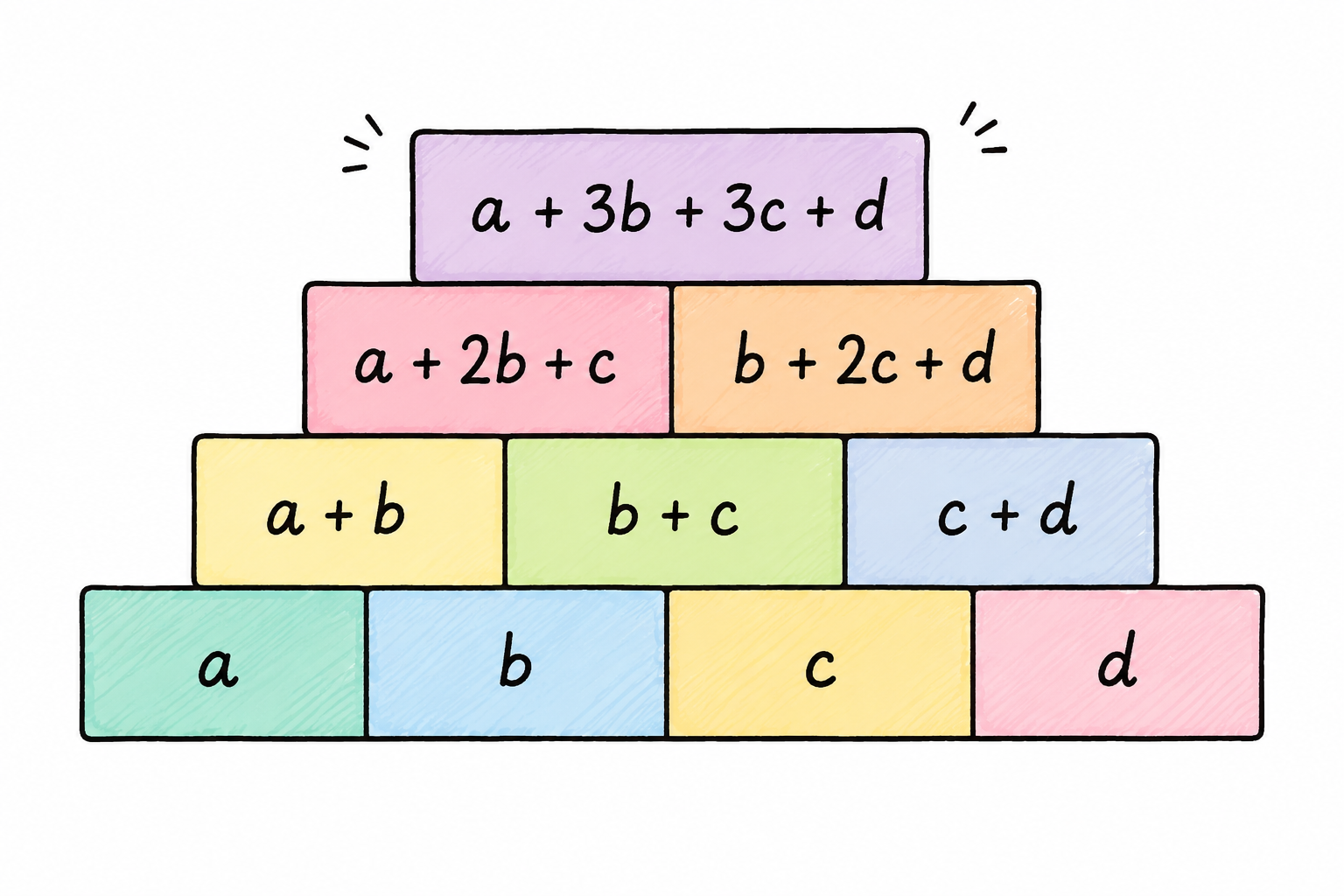
Question 2. Write an expression for the topmost row of a pyramid with 4 rows in terms of the values in the bottom row.
$\textbf{Answer:}$
Question 3. Without building the entire pyramid, find the number in the topmost row given the bottom row in each of these cases.
$\textbf{Answer:}$
We know that, in a number pyramid, each number is the sum of the two numbers directly below it.
So the structure of the number pyramid is as follows.
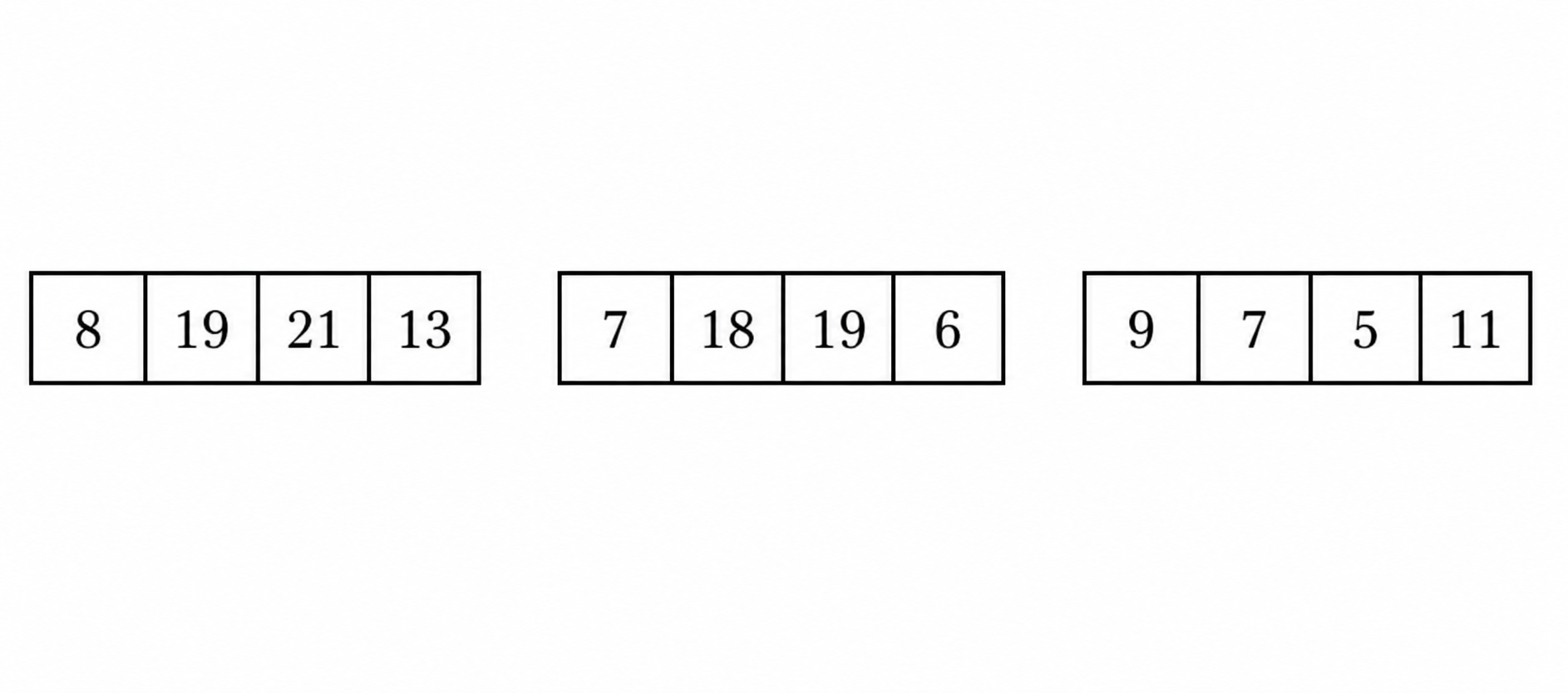
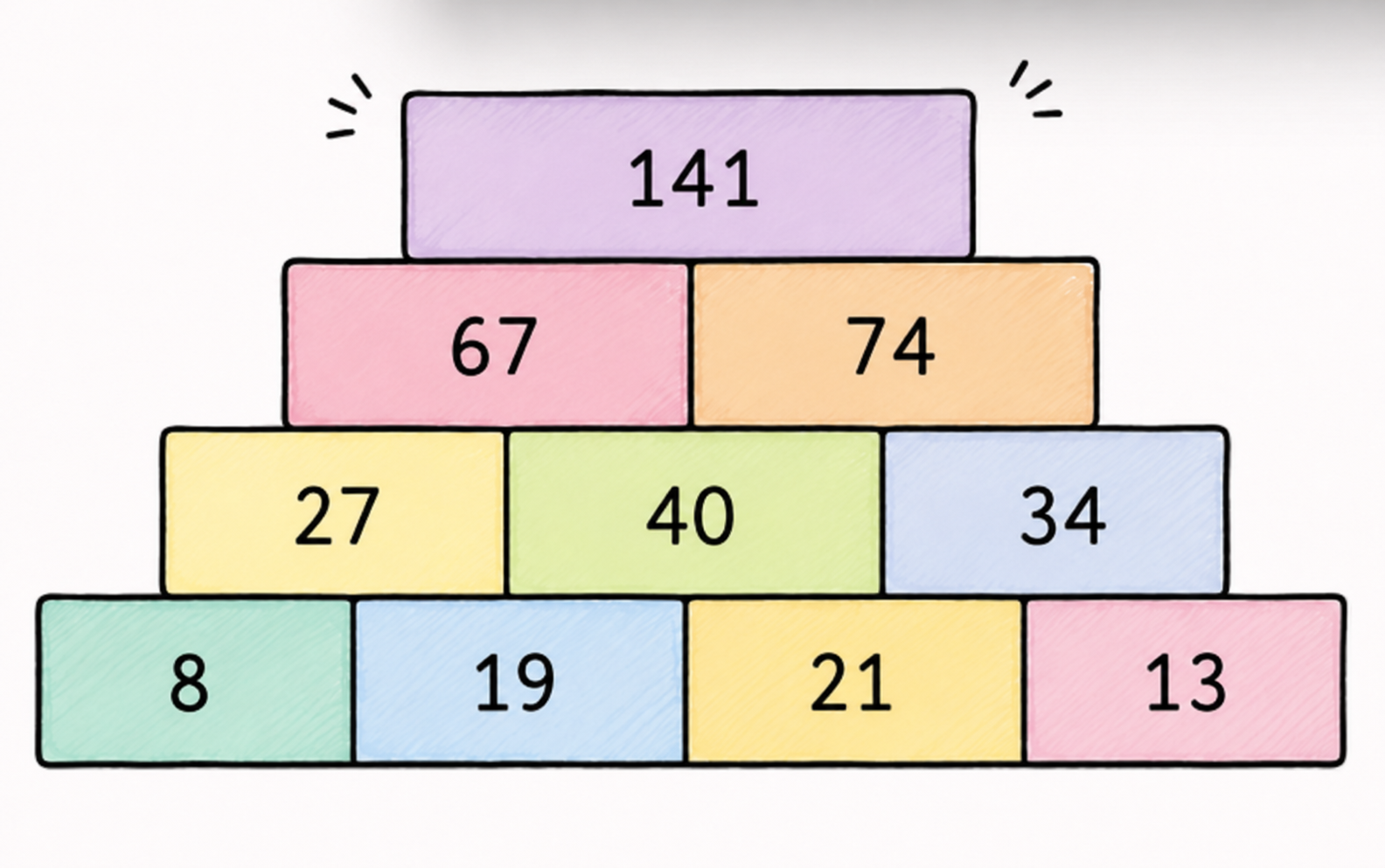
3 (i): 141
$\textbf{Explanation:}$
Bottom row = 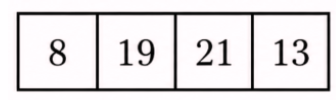
So, let a = 8, b = 19, c = 21 and d = 13
Hence, the top most row = a + 3b + 3c + d = 8 + (3 × 19) + (3 × 21) + 13 = 14
The full number pyramid will look like the following.
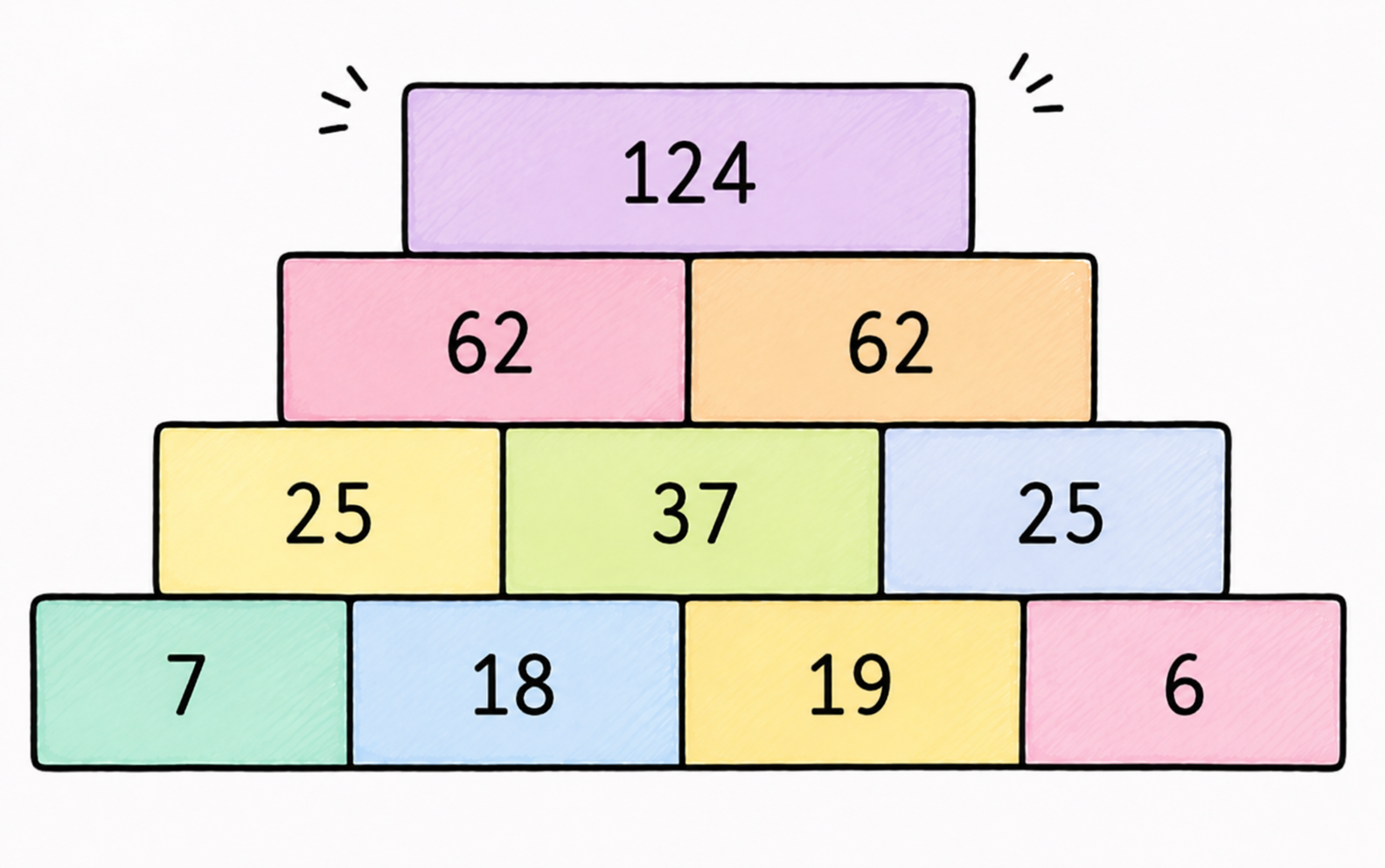
3 (ii): 124
$\textbf{Explanation:}$
Bottom row = 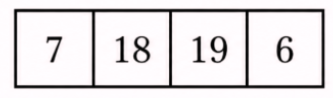
So, let a = 7, b = 18, c = 19 and d = 6
Hence, the top most row = a + 3b + 3c + d = 7 + (3 × 18) + (3 × 19) + 6 = 124
The full number pyramid will look like the following.
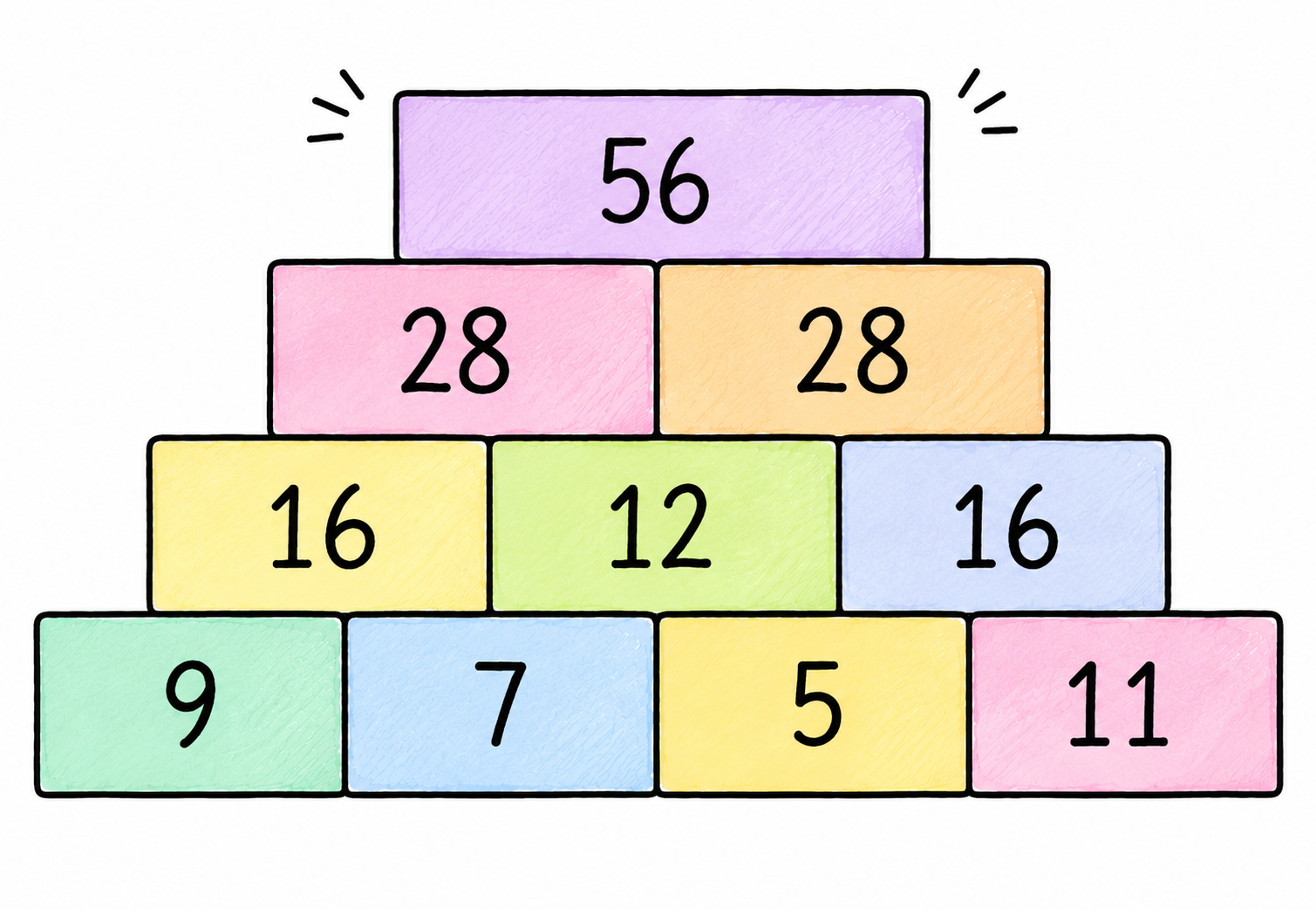
3 (iii): 56
$\textbf{Explanation:}$
Bottom row = 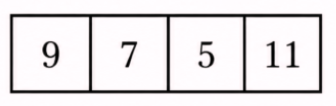
So, let a = 9, b = 7, c = 5 and d = 11
Hence, the top most row = a + 3b + 3c + d = 9 + (3 × 7) + (3 × 5) + 11 = 56
The full number pyramid will look like the following.
Recall the Virahānka-Fibonacci number sequence $1,2,3,5, \ldots$ where each number is the sum of the two numbers before it.
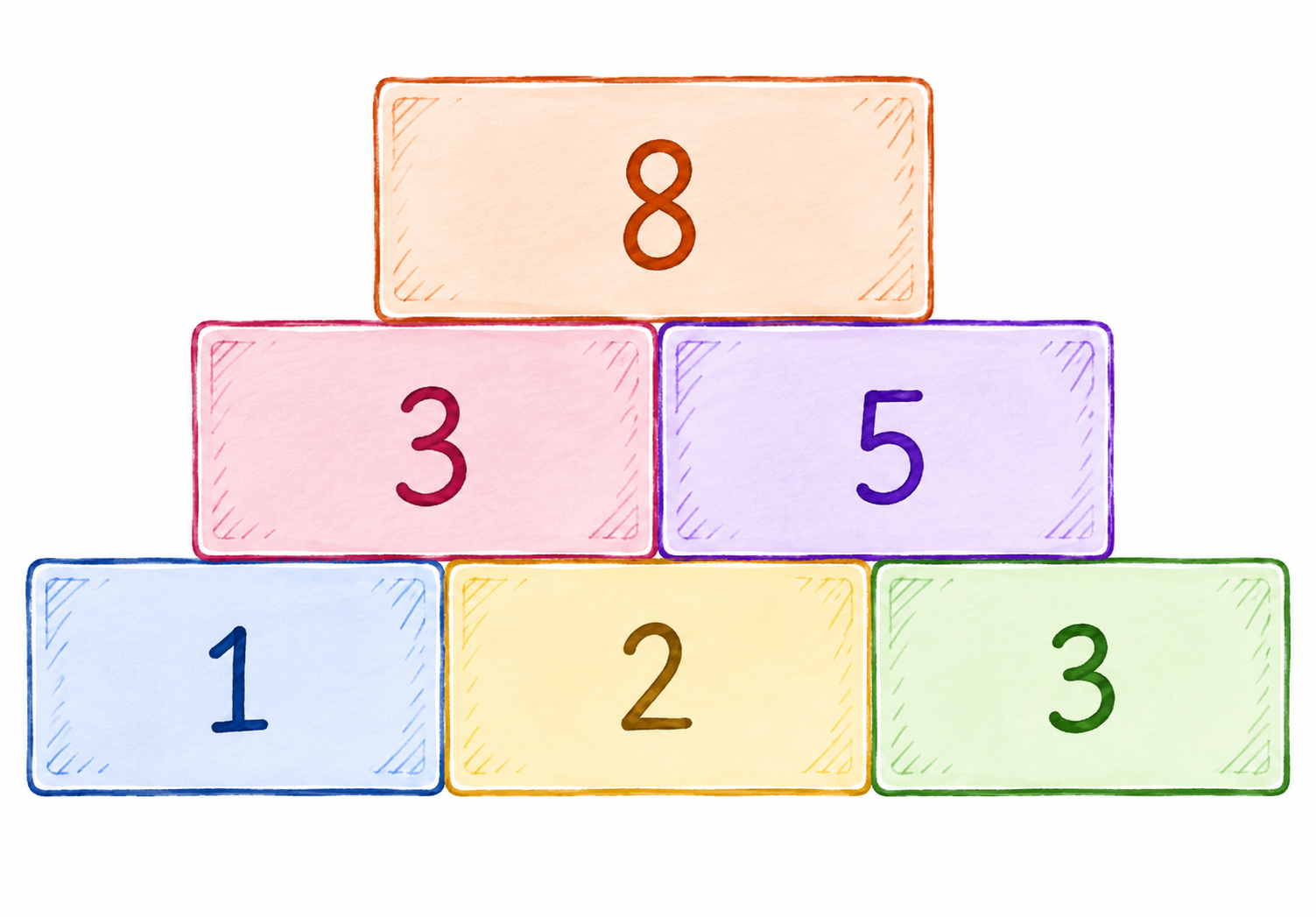
Question 4. If the first three Virahānka-Fibonacci numbers are written in the bottom row of a number pyramid with three rows, fill in the rest of the pyramid. What numbers appear in the grid? What is the number at the top? Are they all Virahānka-Fibonacci numbers?
$\textbf{Answer:}$
The Virahānka-Fibonacci sequence is: 1, 2, 3, 5, 8, 13,…
This is the Virahānka-Fibonacci sequence pyramid without knowing the remaining values.
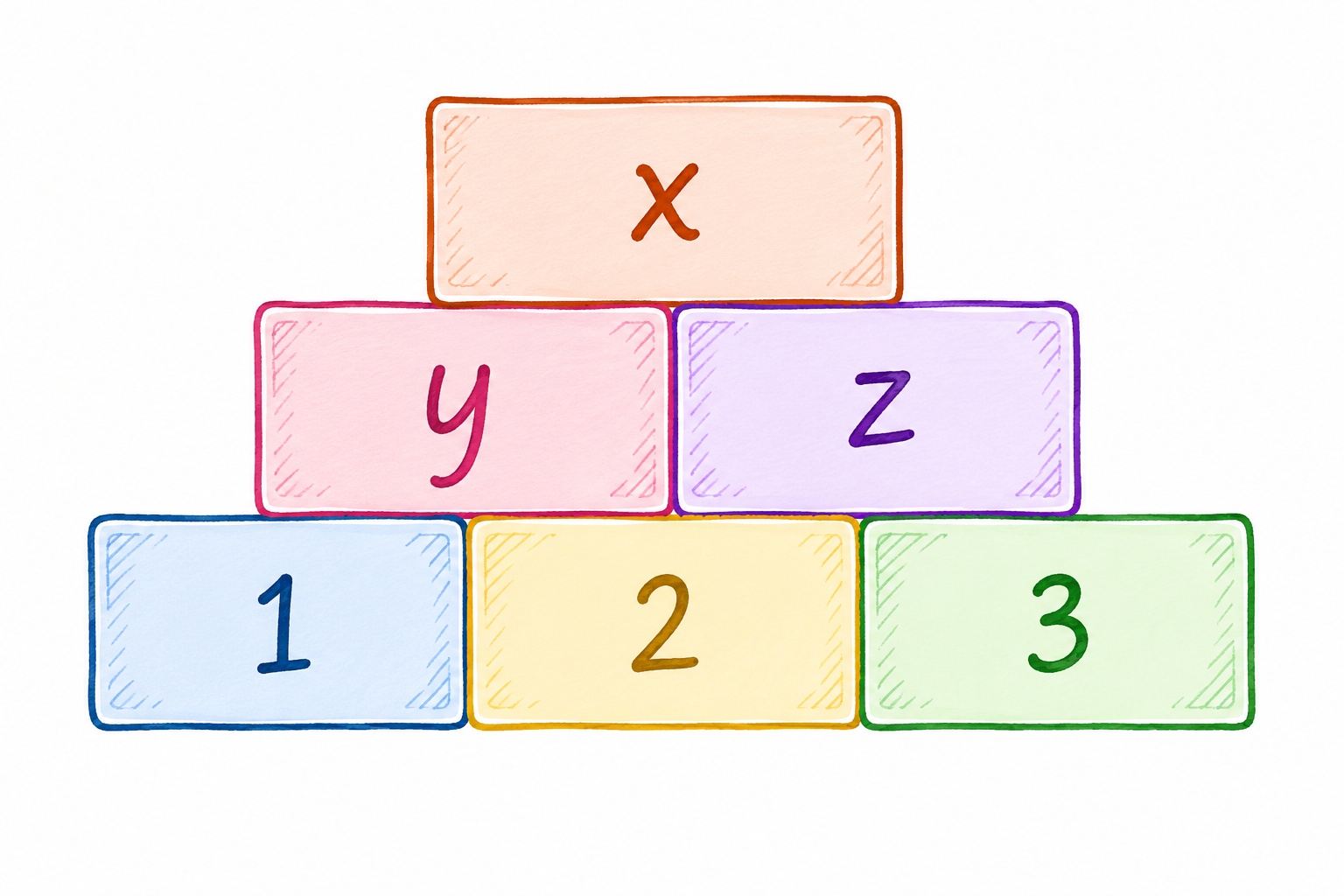
Now, y = 1 + 2 = 3
z = 2 + 3 = 5
And x = 3 + 5 = 8
Hence, the number at the top is 8.
Yes, all numbers in the pyramid are Virahānka-Fibonacci numbers.
Question 5. What can you say about the numbers in the pyramid and the number at the top in the following cases?
(i) The first four Virahānka-Fibonacci numbers are written in the bottom row of a four row pyramid.
(ii) The first 29 Virahānka-Fibonacci numbers are written in the bottom row of a 29 row pyramid.
$\textbf{Answer:}$
5 (i):
The Virahānka-Fibonacci sequence is: 1, 2, 3, 5, 8, 13,…
This is the Virahānka-Fibonacci sequence pyramid without knowing the remaining values.
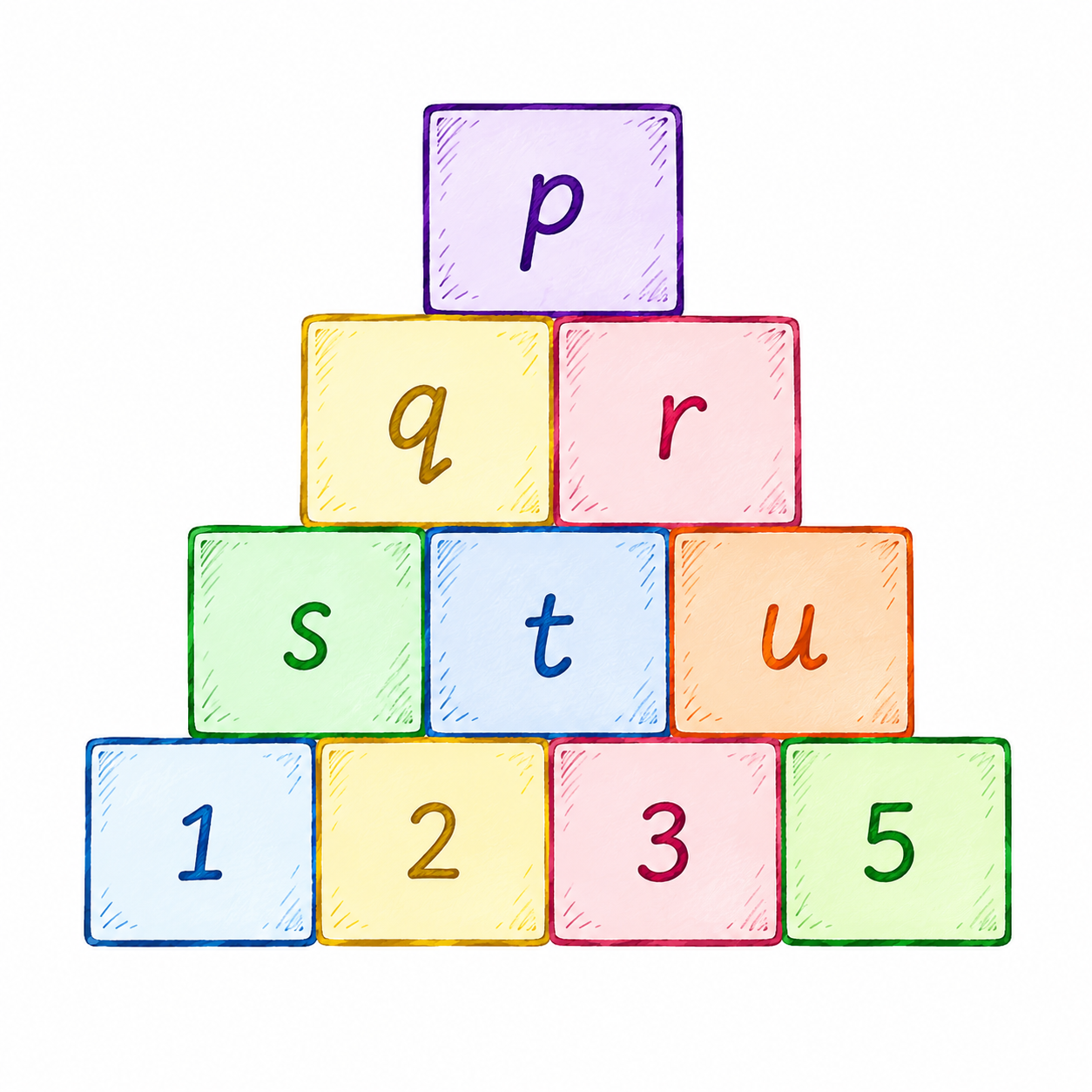
So, s = 1 + 2 = 3,
t = 2 + 3 = 5,
u = 3 + 5 = 8,
q =3 + 5 = 8,
r = 5 + 8 = 13
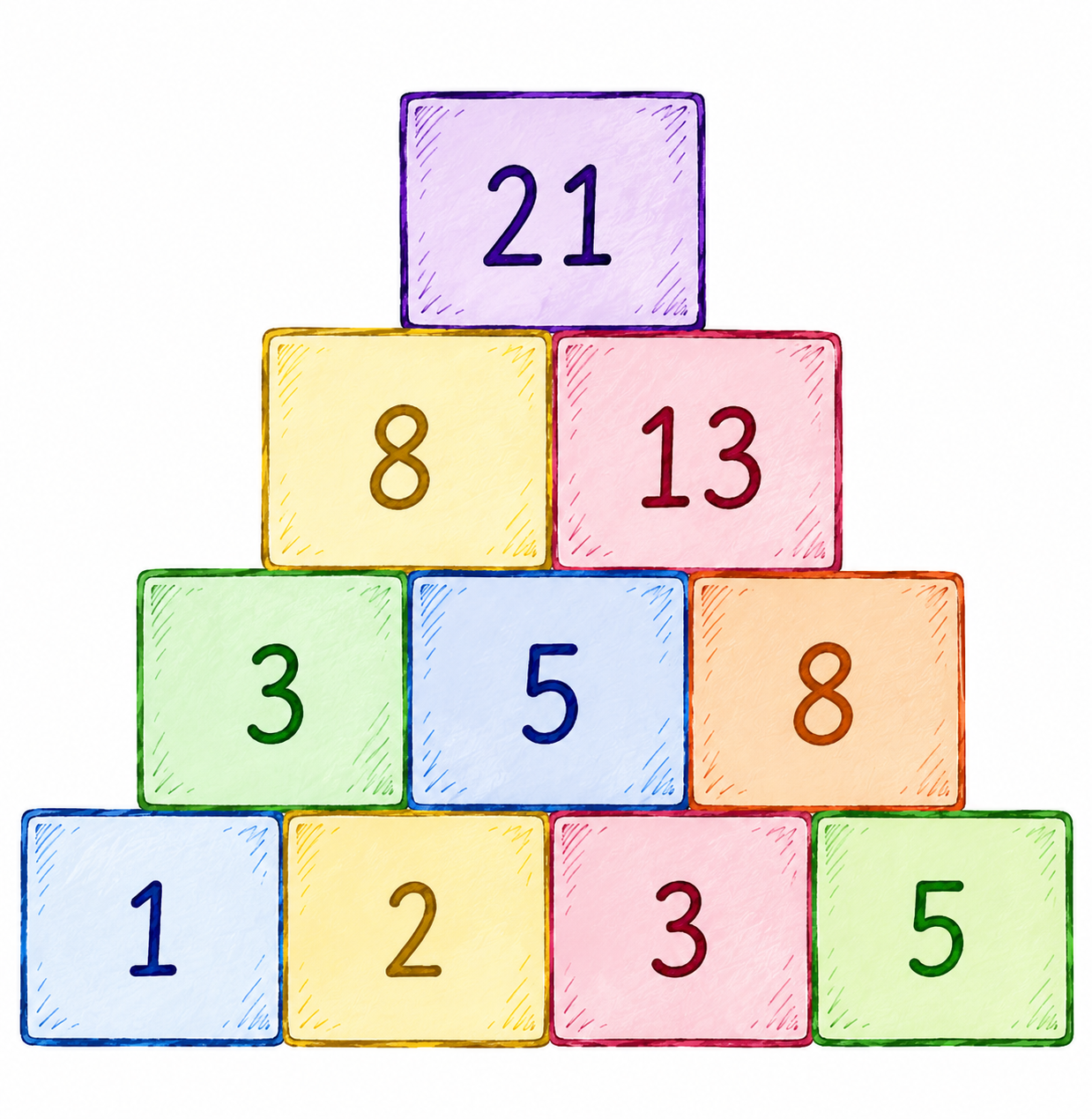
And p = 8 + 13 = 21
All of them are Virahānka-Fibonacci numbers, with the number at the top being 21.
Here is the full pyramid of the first four Virahānka-Fibonacci numbers written in the bottom row of a four row pyramid.
5(ii):
Since every entry is formed by adding two previous entries, each new number obtained is again a Virahānka-Fibonacci number.
Hence:
- Every number in the pyramid is a Virahānka-Fibonacci number.
- The top number is also a Virahānka-Fibonacci number.
Question 6. If the bottom row of an $n$ row pyramid contains the first $n$ Virahānka-Fibonacci numbers, what can we say about the numbers in the pyramid? What can we say about the number at the top?
$\textbf{Answer:}$
Every number that appears in the pyramid is a Virahānka-Fibonacci number because each entry is obtained by adding two previous entries, exactly as in the Virahānka-Fibonacci rule.
For an $n$-row pyramid whose bottom row contains the first $n$ Virahānka-Fibonacci numbers,
These are Virahānka-Fibonacci numbers themselves.
$F_1=1,F_2=2,F_3=3,F_4=5,F_5=8,...$ and so on.
The top number will be $F_{(2n-1)}$, which means the $(2n-1)$th number in the sequence.
Class 8 Maths Part 2 Chapter 6 Question Answers with Detailed Solutions
|
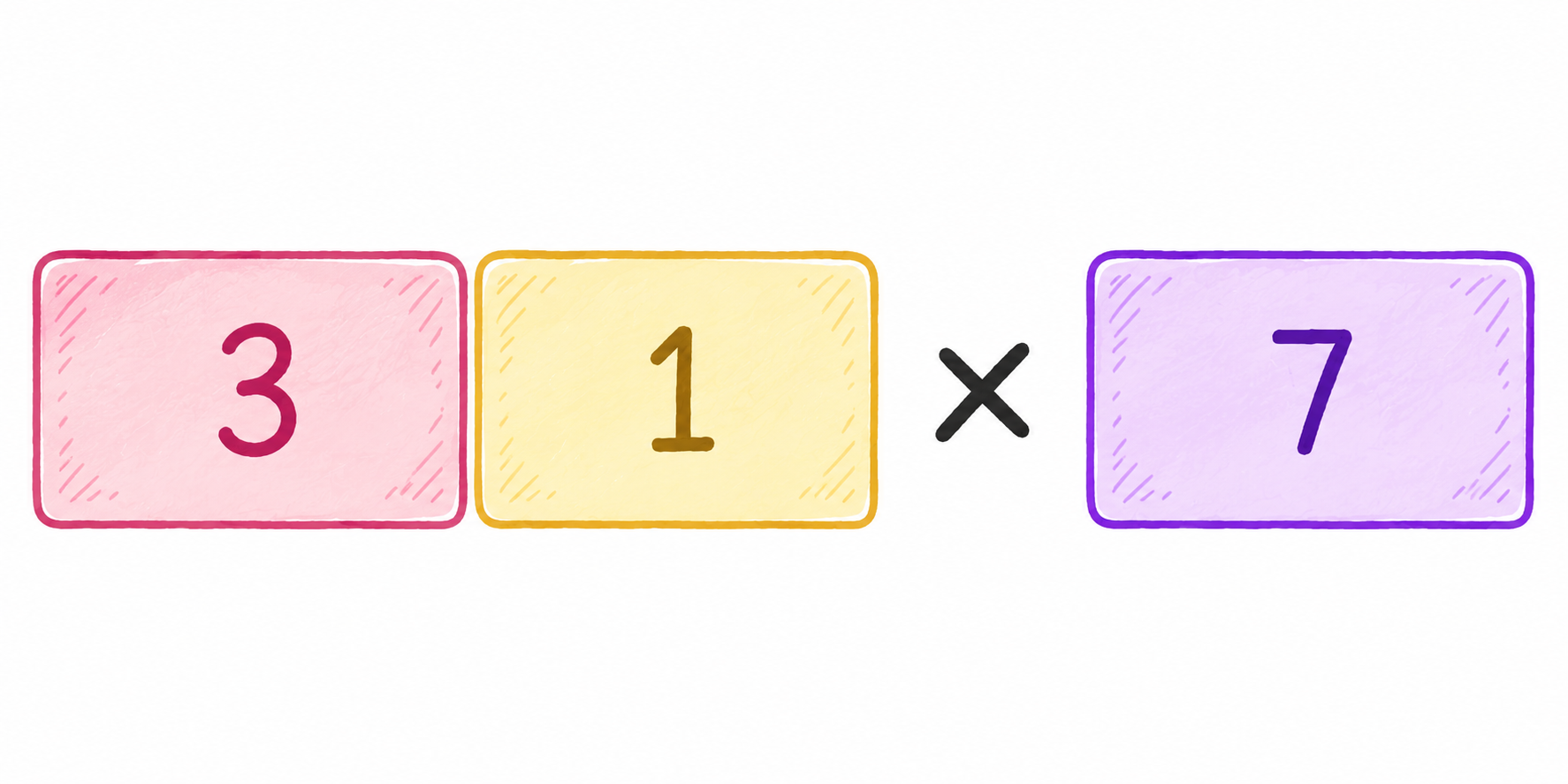
Question 1. Fill the digits 1, 3, and 7 in ☐ ☐ × ☐ to make the largest product possible.
$\textbf{Answer:}$
There are 3 numbers to be arranged.
So a total of 3! or, 6 possibilities.
Let's check all of them.
13 × 7 = 91
17 × 3 = 51
31 × 7 = 217
37 × 1 = 37
71 × 3 = 213
73 × 1 = 73
As 217 is the largest product, so in 1st place 3, 2nd place 1, and in 3rd place 7 should be there.
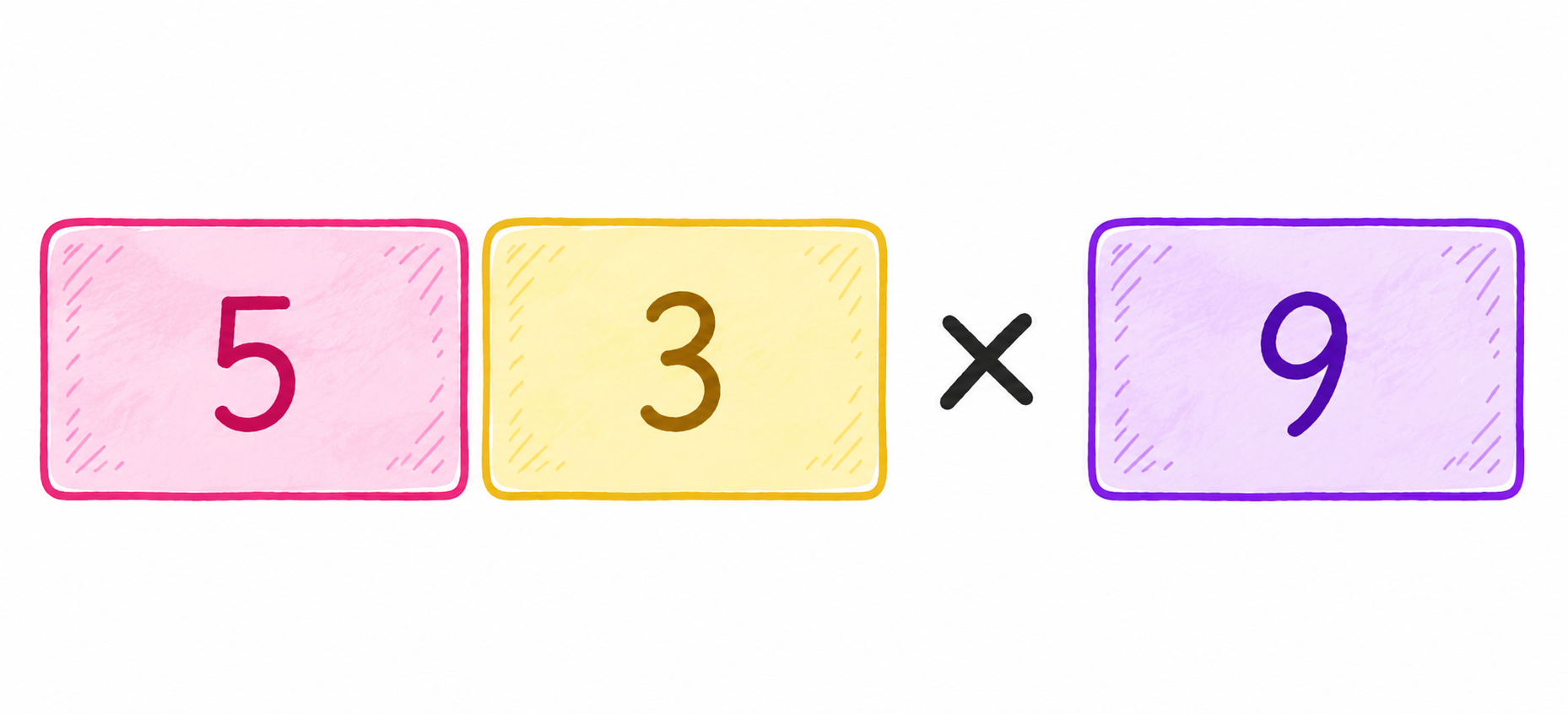
Question 2. Fill the digits 3, 5, and 9 in ☐ ☐ × ☐ to make the largest product possible.
$\textbf{Answer:}$
There are 3 numbers to be arranged.
So a total of 3! or, 6 possibilities.
Let's check all of them.
35 × 9 = 315
39 × 5 = 195
53 × 9 = 477
59 × 3 = 177
93 × 5 = 465
95 × 3 = 285
As 477 is the largest product, so in 1st place 5, 2nd place 3, and in 3rd place 9, should be there.
Class 8 Maths Part 2 Chapter 6 Question Answers with Detailed Solutions
|
Question 1. In the trick given above, what is the quotient when you divide by 9? Is there a relationship between the two numbers and the quotient?
$\textbf{Answer:}$ $(b-a)$
$\textbf{Explanation:}$
In the trick, when we take a two-digit number $a b$ and reverse it to get $b a$, their difference is $(10 b+a)-(10 a+b)=9(b-a)$, when $b>a$
Since the difference is always a multiple of 9, dividing by 9 gives us the quotient.
$\frac{9(b-a)}{9}=b-a$
The quotient equals the difference between the two digits.
Question 2. In the trick given above, instead of finding the difference of the two 2-digit numbers, find their sum. What will happen? For example:
- We start with 31. After reversing we get 13. Adding 31 and 13, we get 44.
- We start with 28. After reversing we get 82. Adding 28 and 82, we get 110.
- We start with 12. After reversing we get 21. Adding 12 and 21, we get 33.
Observe that all these numbers are divisible by 11. Is this always true? Can we justify this claim using algebra?
$\textbf{Answer:}$ Always true
$\textbf{Explanation:}$
Let the number be $10 a+b$.
Its reverse is $10 b+a$.
Their sum $=(10 a+b)+(10 b+a)=11(a+b)$
Since the sum is 11 multiplied by $(a+b)$, it is always divisible by 11.
Hence, the claim is always true.
Example:
$31+13=44=11 \times 4 $
$ 28+82=110=11 \times 10 $
$12+21=33=11 \times 3$
Question 3. Consider any 3-digit number, say $a b c(100 a+10 b+c)$. Make two other 3-digit numbers from these digits by cycling these digits around, yielding $b c a$ and $c a b$. Now add the three numbers. Using algebra, justify that the sum is always divisible by 37.
Will it also always be divisible by 3 ? [Hint: Look at some multiples of 37.]
$\textbf{Answer:}$
Let the three numbers be $(100 a+10 b+c), (100 b+10 c+a),$ and $ (100 c+10 a+b)$
Sum
$=(100 a+a+10 a)+(100 b+b+10 b)+(100 c+c+10 c)$
$=111(a+b+c)$
$=37\times3(a+b+c)$ [$\because 37\times3=111$]
Therefore, the sum is always divisible by both 37 and 3.
Question 4. Consider any 3 -digit number, say $a b c$. Make it a 6 -digit number by repeating the digits, that is $a b c a b c$. Divide this number by 7, then by 11, and finally by 13. What do you get? Try this with other numbers. Figure out why it works.
[Hint: Multiply 7, 11 and 13.]
$\textbf{Answer:}$
Let the three-digit number be $(100a+10b+c)$.
Now, the six-digit number
$=100000a+10000b+1000c+100a+10b+c$
$=1000(100 a+10 b+c)+(100 a+10 b+c)$
$=(1000+1)(100 a+10 b+c) $
$=1001(100 a+10 b+c)$
$=7 \times 11 \times 13 \times (100 a+10 b+c)$ [$\because 1001=7 \times 11 \times 13$]
After dividing the number successively by 7, then 11, then 13, we get,
$(100 a+10 b+c)$, which is the original three digit number
Hence, after dividing by 7, 11 and 13, we get back the original number.
Question 5. There are 3 shrines, each with a magical pond in the front. If anyone dips flowers into these magical ponds, the number of flowers doubles. A person has some flowers. He dips them all in the first pond and then places some flowers in shrine 1. Next, he dips the remaining flowers in the second pond and places some flowers in shrine 2. Finally, he dips the remaining flowers in the third pond and then places them all in shrine 3. If he placed an equal number of flowers in each shrine, how many flowers did he start with? How many flowers did he place in each shrine?
$\textbf{Answer:}$
Let the number of flowers the person started with be $x$.
Let the equal number of flowers he placed in each shrine be $y$.
At the $1^{\text{st}}$ pond and shrine:
Flowers = $2x$
Flowers remaining after placing them at the shrine = $2x-y$
At the $2^{\text{nd}}$ pond and shrine:
Flowers = $=2(2 x-y)=4 x-2 y$
Flowers remaining after placing them at the shrine $= (4x - 2y) - y = 4x - 3y$
At the $3^{\text{rd}}$ pond and shrine:
Flowers $=2(4 x-3 y)=8 x-6 y$
He places all of these remaining flowers in shrine 3.
According to the question,
$8x-6y=y$
$⇒8x=7y$
$⇒\frac xy=\frac78$
Since the number of flowers must be a whole number, the smallest positive integer solution where $x$ and $y$ are in the ratio 7 : 8 be 7 and 8.
So, $x=7$ and $y=8$
Hence, the person started with 7 flowers and placed 8 flowers in each shrine.
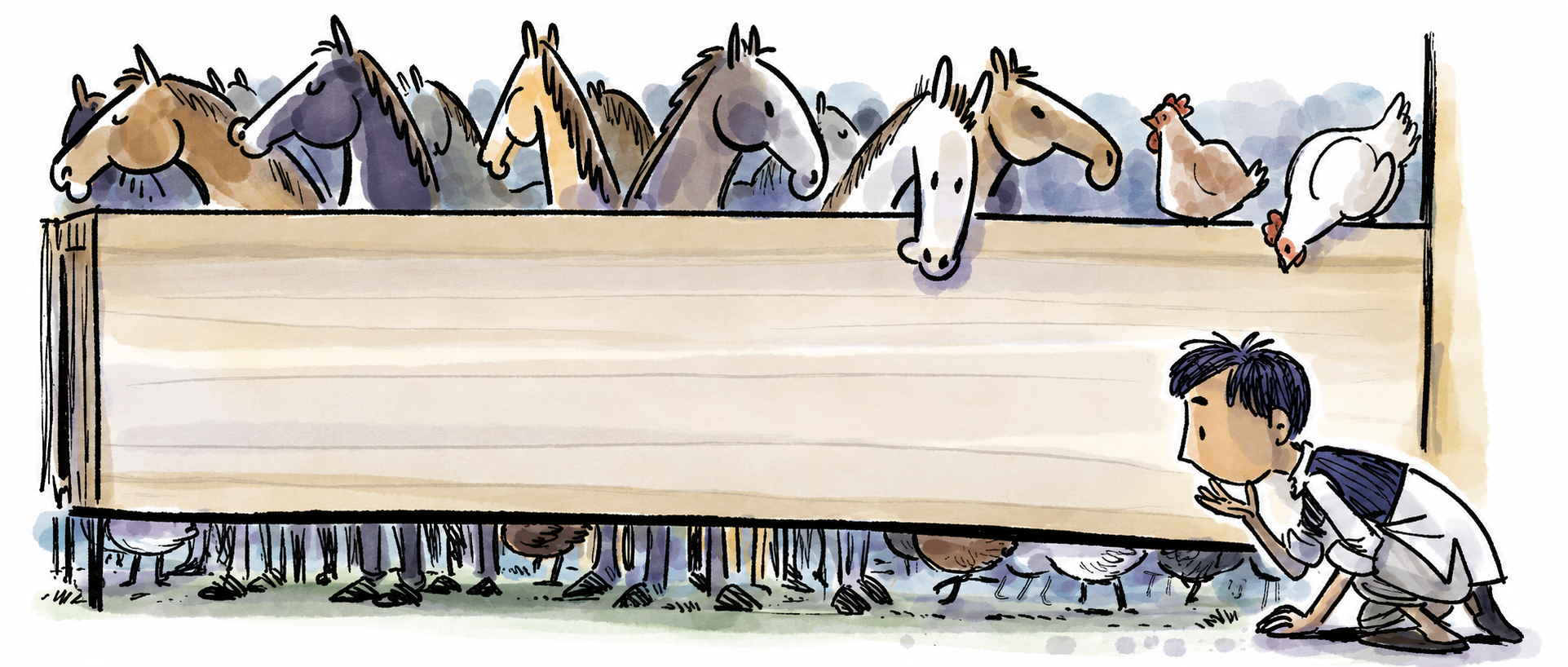
Question 6. A farm has some horses and hens. The total number of heads of these animals is 55 and the total number of legs is 150. How many horses and how many hens are on the farm?
Can you solve this without letter-numbers?
[Hint: If all the 55 animals were hens, then how many legs would there be? Using the difference between this number and 150, can you find the number of horses?]
$\textbf{Answer:}$ 20 and 35
$\textbf{Explanation:}$
We know that hens have two legs and horses have 4 legs.
If all 55 animals were hen, then total legs = 55 × 2 = 110 legs
But total legs = 150
Remaining legs = 150 - 110 = 40 legs
Each horse has 2 more legs than a hen.
So, the number of horses $=\frac{40}2=20$
Number of hens $=55-20=35$
Question 7. A mother is 5 times her daughter's age. In 6 years' time, the mother will be 3 times her daughter's age. How old is the daughter now?
$\textbf{Answer:}$ 6 years
$\textbf{Explanation:}$
Let the daughter's age be $x$.
So, her mother's age is $5x$.
According to the question,
$(x+6)\times3=5x+6$
$⇒3x+18=5x+6$
$⇒2x=12$
$⇒x=6$ years
Hence, her daughter's age is 6 years.
Question 8. Two friends, Gauri and Naina, are cowherds. One day, they pass each other on the road with their cows. Gauri says to Naina, "You have twice as many cows as I do". Naina says, "That's true, but if I gave you three of my cows, we would each have the same number of cows". How many cows do Gauri and Naina have?
$\textbf{Answer:}$ 6 and 12 cows
$\textbf{Explanation:}$
Let the number of cows Gauri has be $x$.
So, Naina has $2x$ cows.
According to the question,
$2x-3=x+3$
$\therefore x=6$
So, Gauri has 6 cows.
Naina has $2\times6=12$ cows
Hence, Gauri has 6 cows, and Naina has 12 cows.
Question 9. I run a small dosa cart and my expenses are as follows:
- Rent for the dosa cart is ₹5000 per day.
- The cost of making one dosa (including all the ingredients and fuel) is ₹10.
(i) If I can sell 100 dosas a day, what should be the selling price of my dosa to make a profit of ₹2000?
(ii) If my customers are willing to pay only ₹ 50 for a dosa, how many dosas should I aim to sell in a day to make a profit of ₹ 2000?
$\textbf{Answer:}$
9(i): 80
$\textbf{Explanation:}$
Total fixed expense = ₹5000
Cost of making one dosa = ₹10
So, the cost of making 100 dosas = 100 × 10 = 1000
He wants to make a profit of ₹2000.
So, the total selling price should be = ₹5000 + ₹1000 + ₹2000 = ₹8000
$\therefore$ Selling price per dosa = $\frac{8000}{100}=80$
9(ii): 175
$\textbf{Explanation:}$
Selling price of a dosa = ₹50
Cost price of making a dos = ₹10
So, profit on one dosa = ₹50 - ₹10 = ₹40
Rent + Profit = ₹5000 + ₹2000 = ₹7000
$\therefore$ Number of dosas to be sold $=\frac{7000}{40}=175$
Hence, he should sell 175 dosas per day.
Question 10. Evaluate the following sequence of fractions:
$\frac{1}{3}, \frac{(1+3)}{(5+7)}, \frac{(1+3+5)}{(7+9+11)}$
What do you observe? Can you explain why this happens?
[Hint: Recall what you know about the sum of the first $n$ odd numbers.]
$\textbf{Answer:}$
$\frac{1}{3}$
$\frac{(1+3)}{(5+7)}=\frac4{12}=\frac13$
$\frac{(1+3+5)}{(7+9+11)}=\frac9{27}=\frac13$
So, all of the above fractions are equal.
We know that the sum of the first $n$ odd numbers is $n^2$.
Numerator:
$1=1^2$
$1+3=4=2^2$
$1+3+5=9=3^2$
Denominator:
$5+7=12=4\times3$
$7+9+11=27=9\times3$
Hence, the denominator is always three times the numerator.
Confused between CGPA and Percentage?
Get your results instantly with our calculator!
Key Concepts Explained in Algebra Play - Ganita Prakash Book 2
Topics you will learn in NCERT Solutions for Class 8 Maths Part 2 Chapter 6 Algebra Play include:
-
6.1 Algebra Play
-
6.2 Thinking about ‘Think of a Number’ Tricks
-
6.3 Number Pyramids
-
6.4 Fun with Grids
-
6.5 The Largest Product
-
6.6 Decoding Divisibility Tricks
Extra Questions for Class 8 Maths Part 2 Chapter 6 Algebra Play
Question 1:
The value of $\lambda$ for which the expression $x^3 + x^2 - 5x + \lambda$ will be divisible by $(x-2)$ is:
$\textbf{Answer:}$
Given: $(x - 2)$ is a factor of the polynomial $P(x)= x^3 + x^2 - 5x + \lambda$
So, $P(2)=0$
⇒ $8 + 4 - 10 + λ = 0$
⇒ $λ + 2 = 0$
⇒ $λ= -2$
Hence, the correct answer is – 2.
Question 2:
Which of the following numbers is not divisible by 6?
(i) 1,97,232
(ii) 9,72,132
(iii) 8,00,552
(iv) 17,90,184
$\textbf{Answer:}$
A number is divisible by 6 if it is divisible by 2 and 3.
A number is divisible by 2 if its last digit is even (0, 2, 4, 6, or 8).
A number is divisible by 3 if the sum of its digits is divisible by 3.
(i) 1,97,232
The last digit is 2 (an even number), divisible by 2. The sum of the digits is 24, which is divisible by 3. So, 1,97,232 is divisible by 6.
(ii) 9,72,132
The last digit is 2 (an even number), divisible by 2. The sum of the digits is 24, which is divisible by 3. So, 9,72,132 is divisible by 6.
(iii) 8,00,552
The last digit is 2 (an even number), divisible by 2. The sum of the digits is 22, which is not divisible by 3. So, 8,00,552 is NOT divisible by 6.
(iv) 17,90,184
The last digit is 4 (an even number), divisible by 2. The sum of the digits is 30, which is divisible by 3. So, 17,90,184 is divisible by 6.
Hence, the correct answer is (iii).
Question 3:
Find the least value for * in the number 3*7440 such that it is divisible by 12.
$\textbf{Answer:}$
The number 3*7440 is divisible by 12, so we can say the number is also divisible by both 4 and 3.
Divisibility law of 4∶ A number is divisible by 4 if its last two digits are divisible by 4.
Divisibility law of 3∶ A number is divisible by 3 if the sum of its digits is divisible by 3.
The last two digits are 40, which means that the number is divisible by 4.
Let the value of * be x.
For checking divisibility by 3, we calculate the sum of the numbers.
Sum of the numbers = 3 + x + 7 + 4 + 4 + 0
= 18 + x
For x = 0, the sum is divisible by 3. So, the least value of x is 0.
Hence, the correct answer is 0.
Question 4:
What is the largest five-digit number, exactly divisible by 88?
$\textbf{Answer:}$
We know the largest 5-digit number = 99999
If we divide 99999 by 88, we get the remainder of 31.
It means if the number were 31 less, it would be completely divisible by 88.
So, 99999 – 31 = 99968 is the largest 5-digit number divisible by 88.
Hence, the correct answer is 99968.
Question 5:
If $a=10$ and $b=3$, then what is the value of $\frac{(a+b)^2}{a^2-b^2}$?
$\textbf{Answer:}$
putting the value $a=10$ and $b=3$, we get,
$\frac{(a+b)^2}{a^2-b^2}$
= $\frac{(10+3)^2}{10^2-3^2}$
= $\frac{13^2}{100-9}$
= $\frac{169}{91}$
Hence, the correct answer is $\frac{169}{91}$.
NCERT Solutions for Class 8 Maths Chapter Wise
We at Careers360 compiled all the NCERT Class 8 Maths solutions in one place for easy student reference. The following links will allow you to access them.
|
NCERT Solutions for Class 8 Maths Part 2 Chapter 1 Fractions in Disguise |
|
NCERT Solutions for Class 8 Maths Part 2 Chapter 2 The Baudhayana-Pythagoras Theorem |
|
NCERT Solutions for Class 8 Maths Part 2 Chapter 3 Proportional Reasoning - 2 |
|
NCERT Solutions for Class 8 Maths Part 2 Chapter 4 Exploring Some Geometric Themes |
|
NCERT Solutions for Class 8 Maths Part 2 Chapter 5 Tales by Dots and Lines |
|
NCERT Solutions for Class 8 Maths Part 2 Chapter 6 Algebra Play |
|
NCERT Solutions for Class 8 Maths Part 2 Chapter 7 Area |
NCERT Books and NCERT Syllabus
Before planning a study schedule, always analyse the latest syllabus. Here are the links to the latest NCERT syllabus and some important books that will help students in this endeavour.
NCERT Solutions for Class 8 Maths Ganita Prakash Part 2 Chapter 6 - Chapter Summary
The NCERT Part 2 Chapter 6 Algebra Play is a fun way to introduce us to algebra through activities, puzzles, and mathematical exploration. In this chapter, students learn how algebra can be used to explain and verify various number tricks and patterns. Through Number Pyramids, students identify numerical relationships and develop pattern-recognition skills. Additionally, various activities make learning algebra interactive and enjoyable, while also strengthening conceptual understanding. In addition to learning how to identify number patterns and relationships, you will also learn about the rules of divisibility, a very important concept and shortcut that will be helpful to us in higher classes and on competitive exams.
This chapter contains 3 exercises with a total of 18 questions for practice and revision.
NCERT Solutions for Class 8 Maths Part 2 Chapter 6 - Expert Review
These NCERT Solutions for Class 8 Maths Part 2 Chapter 6 Algebra Play provide detailed and step by step explanations for every question in the chapter. Here are some points about these solutions.
-
The chapter introduces algebra creatively and engagingly through puzzles, games, and number-based activities.
-
Important concepts such as variables, algebraic expressions, and numerical relationships are introduced to students in a clear and easy to understand manner.
-
Overall, Chapter 6 is one of the most interactive chapters in Class 8 Maths, making algebra both enjoyable and understandable.
Important concepts and topics that are related to the latest NCERT Solutions for Class 8 Maths Ganita Prakash Part 2 Chapter 6 in higher classes are given below.
Class 9-10
-
Algebraic expressions and identities
-
Linear equations in one and two variables
-
Polynomials and factorisation
-
Number patterns and sequences
-
Mathematical reasoning and logical thinking
-
Divisibility rules and number system concepts
-
Problem-solving using algebraic methods
-
Applications of variables in real-life situations
Class 11-12
-
Advanced algebraic manipulation
-
Quadratic equations and polynomial functions
-
Sequences and series
-
Mathematical induction and pattern recognition
-
Functions and their properties
-
Permutations and combinations involving logical reasoning
-
Mathematical modelling and analytical thinking
-
Higher-order problem-solving techniques
JEE (Main & Advanced)
-
Algebraic simplification and manipulation
-
Polynomial and equation-based reasoning
-
Number theory and divisibility concepts
-
Pattern recognition and logical deduction
-
Mathematical puzzles and analytical aptitude
-
Sequences, series, and recurrence-based thinking
Frequently Asked Questions (FAQs)
Number Pyramids are arrangements of numbers where each box is related to the numbers below it according to a specific pattern.
Number Pyramids help students identify patterns, improve logical thinking, and strengthen problem-solving skills.
Grids are arrangements of numbers in rows and columns that help us explore patterns and relationships in mathematical problems.
Divisibility tricks are shortcuts that help determine whether a number is divisible by another number without performing long division.
Yes, algebra is often used to explain and solve mathematical puzzles and number tricks.

Popular Questions
A block of mass 0.50 kg is moving with a speed of 2.00 ms-1 on a smooth surface. It strikes another mass of 1.00 kg and then they move together as a single body. The energy loss during the collision is
| Option 1)
|
Option 2)
|
| Option 3)
|
Option 4)
|
An athlete in the olympic games covers a distance of 100 m in 10 s. His kinetic energy can be estimated to be in the range
| Option 1)
|
Option 2)
|
| Option 3)
|
Option 4)
|
A particle is projected at 600 to the horizontal with a kinetic energy . The kinetic energy at the highest point
| Option 1)
|
Option 2)
|
| Option 3)
|
Option 4)
|
In the reaction,
| Option 1)
|
Option 2)
|
| Option 3)
|
Option 4)
|
How many moles of magnesium phosphate, will contain 0.25 mole of oxygen atoms?
| Option 1)
0.02 |
Option 2)
3.125 × 10⁻² |
| Option 3)
1.25 × 10⁻² |
Option 4)
2.5 × 10⁻² |