KCC Institute of Legal and Higher Education, Greater Noida
Law Admissions 2026 Open | Avail Merit-Based Scholarships


NCERT Solutions for Class 8 Maths Part 2 Chapter 3 Proportional Reasoning - 2 develops essential reasoning skills by explaining to students how to compare quantities, interpret scales, divide amounts fairly and understand direct and inverse relationships; concepts that are widely used in higher mathematics and everyday life. We have already learned about the first part of the chapter in the other book of Class 8. The main objective of these latest NCERT Solutions for Class 8 Maths is to help students understand how quantities are compared, divided, and related through ratios, proportions and inverse proportions.
This Story also Contains
Proportional reasoning helps us to get to know the relationship between numbers. Ratios also help us to get to know the relationship between numbers in a simple way. Pie charts show us how a whole quantity can be divided into different parts in a given ratio. NCERT Solutions for Class 8 are prepared by expert faculty at Careers360 and are a very good resource for exam preparation. Students of various boards, including CBSE, use these latest NCERT Solutions updated for CBSE curriculum as it makes the revision process easier and more effective.
Students can download the NCERT Solutions for Class 8 Maths Ganita Prakash Part 2 Chapter 3 Proportional Reasoning - 2 PDF by clicking the link provided below.
Here are the NCERT Solutions for Class 8 Maths Ganita Prakash Part 2 Chapter 3 Proportional Reasoning - 2 question answers with clear and detailed solutions.
Class 8 Maths Part 2 Chapter 3 Question Answers with Detailed Solutions
|
Question 1. A cricket coach schedules practice sessions that include different activities in a specific ratio - time for warm-up/cool-down : time for batting : time for bowling : time for fielding $:: 3: 4: 3: 5$. If each session is 150 minutes long, how much time is spent on each activity?
$\textbf{Answer:}$
Given: Warm-up/Cool-down : Batting : Bowling : Fielding $=3: 4: 3: 5$
Total parts $=3+4+3+5=15$
Total session time = 150 minutes
So, time for 1 part $=\frac{150}{15}=10$ minutes
Therefore,
Time spent on Warm-up/Cool-down $=3 \times 10=30$ minutes
Time spent on Batting $=4 \times 10=40$ minutes
Time spent on Bowling $=3 \times 10=30$ minutes
Time spent on Fielding $=5 \times 10=50$ minutes
Question 2. A school library has books in different languages in the following ratio no. of Odiya books : no. of Hindi books : no. of English books $:: 3: 2: 1$. If the library has 288 Odiya books, how many Hindi and English books does it have?
$\textbf{Answer:}$ 192 and 96
$\textbf{Explanation:}$
Given:
Number of Odiya books : Number of Hindi books : Number of English books $= 3: 2: 1$
Total Odiya books = 288, which is equal to 3 parts.
So, 1 part = $\frac{288}3=96$ books
Therefore,
Total Hindi books $=2\times96=192$
Total English books $=1\times96=96$
Question 3. I have 100 coins in the ratio - no. of ₹10 coins : no. of ₹5 coins : no. of ₹2 coins : no. of ₹1 coins $:: 4: 3: 2: 1$. How much money do I have in coins?
$\textbf{Answer:}$ ₹600
$\textbf{Explanation:}$
₹10 coins : ₹5 coins: ₹2 coins: ₹1 coins $=4: 3: 2: 1$
Total parts $=4+3+2+1=10$
Total coins $=100$
So, value of 1 part $=\frac{100}{10}=10$
Therefore,
Number of ₹10 coins = $4\times10=40$
Number of ₹5 coins = $3\times10=30$
Number of ₹2 coins = $2\times10=20$
Number of ₹1 coins = $1\times10=10$
$\therefore$ Total value of these coins
$=40 \times 10+30 \times 5+20 \times 2+10 \times 1$
$=400+150+40+10$
$=600$
Hence, you have ₹600 in coins.
Question 4. Construct a triangle with sidelengths in the ratio $3: 4: 5$. Will all the triangles drawn with this ratio of sidelengths be congruent to each other? Why or why not?
$\textbf{Answer:}$
Let the common factor be $x$.
Then the sides are $3x,4x,$ and $5x$.
When $x=1$, three sides of the triangle are: 3, 4, and 5.
When $x=2$, three sides of the triangle are: 6, 8, and 10.
When $x=3$, three sides of the triangle are: 9, 12, and 15.
and so on.
No, triangles with side lengths in the ratio $3: 4: 5$ are similar, i.e., the same shape, but they need not have the same size. Since congruent triangles must have exactly equal corresponding sides, triangles such as $3,4,5$ and 6,8,10 are not congruent.
Hence, they are similar but not necessarily congruent because their sizes may differ.
Question 5. Can you construct a triangle with sidelengths in the ratio $1: 3: 5$? Why or why not?
$\textbf{Answer:}$ No
$\textbf{Explanation:}$
Let the sides of the triangles be $x,3x$ and $5x$.
We know that for a triangle, the sum of any two sides must be greater than the third side.
But $x+3x<5x$
Since the sum of the two smaller sides is less than the largest side, the triangle inequality is violated.
Hence, no such triangle can be constructed with side lengths in the ratio $1: 3: 5$.
Class 8 Maths Part 2 Chapter 3 Question Answers with Detailed Solutions
|
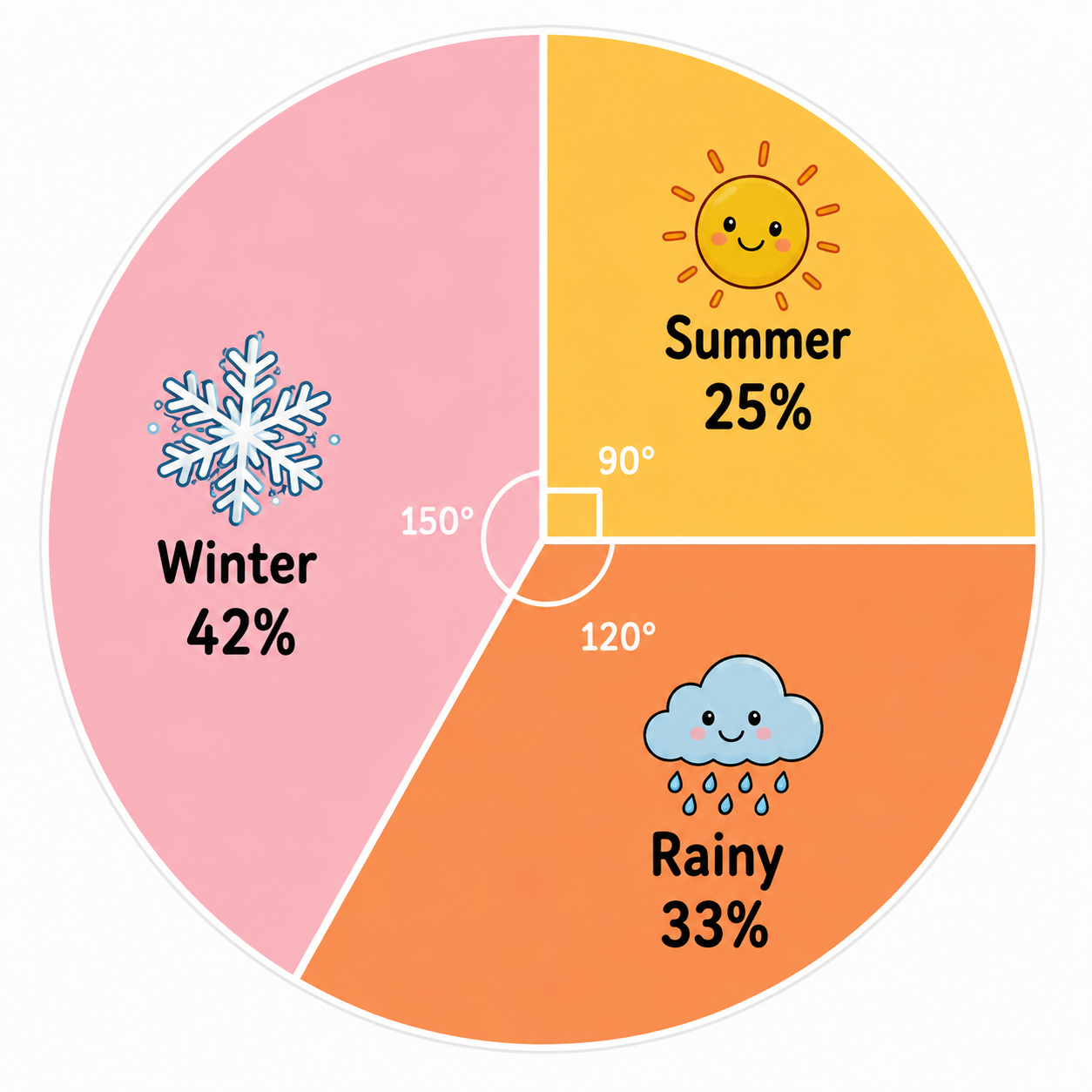
Question 1. A group of 360 people were asked to vote for their favourite season from the three seasons-rainy, winter and summer. 90 liked the summer season, 120 liked the rainy season, and the rest liked the winter. Draw a pie chart to show this information.
$\textbf{Answer:}$
Total number of people = 360
People liking the summer season = 90
People liking rainy season = 120
People liking winter season $=360-(90+120)=150$
Therefore,
Summer season's angle $=\frac{90}{360} \times 360=90^{\circ}$
Rainy season's angle $=\frac{120}{360} \times 360=120^{\circ}$
Winter season's angle $=\frac{150}{360} \times 360=150^{\circ}$
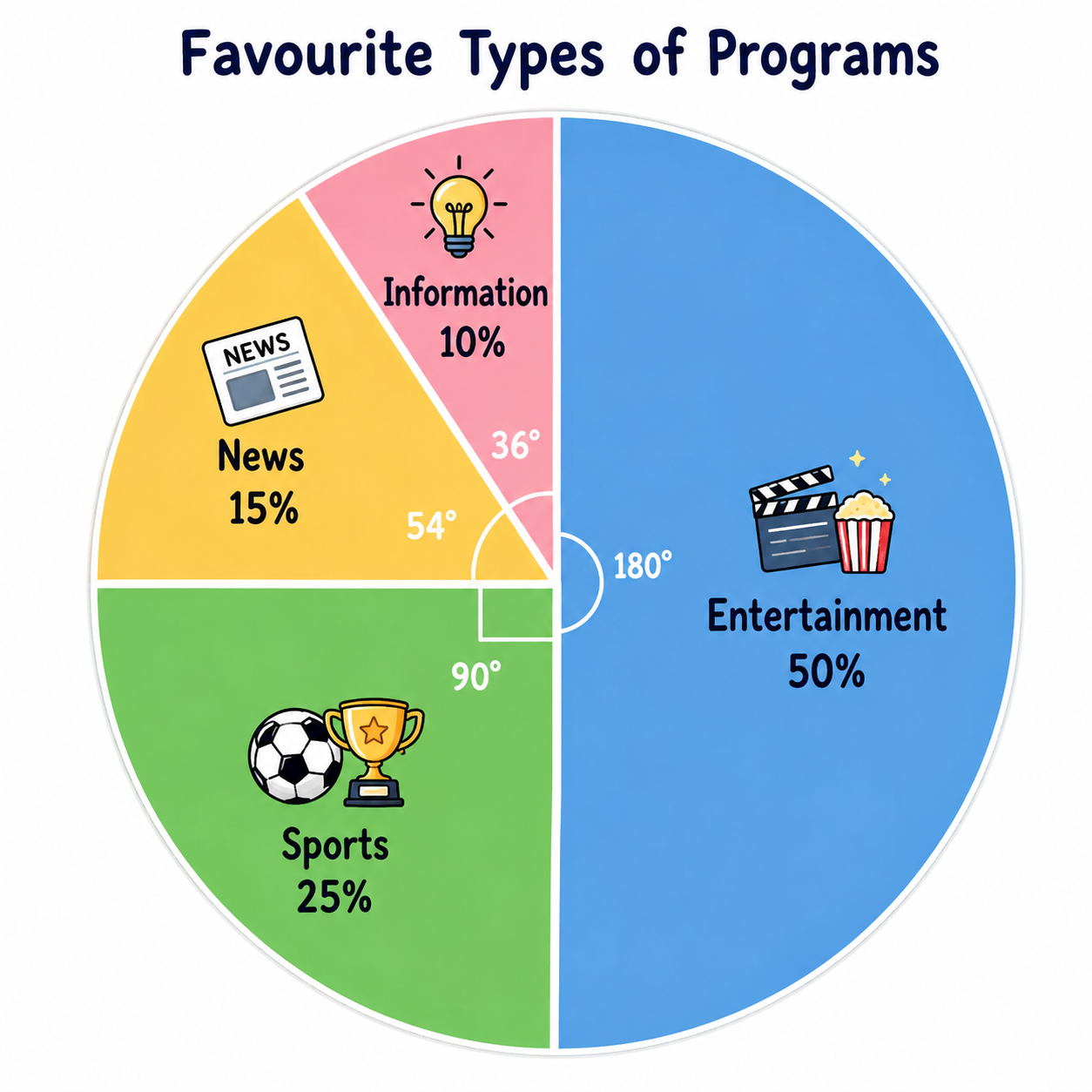
Question 2. Draw a pie chart based on the following information about viewers' favourite type of TV channel: Entertainment - 50%, Sports - 25%, News - 15%, Information - 10%.
$\textbf{Answer:}$
Given:
Entertainment: 50%, Sports: 25%, News: 15%, Information: 10%
Total angle = 360°
Part of Entertainment in the pie chart $=\frac{50}{100}\times360=180^\circ$
Part of Sports in the pie chart $=\frac{25}{100}\times360=90^\circ$
Part of News in the pie chart $=\frac{15}{100}\times360=54^\circ$
Part of Information in the pie chart $=\frac{10}{100}\times360=36^\circ$
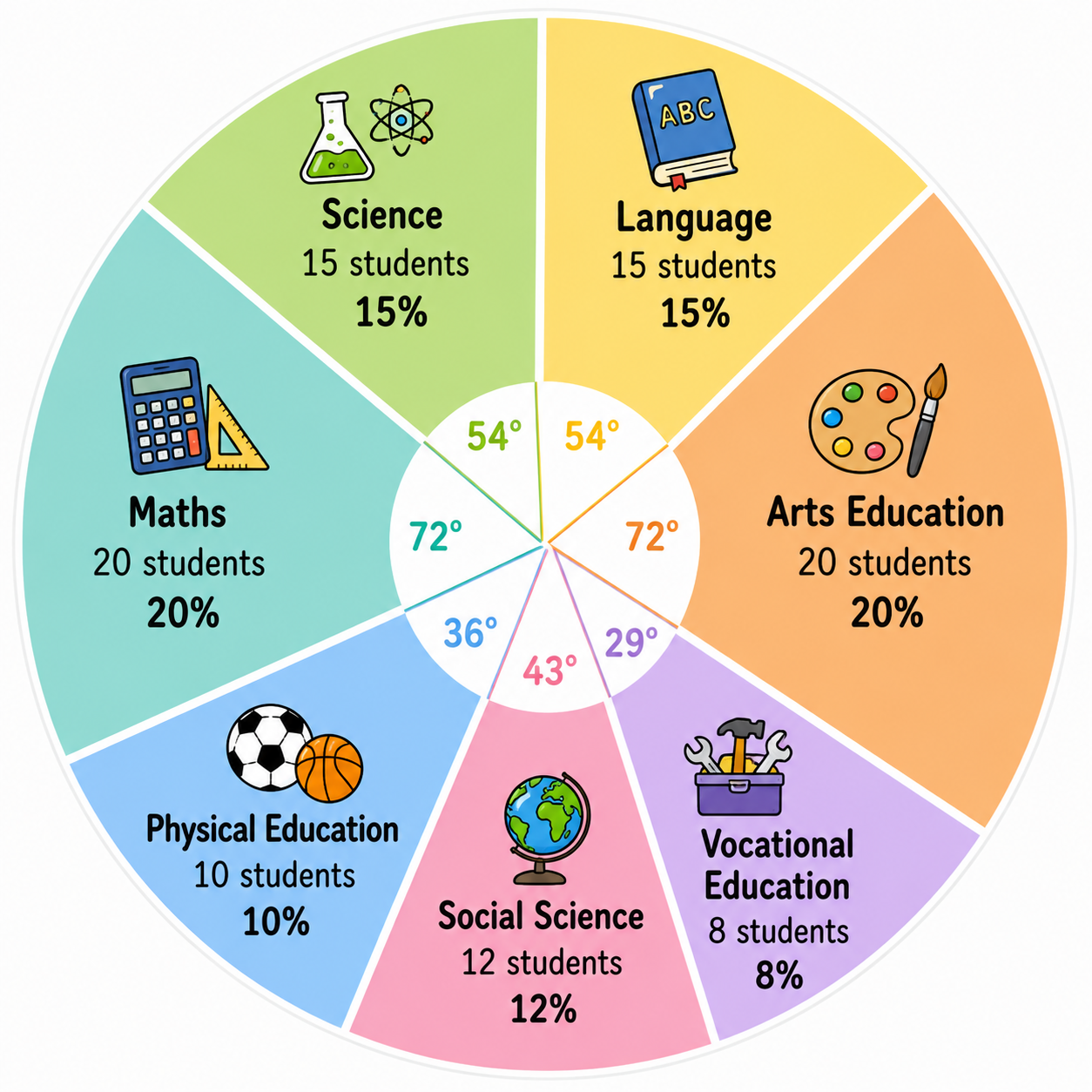
Question 3. Prepare a pie chart that shows the favourite subjects of the students in your class. You can collect the data of the number of students for each subject shown in the table (each student should choose only one subject). Then write these numbers in the table and construct a piechart:

$\textbf{Answer:}$
Let the total number of students be 100.
Number of students in the Language subject = 15
Number of students in the Arts Education subject = 20
Number of students in the Vocational Education subject = 8
Number of students in the Social Science subject = 12
Number of students in the Physical Education subject = 10
Number of students in the Maths subject = 20
Number of students in the Science subject = 15
Total angle = 360°
Part of the students in the Language subject in the pie chart $=\frac{15}{100}\times360=54^\circ$
Part of the students in the Arts Education subject in the pie chart $=\frac{20}{100}\times360=72^\circ$
Part of the students in the Vocational Education subject in the pie chart $=\frac{8}{100}\times360\approx 29^\circ$
Part of the students in the Social Science subject in the pie chart $=\frac{12}{100}\times360\approx 43^\circ$
Part of the students in the Physical Education subject in the pie chart $=\frac{10}{100}\times360=36^\circ$
Part of the students in the Maths subject in the pie chart $=\frac{20}{100}\times360=72^\circ$
Part of the students in the Science subject in the pie chart $=\frac{15}{100}\times360=54^\circ$
Class 8 Maths Part 2 Chapter 3 Question Answers with Detailed Solutions
|
Question 1. Which of these are in inverse proportion?
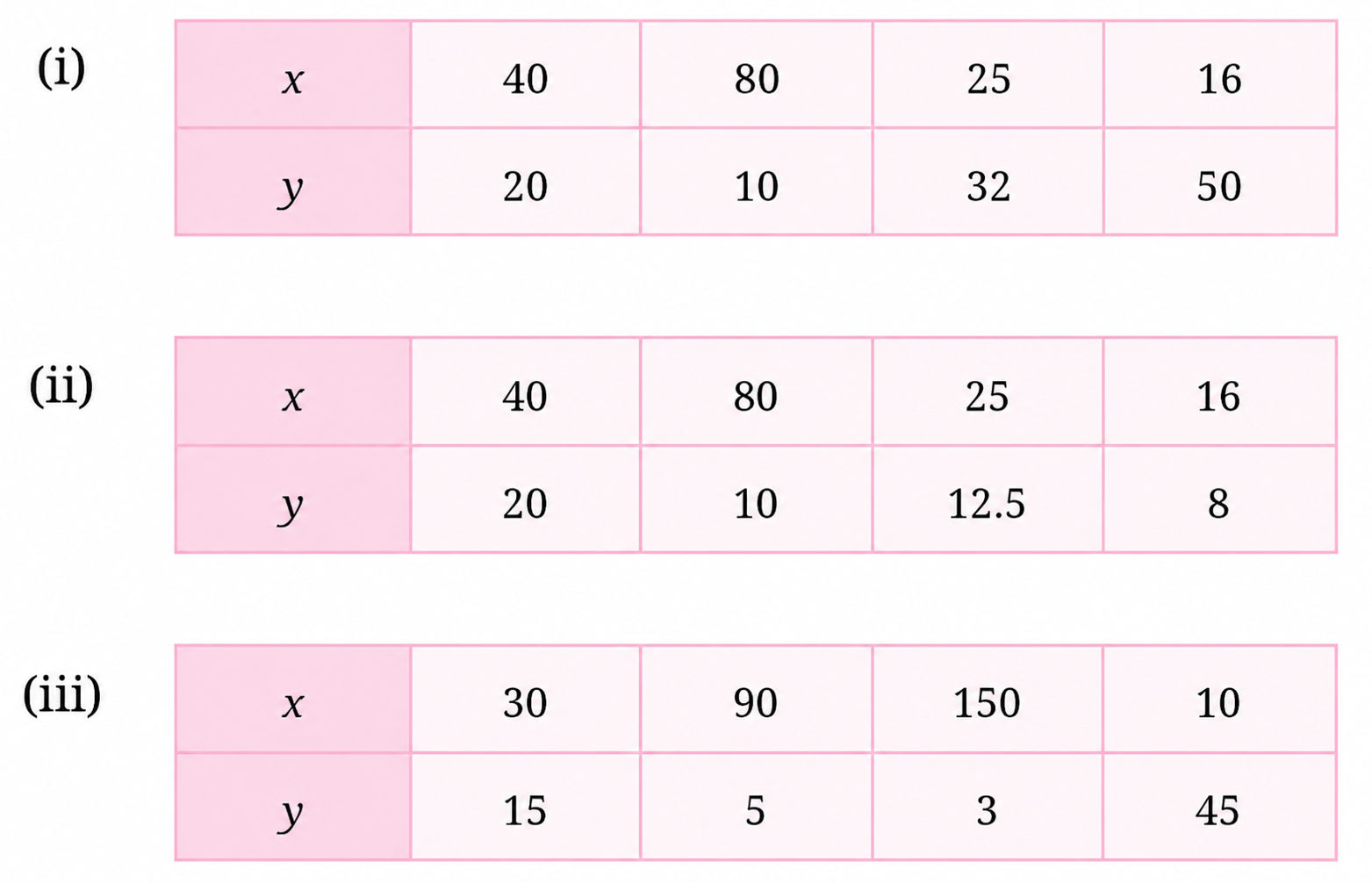
$\textbf{Answer:}$
We know that Quantities are inversely proportional if, when one quantity changes by a factor $n$, the other quantity changes by the inverse $\frac{1}{n}$.
That means if $x$ and $y$ are in inverse proportion, then the product of $x$ and $y$ will be the same in all cases.
(i)
When $x_1=40$ and $y_1=20$, $x_1y_1=40\times20=800$
When $x_2=80$ and $y_2=10$, $x_2y_2=80\times10=800$
When $x_3=25$ and $y_3=32$, $x_3y_3=25\times32=800$
When $x_4=16$ and $y_4=50$, $x_4y_4=16\times50=800$
Since the product of $x$ and $y$ is constant, $x$ and $y$ are in inverse proportion.
(ii)
When $x_1=40$ and $y_1=20$, $x_1y_1=40\times20=800$
When $x_2=80$ and $y_2=10$, $x_2y_2=80\times10=800$
When $x_3=25$ and $y_3=12.5$, $x_3y_3=25\times12.5=312.5$
When $x_4=16$ and $y_4=8$, $x_4y_4=16\times8=128$
Since the product of $x$ and $y$ is not constant, $x$ and $y$ are not in inverse proportion.
(iii)
When $x_1=30$ and $y_1=15$, $x_1y_1=30\times15=450$
When $x_2=90$ and $y_2=5$, $x_2y_2=90\times5=450$
When $x_3=150$ and $y_3=8$, $x_3y_3=150\times8=1200$
When $x_4=10$ and $y_4=45$, $x_4y_4=10\times45=450$
Since the product of $x$ and $y$ is not constant, $x$ and $y$ are not in inverse proportion.
Question 2. Fill in the empty cells if x and y are in inverse proportion.
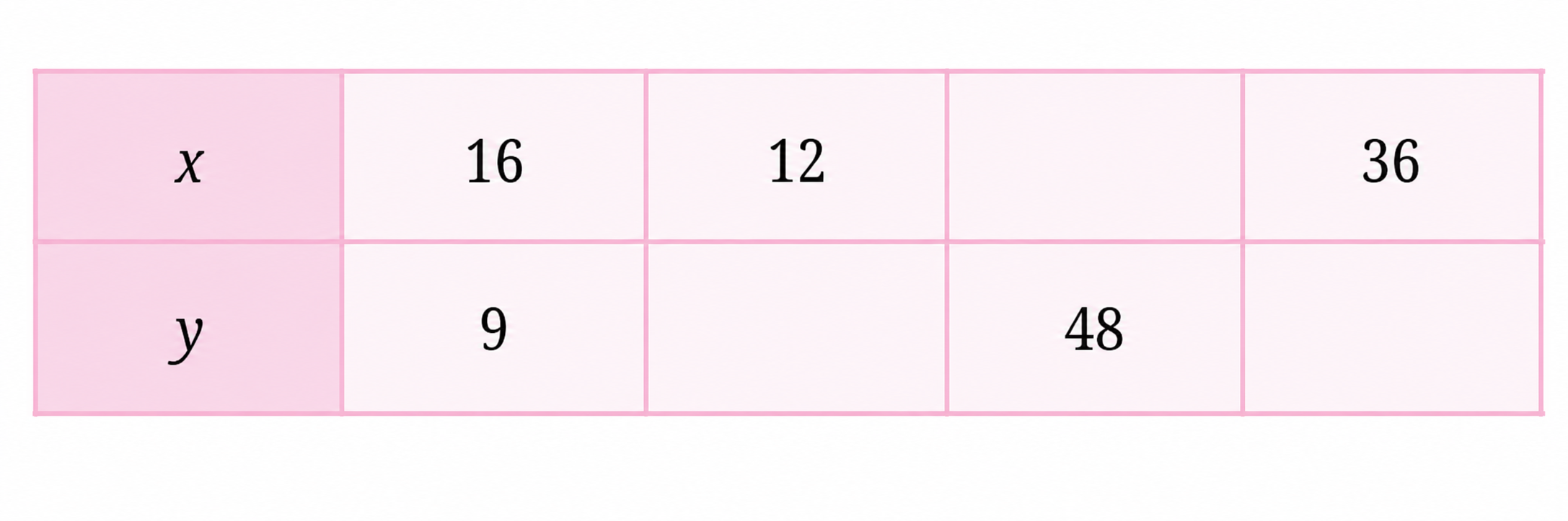
$\textbf{Answer:}$
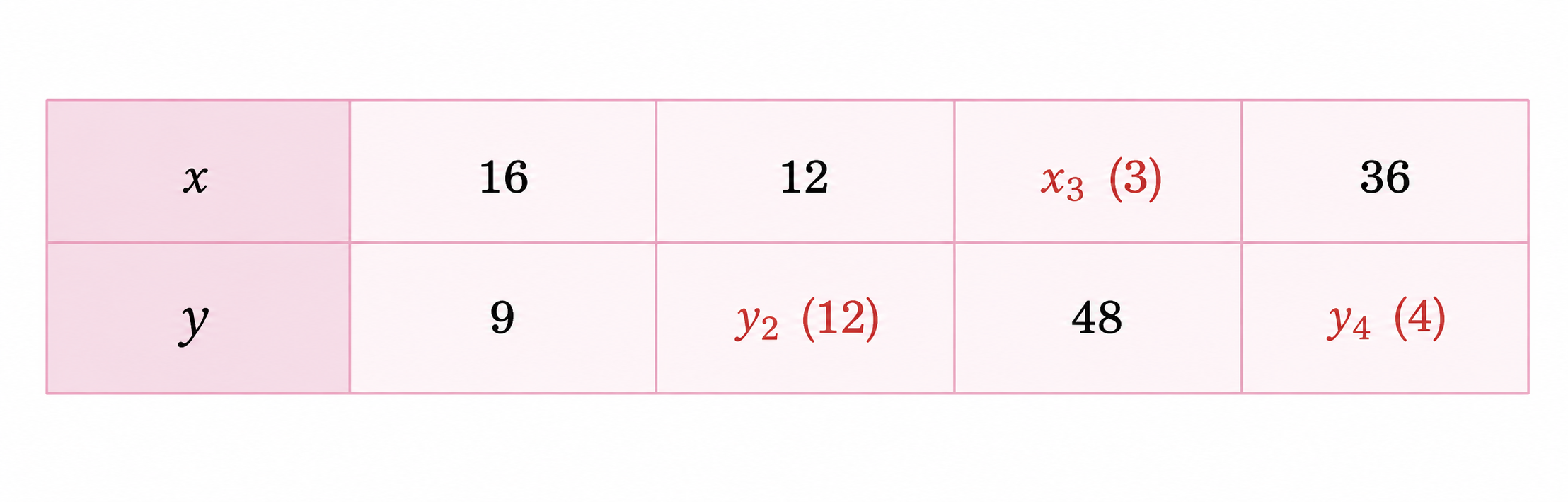
$\textbf{Explanation:}$
If $x$ and $y$ are in inverse proportion, then the product of $x$ and $y$ will be the same in all cases.
When $x_1=16$ and $y_1=9$, $x_1y_1=16\times9=144$
When $x_2=12$, then $y_2=\frac{144}{12}=12$
When $y_3=48$, then $y_3=\frac{144}{48}=3$
When $x_4=36$, then $y_4=\frac{144}{36}=4$
Class 8 Maths Part 2 Chapter 3 Question Answers with Detailed Solutions
|
Question 1. Which of the following pairs of quantities are in inverse proportion?
(i) The number of taps filling a water tank and the time taken to fill it.
(ii) The number of painters hired and the days needed to paint a wall of fixed size.
(iii) The distance a car can travel and the amount of petrol in the tank.
(iv) The speed of a cyclist and the time taken to cover a fixed route.
(v) The length of cloth bought and the price paid at a fixed rate per metre.
(vi) The number of pages in a book and the time required to read it at a fixed reading speed.
$\textbf{Answer:}$
Two quantities are in inverse proportion if increasing one causes the other to decrease so that their product remains constant.
|
Pair |
Relation |
Inverse Proportion? |
|
(i) Number of taps and time to fill a tank |
More taps → less time |
These are Inversely Proportional. |
|
(ii) Number of painters and days to paint a wall |
More painters → fewer days |
These are Inversely Proportional. |
|
(iii) Distance travelled and petrol available |
More petrol → more distance |
These are not Inversely Proportional. These are directly proportional to each other. |
|
(iv) Speed of a cyclist and time for a fixed route |
Greater speed → less time |
These are Inversely Proportional. |
|
(v) Length of cloth and price paid |
More cloth → higher price |
These are not Inversely Proportional. These are directly proportional to each other. |
|
(vi) Number of pages and reading time |
More pages → more time |
These are not Inversely Proportional. These are directly proportional to each other. |
Question 2. If 24 pencils cost ₹120, how much will 20 such pencils cost?
$\textbf{Answer:}$ ₹100
$\textbf{Explanation:}$
24 pencils cost ₹120.
So, 1 pencil costs $\frac{120}{24}=5$
Therefore, the cost of 20 such pencils $20\times5=100$
Question 3. A tank on a building has enough water to supply 20 families living there for 6 days. If 10 more families move in there, how long will the water last? What assumptions do you need to make to work out this problem?
$\textbf{Answer:}$ 4 days
$\textbf{Explanation:}$
A tank can supply 20 families for 6 days.
Total water available = 120 × 6 = 120 family days
Total family after addition = 20 + 10 = 30
$\therefore$ Number of days the water will last $=\frac{120}{30}=4$ days
Assumptions:
Law Admissions 2026 Open | Avail Merit-Based Scholarships
BBA/MBA/PGDM Early Bird Applications Deadline 06th Nov'26. Apply now using coupon code CAREER250 and get ₹250 off the application fee
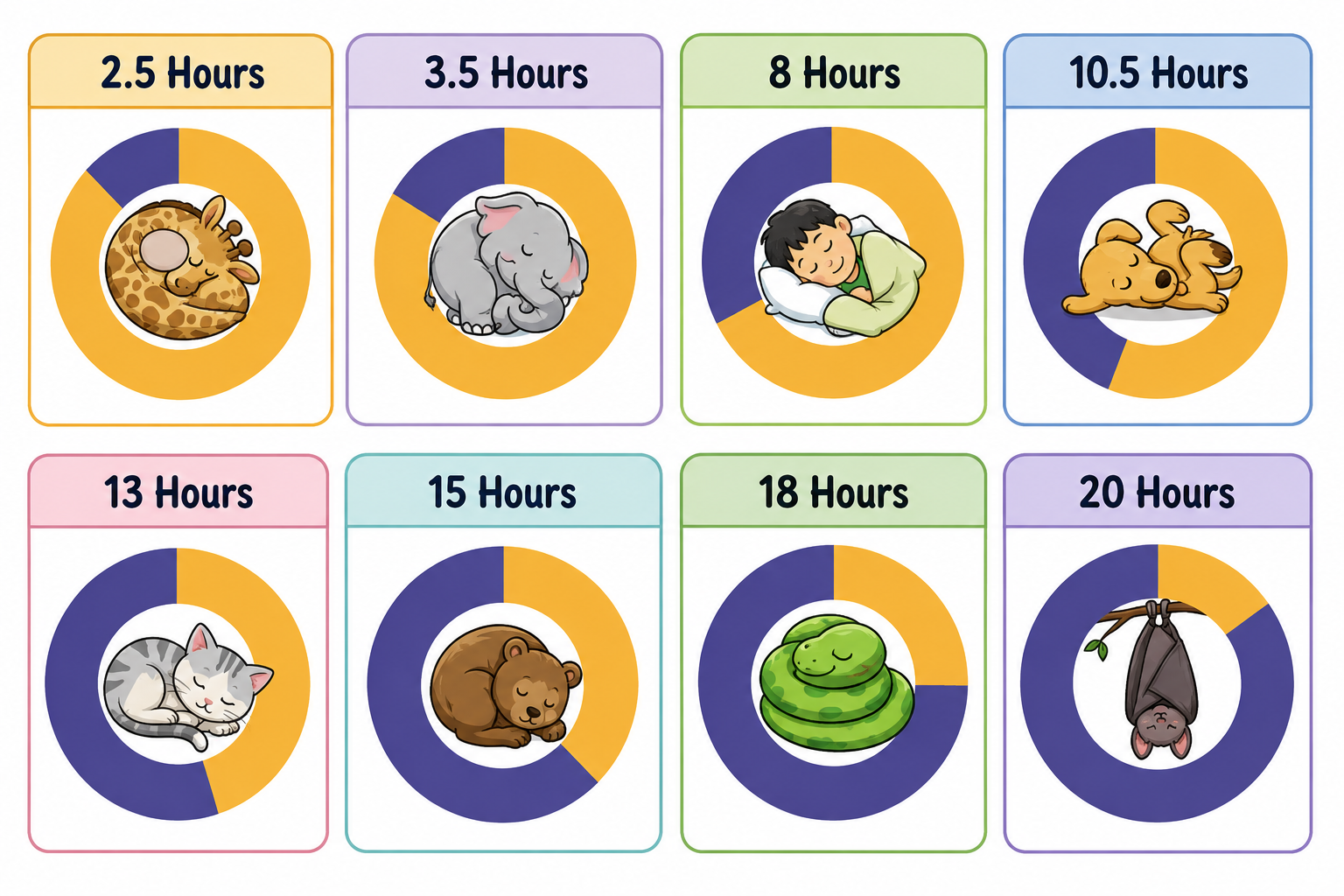
Question 4. Fill in the average number of hours each living being sleeps in a day by looking at the charts. Select the appropriate hours from this list: 15, 2.5, 20, 8, 3.5, 13, 10.5, 18.
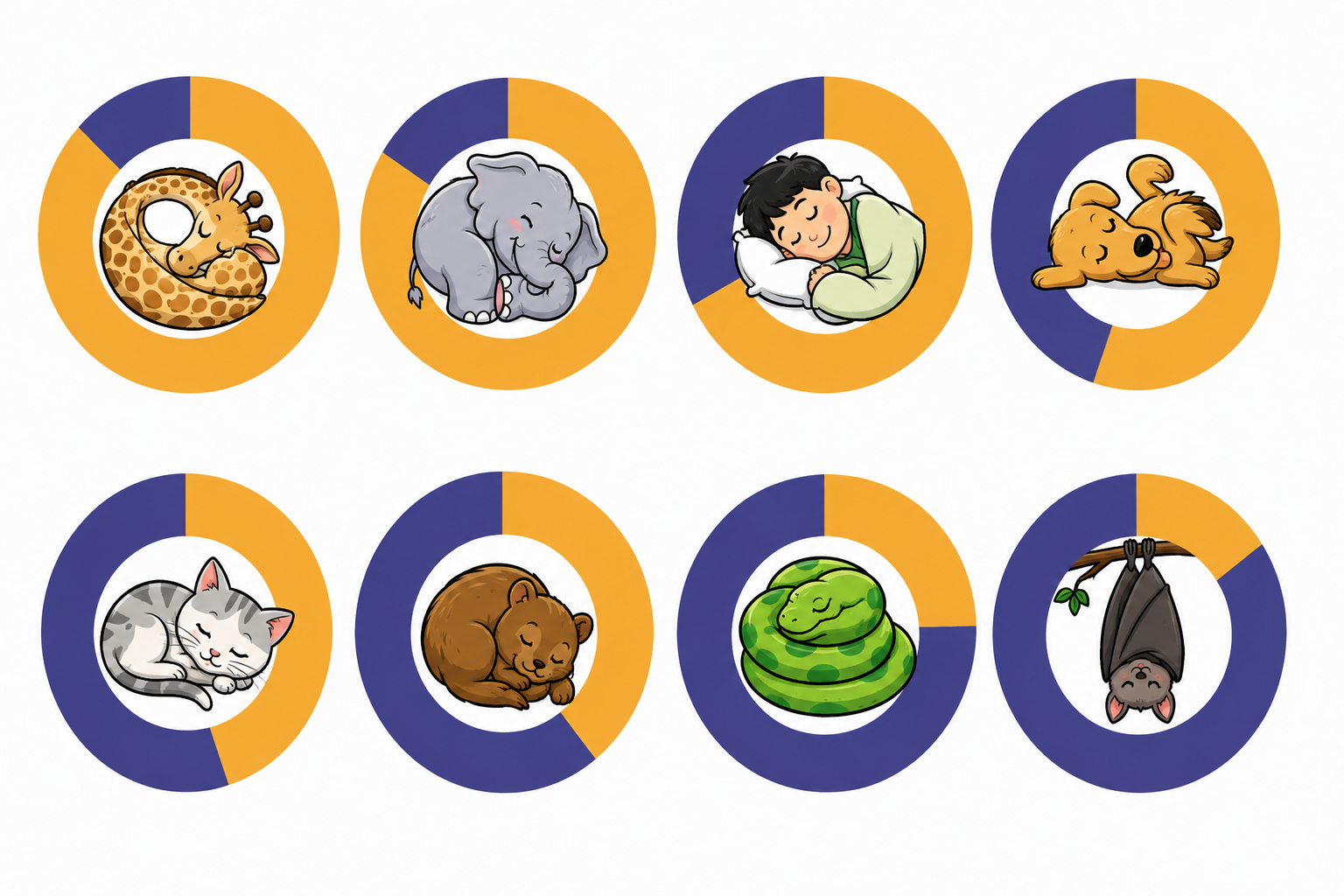
$\textbf{Answer:}$
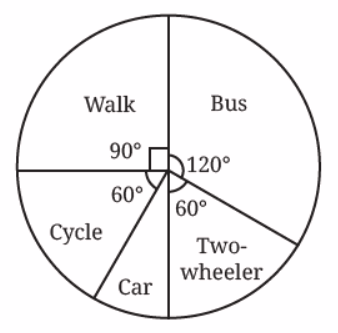
Question 5. The pie chart on the right shows the result of a survey carried out to find the modes of transport used by children to go to school. Study the pie chart and answer the following questions.
(i) What is the most common mode of transport?
(ii) What fraction of children travel by car?
(iii) If 18 children travel by car, how many children took part in the survey? How many children use taxis to travel to school?
(iv) By which two modes of transport are equal numbers of children travelling?
$\textbf{Answer:}$
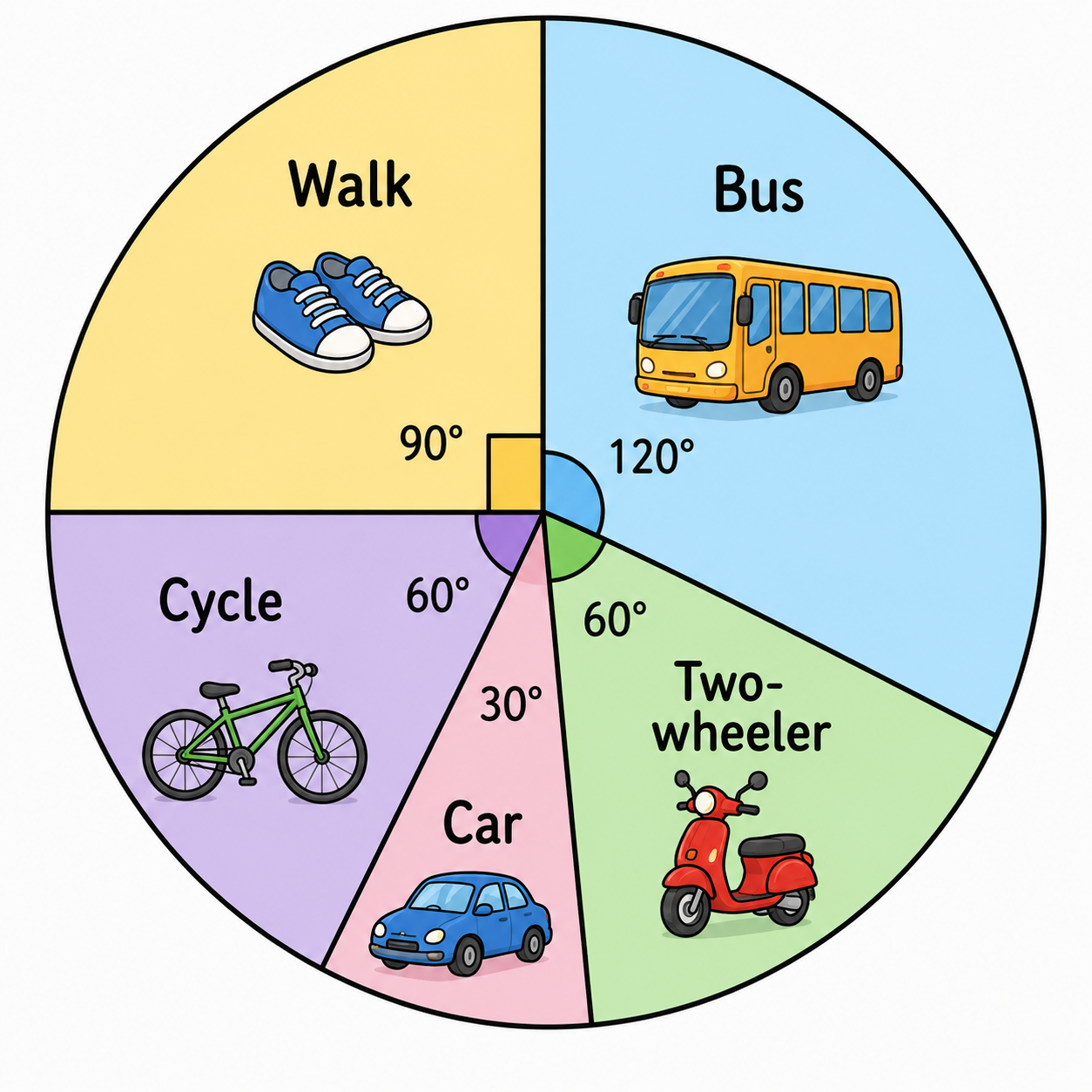
Total = 360°
Walk = 90°
Bus = 120°
Cycle = 60°
Two-wheeler = 60°
Car = 360° − (90° + 120° + 60° + 60°) = 30°
5 (i): Bus
$\textbf{Explanation:}$
Bus = 120°, which is the maximum.
Hence, bus is the most common mode of transport.
5 (ii): $\frac{1}{12}$
$\textbf{Explanation:}$
Children travel by car = 30°
$\therefore$ Required fraction = $\frac{30°}{360°}=\frac1{12}$
(iii) 600 and 50
$\textbf{Explanation:}$
Given: 18 children travel by car, which equals 30°.
So, 1° is equivalent to $\frac{30}{18}=\frac53$
So, the total number of children that took part in the survey $=\frac53\times360=600$
Number of students who took taxis $=\frac53\times30=50$
(iv) Cycles and two-wheelers
$\textbf{Explanation:}$
Cycles and two-wheelers have equal numbers of children travelling, as both have a part in the pie chart, i.e., 60°.
Question 6. Three workers can paint a fence in 4 days. If one more worker joins the team, how many days will it take them to finish the work? What are the assumptions you need to make?
$\textbf{Answer:}$ 3 days
$\textbf{Explanation:}$
3 workers can paint a fence in 4 days.
We know that Total Work = Workers × Days $=3\times4=12$ days
Therefore, (3 + 1) = 4 workers can paint a fence in
$\text{Days} = \frac{\text{Total Work}}{\text{Total Workers}} = \frac{12}{4} = 3 \text{ days}$
Hence, it will take 3 days to finish the work.
Assumptions:
Question 7. It takes 6 hours to fill 2 tanks of the same size with a pump. How long will it take to fill 5 such tanks with the same pump?
$\textbf{Answer:}$ 15 hours
$\textbf{Explanation:}$
It takes 6 hours to fill 2 tanks of the same size with a pump.
So, the time to fill 1 tank $=\frac62=3$ hours
Then, the time to fill 5 such tanks $=5\times3=15$ hours
Hence, it will take 15 hours to fill 5 tanks.
Question 8. A given set of chairs are arranged in 25 rows, with 12 chairs in each row. If the chairs are rearranged with 20 chairs in each row, how many rows does this new arrangement have?
$\textbf{Answer:}$ 15 rows
$\textbf{Explanation:}$
Total chairs = Number of rows × Number of chairs in each row = 25 × 12 = 300
Now, there are 20 chairs in each row.
$\therefore$ Number of rows = $\frac{300}{20}=15$
Hence, there are 15 rows in this new arrangement.
Question 9. A school has 8 periods a day, each of 45 minutes duration. How long is each period, if the school has 9 periods a day, assuming that the number of school hours per day stays the same?
$\textbf{Answer:}$ 40 minutes
$\textbf{Explanation:}$
Total class hours = Number of periods × Duration of a period = 8 × 45 = 360 minutes
Now, there are 9 periods.
$\therefore$ Duration of each period = $\frac{360}9=40$ minutes
Hence, 40 minutes is the duration of a new period.
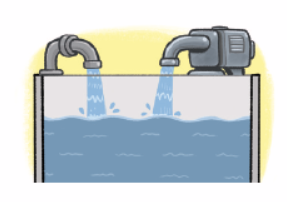
Question 10. A small pump can fill a tank in 3 hours, while a large pump can fill the same tank in 2 hours. If both pumps are used together, how long will the tank take to fill?
$\textbf{Answer:}$ 72 minutes or 1 hour 12 minutes
$\textbf{Explanation:}$
A small pump can fill a tank in 3 hours.
In 1 hour, it will fill $\frac13$ part of the tank.
A large pump can fill the same tank in 2 hours.
In 1 hour, it will fill $\frac12$ part of the tank.
Together in 1 hour, they will fill $\frac13+\frac12=\frac56$
Therefore, together they will take $\frac1{\frac56}=\frac65$ hours to fill the tank.
$\frac65$ hours = $\frac65\times60=72$ minutes or 1 hour 12 minutes
Hence, both pumps together will take 1 hour 12 minutes or 72 minutes to fill the tank.
Question 11. A factory requires 42 machines to produce a given number of toys in 63 days. How many machines are required to produce the same number of toys in 54 days?
$\textbf{Answer:}$ 49
$\textbf{Explanation:}$
We know that $M_1D_1=M_2D_2$, where $M_1, M_2$ are the number of machines produced, and $D_1, D_2$ are the number of required days.
So, $42\times63=M_2\times54$
$\therefore M_2=49$
Hence, 49 machines are required to produce the same number of toys in 54 days.
Question 12. A car takes 2 hours to reach a destination, travelling at a speed of $60 \mathrm{~km} / \mathrm{h}$. How long will the car take if it travels at a speed of $80 \mathrm{~km} / \mathrm{h}$?
$\textbf{Answer:}$ 1.5 hours
$\textbf{Explanation:}$
We know that Distance = Speed × Time
So, total distance = 60 × 2 = 120 km
Now, the speed is 80 km/hr.
Time $=\frac{\text { Distance }}{\text { Speed }}=\frac{120}{80}=\frac32=1.5$ hours or 1 hour 30 minutes
The car will take 1.5 hours or 1 hour and 30 minutes to reach the destination.
Get your results instantly with our calculator!
Topics you will learn in NCERT Solutions for Class 8 Maths Part 2 Chapter 3 Proportional Reasoning - 2 include:
3.1 Proportionality - A Quick Recap
3.2 Ratios in Maps
3.3 Ratios with More than 2 Terms
3.4 Dividing a Whole in a Given Ratio
3.5 A Slice of the Pie
3.6 Inverse Proportions
Question 1:
A camp of soldiers has food for 200 days. After 20 days, 100 more soldiers join the camp, and the food can now last for 80 days. What was the initial number of soldiers in the camp?
$\textbf{Answer:}$
Let the initial number of soldiers be $x$ and the initial number of days the food could last for 200
Food Supply = the number of soldiers × the number of days = $x×200$
After 20 days, food for (200 – 20) = 180 days remained for $x$ soldiers.
So, $x×180 = (x+100)×80$
⇒ $100x = 800$
⇒ $x = 80$
Hence, the correct answer is 80.
Question 2:
Pipes P and Q can fill a tank in 12 hours and 36 hours, respectively. If both pipes are opened, then how much time (in hours) will it take to fill the tank?
$\textbf{Answer:}$
We have,
Pipes P and Q can fill a tank in 12 hours and 36 hours.
Part filled by P in 1 hour = $\frac{1}{12}$
Part filled by Q in 1 hour = $\frac{1}{36}$
Part filled by both P and Q together in 1 hour = $\frac{1}{12}+\frac{1}{36}$ = $\frac{3+1}{36}$ = $\frac{4}{36}$ = $\frac{1}{9}$
The total time needed to fill the tank by P and Q is 9 hours.
Hence, the correct answer is 9.
Question 3:
Three numbers are in the ratio of 1 : 2 : 3. The product of the three numbers is 1296. What is the sum of the three numbers?
$\textbf{Answer:}$
The ratio of three numbers = 1 : 2 : 3
Product of three numbers = 1296
Let the numbers be $x, 2x$ and $3x$.
Product of three numbers $= x × 2x × 3x = 6x^3$
So, 6x$^3$ = 1296
⇒ $x^3 = \frac{1296}{6} = 216$
⇒ $x = 6$
So, First number $= x = 6$
Second Number $= 2x = 2 × 6 = 12$
Third Number $= 3x = 3 × 6 = 18$
So, the sum of all numbers = 6 + 12 + 18 = 36
Hence, the correct answer is 36.
Question 4:
The following pie chart shows the percentage number of students who play different sports.
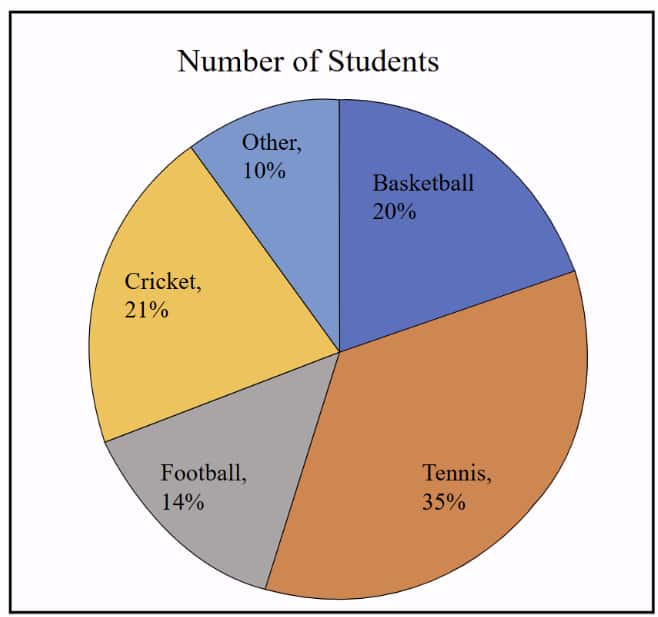
If the total number of students is 500, then how many students play cricket?
$\textbf{Answer:}$
Given: The total number of students is 500.
The number of students who play cricket is 21% of 500 = $\frac{21}{100}$ × 500 = 105
Hence, the correct answer is 105.
Question 5:
The following pie chart shows results from a survey of 160 kids about their favourite desserts.
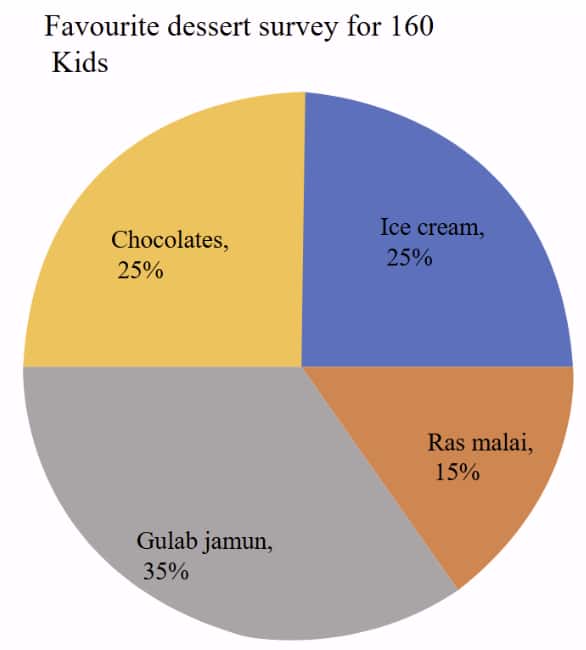
What is the number of kids who like ice cream?
$\textbf{Answer:}$
Total kids in the survey = 160
Kids who likes icecream = 25%
So, the number of kids who like ice cream $= \frac{25}{100}\times160 = 40$
Hence, the correct answer is 40.
We at Careers360 compiled all the latest NCERT Class 8 Maths solutions based on latest textbook in one place for easy student reference. The following links will allow you to access them.
|
NCERT Solutions for Class 8 Maths Part 2 Chapter 1 Fractions in Disguise |
|
NCERT Solutions for Class 8 Maths Part 2 Chapter 2 The Baudhayana-Pythagoras Theorem |
|
NCERT Solutions for Class 8 Maths Part 2 Chapter 3 Proportional Reasoning - 2 |
|
NCERT Solutions for Class 8 Maths Part 2 Chapter 4 Exploring Some Geometric Themes |
|
NCERT Solutions for Class 8 Maths Part 2 Chapter 5 Tales by Dots and Lines |
|
NCERT Solutions for Class 8 Maths Part 2 Chapter 6 Algebra Play |
|
NCERT Solutions for Class 8 Maths Part 2 Chapter 7 Area |
Before planning a study schedule, always analyse the latest syllabus. Here are the links to the latest NCERT syllabus and some of the important books that will help students in this cause.
The chapter NCERT Part 2 Chapter 3 Proportional Reasoning 2 is based on the basic concepts of ratios and proportions that were learned previously in the part 1. This chapter starts with a quick revision of proportionality and strengthens the understanding of equivalent ratios among students. NCERT Solutions for Class 8 Maths Ganita Prakash Part 2 Chapter 3 introduces ratios of more than two quantities and explains their real-life applications. This chapter also explains inverse proportion and how one quantity changes when the other quantity changes in the opposite direction.
This chapter contains 4 exercises with a total of 22 questions for practice.
These NCERT solutions are explained step by step in an easy approach to make the concept of ratios and proportions understandable for all kinds of students.
Also,
Here are the concepts and topics that are related to the latest NCERT Solutions for Class 8 Maths Ganita Prakash Part 2 Chapter 3 in higher classes.
Class 9-10
Direct and inverse proportion
Ratio and proportion
Variation and unitary method
Speed, time and distance
Work and time
Scaling and map problems
Applications of proportional reasoning in geometry and mensuration
Real-life word problems involving proportional relationships
Class 11-12
Variation and functional relationships
Linear equations and graphs
Coordinate geometry applications
Rates of change and proportional models
Trigonometric ratios and proportionality
Applications in physics and statistics
JEE (Main & Advanced)
Ratio, proportion, and variation concepts
Time and work problems
Speed, time and distance applications
Functional relationships and graphs
Trigonometric proportionality
Coordinate geometry applications
Mathematical modelling and problem-solving
Quantitative aptitude and data interpretation based on proportional reasoning
Frequently Asked Questions (FAQs)
Proportional reasoning is the ability to understand and compare quantities using ratios and proportions. It helps us solve real-life problems involving comparisons, scaling, sharing, maps, speed, and measurements.
In direct proportion, when one quantity increases, the other quantity also increases in the same ratio.
In inverse proportion, when one quantity increases, the other decreases proportionally.
It is used in map reading, business, construction, recipe preparation, and time-management problems.
It builds a strong foundation for algebra, geometry, statistics, and higher mathematics.

A block of mass 0.50 kg is moving with a speed of 2.00 ms-1 on a smooth surface. It strikes another mass of 1.00 kg and then they move together as a single body. The energy loss during the collision is
| Option 1)
|
Option 2)
|
| Option 3)
|
Option 4)
|
An athlete in the olympic games covers a distance of 100 m in 10 s. His kinetic energy can be estimated to be in the range
| Option 1)
|
Option 2)
|
| Option 3)
|
Option 4)
|
A particle is projected at 600 to the horizontal with a kinetic energy . The kinetic energy at the highest point
| Option 1)
|
Option 2)
|
| Option 3)
|
Option 4)
|
In the reaction,
| Option 1)
|
Option 2)
|
| Option 3)
|
Option 4)
|
How many moles of magnesium phosphate, will contain 0.25 mole of oxygen atoms?
| Option 1)
0.02 |
Option 2)
3.125 × 10⁻² |
| Option 3)
1.25 × 10⁻² |
Option 4)
2.5 × 10⁻² |

Law Admissions 2026 Open | Avail Merit-Based Scholarships
BBA/MBA/PGDM Early Bird Applications Deadline 06th Nov'26. Apply now using coupon code CAREER250 and get ₹250 off the application fee
Ranked #36 amongst institutions in Management by NIRF | 100% Placement
Globally Recognized by AACSB (US) & AMBA (UK) | 18 LPA Avg. CTC for PGPM 2026
NEET PG All India & State College Predictor with Admission Process Guide
Top B-School: Ranked #9 in NIRF Management Rankings 2025.