KCC Institute of Legal and Higher Education, Greater Noida
Law Admissions 2026 Open | Avail Merit-Based Scholarships


Geometry is an important branch of Mathematics and it plays a very important role in improving geometry among students. NCERT Solutions for Class 8 Maths Part 2 Chapter 7 Area helps students to explore the world of areas of various important geometrical figures like rhombus, trapezium, parallelogram and many more. Along with this, it revisits the topics which are already learned like areas of rectangles, squares and triangles. These NCERT solutions for Class 8 have the main objective to serve as an important study resource for students to prepare and revise effectively.
This Story also Contains
These NCERT solutions are updated in accordance with the latest CBSE curriculum. Teachers with multiple years of experience have prepared these solutions keeping in mind the needs of students. Step by step explanations along with relevant pictures have been provided to make the learning easier. Students can also download a PDF of the solutions for offline study purposes from this article. These are also some extra questions, chapter summaries and expert reviews added in this article which will help students immensely in their preparation for the Class 8 final exam and also in future studies.
Students can download the NCERT Solutions for Class 8 Maths Part 2 Chapter 7 Area PDF by clicking the link provided below.
Here are the NCERT Solutions for Class 8 Maths Part 2 Chapter 7 Area question answers with clear and detailed solutions.
Class 8 Maths Part 2 Chapter 7 Question Answers with Detailed Solutions
|
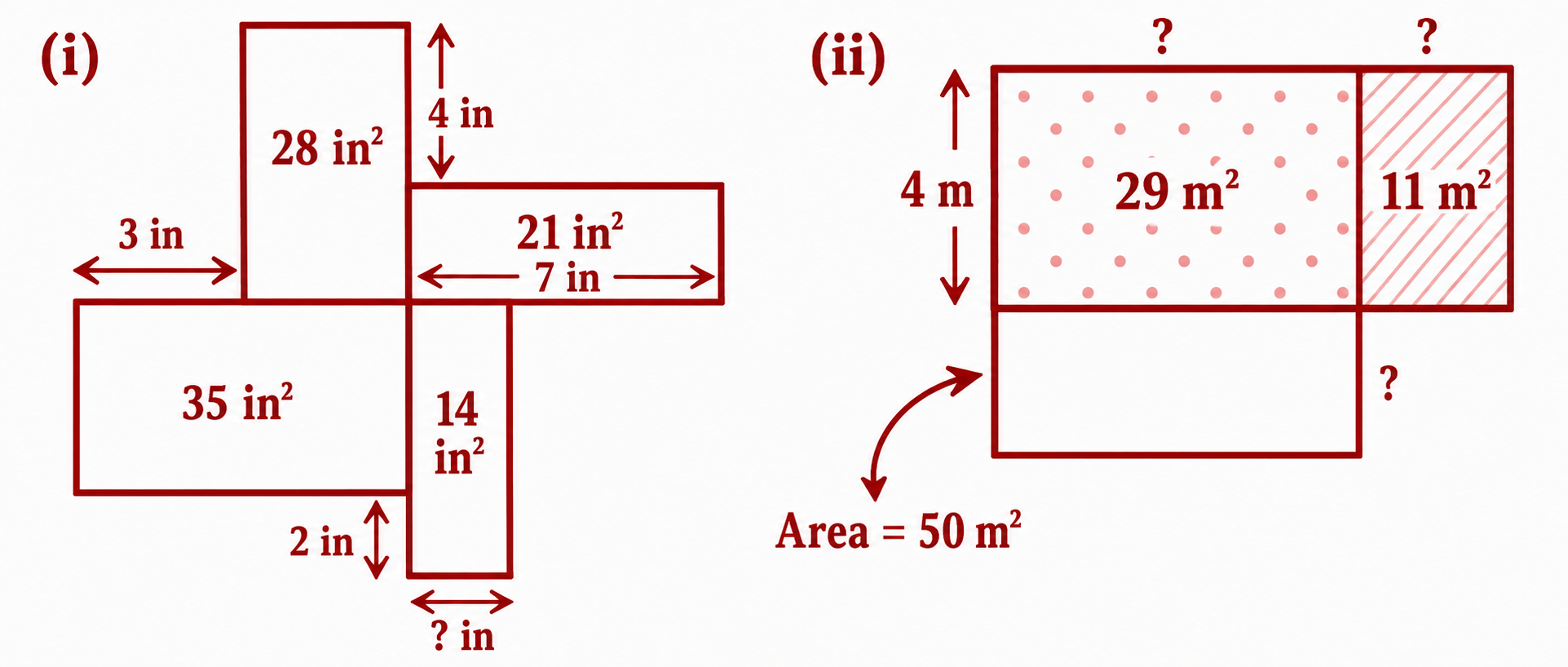
Question 1: Identify the missing sidelengths.
$\textbf{Answer:}$
1(i): 2 inch
$\textbf{Explanation:}$
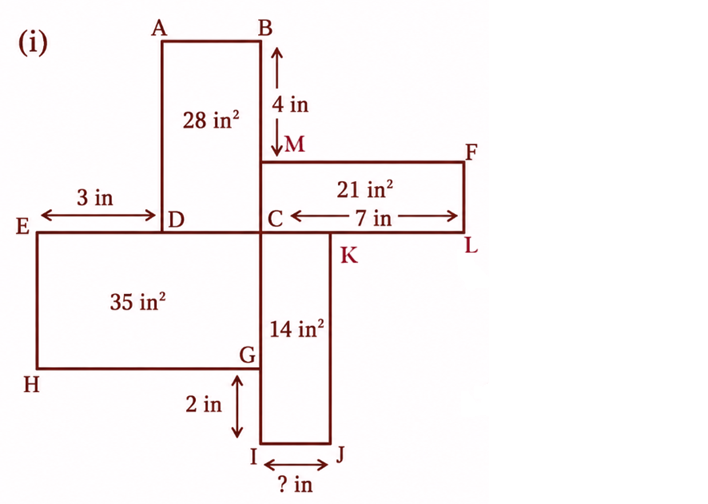
In the rectangle MFLC, Area is 21 $\text{inch}^2$ and Width = 7 inch
So, length = $\frac{21}7=3$ inch
Therefore, FL = MC = 3 inch
So, BC = 4 + 3 = 7 inch
In the rectangle ABCD, Area is 28 $\text{inch}^2$ and Length = 7 inch
So, width = $\frac{28}7=4$ inch
Therefore, AB = DC = 4 inch
Now, CE = DC + DE = 4 + 3 = 7 Inch
In the rectangle ECGH, Area is 35 $\text{inch}^2$ and Width = 7 inch
So, length $=\frac{35}7=5$ inch
Therefore, EH = CG = 5 Inch
Now, CI = CG + GI = 5 + 2 = 7 Inch
In the rectangle CKJI, Area is 14 $\text{inch}^2$ and Length = 7 inch
So, width $=\frac{14}7=2$ inch
Therefore, IJ = 2 inch
1(ii):
AB = $\frac{29}4$ m, BC = $\frac{11}4$ m, EF = $\frac{84}{29}$ m
$\textbf{Explanation:}$
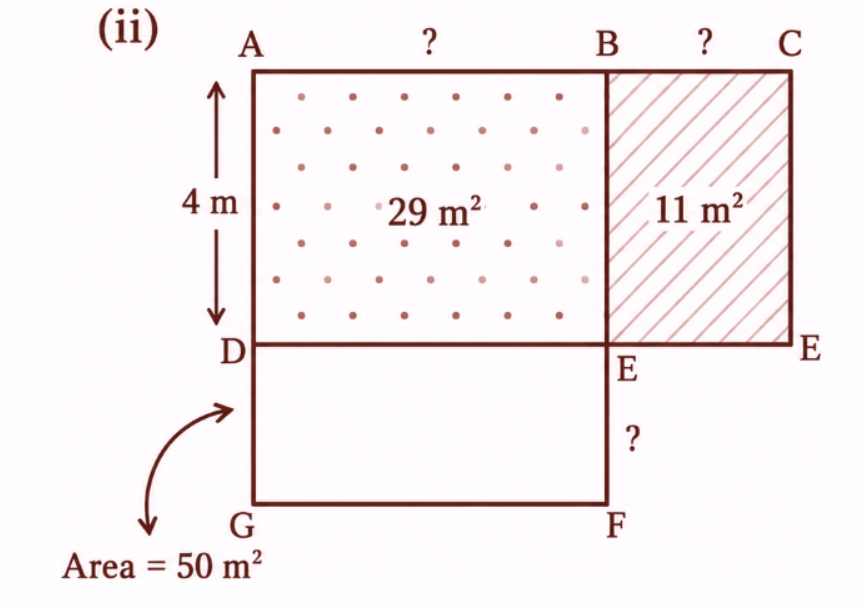
In the rectangle ABED, Area is 29 $\text{m}^2$ and Length = 4 m
So, width $=\frac{29}4$ m
Therefore, AB $=\frac{29}4$ m
Now, AD = BE = 4 m
In the rectangle BCHE, Area is 11 $\text{m}^2$ and Length = 4 m
So, width $=\frac{11}4$ m
Therefore, BC $=\frac{11}4$ m
AB = DE = $\frac{29}4$ m
Area of Rectangle ABFG = 50 $\text{m}^2$
⇒ Area of Rectangle ABED + Area of Rectangle DEFG = 50 $\text{m}^2$
⇒29 + Area of Rectangle DEFG = 50 $\text{m}^2$
⇒ Area of Rectangle DEFG = 50 - 29 = 21 $\text{m}^2$
In the rectangle DEFG, Area is 21 $\text{m}^2$ and Width = $\frac{29}4$ m
So, length = $\frac{21}{\frac{29}4}=\frac{84}{29}$ m
Therefore, EF $=\frac{84}{29}$ m
Question 2: The figure shows a path (the shaded portion) laid around a rectangular park EFGH.
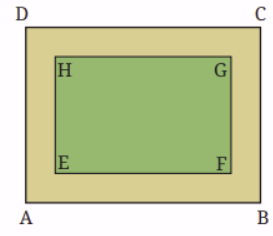
(i) What measurements do you need to find the area of the path? Once you identify the lengths to be measured, assign possible values of your choice to these measurements and find the area of the path. Give a formula for the area. An example of a formula — Area of a rectangle = length × width.
[Hint: There is a relation between the areas of EFGH, the path, and ABCD.]
(ii) If the width of the path along each side is given, can you find its area? If not, what other measurements do you need? Assign values of your choice to these measurements and find the area of the path. Give a formula for the area using these measurements.
[Hint: Break the path into rectangles.]
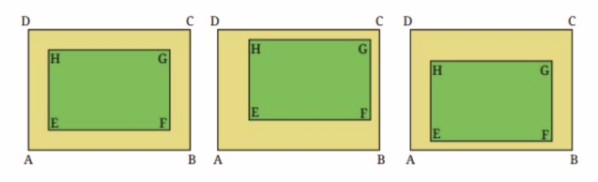
(iii) Does the area of the path change when the outer rectangle is moved while keeping the inner rectangular park EFGH inside it, as shown?
$\textbf{Answer:}$
2(i):
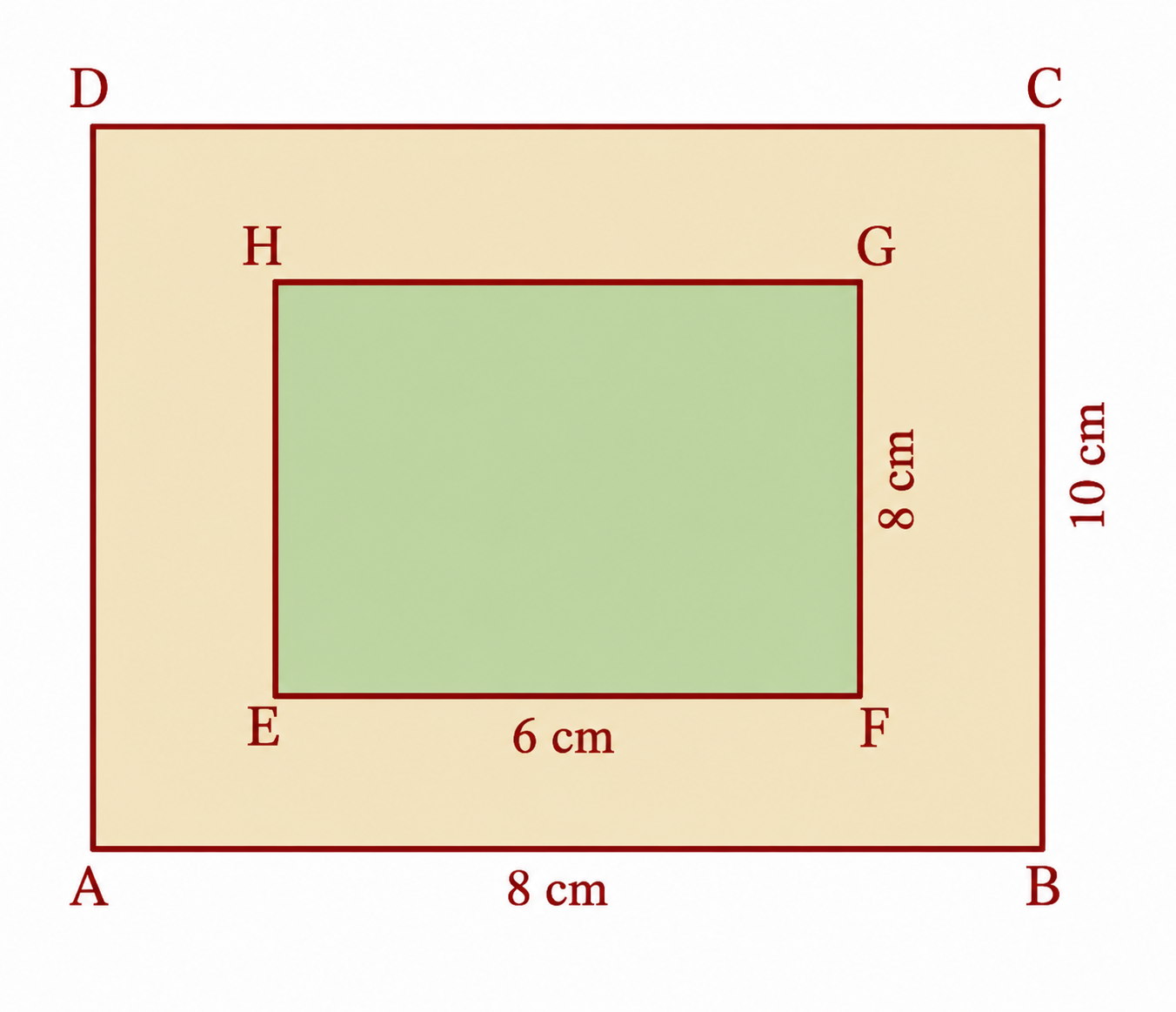
Here, the length and width of the outer rectangle ABCD are 10 cm and 8 cm, respectively.
So, area of the outer rectangle = 10 × 8 = 80 $\text{cm}^2$
Length and width of the inner rectangle EFGH are 8 cm and 6 cm, respectively.
So, area of the inner rectangle = 8 × 6 = 48 $\text{cm}^2$
$\therefore$ Area of the Pathway
= Area of the outer rectangle - Area of the inner rectangle
= 80 - 48
= 32 $\text{cm}^2$
2(ii):
If the width of the path along each side is only given, then we cannot find its area. Along with its uniform width, we need the dimensions of either the inner or the outer rectangle.
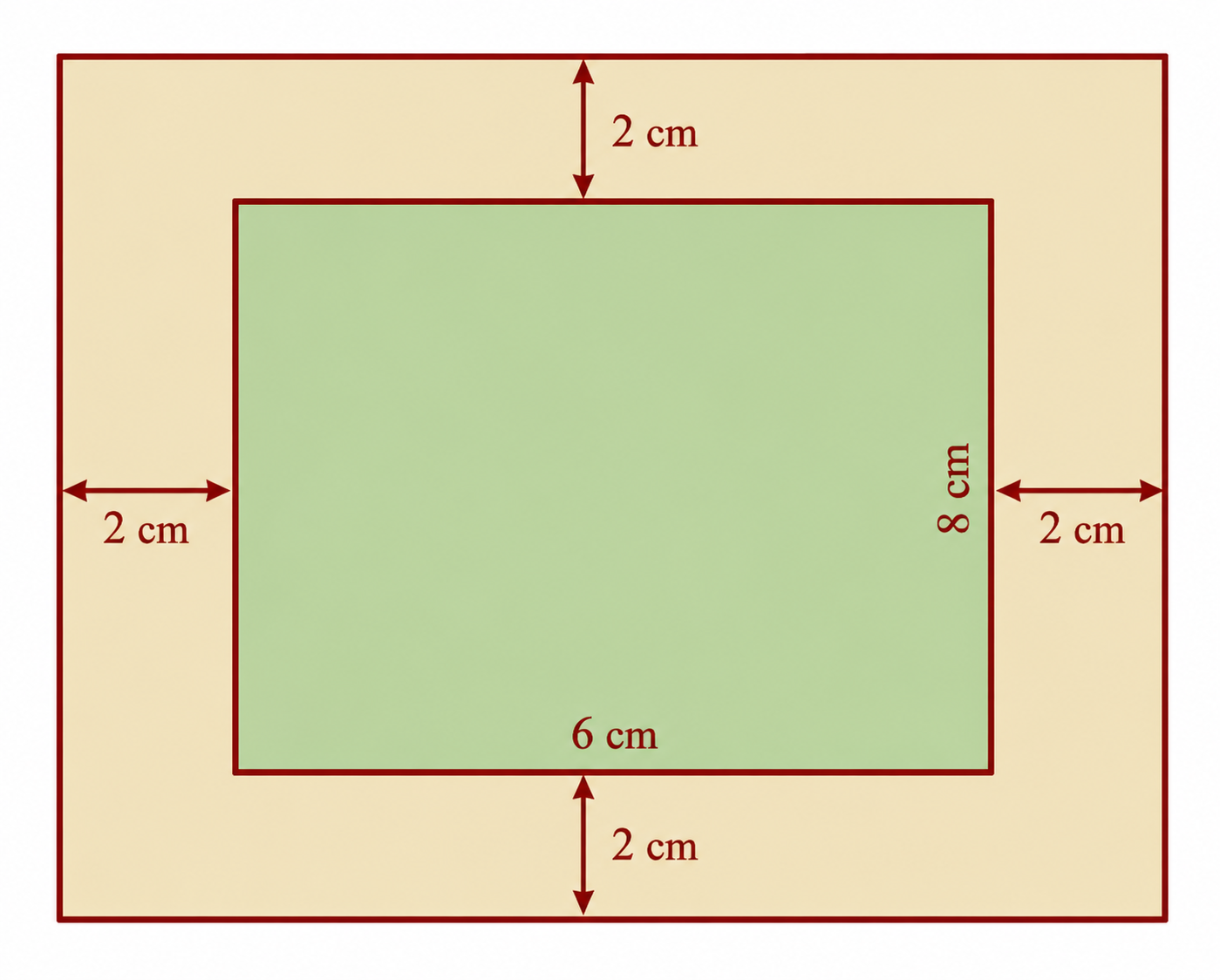
Let the width of the road be 2 cm on all sides.
Length and width of the inner rectangle EFGH are 8 cm and 6 cm, respectively.
So, area of the inner rectangle = 8 × 6 = 48 $\text{cm}^2$
Now, length of the outer rectangle = 8 + (2 × 2) = 12 cm
And width of the outer rectangle = 6 + (2 × 2) = 10 cm
So, area of the outer rectangle = 12 × 10 = 120 $\text{cm}^2$
$\therefore$ Area of the Pathway
= Area of the outer rectangle - Area of the inner rectangle
= 120 - 48
= 72 $\text{cm}^2$
2(iii):
No, the area of the path does not change when the outer rectangle is moved while keeping the inner rectangular park EFGH inside it if the dimensions of the rectangle do not change.
Question 3: The figure shows a plot with sides 14m and 12m, and with a crosspath. What other measurements do you need to find the area of the crosspath? Once you identify the lengths to be measured, assign some possible values of your choice and find the area of the path. Give a formula for the area based on the measurements you choose.
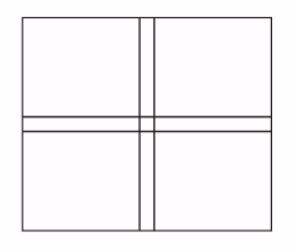
$\textbf{Answer:}$
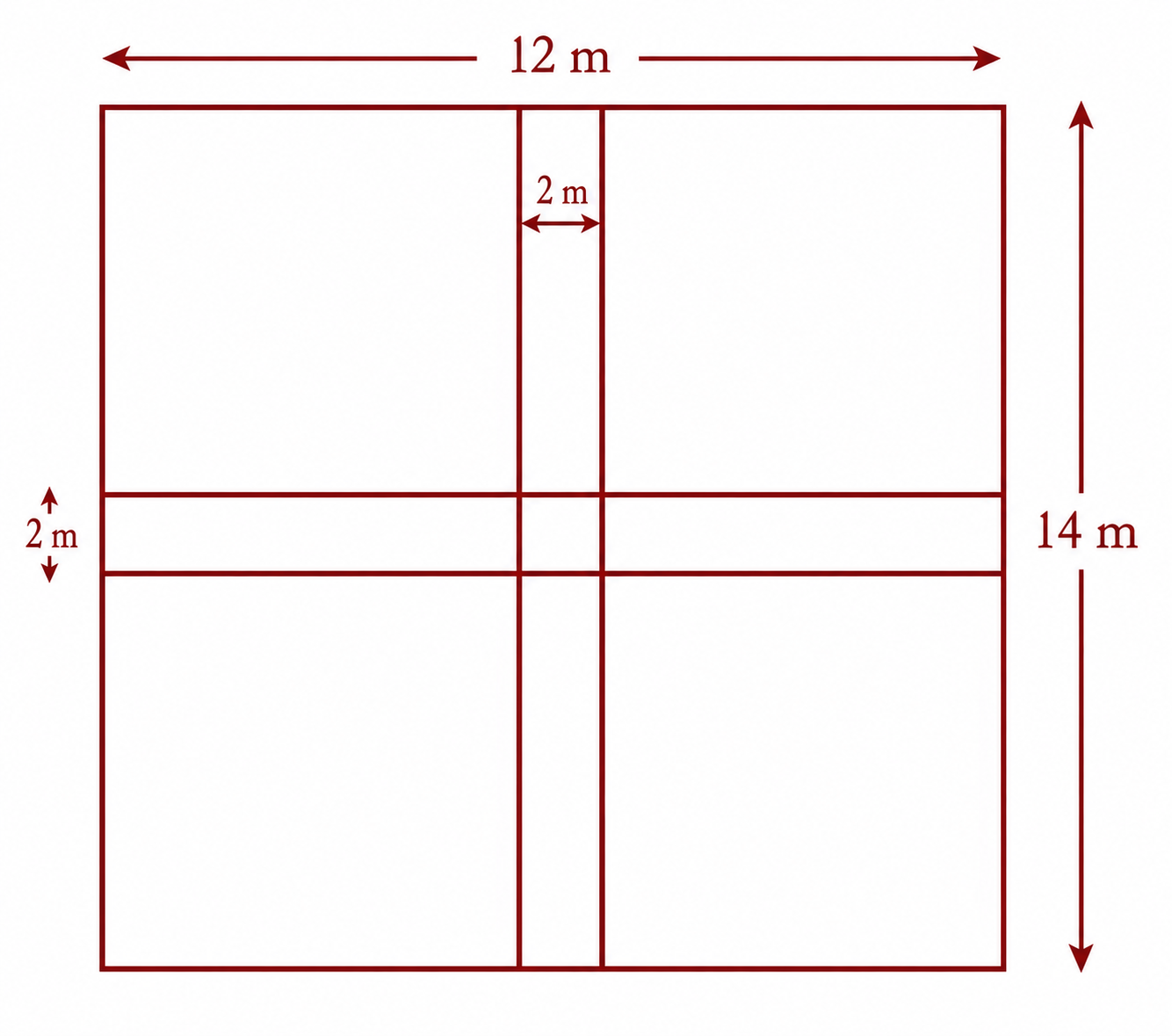
Let the width of the road on the vertical side be 2 m, and the height of the road on the horizontal side be also 2m.
So, the area of the road vertically = 14 × 2 = 28 $\text{m}^2$
Area of the road horizontally = 2 × 12 = 24 $\text{m}^2$
In the middle, the road overlaps.
Overlapping position of the road is a square with a side length of 2 m.
Its area = $2^2=4\ \text{m}^2$
So, area of the road = 28 + 24 - 4 = 48 $\text{m}^2$
Formula:
Area of the road
= (Length of the plot × Vertical width of the road) + (Length of the road horizontally × Width of the plot) + (Vertical width of the road × Length of the road horizontally )
Question 4: Find the area of the spiral tube shown in the figure. The tube has the same width throughout.
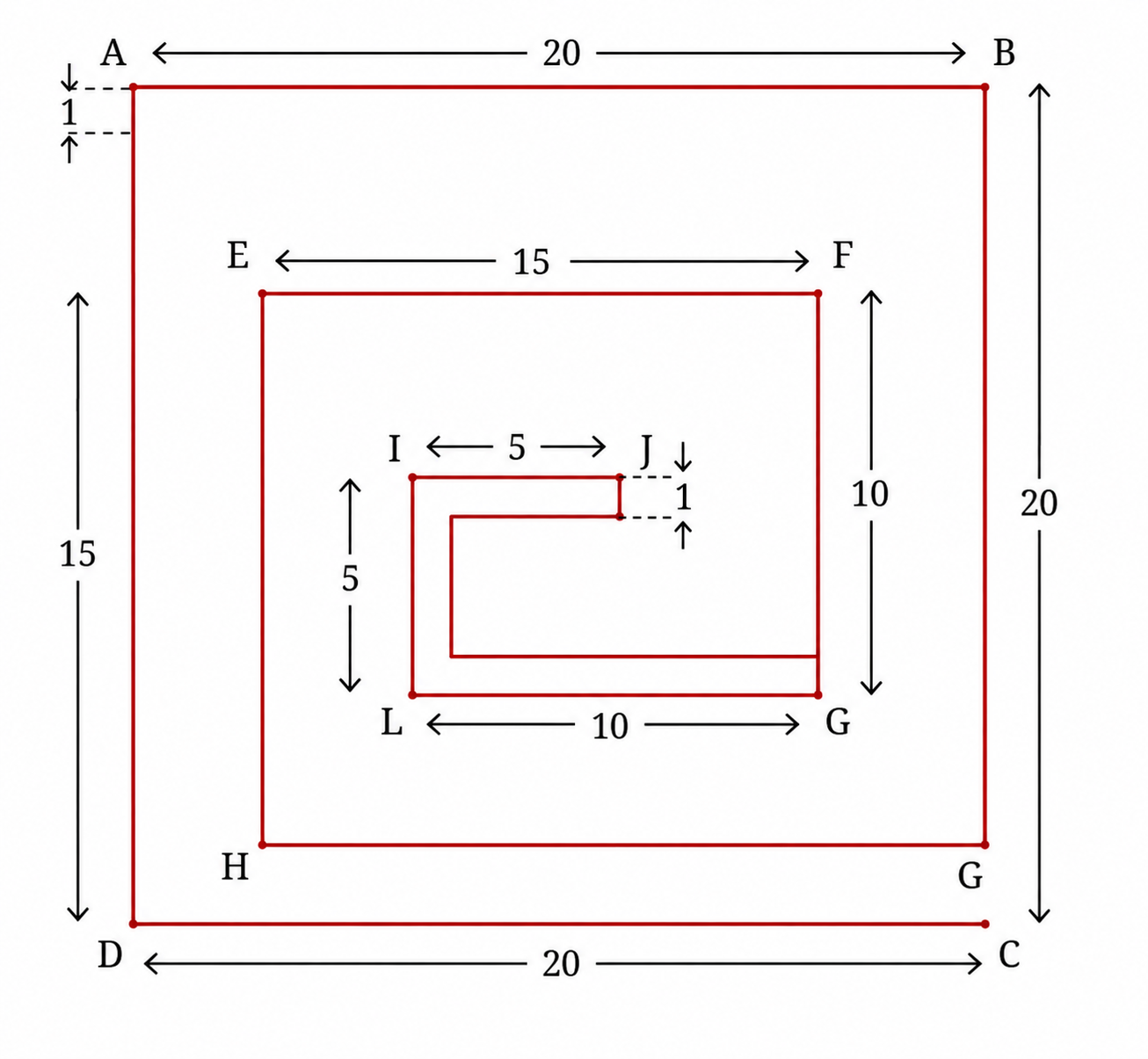
[Hint: There are different ways of finding the area. Here is one method.]
$\textbf{Answer:}$
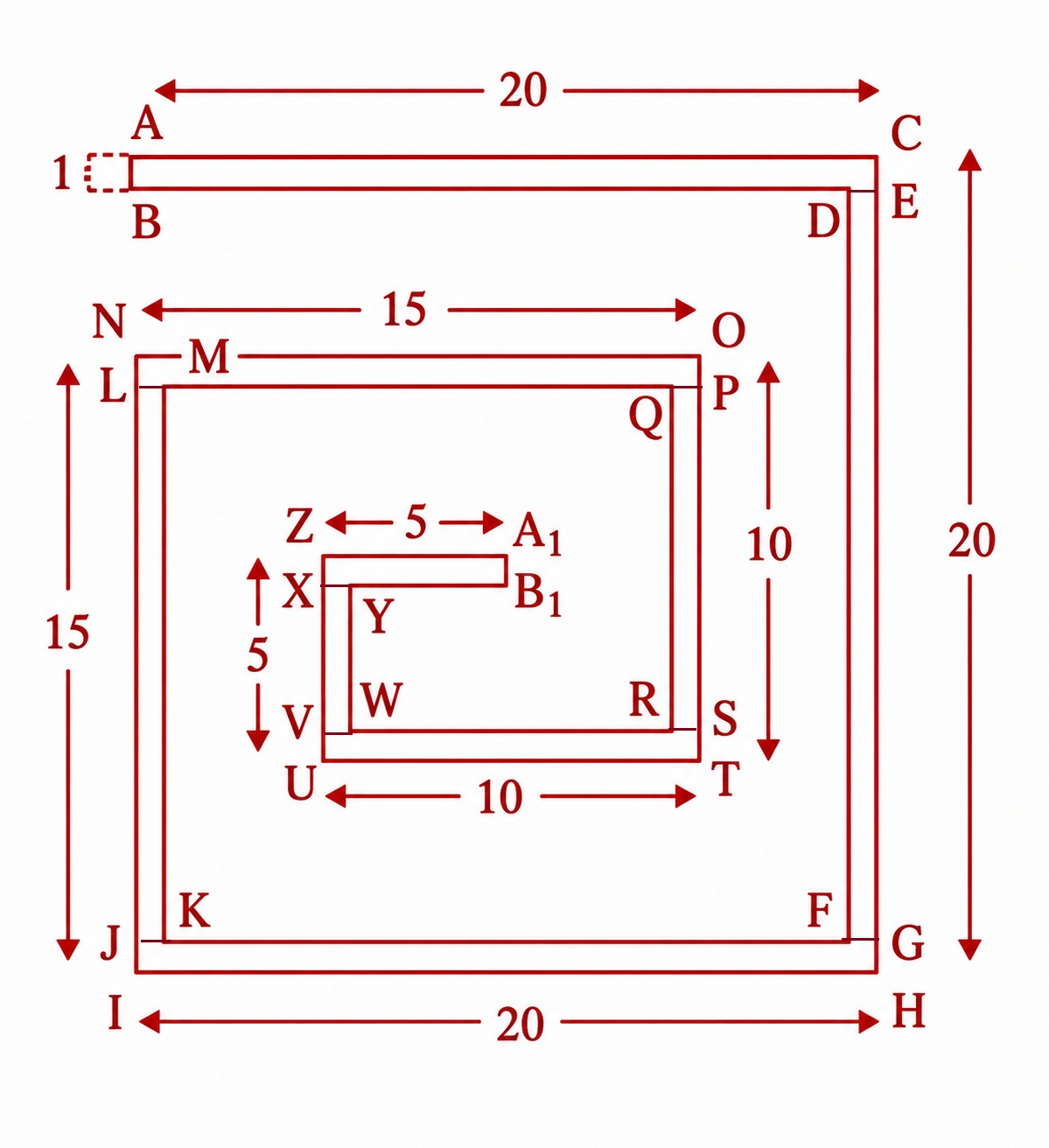
The area of the spiral tube
= Area of the rectangle, ABEC + Area of the rectangle, DEGF + Area of the rectangle, GHIJ + Area of the rectangle, JKML + Area of the rectangle, NOPL + Area of the rectangle, PQRS + Area of the rectangle, STUV + Area of the rectangle, VWYX + Area of the rectangle, $X Z A_1 B_1$
$=A C \times A B+E G \times D E+I H \times J I+L J \times L M+N O \times N L+P Q \times P S+U T \times S T+V X \times V W+ $
$ Z A_1 \times A_1 B_1 $
$ =20 \times 1+18 \times 1+20 \times 1+13 \times 1+15 \times 1+8 \times 1+10 \times 1+3 \times 1+5 \times 1 $
$=20+18+20+13+15+8+10+3+5 =112 \text { sq. units }$
Thus, the area of the spiral tube is 112 sq. units.
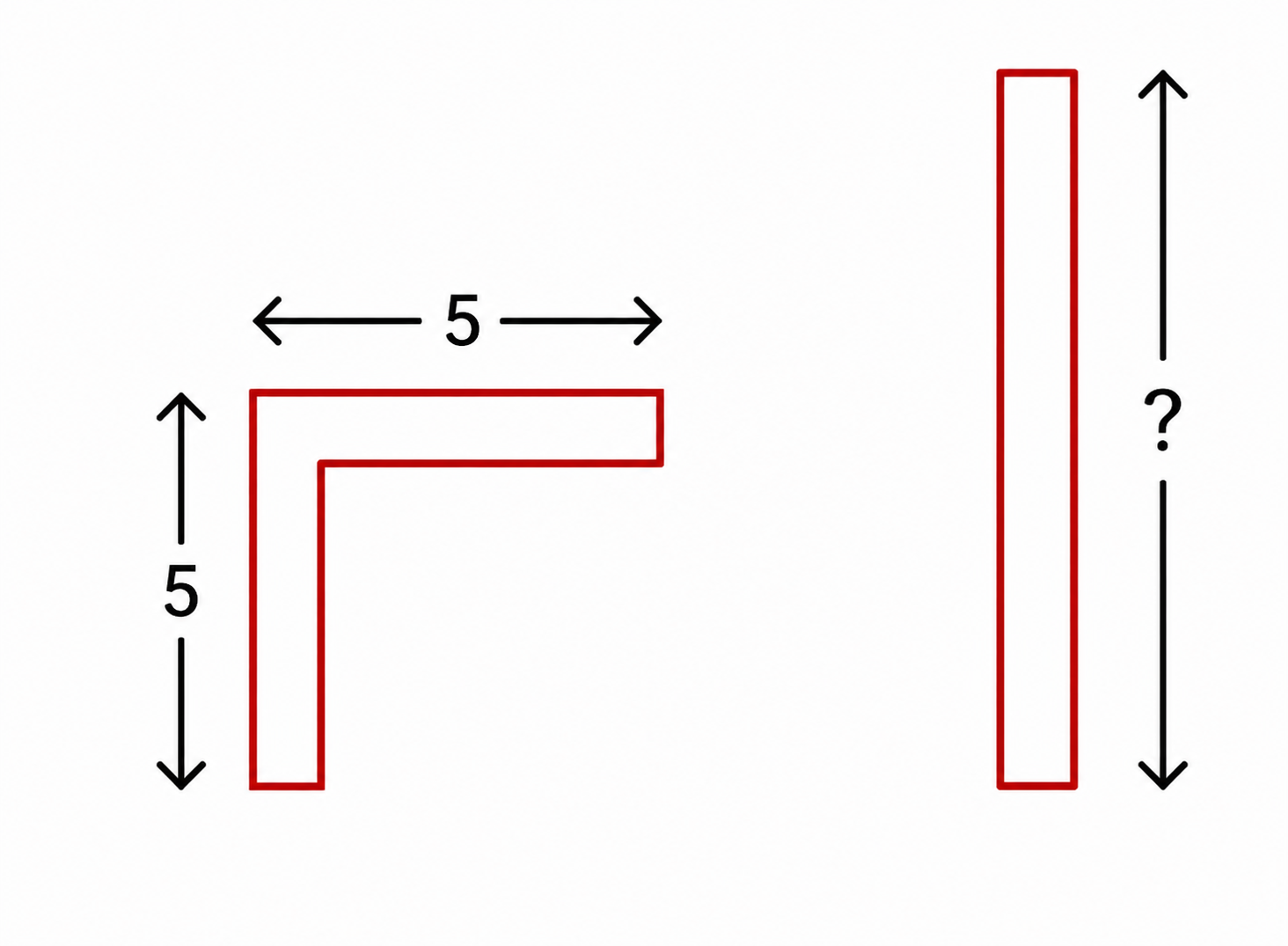
Let the length of the straight tube be $x$.
The area of the bent tube on the left = Area of rectangle BACD + Area of rectangle BGFE
$ =A C \times C D+B G \times B E$
$=5 \times 1+4 \times 1 $
$=9 \text { sq. units }$
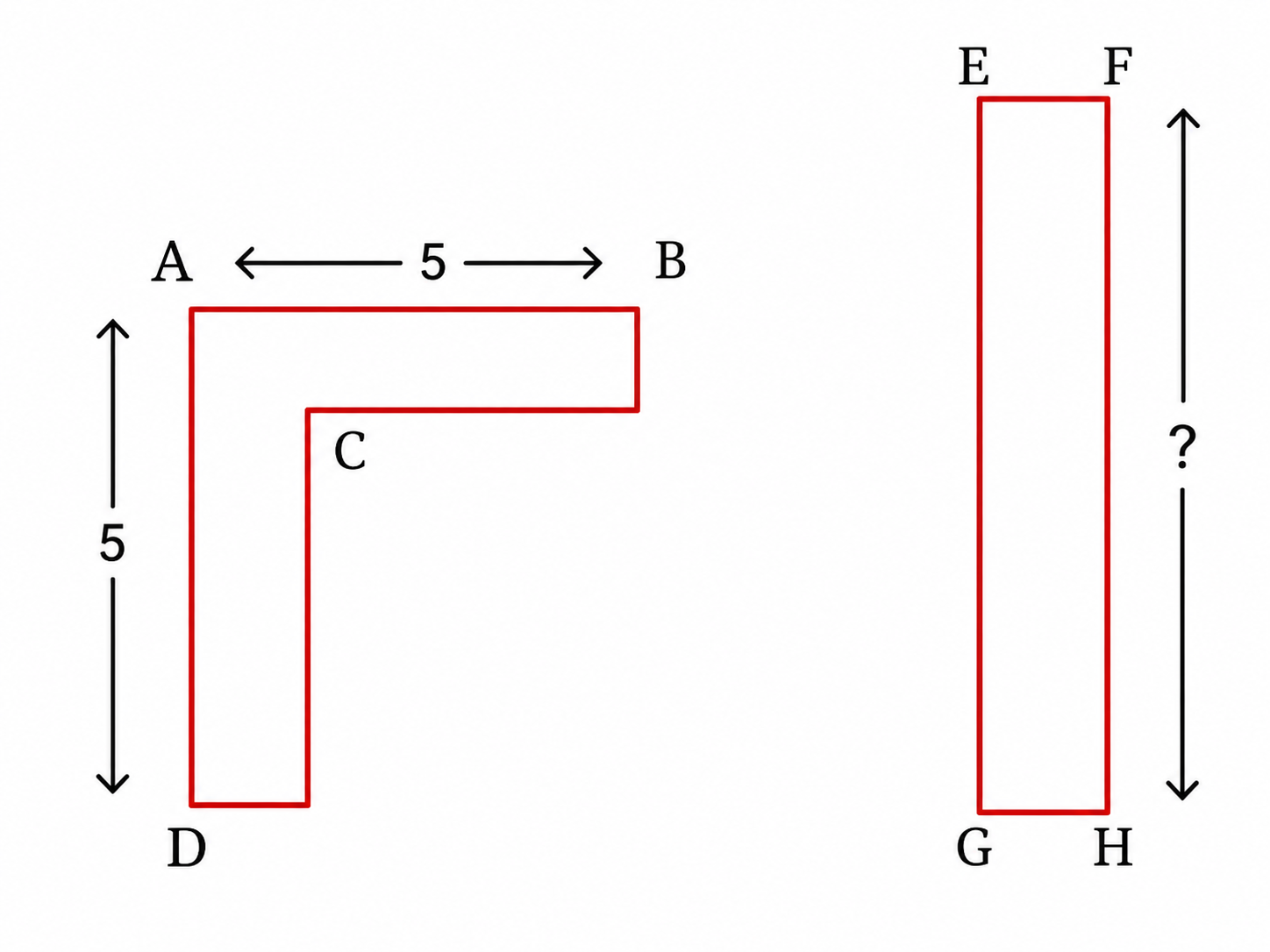
Area of straight tube $=x \times 1$
Area of bent tube $=9$ sq. units
According to the question, both are the same.
So, $x\times 1=9$
$\Rightarrow x=9$ units
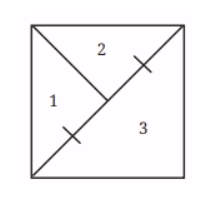
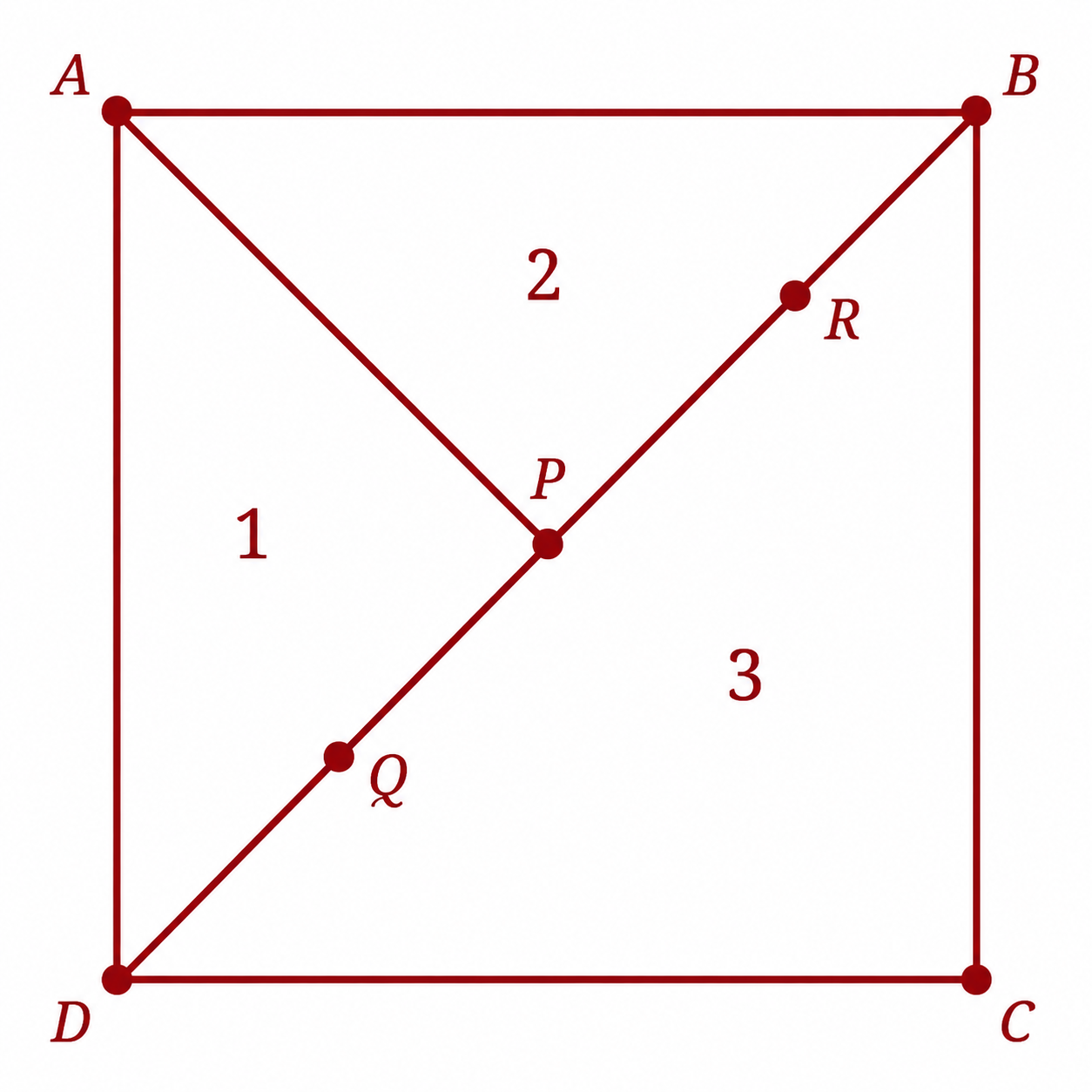
Question 5: In this figure, if the sidelength of the square is doubled, what is the increase in the areas of the regions 1, 2 and 3? Give reasons.
$\textbf{Answer:}$
$\textbf{Answer:}$
Let the original side length of the square be $x$.
The area of the original square $=x^2$
From the geometric markings, region 3 takes up exactly $\frac{1}{2}$ of the square's area, while regions 1 and 2 each take up $\frac{1}{4}$ of the area.
Original Area of Region $1=\frac{1}{4} x^2$
Original Area of Region $2=\frac{1}{4} x^2$
Original Area of Region $3=\frac{1}{2} x^2$
When the side length of the square is doubled, the new side length becomes $2 x$.
New Total Area $=(2 x)^2=4 x^2$
Since the proportions of the regions inside the square remain exactly the same:
⇒ New Area of Region $1=\frac{1}{4}\left(4 x^2\right)=x^2$
⇒ New Area of Region $2=\frac{1}{4}\left(4 x^2\right)=x^2$
⇒ New Area of Region $3=\frac{1}{2}\left(4 x^2\right)=2 x^2$
Now,
⇒ Increase for Region $1=x^2-\frac{1}{4} x^2=\frac{3}{4} x^2$
⇒ Increase for Region $2=x^2-\frac{1}{4} x^2=\frac{3}{4} x^2$
⇒ Increase for Region $3=2 x^2-\frac{1}{2} x^2=\frac{3}{2} x^2$
Comparing the increase to the original values, $\frac{3}{4} x^2=3 \times\left(\frac{1}{4} x^2\right)$ and $\frac{3}{2} x^2=3 \times\left(\frac{1}{2} x^2\right)$.
So, the area of each individual region increases by 3 times its original value.
Question 6: Divide a square into 4 parts by drawing two perpendicular lines inside the square as shown in the figure.
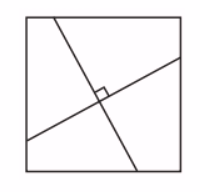
Rearrange the pieces to get a larger square, with a hole inside. You can try this activity by constructing the square using cardboard, thick chart paper, or similar materials.
$\textbf{Answer:}$
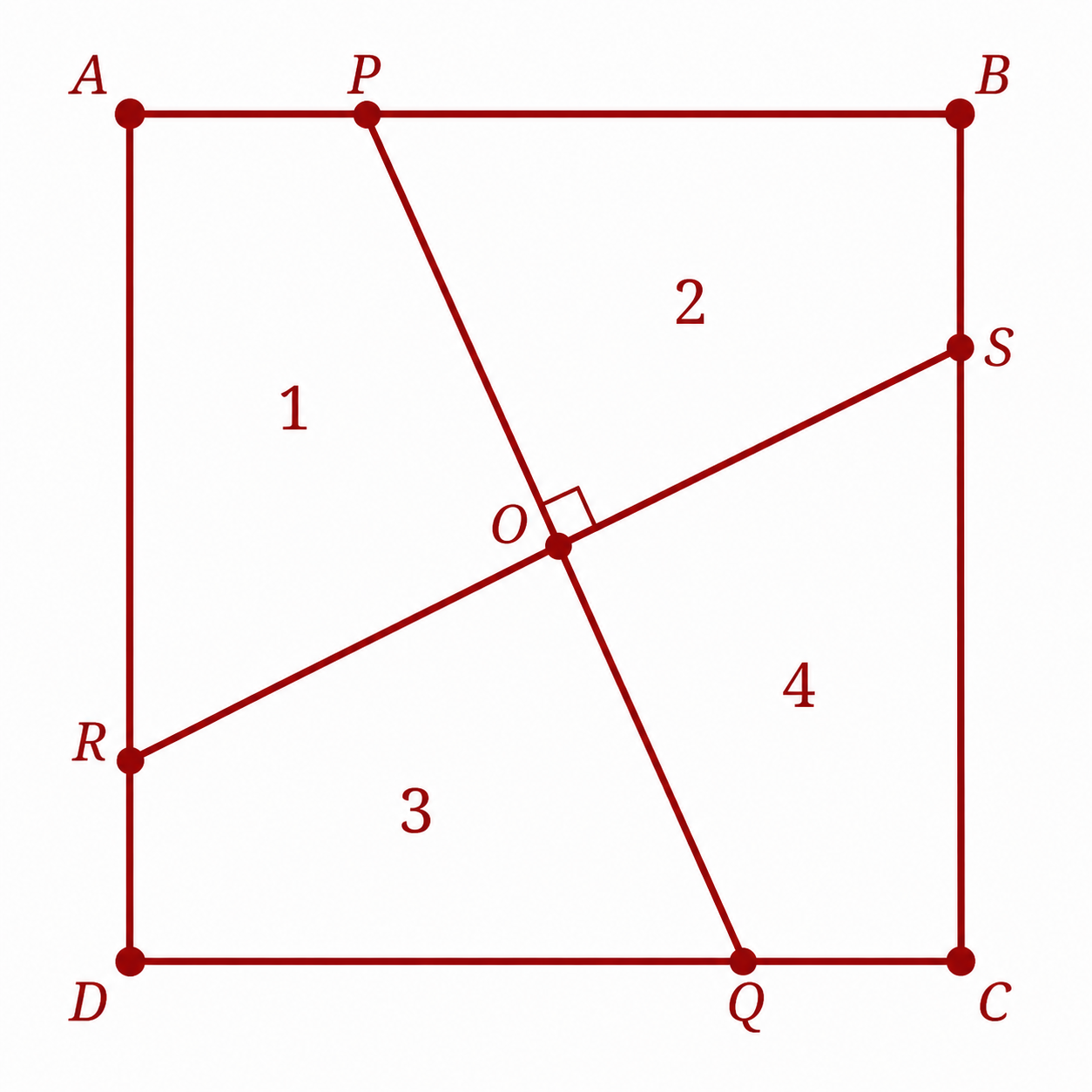
Let the original square be constructed out of cardboard or chart paper.
The two perpendicular lines divide the square into 4 identical (congruent) quadrilateral pieces.
⇒ Label the four pieces in a clockwise direction as Part 1, Part 2, Part 3, and Part 4.
To create a larger outer square with an empty space (hole) in the centre, we rotate each piece outward.
⇒ Take each piece and rotate it by $90^{\circ}$ relative to its original orientation, moving the original outer corners of the square to face inwards.
⇒ Arrange the pieces such that their longest straight edges form the new, extended outer boundaries of a larger square.
Using this outward rotation, the original perpendicular intersection points now form the corners of a small square-shaped hole at the absolute centre of the arrangement.
⇒ Area of larger outer square = Total area of the 4 pieces + Area of the central hole
Hence, the correct answer is to rotate each of the 4 dissected pieces outward by 90 degrees to form the larger square with a central hole.
Class 8 Maths Part 2 Chapter 7 Question Answers with Detailed Solutions
|
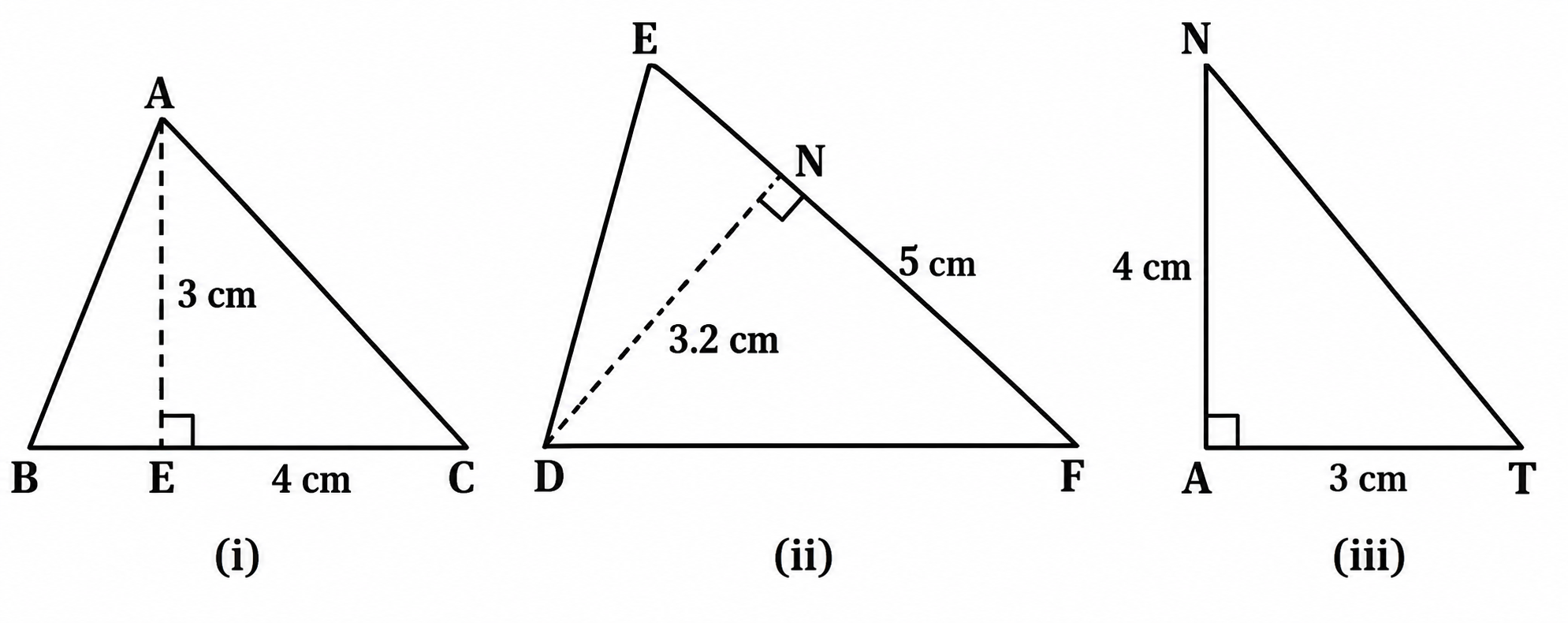
Question 1. Find the areas of the following triangles:
$\textbf{Answer:}$
We know that the area of a triangle $=\frac{1}{2} \times$ base × height
1(i): $6\ \text{cm}^2$
$\textbf{Explanation:}$
In triangle ABC, Base, BC = 4 cm and height, AE = 3 cm
So, area of $\triangle$ABC = $\frac12\times4\times3=6\ \text{cm}^2$
1(ii): $8\ \text{cm}^2$
$\textbf{Explanation:}$
In triangle DEF, Base, EF = 5 cm and height, DN = 3.2 cm
So, area of $\triangle$ABC = $\frac12\times5\times3.2=8\ \text{cm}^2$
1(iii): $6\ \text{cm}^2$
$\textbf{Explanation:}$
In triangle ANT, Base, AT = 3 cm and height, AN = 4 cm
So, area of $\triangle$ABC = $\frac12\times3\times4=6\ \text{cm}^2$
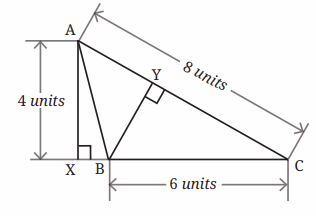
Question 2: Find the length of the altitude BY.
$\textbf{Answer:}$ 3 units
$\textbf{Explanation:}$
Area of $\triangle A B C=\frac{1}{2} \times$ base × height
Taking base as $B C=6$ units and the corresponding altitude as $A X=4$ units.
⇒ Area of $\triangle A B C=\frac{1}{2} \times 6 \times 4$
⇒ Area of $\triangle A B C=12$
Now, taking base as $A C=8$ units and the corresponding altitude as $B Y$.
$
\begin{aligned}
& \Rightarrow \text { Area of } \triangle A B C=\frac{1}{2} \times A C \times B Y \\
& \Rightarrow 12=\frac{1}{2} \times 8 \times B Y \\
& \Rightarrow 12=4 \times B Y \\
& \Rightarrow B Y=3
\end{aligned}
$
Hence, the correct answer is 3 units.
Question 3: Find the area of ∆SUB, given that it is isosceles, SE is perpendicular to UB, and the area of ∆SEB is 24 sq. units.
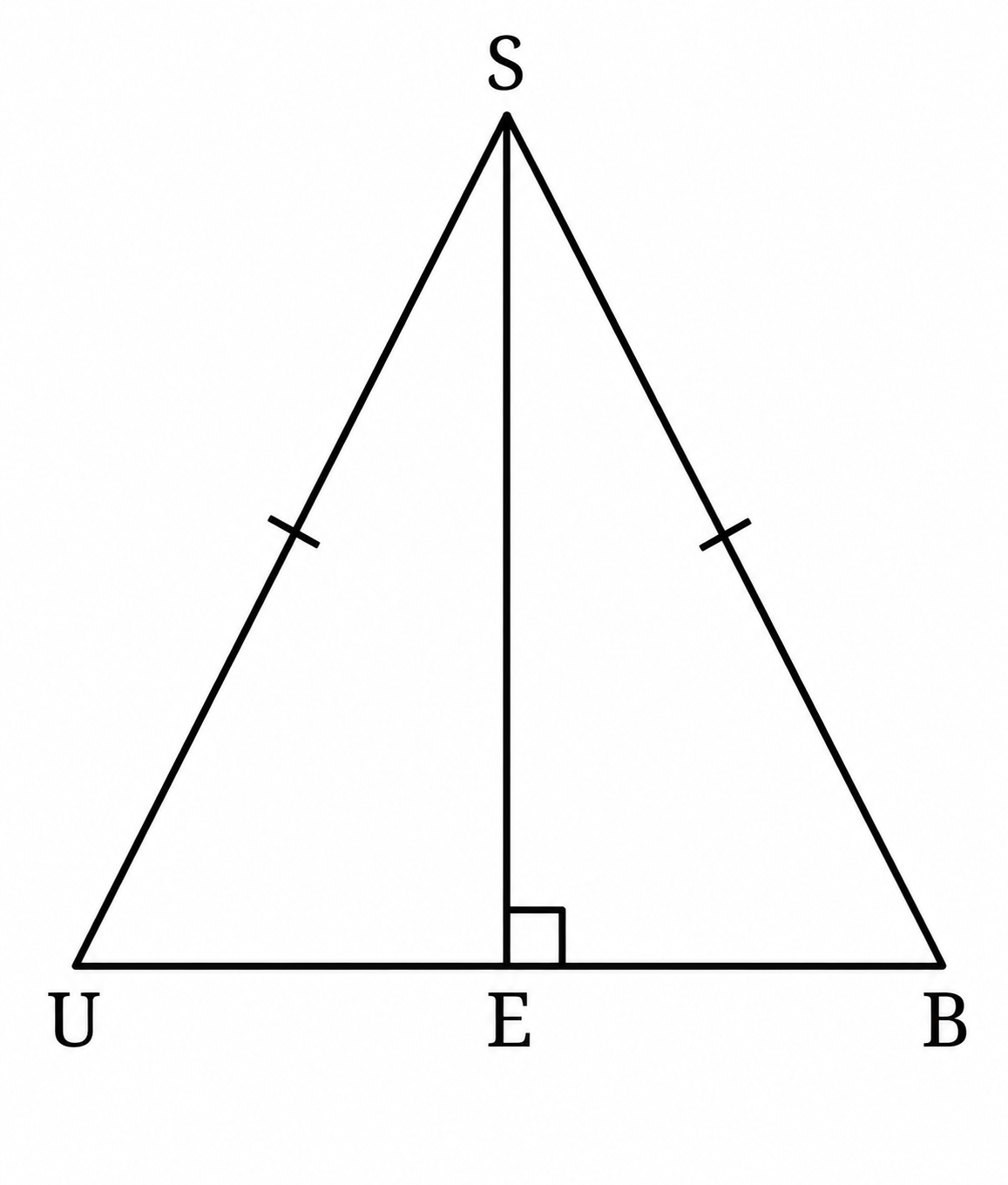
$\textbf{Answer:}$ 48 sq. units
$\textbf{Explanation:}$
Given that, ∆SUB is an isosceles triangle.
SE is perpendicular to UB.
So, it divided ∆SUB into two equal triangles.
Area of ∆SEB = 24 sq. units [Given]
So, Area of ∆SUB = 2 × Area of ∆SEB = 2 × 24 = 48 sq. units
In the Śulba-Sūtras, which are ancient Indian geometric texts that deal with the construction of altars, we can find many interesting problems on the topic of areas. When altars are built, they must have the exact prescribed shape and area. This gives rise to problems of the kind where one has to transform a given shape into another of the same area. The Śulba-Sūtras give solutions to many such problems.
Such problems are also posed and solved in Euclid's Elements. Here are two problems of this kind.
Question 4: [Śulba-Sūtras] Give a method to transform a rectangle into a triangle of equal area.
$\textbf{Answer:}$
Let the given rectangle be $A B C D$ with length $L$ and width $W$.
The area of the rectangle is given by Area $=L \times W$.
To create a triangle with the same area, we can maintain the same base $L$ but double the height to $ 2W$.
⇒ Mark a point $E$ on the line extending past side $A D$ such that the total height from the base is $2 W$.
⇒ Connect point $E$ to the two corners of the base, $B$ and $C$, to form triangle $E B C$.
Using the triangle area formula, Area $=\frac{1}{2} \times$ base × height
⇒ Area of $\triangle E B C=\frac{1}{2} \times L \times 2 W$
⇒ Area of $\triangle E B C=L \times W$
Question 5: [Śulba-Sūtras] Give a method to transform a triangle into a rectangle of equal area.
$\textbf{Answer:}$
Let the given triangle be $X Y Z$ with base $b$ and height $h$.
The area of the triangle is given by Area $=\frac{1}{2} \times b \times h$.
To make a rectangle with the same area, we can keep the same base $b$ but cut the height exactly in half to $\frac{1}{2} h$.
⇒ Draw a horizontal line through the middle of the triangle's height to find its midpoints.
⇒ Drop perpendicular lines from these midpoints to the base to form a rectangle.
Using the rectangle area formula, Area $=$ length × width
⇒ Area of rectangle $=b \times \frac{1}{2} h$
⇒ Area of rectangle $=\frac{1}{2} \times b \times h$
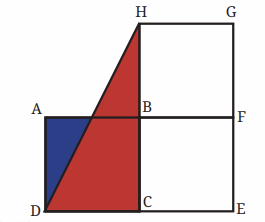
Question 6: ABCD, BCEF, and BFGH are identical squares.
(i) If the area of the red region is 49 sq. units, then what is the area of the blue region?
(ii) In another version of this figure, if the total area enclosed by the blue and red regions is 180 sq. units, then what is the area of each square?
6(i): 12.25 sq. units.
$\textbf{Explanation:}$
Let the side length of each identical square be $x$.
The blue region is part of square $A B C D$, and the red region is triangle $\triangle D H C$.
⇒ Area of each square $=x^2$
The base of triangle $\triangle D H C$ is $D C=x$, and
its height is $H C=H B+B C=x+x= 2 x$.
So, Area of red region $(\triangle D H C)=\frac{1}{2} \times$ base × height
$\Rightarrow 49=\frac{1}{2} \times x \times 2 x$
$\Rightarrow 49=x^2$
Since the area of each square is $x^2=49$, the area of square $A B C D$ is 49 sq. units.
Looking at the figure, the line segment $D H$ cuts across the squares such that:
Area of blue region $=$ Area of square $A B C D-$ Area of $\triangle D H C$ inside $A B C D$
By symmetry, the line $D H$ passes through the midpoint of $A B$, dividing the area of square $A B C D$ exactly the same way it divides the combined shape.
⇒ Area of blue region $=$ Area of square $A B C D-$ (Area of $\triangle D H C-$
Area of $\triangle D H B$ above $A B$ )
⇒ Area of blue region $=$ Area of square $A B C D-$ Area of trapezoid $B C D I$
Alternatively, by geometric dissection, the blue triangle at the top left is congruent to the empty white space inside $A B C D$, meaning:
⇒ Area of blue region $=$ Area of square $A B C D-$
Area of the red region inside $A B C D$
⇒ Area of blue region $=$ Area of square $A B C D-\frac{3}{4}($ Area of square $A B C D)= \frac{1}{4} x^2$
Using $x^2=49$ :
⇒ Area of blue region $=\frac{1}{4} \times 49$
⇒ Area of blue region = 12.25 sq. units.
6(ii): 144 sq. units.
$\textbf{Explanation:}$
The total area enclosed by the blue and red regions combined forms the large triangle $\triangle \mathrm{DHC}$ plus the blue region.
From the geometry of the figure, the total area of the blue and red regions combined is exactly equal to the area of one full square plus half of another square, which simplifies to $\frac{5}{4}$ of a square's area.
Alternatively, we can compute it directly by adding the area of the blue region to the red region.
⇒ Total Area $=$ Area of blue region + Area of red region
⇒ Total Area $=\frac{1}{4} x^2+x^2=\frac{5}{4} x^2$
Given that the total area is 180 sq. units:
$ \frac{5}{4} x^2=180 $
$ \Rightarrow 5 x^2=720$
$ \Rightarrow x^2=144$
Question 7: If M and N are the midpoints of XY and XZ, what fraction of the area of ∆XYZ is the area of ∆XMN? [Hint: Join NY]
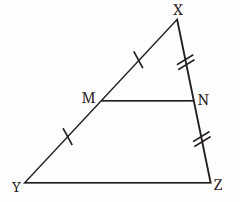
$\textbf{Answer:}$ $\frac14$
$\textbf{Explanation:}$
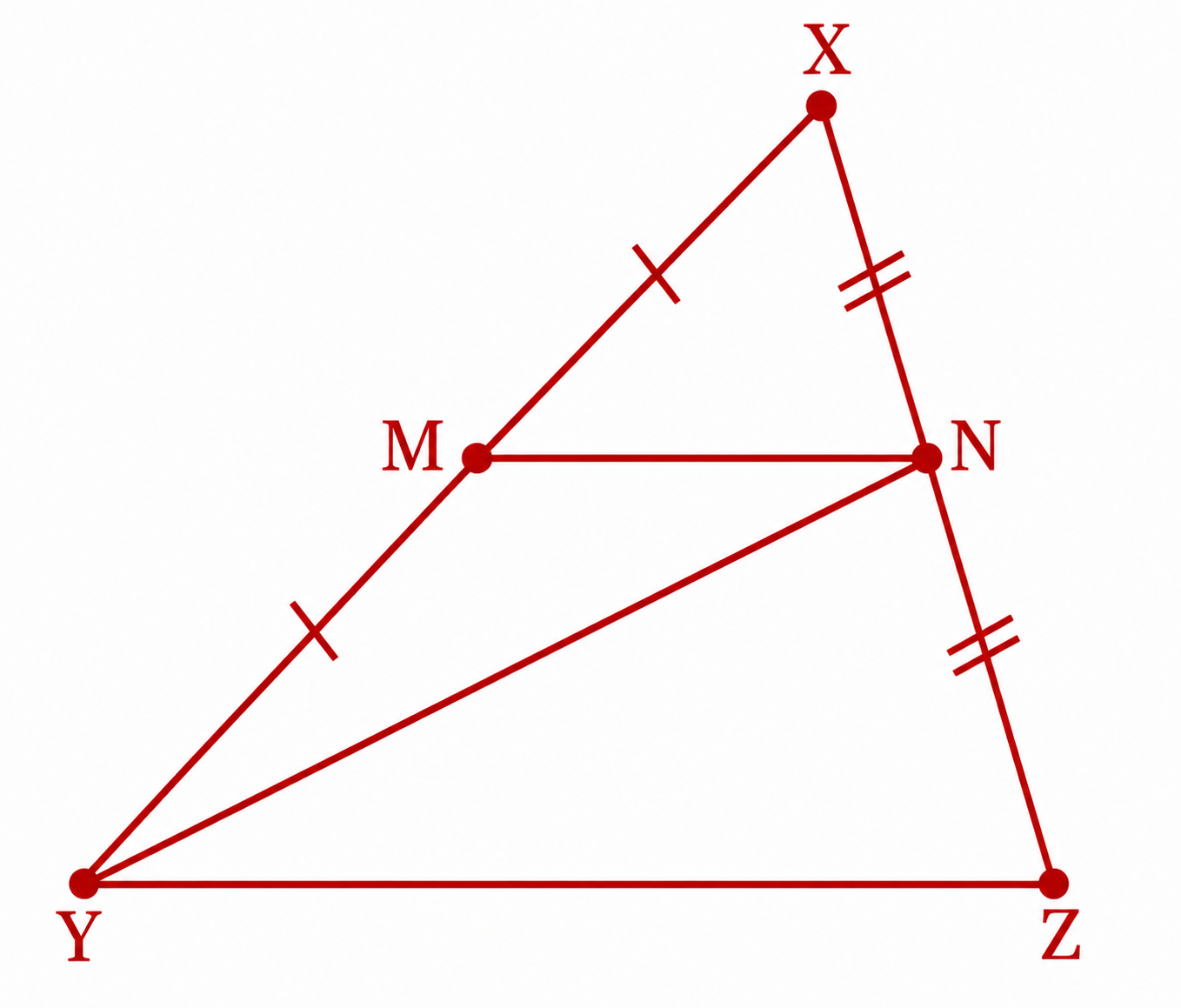
Join NY.
In $\triangle X Y Z, N$ is the midpoint of $X Z$, so $Y N$ is a median which divides $\triangle X Y Z$ into two equal areas.
$\text { ⇒ Area of } \triangle X Y N=\frac{1}{2} \times \text { Area of } \triangle X Y Z$-------(1)
In $\triangle X Y N$, $M$ is the midpoint of the base $X Y$.
$N M$ is a median of $\triangle X Y N$, which divides its area exactly in half.
⇒ Area of $\triangle X M N=\frac{1}{2} \times$ Area of $\triangle X Y N$
⇒ Area of $\triangle X M N=\frac{1}{2} \times\left(\frac{1}{2} \times\right.$ Area of $\left.\triangle X Y Z\right)$ [Using equation (1)]
⇒ Area of $\triangle X M N=\frac{1}{4} \times$ Area of $\triangle X Y Z$
Question 8: Gopal needs to carry water from the river to his water tank. He starts from his house. What is the shortest path he can take from his house to the river and then to the water tank? Roughly recreate the map in your notebook and trace the shortest path.
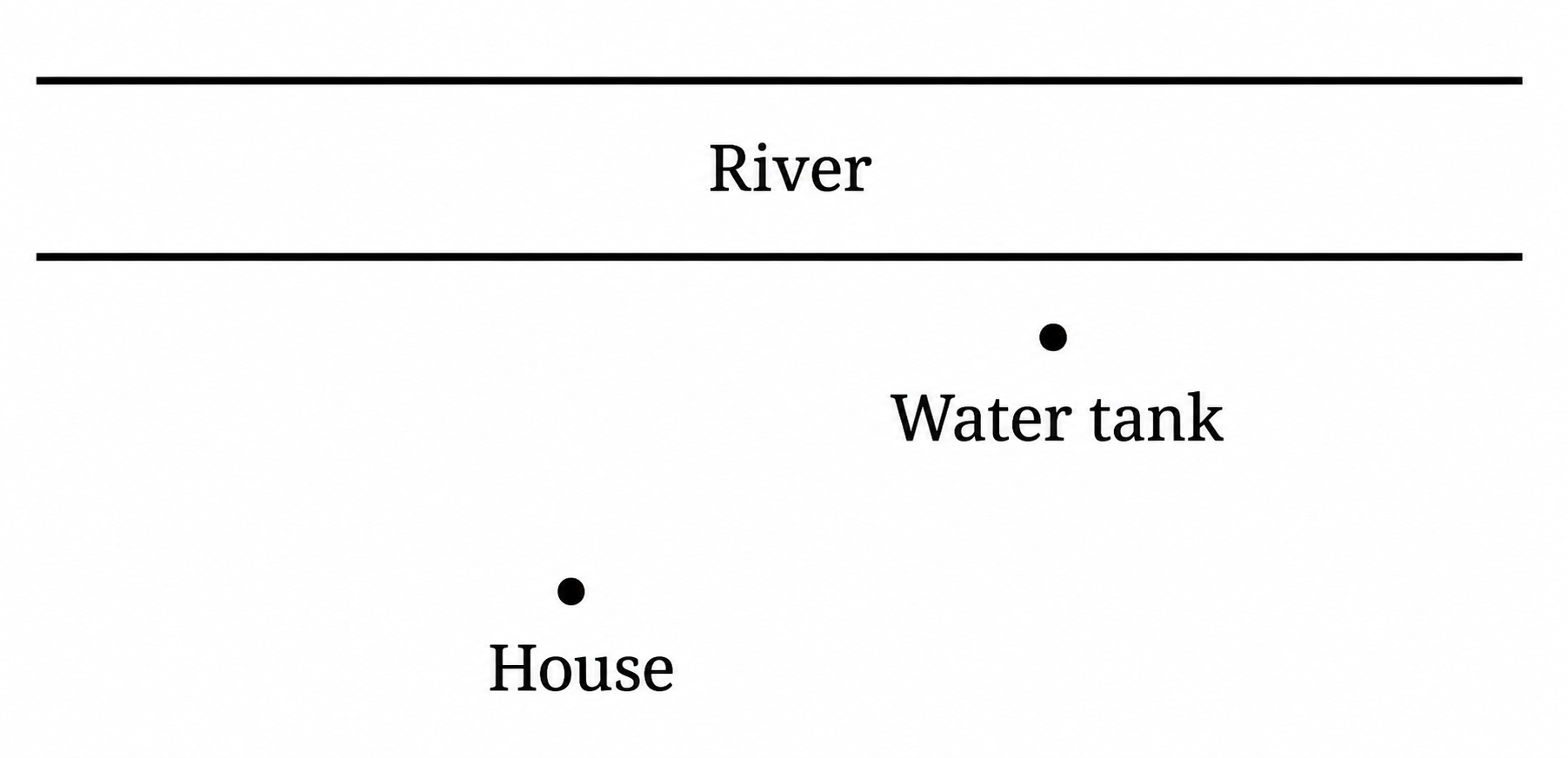
$\textbf{Answer:}$
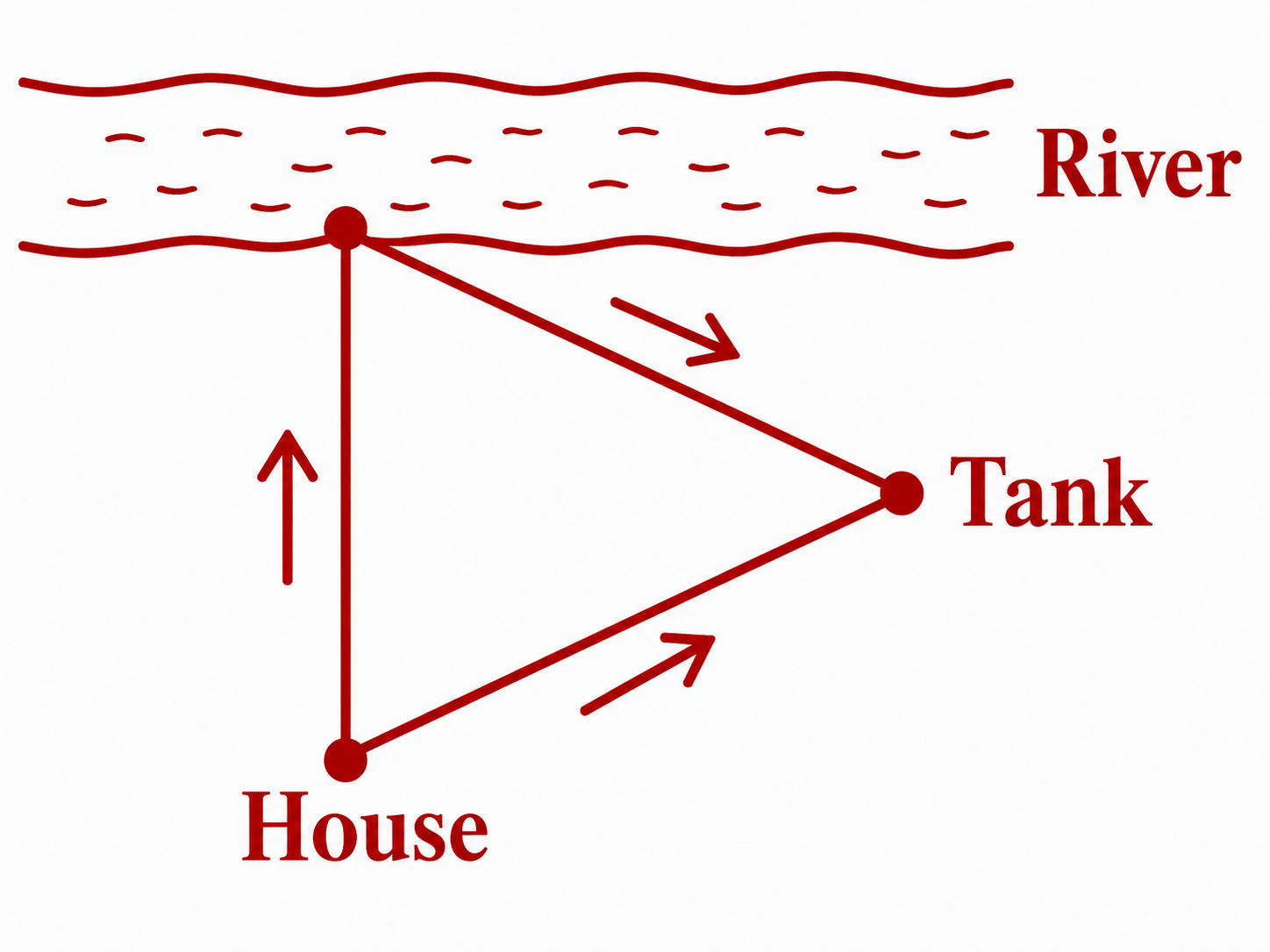
Let the House be point $A$, the Water tank be point $B$, and the straight line representing the riverbank be line $L$.
Find the reflection of point $B$ across the riverbank line $L$, and label this reflected point $B^{\prime}$.
Draw a straight line from point $A$ (House) to point $B^{\prime}$ (the reflected Water tank).
The point where this straight line intersects the riverbank line $L$ is the ideal point to collect water, which we can label as $P$.
Connect point $P$ to the actual Water tank at point $B$ to complete the path.
Using the property of reflections, the straight line distance $A P+P B^{\prime}$ is equal to the path distance $A P+P B$.
Since a straight line is always the shortest distance between two points ( $A$ and $B^{\prime}$ ), the path $A \rightarrow P \rightarrow B$ is the absolute shortest route.
Class 8 Maths Part 2 Chapter 7 Question Answers with Detailed Solutions
|
Question 1. Find the area of the quadrilateral ABCD given that $\mathrm{AC}=22 \mathrm{~cm}$, $\mathrm{BM}=3 \mathrm{~cm}, \mathrm{DN}=3 \mathrm{~cm}, \mathrm{BM}$ is perpendicular to AC, and DN is perpendicular to AC.
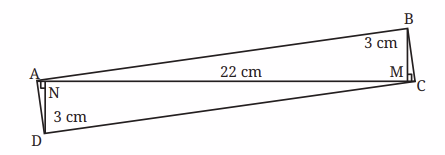
$\textbf{Answer:}$ $66 \ \mathrm{cm}^2$
$\textbf{Explanation:}$
Here,
Area of quadrilateral $A B C D=$ Area of $\triangle A B C+$ Area of $\triangle A D C$
We know that the area of a triangle $=\frac{1}{2} \times$ base × height
Here,
Base $A C=22 \mathrm{~cm}$, and perpendicular heights are $B M=3 \mathrm{~cm}$ and $D N=3 \mathrm{~cm}$.
Area of $\triangle A B C=\frac{1}{2} \times A C \times B M$
⇒ Area of $\triangle A B C=\frac{1}{2} \times 22 \times 3=33\ \mathrm{cm}^2$
Area of $\triangle A D C=\frac{1}{2} \times A C \times D N$
⇒ Area of $\triangle A D C=\frac{1}{2} \times 22 \times 3=33\ \mathrm{cm}^2$
Therefore,
Area of quadrilateral $A B C D=$ Area of $\triangle A B C+$ Area of $\triangle A D C$
⇒ Area of quadrilateral $A B C D=33+33$
⇒ Area of quadrilateral $A B C D=66 \ \mathrm{cm}^2$
Question 2. Find the area of the shaded region given that ABCD is a rectangle.
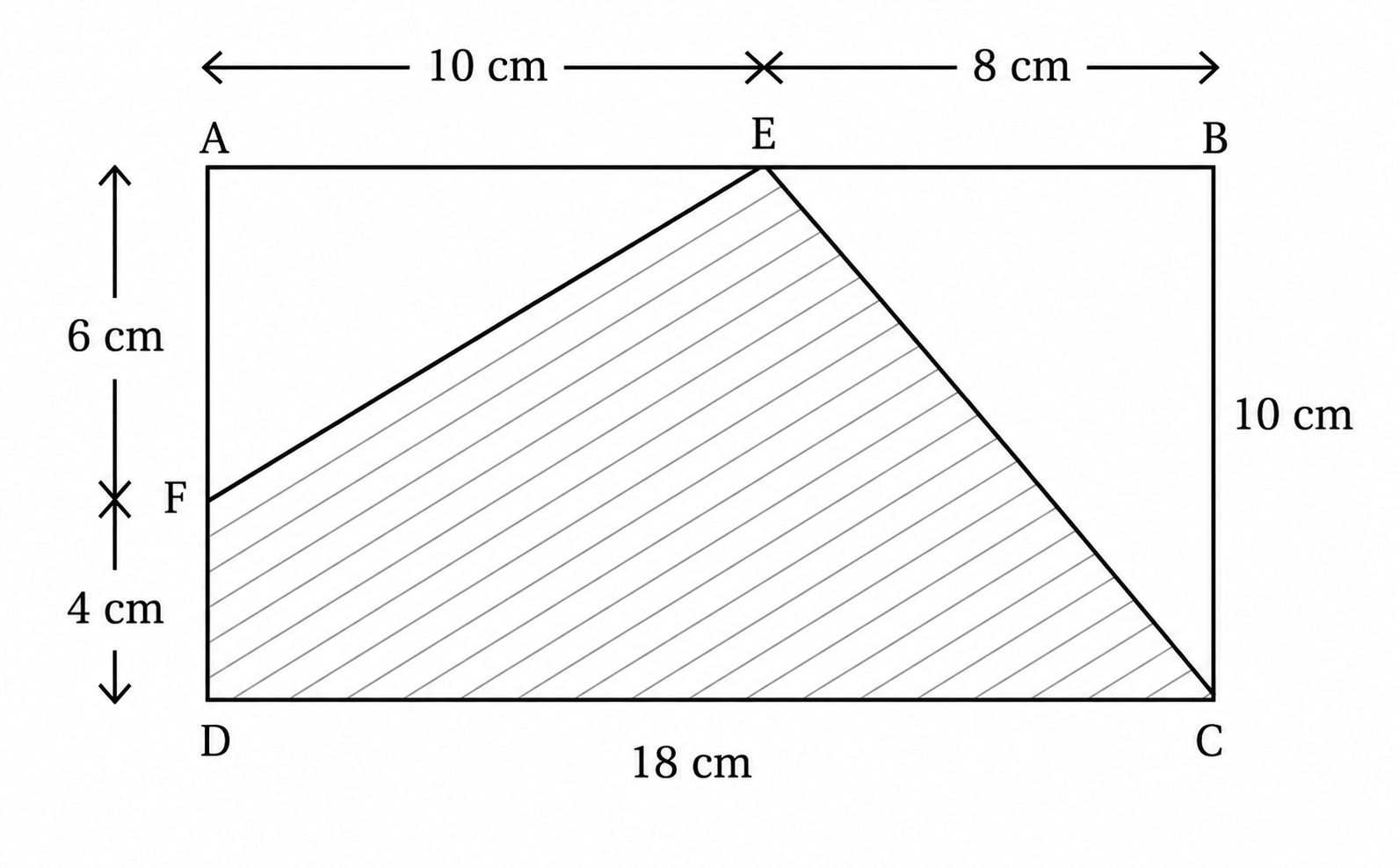
$\textbf{Answer:}$ 110 $\text{cm}^2$
$\textbf{Explanation:}$
Here Area of the shaded region = Area of the rectangle ABCD - (Area of $\triangle$BEC + Area of $\triangle$ AEF)
Area of the rectangle ABCD = Length Width = 10 × 18 = 180 $\text{cm}^2$
Area of $\triangle$BEC = $\frac12\times$ Base $\times$ Height = $\frac12\times8\times10=40 \ \text{cm}^2$
Area of $\triangle$AEF = $\frac12\times$ Base $\times$ Height = $\frac12\times10\times6=30 \ \text{cm}^2$
$\therefore$ Area of the shaded region = 180 - (40 + 30) = 110 $\text{cm}^2$
Question 3: What measurements would you need to find the area of a regular hexagon?
$\textbf{Answer:}$
A regular hexagon can be divided into 6 congruent equilateral triangles.
The area of a regular hexagon is given by $A=\frac{3 \sqrt{3}}{2} s^2$, where $s$ is the side length.
Alternatively, the area can be expressed as $A=\frac{1}{2} \times P \times a$, where $P$ is the perimeter and $a$ is the apothem.
Hence, to find the area, we need either the length of any one side (s), or the length of the apothem (a).
Question 4: What fraction of the total area of the rectangle is the area of the blue region?
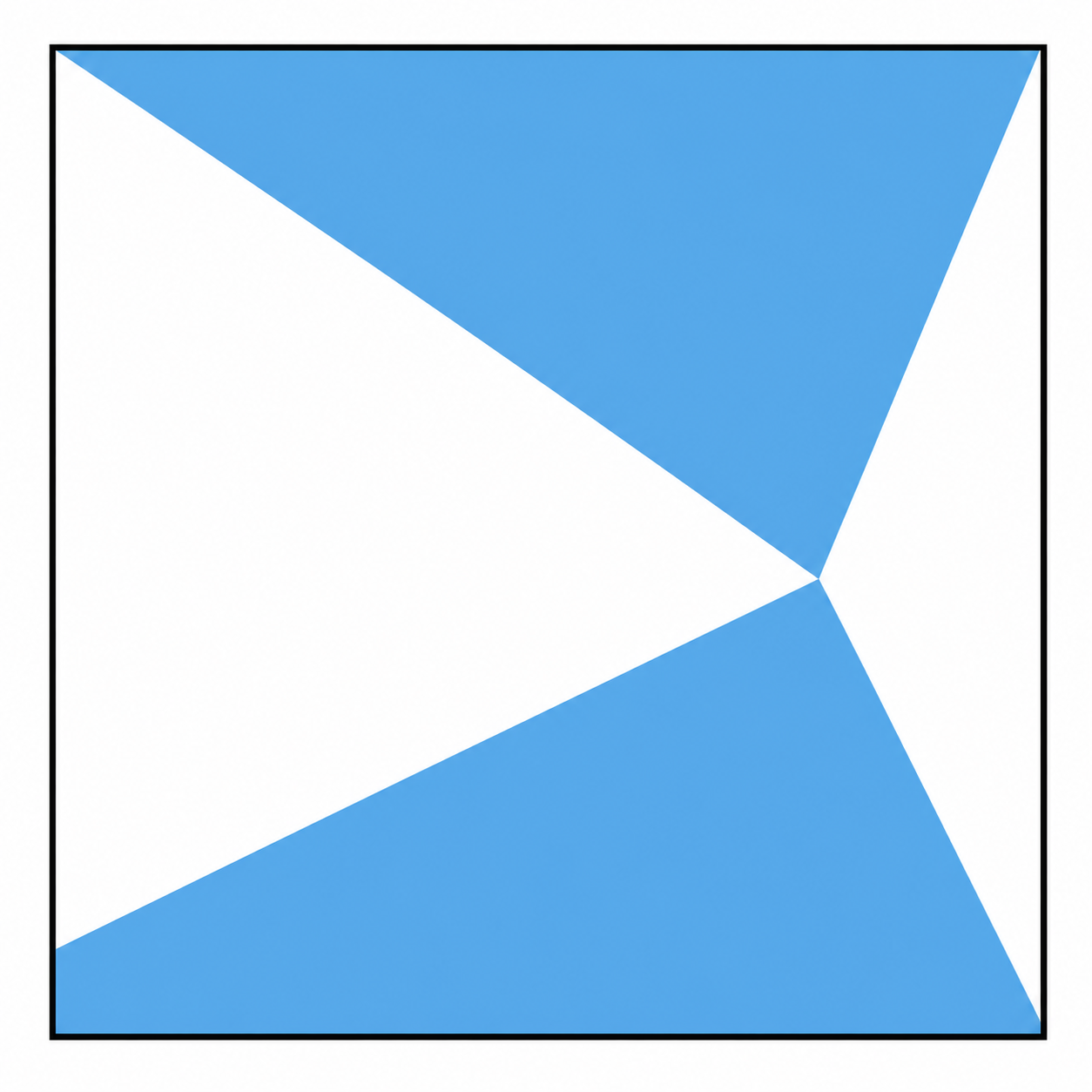
$\textbf{Answer:}$ $\frac12$
$\textbf{Explanation:}$
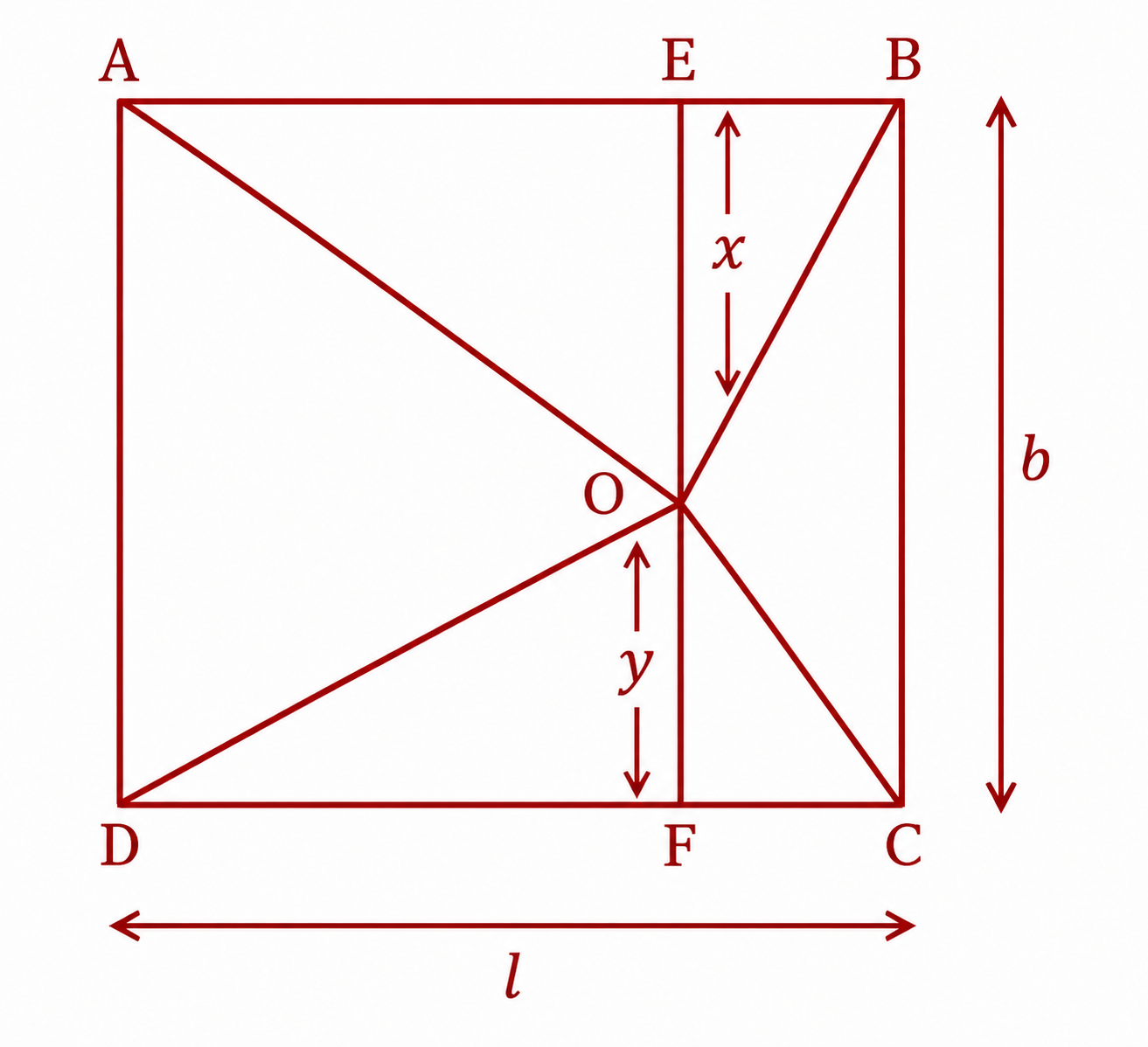
Let the length and width of the rectangle be $l$ and $b$, respectively.
So, area of the rectangle = $lb$ square units
Draw two perpendiculars on DC and AB, respectively.
Area of $\triangle \mathrm{AOB}=\frac{1}{2} \times \mathrm{AB} \times \mathrm{OE}=\frac{1}{2} lx$ square units
Area of $\triangle \mathrm{DOC}=\frac{1}{2} \times \mathrm{DC} \times \mathrm{OF}=\frac{1}{2} ly$ square units
Total area of the shaded region
= $\frac{1}{2} lx+\frac{1}{2} ly$
= $\frac{1}{2} l(x+y)$
= $\frac{1}{2} lb$ square units $[\because x+y=b]$, which is the half of the total area
$\therefore$ Area of shaded blue region $=\frac{1}{2} \times$ Area of rectangle
Question 5: Give a method to obtain a quadrilateral whose area is half that of a given quadrilateral.
$\textbf{Answer:}$
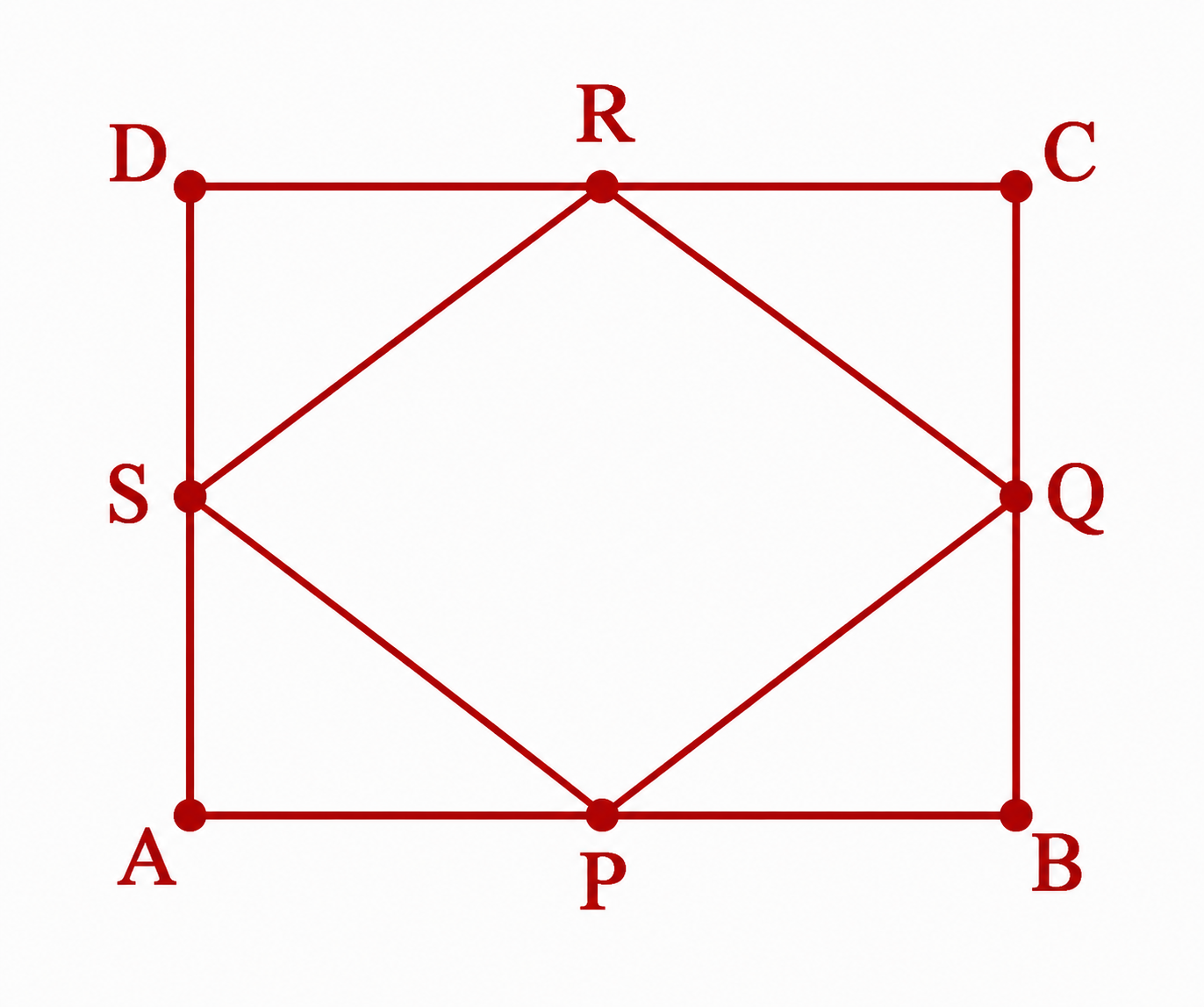
Let the given quadrilateral be $A B C D$.
The area of a quadrilateral formed by joining the midpoints of its adjacent sides (known as the Varignon quadrilateral) is half the area of the original quadrilateral.
⇒ Find the midpoints of sides $A B, B C, C D$, and $D A$, and label them $P, Q, R$, and $S$ respectively.
⇒ Connect the midpoints in order to form the quadrilateral $P Q R S$.
Using Varignon's Theorem, Area of $P Q R S=\frac{1}{2} \times$ Area of ABCD.
Hence, the correct answer is to join the midpoints of the sides of the given quadrilateral.
Class 8 Maths Part 2 Chapter 7 Question Answers with Detailed Solutions
|
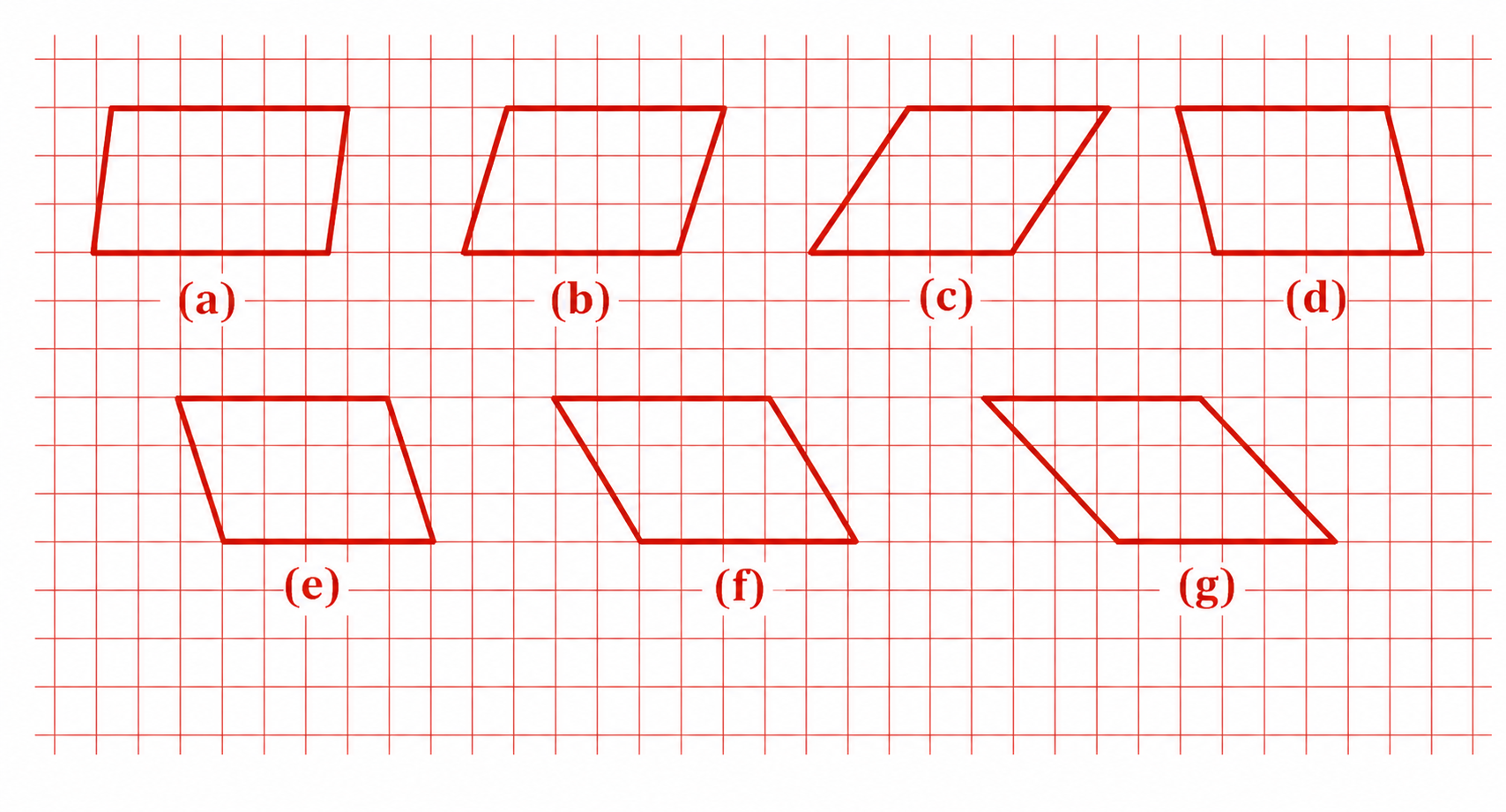
Question 1: Observe the parallelograms in the figure below.
(i) What can we say about the areas of all these parallelograms?
(ii) What can we say about their perimeters? Which figure appears to have the maximum perimeter, and which has the minimum perimeter?
$\textbf{Answer:}$
1 (i):
The area of a parallelogram = Base × Height
Let each grid square represent a unit of $1 \times 1$.
Here, Area of each parallelogram = $5\times3=15$ square units
So, the areas of all these parallelograms are equal.
1 (ii):
The perimeter of a parallelogram $ = 2(\text{base} + \text{slant side})$.
Since the horizontal base is fixed at $4\text{ units}$ for all figures, the perimeter depends entirely on the length of the slanted side.
As a parallelogram becomes more tilted (slanted), its height remains constant, but its slant side stretches longer to cover the wider horizontal shift.
Law Admissions 2026 Open | Avail Merit-Based Scholarships
BBA/MBA/PGDM Early Bird Applications Deadline 19th Oct '26. Apply now using coupon code CAREER250 and get ₹250 off the application fee
So, perimeters vary across the figures; figure $(g)$ has the maximum perimeter and figure $(a)$ has the minimum perimeter.
Question 2. Find the areas of the following parallelograms:
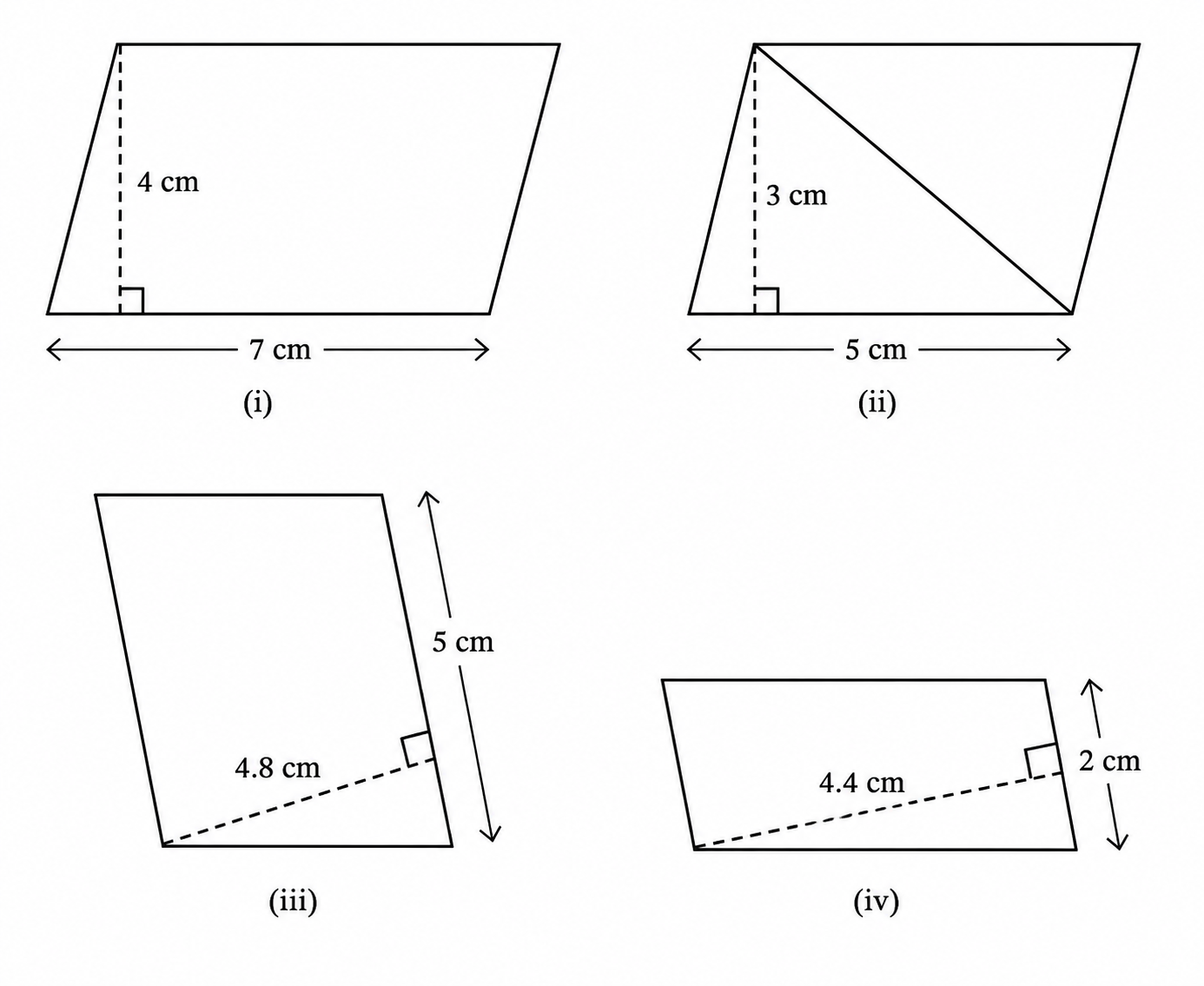
$\textbf{Answer:}$
Area of a parallelogram = base × height
2 (i): 28 $\text{cm}^2$
$\textbf{Explanation:}$
Here, base = 7 cm, height = 4 cm.
So, area of the parallelogram = 7 × 4 = 28 $\text{cm}^2$
2 (ii): 15 $\text{cm}^2$
$\textbf{Explanation:}$
Here, base = 5 cm, height = 3 cm.
So, area of the parallelogram = 5 × 3 = 15 $\text{cm}^2$
2 (iii): 24 $\text{cm}^2$
$\textbf{Explanation:}$
Here, base = 5 cm, height = 4.8 cm.
So, area of the parallelogram = 5 × 4.8 = 24 $\text{cm}^2$
2 (iv): 8.8 $\text{cm}^2$
$\textbf{Explanation:}$
Here, base = 2 cm, height = 4.4 cm.
So, area of the parallelogram = 2 × 4.4 = 8.8 $\text{cm}^2$
Question 3. Find QN.
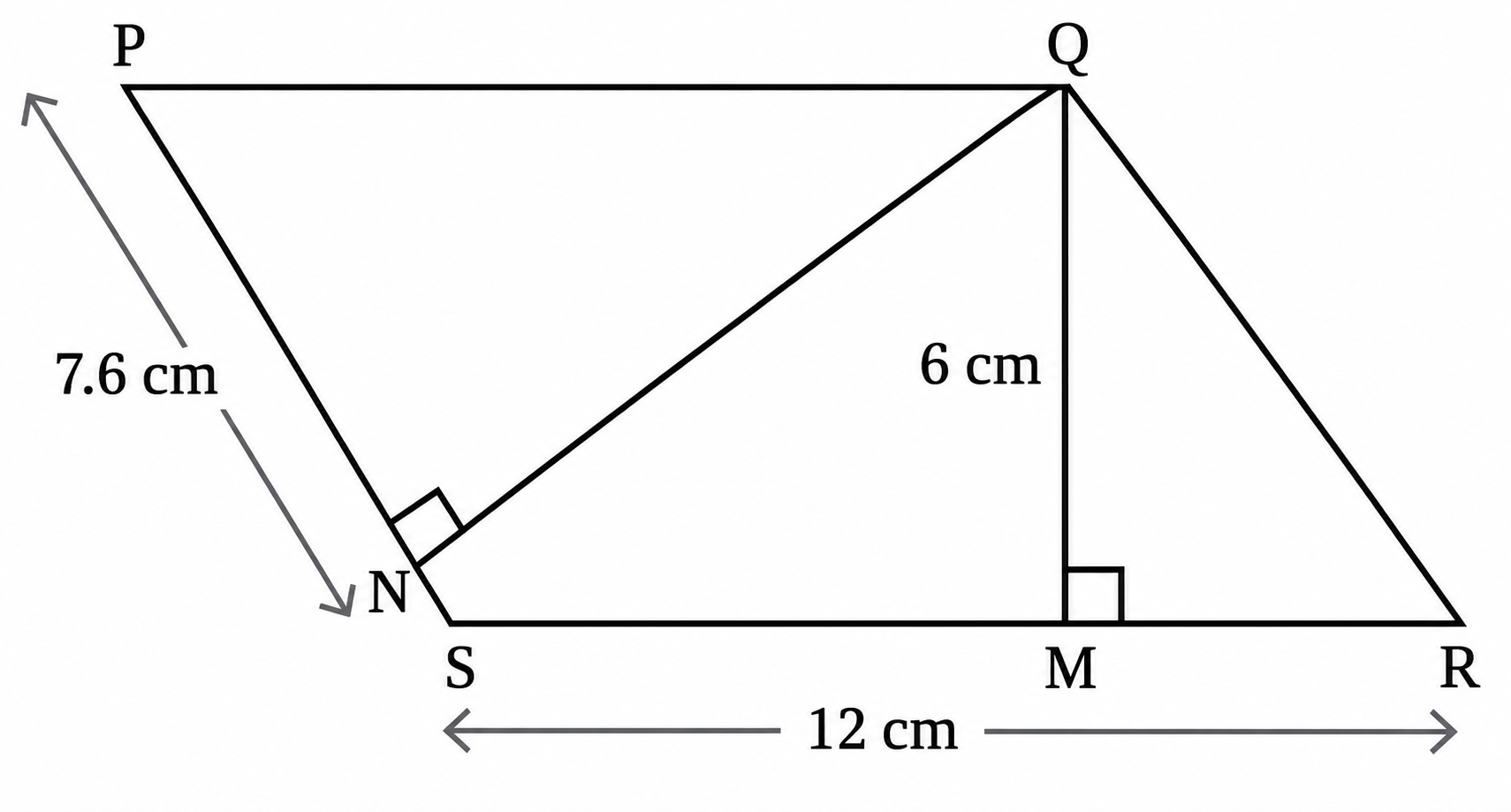
$\textbf{Answer:}$ 9.47 cm
$\textbf{Explanation:}$
Area of a parallelogram = base × height
In parallelogram PQRS, base, SR = 12 cm, height, QM = 6 cm
So, Area of parallelogram PQRS = 12 × 6 = 72 $\text{cm}^2$
Also, in parallelogram PQRS, PS is a base, and QN is a height.
So, 7.6 × QN = 72
$\therefore$ QN = 9.47 cm
Question 4. Consider a rectangle and a parallelogram of the same sidelengths: 5 cm and 4 cm. Which has the greater area?
[Hint: Imagine constructing them on the same base.]
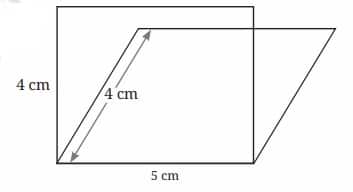
$\textbf{Answer:}$
We know that the area of the rectangle = length × width
Here, length = 4 cm and width = 5 cm.
So area of the rectangle= 4 × 5 = 20 $\text{cm}^2$
Question 5. Give a method to obtain a rectangle whose area is twice that of a given triangle. What are the different methods that you can think of?
$\textbf{Answer:}$
Let the given triangle have a base $b$ and a perpendicular height $h$.
The area of the triangle $=\frac{1}{2} \times b \times h$.
To obtain a rectangle whose area is twice that of the triangle, the area must be $2 \times \left(\frac{1}{2} \times b \times h\right)=b \times h$.
We can achieve this using two different geometric construction methods:
Method 1:
Keep the base of the rectangle exactly equal to the base of the triangle (b).
Keep the perpendicular height of the rectangle exactly equal to the height of the triangle ( $h$ ).
Using the rectangle area formula, Area $=$ base × height
⇒ Area of Rectangle $=bh$
Method 2:
Create a rectangle by doubling the base length to $2 b$ while keeping the height as half the triangle's height $\left(\frac{1}{2} h\right)$.
Alternatively, keep the base as $b$ and double the height parameter depending on the available orientation.
⇒ Area of Rectangle $=2 b \times \frac{1}{2} h=b \times h$
Question 6. [Śulba-Sūtras] Give a method to obtain a rectangle of the same area as a given triangle.
$\textbf{Answer:}$
Let the given triangle have a base $b$ and a perpendicular height $h$.
The area of the triangle $=\frac{1}{2} \times b \times h$.
According to the ancient Śulba-Sütras, a triangle can be transformed into a rectangle of equal area by bisecting its height.
Draw a horizontal line parallel to the base that passes exactly through the midpoint of the triangle's height, cutting the height into $\frac{1}{2} h$.
Drop vertical perpendicular lines from the midpoints of the sides down to the base line.
Using the parts cut from the top of the triangle, fold or relocate them into the empty spaces at the sides to complete the rectangle shape.
Using the rectangle area formula with length $b$ and width $\frac{1}{2} h$ :
⇒ Area of Rectangle $=b \times \frac{1}{2} h$
⇒ Area of Rectangle $=\frac{1}{2} \times b \times h$
Question 7. [Śulba-Sūtras] An isosceles triangle can be converted into a rectangle by dissection in a simpler way. Can you find out how to do it?
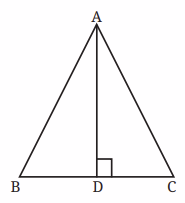
[Hint: Show that triangles $\triangle \mathrm{ADB}$ and $\triangle \mathrm{ADC}$ can be made into halves of a rectangle. Figure out how they should be assembled to get a rectangle. Use cut-outs if necessary.]
$\textbf{Answer:}$
Let the given isosceles triangle be $A B C$ with $A B=A C$, and $A D$ be the altitude drawn perpendicular to the base $B C$.
The line $A D$ is an axis of symmetry, which bisects the base $B C$ such that $B D=D C$.
⇒ Slicing along the altitude $A D$ splits the triangle into two congruent right-angled triangles, $\triangle A D B$ and $\triangle A D C$.
To assemble these two halves into a rectangle, keep $\triangle A D B$ fixed in its place.
⇒ Take $\triangle A D C$, rotate it by $180^{\circ}$, and place it such that its hypotenuse $A C$ aligns perfectly with the hypotenuse $A B$ of the fixed triangle.
This rearrangement shifts the base segment $D C$ to the top, creating a shape with a uniform width of $B D$ (or $D C$ ) and a vertical height of $A D$.
Using the rectangle area formula:
⇒ Area of Rectangle $=$ length × width
$\Rightarrow \mathrm{Area}=B D \times A D=\frac{1}{2} B C \times A D$
Question 8. [Śulba-Sūtras] Give a method to convert a rectangle into an isosceles triangle by dissection.
$\textbf{Answer:}$
Let the given rectangle be $A B C D$ with length $L$ and width $W$.
The area of the rectangle $=L \times W$.
According to the principles of geometric dissection, we can slice the rectangle and rearrange its parts to form an isosceles triangle of equal area by doubling its height.
Mark the midpoint of the top side $A B$ and label it $M$.
Extend the vertical side $D A$ upwards to a point $E$ such that the length $A E=A D=W$, making the total height $D E=2 W$.
Draw a straight cut line from the new peak point $E$ through the midpoint $M$ until it hits the opposite vertical side $B C$ extended, or simply construct the symmetric slant cuts from the top peak to the base corners.
Alternatively, draw a line connecting the midpoint of the top side $M$ to the bottom-left corner $D$ and the bottom-right corner $C$. Cut along $M D$ and $M C$ to create three pieces: a central isosceles triangle $\triangle M D C$ and two right-angled corner triangles.
⇒ Invert and join the two outer right-angled triangles above the central piece such that their vertical sides align at the top apex.
Using the triangle area formula with base $C D=L$ and total height $2 W$ :
⇒ Area of Isosceles Triangle $=\frac{1}{2} \times L \times 2 W=LW$
Question 9. Which has greater area-an equilateral triangle or a square of the same sidelength as the triangle? Which has greater area-two identical equilateral triangles together or a square of the same sidelength as the triangle? Give reasons.
$\textbf{Answer:}$
Let the side length be 1 cm.
Area of the equilateral triangle
= $\frac{\sqrt3}4× \text{Side}^2=\frac{\sqrt3}4\times1^2=\frac{\sqrt3}4=\frac{1.732}4\approx0.433$
Area of the square = $1^1=1$
Here, $1>0.433$
Therefore, the square has a greater area.
Now,
Area of two equilateral triangles
= $2\times\frac{\sqrt3}4× \text{Side}^2=2\times\frac{\sqrt3}4\times1^2=2\times\frac{\sqrt3}4=2\times\frac{1.732}4\approx0.866$
Area of the square = $1^1=1$
Here, $1>0.866$
Therefore, the square has a greater area.
Class 8 Maths Part 2 Chapter 7 Question Answers with Detailed Solutions
|
Question 1. Find the area of a rhombus whose diagonals are 20 cm and 15 cm.
$\textbf{Answer:}$ $150\ \text{cm}^2$
$\textbf{Explanation:}$
Area of a rhombus = $\frac12 \times$ Product of two diagonals = $\frac12\times20\times15)=150\ \text{cm}^2$
Question 2. Give a method to convert a rectangle into a rhombus of equal area using dissection.
$\textbf{Answer:}$
Let the given rectangle be $A B C D$ with length $L$ and width $W$.
The area of the rectangle is given by Area $=L \times W$.
To dissect and rearrange it into a rhombus of the same area, we can slice it and reposition the pieces.
⇒ Mark the midpoints of the top side $A B$ and the bottom side $C D$, and label them $M$ and $N$ respectively.
⇒ Draw a vertical straight line connecting $M$ and $N$, dividing the rectangle into two smaller, identical rectangles ( $A M N D$ and $M B C N$ ).
Inside the left rectangle $A M N D$, draw a diagonal line from the top-left corner $A$ to the bottom-right corner $N$. Cut along this line to create a right-angled triangle $\triangle A D N$.
⇒ Move this triangle $\triangle A D N$ to the opposite side and attach its vertical side $A D$ along the vertical line $B C$ of the right rectangle.
Inside the remaining piece, make a parallel diagonal cut from $M$ to $C$ and slide the resulting section to align perfectly, forming a four-sided shape with equal side lengths.
Using the properties of geometric dissection, no material is added or removed during this rearrangement.
⇒ Area of the new rhombus $=$ Area of the original rectangle
⇒ Area $=L \times W$
Question 3. Find the areas of the following figures:
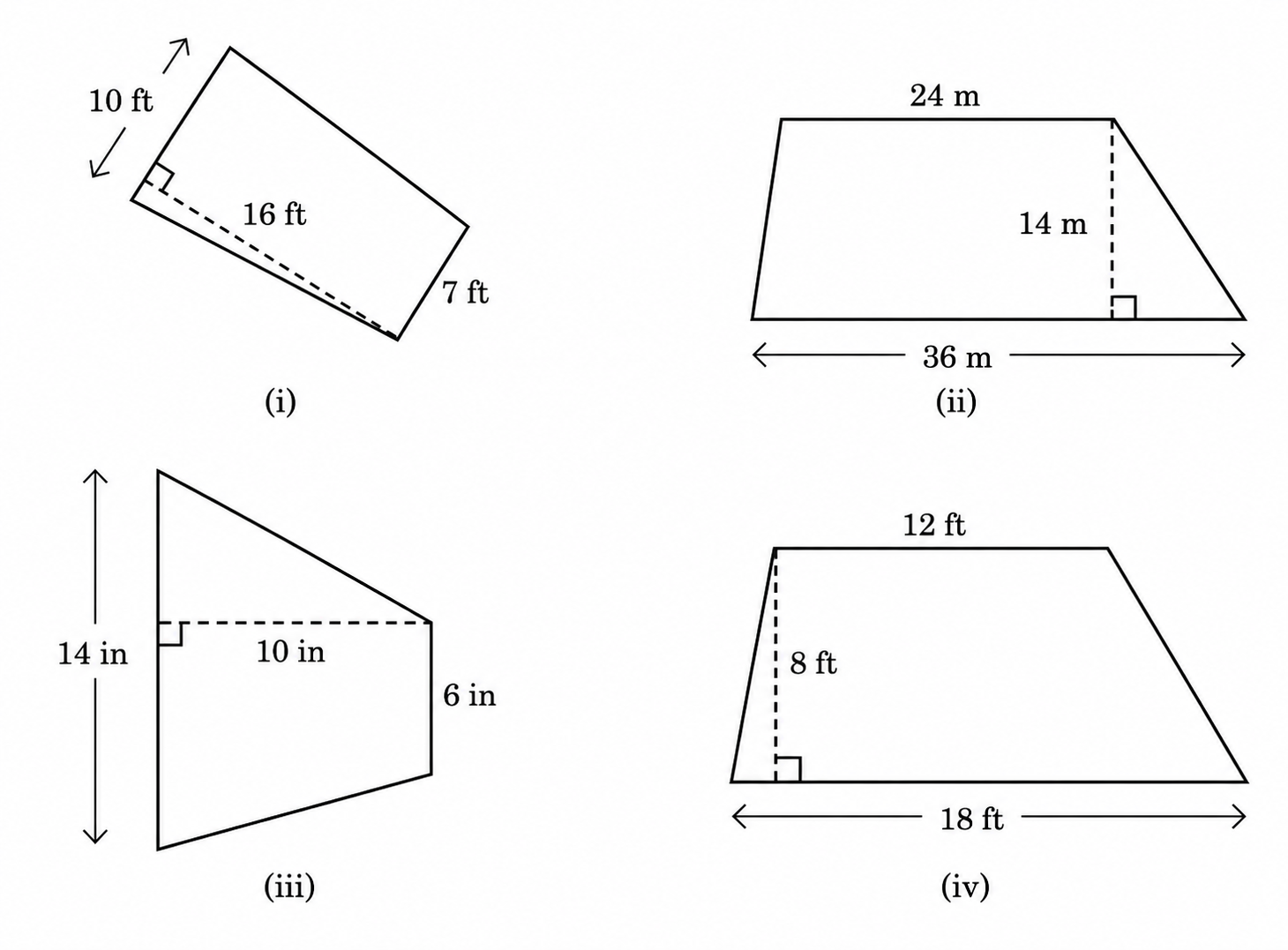
$\textbf{Answer:}$
The area of a trapezium $=\frac{1}{2} \times$ Sum of parallel sides $\times$ Distance between the Parallel sides
3(i): $136\ \text{ft}^2$
$\textbf{Explanation:}$
Here, the parallel sides are 10 ft and 7 ft. Their distance is 16 ft.
$\therefore$ The area of a trapezium $=\frac{1}{2} \times(10+7)\times16=136\ \text{ft}^2$
3(ii): $420\ \text{m}^2$
$\textbf{Explanation:}$
Here, the parallel sides are 24 m and 36 m. Their distance is 14 m.
$\therefore$ The area of a trapezium $=\frac{1}{2} \times(24+36)\times14=420\ \text{m}^2$
3(iii): $100\ \text{inch}^2$
$\textbf{Explanation:}$
Here, the parallel sides are 14 inches and 6 inches. Their distance is 10 inches.
$\therefore$ The area of a trapezium $=\frac{1}{2} \times(14+6)\times10=100\ \text{inch}^2$
3(iv): $120\ \text{ft}^2$
$\textbf{Explanation:}$
Here, the parallel sides are 12 ft and 18 ft. Their distance is 8 ft.
$\therefore$ The area of a trapezium $=\frac{1}{2} \times(12+18)\times8=120\ \text{ft}^2$
Question 4. [Śulba-Sūtras] Give a method to convert an isosceles trapezium to a rectangle using dissection.
$\textbf{Answer:}$
Let the given isosceles trapezium be $A B C D$ where $A B \| C D$, and $A D=B C$.
The area of the trapezium $=\frac{1}{2} \times(A B+C D) \times h$, where $h$ is the perpendicular height.
To dissect and rearrange it into a rectangle of equal area, we locate the midpoints of the nonparallel sides.
Mark the midpoints of the sides $A D$ and $B C$, and label them $I$ and $J$ respectively.
Draw a vertical straight line perpendicular to the base $C D$ passing through the midpoint $I$.
Let this line intersect the extended top line $B A$ at $H$ and the bottom base $C D$ at $G$.
Draw another vertical straight line perpendicular to the base $C D$ passing through the midpoint $J$. Let this line intersect the extended top line $A B$ at $E$ and the bottom base $C D$ at $F$.
Cut along the perpendicular lines $H G$ and $E F$. Take the outer corner right-angled triangles $\triangle D G I$ and $\triangle C F J$ and rotate them upward to fit perfectly into the empty gaps $\triangle A H I$ and $\triangle B E J$.
⇒ This forms the rectangle $E F G H$ with length $G F$ and height $H G$.
Using the congruency of the rearranged triangles ( $\triangle D G I \cong \triangle A H I$ and $\triangle C F J \cong \triangle B E J)$, no area is lost or gained.
⇒ Area of Rectangle EFGH = Area of Trapezium ABCD
Question 5. Here is one of the ways to convert trapezium ABCD into a rectangle EFGH of equal area —
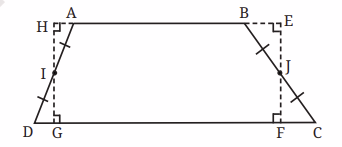
Given the trapezium ABCD, how do we find the vertices of the rectangle EFGH?
[Hint: If ∆AHI ≅ ∆DGI and ∆BEJ ≅ ∆CFJ, then the trapezium and rectangle have equal areas.]
$\textbf{Answer:}$
Let the given isosceles trapezium be $A B C D$ where the parallel sides are $A B$ and $C D$.
The non-parallel sides are $A D$ and $B C$, with their midpoints marked as $I$ and $J$ respectively. To find the vertices of the rectangle $E F G H$ of equal area, we perform a perpendicular dissection through these midpoints.
Locate the midpoint $I$ on side $A D$ and draw a straight line perpendicular to the base $C D$.
Let this vertical line meet the extension of the top side $A B$ at vertex $H$ and the bottom base $C D$ at vertex $G$.
Locate the midpoint $J$ on side $B C$ and draw a second straight line perpendicular to the base $C D$.
Let this vertical line meet the extension of the top side $A B$ at vertex $E$ and the bottom base $C D$ at vertex $F$.
Using the given hint, the triangle cut off at the bottom corner is identical to the space filled at the top $(\triangle A H I \cong \triangle D G I$ and $\triangle B E J \cong \triangle C F J)$.
$\Rightarrow$ Area of Rectangle $E F G H=$ Area of Trapezium $A B C D$
Question 6. Using the idea of converting a trapezium into a rectangle of equal area, and vice versa, construct a trapezium of area $144 \mathrm{~cm}^2$.
$\textbf{Answer:}$
Let a rectangle $E F G H$ have a length of 16 cm and a height of 9 cm.
⇒ Area of rectangle $=16 \times 9=144 \mathrm{~cm}^2$
To transform it into a trapezium, we can mark the midpoints of its vertical sides, $H G$ and $E F$, and label them $I$ and $J$ respectively.
Draw a slanted line through $I$ that cuts the top extended side at $A$ and the bottom side at $D$ such that $\triangle A H I \cong \triangle D G I$.
Draw another slanted line through $J$ that cuts the top side at $B$ and the bottom extended side at $C$ such that $\triangle B E J \cong \triangle C F J$.
Using the property of equal area dissection, the newly formed shape $A B C D$ is an isosceles trapezium.
⇒ Area of trapezium $A B C D=$ Area of rectangle $E F G H$
⇒ Area $=144 \mathrm{~cm}^2$
Question 7. A regular hexagon is divided into a trapezium, an equilateral triangle, and a rhombus, as shown. Find the ratio of their areas.
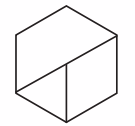
$\textbf{Answer:}$ 3 : 1 : 2
$\textbf{Explanation:}$
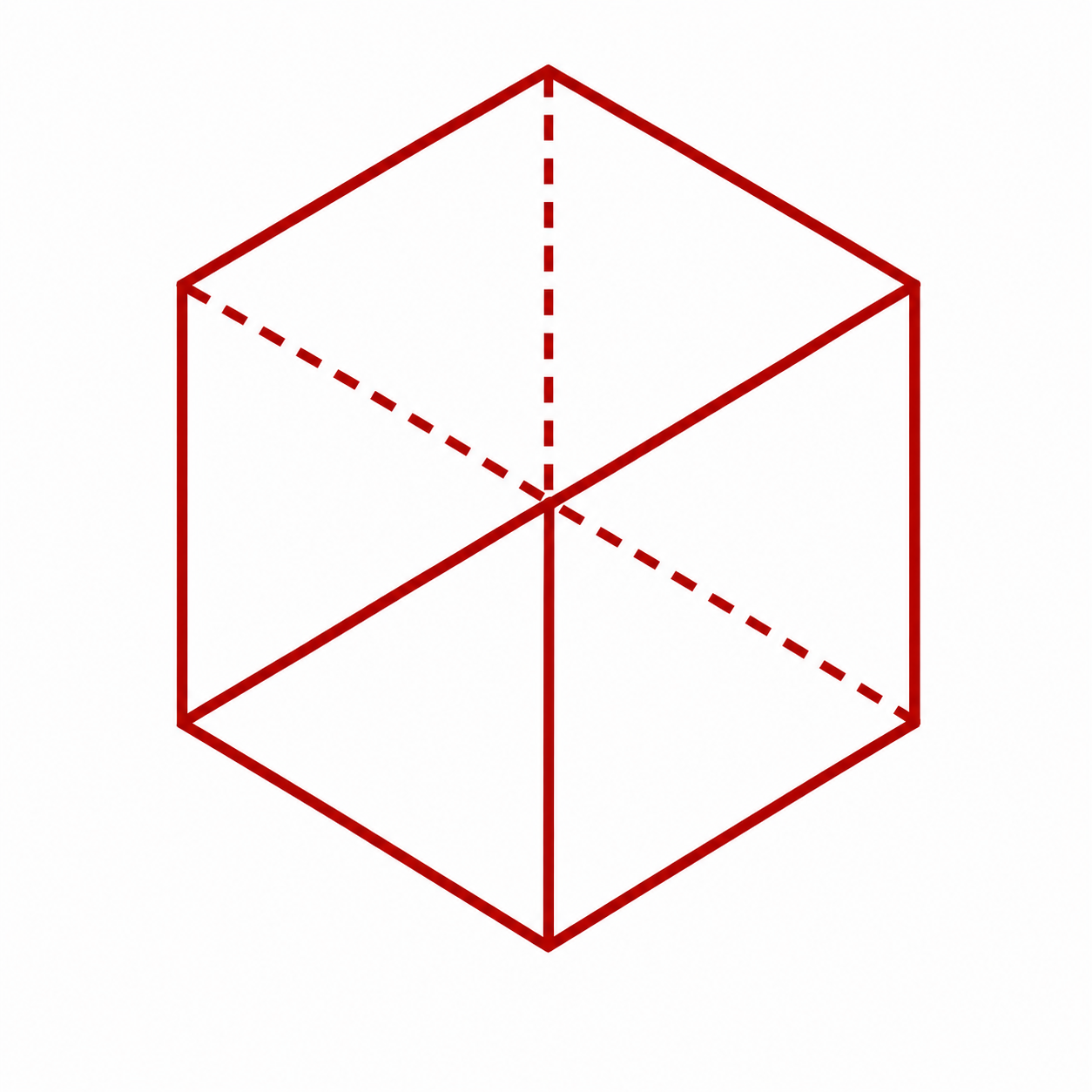
The rhombus is created by adding two equilateral triangles together.
Also, the trapezium is created by adding three equilateral triangles together.
Since all these small equilateral triangles are congruent, their areas are equal.
So, their ratio is:
Trapezium : Equilateral triangle :Rhombus = 3 : 1 : 2
Question 8. ZYXW is a trapezium with ZY ‖ WX. A is the midpoint of XY. Show that the area of the trapezium ZYXW is equal to the area of ∆ZWB.
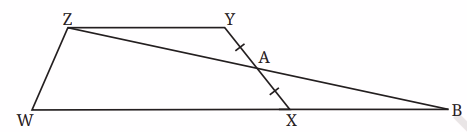
$\textbf{Answer:}$
In triangles AYZ and AXB,
AY = AX [$\because$ A is the midpoint of XY]
$\angle$YAX = $\angle$XAB [Vertically opposite angles]
$\angle$AYZ = $\angle$AXB [Alternate interior angles]
So, according to the Area-Side-Area (ASA) criteria, $\triangle$AYZ $\cong \triangle$AXB
Then, Area of $\triangle$AYZ = $\triangle$AXB
Adding the area of the quadrilateral AZWX on both sides, we get,
Area of $\triangle$AYZ + area of the quadrilateral AZWX = $\triangle$AXB + area of the quadrilateral AZWX
Area of trapezium ZYXW = Area of $\triangle$ZWB
Hence, proved.
Get your results instantly with our calculator!
Topics you will learn in NCERT Solutions for Class 8 Maths Part 2 Chapter 7 Area include:
7.1 Rectangle and Squares
Question 1:
The lengths of the diagonals of a rhombus are 48 cm and 20 cm. What is the perimeter of the rhombus?
$\textbf{Answer:}$
Diagonals of a rhombus bisect each other perpendicularly.
Let’s denote the length of each side of the rhombus as a
Using Pythagoras:
$\begin{aligned} & a^2=\left(\frac{48}{2}\right)^2+\left(\frac{20}{2}\right)^2=576+100=\sqrt{676} \\ & \Rightarrow a=26\end{aligned}$
So, the length of each side is 26
⇒ Perimeter = 4a = 4 × 26 = 104 cm
Hence, the correct answer is 104 cm.
Question 2:
If the area of a parallelogram is 508 $\mathrm{m}^2$ and its base is 40 m, then what is the corresponding height of the parallelogram?
$\textbf{Answer:}$
Given: Area of a parallelogram = 508 $\mathrm{m}^2$ and Base = 40 m
We know that,
Area of a parallelogram = base × corresponding height
⇒ 508 = 40 × height
⇒ Height = $\frac{508}{40}$ = 12.7
Hence, the correct answer is 12.7 m.
Question 3:
The length of two parallel sides of a trapezium are 25 metres and 30 metres. If its height is 20 metres, then what is the area of the trapezium?
$\textbf{Answer:}$
Given: The length of two parallel sides of a trapezium is 25 metres and 30 metres and its height is 20 metres.
The area of the trapezium
= $\frac{1}{2}$ × The sum of parallel sides × Height
= $\frac{1}{2}\times (25+30) \times 20$
= $\frac{1}{2}\times 55 \times 20$
= $550$ $\mathrm{m}^2$
Hence, the correct answer is 550 $\mathrm{m}^2$.
Question 4:
A square park has sides of length 18 cm. A 1 cm wide path along the edges is inside it. What is the area of the path?
$\textbf{Answer:}$
The outer square has sides of length 18 cm, so its area is 18 × 18 $\mathrm{cm}^2$.
The inner square, formed by the 1 cm wide path along the edges, has sides
= 18 − (2 × 1) = 16 cm
The area of the inner square is = 16 ×16 $\mathrm{cm}^2$
Area of path = Area of the outer square − Area of the inner square
= (18 × 18) − (16 × 16)
= 324 − 256 = 68 $\mathrm{cm}^2$
Hence, the correct answer is 68 $\mathrm{cm}^2$.
Question 5:
A picture is 40 cm wide and 1.6 m long. The ratio of its width to its perimeter is:
$\textbf{Answer:}$
1.6 m = 160 cm
The perimeter($P$) of a rectangle is given by the formula:
$P = 2\times(\text{length} + \text{width})$
Substituting the given values,
$P = 2\times(160 + 40) = 400 \, \text{cm}$
The ratio of the width to the perimeter,
$\frac{\text{width}}{P} = \frac{40}{400} = \frac{1}{10}=1:10$
Hence, the correct answer is 1 : 10.
We at Careers360 compiled all the NCERT Class 8 Maths solutions in one place for easy student reference. The following links will allow you to access them.
|
NCERT Solutions for Class 8 Maths Part 2 Chapter 1 Fractions in Disguise |
|
NCERT Solutions for Class 8 Maths Part 2 Chapter 2 The Baudhayana-Pythagoras Theorem |
|
NCERT Solutions for Class 8 Maths Part 2 Chapter 3 Proportional Reasoning - 2 |
|
NCERT Solutions for Class 8 Maths Part 2 Chapter 4 Exploring Some Geometric Themes |
|
NCERT Solutions for Class 8 Maths Part 2 Chapter 5 Tales by Dots and Lines |
|
NCERT Solutions for Class 8 Maths Part 2 Chapter 6 Algebra Play |
|
NCERT Solutions for Class 8 Maths Part 2 Chapter 7 Area |
Before planning a study schedule, always analyse the latest syllabus. Here are the links to the latest NCERT syllabus and some important books that will help students in this endeavour.
Class 8 Part 2 Chapter 7 Area introduces students to finding the areas of various two-dimensional figures using standard mathematical formulas. This chapter explains the area of a rectangle and a square using the basic concepts of length, breadth, and side. Students also learn how to calculate the area of a parallelogram using its base and its corresponding height. This chapter also covers the formula for finding the area of a trapezium and its practical applications. It introduces students to the method of calculating the area of a rhombus using its diagonals. The concepts learned in this chapter build a strong foundation for mensuration and geometry.
This chapter contains 6 exercises with a total of 36 questions for revision and preparation purposes.
These NCERT solutions provide clear, step-by-step explanations for every question, making area calculations simple to understand. Here are some points about these solutions.
These NCERT Class 8 Part 2 Chapter 7 Solutions strengthen students' understanding of geometric figures and their properties.
These solutions simplify complex problems and help students prepare effectively for school examinations.
Overall, Chapter 7 is an important mensuration chapter that lays the groundwork for higher-level geometry and practical applications.
Important concepts and topics related to the latest NCERT Solutions for Class 8 Maths Ganita Prakash Part 2 Chapter 7 in higher classes are provided below.
Class 9-10
Area of triangles and quadrilaterals
Heron's Formula
Areas related to circles
Surface areas and volumes
Coordinate geometry involving area
Construction and geometric applications
Mensuration-based word problems
Practical applications of area formulas
Class 11-12
Coordinate geometry and area calculations
Integration as the area under curves
Three-dimensional geometry
Surface area and volume of solids
Vector geometry applications
Geometric reasoning and visualisation
Analytical geometry involving polygons
Engineering and architectural applications
JEE (Main & Advanced)
Coordinate geometry and area-based problems
Mensuration and geometric optimisation
Surface area and volume calculations
Vector and analytical geometry
Complex geometry involving quadrilaterals
Mathematical modelling using geometric figures
Multi-concept geometry problems
Advanced problem-solving involving area and measurement

A block of mass 0.50 kg is moving with a speed of 2.00 ms-1 on a smooth surface. It strikes another mass of 1.00 kg and then they move together as a single body. The energy loss during the collision is
| Option 1)
|
Option 2)
|
| Option 3)
|
Option 4)
|
An athlete in the olympic games covers a distance of 100 m in 10 s. His kinetic energy can be estimated to be in the range
| Option 1)
|
Option 2)
|
| Option 3)
|
Option 4)
|
A particle is projected at 600 to the horizontal with a kinetic energy . The kinetic energy at the highest point
| Option 1)
|
Option 2)
|
| Option 3)
|
Option 4)
|
In the reaction,
| Option 1)
|
Option 2)
|
| Option 3)
|
Option 4)
|
How many moles of magnesium phosphate, will contain 0.25 mole of oxygen atoms?
| Option 1)
0.02 |
Option 2)
3.125 × 10⁻² |
| Option 3)
1.25 × 10⁻² |
Option 4)
2.5 × 10⁻² |

Law Admissions 2026 Open | Avail Merit-Based Scholarships
BBA/MBA/PGDM Early Bird Applications Deadline 19th Oct '26. Apply now using coupon code CAREER250 and get ₹250 off the application fee
Ranked #36 amongst institutions in Management by NIRF | 100% Placement
Globally Recognized by AACSB (US) & AMBA (UK) | 18 LPA Avg. CTC for PGPM 2026
Leading Design College | 95% Placement Record | Merit-cum-Means Scholarships for Deserving Students
NEET PG All India & State College Predictor with Admission Process Guide