KCC Institute of Legal and Higher Education, Greater Noida
Law Admissions 2026 Open | Avail Merit-Based Scholarships


The Baudhayana-Pythagoras Theorem is a very useful rule that allows us to solve such problems by considering the lengths of only the other two sides. Before the invention of modern technology, mathematicians used this theorem to calculate unknown distances. These latest NCERT Solutions for Class 8 Maths Part 2 Chapter 2 The Baudhayana-Pythagoras Theorem, based on latest textbook, provide a base for higher studies in mathematics, physics, engineering, architecture and many real life applications related to measurement and distance.
This Story also Contains
The Baudhāyana-Pythagoras Theorem is one of the most fundamental theorems in geometry. It expresses the relationship among the three sides of a right-angled triangle. This theorem makes our calculations easier and simpler. These latest NCERT Solutions for Class 8 made by our experienced faculty at Career360 can be considered a very important study material for students in their pursuit of high scores. Many toppers use NCERT Solutions updated for CBSE to strengthen their ability to solve various types of mathematical problems.
Students can download the NCERT Solutions for Class 8 Maths Part 2 Chapter 2 The Baudhayana-Pythagoras Theorem PDF by clicking the link provided below.
Here are the NCERT Solutions for Class 8 Maths Part 2 Chapter 2 The Baudhayana-Pythagoras Theorem question answers with clear and detailed solutions.
Class 8 Maths Part 2 Chapter 2 Question Answers with Detailed Solutions
|
Question 1. Earlier, we saw a method to create a square with double the area of a given square paper. There is another method to do this in which two identical square papers are cut in the following way.
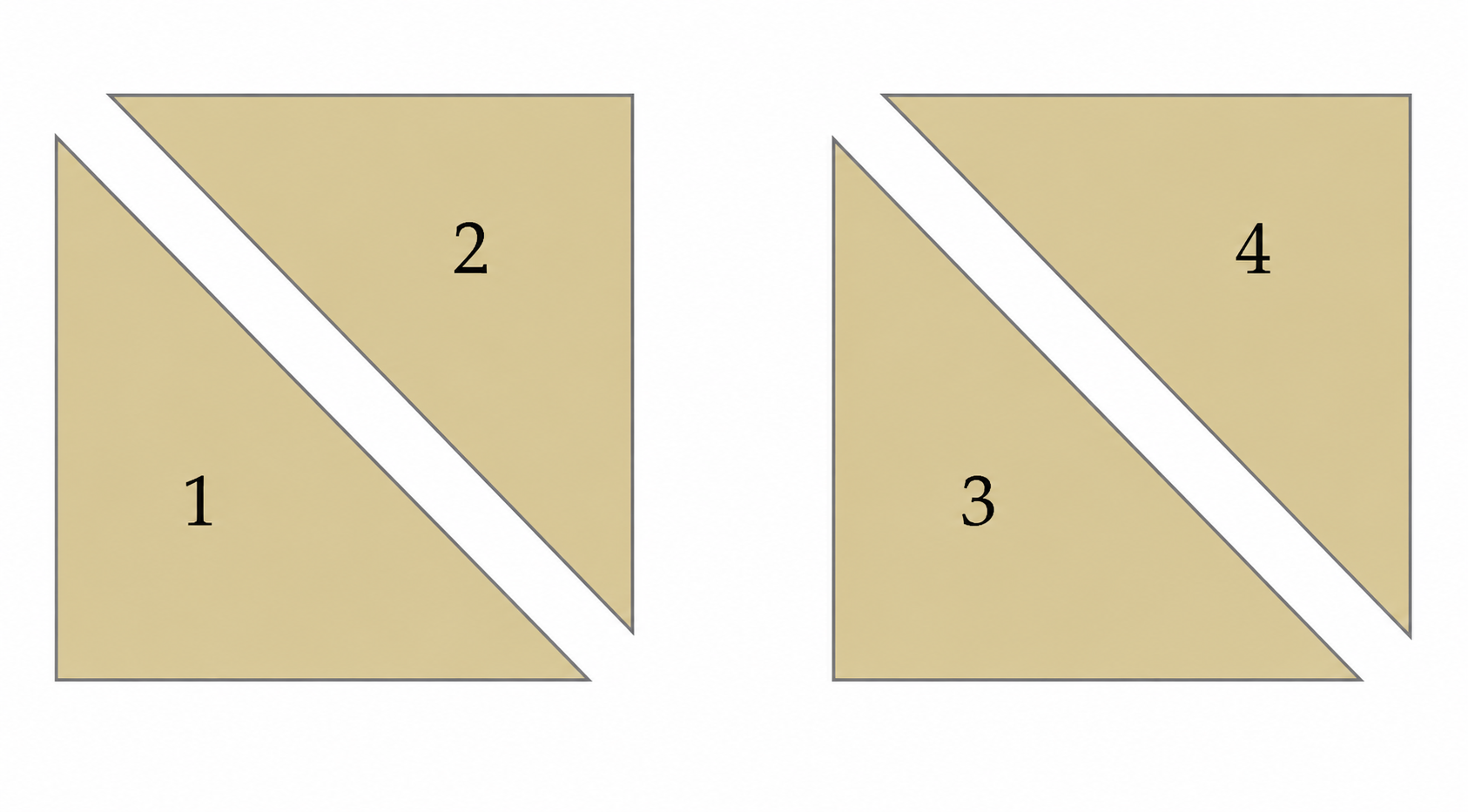
Can you arrange these pieces to create a square with double the area of either square?
$\textbf{Answer:}$
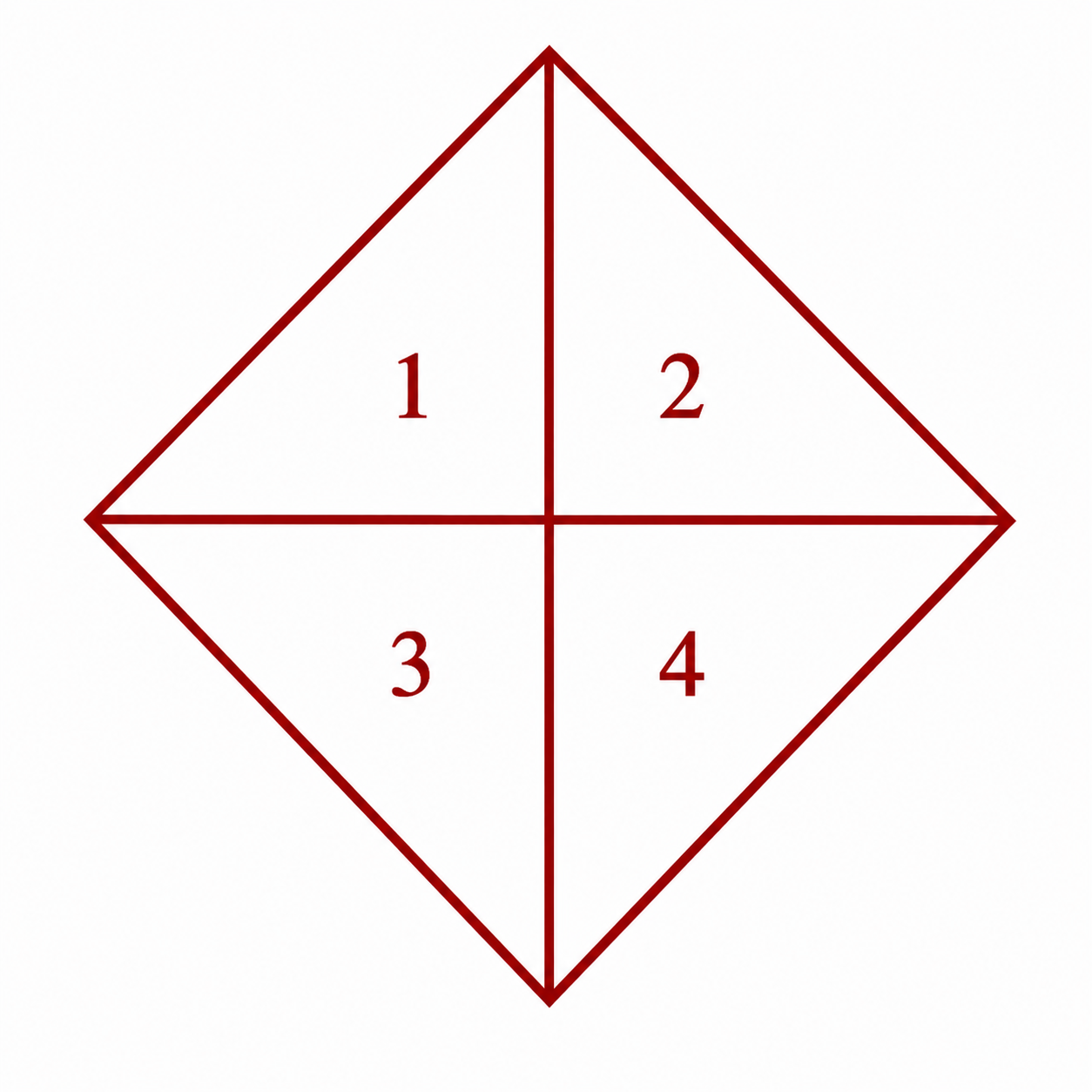
A diagonal divides a square into two equal-area triangles:
$\triangle 1=\triangle 2$ and $ \triangle 3=\triangle 4$
Original square $=\triangle 1+\triangle 2=\triangle 3+\triangle 4$
Newly formed square $=\Delta 1+\Delta 2+\Delta 3+\Delta 4$
⇒ Newly formed square $=2 \times$ Original Square
Hence, the given triangles can be arranged to create a square with double the area of either square.
Question 2. The length of the two equal sides of an isosceles right triangle is given. Find the length of the hypotenuse. Find bounds on the length of the hypotenuse such that they have at least one digit after the decimal point.
(i) 3
(ii) 4
(iii) 6
(iv) 8
(v) 9
$\textbf{Answer:}$
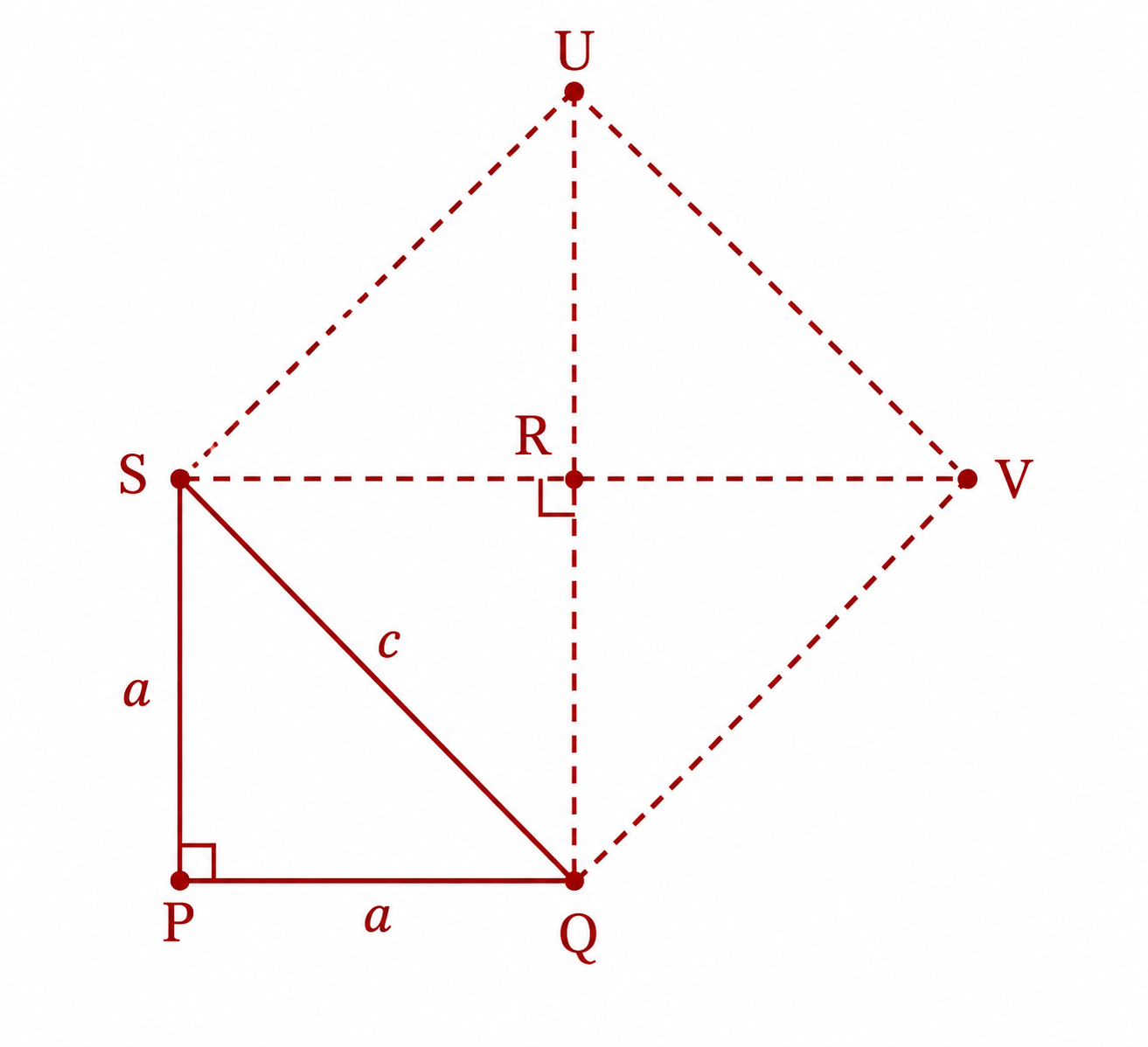
In an isosceles right triangle, if each equal side is $a$, then the hypotenuse is $a\sqrt2$.
Also $\sqrt2\approx1.414$
2 (i):
If $a=3,$ then hypotenuse $=3\sqrt2\approx3\times1.414\approx4.242$
So, bounds of hypotenuse: 4 < Hypotenuse < 5
2 (ii):
If $a=4,$ then hypotenuse $=4\sqrt2\approx4\times1.414\approx5.656$
So, bounds of hypotenuse: 5 < Hypotenuse < 6
2 (iii):
If $a=6,$ then hypotenuse $=6\sqrt2\approx6\times1.414\approx8.484$
So, bounds of hypotenuse: 8 < Hypotenuse < 9
2 (iv):
If $a=8,$ then hypotenuse $=8\sqrt2\approx8\times1.414\approx11.312$
So, bounds of hypotenuse: 11 < Hypotenuse < 12
2 (v):
If $a=9,$ then hypotenuse $=9\sqrt2\approx9\times1.414\approx12.726$
So, bounds of hypotenuse: 12 < Hypotenuse < 13
Question 3. The hypotenuse of an isosceles right triangle is 10. What are its other two sidelengths?
[Hint: Find the area of the square composed of two such right triangles.]
$\textbf{Answer:}$ $5\sqrt2$ and $5\sqrt2$
$\textbf{Explanation:}$
In an isosceles right triangle, if each equal side is $a$, then the hypotenuse is $a\sqrt2$.
So, $a\sqrt2=10$
$⇒a=\frac{10}{\sqrt2}=5\sqrt2$
Hence, the other two equal sides are $5\sqrt2$ and $5\sqrt2$.
Class 8 Maths Part 2 Chapter 2 Question Answers with Detailed Solutions
|
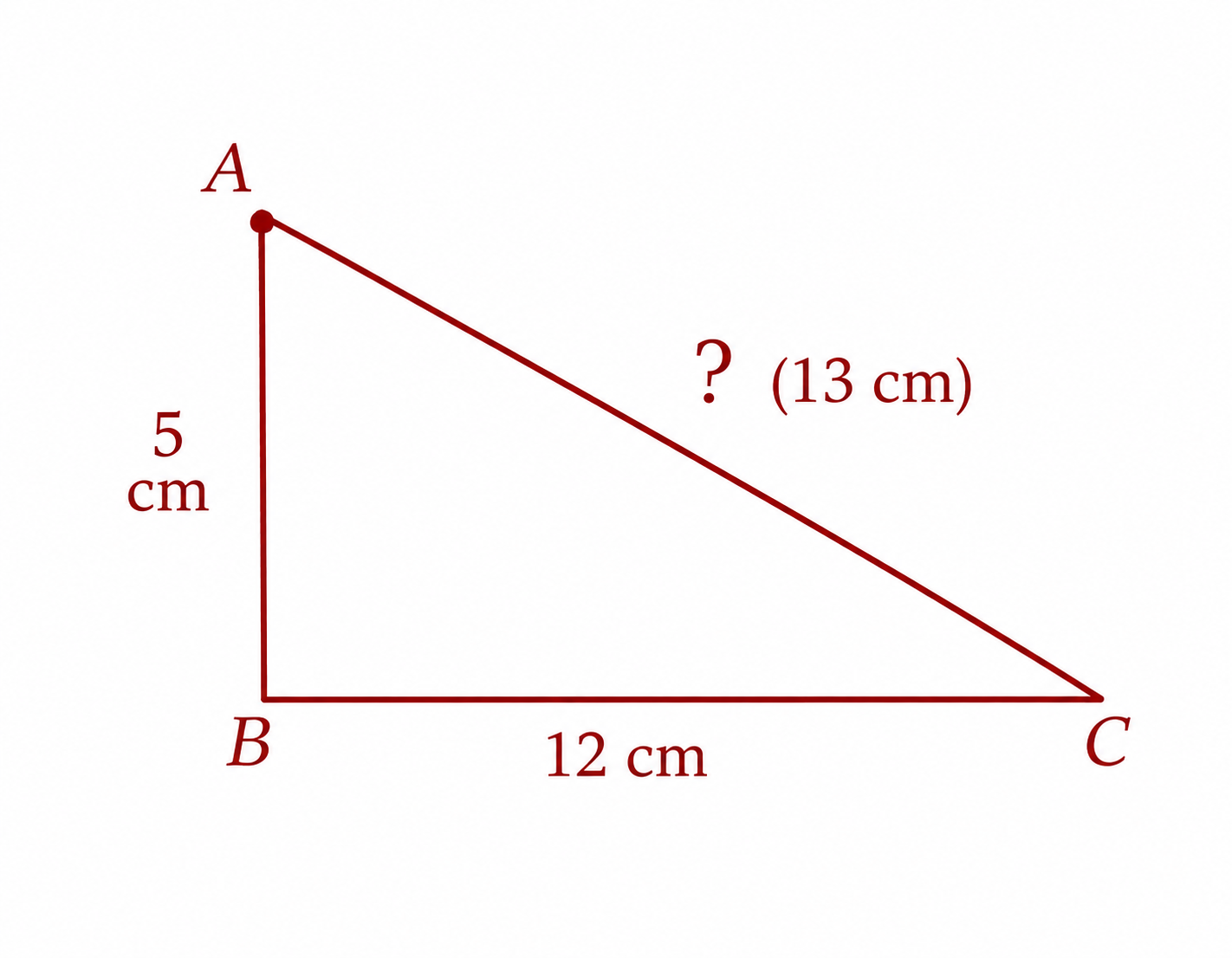
Question 1. If a right-angled triangle has shorter sides of lengths 5 cm and 12 cm, then what is the length of its hypotenuse?
First draw the right-angled triangle with these sidelengths and measure the hypotenuse, then check your answer using Baudhāyana's Theorem.
$\textbf{Answer:}$ 13 cm
$\textbf{Explanation:}$
Here, the short sides are 5 cm and 12 cm.
According to the Baudhāyana's Theorem, if $a, b, c$ are the side lengths of a right-angled triangle, where $c$ is the length of the hypotenuse, then $a^2+b^2=c^2$
$c^2=5^2+12^2=25+144=169$
$⇒c=\sqrt{169}=13$ cm
Hence, the length of its hypotenuse is 13 cm.
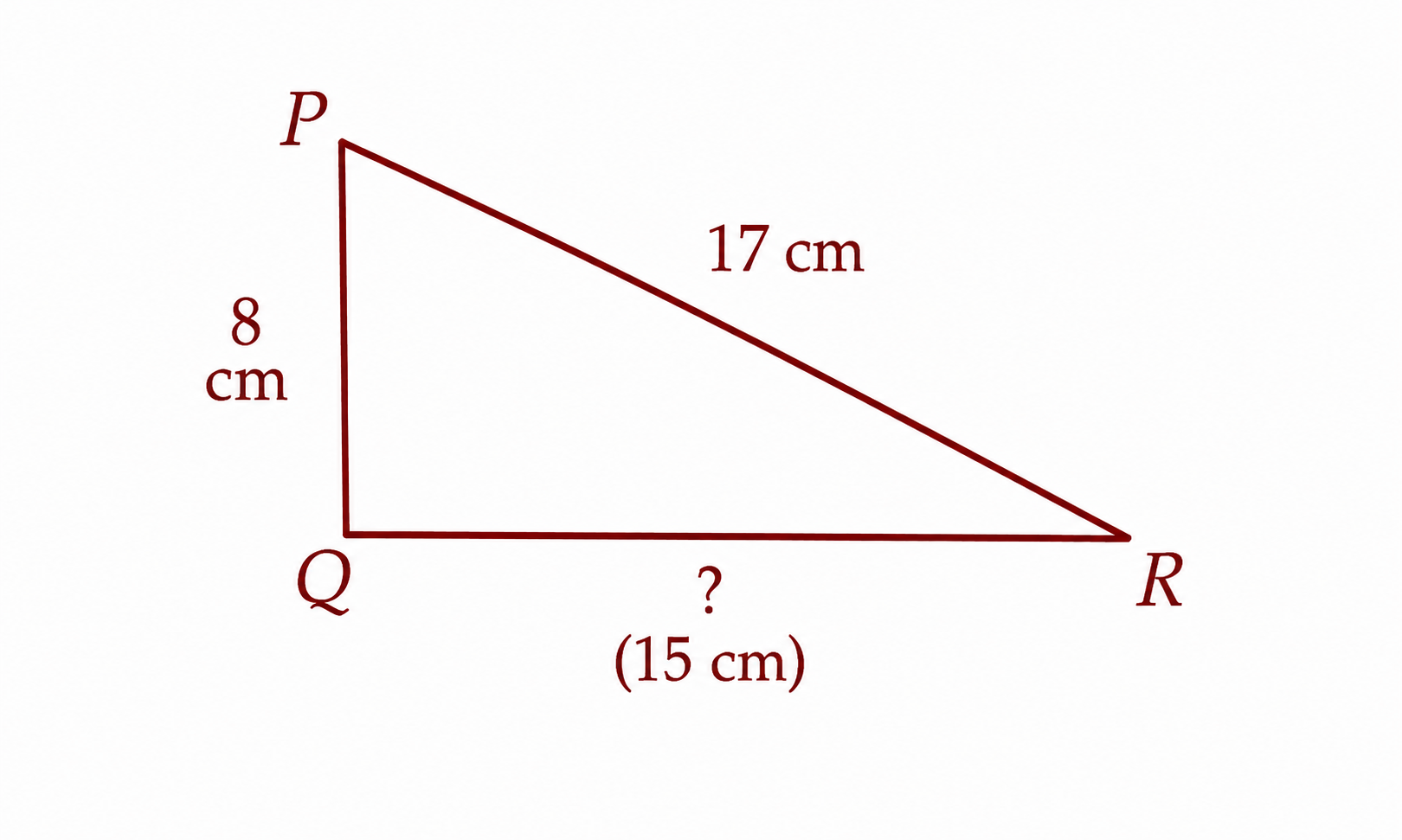
Question 2. If a right-angled triangle has a short side of length 8 cm and hypotenuse of length 17 cm, what is the length of the third side? Again, try drawing the triangle and measuring, and then check your answer using Baudhāyana's Theorem.
$\textbf{Answer:}$ 15 cm
$\textbf{Explanation:}$
We know that, if $a, b, c$ are the side lengths of a right-angled triangle, where $c$ is the length of the hypotenuse, then $a^2+b^2=c^2$
Let $a$ be the longer side.
According to the question,
$a^2+8^2=17^2$
$⇒a^2=289-64=225$
$\therefore a=\sqrt{225}=15$ cm
Hence, the length of the third side is 15 cm.
Question 3. Using the constructions you have now seen, how would you construct a square whose area is triple the area of a given square? Five times the area of a given square? (Baudhāyana’s Śulba-Sūtra, Verse 1.10)
$\textbf{Answer:}$
3 (a):
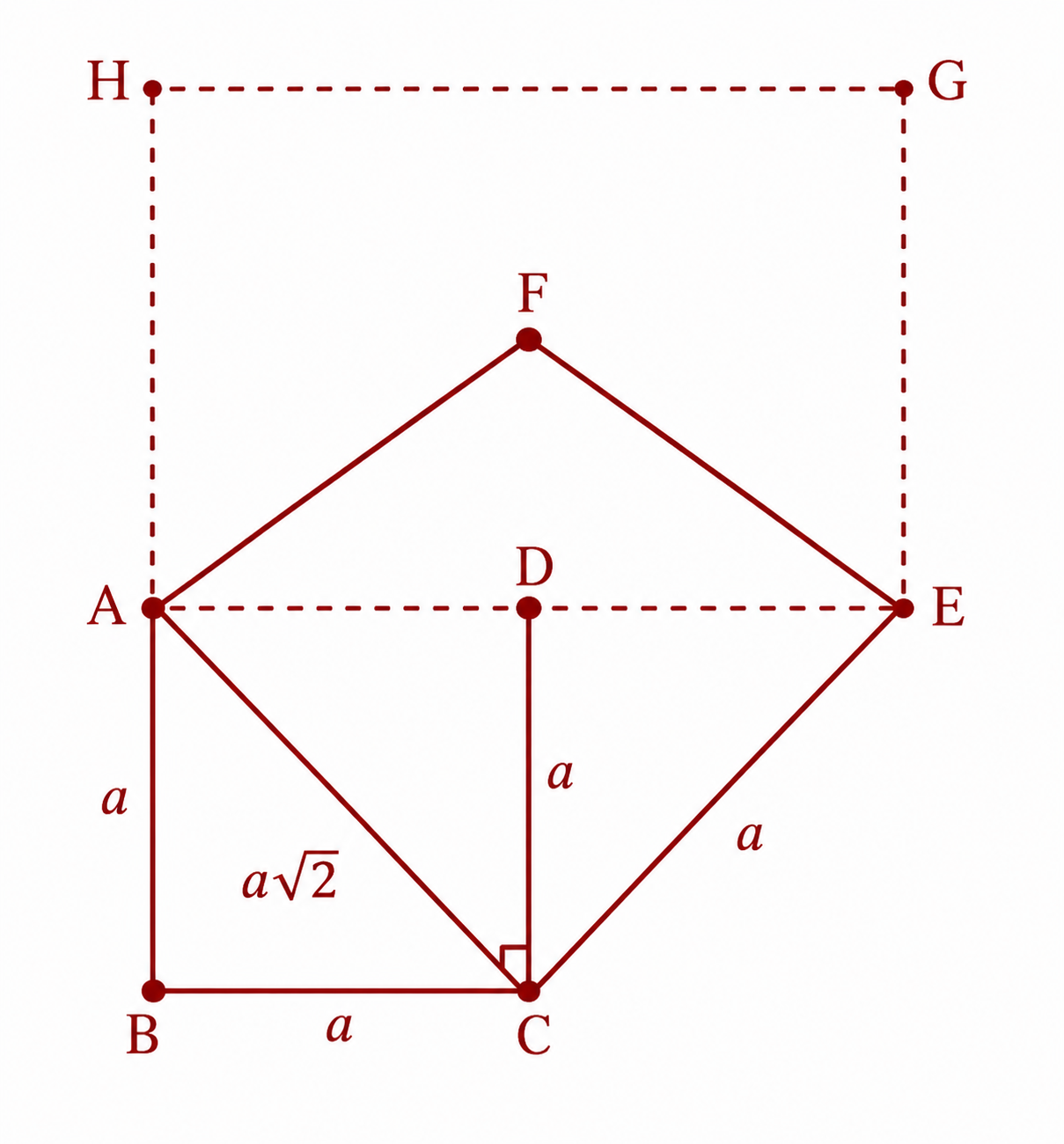
ABCD is a square with side $a$.
So, diagonal, AC $=a \sqrt{2}$
ACEF is a rectangle with sides $a \sqrt{ 2} $ and $a$.
Now AE $=a \sqrt{3} $
Now, AEGH is a square with a side of $\mathrm{a} \sqrt{3 }$
Then Area of AEGH $=3 \mathrm{a}^2$
Also, area of ABCD $=\mathrm{a}^2$
$\therefore$ Area of AEGH $=3 \times$ Area of ABCD
3 (b):
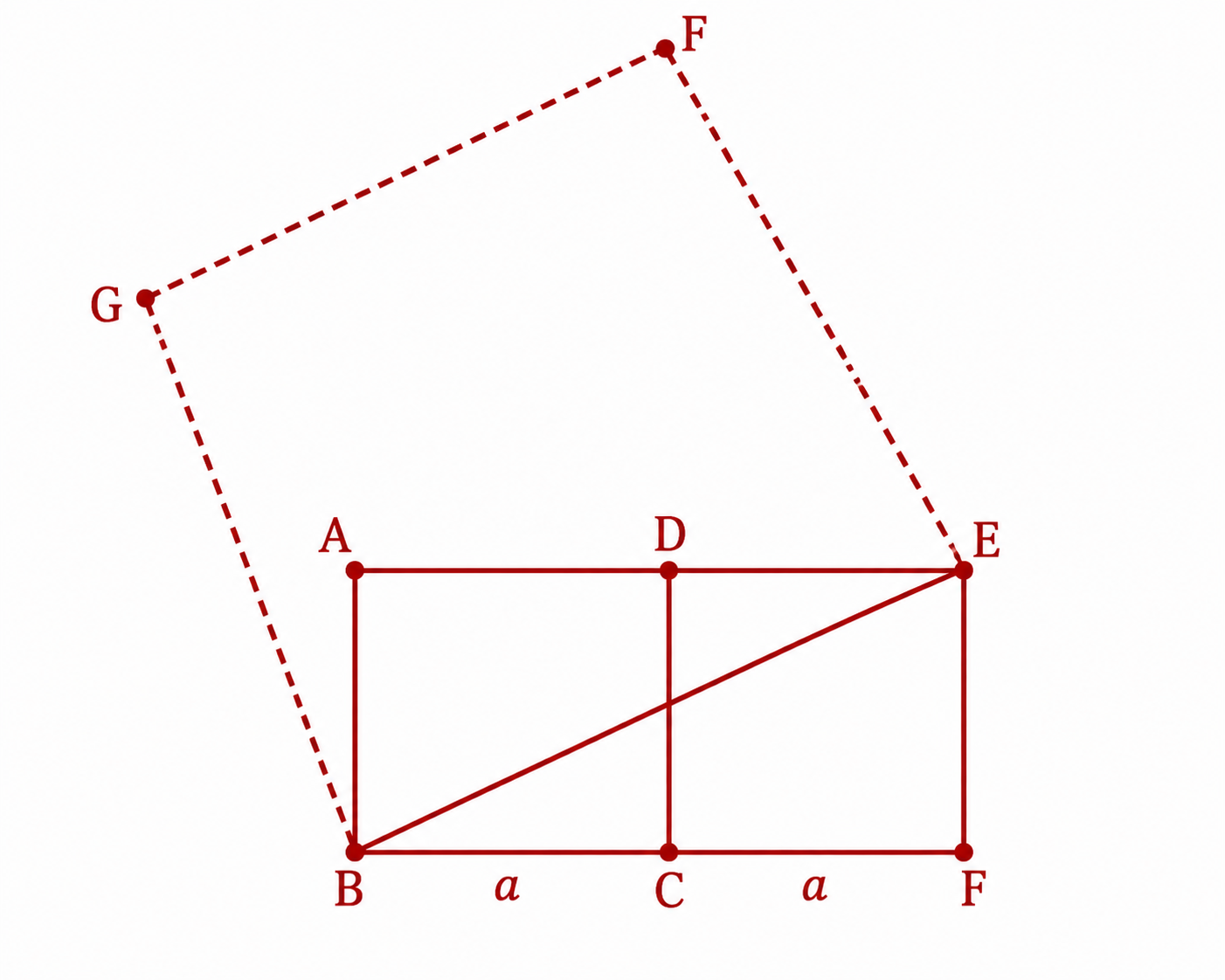
$A B C D$ and $C F E D$ are squares with side $a$.
$B E$ is a diagonal of the rectangle $A B F E$.
In rectangle ABFE
$E F=a$ and $B F=B C+C F=a+a=2 a$
Using Baudhayana's Theorem
$ B E^2=E F^2+B F^2 $
$ ⇒B E^2=a^2+(2 a)^2 $
$⇒B E^2 =a^2+4 a^2 $
$ ⇒B E^2=5 a^2 $
$ \therefore B E=\sqrt{5} a$
BEFG is a square with side BE.
Area $B E F G=B E^2 =(\sqrt{5 } a)^2=5 a^2$
Then the area of $B E F G=5 \times$ the area of $A B C D$
Question 4. Let $a, b$ and $c$ denote the length of the sides of a right triangle, with $c$ being the length of the hypotenuse. Find the missing sidelength in each of the following cases:
(i) $a=5, b=7$
(ii) $a=8, b=12$
(iii) $a=9, c=15$
(iv) $a=7, b=12$
(v) $a=1.5, b=3.5$
$\textbf{Answer:}$
We know that,
If $a, b, c$ are the sidelengths of a right-angled triangle, where $c$ is the length of the hypotenuse, then $a^2+b^2=c^2$
4 (i):
$a=5, b=7$
Then, $5^2+7^2=c^2$
$⇒c^2=25+49=74$
$\therefore c= \sqrt{74}$
4 (ii):
$a=8, b=12$
Then, $8^2+12^2=c^2$
$⇒c^2=64+144=208$
$\therefore c=\sqrt{208}=4\sqrt{13}$
4 (iii):
$a=9, c=15$
Then, $9^2+b^2=15^2$
$b^2=225-81=144$
$\therefore b=\sqrt {144}=12$
4 (iv):
$a=7, b=12$
Then, $7^2+12^2=c^2$
$⇒c^2=49+144=193$
$\therefore c=\sqrt{193}$
4 (v):
$a=1.5, b=3.5$
Then, $1.5^2+3.5^2=c^2$
$⇒c^2=2.25+12.25=14.5$
$\therefore c=\sqrt{14.5}$
Class 8 Maths Part 2 Chapter 2 Question Answers with Detailed Solutions
|
Question 1. Find 5 more Baudhāyana triples using this idea.
$\textbf{Answer:}$
We know that triples $(a, b, c)$ that form the side lengths of a right triangle (equivalently, satisfy $a^2+b^2=c^2$ ) are called Baudhāyana triplets.
General form of triplets is:
$(a, b, c)=\left(n^2-1,2 n, n^2+1\right)$
When $n=4$, triplets are (15, 8, 17).
When $n=5$, triplets are (24, 10, 26).
When $n=6$, triplets are (25, 12, 37).
When $n=7$, triplets are (48, 14, 50).
When $n=8$, triplets are (63, 16, 65).
Question 2. Does this method yield non-primitive Baudhāyana triples?
[Hint: Observe that among the triples generated, one of the smaller sidelengths is one less than the hypotenuse.]
$\textbf{Answer:}$ Yes
$\textbf{Explanation:}$
A primitive triple has no common factor other than 1. This method generates both primitive and non-primitive triples.
Non-primitive triples appear when the generated values share a common factor (like 2, 3, etc.).
Question 3. Are there primitive triples that cannot be obtained through this method? If yes, give examples.
$\textbf{Answer:}$ Yes
$\textbf{Explanation:}$
This method does not generate all primitive triples.
All primitive triples are given by the general Euclid formula: $\left(m^2-n^2, 2 m n, m^2+n^2\right)$
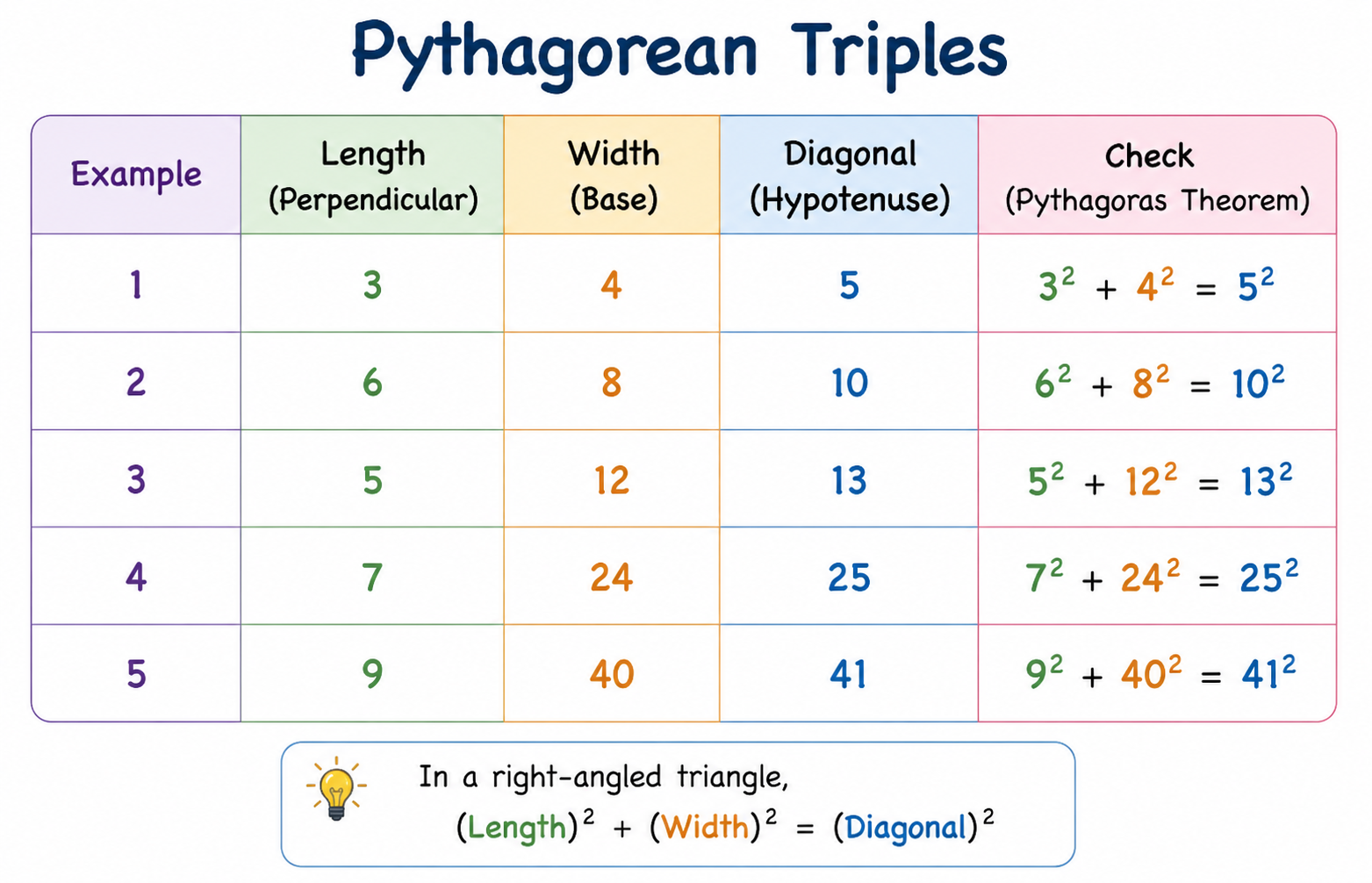
Example: (9, 40, 41), (20, 21, 29), (7, 24, 25)
Class 8 Maths Part 2 Chapter 2 Question Answers with Detailed Solutions
|
Question 1. Find the diagonal of a square with side length 5 cm.
$\textbf{Answer:}$ $5\sqrt5$ cm
$\textbf{Explanation:}$
We know that the length of the diameter of a square = $\sqrt2 \times$ Side length
Here, Side length = 5 cm
So, diameter length = $5\sqrt5$ cm
Question 2. Find the missing sidelengths in the following right triangles:
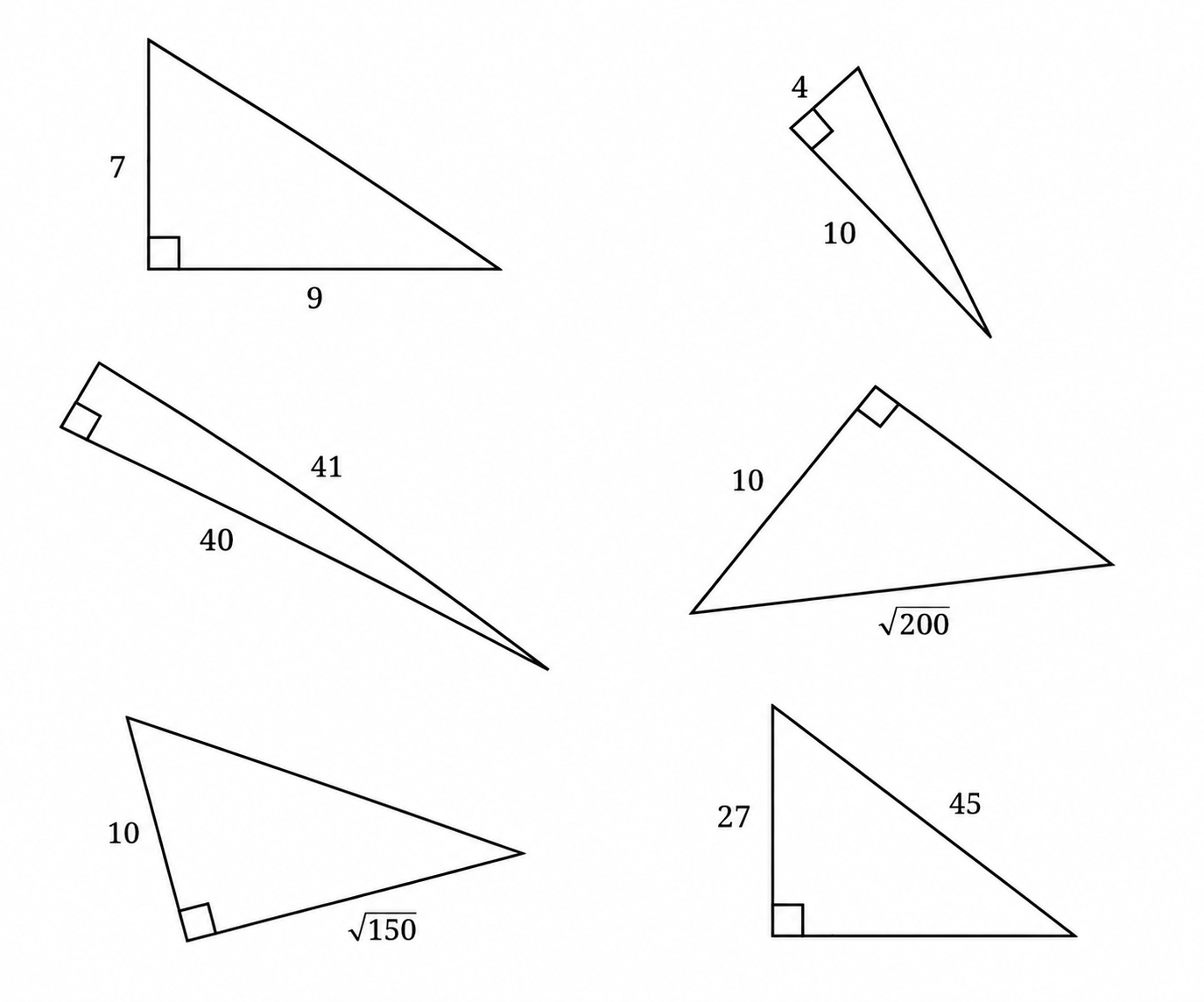
$\textbf{Answer:}$
We know that,
If $a, b, c$ are the sidelengths of a right-angled triangle, where $c$ is the length of the hypotenuse, then $a^2+b^2=c^2$
$⇒c=\sqrt{a^2+b^2}$
2 (i): $\sqrt{130}$ units
$\textbf{Explanation:}$
In the 1st triangle, the side lengths are 7 and 9.
So, hypotenuse $=\sqrt{7^2+9^2}=\sqrt{49+81}=\sqrt{130}$
Therefore, the length of the hypotenuse is $\sqrt{130}$ units.
2 (ii): $2\sqrt{29}$ units
$\textbf{Explanation:}$
In the 2nd triangle, the side lengths are 4 and 10.
So, hypotenuse $=\sqrt{4^2+10^2}=\sqrt{16+100}=\sqrt{116}=2\sqrt{29}$
Therefore, the length of the hypotenuse is $2\sqrt{29}$ units.
2 (iii): 9 units
$\textbf{Explanation:}$
In the third triangle, one side length is given, i.e., 40.
And hypotenuse = 41
Let the other side length be $a$.
So, $40^2+a^2=41^2$
$⇒a^2=1681-1600=81$
$⇒a=9$
Therefore, the length of the other side is 9 units.
2 (iv): 10 units
$\textbf{Explanation:}$
In the 4th triangle, one side length is given, i.e., 10.
And hypotenuse = $\sqrt{200}$
Let the other side length be $b$.
So, $10^2+b^2=(\sqrt{200})^2$
$⇒b^2=200-100=100$
$⇒b=10$
Therefore, the length of the other side is 10 units.
2 (v): $5 \sqrt{10}$ units
$\textbf{Explanation:}$
In the 5th triangle, the side lengths are 10 and $\sqrt{150}$.
So, hypotenuse $=\sqrt{10^2+(\sqrt {150})^2}=\sqrt{100+150}=\sqrt{250}=5\sqrt{10}$
Therefore, the length of the hypotenuse is $5 \sqrt{10}$ units.
2 (vi): 36 units
$\textbf{Explanation:}$
In the 6th triangle, one side length is given, i.e., 27.
And hypotenuse = 45
Let the other side length be $c$.
So, $27^2+c^2=45^2$
$⇒c^2=2025-729=1296$
$⇒c=36$
Therefore, the length of the other side is 36 units.
Question 3. Find the sidelength of a rhombus whose diagonals are of length 24 units and 70 units.
$\textbf{Answer:}$ 37 units
$\textbf{Explanation:}$
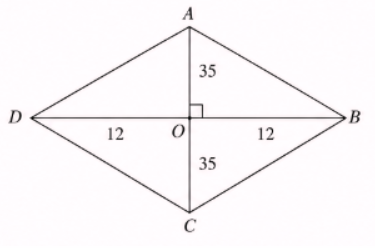
In a rhombus, the diagonals are perpendicular bisectors of each other.
Half-diagonals are 12 and 35.
Let the side length be $s$.
Using the right triangle formed by half-diagonals and a side,
$s=\sqrt{12^2+35^2}=\sqrt{144+1225}=\sqrt{1369}=37 \text { units. }$
Hence, the side length is 37 units.
Question 4. Is the hypotenuse the longest side of a right triangle? Justify your answer.
$\textbf{Answer:}$ Yes
$\textbf{Explanation:}$
Yes, the hypotenuse is the longest side of a right triangle.
We know that, if $a, b, c$ are the sidelengths of a right-angled triangle, where $c$ is the length of the hypotenuse, then $a^2+b^2=c^2$
Since the lengths of the sides must be positive numbers, squaring them results in positive values, i.e., $a^2>0$ and $b^2>0$ [$\because$ After adding $b^2$ to $a^2$, we get $c^2$]
Then $c^2>a^2$ and $c^2>b^2$
Hence, $c>a$ and $c>b$.
Hence, proved.
Question 5. True or False: Every Baudhāyana triple is either a primitive triple or a scaled version of a primitive triple.
$\textbf{Answer:}$ True
$\textbf{Explanation:}$
Every Baudhāyana triple is either a primitive triple or a scaled version of a primitive triple.
A Baudhāyana triple is a set of three whole numbers $(a, b, c)$ that can form the sides of a right-angled triangle. They must satisfy the Baudhāyana-Pythagorean property:
$\text { Base }^2 \text { + Height }{ }^2=\text { Hypotenuse }^2$
$⇒a^2+b^2=c^2$
Primitive Triples are three numbers that share no common factor other than 1.
For example, in $(3, 4, 5)$ or $(5, 12, 13)$, you cannot divide all three numbers by any number larger than 1.
Scaled Triples are numbers created by multiplying a primitive triple by a constant whole number.
Lets take the primitive triple $(3, 4, 5)$ and multiply every number by $2$:
New numbers: $(3\times2, 4\times2, 5\times2) \rightarrow (6, 8, 10)$
Let's check if this new set is still a valid triple:
$ \Rightarrow 6^2+8^2=36+64=100$
$ \Rightarrow 10^2=100$
Since $36+64=100$, it works perfectly.
Question 6. Give 5 examples of rectangles whose sidelengths and diagonals are all integers.
$\textbf{Answer:}$
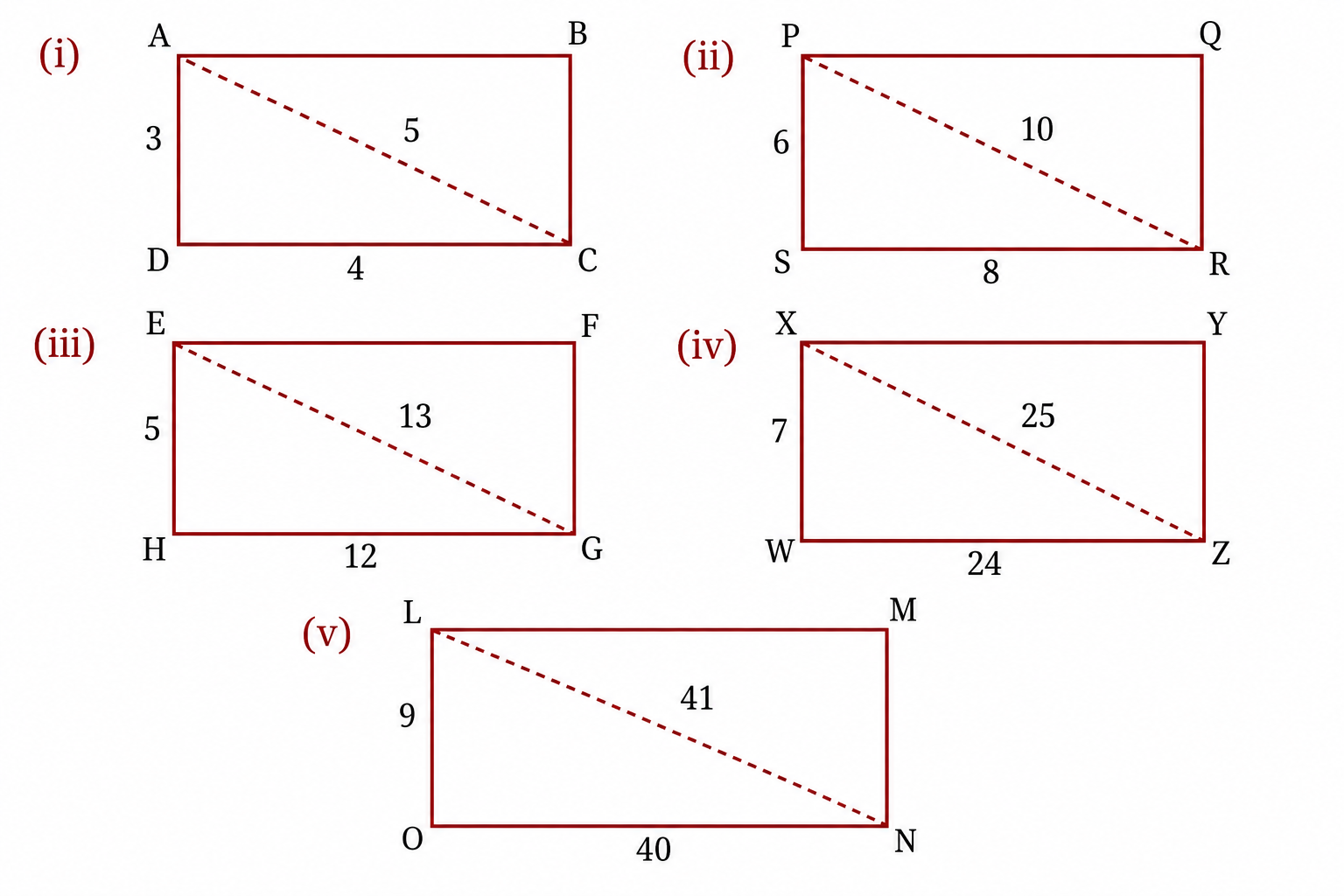
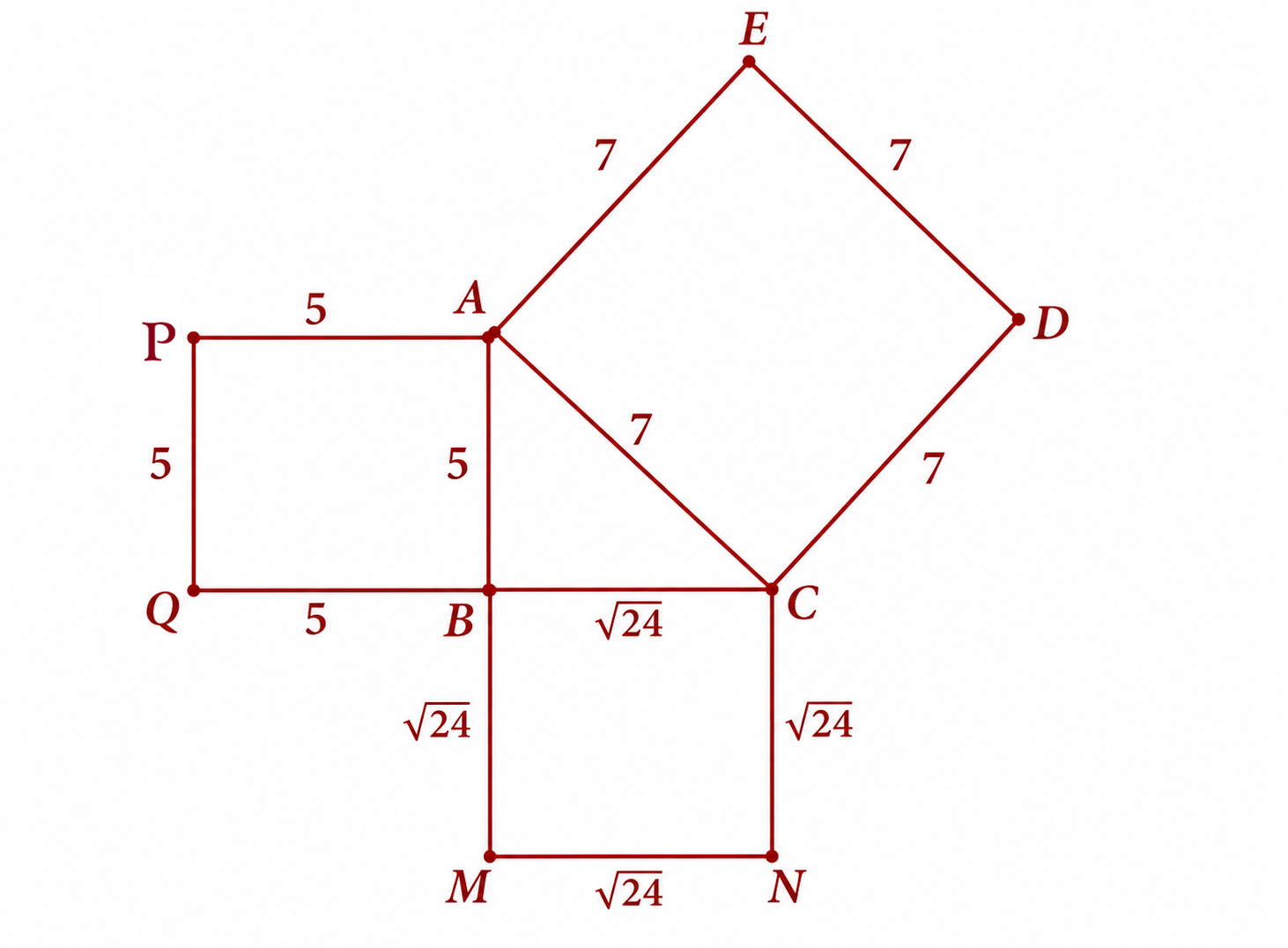
Question 7. Construct a square whose area is equal to the difference of the areas of squares of sidelengths 5 units and 7 units.
$\textbf{Answer:}$
Area of required square = $7^2-5^2=49-25=24$ square units
Now, we know, area of a square = $\text{Side length}^2$
⇒ 24 = $\text{Side length}^2$
$\therefore$ Side length = $\sqrt{24}$ units
Area of the newly formed square = $(\sqrt{24})^2=24$ square units
Question 8.
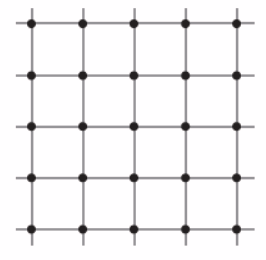
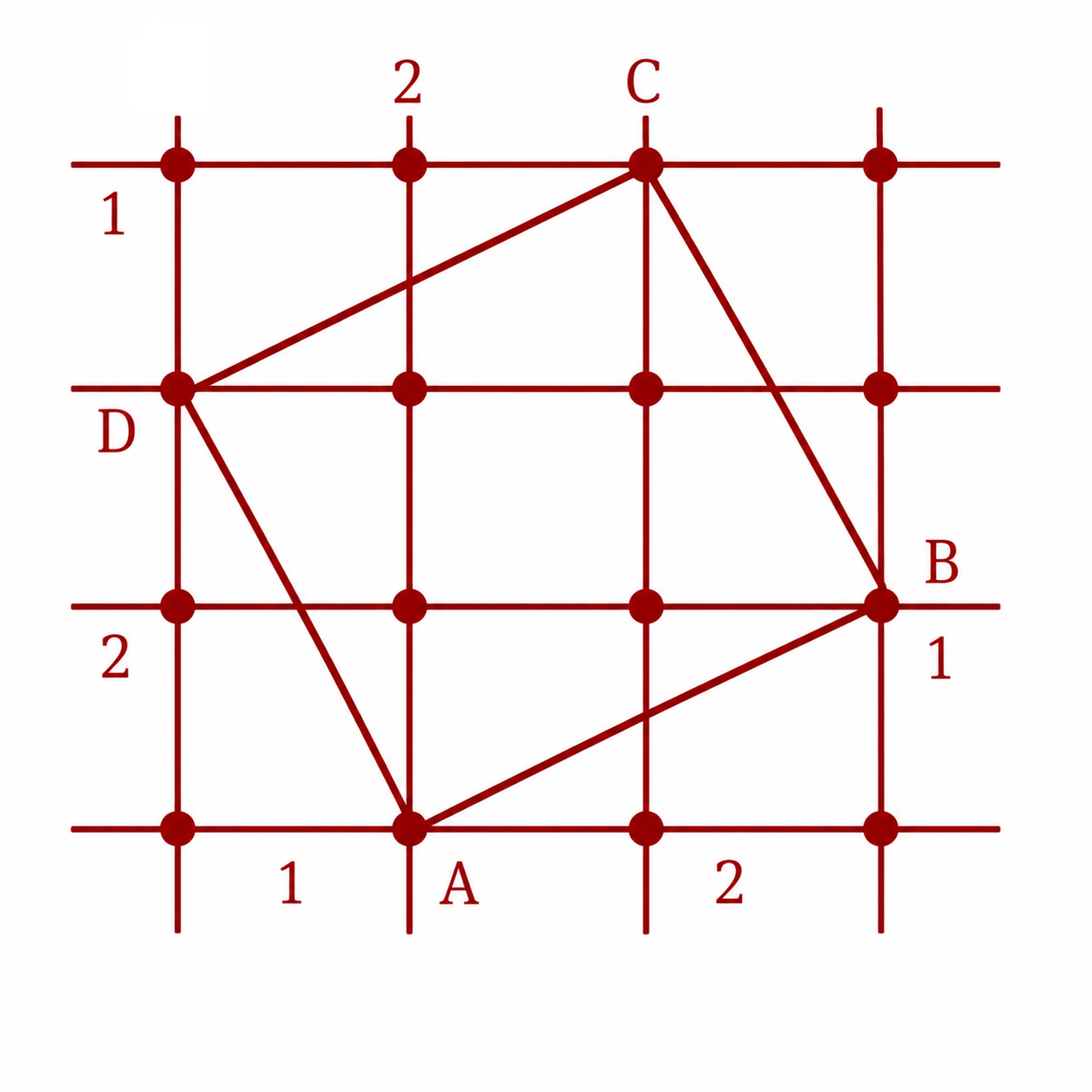
(i) Using the dots of a grid as the vertices, can you create a square that has an area of (a) 2 sq. units, (b) 3 sq. units, (c) 4 sq.units, and (d) 5 sq. unit?
(ii) Suppose the grid extends indefinitely. What are the possible integer-valued areas of squares you can create in this manner?
$\textbf{Answer:}$
8 (i):
We know that the area of a square on a dot grid must always be expressible as the sum of two perfect squares.
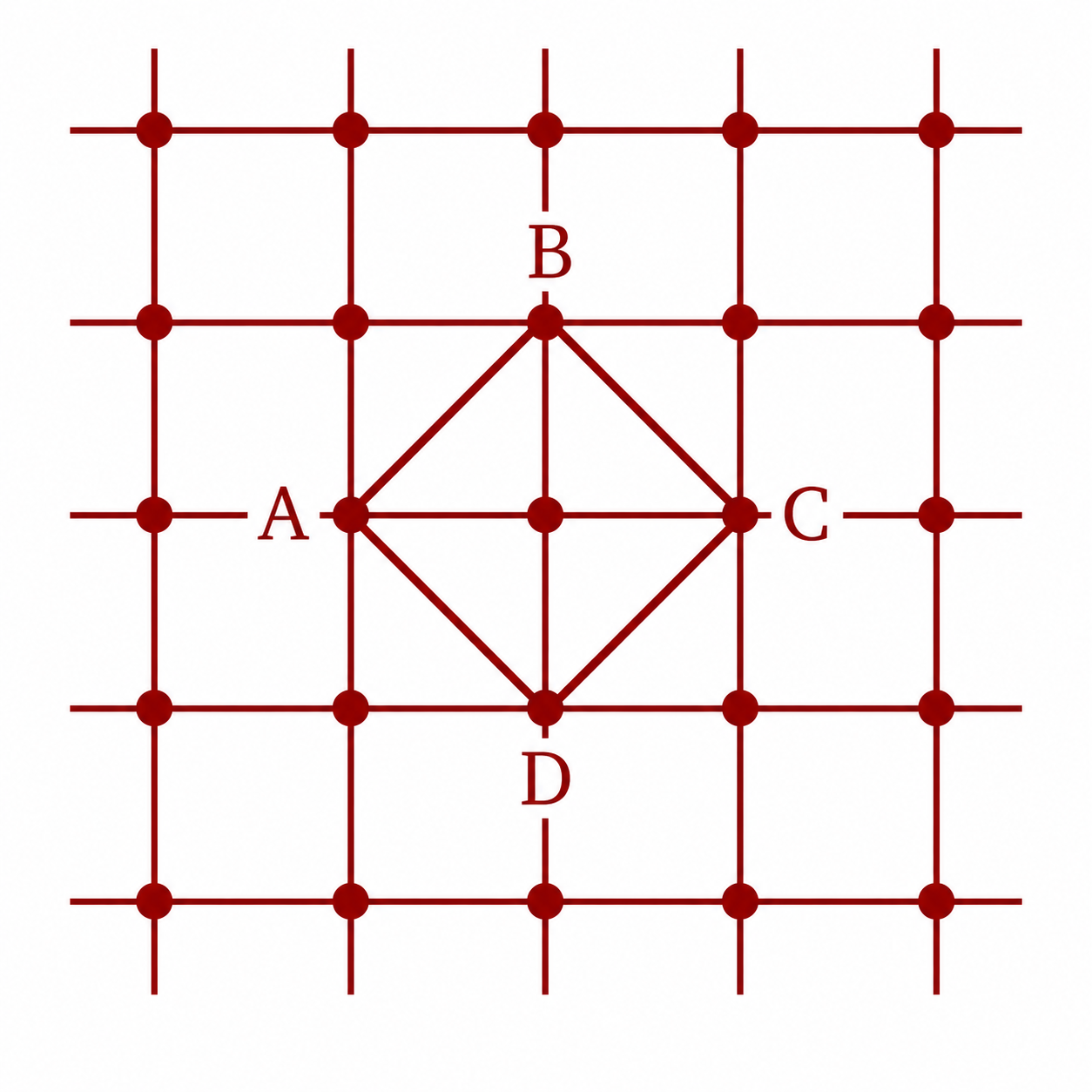
(a)
Area = 2 square units = $1^2+1^2=2$
Hence, a square of area 2 sq. units can be created.
(b)
Area = 3 square units
The only perfect squares less than or equal to 3 are 0 and 1.
No combination of these adds up to 3.
Hence, a square of area 3 sq. units cannot be created.
(c)
Area = 4 square units = $2^2+0^2=4$
Hence, a square of area 4 sq. units can be created.
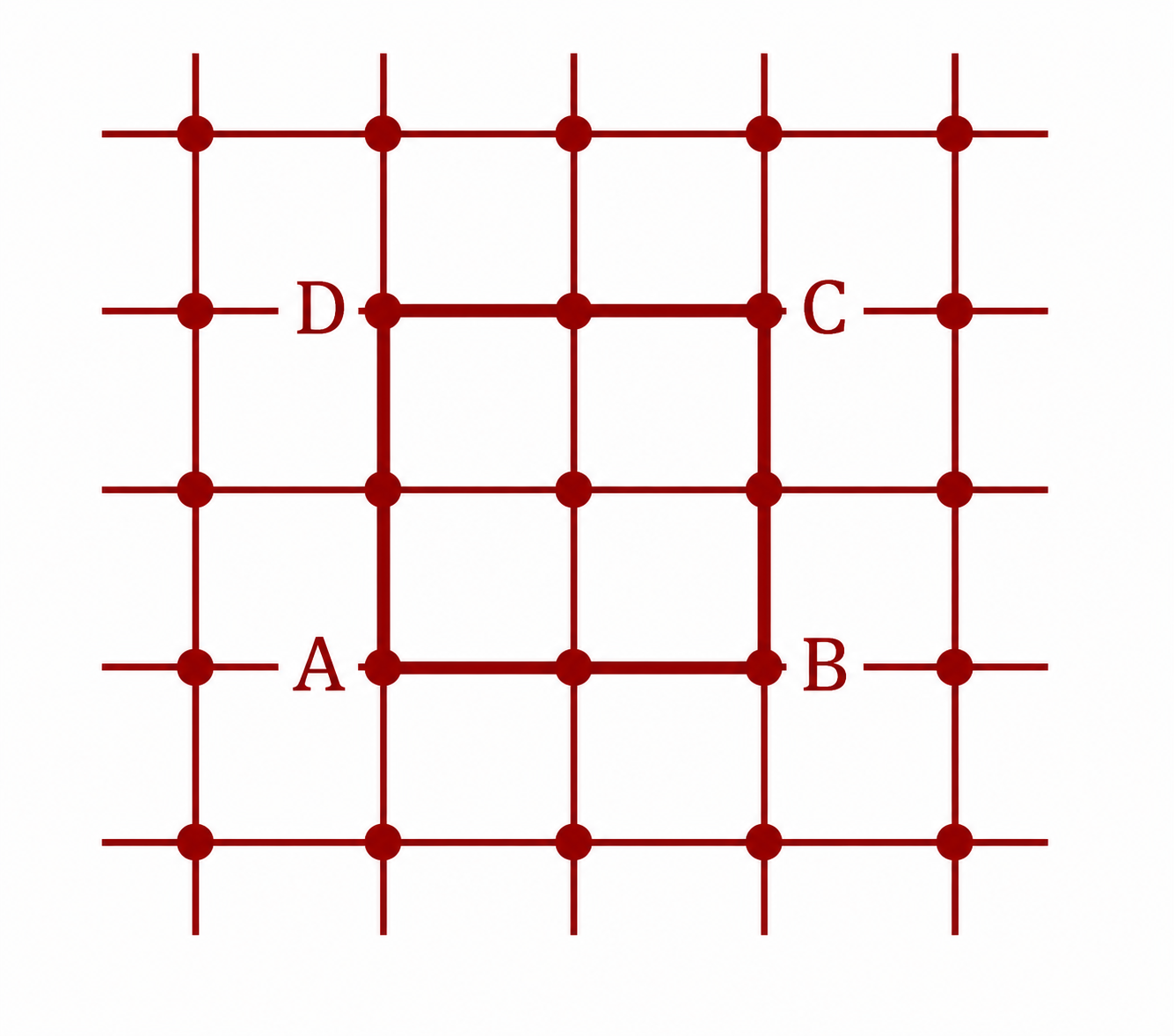
(d)
Area = 5 square units = $2^2+1^2=5$
Hence, a square of area 5 sq. units can be created.
8 (ii):
From the above, we can say that the area of any valid grid-based square with vertices must satisfy the equation:
Area $=x^2+y^2$, where $x$ and $y$ are integers representing the horizontal and vertical distances between adjacent corners.
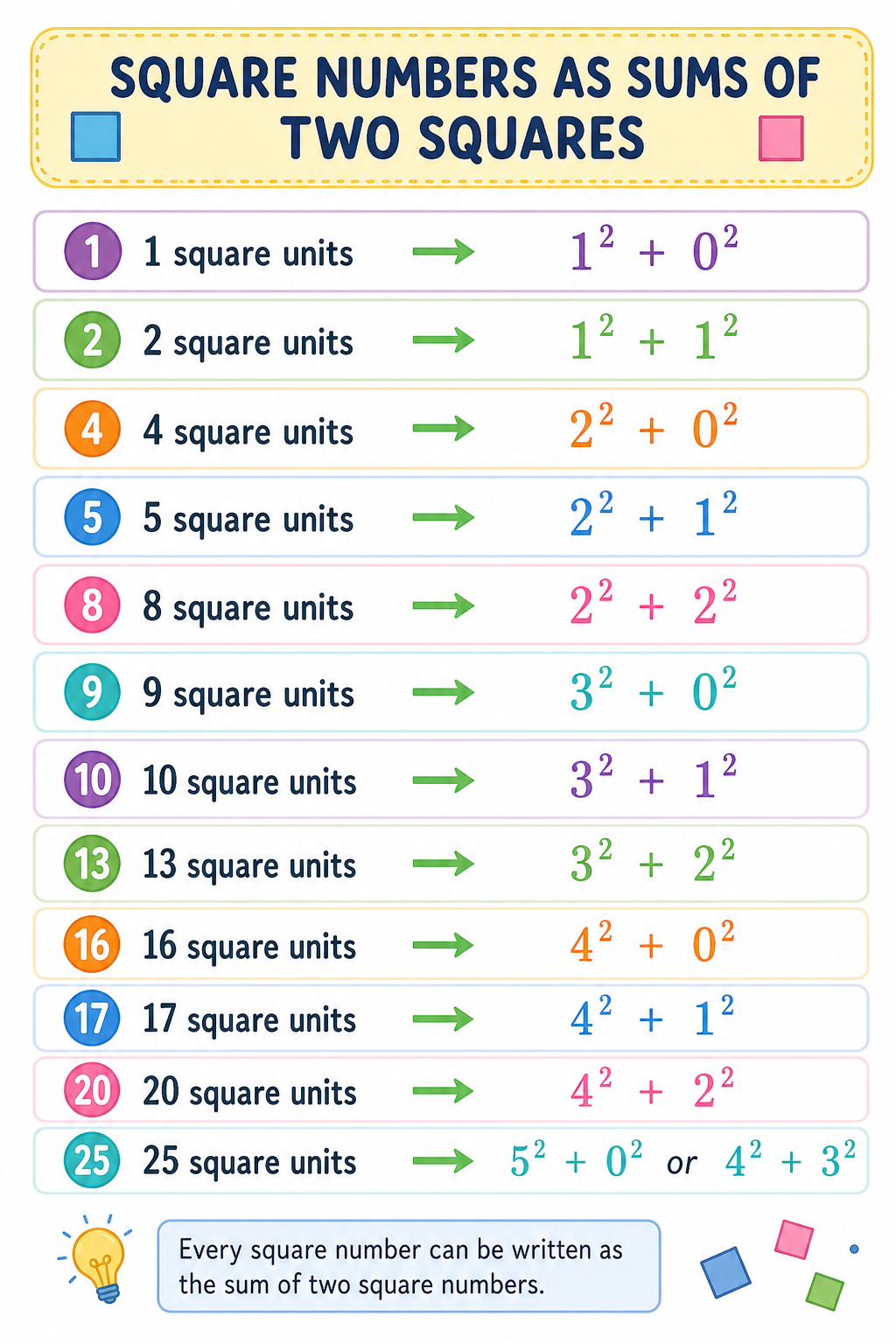
Therefore, the possible integer-valued areas are numbers that can be expressed as the sum of two integer squares.
Some examples are:
Question 9. Find the area of an equilateral triangle with side length 6 units.
[Hint: Show that an altitude bisects the opposite side. Use this to find the height.]
$\textbf{Answer:}$ $9\sqrt{3}$ square units
$\textbf{Explanation:}$
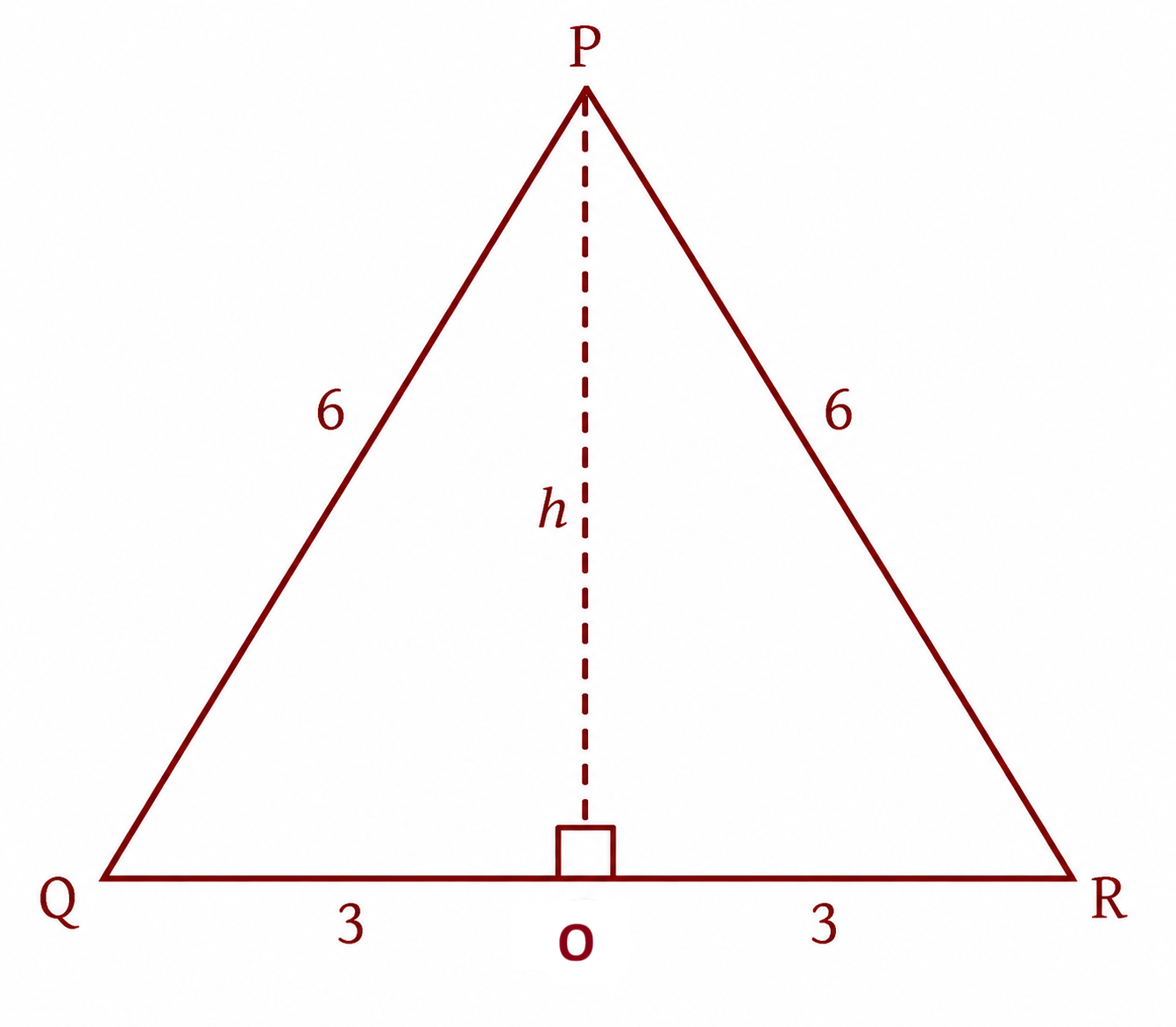
Let PQR be a triangle with side length 6 units.
Draw PO $\perp$ QR
So, OQ = OR = $\frac62=3$ units
Let the length of PO be $h$ units.
Now, in triangle POQ,
$6^2=h^2+3^2$
$⇒h^2=27$
$⇒h=3\sqrt3$
We know that, area of a triangle = $\frac12 \times$ Base $\times$ Height
Here, Base = 6 units, and height, PO = $3\sqrt3$ units
So, area of a triangle PQR = $\frac12\times6\times3\sqrt3=9\sqrt3 $ square units
Hence, the area of the equilateral triangle is $9\sqrt{3}$ square units.
Alternate method:
We know that the area of an equilateral triangle
= $\frac{\sqrt3}4\times \text{Side length}^2$
= $\frac{\sqrt3}4\times 6^2$
= $\frac{\sqrt3}4\times 36$
= $9\sqrt3$ square units
Hence, the area of the equilateral triangle is $9\sqrt{3}$ square units
Get your results instantly with our calculator!
Topics you will learn in NCERT Solutions for Class 8 Maths Part 2 Chapter 2 The Baudhayana-Pythagoras Theorem include:
2.1 Doubling a Square
2.2 Halving a Square
2.3 Hypotenuse of an Isosceles Right Triangle
2.4 Combining Two Different Squares
2.5 Right-Triangles Having Integer Sidelengths
2.6 A Long-Standing Open Problem
2.7 Further Applications of the Baudhāyana -
Pythagoras Theorem
Law Admissions 2026 Open | Avail Merit-Based Scholarships
BBA/MBA/PGDM Early Bird Applications Deadline 06th Nov'26. Apply now using coupon code CAREER250 and get ₹250 off the application fee
Question 1:
Find the area of a right-angled triangle whose base is 12 cm and the hypotenuse is 13 cm.
$\textbf{Answer:}$
Area of right-angled triangle $=\frac{1}{2}\times \text{Base}\times\text{Height}$
Given, Base = 12 cm and Hypotenuse = 13 cm
Let the perpendicular be $p$.
Using Pythagoras theorem,
$\small\text{Hypotenuse}^2=\text{Base}^2+\text{Perpendicular}^2$
⇒ $13^2=12^2+p^2$
⇒ $169=144+p^2$
⇒ $p^2=25$
⇒ $p=5$ cm
$\therefore$ Area $= \frac{1}{2}\times 12\times 5=6\times 5 = 30$ cm$^2$
Hence, the correct answer is 30 cm$^2$.
Question 2:
The lengths of the two sides adjacent to the right angle of a right-angled triangle are 1.6 cm and 6.3 cm. Find the length of the hypotenuse.
$\textbf{Answer:}$
Given, Base = 1.6 cm and Perpendicular = 6.3 cm
Applying Pythagoras theorem, we get,
$\small\text{Hypotenuse}^2 = \text{Base}^2+\text{Perpendicular}^2$
⇒ $h^2=(1.6)^2+(6.3)^2$
⇒ $h^2=2.56+39.69=42.25$
⇒ $h=\sqrt{42.25}=6.5$ cm
Hence, the correct answer is 6.5 cm.
Question 3:
In a right-angled triangle, if the hypotenuse is 20 cm and the ratio of the other two sides is 4 : 3, the lengths of the sides are:
$\textbf{Answer:}$
Given: In a right-angled triangle, the hypotenuse is 20 cm and the ratio of the other two sides is 4 : 3.
Let the two sides be $4x$ cm and $3x$ cm.
Then $(4x)^2+(3x)^2=20^2$
⇒ $25x^2=400$
⇒ $x^2=\frac{400}{25}$
⇒ $x^2=16$
⇒ $x$ = 4
Therefore, the lengths of the two sides are (4 × 4) = 16 cm and (3 × 4) = 12 cm.
Hence, the correct answer is 16 cm and 12 cm.
Question 4:
The lengths of the three sides of a right-angled triangle are (x – 2) cm, (x) cm, and (x + 2) cm, respectively. Then the value of x is:
$\textbf{Answer:}$
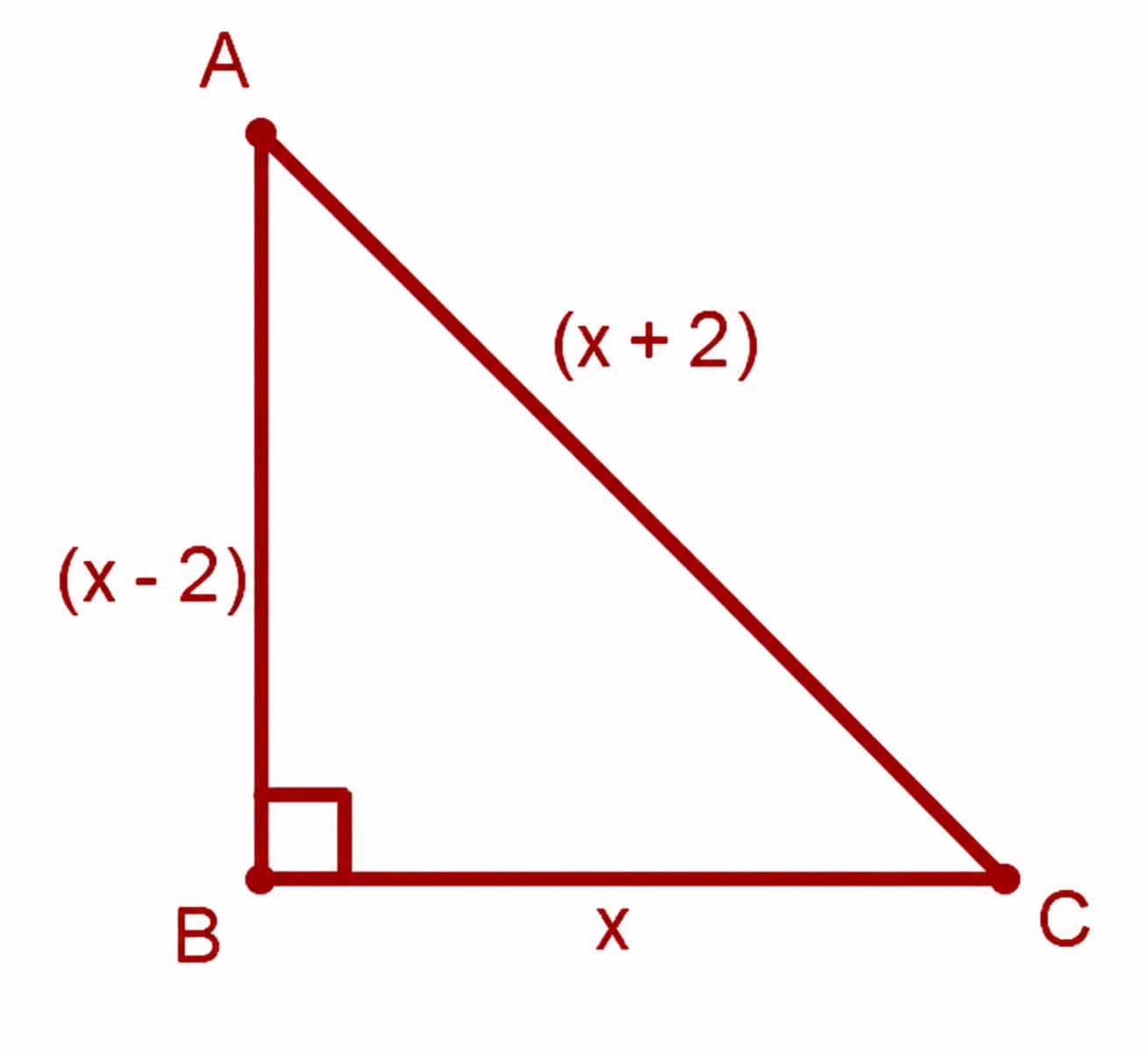
In triangle ABC,
ABC is a right-angle triangle.
Apply Pythagoras theorem,
$A C^2=A B^2+B C^2 $
$ \Rightarrow(x+2)^2=(x-2)^2+x^2 $
$ \Rightarrow x^2+4+4 x=x^2+4-4 x+x^2 $
$ \Rightarrow x^2=8 x$
$ \Rightarrow x=8$
Hence, the value of $x$ is 8.
Question 5:
If the hypotenuse of an isosceles right-angled triangle is 15 cm, then the other two sides (in cm) are __________.
$\textbf{Answer:}$
Given: Hypotenuse of the isosceles right-angled triangle = 10 cm
Let the other two equal sides be $x$ cm.
Now applying the Pythagoras theorem, we get,
$x^2+x^2=10^2$
⇒ $2x^2=100$
$\therefore x=\sqrt{50}=5\sqrt{2}$
Hence, the correct answer is $5\sqrt{2}$ and $5\sqrt{2}$.
We at Careers360 compiled all the NCERT Class 8 Maths solutions in one place for easy student reference. The following links will allow you to access them.
|
NCERT Solutions for Class 8 Maths Part 2 Chapter 1 Fractions in Disguise |
|
NCERT Solutions for Class 8 Maths Part 2 Chapter 2 The Baudhayana-Pythagoras Theorem |
|
NCERT Solutions for Class 8 Maths Part 2 Chapter 3 Proportional Reasoning - 2 |
|
NCERT Solutions for Class 8 Maths Part 2 Chapter 4 Exploring Some Geometric Themes |
|
NCERT Solutions for Class 8 Maths Part 2 Chapter 5 Tales by Dots and Lines |
|
NCERT Solutions for Class 8 Maths Part 2 Chapter 6 Algebra Play |
|
NCERT Solutions for Class 8 Maths Part 2 Chapter 7 Area |
Before planning a study schedule, always analyse the latest syllabus. Here are the links to the latest NCERT syllabus and some of the important books that will help students in this cause.
Chapter 2 Chapter 2 deals with the Baudhāyana-Pythagoras Theorem and the importance of the theorem in geometry. The students are taught how to double and halve the area of a square by using the geometric construction. The chapter also explains the relation between the sides of an isosceles right triangle. The various applications of the Baudhāyana-Pythagoras Theorem enable the students to relate geometry to real-life situations.
This chapter comprises 4 exercises and a total of 19 questions.
The Baudhayana-Pythagoras Theorem is a very important concept in Geometry which students use not only in Class 8, but also in higher classes and competitive examinations. Here are some points about these solutions.
These NCERT Solutions for Class 8 Maths Part 2 Chapter 2 develop a strong foundation in geometry and right-angled triangles.
The inclusion of historical and open mathematical problems in this chapter makes learning more interesting and engaging.
These solutions provide detailed and step-by-step explanations for every question.
Overall, Chapter 2 is one of the most important geometry chapters in Class 8 Maths and serves as a foundation for future mathematical studies.
Here are the concepts and topics that are related to the latest NCERT Solutions for Class 8 Maths Ganita Prakash Part 2 Chapter 2 in higher classes.
Class 9-10
Pythagoras Theorem and its converse
Right-angled triangles
Verification and applications of the theorem
Similar triangles
Trigonometry (Heights and Distances)
Coordinate Geometry (Distance Formula)
Geometrical constructions involving right triangles
Areas and geometric applications using right triangles
Problem-solving in two-dimensional geometry
Class 11-12
Coordinate Geometry
Straight lines and circles
Conic sections
Distance and midpoint concepts
Vector Algebra
Three-Dimensional Geometry
Shortest distance problems
Applications of right triangles in analytical geometry
JEE (Main & Advanced)
Pythagoras Theorem and its converse
Coordinate Geometry
Trigonometry and right triangle identities
Vector Algebra
Three-Dimensional Geometry
Complex number geometry
Shortest distance and locus problems
Geometry-based applications in Physics and Mathematics
Frequently Asked Questions (FAQs)
The Baudhayana-Pythagoras Theorem states that in a right-angled triangle, the square of the hypotenuse is equal to the sum of the squares of the other two sides.
The hypotenuse is the longest side of a right-angled triangle and lies opposite the right angle.
Pythagorean triples are sets of three whole numbers that satisfy the Baudhayana-Pythagoras Theorem, such as (3, 4, 5) and (5, 12, 13).
Yes. It forms the foundation for advanced topics in geometry, trigonometry, coordinate geometry, and many real-world mathematical applications.
Baudhayana-Pythagoras theorem is used in construction, surveying, architecture, navigation, computer graphics, and determining distances.

A block of mass 0.50 kg is moving with a speed of 2.00 ms-1 on a smooth surface. It strikes another mass of 1.00 kg and then they move together as a single body. The energy loss during the collision is
| Option 1)
|
Option 2)
|
| Option 3)
|
Option 4)
|
An athlete in the olympic games covers a distance of 100 m in 10 s. His kinetic energy can be estimated to be in the range
| Option 1)
|
Option 2)
|
| Option 3)
|
Option 4)
|
A particle is projected at 600 to the horizontal with a kinetic energy . The kinetic energy at the highest point
| Option 1)
|
Option 2)
|
| Option 3)
|
Option 4)
|
In the reaction,
| Option 1)
|
Option 2)
|
| Option 3)
|
Option 4)
|
How many moles of magnesium phosphate, will contain 0.25 mole of oxygen atoms?
| Option 1)
0.02 |
Option 2)
3.125 × 10⁻² |
| Option 3)
1.25 × 10⁻² |
Option 4)
2.5 × 10⁻² |

Law Admissions 2026 Open | Avail Merit-Based Scholarships
BBA/MBA/PGDM Early Bird Applications Deadline 06th Nov'26. Apply now using coupon code CAREER250 and get ₹250 off the application fee
Ranked #36 amongst institutions in Management by NIRF | 100% Placement
Globally Recognized by AACSB (US) & AMBA (UK) | 18 LPA Avg. CTC for PGPM 2026
NEET PG All India & State College Predictor with Admission Process Guide
Top B-School: Ranked #9 in NIRF Management Rankings 2025.