KCC Institute of Legal and Higher Education, Greater Noida
Law Admissions 2026 Open | Avail Merit-Based Scholarships


From Koch snowflakes to Sierpinski triangle, we will explore all types of important geometric patterns in the “Exploring Some Geometric Themes” chapter based on the latest textbook, also updated for the CBSE curriculum. These NCERT Solutions for Class 8 Maths Part 2 Chapter 4 Exploring Some Geometric Themes will make all these topics more engaging and clearer to us. This chapter also makes us familiar with fractals and solids.
This Story also Contains
Geometry allows us to look at the world around us with order, balance and beauty. The concepts learnt in this chapter are of vital importance in higher geometry, architecture, design, engineering and computer graphics. Careers360’s experienced teachers have prepared these NCERT Solutions for Class 8 so that students can get help while trying the solutions by themselves. These latest NCERT solutions are comprehensive and have step-wise calculations so that all students can get comfortable with the material.
Students can download the NCERT Solutions for Class 8 Maths Part 2 Chapter 4 Exploring Some Geometric Themes PDF by clicking the link provided below.
Here are the NCERT Solutions for Class 8 Maths Ganita Prakash Part 2 Chapter 4 Exploring Some Geometric Themes question answers with clear and detailed solutions.
Class 8 Maths Part 2 Chapter 4 Question Answers with Detailed Solutions
|
Question 1. Draw the initial few steps (at least till Step 2) of the shape sequence that leads to the Sierpinski Triangle.
$\textbf{Answer:}$
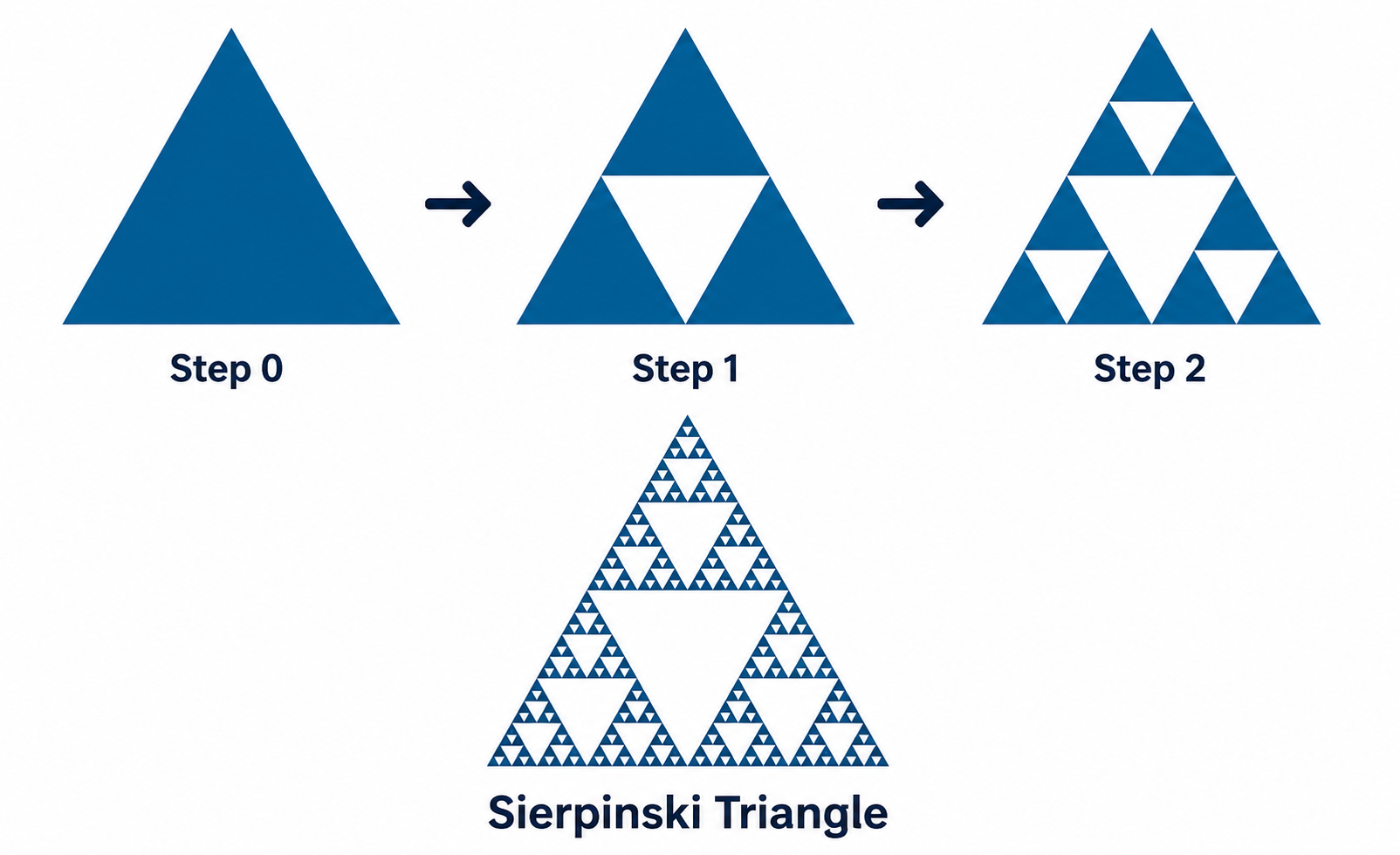
Step 0: Draw a single solid equilateral triangle.
Step 1: Remove the central triangle, leaving 3 smaller solid triangles surrounding 1 central triangular hole.
Step 2: Repeat the process for each of the 3 remaining triangles, remove their centres and leave 9 even smaller solid triangles.
Question 2. Find the number of holes, and the triangles that remain at each step of the shape sequence that leads to the Sierpinski Triangle.
$\textbf{Answer:}$
Step 0:
Number of remaining triangles: $3^0 = 1$
New holes introduced: 0
Total cumulative holes: 0
Step 1:
Number of remaining triangles: $3^1 = 3$
New holes introduced: 1
Total cumulative holes: 1
Step 2:
Number of remaining triangles: $3^2 = 9$
New holes introduced: 3
Total cumulative holes: 1 + 3 = 4
Step 3:
Number of remaining triangles: $3^3 = 27$
New holes introduced: 9
Total cumulative holes: 4 + 9 = 13
…….
Step $n$:
Number of remaining triangles: $3^n$
New holes introduced: $3^{n-1}$, for $n \geq 1$
Total cumulative holes: $\frac{3^n-1}{2}$
Question 3. Find the area of the region remaining at the $n$th step in each of the shape sequences that lead to the Sierpinski fractals. Take the area of the starting square/triangle to be 1 sq. unit.
$\textbf{Answer:}$
At each step, every remaining solid triangle has its middle quarter removed. This means that exactly $\frac{3}{4}$ of the area from the previous step is remaining.
Step 0 Area: $1$
Step 1 Area: $\frac{3}{4}$
Step 2 Area: $\left(\frac{3}{4}\right)^2 = \frac{9}{16}$
.....
At the $n$th step, the remaining area is given by:
$A_n = \left(\frac{3}{4}\right)^n$ square units
At each step, every remaining solid square is divided into 9 smaller congruent squares, and the central square is removed. This means that exactly $\frac{8}{9}$ of the area from the previous step is remaining.
Step 0 Area: $1$
Step 1 Area: $\frac{8}{9}$
Step 2 Area: $\left(\frac{8}{9}\right)^2 = \frac{64}{81}$
....
At the $n$th step, the remaining area is given by:
$A_n = \left(\frac{8}{9}\right)^n\text{ sq. units}$
Class 8 Maths Part 2 Chapter 4 Question Answers with Detailed Solutions
|
Question 1. Draw the initial few steps (at least till Step 2) of the shape sequence that leads to the Koch Snowflake.
$\textbf{Answer:}$
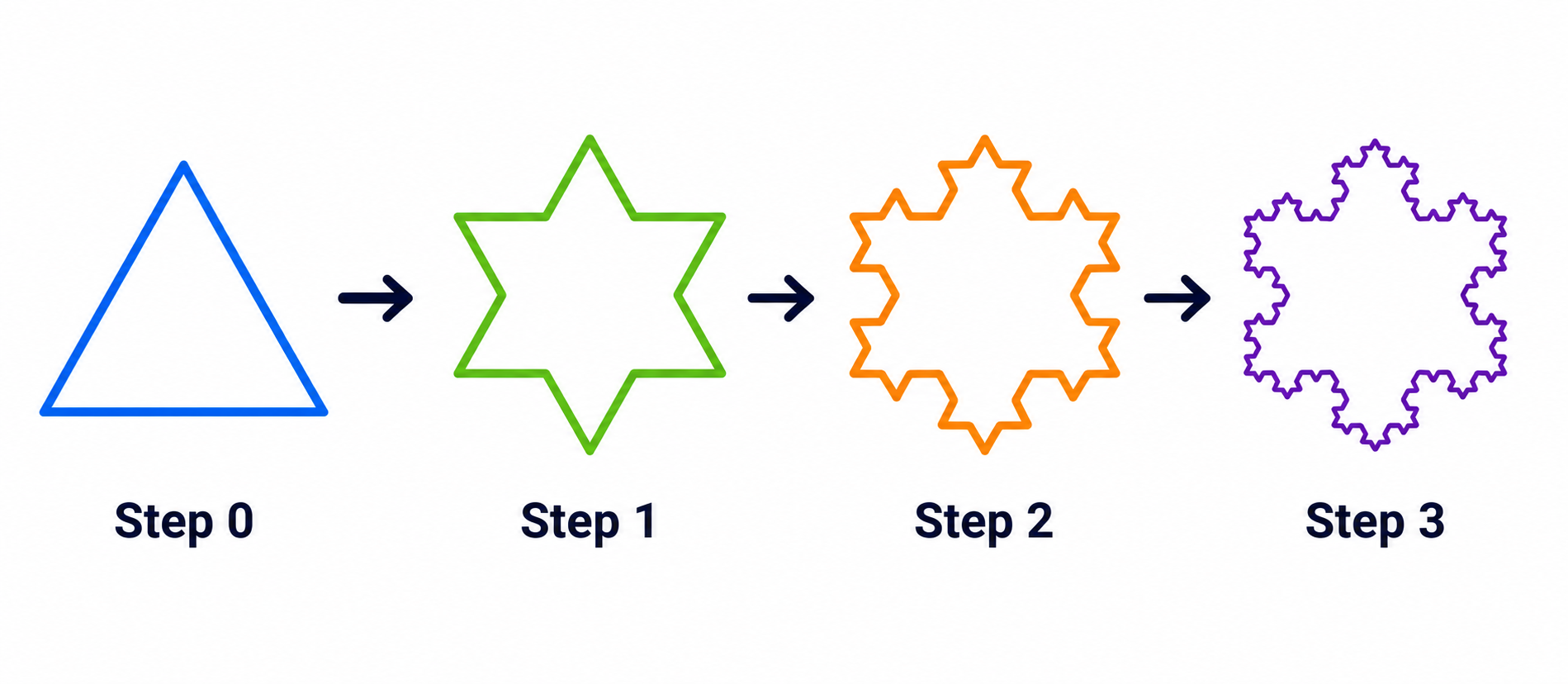
Step 0: Draw a single equilateral triangle.
Step 1: The transformation is applied once to each of the three original sides, creating a hexagon with six points, which resembles a Star of David.
Step 2: The process is repeated for every segment of the Step 1 shape, creating a more intricate, 12-pointed star.
Question 2. Find the number of sides in the $n$th step of the shape sequence that leads to the Koch Snowflake.
$\textbf{Answer:}$
Step 0: Number of sides: $N_0 = 3$.
Step 1: Number of sides: $N_1 = 3 \times 4 = 12$
Step 2: Number of sides: $N_2 = 12 \times 4 = 48$.
......
Step $n$: Number of Sides: $N_n = 3 \times 4^n$
Question 3. Find the perimeter of the shape at the $n$th step of the sequence. Take the starting equilateral triangle to have a sidelength of 1 unit.
$\textbf{Answer:}$
The original equilateral triangle has a side length of 1 unit.
Step 0: Initial perimeter = 1 + 1 + 1 = 3 units
At each step, every side is replaced by 4 sides, and each new side is $\frac13$ of the old side.
Thus, the perimeter is multiplied by: $3\times\frac13=\frac43$
Step 1: $3\times(\frac43)^1$ units
Step 2: $3\times(\frac43)^2$ units
Step 3: $3\times(\frac43)^3$ units
Step 4: $3\times(\frac43)^4$ units
.....
Step $n$: $3\times(\frac43)^n$ units
Class 8 Maths Part 2 Chapter 4 Question Answers with Detailed Solutions
|
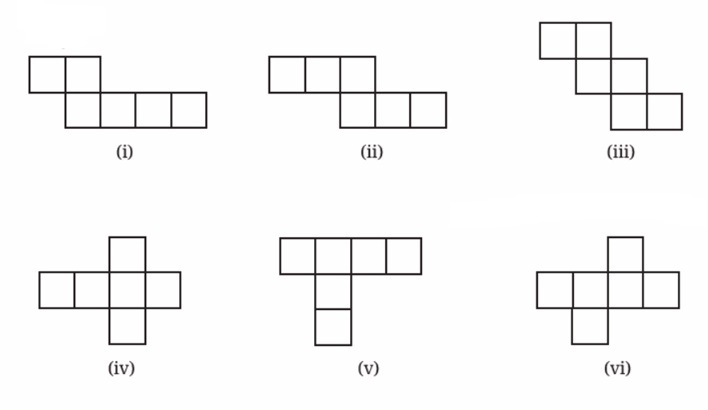
Question 1. Which of the following are the nets of a cube? First, try to answer by visualisation. Then, you may use cutouts and try.
$\textbf{Answer:}$
A valid cube net must fold so that:
Law Admissions 2026 Open | Avail Merit-Based Scholarships
BBA/MBA/PGDM Early Bird Applications Deadline 06th Nov'26. Apply now using coupon code CAREER250 and get ₹250 off the application fee
Structure 1: Not a cube net [$\because$ Overlapping face]
Structure 2: Cube net
Structure 3: Cube net
Structure 4: Cube net
Structure 5: Not a cube net [$\because$ Overlapping face]
Structure 6: Cube net
Question 2. A cube has 11 possible net structures in total. In this count, two nets are considered the same if one can be obtained from the other by a rotation or a flip. For example, the following nets are all considered the same —
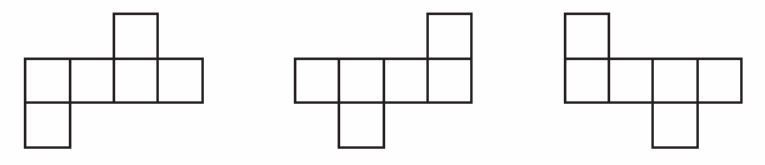
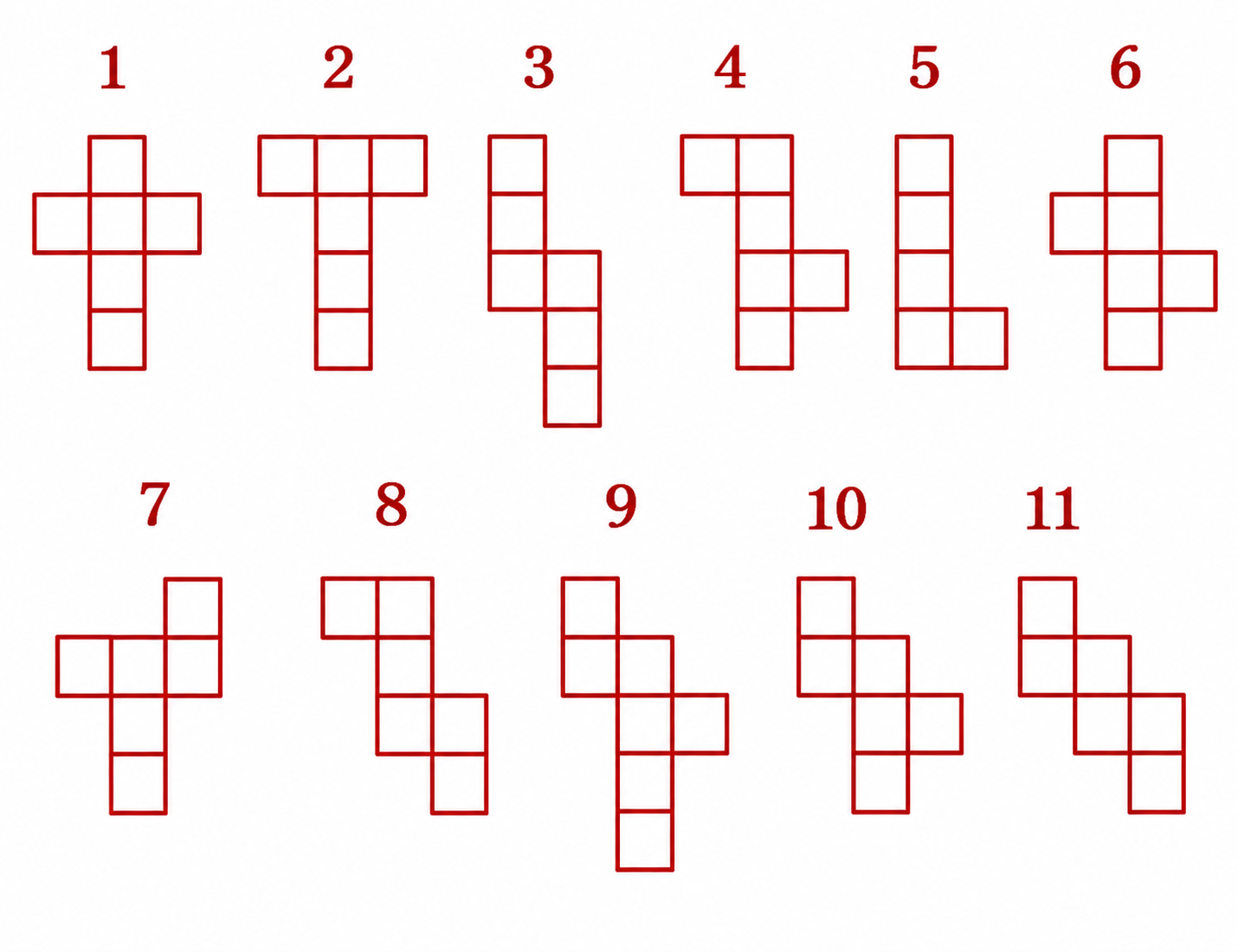
Find all the 11 nets of a cube.
$\textbf{Answer:}$
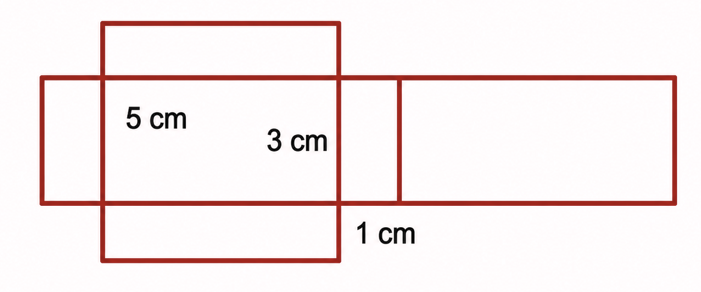
(i) 5 cm, 3 cm, and 1 cm
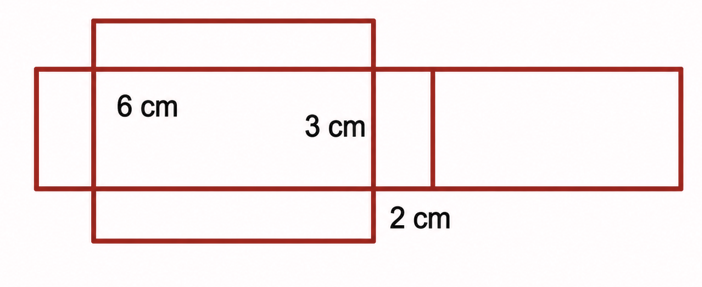
(ii) 6 cm, 3 cm, and 2 cm
$\textbf{Answer:}$
(i)
Faces:
2 rectangles of 5 cm × 3 cm
2 rectangles of 5 cm × 1 cm
2 rectangles of 3 cm × 1 cm
(ii)
Faces:
2 rectangles of 6 cm × 3 cm
2 rectangles of 6 cm × 2 cm
2 rectangles of 3 cm × 2 cm
Class 8 Maths Part 2 Chapter 4 Question Answers with Detailed Solutions
|
Question 1. Observe the front view, top view and side view of the different lines in Fig. 4.6. Is there any relation between their lengths?
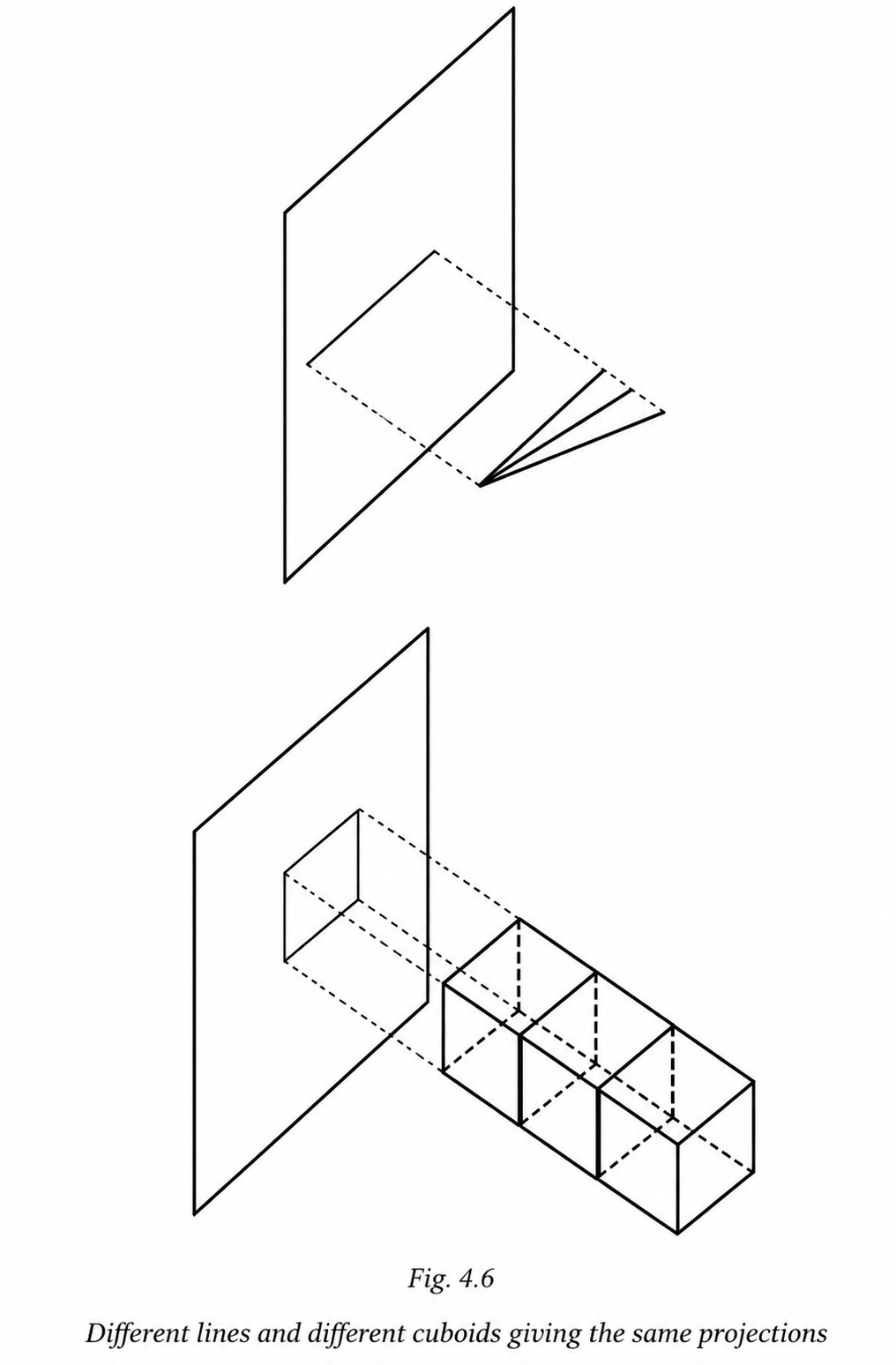
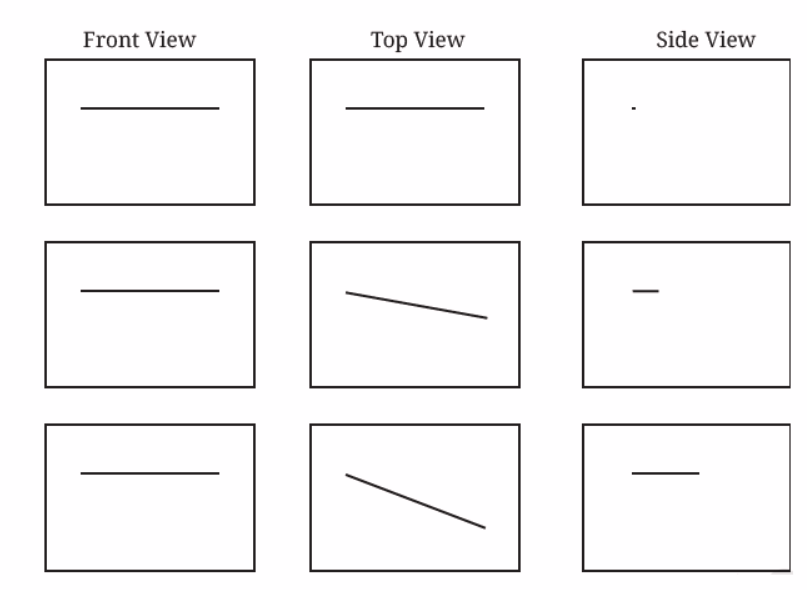
$\textbf{Answer:}$
From these examples, we observe:
So, there is no fixed equality between the lengths of the front view, top view, and side view. Each projection length depends on the orientation of the line.
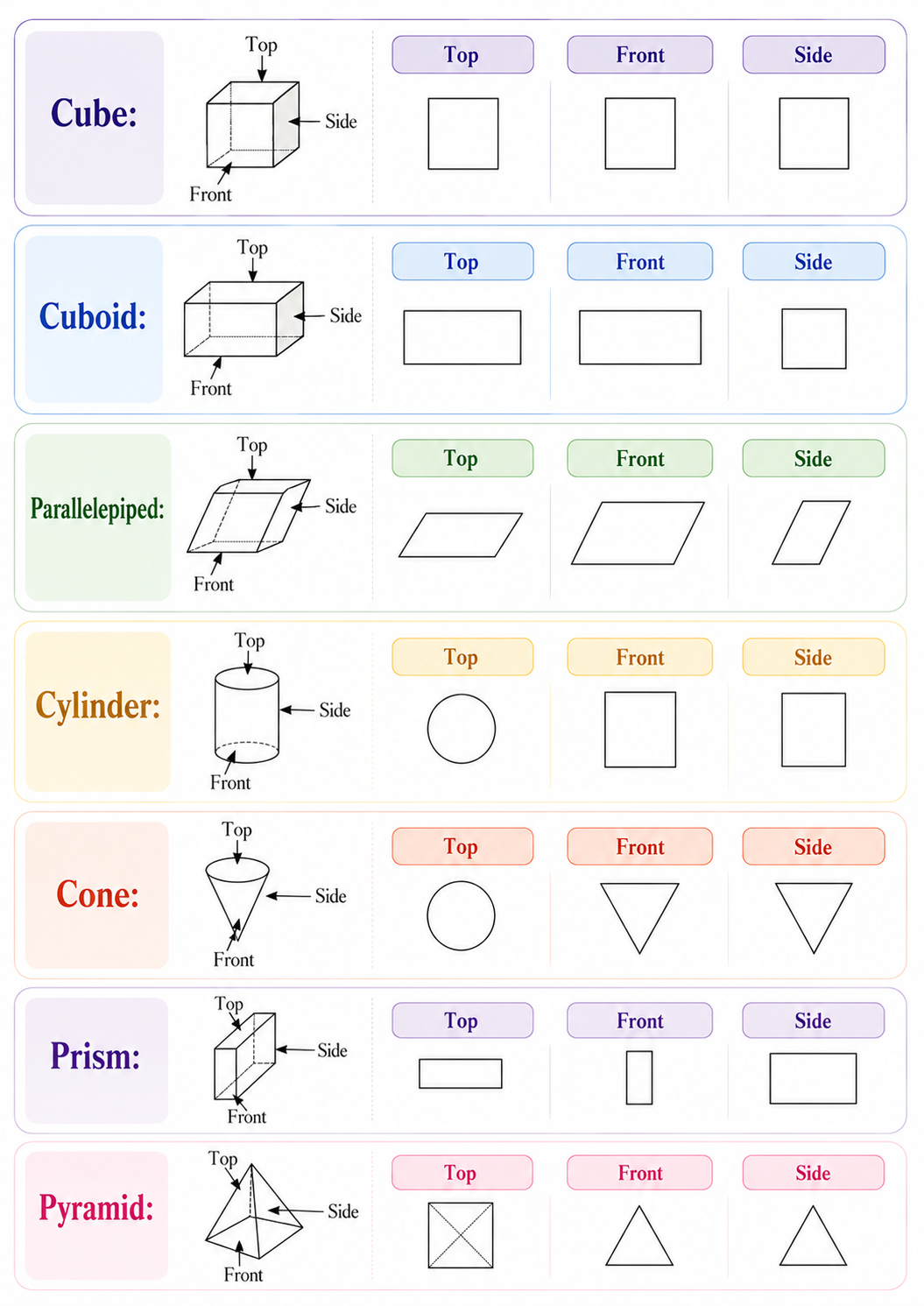
Question 2. Find the front view, top view and side view of each of the following solids, fixing its orientation with respect to the vertical, horizontal and side planes:
cube, cuboid, parallelepiped, cylinder, cone, prism, and pyramid. If needed, see the next problem for clues.
$\textbf{Answer:}$
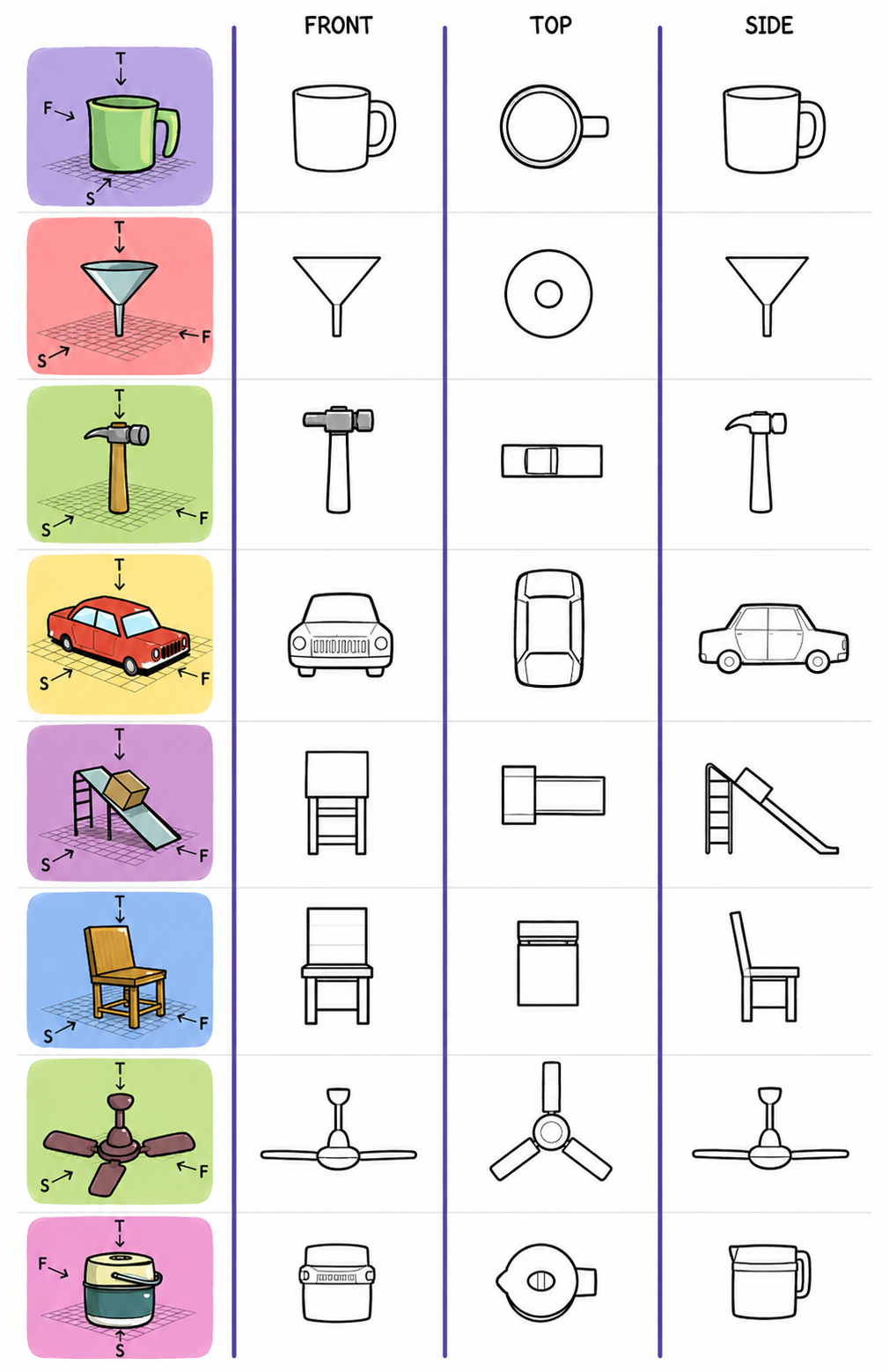
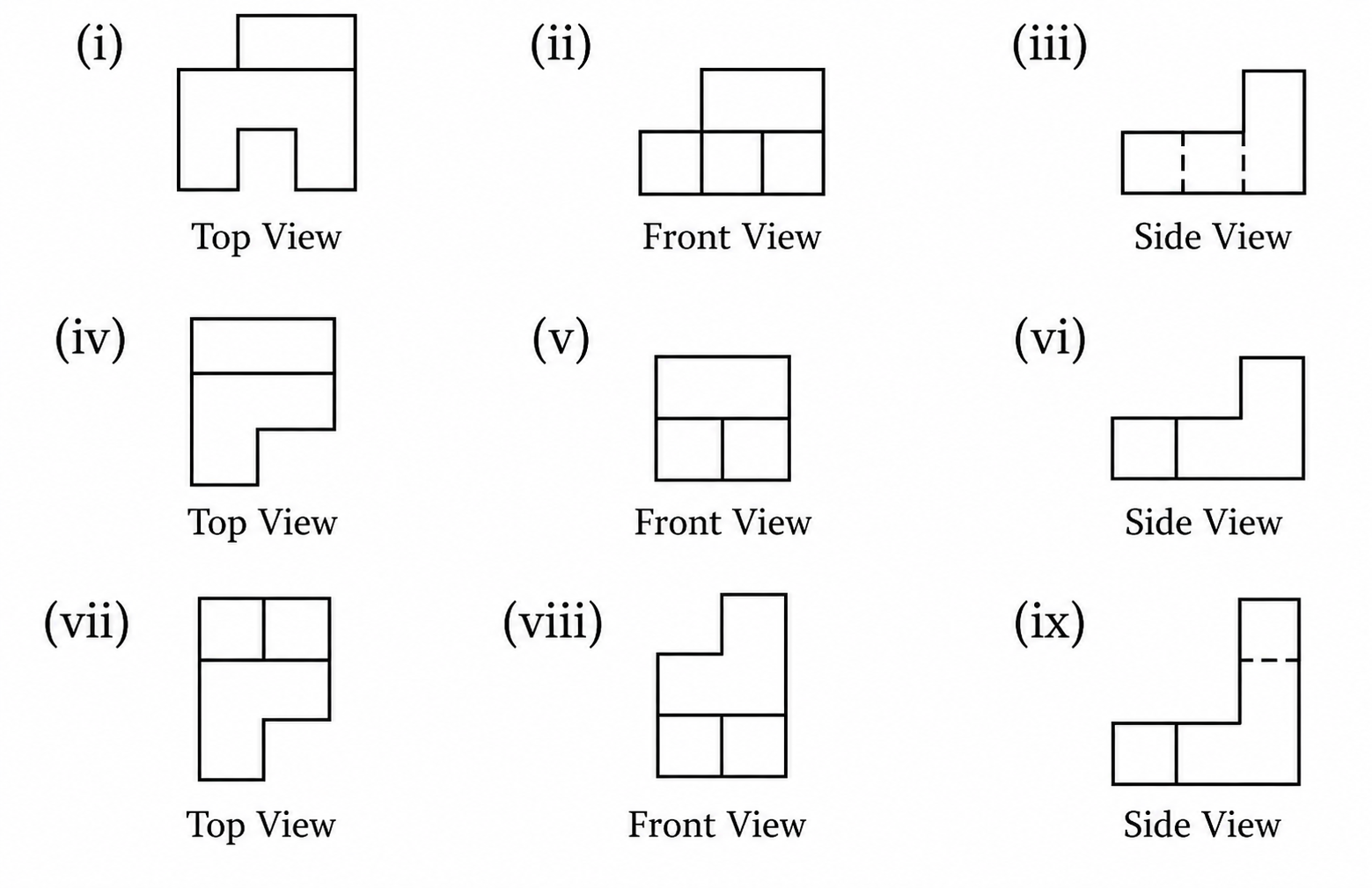
Question 3. Match each of the following objects with its projections.
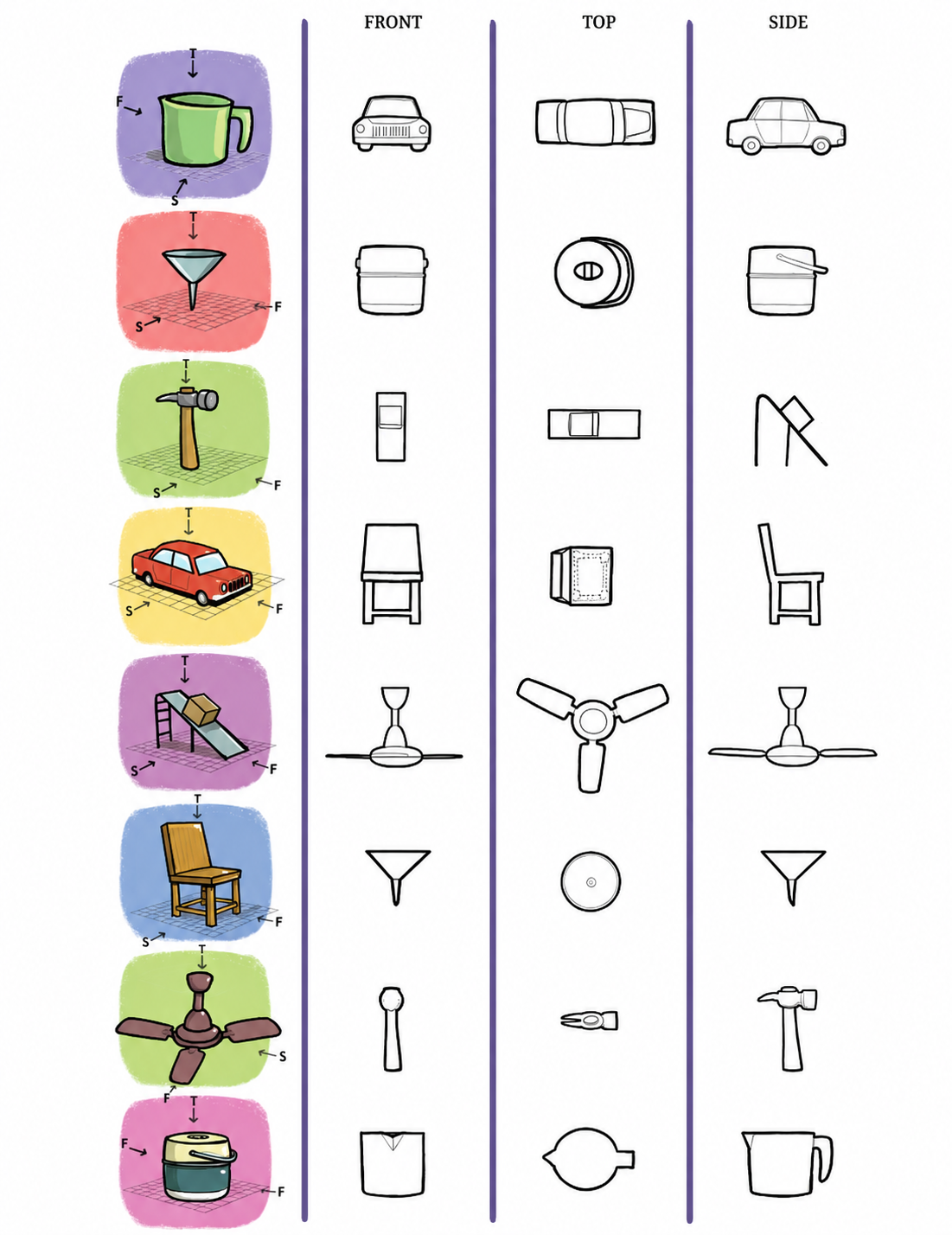
$\textbf{Answer:}$
|
Column A |
Column B |
|
(a) |
(viii) |
|
(b) |
(vi) |
|
(c) |
(vii) |
|
(d) |
(i) |
|
(e) |
(iii) |
|
(f) |
(iv) |
|
(g) |
(v) |
|
(h) |
(ii) |
Class 8 Maths Part 2 Chapter 4 Question Answers with Detailed Solutions
|
Question 1. Draw the top view, front view and the side view of each of the following combinations of identical cubes.
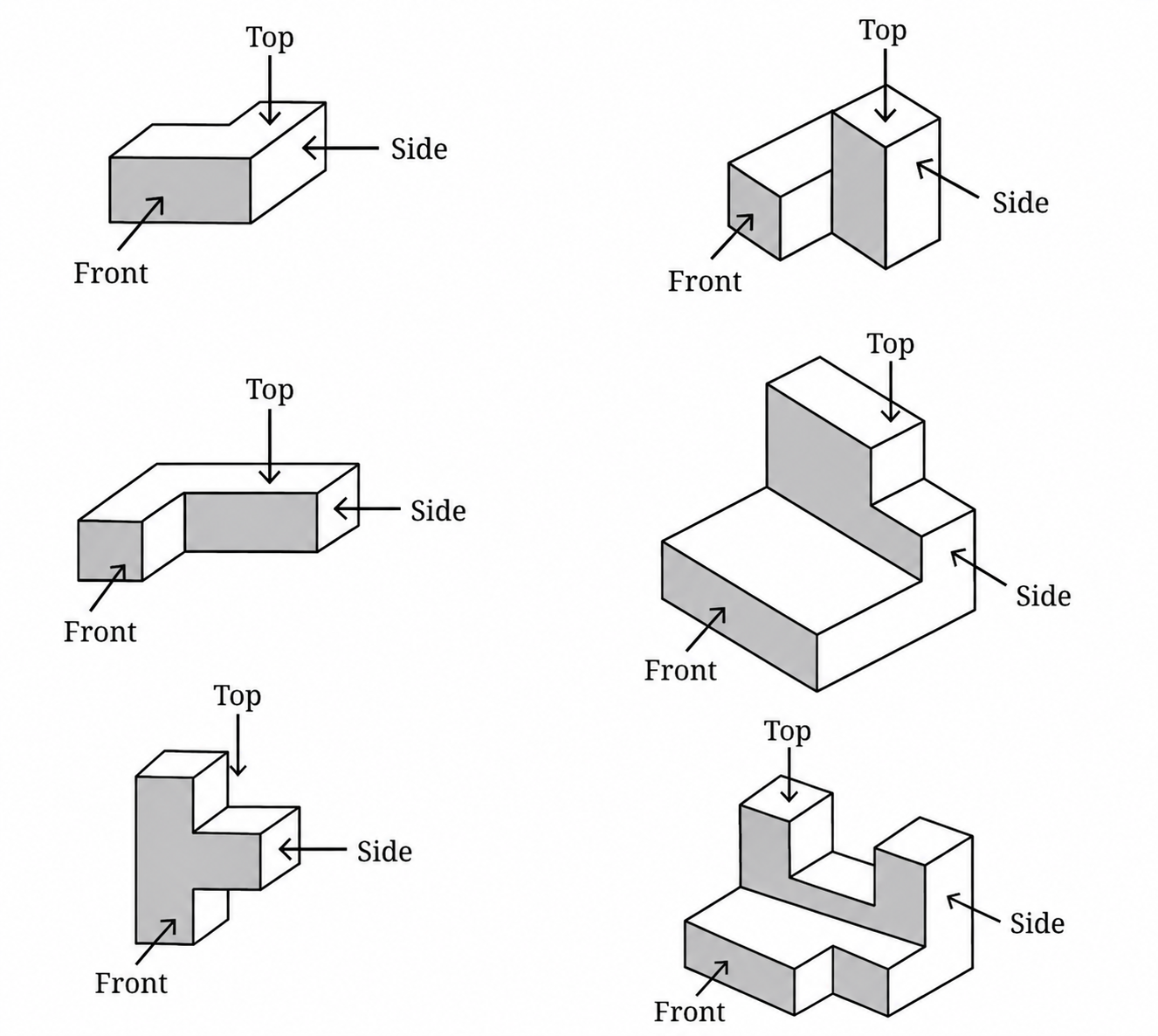
$\textbf{Answer:}$
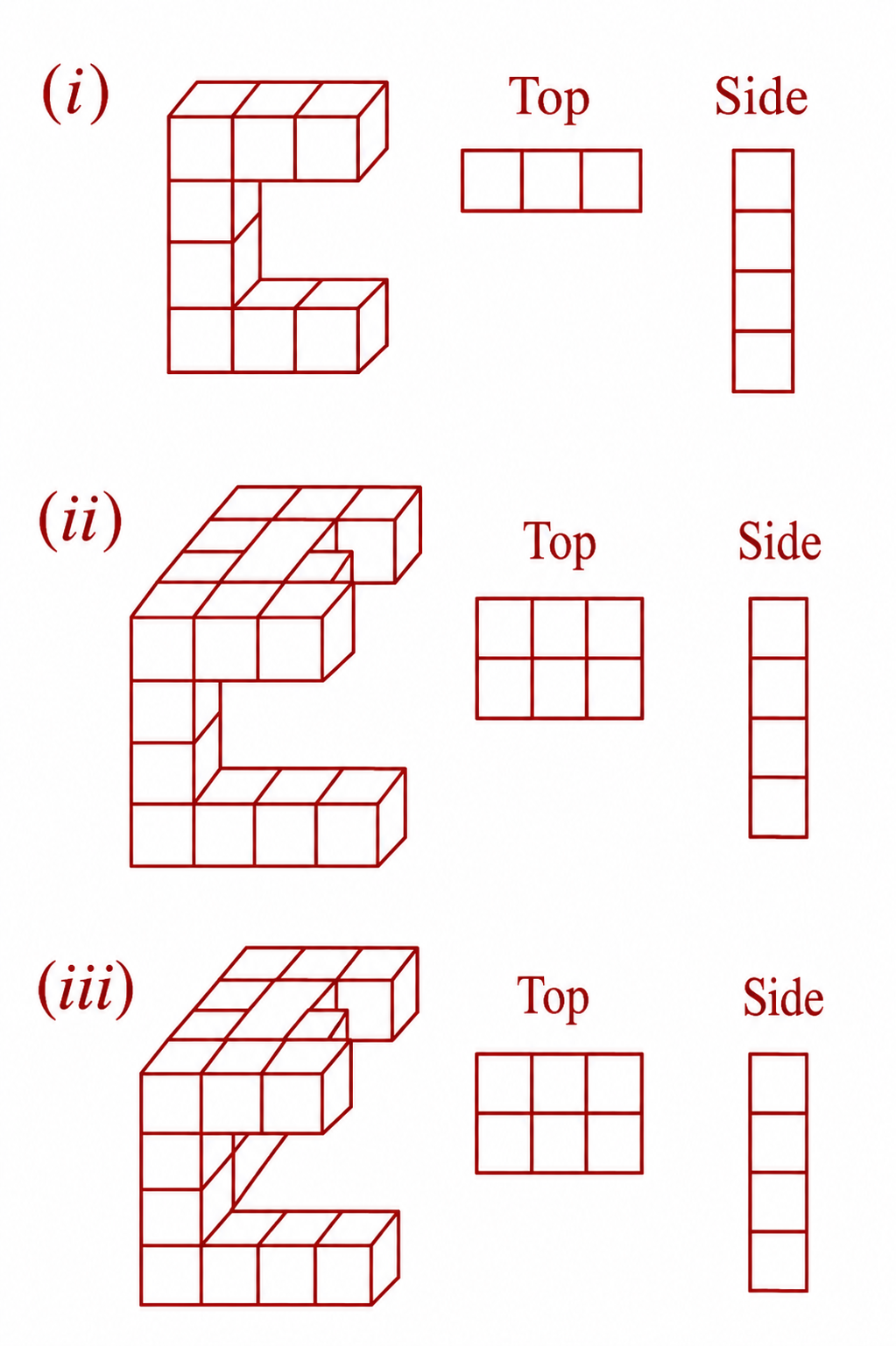
Question 2.
Imagine eight identical cubes, glued together along faces to form the letter  .
.
(i)This looks like a from the front. What does it look like from the side?From the top?
(ii)Glue additional cubes to make a shape that looks like , from the front and  from the top.
(iii)Now, can you glue even more cubes to make it look like from the front, from the top, and  from the side?
(iv)Can you think of other letter combinations to make with a single combination of cubes in this manner?
$\textbf{Answer:}$
(iv)
Yes, many other combinations are possible.
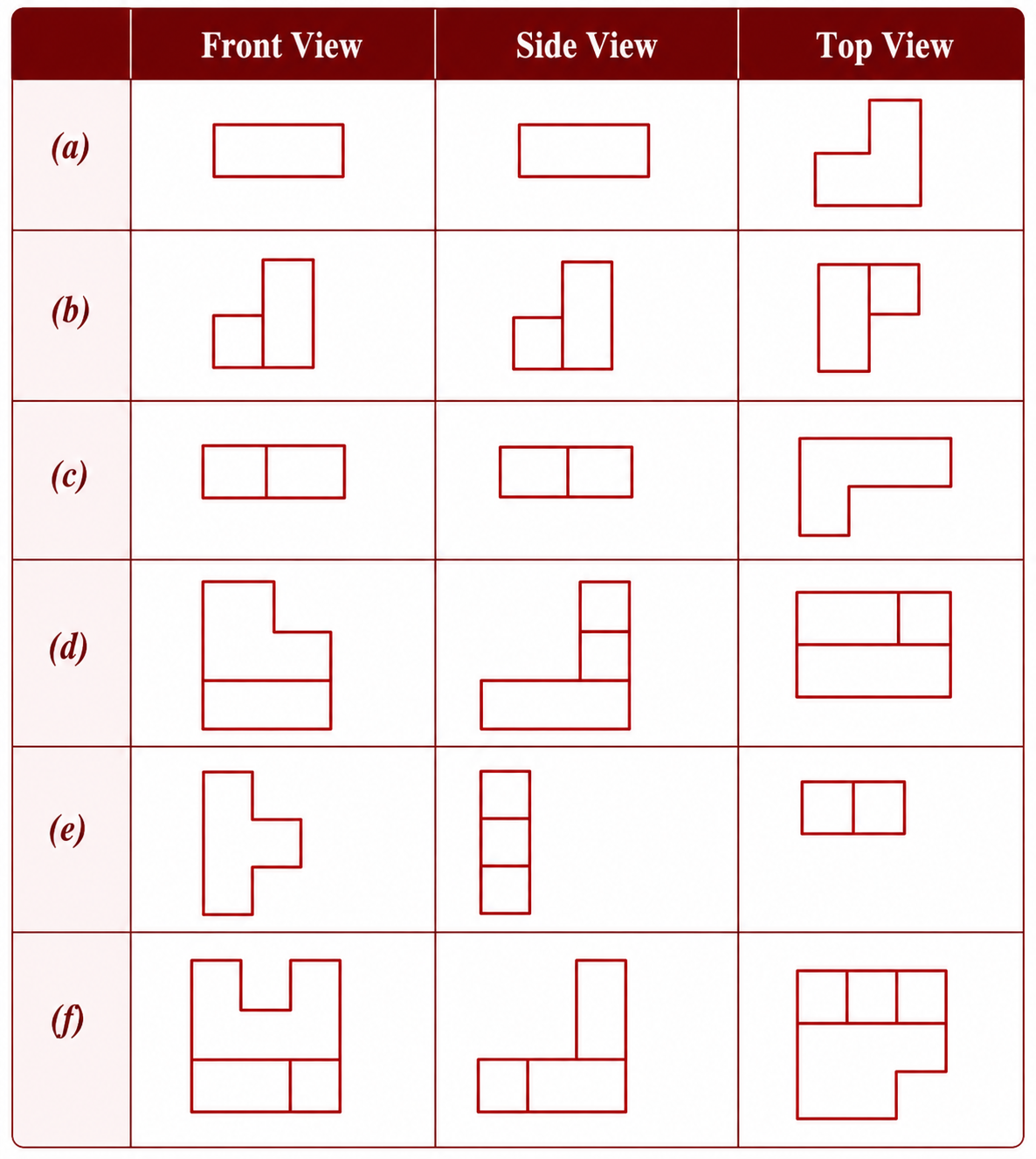
Question 3. Which solid corresponds to the given top view, front view, and side view?
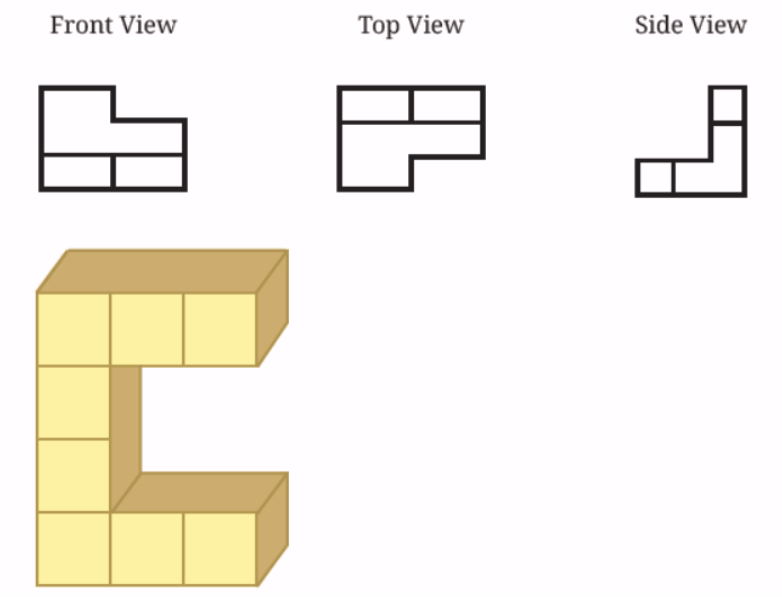
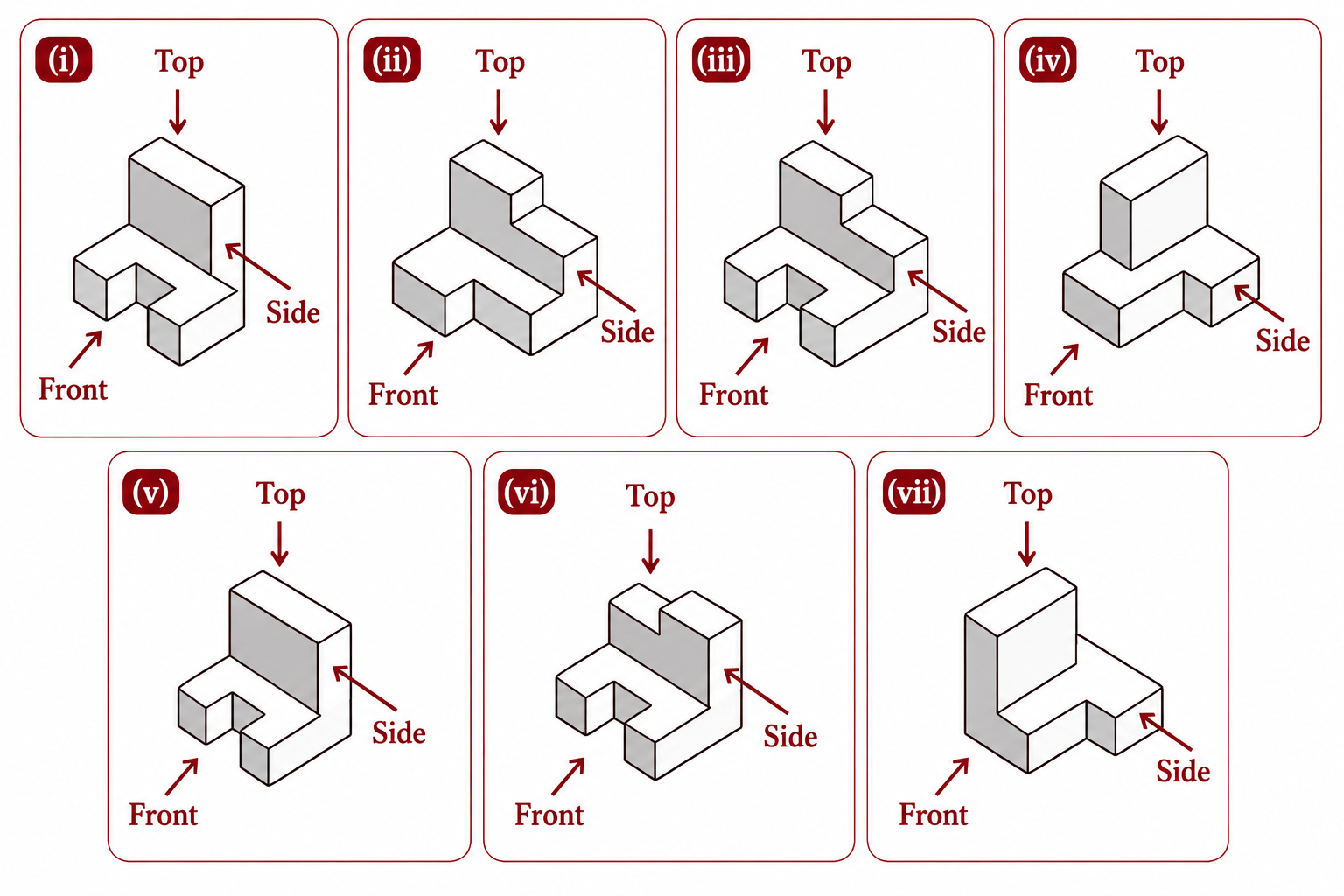
$\textbf{Answer:}$ Solid (ii)
$\textbf{Explanation:}$
Since the front view has a small gap on the top right side, solids (i), (v) and (vii) cannot be possible.
In top view, there is a gap on the right corner, which means in solid front right side should be a gap at the corner.
So, solids (iii) and (vi) are not possible.
Between solid (ii) and (iv), Solid (ii) is more likely.
Hence, the correct answer is solid (ii).
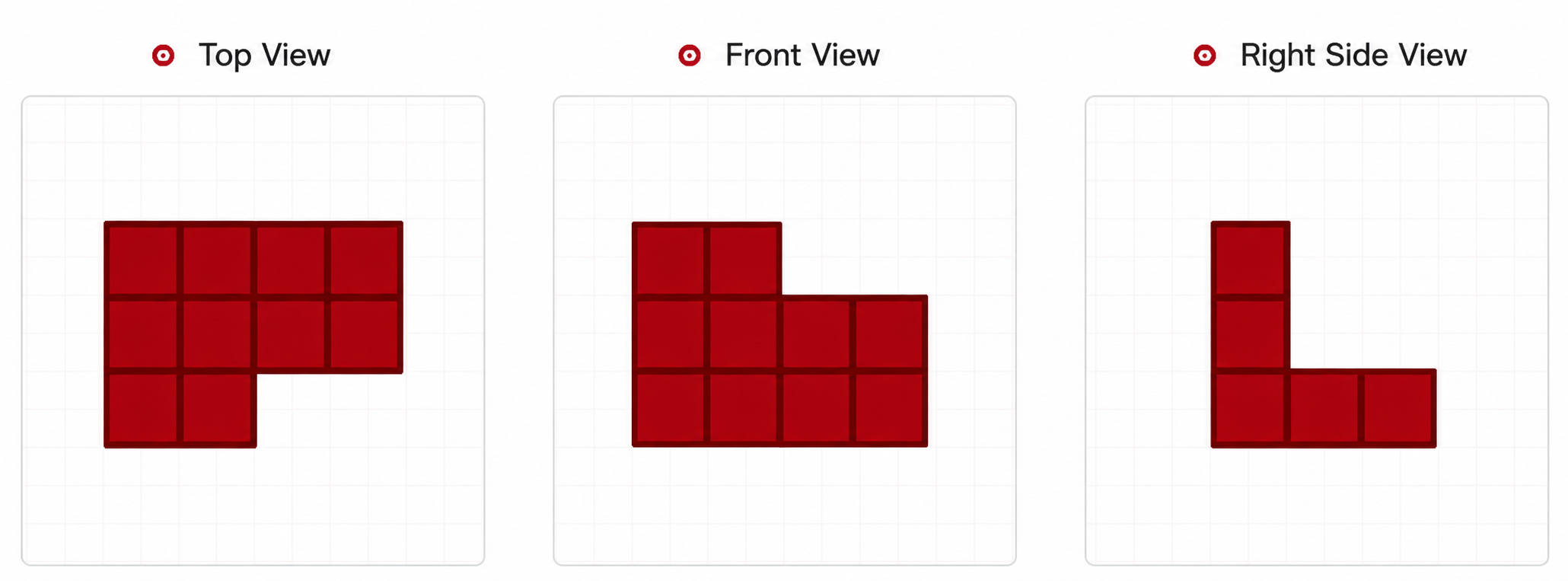
Question 4. Using identical cubes, make a solid that gives the following projections.
$\textbf{Answer:}$
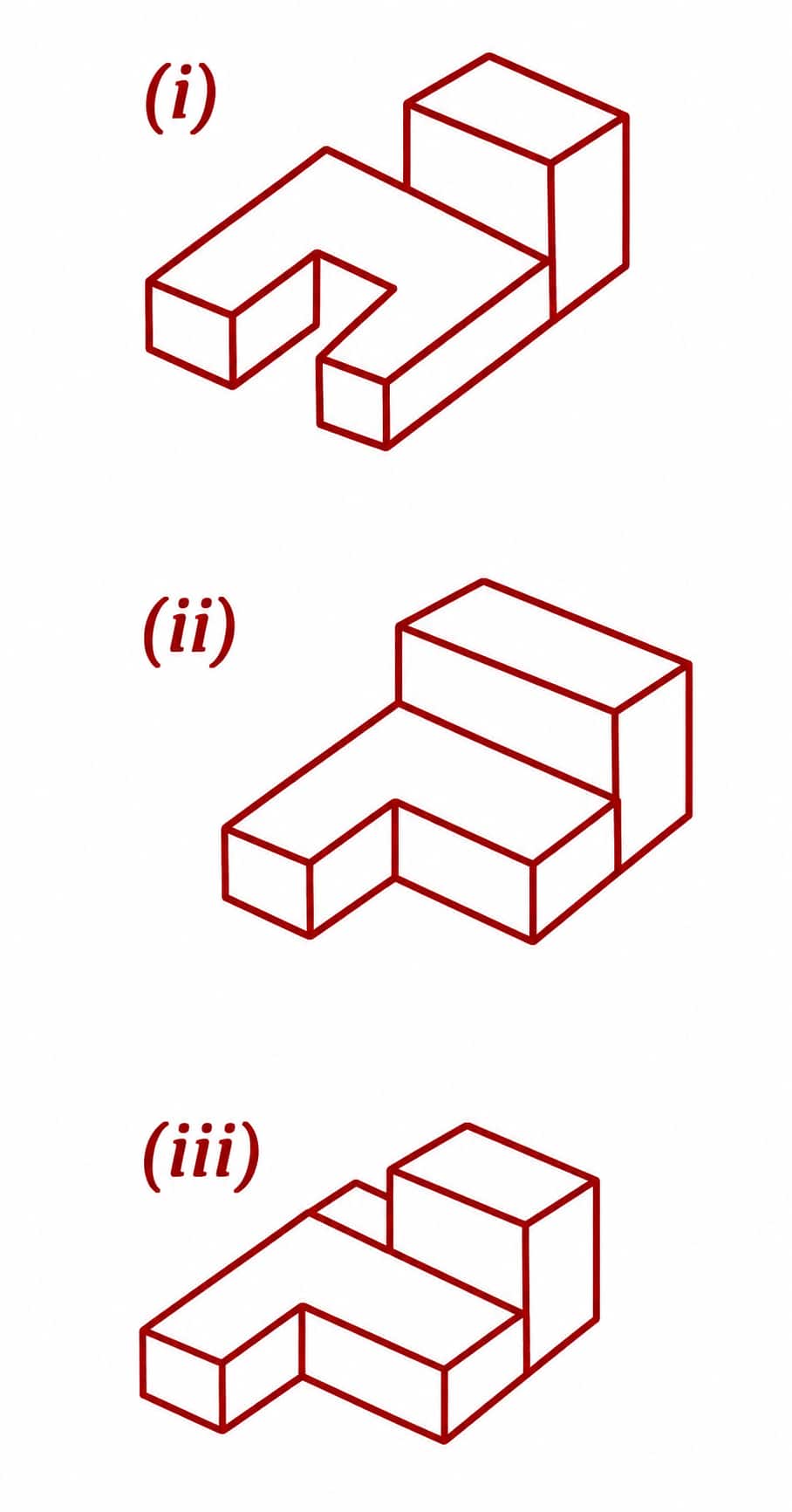
Question 5. Find the number of cubes in this stack of identical cubes.
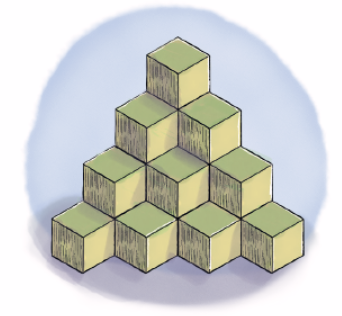
$\textbf{Answer:}$
Layer 1, or the top layer, has 1 cube.
Layer 2 has 2 visible cubes, and there must be a cube directly behind this row.
So, total 2 + 1 = 3 cubes
Layer 3 has 3 cubes visible along the front edge, and the rows behind it have 2 cubes and then 1 cube to support the layers above.
So, total 3 + 2 + 1 = 6 cubes
Layer 4, or the bottom layer, has 4 cubes visible along the front edge, and the rows extending behind it contain 3 cubes, 2 cubes, and 1 cube at the very back corner.
So, total 4 + 3 + 2 + 1 = 10 cubes
Total Cubes = Sum of all 4 layer cubes = 1 + 3 + 6 + 10 = 20 cubes
Hence, the total number of cubes in the stack is 20.
Question 6. What are the different shapes the projection of a cube can make under different orientations?
$\textbf{Answer:}$
When a three-dimensional cube is projected onto a two-dimensional plane, the resulting shape changes dramatically depending on the cube's orientation relative to the projection plane.
Mathematically, the projection of a cube is always a convex polygon with anywhere from 4 to 6 sides.
Here are the specific geometric shapes a cube's projection can form under different orientations:
1. Square
2. Rectangle
3. Parallelogram
4. Rhombus
5. Hexagon
Class 8 Maths Part 2 Chapter 4 Question Answers with Detailed Solutions
|
Question 1. In addition to the 5 ways shown in Fig. 4.8, are there any additional ways of gluing four cubes together along faces? Can you visualise and draw these as well?
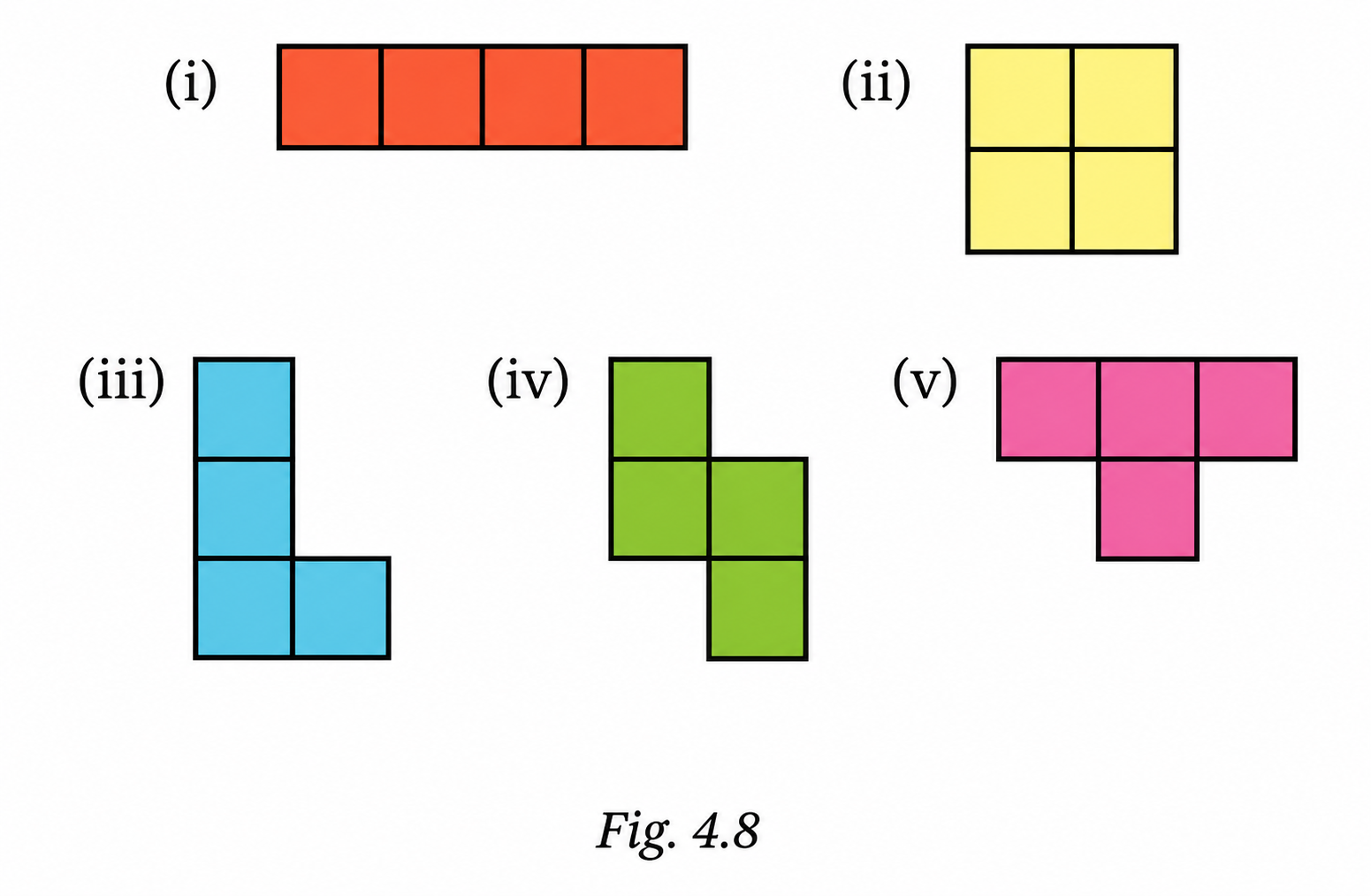
$\textbf{Answer:}$
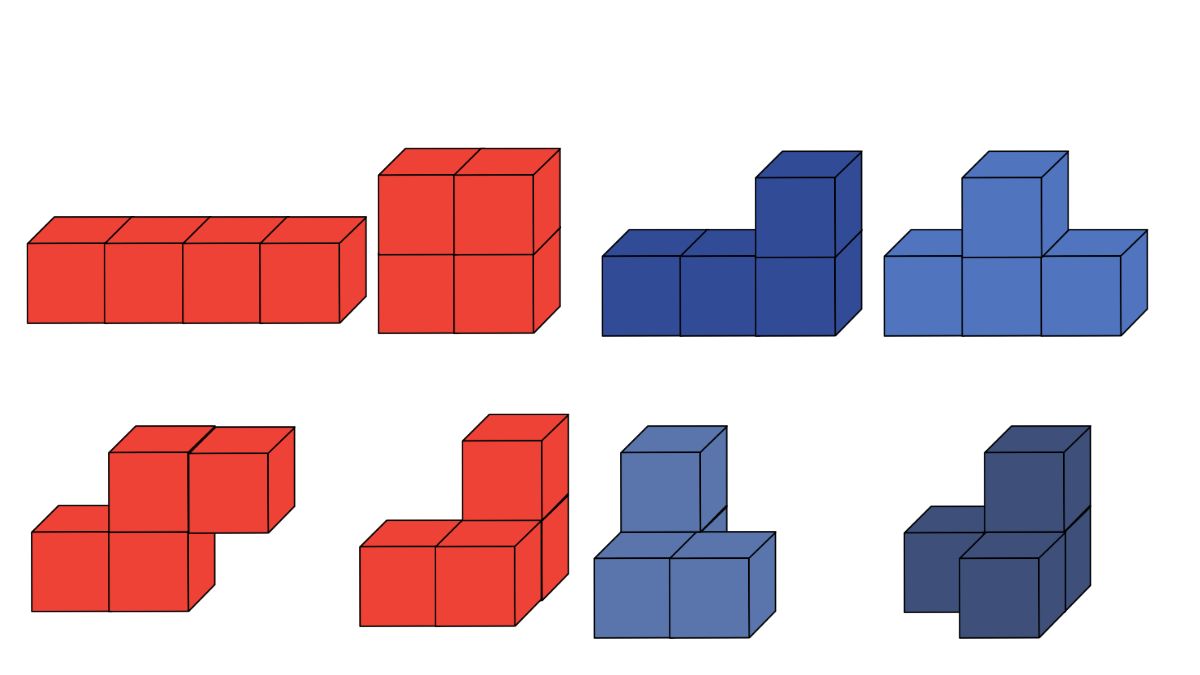
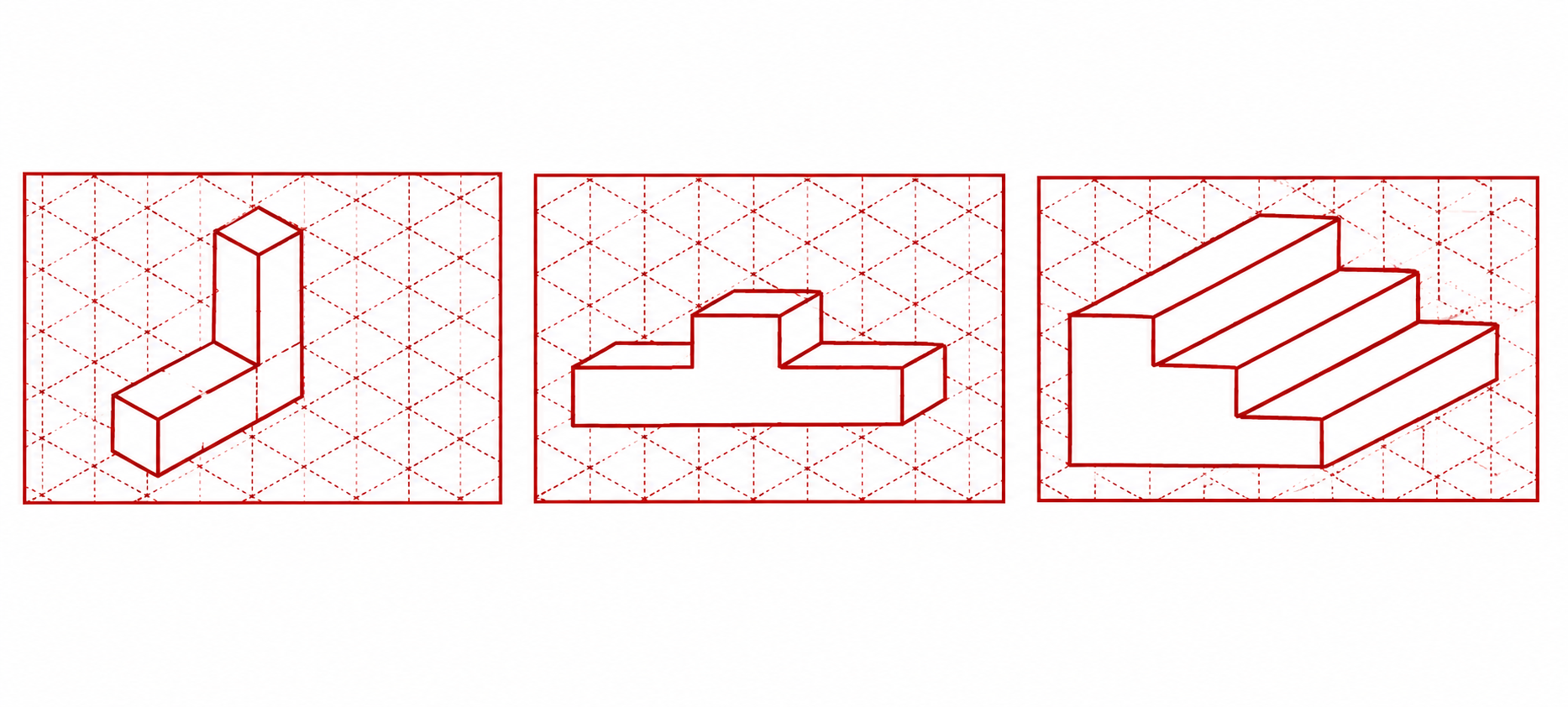
Question 2. Draw the following figures on the isometric grid.
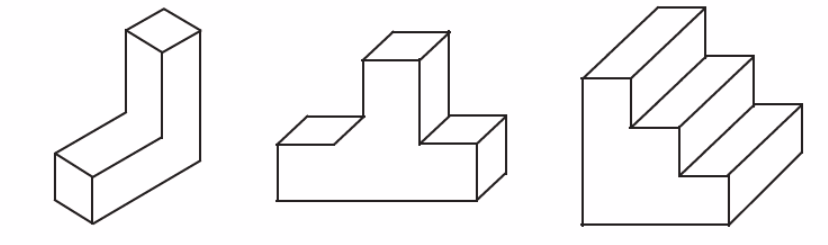
[Hint: It may be useful to determine whether the edge to be currently drawn - say, along the height - goes from down to up or up to down. Accordingly, draw the line segment on the grid either in the direction of the height axis or opposite to it.]
$\textbf{Answer:}$
Question 3. Is there anything strange about the path of this ball? Recreate it on the isometric grid.
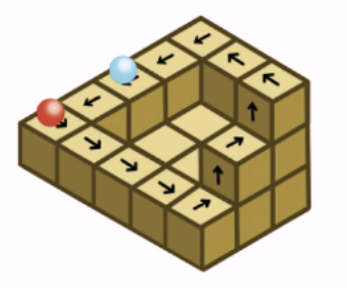
[Hint: Consider a portion of this figure that is physically realisable and identify the 3 primary directions.]
$\textbf{Answer:}$
The strange thing is that the ball is trapped in an impossible loop.
In real life, you cannot keep walking downstairs and magically end up back at the top of the staircase. It breaks the laws of physics!
Question 4. Observe this triangle.
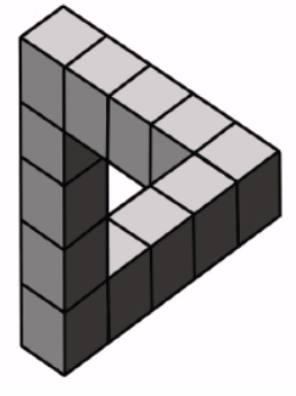
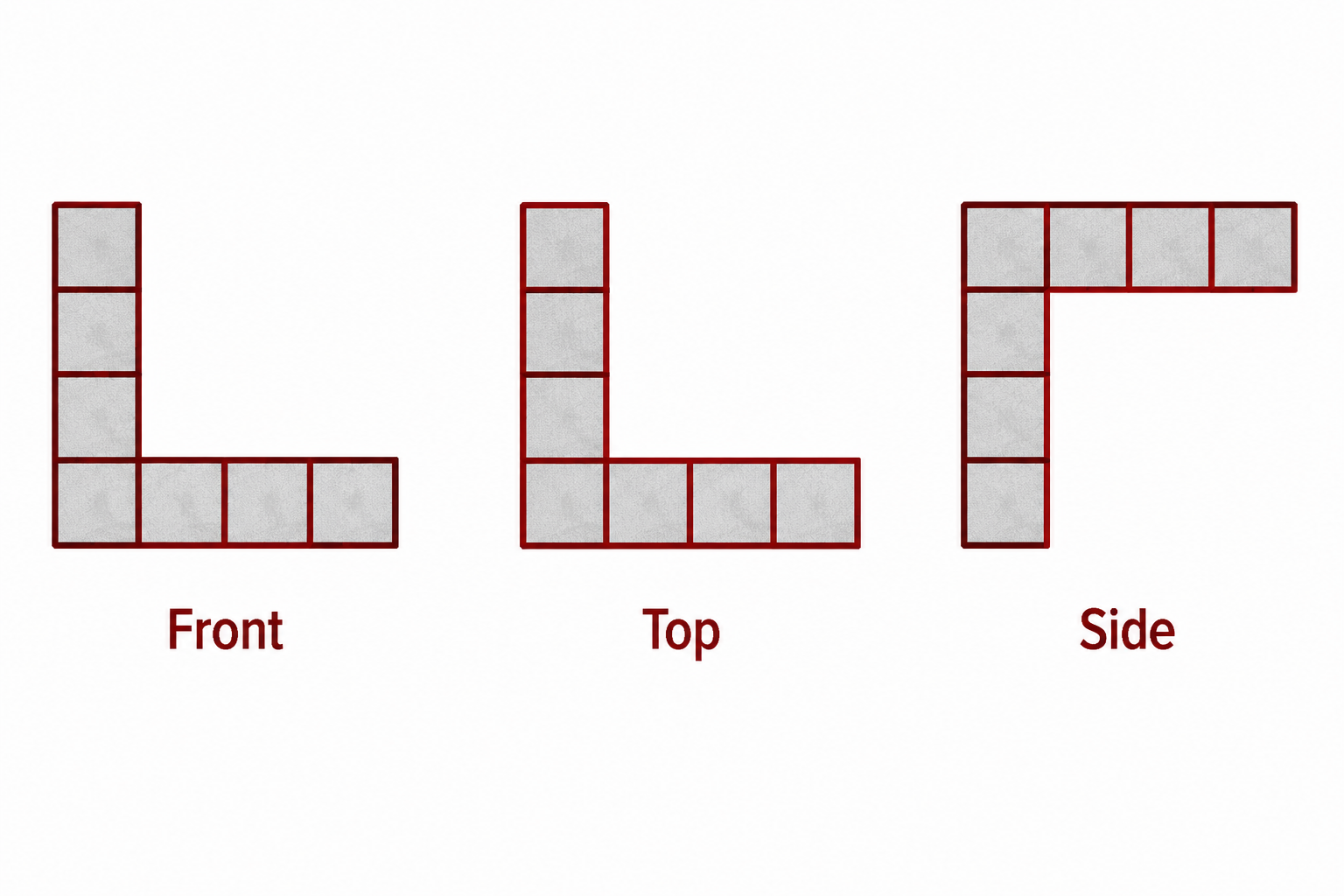
(i) Would it be possible to build a model out of actual cubes? What are the front, top, and side profiles of this impossible triangle?
(ii) Recreate this on an isometric grid.
(iii) Why does the illusion work?
$\textbf{Answer:}$
4 (i):
No, it is not possible to build this as a single, solid, closed triangle in 3D space.
This is called a Penrose Triangle.
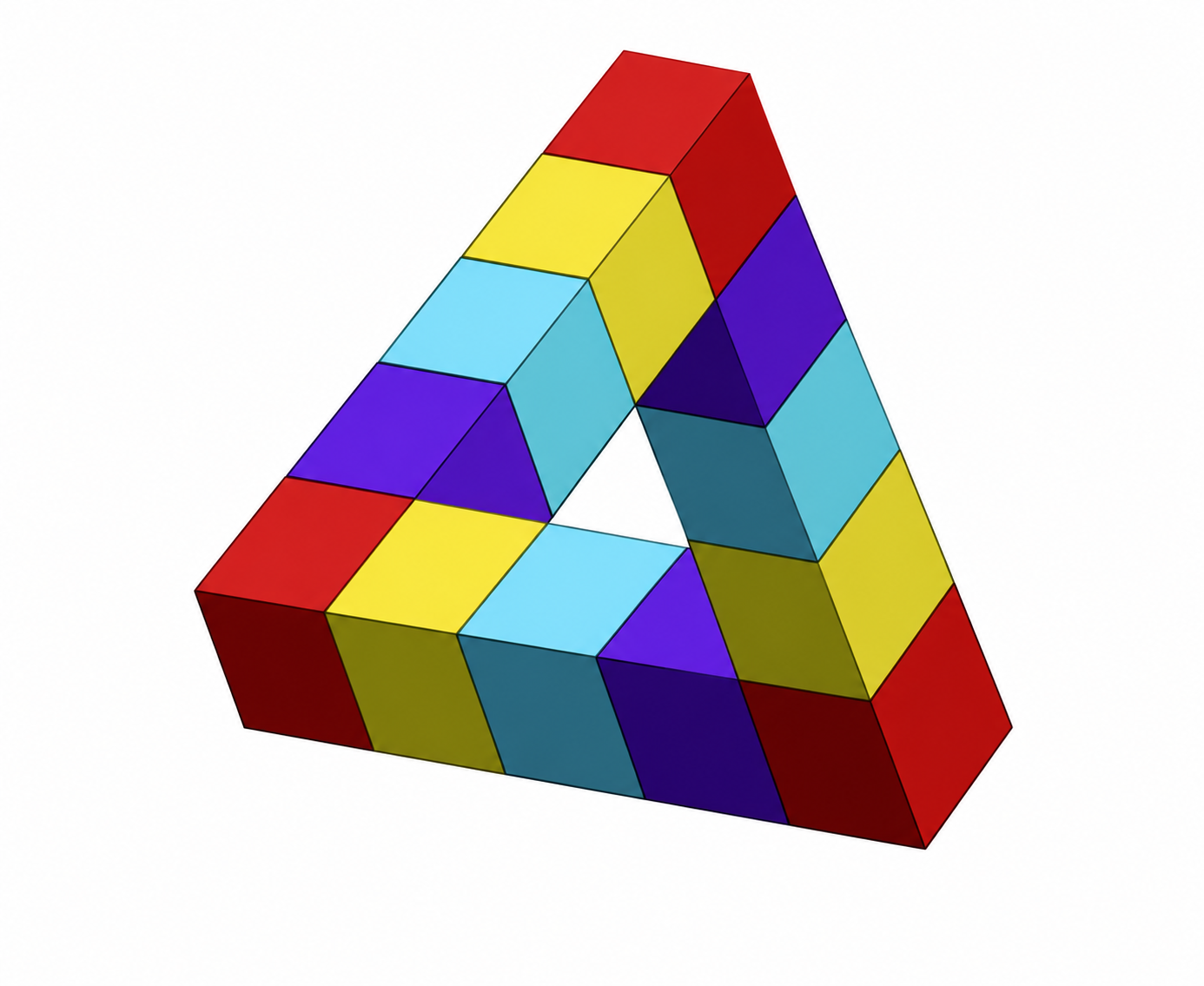
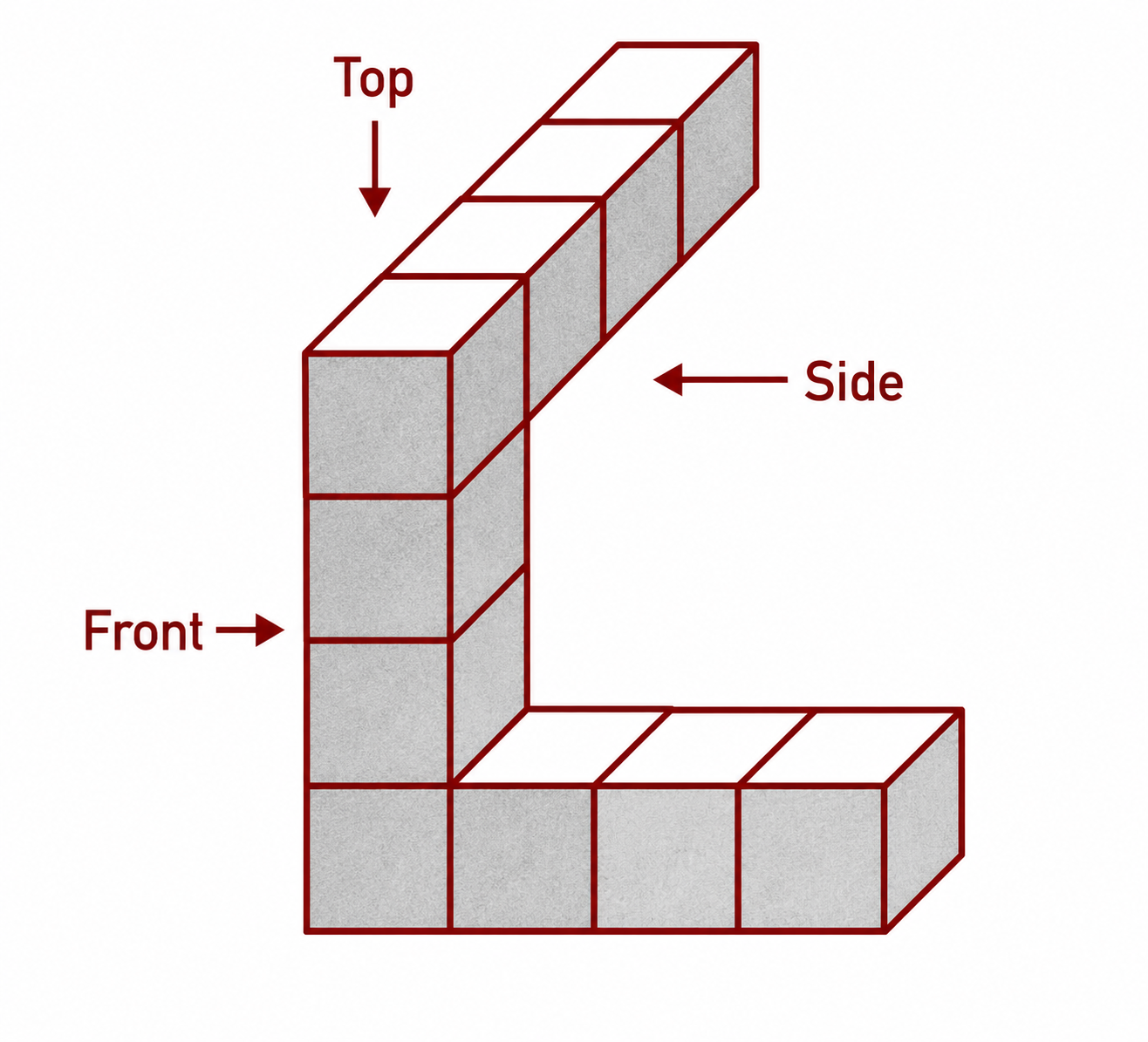
Front, top, and side views are as follows:
4(ii):
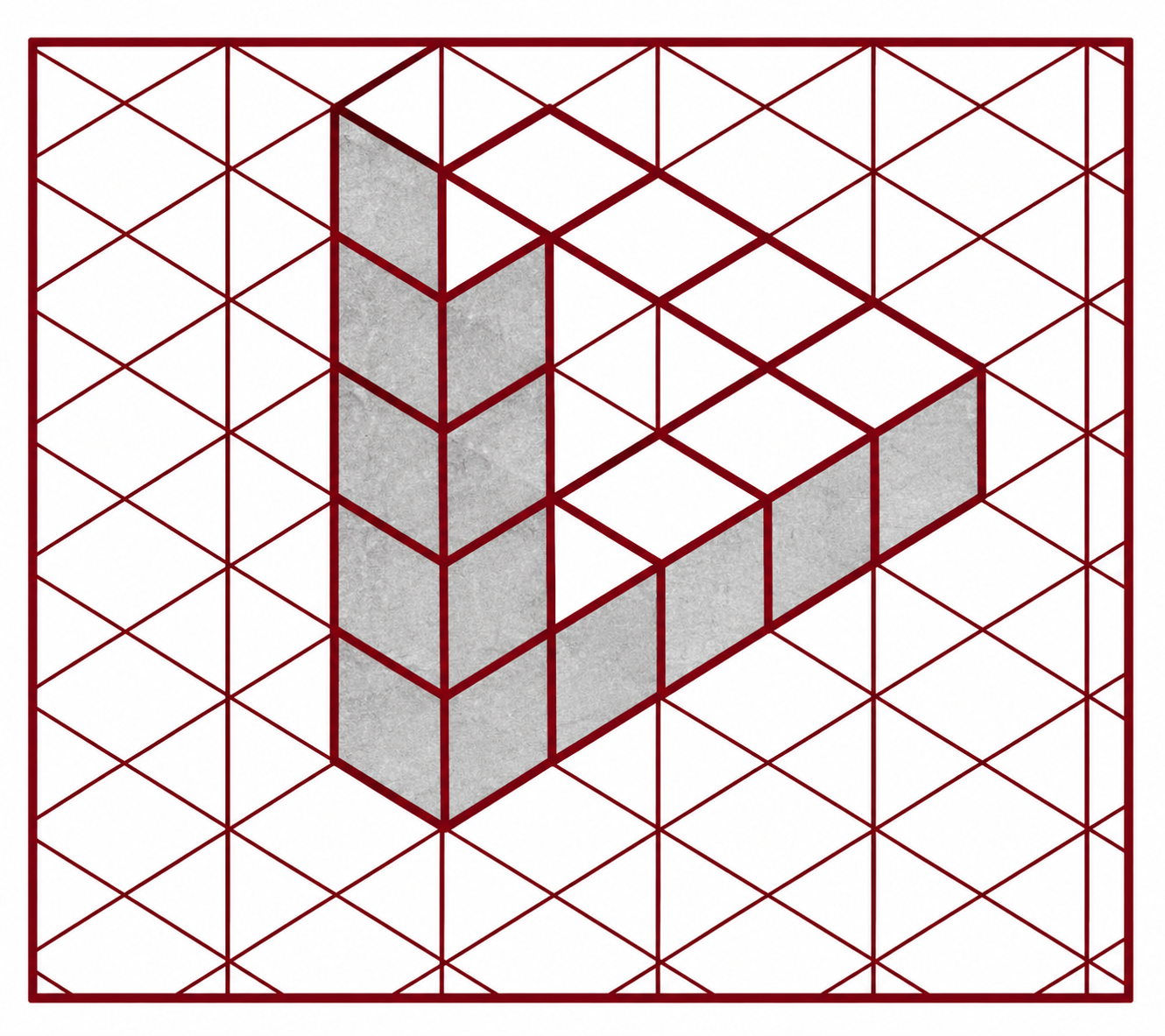
4 (iii):
Our eyes get tricked because of how the blocks are drawn:
Get your results instantly with our calculator!
Topics you will learn in NCERT Solutions for Class 8 Maths Part 2 Chapter 4 Exploring Some Geometric Themes include:
4.1 Fractals
4.2 Visualising Solids
We at Careers360 compiled all the latest NCERT Class 8 Maths solutions based on latest textbook in one place for easy student reference. The following links will allow you to access them.
|
NCERT Solutions for Class 8 Maths Part 2 Chapter 1 Fractions in Disguise |
|
NCERT Solutions for Class 8 Maths Part 2 Chapter 2 The Baudhayana-Pythagoras Theorem |
|
NCERT Solutions for Class 8 Maths Part 2 Chapter 3 Proportional Reasoning - 2 |
|
NCERT Solutions for Class 8 Maths Part 2 Chapter 4 Exploring Some Geometric Themes |
|
NCERT Solutions for Class 8 Maths Part 2 Chapter 5 Tales by Dots and Lines |
|
NCERT Solutions for Class 8 Maths Part 2 Chapter 6 Algebra Play |
|
NCERT Solutions for Class 8 Maths Part 2 Chapter 7 Area |
Before planning a study schedule, always analyse the latest syllabus. Here are the links to the latest NCERT syllabus and some of the important books that will help students in this cause.
The new chapter in the latest NCERT textbook, Class 8 Part 2, Chapter 4, Exploring Some Geometric Themes, will help students by exploring the different types of geometric designs and their significance through algebraic equations. This Chapter will explore the Sierpinski triangle and how patterns repeat to create self-similar forms. This Chapter will also explore the Koch snowflake and illustrate how simple geometric rules can be used to create complex shapes and how fractals can help students appreciate patterns in both math and nature. In addition, there is a section on Visualising Solids that will allow students to visualise three-dimensional objects in many different ways.
There are 6 exercises and a total of 22 questions in the chapter for practice and revision.
These NCERT solutions provide detailed and step-by-step explanations for all questions in the chapter.
Also,
Here are the concepts and topics that are related to the latest NCERT Solutions for Class 8 Maths Ganita Prakash Part 2 Chapter 4 in higher classes.
Class 9-10
Fractals
Koch Snowflake
Sierpinski Triangle
Visualising solids and three-dimensional shapes
Nets of solids
Surface area and volume concepts
Symmetry and geometric patterns
Spatial visualization and geometric reasoning
Class 11-12
Three-Dimensional Geometry
Coordinate geometry of space
Surface area and volume of solids
Geometric transformations and symmetry
Mathematical patterns and recursive structures
Visualisation of complex geometric objects
JEE (Main & Advanced)
Three-Dimensional Geometry
Surface area and volume problems
Coordinate geometry in space
Symmetry and geometric transformations
Recursive and pattern-based reasoning
Advanced problem-solving involving geometric structures and patterns
Frequently Asked Questions (FAQs)
Fractals are geometric patterns that follow specific mathematical rules and repeated structures.
A fractal is a pattern that repeats itself at different scales and often looks similar no matter how closely it is viewed.
A net is a two-dimensional pattern that can be folded to form a three-dimensional solid.
A Koch Snowflake is a fractal created by repeatedly adding smaller equilateral triangles to the sides of a larger equilateral triangle.
A Sierpinski Triangle is a fractal formed by repeatedly removing the central triangle from an equilateral triangle.

A block of mass 0.50 kg is moving with a speed of 2.00 ms-1 on a smooth surface. It strikes another mass of 1.00 kg and then they move together as a single body. The energy loss during the collision is
| Option 1)
|
Option 2)
|
| Option 3)
|
Option 4)
|
An athlete in the olympic games covers a distance of 100 m in 10 s. His kinetic energy can be estimated to be in the range
| Option 1)
|
Option 2)
|
| Option 3)
|
Option 4)
|
A particle is projected at 600 to the horizontal with a kinetic energy . The kinetic energy at the highest point
| Option 1)
|
Option 2)
|
| Option 3)
|
Option 4)
|
In the reaction,
| Option 1)
|
Option 2)
|
| Option 3)
|
Option 4)
|
How many moles of magnesium phosphate, will contain 0.25 mole of oxygen atoms?
| Option 1)
0.02 |
Option 2)
3.125 × 10⁻² |
| Option 3)
1.25 × 10⁻² |
Option 4)
2.5 × 10⁻² |

Law Admissions 2026 Open | Avail Merit-Based Scholarships
BBA/MBA/PGDM Early Bird Applications Deadline 06th Nov'26. Apply now using coupon code CAREER250 and get ₹250 off the application fee
Ranked #36 amongst institutions in Management by NIRF | 100% Placement
Globally Recognized by AACSB (US) & AMBA (UK) | 18 LPA Avg. CTC for PGPM 2026
NEET PG All India & State College Predictor with Admission Process Guide
Top B-School: Ranked #9 in NIRF Management Rankings 2025.