


NCERT Solutions for Class 7 Maths Part 2 Chapter 4 - Another Peek Beyond the Point
Decimals are used in many real-life situations, such as handling money, measuring length and weight, and recording distances. A good understanding of decimal operations helps students solve everyday mathematical problems with greater accuracy. In NCERT Solutions for Class 7 Maths Part 2 Chapter 4 Another Peek Beyond the Point, students first revise the basics of decimals before learning how to multiply and divide decimal numbers. The chapter also highlights common mistakes and useful tips to help students solve questions carefully and correctly. These NCERT Solutions for Class 7 Maths explain every exercise in a simple, step-by-step manner, making it easier for students to understand the methods used in decimal multiplication and division. Each solution is written in clear language so that students can follow the calculations without confusion and develop confidence while solving similar problems.
Prepared by the subject experts at Careers360, these NCERT Solutions are based on the latest CBSE syllabus and the updated NCERT textbook. Whether students are revising the chapter, completing homework, or preparing for examinations, these NCERT Solutions for Class 7 provide reliable guidance and help them build a strong understanding of decimal operations through regular practice.
Class 7 Maths Part 2 Chapter 4 Solutions PDF Free Download - Ganita Prakash Book 2
Students can download the NCERT Solutions for Class 7 Maths Part 2 Chapter 4 Another Peek Beyond the Point PDF by clicking the link provided below.
NCERT Solutions for Class 7 Maths Ganita Prakash Part 2 Chapter 4 Exercise Questions and Answers
Here are the NCERT Solutions for Class 7 Maths Part 2 Chapter 4 Another Peek Beyond the Point question answers with clear and detailed solutions.
Class 7 Maths Part 2 Chapter 4 Question Answers with Detailed Solutions |
1. Recall that a tenth is 0.1, a hundredth is 0.01, and so on. Find the following products in tenths, hundredths and so on:
(a) $6 \times 4$ tenths $=24$ tenths
(b) $7 \times 0.3$
(c) $9 \times 5$ hundredths
Answer:
1(a):
$6 \times 4$ tenths $=24$ tenths $=2.4$
1(b):
Since 0.3 = 3 tenths
$7 \times 3$ tenths $=21$ tenths $=2.1$
1(c):
Since 5 hundredths $=0.05$,
$9 \times 5 \text { hundredths }=45 \text { hundredths }=0.45$
2. Find the products:
(a) $27.34 \times 6$
(b) $4.23 \times 3.7$
(c) $0.432 \times 0.23$
Answer:
2(a):
$27.34 \times 6=164.04$
2(b):
$4.23 \times 3.7$
Here,
$423 \times 37=15651$
There are 3 decimal places altogether (2 in 4.23 and 1 in 3.7).
So, $4.23 \times 3.7=15.651$
2(c):
$0.432 \times 0.23$
Here, $432\times23=9936$
There are 5 decimal places in total
So, $0.432 \times 0.23=0.09936$
3. Thejus needs 1.65 m of cloth for a shirt. How many metres of cloth are needed for 3 shirts?
Answer: 4.95 m
Explanation:
Cloth for one shirt = 1.65 m
So, clothes for 3 shirts = $1.65\times3=4.95$ m
4. Meenu bought 4 notebooks and 3 erasers. The cost of each book was ₹15.50 and each eraser was ₹2.75. How much did she spend in all?
Answer: ₹ 70.25
Explanation:
Cost of 4 notebooks = 15.50 × 4 = 62
Cost of 3 erasers = 2.75 × 3 = 8.25
Total cost = 62 + 8.25 = ₹ 70.25
5. The thickness of a rupee coin is 1.45 mm. What is the total height of the cylinder formed by placing 36 rupee coins one over the other? Write the answer in centimeters.
Answer: 5.22 cm
Explanation:
Height of one coin = 1.45 mm
Height of 36 coins = 1.45 × 36 = 52.2 mm
Since 10 mm = 1 cm, 52.2 mm = 5.22 cm
6. The price of 1 kg of oranges is ₹56.50. What is the price of 2.250 kg of oranges? Can we write 56.50 as 56.5 and 2.250 as 2.25 and multiply? Will we get the same product? Why?
Answer: ₹ 127.125
Explanation:
Price per kg = ₹56.50
Price of 2.250 kg = 56.50 × 2.250 = ₹ 127.125
Yes, Trailing zeros after the decimal point do not change the value of a decimal number.
So, we can write 56.50 as 56.5 and 2.250 as 2.25 and multiply.
$56.50 \times 2.250=56.5 \times 2.25=127.125$
7. Dwarakanath purchases notebooks at a wholesale price of ₹23.6 per piece and sells each notebook at ₹30/-. How much profit does he make if he sells 50 books in a week?
Answer: ₹320
Explanation:
Cost price of one notebook = ₹23.60
Selling price of one notebook = ₹30.00
So, Profit on one notebook = 30.00 - 23.60 = 6.4
$\therefore$ Profit on 50 notebooks = 6.4 × 50 = ₹320
8. Given that $18 \times 12=216$, find the products:
(a) $18 \times 1.2$
(b) $18 \times 0.12$
(c) $1.8 \times 1.2$
(d) $0.18 \times 0.12$
(e) $0.018 \times 0.012$
(f) $1.8 \times 12$
In which of the cases above is the product less than 1?
Answer:
8(a):
Since $1.2=\frac{12}{10} $
$18 \times 1.2=\frac{216}{10}=21.6>1$
8(b):
Since $0.12 =\frac{12}{100} $
$18 \times 0.12 =\frac{216}{100}=2.16>1$
8(c):
Since, $1.8=\frac{18}{10}$ and $1.2=\frac{12}{10} $
$1.8 \times 1.2=\frac{216}{100}=2.16>1$
8(d):
Since, $0.18 =\frac{18}{100} $ and $0.12 =\frac{12}{100} $
$0.18 \times 0.12=\frac{216}{10000}=0.0216<1$
8(e):
Since, $0.018=\frac{18}{1000}$ and $0.012=\frac{12}{1000}$
$0.018 \times 0.012=\frac{216}{1000000}=0.000216<1$
8(f):
Since, $1.8=\frac{18}{10}$
$1.8 \times 12=\frac{216}{10}=21.6>1$
The product is less than 1 in (d) and (e).
9. In which of the following multiplications is the product less than 1? Can you find the answer without actually doing the multiplications?
(a) $7 \times 0.6$
(b) $0.7 \times 0.6$
(c) $0.7 \times 6$
(d) $0.07 \times 0.06$
Answer:
9 (a): $7 \times 0.6$
Here, one factor is greater than 1.
$\therefore$ Product is not less than 1.
9 (b): $0.7 \times 0.6$
Here, both factors are less than 1.
$\therefore$ Product is less than 1.
9 (c): $0.7 \times 6$
Here, one factor is greater than 1.
$\therefore$ Product is not less than 1.
9 (d): $0.07 \times 0.06$
Here, both factors are less than 1.
$\therefore$ Product is less than 1.
Hence, the product is less than 1 in (b) and (d).
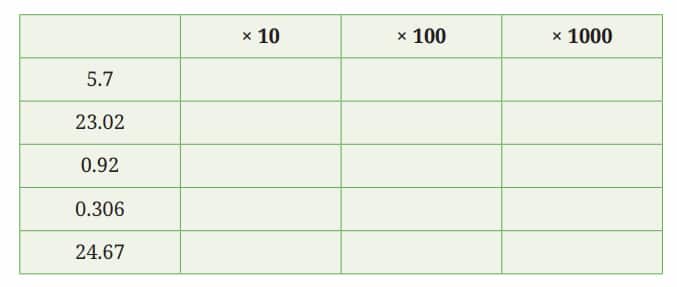
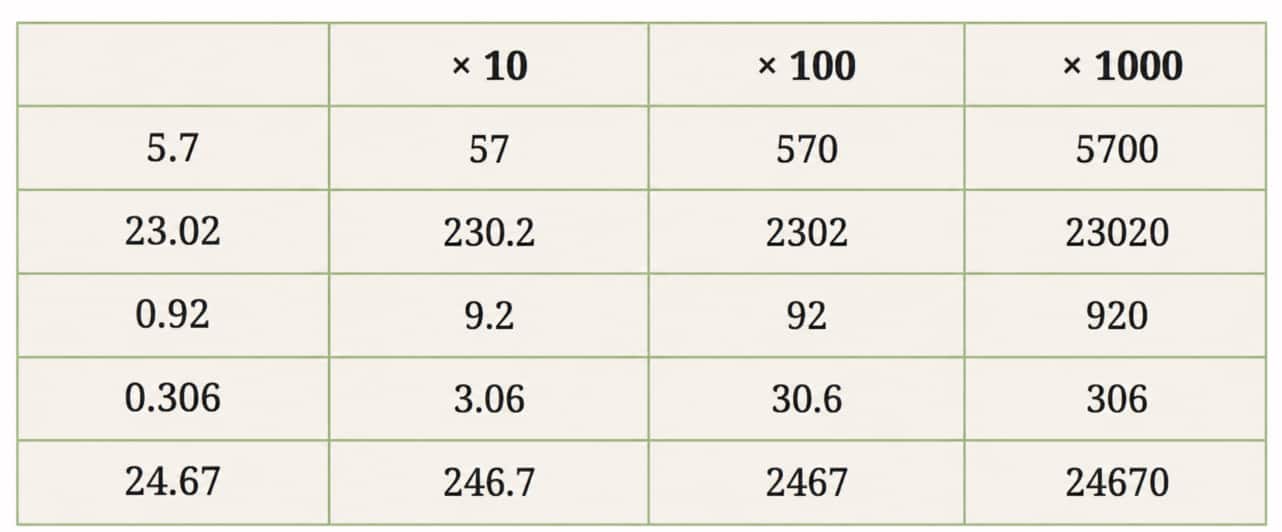
10. Multiplying the following numbers by 10,100 and 1000 to complete the table.
Answer:
Class 7 Maths Part 2 Chapter 4 Question Answers with Detailed Solutions |
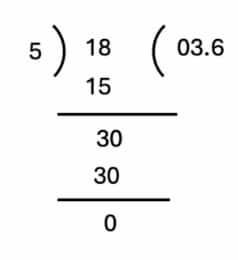
1. Find the quotient by converting the denominator into 1, 10, 100 or 1000 and verify the solution by the long division method (division by place value).
(a) $\frac{18}{5}$
(b) $\frac{415}{4}$
(c) $\frac{1217}{2}$
(d) $\frac{4827}{8}$
Answer:
1 (a): $\frac{18}{5}$
Multiply the numerator and denominator by 2.
$\frac{18}{5}=\frac{18 \times 2}{5 \times 2}=\frac{36}{10}=3.6$
1 (b): $\frac{415}{4}$
Multiply the numerator and denominator by 25.
$\frac{415}{4}=\frac{415 \times 25}{4 \times 25}=\frac{10375}{100}=103.75$
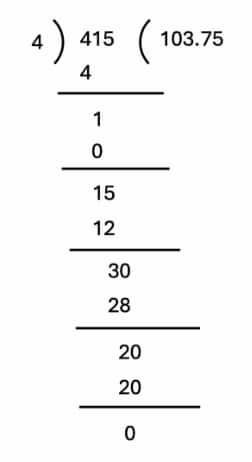
1 (c): $\frac{1217}{2}$
Multiply the numerator and denominator by 5.
$\frac{1217}{2}=\frac{1217 \times 5}{2 \times 5}=\frac{6085}{10}=608.5$
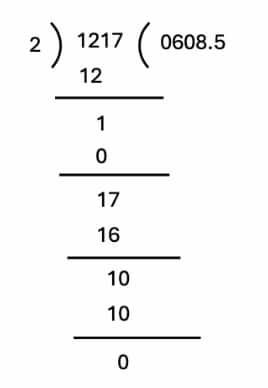
1 (d): $\frac{4827}{8}$
Multiply the numerator and denominator by 125.
$\frac{4827}{8}=\frac{4827 \times 125}{8 \times 125}=\frac{603375}{1000}=603.375$
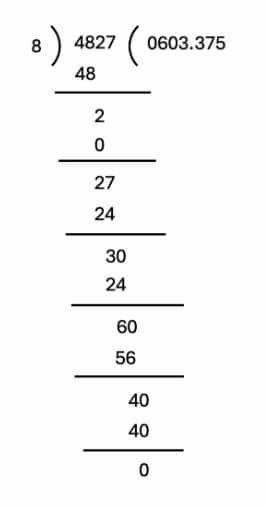
2. Choose the correct answer:
(a) $\frac{1526}{4}=$
(i) 38.15
(ii) 380.15
(iii) 381.5
(iv) 381.05
(b) $\frac{3567}{8}=$
(i) 4458.75
(ii) 44.5875
(iii) 445.875
(iv) 4458.75
2(a): Option(iii)
Explanation:
$\frac{1526}{4}=381.5$
2(b): Option(iii)
Explanation:
$\frac{3567}{8}=445.875$
3. What is the quotient?
(a) $132 \div 4=$
(b) $13.2 \div 4=$
(c) $1.32 \div 4=$
(d) $0.132 \div 4=$
Answer:
3 (a): $132 \div 4= 33$
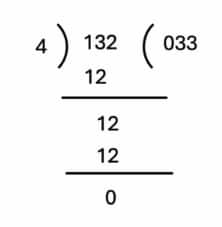
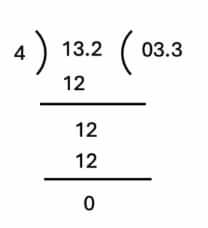
3 (b): $13.2 \div 4=3.3$
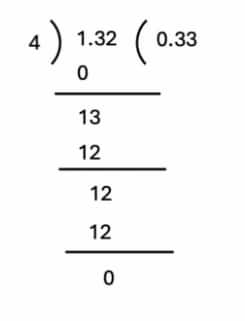
3 (c): $1.32 \div 4=0.33$
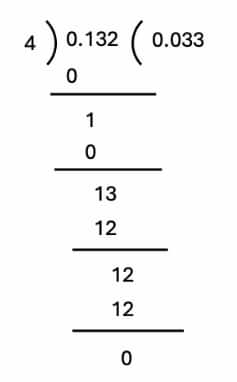
3 (d): $0.132 \div 4=0.033$
4. What is the quotient?
(a) $126 \div 8=$
(b) $12.6 \div 8=$
(c) $1.26 \div 8=$
(d) $0.126 \div 8=$
(e) $0.0126 \div 8=$
Answer:
4 (a): $126 \div 8=15.75$
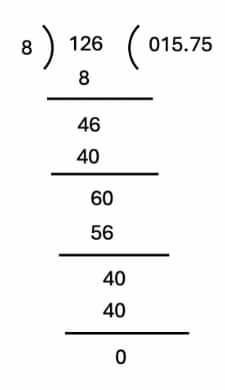
4 (b): $12.6 \div 8=1.575$
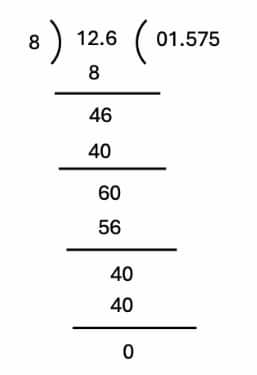
4 (c): $1.26 \div 8=0.1575$
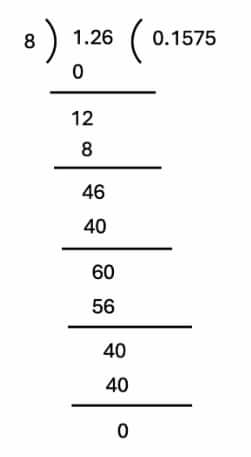
4 (d): $0.126 \div 8=0.01575$
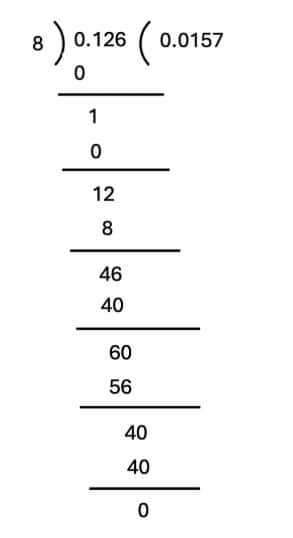
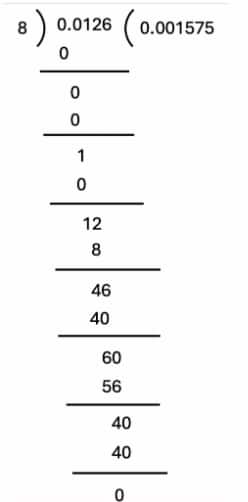
4 (e): $0.0126 \div 8=0.001575$
Class 7 Maths Part 2 Chapter 4 Question Answers with Detailed Solutions |
1. Express the following fractions in decimal form:
(a) $\frac{2}{5}$
(b) $\frac{13}{4}$
(c) $\frac{4}{50}$
(d) $\frac{5}{8}$
Answer:
1(a):,$\frac{2}{5}=\frac{4}{10}=0.4$
1(b): $\frac{13}{4}=3.25$
1(c): $\frac{4}{50}=\frac{8}{100}=0.08$
1(d): $\frac{5}{8}=0.625$
2. Find the quotients:
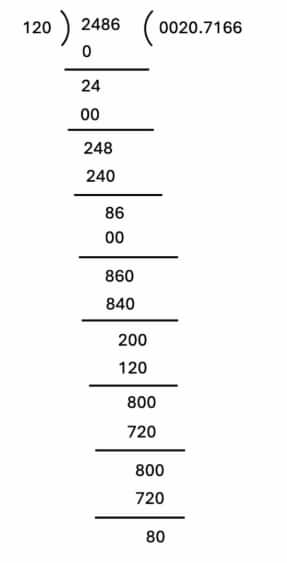
(a) $24.86 \div 1.2$
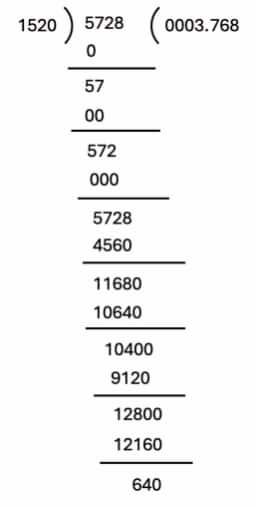
(b) $5.728 \div 1.52$
Answer:
2(a):
$\begin{aligned} & 24.86 \div 1.2 \\ & =\frac{2486}{100} \div \frac{12}{10} \\ & =\frac{2486}{100} \times \frac{10}{12} \\ & =\frac{2486}{240} \times \frac{1}{12} \\ & =\frac{2486}{120}=20.7166 \ldots\end{aligned}$
2(b):
$\begin{aligned} & 5.728 \div 1.52 \\ & =\frac{5728}{1000} \div \frac{152}{100} \\ & =\frac{5728}{1000} \times \frac{100}{152} \\ & =\frac{5728}{10} \times \frac{1}{152} \\ & =\frac{5728}{1520}=3.768 \ldots\end{aligned}$
3. Evaluate the following using the information $156 \times 12=1872$.
(a) $15.6 \times 1.2=$ $\_\_\_\_$
(b) $187.2 \div 1.2=$ $\_\_\_\_$
(c) $18.72 \div 15.6=$ $\_\_\_\_$
(d) $0.156 \times 0.12=$ $\_\_\_\_$
Answer:
3(a):
$15.6 \times 1.2=\frac{1872}{100}=18.72$
3(b):
$\frac{187.2}{1.2}=156$
3(c):
$\frac{18.72}{15.6}=1.2$
3(d):
$0.156 \times 0.12=\frac{1872}{100000}=0.01872$
4. Evaluate the following:
(a) $25 \div$ $\_\_\_\_$ $=0.025$
(b) $25 \div \quad=250$
(c) $25 \div$ $\_\_\_\_$ $=2.5$
(d) $25 \div 10=25 \times$ $\_\_\_\_$
(e) $25 \div 0.10=25 \times$ $\_\_\_\_$
(f) $25 \div 0.01=25 \times$ $\_\_\_\_$
Answer:
Let the blank space be $x$.
4(a):
$\frac{25}x=0.025$
$\therefore x=1000$
4(b)
$\frac{25}x=250$
$\therefore x=0.1$
4(c):
$\frac{25}x=2.5$
$\therefore x=10$
4(d):
$\frac{25}{10}=25x$
$\therefore x=0.1$
4(e):
$\frac{25}{0.10}=25x$
$\therefore x=10$
4(f)
$\frac{25}{0.01}=25x$
$\therefore x=100$
5. Find the quotient:
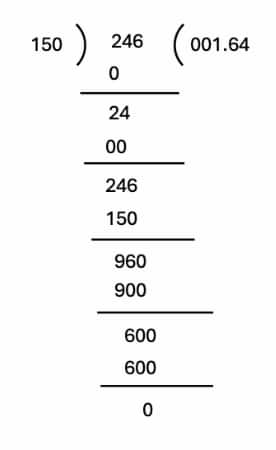
(a) $2.46 \div 1.5=$
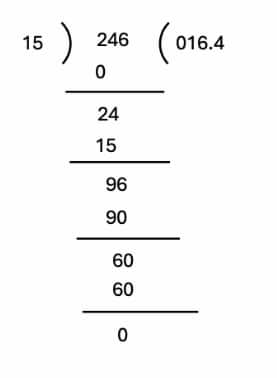
(b) $2.46 \div 0.15=$
(c) $2.46 \div 0.015=$
Is the quotient obtained in $24.6 \div 1.5$ the same as the quotient obtained in $2.46 \div 0.15$?
Answer:
5 (a): $2.46 \div 1.5=1.64$
 5 (b): $2.46 \div 0.15=16.4$
 5 (c): $2.46 \div 0.015=164$
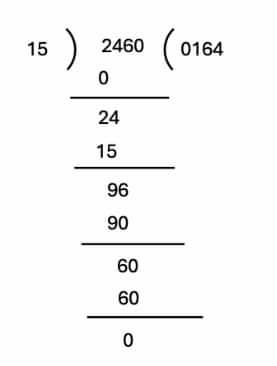
$24.6 \div 1.5=16.4 $
$2.46 \div 0.15=16.4$
Yes. The quotients are the same because multiplying or dividing both the dividend and the divisor by the same non-zero number does not change the quotient.
6. A 4 m long wooden block has to be cut into 5 pieces of equal length. What is the length of each piece?
Answer: 0.8 m
Explanation:
A 4 m long wooden block has to be cut into 5 pieces of equal length.
$\therefore$ Length of each piece $=\frac45=0.8$ m
7. If the perimeter of a regular polygon with 12 sides is 208.8 cm, what is the length of its side?
Answer: 17.34 cm
Explanation:
Perimeter of a regular polygon with 12 sides is 208.8 cm.
$\therefore$ Length of 1 side = $\frac{208.8}{12}=17.34$ cm
8. 3 litres of watermelon juice is shared among 8 friends equally. How much watermelon juice will each get? Express the quantity of juice in millilitres.
Answer: 375 ml
Explanation:
1 litre = 1000 ml
So, 3 litres = 3000 ml
$\therefore$ Juice per firend = $\frac{3000}8=375$ ml
9. A car covers 234.45 km using 12.6 litres of petrol. What is the distance travelled per litre?
Answer: Approx 18.61 km
Explanation:
A car covers 234.45 km using 12.6 litres of petrol.
$\therefore$ Distance per litre = $\frac{234.45}{12.6}\approx18.61$ km
10. 13.5 kg of flour (aata) was distributed equally among 15 students. How much flour did each student receive?
Answer: 0.9 kg or 900 gm
Explanation:
13.5 kg of flour (aata) was distributed equally among 15 students.
$\therefore$ Flour per student $=\frac{13.5}{15}=0.9$ kg = 900 gram
Class 7 Maths Part 2 Chapter 4 Question Answers with Detailed Solutions |
1. A 210 gram packet of peanut chikki costs ₹70.5, while a 110 gram packet of potato chips costs ₹33.25. Which is cheaper?
Answer: Potato chips
Explanation:
Peanut chikki:
Weight = 210 g
Cost = ₹70.50
$\therefore$ Cost per gram $=\frac{70.5}{210}\approx0.3357$
Potato chips:
Weight = 110 g
Cost = ₹33.25
$\therefore$ Cost per gram $=\frac{33.25}{110} \approx 0.3023$
Since ₹0.302 < ₹0.336, the potato chips are cheaper.
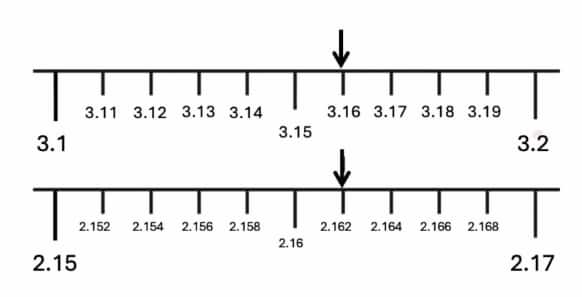
2. Write the decimal number at the arrow mark:
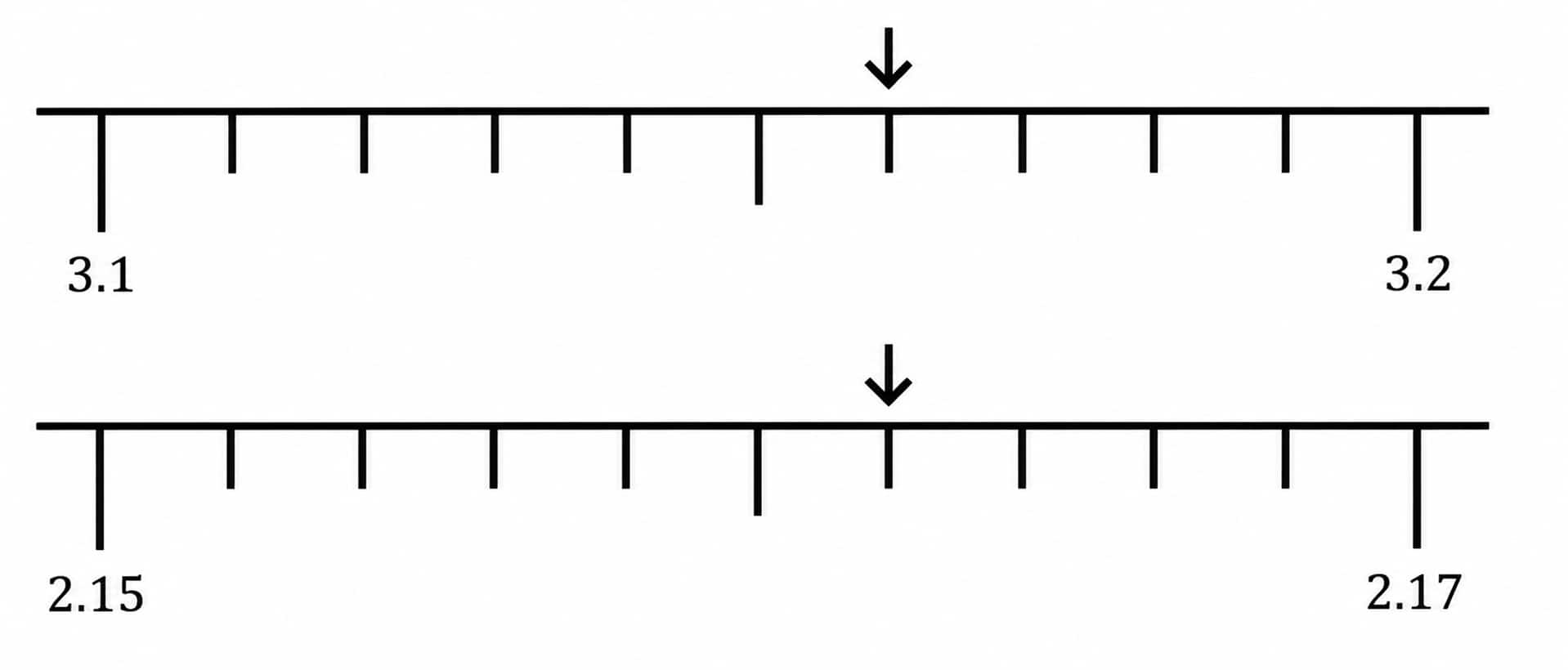
Answer:
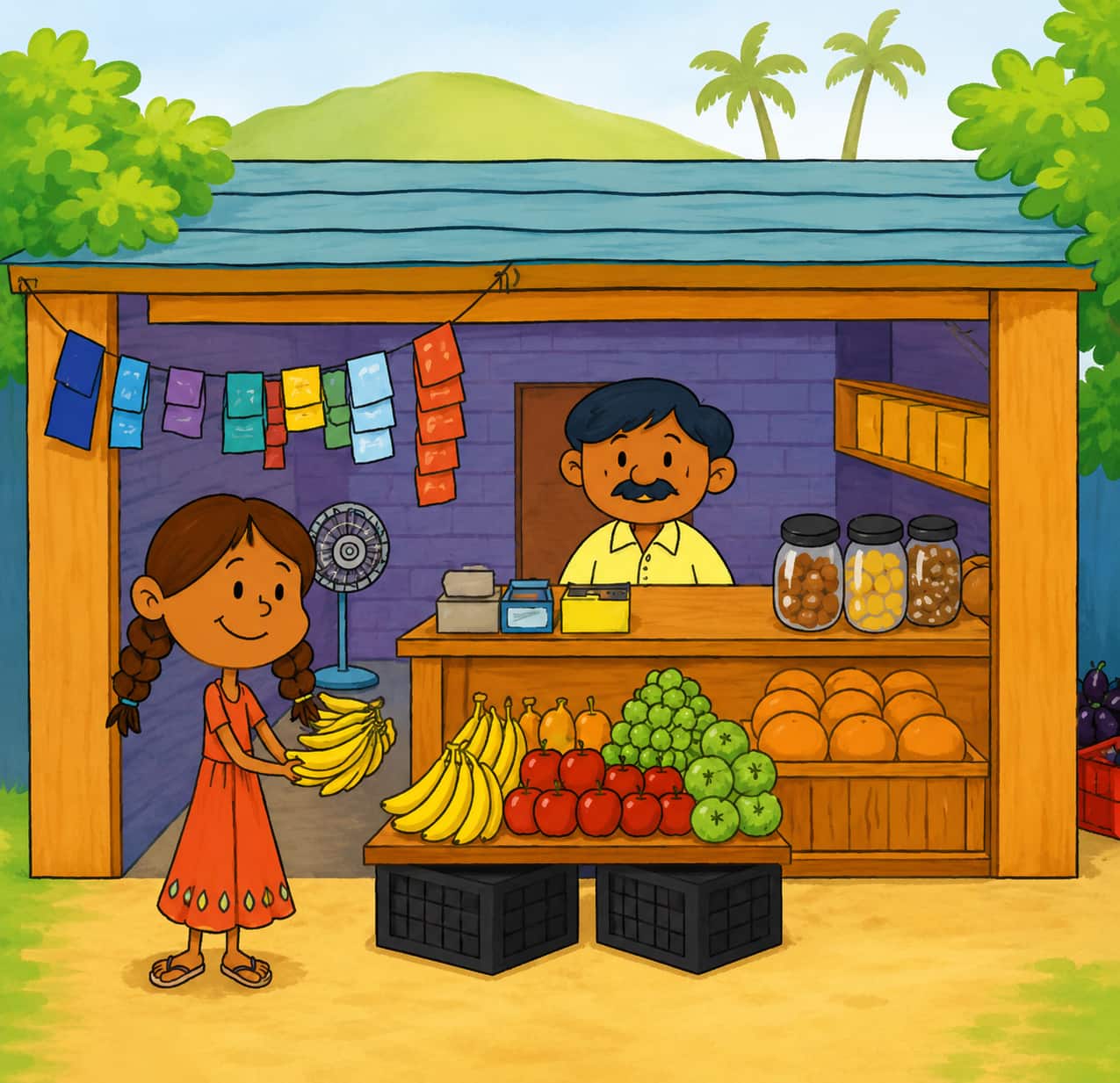
3. Shyamala bought 3 kg bananas at ₹ $30 /-$ per kg. She counted 35 bananas in all. She sells each banana for ₹5/-. How much profit does she make selling all the bananas?
Answer: ₹85
Explanation:
Shyamala bought 3 kg of bananas at ₹ $30 /-$ per kg.
Total cost price = 3 × 30 = ₹90
She sold 35 bananas at ₹5 each.
Total selling price = 5 × 35 = ₹175
$\therefore$ profit = Selling price - Cost price = 175 - 90 = ₹85
4. A teacher placed textbooks that are 2.5 cm thick on a bookshelf. The teacher wanted to place 80 textbooks on the shelf. The bookshelf is 160 cm long. How many books could be placed on the shelf? Was there any space left? If yes, how much?
Answer: 64
Explanation:
Number of books $=\frac{\text { Length of shelf }}{\text { Thickness of one book }}=\frac{160}{2.5}=64$
So, 64 books can be placed on the shelf.
Since only 64 books fit on the shelf, 16 books (80 − 64) cannot be placed.
Space occupied by 64 books $=64 \times 2.5=160 \mathrm{~cm}$
This is exactly the length of the bookshelf.
So, no spaces left.
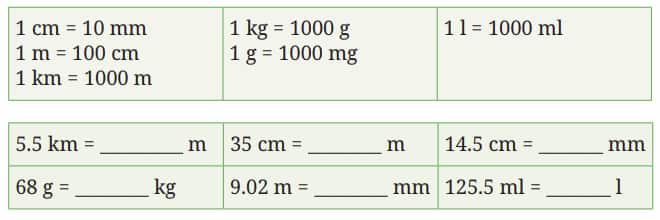
5. Fill in the following blanks appropriately:
Answer:
5.5 km = 5.5 × 1000 = 5500 m
35 cm = $\frac{35}{100}=0.35$ m
14.5 cm = 14.5 × 10 = 145 mm
68 g = $\frac{68}{1000}=0.068$ kg
9.02 m = 9.02 × 1000 = 9020 mm
125.5 ml = $\frac{125.5}{1000}=0.1255$ l
6. The following problem was set by Sridharacharya in his book, Patiganita. " $6 \frac{1}{4}$ is divided by $2 \frac{1}{2}$, and $60 \frac{1}{4}$ is divided by $3 \frac{1}{2}$. Tell the quotients separately." Can you try to solve it by converting the fractions into decimals?
Answer:
(a): $6 \frac{1}{4}=6.25, $ and $2 \frac{1}{2}=2.5$
So, $6.25 \div 2.5=\frac{62.5}{25}=2.5$
(b):
$60 \frac{1}{4}=60.25, $ and $3 \frac{1}{2}=3.5$
$60.25 \div 3.5=\frac{602.5}{35}=17.214285714$
7. Fill the boxes in at least 2 different ways:
(a) □ × □ $=2.4$
(b) □ × □ $=14.5$
Answer:
7(a):
$2 \times 1.2=2.4$
$0.6 \times 4=2.4$
7(b):
$2 \times 7.25=14.5$
$5 \times 2.9=14.5$
8. Find the following quotients given that $756 \div 36=21$ :
(a) $75.6 \div 3.6$
(b) $7.56 \div 0.36$
(c) $756 \div 0.36$
(d) $75.6 \div 360$
(e) $7560 \div 3.6$
(f) $7.56 \div 0.36$
Answer:
8(a):
$75.6 \div 3.6=\frac{756}{36}=21$
8(b):
$7.56 \div 0.36=\frac{756}{36}=21$
8(c):
$756 \div 0.36=\frac{75600}{36}=2100$
8(d):
$75.6 \div 360=\frac{756}{3600}=\frac{21}{100}=0.21$
8(e):
$7560 \div 3.6=\frac{75600}{36}=2100$
8(f):
$7.56 \div 0.36=\frac{756}{36}=21$
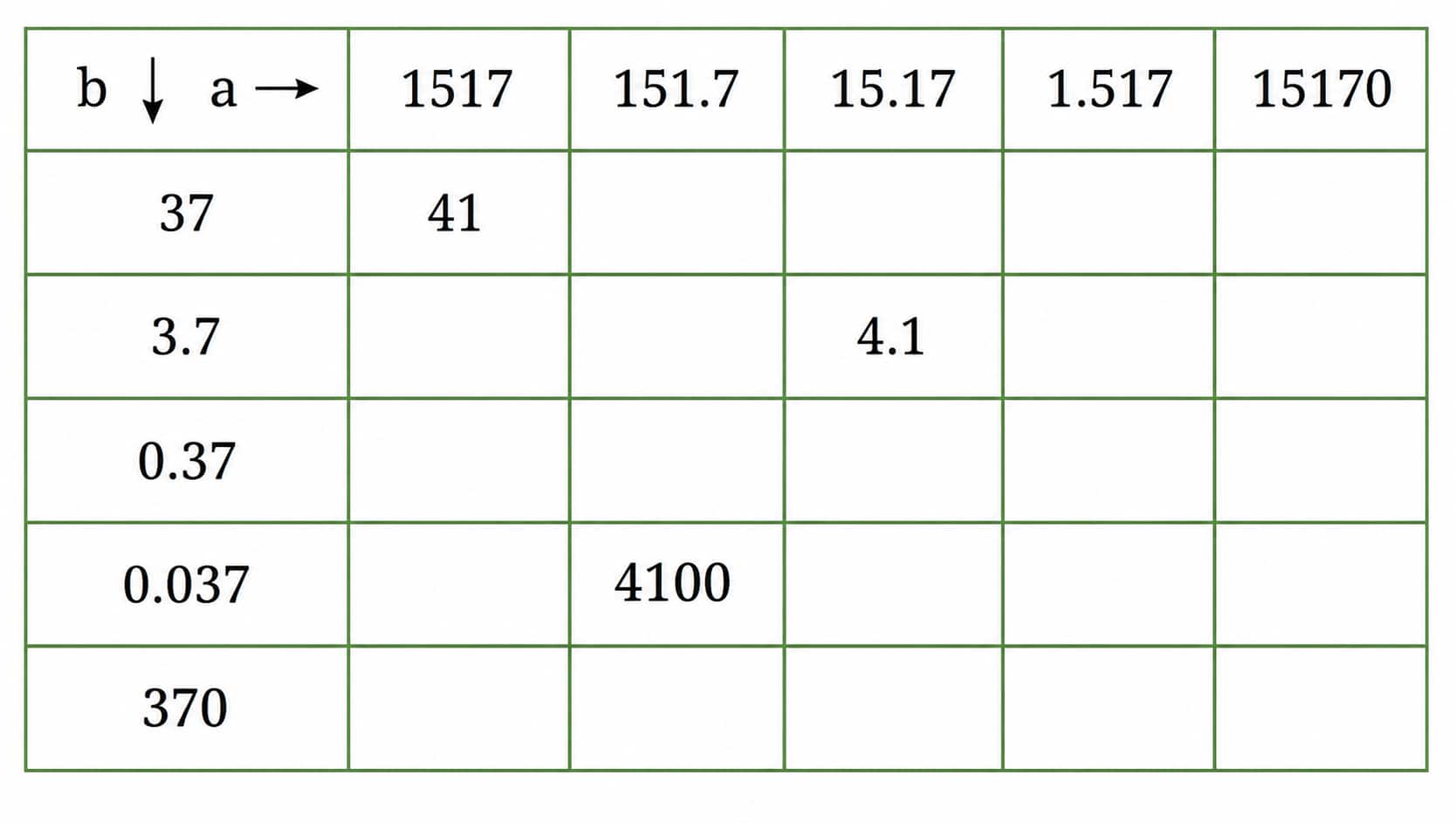
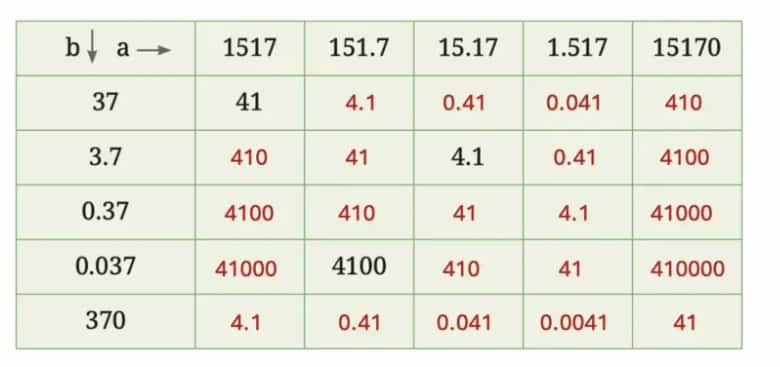
9. Find the missing cells if each cell represents $\mathrm{a} \div \mathrm{b}$ :
Answer:
10. Using the digits $2,4,5,8$, and 0 fill the boxes □
$\square$ $\square$ . $ \square \times$ $\square$ . $\square$ to get the:
(a) maximum product
(b) minimum product
(c) product greater than 150
(d) product nearest to 100
(e) product nearest to 5
Since 0.942368 < 1, $245.05 \times 0.942368<245.05$
Since 7.9682 > 1, $245.05 \times 7.9682>245.05$
Dividing by a number greater than 1 makes the value smaller:
$245.05 \div 7.9682<245.05$
Dividing by a number less than 1 makes the value greater:
$245.05 \div 0.942368>245.05$
Also, $245.05 \div 7.9682 \approx 30.75$
and
$245.05 \times 0.942368 \approx 230.93 .$
Therefore,
$245.05 \div 7.9682<245.05 \times 0.942368$
$<7.9682<245.05<245.05 \div 0.942368<245.05 \times 7.9682$
Confused between CGPA and Percentage?
Get your results instantly with our calculator!
Key Concepts Explained in Another Peek Beyond the Point - Ganita Prakash Book 2
Topics you will learn in NCERT Solutions for Class 7 Maths Part 2 Chapter 4 Another Peek Beyond the Point include:
4.1 A Quick Recap of Decimals
4.2 Decimal Multiplication
4.3 Decimal Division
4.4 Look Before You Leap!
NCERT Solutions for Class 7 Maths Chapter Wise
We at Careers360 compiled all the NCERT Class 7 Maths solutions in one place for easy student reference. The following links will allow you to access them.
NCERT Solutions for Class 7 Maths Part 2 Chapter 1 Geometric Twins |
|---|
NCERT Solutions for Class 7 Maths Part 2 Chapter 2 Operations with Integers |
NCERT Solutions for Class 7 Maths Part 2 Chapter 3 Finding Common Ground |
NCERT Solutions for Class 7 Maths Part 2 Chapter 4 Another Peek Beyond the Point |
NCERT Solutions for Class 7 Maths Part 2 Chapter 5 Connecting the Dots... |
NCERT Solutions for Class 7 Maths Part 2 Chapter 6 Constructions and Tilings |
NCERT Solutions for Class 7 Maths Part 2 Chapter 7 Finding the Unknown |
NCERT Books and NCERT Syllabus
Before planning a study schedule, always analyse the latest syllabus. Here are the links to the latest NCERT syllabus and some important books that will help students in this endeavour.
Chapter Summary: NCERT Solutions for Class 7 Maths Ganita Prakash Part 2 Chapter 4
NCERT Class 7 Part 2 Chapter 4, Another Peek Beyond the Point, revises the fundamentals of decimals before introducing multiplication and division of decimal numbers. Students begin with a quick recap of decimal place values, comparison, and conversion between fractions and decimals. This chapter explains the multiplication of decimals, including multiplication by whole numbers and other decimal numbers. This chapter covers the division of decimals, including division by whole numbers and decimal numbers. Solved examples and exercises improve computational accuracy and strengthen numerical skills. Regular practice develops confidence in handling decimal calculations efficiently. These concepts learned in this chapter build a strong foundation for arithmetic, algebra, and measurement in higher classes.
This chapter consists of four exercises, totalling 35 questions.
Expert Review of NCERT Solutions for Class 7 Maths Part 2 Chapter 4
These NCERT solutions provide clear, step-by-step explanations for every exercise and theorem in the chapter. Here are some more points about this chapter and solutions.
These solutions emphasise estimation techniques, helping students identify calculation errors and improve accuracy.
These solutions follow the latest NCERT syllabus and are highly useful for school examinations and regular revision.
Overall, Chapter 4 is an essential arithmetic chapter that prepares students for more advanced mathematical operations involving decimals and rational numbers.
Important concepts and topics related to the latest NCERT Solutions for Class 7 Maths Ganita Prakash Part 2 Chapter 4 Another Peek Beyond the Point in higher classes are provided below.
Class 8-10
Rational numbers
Operations on decimals and fractions
Algebraic expressions and equations
Percentage and profit & loss
Mensuration and measurement
Statistics and data handling
Coordinate geometry involving decimal values
Practical applications involving money and measurements
Class 11-12
Algebraic calculations
Functions involving decimal values
Coordinate geometry
Calculus and numerical approximations
Statistics and probability
Financial mathematics
Mathematical modelling
Scientific calculations and measurement
JEE (Main & Advanced)
Number system fundamentals
Arithmetic and algebraic calculations
Coordinate geometry
Mensuration and measurement
Approximation and estimation techniques
Quantitative aptitude
Data interpretation and numerical reasoning
Multi-step problem-solving involving decimal computations

Popular Questions
A block of mass 0.50 kg is moving with a speed of 2.00 ms-1 on a smooth surface. It strikes another mass of 1.00 kg and then they move together as a single body. The energy loss during the collision is
| Option 1)
|
Option 2)
|
| Option 3)
|
Option 4)
|
An athlete in the olympic games covers a distance of 100 m in 10 s. His kinetic energy can be estimated to be in the range
| Option 1)
|
Option 2)
|
| Option 3)
|
Option 4)
|
A particle is projected at 600 to the horizontal with a kinetic energy . The kinetic energy at the highest point
| Option 1)
|
Option 2)
|
| Option 3)
|
Option 4)
|
In the reaction,
| Option 1)
|
Option 2)
|
| Option 3)
|
Option 4)
|
How many moles of magnesium phosphate, will contain 0.25 mole of oxygen atoms?
| Option 1)
0.02 |
Option 2)
3.125 × 10⁻² |
| Option 3)
1.25 × 10⁻² |
Option 4)
2.5 × 10⁻² |