


NCERT Solutions for Class 7 Maths Part 2 Chapter 3 - Finding Common Ground
Finding the Highest Common Factor (HCF) and the Least Common Multiple (LCM) is an important part of learning mathematics because these concepts are used to solve many types of problems involving numbers. In NCERT Solutions for Class 7 Maths Part 2 Chapter 3 Finding Common Ground, students learn different methods to find the HCF and LCM of two or more numbers. The chapter also explains how these concepts are connected and where they can be applied while solving mathematical questions. These NCERT Solutions for Class 7 Maths provide detailed, step-by-step answers to every exercise in the chapter. Each solution is explained in simple language so that students can understand the methods easily and apply them to similar questions on their own. Practising these solutions regularly helps improve calculation skills and builds confidence in solving problems related to factors and multiples.
This Story also Contains
- Class 7 Maths Part 2 Chapter 3 Solutions PDF Free Download - Ganita Prakash Book 2
- NCERT Solutions for Class 7 Maths Ganita Prakash Part 2 Chapter 3 Exercise Questions and Answers
- Key Concepts Explained in Finding Common Ground - Ganita Prakash Book 2
- Extra Questions for Class 7 Maths Part 2 Chapter 3 Finding Common Ground
- NCERT Solutions for Class 7 Maths Chapter Wise
- NCERT Books and NCERT Syllabus
- Chapter Summary: NCERT Solutions for Class 7 Maths Ganita Prakash Part 2 Chapter 3
- Expert Review of NCERT Solutions for Class 7 Maths Part 2 Chapter 3
Prepared by the subject experts at Careers360, these NCERT Solutions are based on the latest CBSE syllabus and the updated NCERT textbook. Whether students are completing homework, revising important concepts, or preparing for examinations, these NCERT Solutions for Class 7 serve as a useful study resource to strengthen their understanding of HCF, LCM, and related numerical concepts.
Class 7 Maths Part 2 Chapter 3 Solutions PDF Free Download - Ganita Prakash Book 2
Students can download the NCERT Solutions for Class 7 Maths Part 2 Chapter 3 Finding Common Ground PDF by clicking the link provided below.
NCERT Solutions for Class 7 Maths Ganita Prakash Part 2 Chapter 3 Exercise Questions and Answers
Here are the NCERT Solutions for Class 7 Maths Part 2 Chapter 3 Finding Common Ground question answers with clear and detailed solutions.
Class 7 Maths Part 2 Chapter 3 Question Answers with Detailed Solutions |
Question:
List all the factors of the following numbers:
(a) 90
(b) 105
(c) 132
(d) 360 (this number has 24 factors)
(e) 840 (this number has 32 factors)
Answer:
(a)
$90=2 \times 3^2 \times 5$
Factors are:
1, 2, 3, 5, 6, 9, 10, 15, 18, 30, 45, 90
(b)
$105=3 \times 5 \times 7$
Factors are: 1, 3, 5, 7, 15, 21, 35, 105
(c)
$132=2^2 \times 3 \times 11$
Factors are: 1, 2, 3, 4, 6, 11, 12, 22, 33, 44, 66, 132
(d)
$360=2^3 \times 3^2 \times 5$
Factors are:
1, 2, 3, 4, 5, 6, 8, 9, 10, 12, 15, 18, 20, 24, 30, 36, 40, 45, 60, 72, 90, 120, 180, 360
(e)
$840=2^3 \times 3 \times 5 \times 7$
Factors are:
1, 2, 3, 4, 5, 6, 7, 8, 10, 12, 14, 15, 20, 21, 24, 28, 30, 35, 40, 42, 56, 60, 70, 84, 105, 120, 140, 168, 210, 280, 420, 840
Class 7 Maths Part 2 Chapter 3 Question Answers with Detailed Solutions |
Question:
Find the common factors and the HCF of the following numbers:
(a) 50, 60
(b) 140, 275
(c) 77, 725
(d) 370, 592
(e) 81, 243
How do we directly find the HCF without listing all the factors?
Answer:
(a)
Factors of 50: 1, 2, 5, 10, 25, 50
Factors of 60: 1, 2, 3, 4, 5, 6, 10, 12, 15, 20, 30, 60
Common factors: 1, 2, 5, 10
HCF = 10
(b)
Factors of 140: 1, 2, 4, 5, 7, 10, 14, 20, 28, 35, 70, 140
Factors of 275: 1, 5, 11, 25, 55, 275
Common factors: 1, 5
HCF = 5
(c)
Factors of 77: 1, 7, 11, 77
Factors of 725: 1, 5, 25, 29, 145, 725
Common factors: 1
HCF = 1
(d)
Factors of 370: 1, 2, 5, 10, 37, 74, 185, 370
Factors of 592: 1, 2, 4, 8, 16, 37, 74, 148, 296, 592
Common factors: 1, 2, 37, 74
HCF = 74
(e)
Factors of 81: 1, 3, 9, 27, 81
Factors of 243: 1, 3, 9, 27, 81, 243
Common factors: 1, 3, 9, 27, 81
HCF = 81
Also,
We can find the HCF by prime factorisation.
Necessary steps are:
Write each number as a product of prime factors.
Identify the common prime factors.
Multiply the common prime factors by the smallest powers.
Class 7 Maths Part 2 Chapter 3 Question Answers with Detailed Solutions |
1. Find the HCF of the following numbers:
(a) 24,180
(b) 42, 75, 24
(c) 240, 378
(d) 400, 2500
(e) 300, 800
Answer:
(a)
$\begin{aligned} & 24=2^3 \times 3 \\ & 180=2^2 \times 3^2 \times 5\end{aligned}$
Common factors are $2^2\times3$
$\therefore$ HCF $=2^2\times3=12$
(b)
$\begin{aligned} & 42=2 \times 3 \times 7 \\ & 75=3 \times 5^2 \\ & 24=2^3 \times 3\end{aligned}$
The only common prime factor is 3.
$\therefore$ HCF = 3
(c)
$\begin{aligned} & 240=2^4 \times 3 \times 5 \\ & 378=2 \times 3^3 \times 7\end{aligned}$
Common prime factors = 2 × 3
$\therefore$ HCF = 6
(d)
$\begin{aligned} & 400=2^4 \times 5^2 \\ & 2500=2^2 \times 5^4\end{aligned}$
Common prime factors $=2^2 \times 5^2$
$\therefore$ HCF $=2^2 \times 5^2=100$
(e)
$\begin{aligned} & 300=2^2 \times 3 \times 5^2 \\ & 800=2^5 \times 5^2\end{aligned}$
Common prime factors $=2^2 \times 5^2$
$\therefore$ HCF $=2^2 \times 5^2=100$
2. Consider the numbers 72 and 144. Suppose they are factorised into composite numbers as: $72=6 \times 12$ and $144=8 \times 18$. Seeing this, can one say that these two numbers have no common factor other than 1? Why not?
Answer:
No, we cannot say that they have no common factor other than 1.
The given factorisations use composite numbers, which do not clearly show all the prime factors. To determine the HCF, we must factorise the numbers into prime factors.
$\begin{aligned} & 72=2^3 \times 3^2 \\ & 144=2^4 \times 3^2\end{aligned}$
The common prime factors are $2^3 \times 3^2=8 \times 9=72$
Therefore, HCF = 72, not 1.
Hence, factorising into composite numbers alone does not help us determine the HCF correctly. Prime factorisation is necessary.
Class 7 Maths Part 2 Chapter 3 Question Answers with Detailed Solutions |
Question:
Find the LCM of the following numbers:
(a) 30, 72
(b) 36, 54
(c) 105, 195, 65
(d) 222, 370
Answer:
(a)
$\begin{aligned} & 30=2 \times 3 \times 5 \\ & 72=2^3 \times 3^2\end{aligned}$
$\therefore$ LCM $=2^3 \times 3^2 \times 5=360$
(b)
$\begin{aligned} & 36=2^2 \times 3^2 \\ & 54=2 \times 3^3\end{aligned}$
$\therefore$ LCM $=2^2 \times 3^3=108$
(c)
$\begin{aligned} & 105=3 \times 5 \times 7 \\ & 195=3 \times 5 \times 13 \\ & 65=5 \times 13\end{aligned}$
$\therefore$ LCM $=3 × 5 × 7 × 13=1365$
(d)
$\begin{aligned} & 222=2 \times 3 \times 37 \\ & 370=2 \times 5 \times 37\end{aligned}$
$\therefore$ LCM $=2 × 3 × 5 × 37=1110$
Class 7 Maths Part 2 Chapter 3 Question Answers with Detailed Solutions |
1. Make a general statement about the HCF for the following pairs of numbers. You could consider examples before coming up with general statements. Look for possible explanations of why they hold.
(a) Two consecutive even numbers
(b) Two consecutive odd numbers
(c) Two even numbers
(d) Two consecutive numbers
(e) Two co-prime numbers
Share your observations with the class.
Answer:
(a)
Example:
Two consecutive even numbers = 8, 10
HCF = 2
Here, HCF is always 2.
Two consecutive even numbers always have 2 as their HCF.
(b)
Example:
Two consecutive odd numbers = 9, 11
HCF = 1
Here, HCF is always 1.
Two consecutive odd numbers are always co-prime, so their HCF is 1.
(c)
Example:
Two even numbers = 8, 12
HCF = 4
Here, HCF is always at least 2, but it may be larger.
Two even numbers always have 2 as a common factor, so their HCF is 2 or more.
(d)
Two consecutive numbers = 8, 9
HCF = 1
Here, HCF is always 1.
Two consecutive numbers are always co-prime, so their HCF is 1.
(e)
Example:
Two co-prime numbers = 7, 11
They have no common factor except 1.
The HCF of two co-prime numbers is always 1.
2. The LCM of 3 and 24 is 24 (it is one of the two given numbers).
(a) Find more such number pairs where the LCM is one of the two numbers.
(b) Make a general statement about such numbers. Describe such number pairs using algebra.
Answer:
(a)
Number 1 | Number 2 | LCM |
2 | 10 | 10 |
4 | 20 | 20 |
5 | 30 | 30 |
6 | 42 | 42 |
8 | 40 | 40 |
9 | 45 | 45 |
12 | 60 | 60 |
15 | 75 | 75 |
(b)
If one number is a factor of the other, then the LCM is the larger number.
If $b=k a$, where $k$ is a whole number, then $\operatorname{LCM}(a, b)=b$
3. Make a general statement about the LCM for the following pairs of numbers. You could consider examples before coming up with these general statements. Look for possible explanations of why they hold.
(a) Two multiples of 3
(b) Two consecutive even numbers
(c) Two consecutive numbers
(d) Two co-prime numbers
Answer:
(a)
Example:
Two multiples of 3 = 6, 9
LCM = 18
Here, LCM is always a multiple of 3.
The LCM of two multiples of 3 is always a multiple of 3.
(b)
Example:
Two consecutive even numbers = 6, 8
LCM = 24
Here, LCM is usually half of their product.
Since the HCF of two consecutive even numbers is 2, their LCM = (Product of the numbers) ÷ 2.
(c)
Example:
Two consecutive numbers = 5, 6
LCM = 30
Here, LCM is equal to their product.
Since consecutive numbers are co-prime, their LCM = Product of the two numbers.
(d)
Example:
Two co-prime numbers = 8, 15
LCM = 120
Here, LCM is equal to their product.
The LCM of two co-prime numbers is always equal to the product of the numbers.
Class 7 Maths Part 2 Chapter 3 Question Answers with Detailed Solutions |
1. In the two rows below, colours repeat as shown. When will the blue stars meet next?

Answer: 16th
Explanation:
Blue star positions in top row: $4,10,16,22, \ldots$ (adding +6 each time).
Blue star positions in bottom row: $4,8,12,16,20, \ldots$ (adding +4 each time).
The next common position after 4 is 16.
So, they will meet at the 16th star.
2.
(a) Is $5 \times 7 \times 11 \times 11$ a multiple of $5 \times 7 \times 7 \times 11 \times 2$ ?
(b) Is $5 \times 7 \times 11 \times 11$ a factor of $5 \times 7 \times 7 \times 11 \times 2$ ?
Answer:
2(a): No
Explanation:
The first number is $5 \times 7 \times 11^2$, while the second number contains an extra factor of 2 and an extra factor of 7.
Since these factors are missing in the first number, it is not a multiple of the second number.
2(b): No
Explanation:
The first number contains $11^2$, whereas the second number has only one factor of 11. Therefore, the second number is not divisible by the first.
3. Find the HCF and LCM of the following (state your answers in the form of prime factorisations):
(a) $3 \times 3 \times 5 \times 7 \times 7$ and $12 \times 7 \times 11$
(b) 45 and 36
Answer:
3(a):
$\begin{aligned} & \text { First number }=3^2 \times 5 \times 7^2 \\ & \text { Second number }=12 \times 7 \times 11=2^2 \times 3 \times 7 \times 11\end{aligned}$
Therefore, HCF $=3\times7$
LCM $=2^2 \times 3^2 \times 5 \times 7^2 \times 11$
3(b):
$\begin{aligned} & 45=3^2 \times 5 \\ & 36=2^2 \times 3^2\end{aligned}$
Therefore, HCF $=3^2$
and LCM $=2^2 \times 3^2 \times 5$
4. Find two numbers whose HCF is 1 and LCM is 66.
Answer:
$66=2 \times 3 \times 11$
Three possible pairs are: (6, 11), (2, 33), and (3, 22)
5. A cowherd took all his cows to graze in the fields. The cows came to a crossing with 3 gates. An equal number of cows passed through each gate. Later at another crossing with 5 gates again an equal number of cows passed through each gate. The same happened at the third crossing with 7 gates. If the cowherd had less than 200 cows, how many cows did he have? (Based on the folklore mathematics from Karnataka.)
Answer: 105
Explanation:
The number of cows must be divisible by 3, 5, and 7.
LCM of 3, 5, and 7 = 105
The only multiple of 105 that is less than 200 is 105.
Therefore, the cowherd had 105 cows.
6. The length, width, and height of a box are $12 \mathrm{~cm}, 18 \mathrm{~cm}$, and 36 cm respectively. Which of the following sized cubes can be packed in this box without leaving gaps?
(a) 9 cm
(b) 6 cm
(c) 4 cm
(d) 3 cm
(e) 2 cm
Answer:
A cube can exactly fill the box if its side length divides 12 cm, 18 cm, and 36 cm.
Cube side | Divides 12? | Divides 18? | Divides 36? | Can it be packed? |
9 cm | No | Yes | Yes | No |
6 cm | Yes | Yes | Yes | ✓ |
4 cm | Yes | No | Yes | No |
3 cm | Yes | Yes | Yes | ✓ |
2 cm | Yes | Yes | Yes | ✓ |
7. Among the numbers below, which is the largest number that perfectly divides both 306 and 36?
(a) 36
(b) 612
(c) 18
(d) 3
(e) 2
(f) 360
Answer: Option (c)
Explanation:
$\begin{aligned} & 306=2 \times 3^2 \times 17 \\ & 36=2^2 \times 3^2\end{aligned}$
HCF = $2\times3^2=18$
Therefore, the largest number that divides both 306 and 36 is 18.
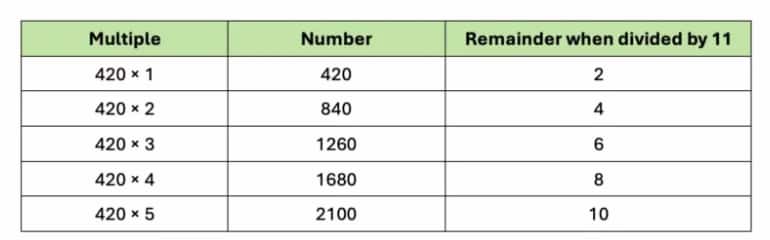
8. Find the smallest number that is divisible by $3,4,5$ and 7, but leaves a remainder of 10 when divided by 11.
Answer:
The required number must be divisible by 3, 4, 5, and 7.
So, LCM of 3, 4, 5, 7 = 420
Hence, the required number must be a multiple of 420.
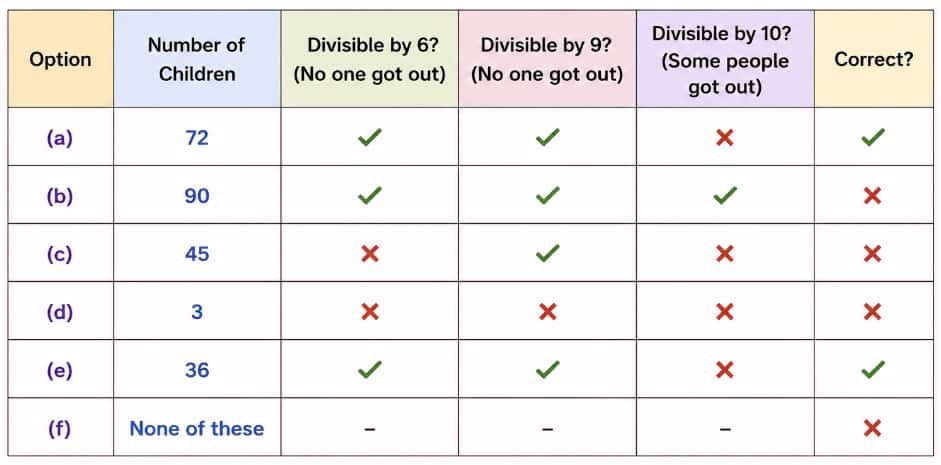
9. Children are playing 'Fire in the Mountain'. When the number 6 was called out, no one got out. When the number 9 was called out, no one got out. But when the number 10 was called out, some people got out. How many children could have been playing initially?
(a) 72
(b) 90
(c) 45
(d) 3
(e) 36
(f) None of these
Answer: Option (a) and (e)
Explanation:
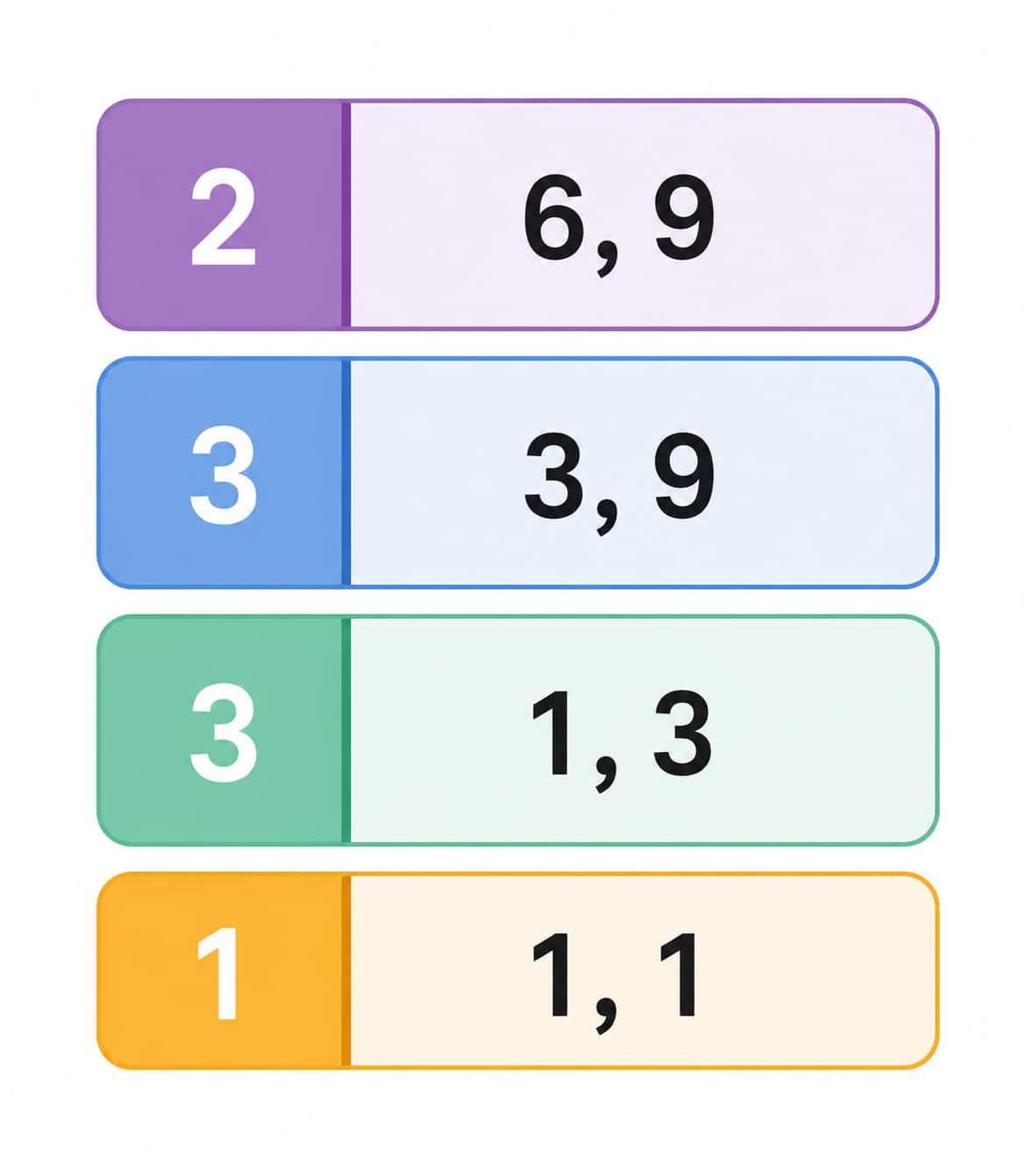
The number of children:
is divisible by 6 (no one gets out when 6 is called),
is divisible by 9,
is not divisible by 10.
LCM of 6 and 9 is 18.
10. Tick the correct statement(s). The LCM of two different prime numbers ( $m, n$ ) can be:
(a) Less than both numbers
(b) In between the two numbers
(c) Greater than both numbers
(d) Less than $m \times n$
(e) Greater than $m \times n$
Answer: Option (c)
Explanation:
For two different prime numbers $m$ and $n$,
$\operatorname{LCM}(m, n)=m \times n$
Hence, the correct answer is option (c).
11. A dog is chasing a rabbit that has a head start of 150 feet. It jumps 9 feet every time the rabbit jumps 7 feet. In how many leaps does the dog catch up with the rabbit?
Answer: 75
Explanation:
The rabbit has a head start of 150 feet.
In each leap, the dog gains 2 feet.
$\therefore$ Number of leaps required $=\frac{150}2=75$
12. What is the smallest number that is a multiple of $1,2,3,4,5,6,8,9, 10$? Do you remember the answer from Grade 6, Chapter 5?
Answer: 360
Explanation:
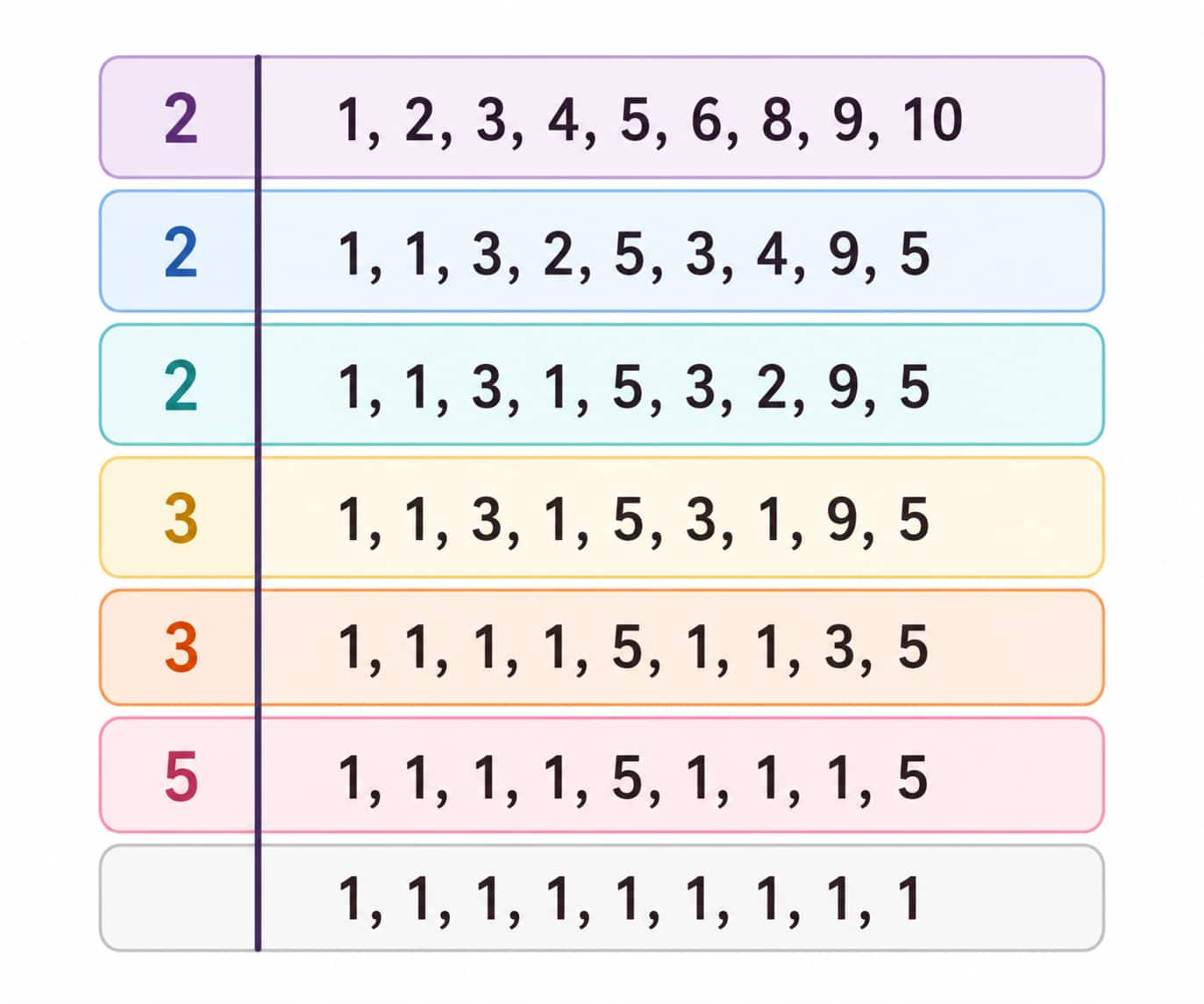
LCM $=2^3 \times 3^2 \times 5=8 \times 9 \times 5=360$
13. Here is a problem posed by the ancient Indian Mathematician Mahaviracharya ( 850 C.E.). Add together $\frac{8}{15}, \frac{1}{20}, \frac{7}{36}, \frac{11}{63}$ and $\frac{1}{21}$. What do you get? How can we find this sum efficiently?
Answer:
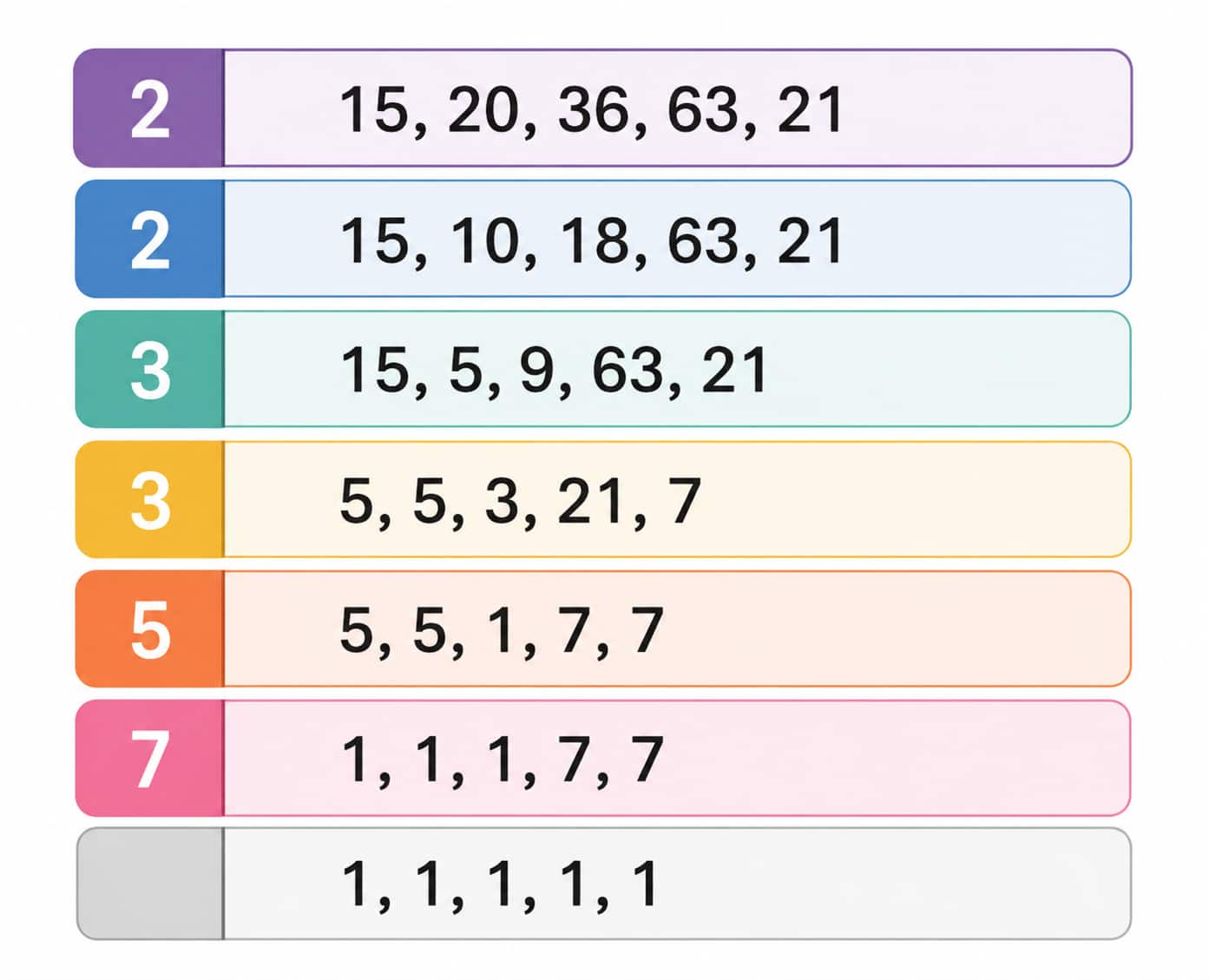
$\begin{aligned} & 15=3 \times 5 \\ & 20=2^2 \times 5 \\ & 36=2^2 \times 3^2 \\ & 63=3^2 \times 7 \\ & 21=3 \times 7\end{aligned}$
LCM $=2^2 \times 3^2 \times 5 \times 7=1260$
Now,
$\begin{aligned} & \frac{8}{15}=\frac{672}{1260} \\ & \frac{1}{20}=\frac{63}{1260} \\ & \frac{7}{36}=\frac{245}{1260} \\ & \frac{11}{63}=\frac{220}{1260} \\ & \frac{1}{21}=\frac{60}{1260}\end{aligned}$
Sum of the numerators $=672+63+245+220+60=1260$
Denominator = 1260
Hence, $\frac{1260}{1260}=1$
Efficient method: Find the LCM of the denominators, convert each fraction to an equivalent fraction with that denominator, and then add the numerators.
Confused between CGPA and Percentage?
Get your results instantly with our calculator!
Key Concepts Explained in Finding Common Ground - Ganita Prakash Book 2
Topics you will learn in NCERT Solutions for Class 7 Maths Part 2 Chapter 3 Finding Common Ground include:
3.1 The Greatest of All
3.2 Least, but not Last!
3.3 Patterns, Properties, and a Pretty Procedure!
Extra Questions for Class 7 Maths Part 2 Chapter 3 Finding Common Ground
Question 1:
The highest common factor and the least common multiple of the two numbers are 12 and 120, respectively. If one of the numbers is 60, then what will be the other number?
Answer:
HCF = 12
LCM = 120
One number = 60
Let $x$ be the second number.
We know that HCF × LCM = product of two numbers
⇒ 12 × 120 = 60 × $x$
⇒ $x$ = $\frac{12 × 120}{60}$ = 24
Hence, the correct answer is 24.
Question 2:
Two numbers are in the ratio of 3 : 5. If their HCF is 8, then find the numbers.
Answer:
The two numbers are in the ratio 3 : 5 and their highest common factor (HCF) is 8.
The numbers are obtained by multiplying the HCF with the ratio values. So, the numbers are:
First number = 3 × HCF = 3 × 8 = 24
Second number = 5 × HCF = 5 × 8 = 40
Hence, the correct answer is 24 and 40.
Question 3:
Six bells commence tolling together at 7:59 am. They toll at intervals of 3, 6, 9,12, and 15 seconds respectively. How many times will they toll together till 8:16 am? (excluding the toll at 7:59 am)
Answer:
Six bells tolling at 7:59 am
Time duration = 8:16 am - 7:59 am = 17 minutes
All five bells toll together after the interval = Least Common Multiple of 3, 6, 9, 12, and 15
= 180 sec
= 3 minutes
Now,
⇒ Number of tolls = $\frac{\text{Total Time Duration}}{\text{Time interval of tolling together}}$ = $\frac{17}{3}$ = 5.66 (5 times)
Hence, the correct answer is 5.
Question 4:
What is the smallest perfect square number that is divisible by both 10 and 15?
Answer:
Given: The number is divisible by both 10 and 15.
Finding the lowest multiple of two or more numbers is done using the LCM method.
LCM of 10 and 15 = 30
The prime factors of 30 = 2 × 3 × 5
Make it a perfect square number,
30 × 2 × 3 × 5 = 900
Hence, the correct answer is 900.
Question 5:
What is the LCM of two numbers, whose product is 432 and HCF is 6?
Answer:
The product of two numbers is equal to the product of their Least Common Multiple (LCM) and Highest Common Factor (HCF).
So, if the product of two numbers is 432 and their HCF is 6, we can find the LCM by dividing the product of the numbers by their HCF.
$\therefore$ LCM $= \frac{432}{6} = 72$
Hence, the correct answer is 72.
NCERT Solutions for Class 7 Maths Chapter Wise
We at Careers360 compiled all the NCERT Class 7 Maths solutions in one place for easy student reference. The following links will allow you to access them.
NCERT Solutions for Class 7 Maths Part 2 Chapter 1 Geometric Twins |
|---|
NCERT Solutions for Class 7 Maths Part 2 Chapter 2 Operations with Integers |
NCERT Solutions for Class 7 Maths Part 2 Chapter 3 Finding Common Ground |
NCERT Solutions for Class 7 Maths Part 2 Chapter 4 Another Peek Beyond the Point |
NCERT Solutions for Class 7 Maths Part 2 Chapter 5 Connecting the Dots... |
NCERT Solutions for Class 7 Maths Part 2 Chapter 6 Constructions and Tilings |
NCERT Solutions for Class 7 Maths Part 2 Chapter 7 Finding the Unknown |
NCERT Books and NCERT Syllabus
Before planning a study schedule, always analyse the latest syllabus. Here are the links to the latest NCERT syllabus and some important books that will help students in this endeavour.
Chapter Summary: NCERT Solutions for Class 7 Maths Ganita Prakash Part 2 Chapter 3
NCERT Class 7 Part 2 Chapter 3, Finding Common Ground, introduces us to the concepts of Highest Common Factor (HCF) and Least Common Multiple (LCM). Students learn how to find the HCF and LCM of two or more numbers using different methods, including prime factorisation and division. The chapter explains the relationship between HCF and LCM and how these concepts are applied in solving mathematical problems. This chapter includes word problems involving grouping, arranging, scheduling, and repeated events to demonstrate practical applications. The concepts covered in this chapter form a strong foundation for number theory and algebra. Mastering this chapter enables students to solve arithmetic problems confidently and apply HCF and LCM in everyday situations.
There are 6 exercises along with 18 questions in this chapter.
Expert Review of NCERT Solutions for Class 7 Maths Part 2 Chapter 3
These NCERT solutions provide clear, step-by-step explanations for every exercise and theorem in the chapter. Here are some more points about this chapter and solutions.
These solutions focus on conceptual clarity, helping students understand the reasoning behind each method.
These solutions follow the latest NCERT syllabus and are highly useful for school examinations and regular revision.
The chapter builds a strong arithmetic foundation that supports higher-level topics in algebra and number systems.
Overall, Chapter 3 is one of the most important arithmetic chapters in Class 7 Maths, laying the groundwork for advanced concepts involving factors, multiples, and divisibility.
Important concepts and topics related to the latest NCERT Solutions for Class 7 Maths Ganita Prakash Part 2 Chapter 3 Finding Common Ground in higher classes are provided below.
Class 8-10
Rational numbers and simplification
Algebraic expressions and factorisation
Linear equations
Number systems
Exponents and powers
Polynomials and algebraic factorisation
Applications of HCF and LCM in word problems
Arithmetic reasoning and divisibility concepts
Class 11-12
Number theory fundamentals
Polynomial factorization
Modular arithmetic (basic foundation)
Algebraic simplification
Mathematical reasoning
Sequences and divisibility patterns
Functions involving integers
Advanced problem-solving techniques
JEE (Main & Advanced)
Number system and divisibility
Prime factorisation techniques
HCF and LCM applications
Number theory concepts
Algebraic manipulation
Modular arithmetic
Logical and quantitative reasoning
Multi-concept arithmetic and algebra problems

Popular Questions
A block of mass 0.50 kg is moving with a speed of 2.00 ms-1 on a smooth surface. It strikes another mass of 1.00 kg and then they move together as a single body. The energy loss during the collision is
| Option 1)
|
Option 2)
|
| Option 3)
|
Option 4)
|
An athlete in the olympic games covers a distance of 100 m in 10 s. His kinetic energy can be estimated to be in the range
| Option 1)
|
Option 2)
|
| Option 3)
|
Option 4)
|
A particle is projected at 600 to the horizontal with a kinetic energy . The kinetic energy at the highest point
| Option 1)
|
Option 2)
|
| Option 3)
|
Option 4)
|
In the reaction,
| Option 1)
|
Option 2)
|
| Option 3)
|
Option 4)
|
How many moles of magnesium phosphate, will contain 0.25 mole of oxygen atoms?
| Option 1)
0.02 |
Option 2)
3.125 × 10⁻² |
| Option 3)
1.25 × 10⁻² |
Option 4)
2.5 × 10⁻² |