


NCERT Solutions for Class 7 Maths Part 2 Chapter 2 - Operations with Integers
Integers are used in many everyday situations, such as measuring temperature, keeping scores, and calculating profits and losses. Before learning more advanced concepts, it is important to have a clear understanding of how integers work. In NCERT Solutions for Class 7 Maths Part 2 Chapter 2 Operations with Integers, students begin with a quick recap of integers and then learn the rules for multiplying positive and negative numbers. The NCERT Solutions for Class 7 Maths provide clear, step-by-step answers to all the questions in the chapter. Each solution is written in simple language so that students can easily follow the methods and understand the concepts behind every answer. Regular practice with these solutions can help students avoid common mistakes and become more confident while solving integer problems.
Prepared by the subject experts at Careers360, these NCERT Solutions are based on the latest CBSE syllabus and the updated NCERT textbook. Whether students are revising for exams, completing homework, or strengthening their basics, these NCERT Solutions for Class 7 offer reliable guidance and support throughout the chapter.
Class 7 Maths Part 2 Chapter 2 Solutions PDF Free Download - Ganita Prakash Book 2
Students can download the NCERT Solutions for Class 7 Maths Part 2 Chapter 2 Operations with Integers PDF by clicking the link provided below.
NCERT Solutions for Class 7 Maths Ganita Prakash Part 2 Chapter 2 Exercise Questions and Answers
Here are the NCERT Solutions for Class 7 Maths Part 2 Chapter 2 Operations with Integers question answers with clear and detailed solutions.
Class 7 Maths Part 2 Chapter 2 Question Answers with Detailed Solutions |
Question: Let us try to find a few more pairs of numbers from their sums and differences:
(a) Sum = 27, Difference = 9
(b) Sum = 4, Difference = 12
(c) Sum = 0, Difference = 10
(d) Sum = 0, Difference = -10
(e) Sum = -7, Difference = -1
(f) Sum =-7, Difference = -13
Choose a partner and take turns to play this game. In each turn, one of you can think of two integers, and give their sum and difference; the other person must then figure out the integers. After some practice, you can perform this magic trick for your family members and surprise them!
Answer:
Let the two integers be $x$ and $y$.
We know that,
$x+y=\text { Sum }, $ and $x-y=\text { Difference }$
So,
$x=\frac{\text { Sum }+ \text { Difference }}{2}, y=\frac{\text { Sum }- \text { Difference }}{2}$
(a) Sum = 27, Difference = 9
$x=\frac{27+9}{2}=18, \quad y=\frac{27-9}{2}=9$
(b) Sum = 4, Difference = 12
$x=\frac{4+12}{2}=8, \quad y=\frac{4-12}{2}=-4$
(c) Sum = 0, Difference = 10
$x=\frac{0+10}{2}=5, \quad y=\frac{0-10}{2}=-5$
(d) Sum = 0, Difference = -10
$x=\frac{0-10}{2}=-5, \quad y=\frac{0-(-10)}{2}=5$
(e) Sum = -7, Difference = -1
$x=\frac{-7+(-1)}{2}=-4, \quad y=\frac{-7-(-1)}{2}=-3$
(f) Sum =-7, Difference = -13
$x=\frac{-7+(-13)}{2}=-10, \quad y=\frac{-7-(-13)}{2}=3$
Class 7 Maths Part 2 Chapter 2 Question Answers with Detailed Solutions |
1. Using the token interpretation, find the values of:
(a) $3 \times(-2)$
(b) $(-5) \times(-2)$
(c) $(-4) \times(-1)$
(d) $(-7) \times 3$
Answer:
1(a): -6
Explanation:
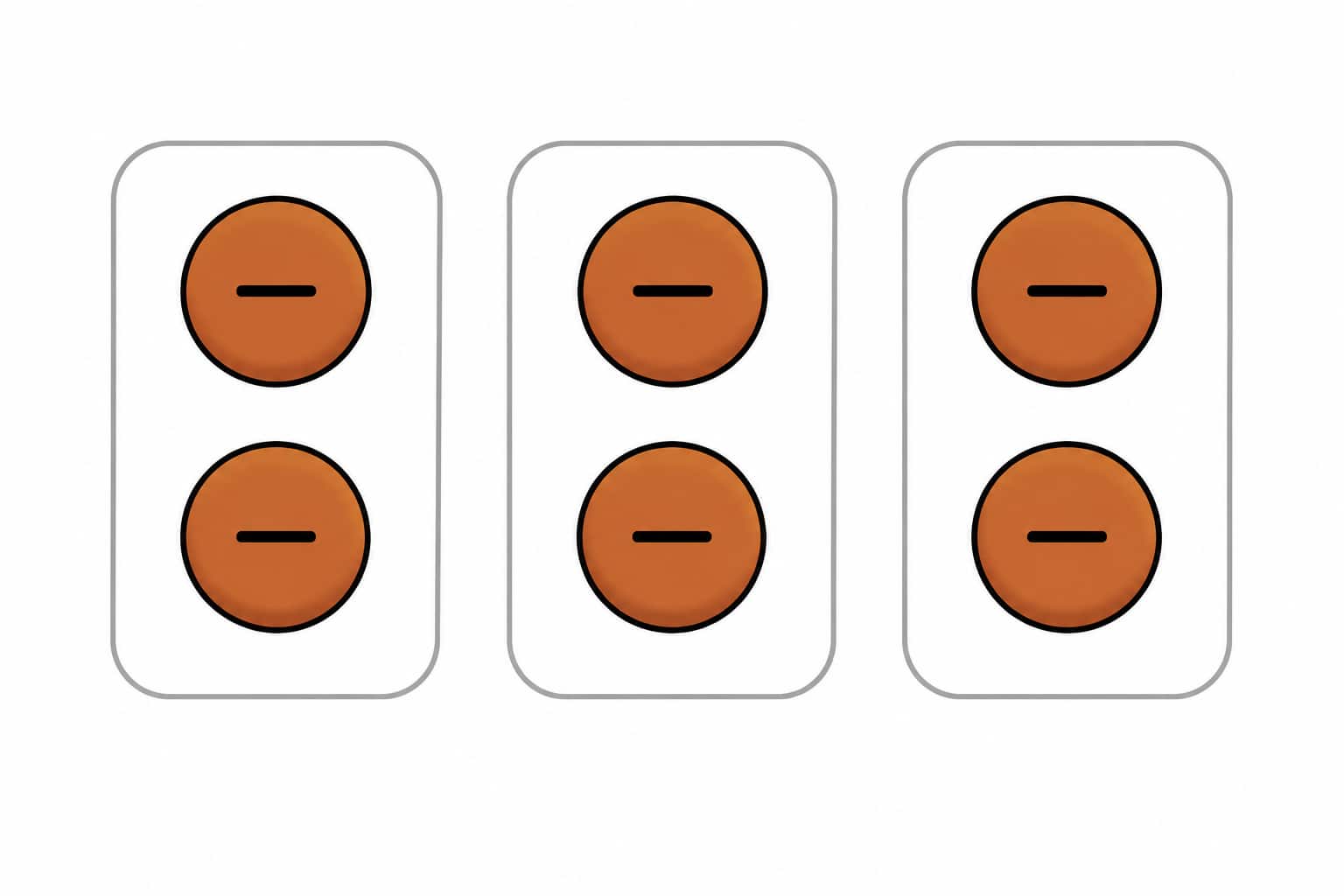
Add 3 groups of 2 negative tokens.
$3 \times(-2)=-6$
1(b): 10
Explanation:
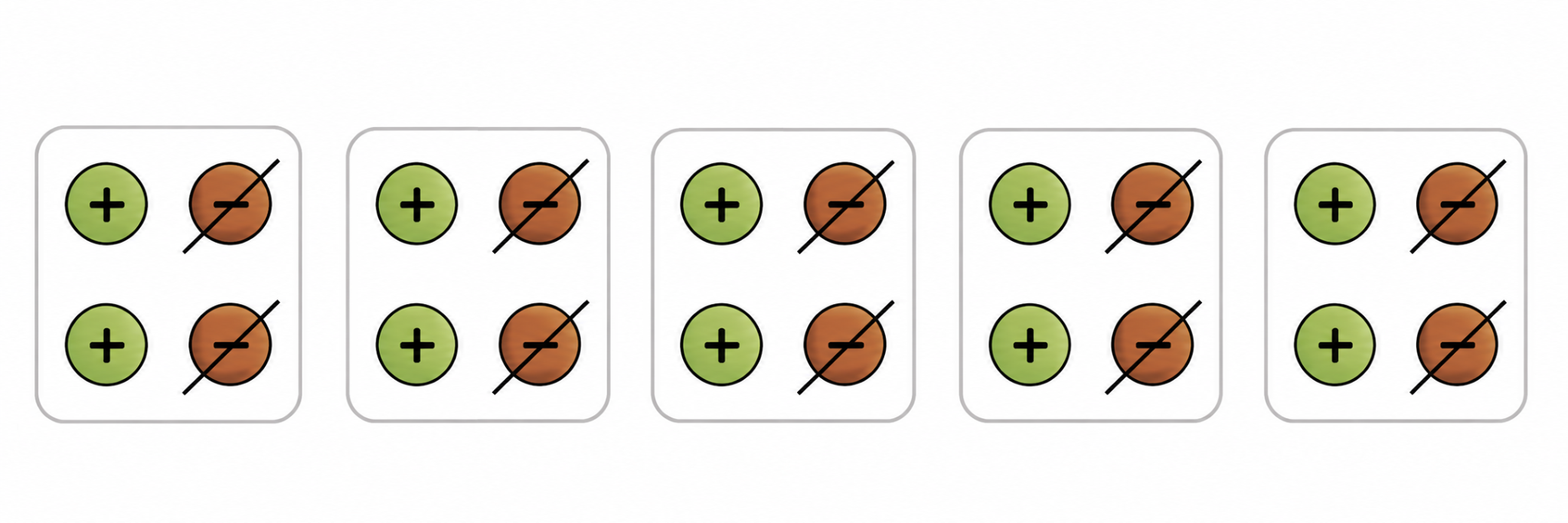
Remove 5 groups of 2 negative tokens.
$(-5) \times(-2)=10$
1(c): 4
Explanation:
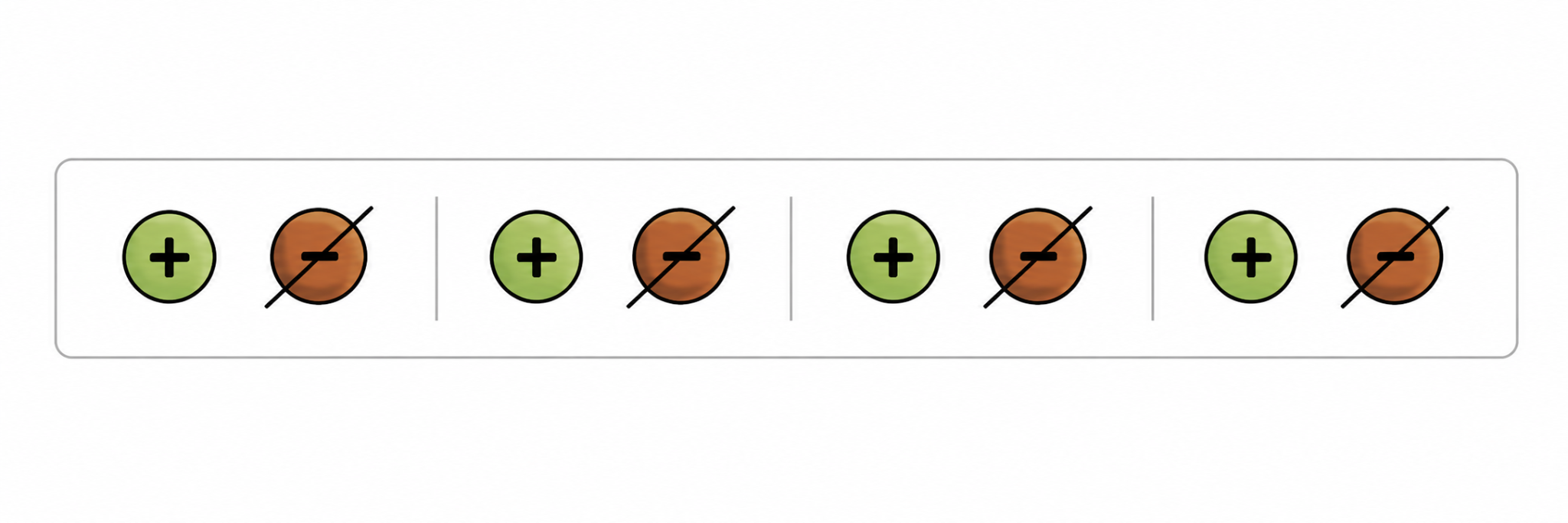
Remove 4 groups of 1 negative token.
$(-4) \times(-1)=4$
1(d): -21
Explanation:
Remove 7 groups of 3 positive tokens.
$(-7) \times 3=-21$
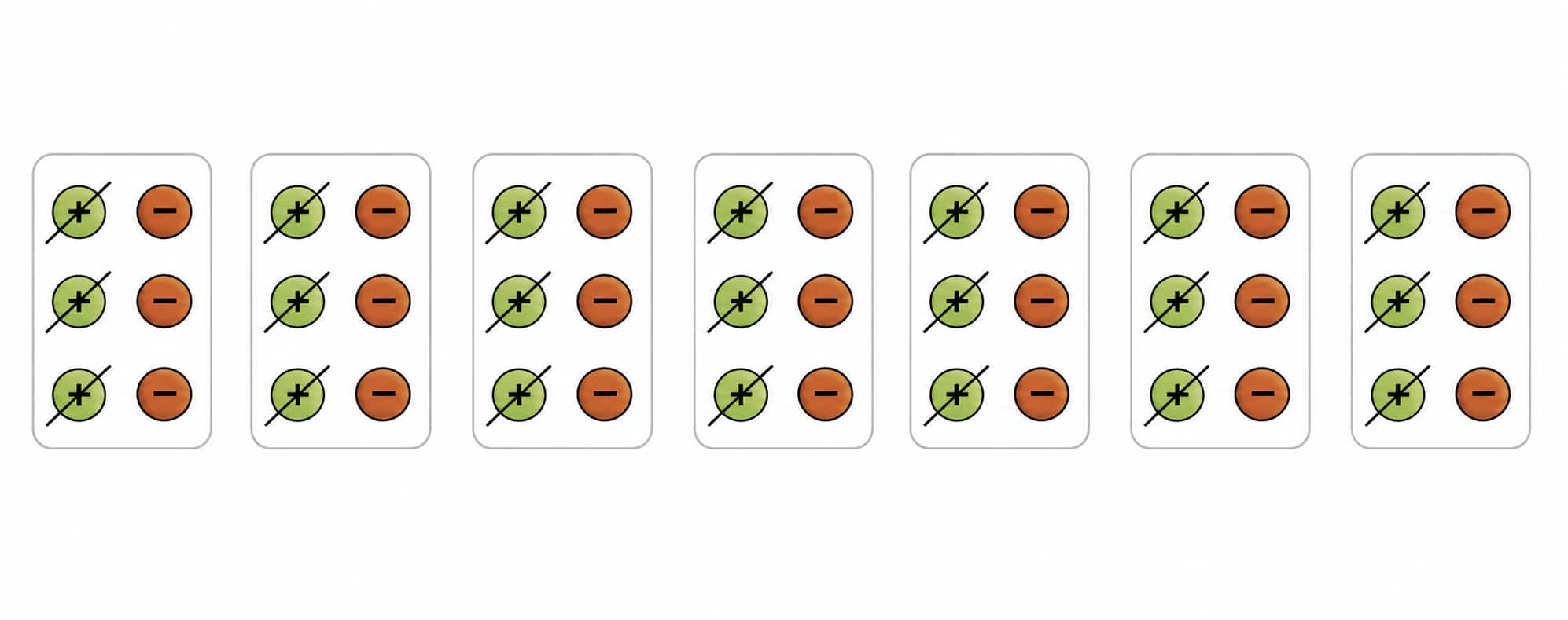
2. If $123 \times 456=56088$, without calculating, find the value of:
(a) $(-123) \times 456$
(b) $(-123) \times(-456)$
(c) $(123) \times(-456)$
Answer:
We know that,
Positive × Positive = Positive
Negative × Positive = Negative
Negative × Negative = Positive
Positive × Negative = Negative
2(a): -56088
Explanation:
A negative number multiplied by a positive number results in a negative product.
$(-123) \times 456=-56088$
2(b): 56088
Explanation:
A negative number multiplied by another negative number results in a positive product.
$(-123) \times(-456)=56088$
2(c): -56088
Explanation:
A positive number multiplied by a negative number results in a negative product.
$(123) \times(-456)=-56088$
3. Try to frame a simple rule to multiply two integers.
Consider the numbers represented by the following tokens:
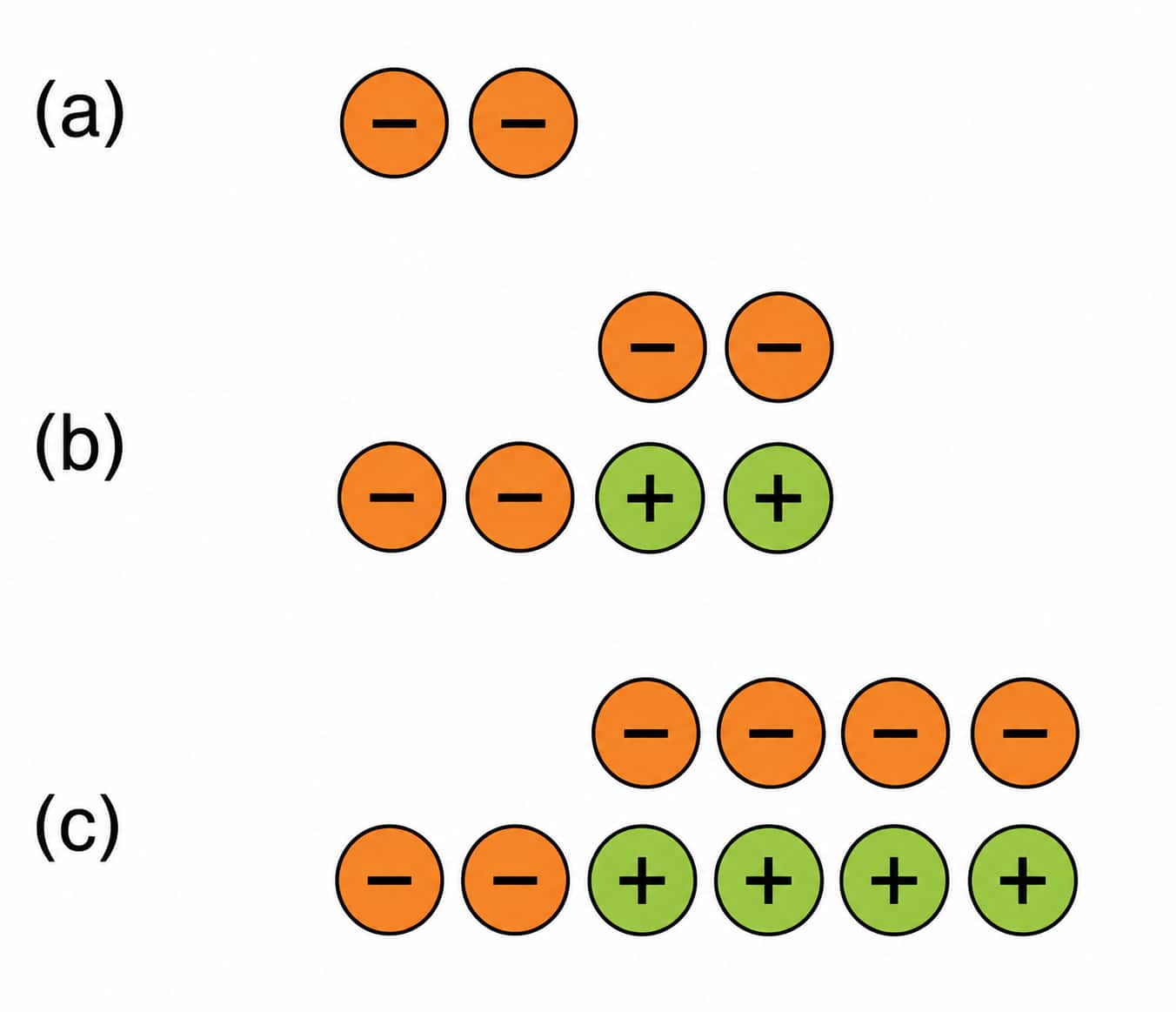
Answer:
Multiply the numbers without considering their signs.
Decide the sign of the product using these rules:
If both integers have the same sign (both positive or both negative), the product is positive.
If the integers have different signs (one positive and one negative), the product is negative.
Always remember, if the signs match, then it's a plus; if they don’t, it's a minus.
Class 7 Maths Part 2 Chapter 2 Question Answers with Detailed Solutions |
Question: Find the following products.
(a) $4 \times(-3)$
(b) $(-6) \times(-3)$
(c) $(-5) \times(-1)$
(d) $(-8) \times 4$
(e) $(-9) \times 10$
(f) $10 \times(-17)$
Answer:
(a) -12
Explanation:
$4 \times(-3)=-12$
(b) 18
Explanation:
$(-6) \times(-3)=18$
(c) 5
Explanation:
$(-5) \times(-1)=5$
(d) -32
Explanation:
$(-8) \times 4=-32$
(e) -90
Explanation:
$(-9) \times 10=-90$
(f) -170
Explanation:
$10 \times(-17)=-170$
Class 7 Maths Part 2 Chapter 2 Question Answers with Detailed Solutions |
1. Find the values of:
(a) $14 \times(-15)$
(b) $-16 \times(-5)$
(c) $36 \div(-18)$
(d) $(-46) \div(-23)$
Answer:
1(a): -210
Explanation:
$14 \times(-15)=-210$
1(b): 80
Explanation:
$-16 \times(-5)=80$
1(c): -2
Explanation:
$36 \div(-18)=-2$
1(d): 2
Explanation:
$(-46) \div(-23)=2$
2. A freezing process requires that the room temperature be lowered from $32^{\circ} \mathrm{C}$ at the rate of $5^{\circ} \mathrm{C}$ every hour. What will be the room temperature 10 hours after the process begins?
Answer: $-18^{\circ} \mathrm{C}$
Explanation:
Decrease per hour = $5^{\circ} \mathrm{C}$
So, in 10 hours, the total decrease in temperature = 5 × 10 = 50 C
$\therefore$ Final temparature $=32+(-50)=-18^{\circ} \mathrm{C}$
3. A cement company earns a profit of ₹8 per bag of white cement sold and a loss of ₹5 per bag of grey cement sold. [Represent the profit/ loss as integers.]
(a) The company sells 3,000 bags of white cement and 5,000 bags of grey cement in a month. What is its profit or loss?
(b) If the number of bags of grey cement sold is 6,400 bags, what is the number of bags of white cement the company must sell to have neither profit nor loss.
Answer:
3(a): Loss, ₹ 1,000
Explanation:
Profit from white cement $=3000 \times 8=$ ₹ 24,000
Loss from grey cement $=5000 \times(-5)=$ -₹ 25,000
$\therefore$ Net profit/loss $=24,000+(-25,000)=$ -₹ 1,000
3(b): 4000 bags
Explanation:
Loss from 6,400 grey cement bags $=6400 \times(-5)=$ -₹ 32,000
To have neither profit nor loss, profit from white cement must be ₹32,000.
Let the number of white cement bags be $x$.
According to the question,
$8 x=32000$
$\therefore x=\frac{32000}{8}=4000$
4. Replace the blank with an integer to make a true statement.
(a) $(-3) \times$ $\_\_\_\_$ = 27
(b) $5 \times$ $\_\_\_\_$ $=(-35)$
(c) $\_\_\_\_$ $\times(-8)=(-56)$
(d) $\_\_\_\_$ × (-12) = 132
(e) $\_\_\_\_$ $\div(-8)=7$
(f) $\_\_\_\_$ $\div 12=-11$
Answer:
(a) -9
Explanation:
$(-3) \times$ $\_\_\_\_$ = 27
Let the blank space be $x$.
So, $-3x=27$
$\therefore x =-9$
(b) -7
Explanation:
$5 \times$ $\_\_\_\_$ $=(-35)$
Let the blank space be $x$.
So, $5x=-35$
$\therefore x=-7$
(c) 7
Explanation:
$\_\_\_\_$ $\times(-8)=(-56)$
Let the blank space be $x$.
So, $-8x=-56$
$\therefore x=7$
(d) -11
Explanation:
$\_\_\_\_$ × (-12) = 132
Let the blank space be $x$.
So, $-12x=132$
$\therefore x=-11$
(e) -56
Explanation:
$\_\_\_\_$ $\div(-8)=7$
Let the blank space be $x$.
So, $-\frac x8=7$
$\therefore x=-56$
(f) -132
Explanation:
$\_\_\_\_$ $\div 12=-11$
Let the blank space be $x$.
So, $\frac x{12}=-11$
$\therefore x=-132$
Class 7 Maths Part 2 Chapter 2 Question Answers with Detailed Solutions |
1. Find the values of the following expressions:
(a) $(-5) \times(18+(-3))$
(b) $(-7) \times 4 \times(-1)$
(c) $(-2) \times(-1) \times(-5) \times(-3)$
Answer:
1 (a): -75
Explanation:
$(-5) \times(18+(-3))$
$=(-5)\times(18-3)$
$=-5\times15$
$=-75$
1 (b): 28
Explanation:
$(-7) \times 4 \times(-1)$
$=-7\times4\times-1$
$=28$
1 (c): 30
Explanation:
$(-2) \times(-1) \times(-5) \times(-3)$
$=2\times15$
$=30$
2. Find the values of the following expressions:
(a) $(-27) \div 9$
(b) $84 \div(-4)$
(c) $(-56) \div(-2)$
Answer:
2(a):
$(-27) \div 9=-3$
2(b):
$84 \div(-4)=-21$
2(c):
$(-56) \div(-2)=28$
3. Find the integer whose product with $(-1)$ is:
(a) 27
(b) -31
(c) -1
(d) 1
(e) 0
Answer:
3(a):
Let the integer be $x$.
According to the question,
$x\times (-1)=27$
$\therefore x=-27$
3(b):
Let the integer be $x$.
According to the question,
$x\times (-1)=-31$
$\therefore x=31$
3(c):
Let the integer be $x$.
According to the question,
$x\times (-1)=-1$
$\therefore x=1$
3(d):
Let the integer be $x$.
According to the question,
$x\times (-1)=1$
$\therefore x=-1$
3(e):
Let the integer be $x$.
According to the question,
$x\times (-1)=0$
$\therefore x=0$
4. If $47-56+14-8+2-8+5=-4$, then find the value of $-47+56-14 +8-2+8-5$ without calculating the full expression.
Answer: 4
Explanation:
The required expression is the negative of the given expression, $47-56+14-8+2-8+5=-4$
So, the answer is $-(-4)=4$
5. Do you remember the Collatz Conjecture from last year? Try a modified version with integers. The rule is - start with any number; if the number is even, take half of it; if the number is odd, multiply it by -3 and add 1; repeat. An example sequence is shown below.
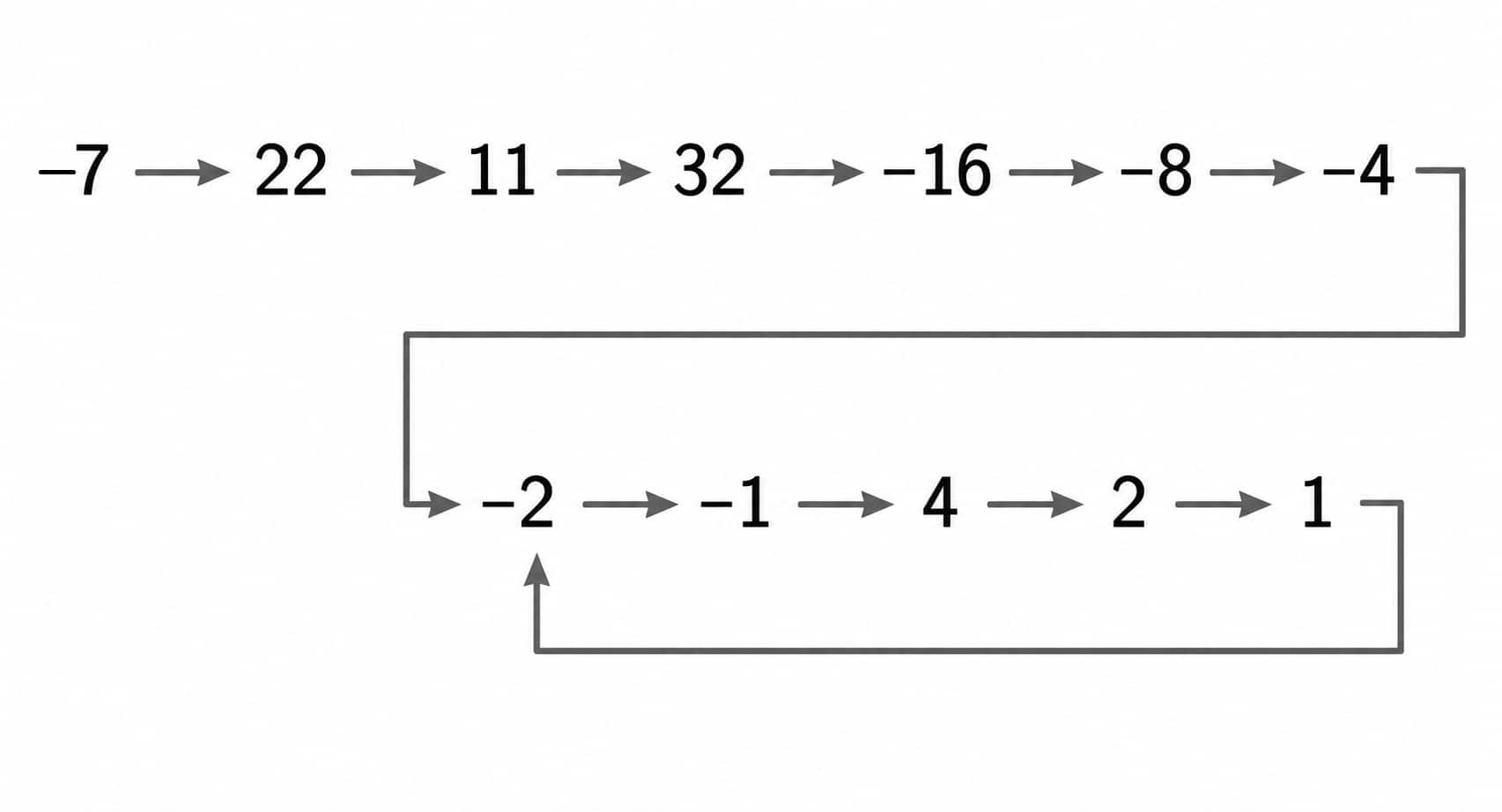
Try this with different starting numbers: (-21), (-6), and so on. Describe the patterns you observe.
Answer:
Starting with $n=-21$ (Odd)
$-21$ is odd $\rightarrow-3(-21)+1=63+1=64$
64 is even → $\frac{64}{2}=32$
32 is even $\rightarrow \frac{32}{2}=16$
6 is even $\rightarrow \frac{16}{2}=8$
8 is even $\rightarrow \frac{8}{2}=4$
4 is even → $\frac{4}{2}=2$
2 is even $\rightarrow \frac{2}{2}=1$
1 is odd $\rightarrow-3(1)+1=-2$
$-2$ is even $\rightarrow \frac{-2}{2}=-1$
$-1$ is odd $\rightarrow-3(-1)+1=3+1=4$
Sequence for -21 :
$-21 \rightarrow 64 \rightarrow 32 \rightarrow 16 \rightarrow 8 \rightarrow 4 \rightarrow 2 \rightarrow 1 \rightarrow-2 \rightarrow-1 \rightarrow 4 \rightarrow \ldots
$
Starting with $n=-6$ (Even)
$-6$ is even → $\frac{-6}{2}=-3$
-3 is odd $\rightarrow-3(-3)+1=9+1=10$
10 is even $\rightarrow \frac{10}{2}=5$
5 is odd $\rightarrow-3(5)+1=-15+1=-14$
-14 is even $\rightarrow \frac{-14}{2}=-7$
$\quad-7$ is odd $\rightarrow-3(-7)+1=21+1=22$
Notice that 22 is the second number in the example sequence from your image $(7 \rightarrow 22 \rightarrow$ 11 . . .).
$22 \rightarrow 11 \rightarrow 32 \rightarrow 16 \rightarrow 8 \rightarrow 4 \rightarrow 2 \rightarrow 1 \rightarrow-2 \rightarrow-1 \rightarrow 4 \rightarrow \ldots
$
Sequence for -6:
$-6 \rightarrow-3 \rightarrow 10 \rightarrow 5 \rightarrow-14 \rightarrow-7 \rightarrow 22 \rightarrow 11 \rightarrow 32 \rightarrow 16 \rightarrow 8 \rightarrow 4
$
Observations:
No matter where these sequences start, they all eventually get pulled into the exact same repeating cycle of 4 numbers: ${-2 \rightarrow -1 \rightarrow 4 \rightarrow 2 \rightarrow (-2)}$
Whenever a sequence hits a positive power of 2 (like $64$, $32$, or $16$), it undergoes a rapid, uninterrupted descent through division by 2 until it hits $1$, which immediately throws it back into the negative territory ($1 \rightarrow -2$) to join the repeating loop.
6. In a test, (+4) marks are given for every correct answer and (-2) marks are given for every incorrect answer.
(a) Anita answered all the questions in the test. She scored 40 marks even though 15 of her answers were correct. How many of her answers were incorrect? How many questions are in the test?
(b) Anil scored ( -10 ) marks even though he had 5 correct answers. How many of his answers were incorrect? Did he leave any questions unanswered?
Answer:
Let:
Marks for each correct answer =+4
Marks for each incorrect answer =−2
6(a): 10 and 25
Explanation:
Let the number of incorrect answers be $x$.
According to the question,
$15\times4+[x\times(-2)]=40$
$-2x=40-60$
$\therefore x=10$
So, Anita gave 10 incorrect answers.
Total number of questions answered = 15+10=25
Since Anita answered all the questions, the test had 25 questions.
6(b): 15 and 5
Explanation:
Let the number of incorrect answers be $x$.
According to the question,
$5\times4+[x\times(-2)]=-10$
$-2x=-10-20$
$\therefore x=15$
So, Anil gave 15 incorrect answers.
Total number of questions answered = 15 + 5 = 20
Total questions = 25
$\therefore$ Unanswered questions by Anil = $25-20=5$ questions
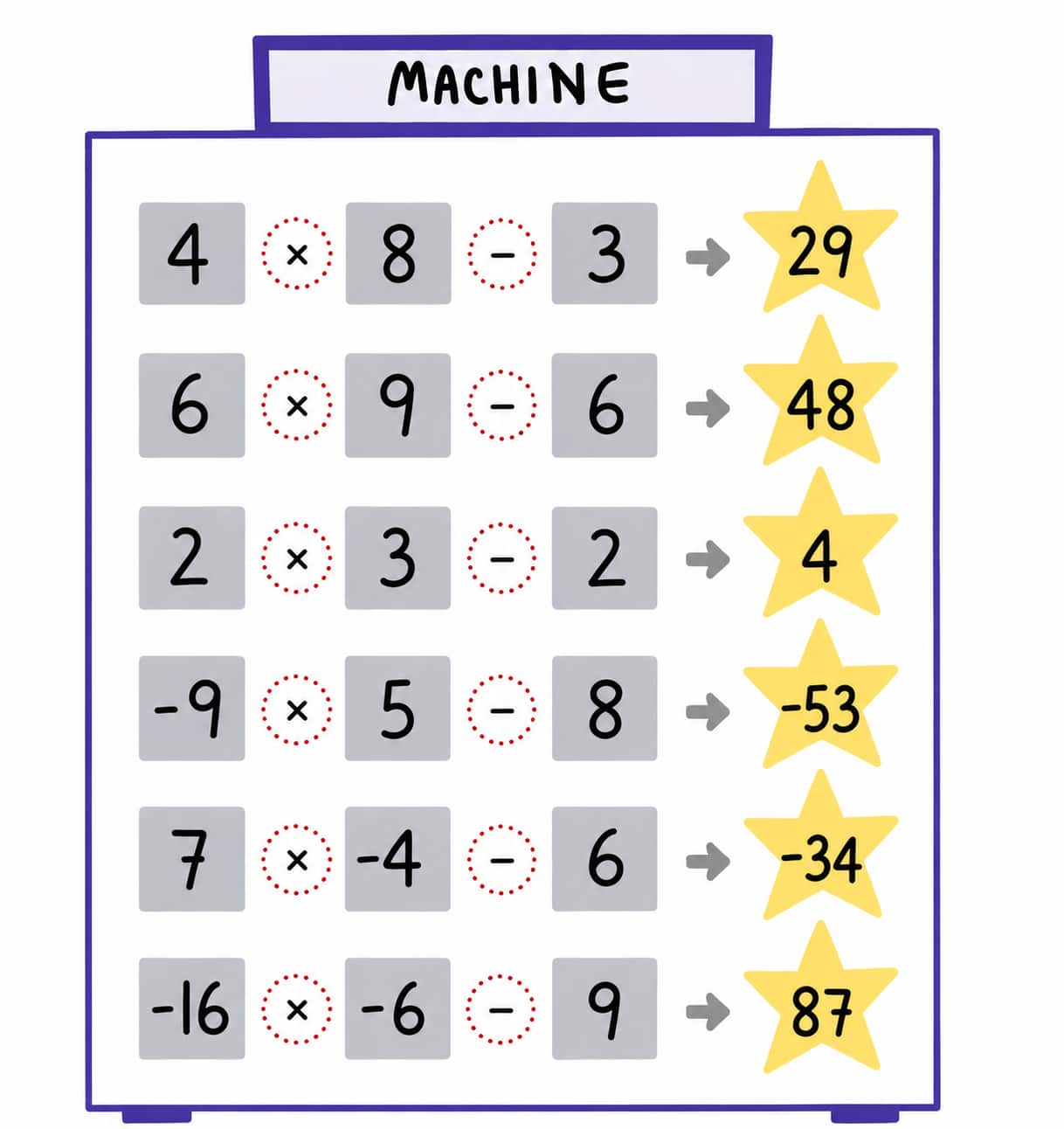
7. Pick the pattern - find the operations done by the machine shown below.
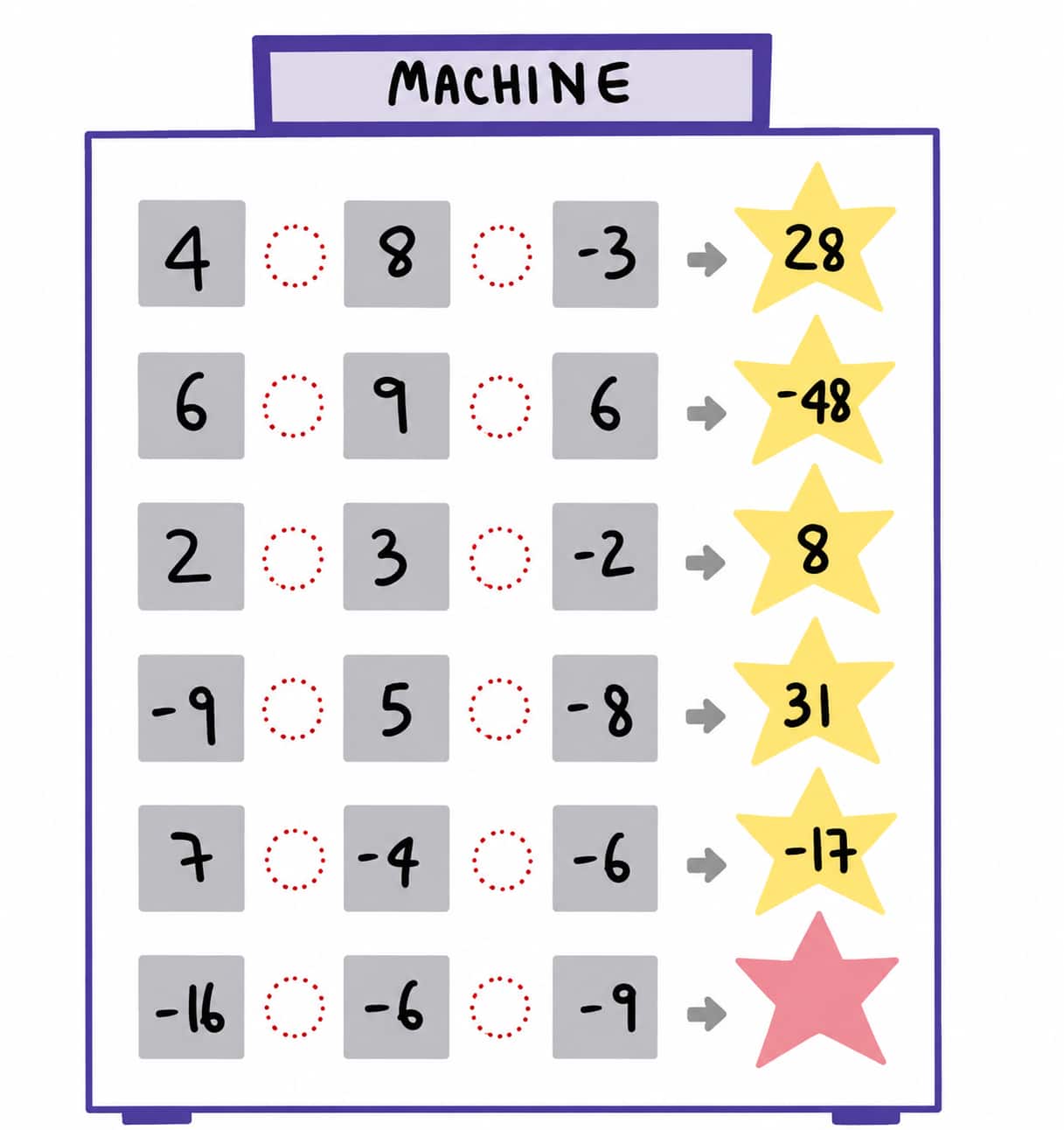
Answer:
8. Imagine you're in a place where the temperature drops by $5^{\circ} \mathrm{C}$ each hour. If the temperature is currently at $8^{\circ} \mathrm{C}$, write an expression which denotes the temperature after 4 hours.
Answer:
The temperature decreases by $5^\circ$C every hour.
Expression: $8+4 \times(-5)$
= –12° C
9. Find 3 consecutive numbers with a product of (a) -6, (b) 120.
Answer:
Let the numbers be $n, n+1, n+2$.
(a) $(-3) \times(-2) \times(-1)=-6$
(b) $4\times5\times6=120$
10. An alien society uses a peculiar currency called 'pibs' with just two denominations of coins - $\mathrm{a}+13$ pibs coin and $a -9$ pibs coin. You have several of these coins. Is it possible to purchase an item that costs +85 pibs?
Yes, we can use 10 coins of +13 pibs and 5 coins of -9 pibs to make a total of +85. Using the two denominations, try to get the following totals:
(a) +20
(b) +40
(c) -50
(d) +8
(e) +10
(f) -2
(g) +1
[Hint: Writing down a few multiples of 13 and 9 can help.]
(h) Is it possible to purchase an item that costs 1568 pibs?
Answer:
(a) +20
Take 5 coins of +13 and 5 coins of -9 : $5 \times 13-5 \times 9=65-45=+20$ pibs.
(b) +40
Take 10 coins of +13 and 10 coins of -9 : $10 \times 13-10 \times 9=130-90=+40 \mathrm{pibs}$.
(c) -50
Take 10 coins of +13 and 20 coins of -9 : $10 \times 13-20 \times 9=130-180=-50 \mathrm{pibs}$.
(d) +8
Take 2 coins of +13 and 2 coins of -9 : $2 \times 13-2 \times 9=26-18=+8$ pibs.
(e) + 10
Take 7 coins of +13 and 9 coins of -9 : $7 \times 13-9 \times 9=91-81=+10$ pibs.
(f) -2
Take 13 coins of +13 and 19 coins of -9 : $13 \times 13-19 \times 9=169-171=-2$ pibs.
$(\mathrm{g})+1$
Take 7 coins of +13 and 10 coins of -9 : $7 \times 13-10 \times 9=91-90=+1$ pibs.
(h) Yes, it is possible.
Take 122 coins of +13 and 2 coins of -9 : $122 \times 13-2 \times 9=1586-18=1568 \mathrm{pibs}$.
11. Find the values of:
(a) $(32 \times(-18)) \div((-36))$
(b) $(32) \div((-36) \times(-18))$
(c) $(25 \times(-12)) \div((45) \times(-27))$
(d) $(280 \times(-7)) \div((-8) \times(-35))$
Answer:
11(a): 16
Explanation:
$(32 \times-18) \div(-36)=\frac{-576}{-36}=16$
11(b): $\frac{4}{81}$
Explanation:
$32 \div((-36) \times(-18))=\frac{32}{648}=\frac{4}{81}$
11(c): $\frac{20}{81}$
Explanation:
$\frac{25 \times(-12)}{45 \times(-27)}=\frac{-300}{-1215}=\frac{20}{81}$
11(d): -7
Explanation:
$\frac{280 \times(-7)}{(-8) \times(-35)}=\frac{-1960}{280}=-7$
12. Arrange the expressions given below in increasing order.
(a) $(-348)+(-1064)$
(b) $(-348)-(-1064)$
(c) $348-(-1064)$
(d) $(-348) \times(-1064)$
(e) $348 \times(-1064)$
(f) $348 \times 964$
Answer: $(e)<(a)<(b)<(c)<(f)<(d)$
Explanation:
(a) $-348+(-1064)=-1412$
(b) $-348-(-1064)=716$
(c) $348-(-1064)=1412$
(d) $(-348)(-1064)=370272$
(e) $348(-1064)=-370272$
(f) $348 \times 964=335472$
Correct order: $(e)<(a)<(b)<(c)<(f)<(d)$
13. Given that $(-548) \times 972=-532656$, write the values of:
(a) $(-547) \times 972$
(b) $(-548) \times 971$
(c) $(-547) \times 971$
Answer:
Given: $(-548) \times 972=-532656$
(a)
$(-547) \times 972=(-548+1) \times 972=-532656+972=-531684$
(b)
$(-548) \times 971=-532656+548=-532108$
(c)
$(-547) \times 971=-531684+547=-531137$
14. Given that $207 \times(-33+7)=-5382$,
write the value of $-207 \times(33-7)$ = $\_\_\_\_$ .
Answer: -5382
Explanation:
$-207\times(33-7)=-207(26)=-5382$
15. Use the numbers $3,-2,5,-6$ exactly once and the operations ' + ', ' - ', and ' x ' exactly once and brackets as necessary to write an expression such that -
(a) the result is the maximum possible
(b) the result is the minimum possible
Answer:
(a) Maximum possible value
Choose the expression $-6 \times(-2-(3+5))$
Workout: $3+5=8,-2-8=-10,-6 \times(-10)=60$.
Maximum value $=60$
(b) Minimum possible value
Choose the expression $((3+5)-(-2)) \times(-6)$
Workout: $3+5=8,8-(-2)=10,10 \times(-6)=-60$.
Minimum value $=-60$
16. Fill in the blanks in at least 5 different ways with integers:
(a) $\square+\square \times \square=-36$
(b) $(\square-\square) \times \square=12$
(c) $(\square-(\square-\square))=-1$
Answer:
(a) $\square+\square \times \square=-36$
1. $0+(-6) \times 6=-36$
2. $4+(-8) \times 5=-36$
3. $-11+5 \times(-5)=-36$
4. $12+(-8) \times 6=-36$
5. $-20+4 \times(-4)=-36$
(b) $(\square-\square) \times \square=12$
1. $(7-3) \times 3=12$
2. $(5-1) \times 3=12$
3. $(10-8) \times 6=12$
4. $(4-2) \times 6=12$
5. $(9-5) \times 3=12$
(c) $(\square-(\square-\square))=-1$
1. $2-(5-2)=-1$
2. $4-(8-3)=-1$
3. $0-(2-1)=-1$
4. $3-(7-3)=-1$
5. $5-(9-3)=-1$
Confused between CGPA and Percentage?
Get your results instantly with our calculator!
Key Concepts Explained in Operations with Integers - Ganita Prakash Book 2
Topics you will learn in NCERT Solutions for Class 7 Maths Part 2 Chapter 2 Operations with Integers include:
2.1 A Quick Recap of Integers
2.2 Multiplication of Integers
NCERT Solutions for Class 7 Maths Chapter Wise
We at Careers360 compiled all the NCERT Class 7 Maths solutions in one place for easy student reference. The following links will allow you to access them.
NCERT Solutions for Class 7 Maths Part 2 Chapter 1 Geometric Twins |
NCERT Solutions for Class 7 Maths Part 2 Chapter 2 Operations with Integers |
NCERT Solutions for Class 7 Maths Part 2 Chapter 3 Finding Common Ground |
NCERT Solutions for Class 7 Maths Part 2 Chapter 4 Another Peek Beyond the Point |
NCERT Solutions for Class 7 Maths Part 2 Chapter 5 Connecting the Dots... |
NCERT Solutions for Class 7 Maths Part 2 Chapter 6 Constructions and Tilings |
NCERT Solutions for Class 7 Maths Part 2 Chapter 7 Finding the Unknown |
NCERT Books and NCERT Syllabus
Before planning a study schedule, always analyse the latest syllabus. Here are the links to the latest NCERT syllabus and some important books that will help students in this endeavour.
Chapter Summary: NCERT Solutions for Class 7 Maths Ganita Prakash Part 2 Chapter 2
According to the latest NCERT textbook, Chapter 2 of Class 7 Part 2, Operations with Integers, begins with a quick recap of positive numbers, negative numbers, and their representation on the number line. The chapter introduces the multiplication of integers and explains the rules for multiplying numbers with the same and different signs. Students learn the relationship between multiplication and repeated addition of integers. The chapter discusses important properties of multiplication, such as closure, commutativity, associativity, and distributive properties. The chapter lays the foundation for algebraic operations involving positive and negative numbers. Mastering this chapter helps students confidently solve integer-based calculations and application-oriented questions.
This chapter consists of 5 exercises with a total of 25 questions.
Expert Review of NCERT Solutions for Class 7 Maths Part 2 Chapter 2
These NCERT solutions provide clear, step-by-step explanations for every exercise and theorem in the chapter. Here are some more points about this chapter and solutions.
The chapter builds a strong arithmetic foundation required for algebra, equations, and coordinate geometry in higher classes.
The solutions follow the latest NCERT syllabus and are ideal for school examinations and regular revision.
Overall, Chapter 2 is a fundamental arithmetic chapter that prepares students for more advanced mathematical concepts involving integers and algebra.
Important concepts and topics related to the latest NCERT Solutions for Class 7 Maths Ganita Prakash Part 2 Chapter 2 Operations with Integers in higher classes are provided below.
Class 8-10
Operations on rational numbers
Algebraic expressions and identities
Linear equations in one and two variables
Coordinate geometry involving positive and negative coordinates
Exponents and powers
Number system concepts
Arithmetic operations in mensuration and algebra
Problem-solving involving integers and signed numbers
Class 11-12
Algebraic manipulation
Functions and graphs
Coordinate geometry
Complex numbers
Vectors and directed quantities
Matrices and determinants
Calculus involving positive and negative values
JEE (Main & Advanced)
Number system fundamentals
Algebraic simplification
Coordinate geometry
Vector algebra
Functions and inequalities
Mathematical reasoning and logical aptitude
Quantitative problem-solving

Popular Questions
A block of mass 0.50 kg is moving with a speed of 2.00 ms-1 on a smooth surface. It strikes another mass of 1.00 kg and then they move together as a single body. The energy loss during the collision is
| Option 1)
|
Option 2)
|
| Option 3)
|
Option 4)
|
An athlete in the olympic games covers a distance of 100 m in 10 s. His kinetic energy can be estimated to be in the range
| Option 1)
|
Option 2)
|
| Option 3)
|
Option 4)
|
A particle is projected at 600 to the horizontal with a kinetic energy . The kinetic energy at the highest point
| Option 1)
|
Option 2)
|
| Option 3)
|
Option 4)
|
In the reaction,
| Option 1)
|
Option 2)
|
| Option 3)
|
Option 4)
|
How many moles of magnesium phosphate, will contain 0.25 mole of oxygen atoms?
| Option 1)
0.02 |
Option 2)
3.125 × 10⁻² |
| Option 3)
1.25 × 10⁻² |
Option 4)
2.5 × 10⁻² |