University of Liverpool, Bengaluru Campus
Study at a world-renowned UK university in India | Admissions open for UG & PG programs.


The use of Integrals enables students to understand the use of integration in solving real-life geometry problems. In this chapter, students will also learn about how to find the area enclosed by means of a Curve, Two Curves, a line, and coordinate axes using definite integrals. These integrate concepts with real life and with analytical and visualisation skills. The NCERT Solutions for Class 12 Maths are professionally prepared by our expert team of experienced Mathematics teachers at Careers360. While preparing these solutions, we ensure the team adheres to the latest CBSE syllabus and provides the students with accurate and stepwise solutions for each question for every chapter of the textbook.
This Story also Contains
Solving these NCERT solutions for Class 12 helps students to understand the application-based concepts in a simple way, raise the problem-solving skills, and solve numerical questions confidently. The chapter is very useful for JEE Main, JEE Advanced, and other competitive exams, as questions based on areas under curves are always asked in these exams. Solving the problems regularly by practicing these NCERT Solutions will help students to develop conceptual clarity, increase their calculation speed and accuracy, and score well.
The NCERT Solutions for Class 12 Maths Chapter 8 have been prepared by Careers360 experts to make learning simpler and to help you score better in exams. Click the link below to download and access the PDF easily.
NCERT Class 12 Maths Chapter 6 Application of Integrals question answers with detailed explanations are provided below.
|
Application of Integrals Class 12 Question Answers Exercise: 8.1 Page number: 296 Total questions: 4 |
Question 1: Find the area of the region bounded by the ellipse $\frac{x^2}{16}+\frac{y^2}{9}=1.$
Answer:
The area bounded by the ellipse : $\frac{x^2}{16}+\frac{y^2}{9}=1$

The area will be 4 times the area of EAB.
Therefore, $Area\ of\ EAB= \int^4_{0} y dx$
$= \int^4_{0}3\sqrt{1-\frac{x^2}{16}} dx$
$= \frac{3}{4}\int^4_{0}\sqrt{16-x^2} dx$
$= \frac{3}{4}\left [ \frac{x}{2}\sqrt{16-x^2}+\frac{16}{2}\sin^{-1}\frac{x}{4} \right ]^4_{0}$
$= \frac{3}{4}\left [ 2\sqrt{16-16} +8\sin^{-1}(1)-0-8\sin^{-1}(0)\right ]$
$= \frac{3}{4}\left [ \frac{8\pi}{2} \right ]$
$= \frac{3}{4}\left [ 4\pi \right ] =3\pi$
Therefore, the area bounded by the ellipse will be $= 4\times {3\pi} = 12\pi\ units.$
Question 2: Find the area of the region bounded by the ellipse $\small \frac{x^2}{4}+\frac{y^2}{9}=1$
Answer:
The area bounded by the ellipse : $\small \frac{x^2}{4}+\frac{y^2}{9}=1$
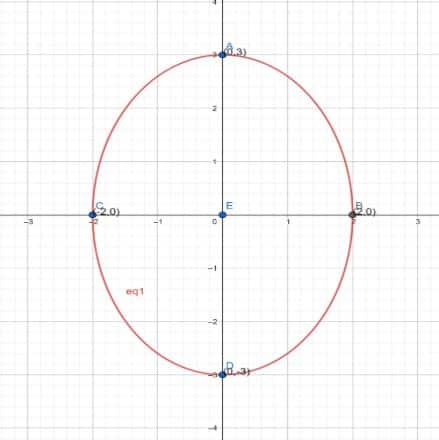
The area will be 4 times the area of EAB.
Therefore, $Area\ of\ EAB= \int^2_{0} y dx$
$= \int^2_{0}3\sqrt{1-\frac{x^2}{4}} dx$
$= \frac{3}{2}\int^2_{0}\sqrt{4-x^2} dx$
$= \frac{3}{2}\left [ \frac{x}{2}\sqrt4-x^2 +\frac{4}{2}\sin^{-1}\frac{x}{2} \right ]^2_{0}$
$= \frac{3}{2}\left [ \frac{2\pi}{2} \right ]$
$= \frac{3\pi}{2}$
Therefore, the area bounded by the ellipse will be $= 4\times \frac{3\pi}{2} = 6\pi\ units.$
Question 3: Choose the correct answer in the following
Answer:
The correct answer is A
The area bounded by circle C(0,0,4) and the line x=2 is
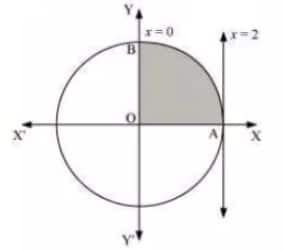
The required area = area of OAB
$\int^2_0ydx = \int^2_0\sqrt{4-x^2}dx$
$\\=[\frac{x}{2}\sqrt{4-x^2}+\frac{4}{2}\sin^{-1}\frac{x}{2}]^2_0\\ =2(\pi/2)\\ =\pi$
Question 4: Choose the correct answer in the following.
(A) $\small 2$ (B) $\small \frac{9}{4}$ (C) $\small \frac{9}{3}$ (D) $\small \frac{9}{2}$
Answer:
The area bounded by the curve $y^2=4x$ and y =3
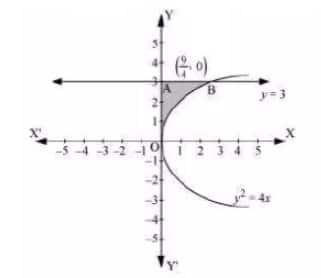
The required area = OAB =
$\\\int ^3_0xdy\\ =\int ^3_0\frac{y^2}{4}dy\\ =\frac{1}{4}.[\frac{y^3}{3}]^3_0\\ =\frac{9}{4}$
|
Application of Integrals Class 12 Question Answers Page Number: 298 Total Questions: 5 |
Question 1: Find the area under the given curves and given lines:
(i) $\small y=x^2,x=1,x=2$ and $\small x$ -axis
Answer:
The area bounded by the curve $\small y=x^2,x=1,x=2$ and $\small x$ -axis
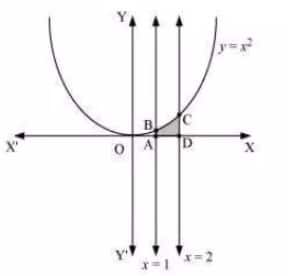
The area of the required region = area of ABCD
$\\=\int_{1}^{2}ydx\\ =\int_{1}^{2}x^2dx\\ =[\frac{x^3}{3}]_1^2\\ =\frac{7}{3}$
Hence, the area of the shaded region is 7/3 units.
Question 1: Find the area under the given curves and given lines:
(ii) $\small y=x^4,x=1,x=5$ and $\small x$ -axis
Answer:
The area bounded by the curev $\small y=x^4,x=1,x=5$ and $\small x$ -axis
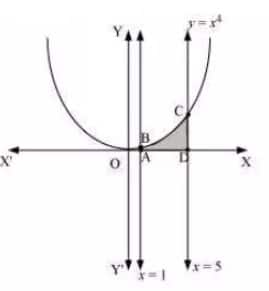
The area of the required region = area of ABCD
$\\=\int_{1}^{5}ydx\\ =\int_{1}^{2}x^4dx\\ =[\frac{x^5}{5}]_1^2\\ =625-\frac{1}{5}\\ =624.8$
Hence, the area of the shaded region is 624.8 units.
Question 2: Sketch the graph of $\small y=|x+3|$ and evaluate $\small \int_{-6}^{0}|x+3|dx.$
Answer:
y=|x+3|
The given modulus function can be written as
x+3>0
x>-3
for x>-3
y=|x+3|=x+3
x+3<0
x<-3
For x<-3
y=|x+3|=-(x+3)
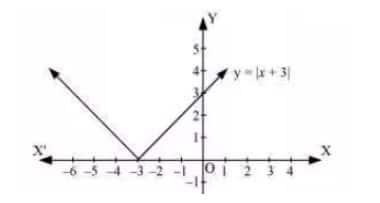
The integral to be evaluated is
$\\\int_{-6}^{0}|x+3|dx$
$=\int_{-6}^{-3}(-x-3)dx+\int_{-3}^{0}(x+3)dx$
$ =[-\frac{x^{2}}{2}-3x]_{-6}^{-3}+[\frac{x^{2}}{2}+3x]_{-3}^{0}$
$=(-\frac{9}{2}+9)-(-18+18)+0-(\frac{9}{2}-9)\\ =9$
Question 3: Find the area bounded by the curve $\small y=\sin x$ between $\small x=0$ and $\small x=2\pi$.
Answer:
The graph of y=sinx is as follows
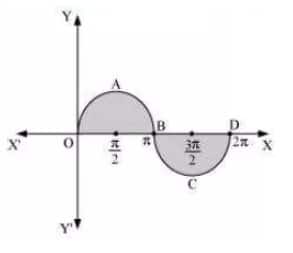
We need to find the area of the shaded region.
ar(OAB)+ar(BCD)
=2ar(OAB)
$\\=2\times \int_{0}^{\pi }sinxdx\\ =2\times [-cosx]_{0}^{\pi }\\ =2\times [-(-1)-(-1)]\\ =4$
The bounded area is 4 units.
Question 4: Choose the correct answer.
(A) $\small -9$ (B) $\small \frac{-15}{4}$ (C) $\small \frac{15}{4}$ (D) $\small \frac{17}{4}$
Answer:
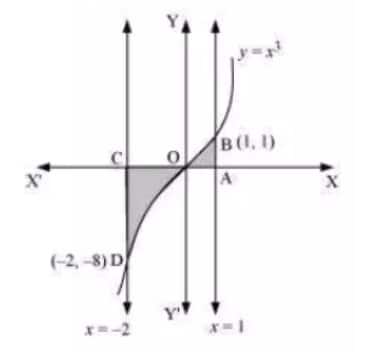
Hence, the required area
$=\int_{-2}^1 ydx$
$=\int_{-2}^1 x^3dx = \left [ \frac{x^4}{4} \right ]_{-2}^1$
$= \left [ \frac{x^4}{4} \right ]^0_{-2} + \left [ \frac{x^4}{4} \right ]^1_{0}$
$= \left [ 0-\frac{(-2)^4}{4} \right ] + \left [ \frac{1}{4} - 0 \right ]$
$= -4+\frac{1}{4} = \frac{-15}{4}$
Therefore, the correct answer is B.
Question 5: Choose the correct answer.
(A) $\small 0$ (B) $\small \frac{1}{3}$ (C) $\small \frac{2}{3}$ (D) $\small \frac{4}{3}$
[ Hint : $y=x^2$ if $x> 0$ and $y=-x^2$ if $x<0$]
Answer:
The required area is
$\\2\int_{0}^{1}x^{2}dx\\ =2\left [ \frac{x^{3}}{3} \right ]_{0}^{1}\\ =\frac{2}{3}\ units$
Get your results instantly with our calculator!
Exercise-wise NCERT Solutions of Application of Integrals Class 12 Maths Chapter 8 are provided in the links below.
Topics you will learn in NCERT Class 12 Maths Chapter 8 Application of Integrals include:
The area enclosed by the curve $y=f(x)$, the $x$-axis, and the lines $x=a$ and $x=b$ (where $b>a$ ) is given by the formula:
Area $=\int_a^b y d x=\int_a^b f(x) d x$
The area of the region bounded by the curve $x=\phi(y)$ as its $y$-axis and the lines $y=c$ and $y=d$ is given by the formula:
Area $=\int_c^d x d y=\int_c^d \phi(y) d y$
The area enclosed between two given curves $y=f(x)$ and $y=g(x)$, and the lines $x=a$ and $x=b$, is given by the formula:
Area $=\int_a^b[f(x)-g(x)] d x \quad($ Where $f(x) \geq g(x)$ in $[a, b])$
If $f(x) \geq g(x)$ in $[a, c]$ and $f(x) \leq g(x)$ in $[c, b]$, where $a<c<b$, then the resultant area between the curves is given as:
Area $=\int_a^c[f(x)-g(x)] d x+\int_c^b[g(x)-f(x)] d x$
This Application of Integrals chapter helps us learn how to find the area under curves using integration. It connects what we learned in the previous chapter to real-life applications. These Class 12 Maths chapter 8 Application of Integrals question answers help us practise using integration to calculate areas between lines and curves. Here are some more points on why these question answers are important.
This chapter deals with the application of definite integrals, in particular, to calculate the area of the region bounded by the given curves and straight lines. Different methods of calculating the areas using integration are covered, along with the graphical interpretation of the concepts to make the problems easier to comprehend. The NCERT Solutions facilitate explaining each question in detail with stepwise explanations. Students have the answers to around 9 textbook questions across 2 exercises, which enhance conceptual knowledge and application skills. Regular practice aids in improving accuracy, reasoning ability, and conceptual clarity for examination performance. An article on advanced Calculus applications is covered.
Mathematics experts at Careers360 deem Application of Integrals as an interesting chapter because students learn how to apply the principles of integration to solve real-life problems on curves and graphs. Students who master the graphical interpretation of definite integrals can enjoy solving application-based questions. NCERT Solutions make every concept simplified with detailed and organized solutions. Experts always advise to perfectly practice the diagrams and every NCERT question to increase speed and accuracy. Adequate, methodical preparation of this chapter can help a student to excel in CBSE Board exam and Competitive exams like JEE Main And JEE Advanced.
Here is a comparison list of the concepts in Application of Integrals that are covered in JEE and NCERT, to help students understand what extra they need to study beyond the NCERT for JEE:
Given below is the chapter-wise list of the NCERT Class 12 Maths solutions with their respective links:
Also read,
Students can check the following links for more in-depth learning.
Students can check the following links for more in-depth learning.
Students can check the following links for more in-depth learning.
Also, read,
Frequently Asked Questions (FAQs)
It is about applying the principles of definite integrals to find the area of a region bounded by curves and lines.
In this chapter, we learn about practical use of Integration. And concepts of Calculus are also understood.
Area bounded by Curves, Between Two Curves, By a Curve and Coordinate Axes & Graphical Interpretation.
These solutions describe well illustrated and simple solutions. Application based questions can be easily understood.
Yes. Application based questions of definite integral are repeatedly asked.
Drawing the graphs to find the limits of integrations and determining the required region.
One should practice the questions from NCERT textbooks and analyze graphs carefully.
Yes, the graphs have to be drawn carefully so that the required region can be easily identified and used as a reference for application.
Yes, they explain each and every textbook question in detail. They help to prepare for CBSE board exams.

On Question asked by student community
Hello Ananya,
Please specify the class for which you need the question papers. I am providing Class 10 and 12 papers.
Here are the links to the CBSE Half-yearly Question Papers (2025-2026).
Hello Ananya,
Please specify the class for which you need the question papers. I am providing Class 10 and 12 papers.
Here are the links to the CBSE Half-yearly Question Papers (2025-2026).
Hello Pawan,
CBSE Class 10 Mathematics 2026 and previous year question paper:
https://school.careers360.com/boards/cbse/cbse-class-10-question-paper-2026
CBSE Class 12 Mathematics 2026 and previous year question paper:
https://school.careers360.com/boards/cbse/cbse-previous-year-question-papers-class-12-maths
Hello Dharani,
Check the link below to download NCERT Class 12 previous year question papers in PDF format for all subjects.
https://school.careers360.com/boards/cbse/cbse-previous-year-question-papers-class-12
Hello Vipin,
Check the link below to download CBSE Class 12 question papers in PDF format for all subjects, including Mathematics.
https://school.careers360.com/boards/cbse/cbse-previous-year-question-papers-class-12
A block of mass 0.50 kg is moving with a speed of 2.00 ms-1 on a smooth surface. It strikes another mass of 1.00 kg and then they move together as a single body. The energy loss during the collision is
| Option 1)
|
Option 2)
|
| Option 3)
|
Option 4)
|
An athlete in the olympic games covers a distance of 100 m in 10 s. His kinetic energy can be estimated to be in the range
| Option 1)
|
Option 2)
|
| Option 3)
|
Option 4)
|
A particle is projected at 600 to the horizontal with a kinetic energy . The kinetic energy at the highest point
| Option 1)
|
Option 2)
|
| Option 3)
|
Option 4)
|
In the reaction,
| Option 1)
|
Option 2)
|
| Option 3)
|
Option 4)
|
How many moles of magnesium phosphate, will contain 0.25 mole of oxygen atoms?
| Option 1)
0.02 |
Option 2)
3.125 × 10⁻² |
| Option 3)
1.25 × 10⁻² |
Option 4)
2.5 × 10⁻² |

Study at a world-renowned UK university in India | Admissions open for UG & PG programs.
Apply for UG & PG programmes from Victoria University, Delhi NCR Campus
Admissions open for UG & PG programs at Illinois Tech Mumbai
Apply for UG & PG courses at University of Aberdeen, Mumbai Campus
UG & PG Admissions open for CS/AI/Business/Economics & other programmes.
Bristol's expertise meets Mumbai's innovation. Admissions open for UG & PG programmes