KCC Institute of Legal and Higher Education, Greater Noida
Law Admissions 2026 Open | Avail Merit-Based Scholarships


Motion is an important topic of NSEJS syllabus as it is the basics for other Physics chapters under NSEJS syllabus. The Class 9 NCERT chapter on motion has the topics of basic describing the term motion, distance, displacement, speed, velocity and acceleration, distance-time, velocity-time and acceleration-time graph, equations of uniformly accelerated motion and circular motion. To solve the problems of the chapter motion basic geometry and algebra are important. Solving linear equations and quadratic equations are important prerequisites for the chapter on Motion if you are appearing for NSEJS.

Also Read| NSEJS Physics Paper Analysis
Understand the equations of motion. All the three equations and related questions are important.
Understanding basic geometry such as equations of straight line is useful to solve problems related to graphs
Study all the graphs, questions and examples given in the NCERT book of Class 9
Solve all the problems from NCERT exemplar for the chapter motion
For more problems refer to Class 11 NCERT chapter Motion Along A Straight Line.
Solve all the questions of NSEJS previous year question paper
Solve NSEJS mock test by different online coaching institutes.
Average speed=total distance travelled/time taken
Average acceleration=total velocity/time taken
Equations of uniformly accelerated motion are-
Law Admissions 2026 Open | Avail Merit-Based Scholarships
BBA/MBA/PGDM Early Bird Applications Deadline 06th Nov'26. Apply now using coupon code CAREER250 and get ₹250 off the application fee
v=u+at
s=ut+at2/2
v2=u2+2as
Distance travelled by the body in nth second
sn=u+a(2n-1)/2
Equation of straight line
y=mx+c where m is the slope and c is the y intercept.
Get your results instantly with our calculator!
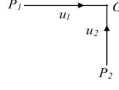
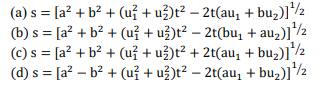
Q-1- Two particles P1 and P2 move towards origin O, along X and Y-axes at constant speeds u1 and u2 respectively as shown in the figure. At t = 0, the particles P1 and P2 are at distances a and b respectively from O. Then the instantaneous distance between the two particles is given by the relation: (NSEJS 2018)
Q-2- particles experience constant acceleration for 20 s after starting from rest. If it travels a distance S1 in the first 10 s and distance S2 in the next 10 s, the relation between S1 and S2 is: (NSEJS 2019)
(a) S2=3S1 (b) S1=3S2 (c) S2= 2S1 (d) S1=10S2
Q-3-The axes of a coordinate system S2are inclined at an angle θ to those of another coordinate system S1. The origins of both the systems are coinciding. A particle P1at rest in system S1, starts from point (-2, 0) and travels along the positive direction of X1 axis with uniform acceleration of 1.25 m/s2 for 4 s and stops. In system S2, particle P2, starts from rest from the origin and travels for 2 s along the positive direction of X2 axis with uniform acceleration 5 m/s2and stops. If the final distance between P1and P2 is 6 m, then the angle between +Y1 axis and +X2 axis is(NSEJS 2021)
(a) 36.8° (b) 53.2° (c) 106.8° (d) 126.8°
NCERT Class 9 book chapter Motion
NCERT Class 11 Chapter Motion In a Straight Line
NCERT Exemplar problems from Motion
NSEJS previous year question paper
The concepts of speed, distance, displacement, velocity and acceleration are prerequisite to all other physics chapters for NSEJS. So learn the chapter motion first and move to other chapters.


Law Admissions 2026 Open | Avail Merit-Based Scholarships
BBA/MBA/PGDM Early Bird Applications Deadline 06th Nov'26. Apply now using coupon code CAREER250 and get ₹250 off the application fee
Ranked #36 amongst institutions in Management by NIRF | 100% Placement
Globally Recognized by AACSB (US) & AMBA (UK) | 18 LPA Avg. CTC for PGPM 2026
NEET PG All India & State College Predictor with Admission Process Guide
NAAC A-Grade | UGC Autonomous