Early hominids moved from dense forests to open savannahs, where standing upright helped them spot predators and travel long distances efficiently. Bipedalism also freed their hands for carrying food and tools, giving them a survival advantage. Thus, environmental changes and evolutionary pressures together favoured the development of upright walking.

Search Colleges, Exams, Schools & more


Login
NCERT Exemplar Class 12 Biology Solutions Chapter 7 - Evolution
Do you know how life originated on Earth? What factors can disturb genetic equilibrium? What is the difference between convergent and divergent evolution? How did humans evolve on Earth? All these curious questions are answered in these NCERT Exemplar Class 12 Biology Solutions Chapter 7 Evolution. It describes how organisms undergo a transformation over numerous generations so that they fit into their surroundings, giving rise to new species. This article includes NCERT Exemplar Solutions MCQs, very short answers, short answers, and long answers covering details about Evolution Chapter 7 Biology.
This Story also Contains
- NCERT Exemplar Class 12 Biology Solutions Chapter 7 Evolution
- Class 12 Biology NCERT Exemplar Solutions Chapter 7 MCQs
- NCERT Exemplar Solutions Class 12 Biology Chapter 7 Very Short Answer Questions
- Class 12 Biology NCERT Exemplar Solutions Chapter 7 Short Answer Questions
- NCERT Exemplar Class 12 Biology Solutions Chapter 7 Long Answer Questions
- How to Solve Questions of NCERT Exemplar Class 12 Biology Solutions Chapter 7?
- Important Topics of Evolution Class 12 NCERT Exemplar
- Advantages of NCERT Exemplar Class 12 Biology Chapter 7 Solutions
- Important Questions from Evolution Class 12 NCERT Exemplar
- NCERT Exemplar Class 12 Biology Chapter Wise
- NCERT Books and NCERT Syllabus
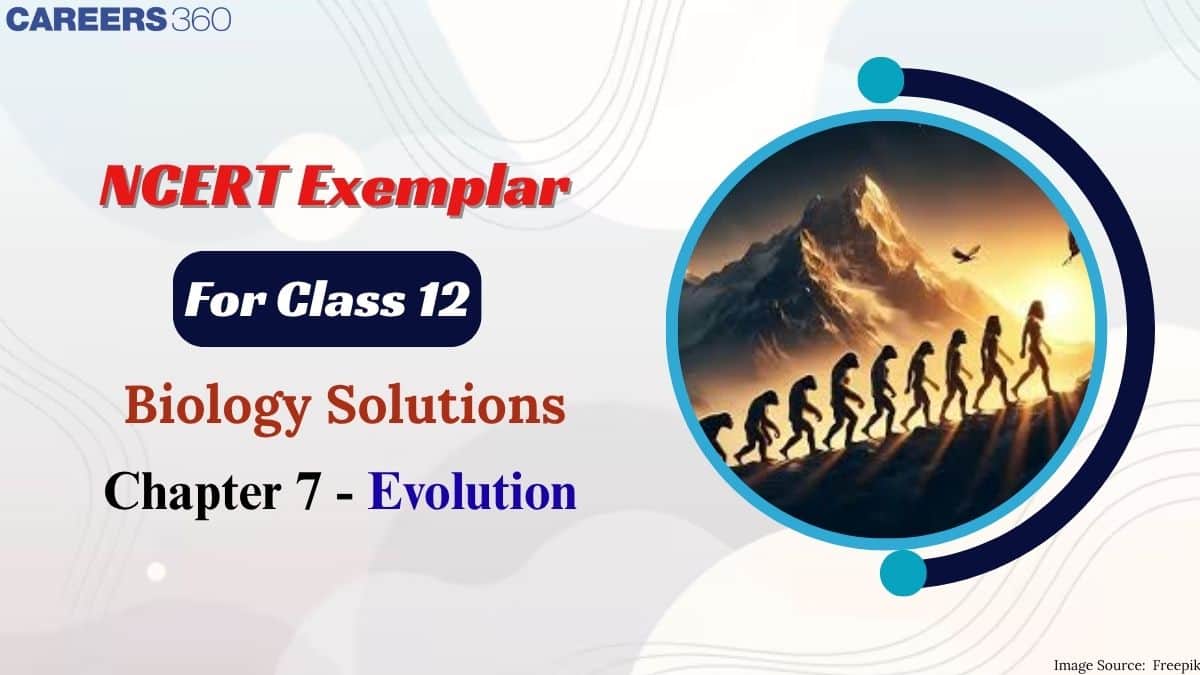
Class 12 Evolution Biology NCERT Exemplar Solution explains Darwin’s theory of natural selection, Lamarckism, Hardy-Weinberg principle, adaptive radiation, convergent and divergent evolution, and fossil evidence. Students can understand how all living organisms are interlinked with common ancestors and how life has evolved over millions of years by studying evolution. These NCERT Exemplar Class 12 Biology Solutions Chapter 7 Evolution also builds scientific thinking and helps students relate biological changes to environmental factors and genetic variations.
NCERT Exemplar Class 12 Biology Solutions Chapter 7 Evolution
The solved NCERT Exemplar exercises provided below are designed to help students better understand the concepts and techniques covered in the chapter. These exercises include a variety of questions, such as multiple-choice, short-answer, and long-answer questions, which will enable students to apply their knowledge in exams. The NCERT Exemplar Class 12 Solutions give detailed explanations, various types of questions, and informative diagrams that make it easy for students to revise, understand, and perform well in exams.
Class 12 Biology NCERT Exemplar Solutions Chapter 7 MCQs
Question:1
Which of the following is used as an atmospheric pollution indicator?
a. Lepidoptera
b. Lichens
c. Lycopersicon
d. Lycopodium
Answer:
The answer is option (b) Lichens
Explanation: Lichens are highly sensitive to air pollution, especially sulphur dioxide. In areas with high pollution levels, lichens decline or disappear, and thus are used as a reliable indicator of atmospheric pollution.
Question:2
The theory of spontaneous generation stated that:
a. Life arose from living forms only
b. Life can arise from both living and non-living things
c. Life can arise from non-living things only.
d. life arises spontaneously, neither from living nor from the non-living.
Answer:
The answer is option (c), life can arise from non-living things only.
Explanation: The theory suggested that organisms like mice and even microorganisms can spontaneously arise from dead matter and inanimate objects.
Question:3
Animal husbandry and plant breeding programmes are examples of:
a. reverse evolution
b. artificial selection
c. mutation
d. natural selection
Answer:
The answer is option (b) artificial selection
Explanation: Animal husbandry and plant breeding programmes are examples of artificial selection. In these programmes, humans with desired traits are selectively bred. It is an artificial selection process are is it is done by human according to their needs.
Question:4
Paleontological evidences for evolution refer to the:
a. development of embryo
b. homologous organs
c. fossils
d. analogous organs
Answer:
The answer is option (c) fossils
Explanation: Fossils are the preserved remains or traces of ancient organisms found in sedimentary rocks. In fact, the study of fossils is called palaeontology. The term‚ paleo' is related to old and historical items.
Question:5
The bones of the forelimbs of whales, bat, cheetah, and man are similar in structure, because:
a. one organism has given rise to another
b. they share a common ancestor
c. They perform the same function
d. They have biochemical similarities
Answer:
The answer is option (b), they share a common ancestor
Explanation: These limbs are homologous organs, meaning they have a similar structure and share a common ancestor but perform different functions.
Question:6
Analogous organs arise due to:
a. divergent evolution
b. artificial selection
c. genetic drift
d. convergent evolution
Answer:
The answer is option (d), convergent evolution
Explanation: Analogous organs have evolved from different ancestors, but all of them show a similar function. Hence, they show convergent evolution.
Question:7
(p+q)2=p2+2pq+q2=1represents an equation used in:
a. population genetics
b. Mendelian genetics
c. biometrics
d. molecular genetics
Answer:
The answer is option (a) population genetics
Explanation: The above equation is the Hardy-Weinberg equation used in population genetics. This equation helps in studying genetic variation and the prediction of allele frequencies in a population.
Question:8
The appearance of antibiotic-resistant bacteria is an example of:
a. adaptive radiation
b. transduction
c. pre-existing variation in the population
d. divergent evolution
Answer:
The answer is option (c), pre-existing variation in the population
Explanation: Some bacteria naturally have resistance due to genetic variation. When exposed to antibiotics, the resistant bacteria survive and reproduce, while the non-resistant ones die.
Question:9
Evolution of life shows that life forms had a trend of moving from:
a. land to water
b. dry land to wetland
c. freshwater to seawater
d. water to land
Answer:
The answer is option (d), water to land
Explanation: Early life starts in water, and over time, some organisms develop adaptations like lungs and limbs to survive on land. This signifies that the evolution of life moved from water to land
Question:10
Viviparity is considered to be more evolved because:
a. The young ones are left on their
b. The young ones are protected by a thick shell
c. The young ones are protected inside the mother's body and are looked after when they are born, leading to more chances of survival
d. the embryo takes a long time to develop
Answer:
The answer is option (c), the young ones are protected inside the mother's body and are looked after when they are born, leading to more chances of survival
Explanation: In viviparous animals, the embryo develops inside the mother's body, receiving protection. It reduces the risk from predators and increasing the chances of their survival.
Question:11
Fossils are generally found in:
a. Sedimentary rocks
b. Igneous rocks
c. Metamorphic rocks
d. Any type of rock
Answer:
The answer is option (a) Sedimentary rocks
Explanation: Fossils can't be found in Igneous rocks as they are formed from lava. Fossils are generally found in sedimentary rocks. Metamorphic rocks are made from igneous or sedimentary rocks.
Question:12
For the MN-blood group system, the frequencies of M and N alleles are 0.7 and 0.3, respectively. The expected frequency of MN-blood group bearing organisms is likely to be
a. 42%
b. 49%
c. 9%
d. 58%
Answer:
The answer is option (a) 42%
Explanation: This can be solved by using the binomial expression:
a2+b2+2ab = 1
Here, M = a and N = b
M2+N2+2MN = 0.72+0.32+2x0.7x0.3
=0.49+0.09+0.42
In this equation ; value of 2MN = 0.42 = 42%
Question:13
Which type of selection explains industrial melanism observed in the moth, Boston Bulgaria:
a. Stabilising
b. Directional
c. Disruptive
d. Artificial
Answer:
The answer is option (b) Directional
Explanation: During the Industrial Revolution, darker moths had a survival advantage over the lighter coloured moths. Due to this, the number of dark-coloured moths increased, showing a shift on one side that is selection.
Question:14
The most accepted line of descent in human evolution is:
a. Australopithecus → Ramapithecus → Homo sapiens → Homo habilis
b. Homo erectus → Homo habilis → Homo sapiens
c. Ramapithecus → Homo habilis → Homo erectus → Homo sapiens
d. Australopithecus → Ramapithecus → Homo erectus → Homo habilis → Homo sapiens.
Answer:
The answer is the option(c) Ramapithecus→Homo habilis→Homo erectus→Homo sapiens
Explanation: Ramapithecus→Homo habilis→Homo erectus→Homo sapiens
Question:15
Which of the following is an example of a link species?
a. Lobe fish
b. Dodo bird
c. Seaweed
d. Chimpanzee
Answer:
The answer is option (a) Lobe fish
Explanation: Lobe fish act as a link between aquatic fish and amphibia. They have fleshy, limb-like fins which are considered evolutionary precursors, showing the transition from water to land; hence, they are considered as link species.
Question:16
Match the scientists listed under column 'I' with ideas listed column 'II'.
Column I | Column II |
A. Darwin | i. abiogenesis |
B. Oparin | ii. use and disuse of organs |
C. Lamarck | iii. Continental drift theory |
D.Wagner | iv. evolution by natural selection |
a. A(i); B(iv); C(ii); D(iii)
b. A(iv); B(iii); C(ii); D(i)
c. A(ii); B(iv); C(iii); D(i)
d. A(iv); B(i); C(ii); D(iii)
Answer:
The answer is the option (d), A(iv); B(i); C(ii); D(iii)
Explanation: Darwin proposed the theory that evolution happens due to natural selection. Oparin provided the concept of abiogenesis. Lamarck proposed the use and disuse of organs. The organs that are not in use eventually weaken or disappear, while the organs in use remain. Wagner gave the Continental Drift theory.
Question:17
In 1953, S. L. Miller created primitive Earth conditions in the laboratory and gave experimental evidence for the origin of the first form of life from preexisting non-living organic molecules. The primitive earth conditions created include:
a. low temperature, volcanic storms, atmosphere rich in oxygen
b. low temperature, volcanic storms, reducing atmosphere
c. high temperature, volcanic storms, non-reducing atmosphere
d. high temperature, volcanic storms, reducing atmosphere containing CH4, NH3, etc.
Answer:
The answer is option (d), high temperature, volcanic storms, reducing atmosphere containing CH4, NH3, etc.
Question:18
Variations during mutations of meiotic recombination are:
a. random and directionless
b. random and directional
c. small and directional
d. random, small, and directional
Answer:
The answer is option (a), random and directionless
Explanation: Mutations occur spontaneously due to errors in DNA replication or external factors. Hence, these changes are random and directionless.
Confused between CGPA and Percentage?
Get your results instantly with our calculator!
💡 Conversion Formula used is: CGPA = Percentage / 9.5
NCERT Exemplar Solutions Class 12 Biology Chapter 7 Very Short Answer Questions
Question:1
What were the characteristics of life forms that had been fossilised?
Answer:
Fossilised organisms usually have hard body parts like bones or shells. They were often buried in sediments, preventing decay, and after some time, undergo mineralization and turn into fossils.
Question:2
Did aquatic life forms get fossilised? If yes, where do we come across such fossils?
Answer:
Yes, aquatic life forms also get fossilised. These fossils are mostly found in sedimentary rocks, especially in seabeds, riverbeds, and lake deposits.
Question:3
What are we referring to when we say 'simple organisms' or 'complex organisms'?
Answer:
When we refer to simple or complex organisms, we describe the level of biological organization as simple organisms have only a few specialized cells, but complex organisms have multiple specialized cells, like humans.
Question:4
How do we compute the age of a living tree?
Answer:
The age of a living tree can be determined by measuring the girth of the trunk and comparing the diameter to the average growth factor of that species. Information regarding the average growth factor of a species is historically available.
Question:5
Give an example of convergent evolution and identify the features towards which they are converging.
Answer:
Birds and bats evolved wings for flight, even though they are not closely related. Their wings are structurally different but both serve the same function, showing adaptation to the same environment.
Question:6
How do we compute the age of a fossil?
Answer:
The age of a fossil is determined using carbon dating. The relative presence of radioactive carbon (14C), which decays over time, is calculated to compute the age of a fossil.
Question:7
What is the most important precondition for adaptive radiation?
Answer:
The most important precondition for adaptive radiation is Common ancestry. This means that a single species, when comes in different environments, evolves into multiple species with specialized functions, as seen in Darwin's Finches.
Question:8
How do we compute the age of a rock?
Answer:
Carbon dating is used to find the age of a rock. The relative presence of radioactive carbon (14C), which decays over time, is calculated to compute the age of a rock.
Question:9
Answer:
Functional macromolecules can evolve into living forms. Through natural selection, they adapt to perform specific functions increasing the survival and processes in an organism.
Question:10
In a certain population, the frequency of three genotypes is as follows:
Genotype | BB | Bb | bb |
Frequency | 22% | 62% | 16% |
What is the likely frequency of B and b alleles?
Answer:
Frequency of B allele= BB + 1/2Bb = 22%+ 1/2x62% = 22% +31% = 53%
Frequency of b allele = 1- Frequency of B allele = 100% - 53% = 47%
Question:11
Answer:
The other two factors that affect the Hardy-Weinberg equilibrium are Mutation and Natural Selection.
Question:12
Answer:
The Founder effect occurs when a small group of individuals from a larger population moves to a new location and starts a new population. As, they carry only a small portion of the original population, the new population has reduced genetic diversity.
Question:13
Who among the Dryopithecus and Ramapithecus was more man-like?
Answer:
Ramapithecus is the species that resembles humans more like humans.
Question:14
By what Latin name was the first hominid known?
Answer:
The first hominid is known by the Latin name Homo habilis.
Question:15
Among Ramapithecus, Australopithecines, and Homo habilis -who probably did not eat meat?
Answer:
Homo habilis is the species that probably did not eat meat.
Class 12 Biology NCERT Exemplar Solutions Chapter 7 Short Answer Questions
Question:1
Answer:
Louis Pasteur’s experiments proved that life arises only from pre-existing life and disproved the idea of spontaneous generation. His work showed that sterile broth remained free of life forms unless it is exposed to pre-existing microorganisms or life. However, this does not explain how the first life forms originated. Scientists believe that abiogenesis, meaning life arising from non-living matter under early conditions, led to the formation of the first organisms, while biogenesis, meaning life from life forms, explains the continuation of life. Thus, evolution depends on pre-existing life, but the origin of the first life is still an open question in science.
Question:2
Answer:
Scientists believe evolution is mostly gradual, but some events, like mass extinctions, cause sudden and abrupt changes affecting specific groups. Most scientists agree on the theory of dinosaurs' extinction, claiming that a meteor strike led to the dinosaurs' large-scale destruction and eventual extinction. This theory suggests that a natural disaster can, in fact, be the cause of the extinction of species.
Question:3
Why is nascent oxygen considered toxic to aerobic life forms?
Answer:
Nascent oxygen(O) is toxic to aerobic life forms because it is highly reactive and unstable. Due to this, there is a possibility that they react with many molecules such as DNA, proteins, and lipids. Sci Nascent oxygen is threatening to life forms, as this can potentially result in unwanted mutations.
Question:4
Answer:
Mutation and recombination create random genetic changes, but natural selection acts on these variations in a specific direction, favoring the traits that improve survival and reproduction. Over time, this leads to adaptations that are best suited to the environment. Hence, creation and presence of variation are directionless, but natural selection and adaptation are directional.
Question:5
Answer:
Before industrialization, light-coloured moths were common, blending with clean tree bark. Post-industrialization, tree trunks turned dark due to pollution, leading to a drop in the population of white-winged moths. In this scenario, dark-winged moths reappeared and survived. Later, when pollution decreased light coloured moths again became dominant. Thus, the evolution of white wings was reversed because of pollution. This shows that evolution is apparently reversible.
Question:6
Answer:
Evolution and natural selection are results of other biological processes, not themselves, because they result from genetic mutations, variations, environmental pressures, and reproduction. Natural selection filters these variations, leading to evolution over generations.
Question:7
State and explain any three factors affecting allele frequency in populations.
Answer:
Factors which affect allele frequency in populations:
Genetic Drift: Due to random sampling, there are changes in the frequency of a gene variant. Genetic drift may cause a gene variant to disappear completely and result in reduced genetic variation.
Genetic Recombination: When offspring with traits different from parents are produced, it is called genetic recombination.
Natural Selection: Nature selects only the traits that help an organism to survive in the changed conditions. Natural selection leads to the survival of the fittest. Traits that are unfit to survive perish in the long run, which paves the way for the evolution of a new species.
NEET Highest Scoring Chapters & Topics
Most Scoring concepts For NEET (Based On Previous Year Analysis)
Download EBookQuestion:8
Answer:
Yes, it is possible to understand gene flow in different populations of the world with the Human Genome Project, which is now turning into a reality. This can help us in assessing and predicting human migratory patterns in prehistory and history.
Question:9
How do you express the meaning of words like race, breed, cultivars or variety?
Answer:
Race: A group within a species that has unique features, usually based on location or adaptation. Members of different races of the same species can interbreed.
Breed: A type of animal with special traits, created by humans through selective breeding, and are homogenous in appearance, for example, Labrador dogs.
Cultivar: A special type of plant grown by farmers for specific qualities through vegetative propagation, for example, seedless grapes.
Variety: Different types of the same plant species, either naturally or bred, for example, different kinds of mangoes.
Question:10
When we say, "survival of the fittest", does it mean that
a. those who are fit only survive, or
b. Those that survive are called fit? Comment.
Answer:
Survival of the fittest means that organisms that are best adapted to their environment are more likely to survive and reproduce. Organisms that survive and pass on their genes are called fit.
Question:11
Enumerate three most characteristic criteria for designating a Mendelian population.
Answer:
The three most important criteria for designating a Mendelian population are as follows:
The population must be sufficiently large.
Free flow of genetic materials is ensured through sexual reproduction.
There should be negligible or nil migration in the population.
Question:12
"Migration may enhance or blur the effects of selection". Comment.
Answer:
Migration may enhance or block the effects of selection by changing genetic variation in a population. If new individuals bring an advantage, natural selection may enhance it. However, if individuals introduce harmful genes, they can be slowed down or blocked by natural selection, hence blurring the effects.
CBSE Class 12th Syllabus: Subjects & Chapters
Select your preferred subject to view the chapters
NCERT Exemplar Class 12 Biology Solutions Chapter 7 Long Answer Questions
Question:1
Answer:
Hardy-Weinberg Principle states that the sum of allelic frequencies in a population remains the same through generations. The total of allelic frequencies in a population is 1.
Frequency of allele A = p
Frequency of allele a = q
p+q = 1
In a diploid individual,
Frequency of allele AA = p2
Frequency of allele aa = p2
Frequency of allele Aa = 2pq
This can be shown by the following equation, which is derived from the algebraic identity
(p+q)2 = p2 + q2 + 2pq = 1
The extent of evolutionary change can be evaluated by measuring the difference between the measured values of these values from the expected value.
The following five factors influence these values:
Gene migration or gene flow
Genetic drift
Genetic recombination
Mutation
Natural selection
Question:2
Explain divergent evolution in detail. What is the driving force behind it?
Answer:
Divergent evolution is a process in which two or more related species develop different traits and adaptations over time due to different environmental pressures or niches. It occurs when a common ancestor gives rise to multiple species with distinct characters, leading to increased diversity. A classic example of divergent evolution is Darwin's Finches on the Galapagos Islands.
The main driving force behind divergent evolution is natural selection, along with mutation, genetic drift, and adaptation to different environments. The homologous organs are a result of divergent evolution. Forelimbs of mammals and birds are good examples of divergent evolution. While mammals use their forelimbs for walking, running, and other chores, birds use their forelimbs (modified into wings) for flight adaptations. In both cases, forelimbs are supported by the humerus, radius, ulna, carpals, and metacarpals. This may indicate common ancestry.
Question:3
Answer:
The story of moths in England during industrialisation is a classic example of natural selection. Before industrialization in England, the population of black-winged moths was less than the population of white-winged moths. Due to the industrial revolution, tree trunks became darker because of the accumulation of industrial smoke or soot, and a reduction in the population of lichens. This provided a camouflaging advantage to black-winged moths, and thus, the population of black-winged moths gradually started to increase.
If the industry had been removed, pollution levels decreased, and the tree bark would have returned to its original light colour. In this case, light colored moths will gonna increase rather than dark coloured moths.
This showed that evolution is apparently reversible.
Question:4
What are the key concepts in Darwin's theory of evolution?
Answer:
The two prominent concepts in the evolutionary theory of Darwin are natural selection and branching descent.
Natural Selection: All living beings adapt to changing environmental conditions by developing useful adaptations. Organisms that can survive the changes will produce more progenies and thereby maintain their lineage. Nature selects only those who are fit to survive, leaving behind the rest to perish. Therefore, we can conclude that natural selection plays an important role in evolution.
Branching Descent: Branching descent follows the popular premise that all life forms are branched from a common origin. This is often referred to as the "Tree of Life," illustrated in the following diagram.
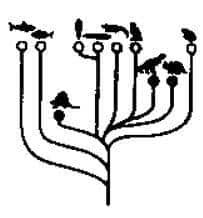
Fishes and Amphibians have a common ancestor. Amphibians have been considered as ancestors to other land animals such as reptiles, mammals, and even birds. Darwin used various proofs to show that living beings have evolved from a common ancestor through branching.
Question:5
Answer:
Two organisms found in the same geographical area often have similar adaptations, and this is called convergent evolution. It is commonly observed in desert plants, although not all of them are closely related.
For example, kangaroo rats(a mammal) and desert lizards(a reptile) both use water-conserving strategies. Kangaroo rats produce fewer offspring with high survival rates, avoiding water loss by staying in burrows and having efficient kidneys. Similarly, desert lizards lay tough-shelled eggs that reduce water loss, and some species even give birth to live young, ensuring better survival in dry conditions.
Question:6
Answer:
Yes, Humans are still evolving, as evolution is a continuous process that affects all living organisms, including us. Evolution occurs through mechanisms such as natural selection, genetic drift, mutations, and gene flow, all of which continue to shape the human species over time. Some scientists have studied human evolution and have shared the following observations that suggest modern humans are also evolving. Since the discovery of farming about 10,000 years ago, human evolution has worked at lightning speed as scientists have observed multiple genetic differences between hunter-gatherers and current humans.
One clear example of human evolution is lactose tolerance. As young ones stop consuming milk after a certain age, they develop lactose intolerance. But human beings consume milk throughout their life as they get it from domesticated animals. Humans have also developed resistance to many infectious diseases. This is another sign of evolution. While evolution in humans may not be visible or rapid, as in other species, it is continuously happening.
Question:7
Answer:
If Darwin had been aware of Mendel's work, he would have given a clear understanding of the origin of variations in species. Darwin's theory of Natural Selection was based on the idea that organisms in a population show variations, and those having beneficial traits survive and reproduce. Mendel observed reproduction in pea plants to come up with his theories on variations. Through these experiments, Mendel could attribute the origin of variations to some factors.
Mendel's discoveries laid the foundation for modern genetics, which later merged with Darwin's Theory in the modern synthesis of evolution. Darwin was from the same era as Mendel and would have had access to the same technology and information as Mendel had. Darwin was out on an exploration, and it would not have been possible to experiment similarly to the one conducted by Mendel. The goals and focus of their experiments were quite different from each other. Because of these factors, it seems highly unlikely that Darwin would have been able to explain the origin of variations.
NCERT Exemplar Class 12 Solutions Subject-wise:
How to Solve Questions of NCERT Exemplar Class 12 Biology Solutions Chapter 7?
By following the steps given below, students can solve the questions of the Evolution chapter effectively without any further help.
- Read the NCERT Exemplar Class 12 Biology Solutions Chapter 7 in depth to understand the origin of life, evolutionary theories, evidence of evolution, and human evolution.
- Practice drawing and labelling diagrams like evolutionary trees, homologous and analogous structures, adaptive radiation patterns, and human evolutionary stages.
- Memorise the order of evolutionary phases, and key terms like natural selection, genetic drift, gene flow, mutation, adaptive radiation, homologous organs, and analogous organs.
- Complete all Exemplar questions, highlighting differences between homologous and analogous organs, convergent and divergent evolution, the Hardy-Weinberg principle, and examples of adaptive radiation.
- Rewrite the work of scientists like Charles Darwin (natural selection), Hugo de Vries (mutation theory), and others who participated in the synthetic theory.
Also, read the NCERT Solution subject-wise
Important Topics of Evolution Class 12 NCERT Exemplar
Given below are the important topics from the Evolution chapter, which discuss how life evolved and diversified over time.
Origin of life and major theories of evolution
Darwin’s and Lamarck’s theories
Mutation theory by Hugo de Vries
Human evolution and adaptations
Must Read NCERT Notes subject-wise
Advantages of NCERT Exemplar Class 12 Biology Chapter 7 Solutions
The Evolution chapter explains how life originated billions of years ago on the planet Earth. Solving exemplar questions provides many advantages to students, some of which are given below:
- NCERT Exemplar Class 12 Biology Chapter 7 Solutions provides a clear understanding of Darwin's Theory of Natural Selection, Lamarck's principles, etc.
- Students will understand how to write answers in the correct format in the exam, along with the diagrams.
- The exemplar problems include different types of questions, such as multiple-choice questions and short and long answer questions, which improve problem-solving skills.
- Regular practice of the questions improves visual memory and better retention of concepts such as natural selection, genetics flow, etc., which allows students to perform well in school exams and competitive exams like NEET.
Important Questions from Evolution Class 12 NCERT Exemplar
Evolution is an important chapter for NEET and board exams that explains how life has evolved and diversified over millions of years. It deals with very important points like the origin of life, evolution theories, evidence for evolution, adaptive radiation, and human evolution.
Question 1. The flippers of the Penguins and the Dolphins are an example of the
Option 1. Adaptive radiation
Option 2. Natural selection
Option 3. Convergent evolution
Option 4. Divergent evolution
Answer :
The flippers of penguins (birds) and dolphins (mammals) serve the same function of swimming, but evolved independently in unrelated groups. They show similarity in structure due to adaptation to a similar environment, not because of common ancestry. This is an example of convergent evolution.
Hence, the correct answer is option (3), Convergent Evolution
Question 2. What environmental factors and evolutionary pressures played a role in the emergence of bipedalism among our hominid ancestors?
Option 1. The proliferation of large carnivores that targeted small mammals led to the development of bipedalism.
Option 2. The transition from mountainous forests to flat grasslands prompted the evolution of bipedalism.
Option 3. The shift from forested habitats to open savannah environments influenced the emergence of bipedalism.
Option 4. The mass extinction of dinosaurs, followed by the subsequent rise of mammals, contributed to the development of bipedalism.
Answer :
Hence, the correct answer is option (3). The shift from forested habitats to open savannah environments influenced the emergence of bipedalism.
Question 3. In the case of the moth species Biston betularia, which form of natural selection can be attributed to the phenomenon of industrial melanism
Option 1. Stabilizing selection
Option 2. Directional selection
Option 3. Disruptive selection
Option 4. Artificial selection
Answer :
Industrial melanism is a phenomenon observed in moth populations, like Biston betularia, where dark-colored individuals become more common due to pollution. In polluted areas, lighter-colored moths are easily spotted and eaten by predators, while darker-colored moths are better camouflaged and have a higher chance of survival. This shift towards darker coloration is an example of directional selection, where the selective pressure favors one extreme of a trait, in this case, darker coloration, leading to an increase in its prevalence in the population.
Hence, the correct answer is option (2). Directional Selection
Question 4. Which of the following is considered the most convincing evidence in favour of evolution?
Option 1. Homologous organs
Option 2. Analogous organs
Option 3. Vestigial organs
Option 4. Atavism
Answer :
Homologous organs have the same basic structural plan and origin but perform different functions in different organisms. This similarity indicates common ancestry, making homologous organs the strongest evidence supporting the theory of evolution.
Hence, the correct answer is option (1), Homologous organs
Question 5. Which evolutionary phenomenon explains the presence of similar adaptive features in different species occupying similar ecological niches?
Option 1. Divergent evolution
Option 2. Adaptive radiation
Option 3. Convergent evolution
Option 4. Genetic drift
Answer :
When unrelated species evolve similar traits due to similar environmental pressures and ecological roles, the process is known as convergent evolution. These traits are called analogous structures and arise independently.
Hence, the correct answer is option (3), Convergent evolution
NCERT Exemplar Class 12 Biology Chapter Wise
Find all chapter-wise practice questions and solutions in the table below to strengthen your concepts and prepare effectively for exams.
NCERT Books and NCERT Syllabus
Students can directly explore the official NCERT Books Class 12 Biology and the updated NCERT Syllabus Class 12 Biology provided here:
Frequently Asked Questions (FAQs)
Q: What evidence supports the theory of evolution?
A:
Evidence comes from multiple sources: fossil records, comparative anatomy (homologous and analogous organs), embryology, molecular biology, and adaptive radiation (such as Darwin’s finches and Australian marsupials), all demonstrating both common ancestry and divergence of species.
Q: What is adaptive radiation and how is it exemplified?
A:
Adaptive radiation is the process by which organisms diversify rapidly into new forms, particularly when a change in the environment makes new resources available. A classic example is the evolution of different species of Darwin’s finches on the Galápagos Islands and the convergent evolution seen in Australian marsupials and placental mammals.
Q: How does the Hardy-Weinberg Principle relate to evolution?
A:
The Hardy-Weinberg Principle states that allele frequencies in a population remain constant from generation to generation unless acted upon by evolutionary forces. Factors like gene flow, genetic drift, mutation, recombination, and natural selection can disturb this equilibrium, leading to evolution.
Q: What is the difference between Darwinian evolution and mutation theory?
A:
Darwinian evolution emphasizes gradual, continuous variation and natural selection as the primary drivers of evolution. In contrast, Hugo de Vries’ mutation theory suggests that sudden, large mutations (saltations) are responsible for the formation of new species, highlighting a more abrupt mechanism of evolutionary change.
Q: What are the different types of natural selection mentioned in NCERT Exemplar Class 12 Biology?
A:
There are three main types of natural selection:
1- Stabilizing Selection – Favors average traits and selects against extreme ones, maintaining stability in a population (e.g., human baby birth weight—too low or too high reduces survival).
2- Directional Selection – Favors one extreme trait, shifting the population’s characteristics in that direction (e.g., giraffes evolving longer necks for better food access).
3- Disruptive Selection – Favors both extreme traits while selecting against the average, leading to diversification (e.g., light and dark-colored oysters).
Q: How do mutations contribute to evolution, as per NCERT Exemplar?
A:
Mutations create genetic variations, which are essential for evolution. Some mutations are harmful, some neutral, and others beneficial. Beneficial mutations help organisms to survive and reproduce, allowing these traits to spread. Over time, this leads to evolution and adaptation to changing environments.
Q: Why is genetic drift significant in evolution? How is it explained in NCERT Exemplar?
A:
Genetic drift causes random changes in allele frequencies, especially in small populations. It can lead to loss or fixation of alleles, reducing genetic diversity. The Founder Effect and Bottleneck Effect are examples. According to NCERT Exemplar, genetic drift makes evolution partly random, influencing genetic variation.
Articles
Related Stories
|
Upcoming School Exams

Certifications By Top Providers
Explore Top Universities Across Globe
Questions related to CBSE Class 12th
On Question asked by student community
Have a question related to CBSE Class 12th ?
Hello Student,
Check the useful resources given below:
https://school.careers360.com/articles/most-repeated-questions-in-physics-class-12-cbse
https://school.careers360.com/boards/cbse/cbse-12th-exam-pattern
Hope it helps!
Hi Teena,
You can check the Hindi class 12th question paper .
if you need more resources please let us know.
Hi Lalit,
Here you can check the question paper.
https://school.careers360.com/boards/cbse/cbse-class-12-economics-question-paper-2026
if you need any other resources please let us know.
Hi Kanha,
You can download all subjects class 12th question paper from the given link .
https://school.careers360.com/boards/cbse/cbse-class-12-question-paper-2026
if you need any other resources please let us know.
Dear Student,
Please refer to the link provided below for the question papers in Hindi :|
https://school.careers360.com/hi/articles/cbse-previous-year-question-papers-class-12
If you need any other resource, do let us know.
Popular CBSE Class 12th Questions
A block of mass 0.50 kg is moving with a speed of 2.00 ms-1 on a smooth surface. It strikes another mass of 1.00 kg and then they move together as a single body. The energy loss during the collision is
| Option 1)
|
Option 2)
|
| Option 3)
|
Option 4)
|
An athlete in the olympic games covers a distance of 100 m in 10 s. His kinetic energy can be estimated to be in the range
| Option 1)
|
Option 2)
|
| Option 3)
|
Option 4)
|
A particle is projected at 600 to the horizontal with a kinetic energy . The kinetic energy at the highest point
| Option 1)
|
Option 2)
|
| Option 3)
|
Option 4)
|
In the reaction,
| Option 1)
|
Option 2)
|
| Option 3)
|
Option 4)
|
How many moles of magnesium phosphate, will contain 0.25 mole of oxygen atoms?
| Option 1)
0.02 |
Option 2)
3.125 × 10⁻² |
| Option 3)
1.25 × 10⁻² |
Option 4)
2.5 × 10⁻² |
Colleges After 12th
CBSE Class 12th Notifications
Never miss CBSE Class 12th update
Get timely CBSE Class 12th updates directly to your inbox. Stay informed!