Aakash Re-NEET 2026 Batch
Enrol for Aakash Re-NEET 2026 Victory Batch at Rs. 99 only. Batch start 16th May.


The NCERT Solutions for Class 12 Biology Chapter 6 Evolution help students understand the origin and development of life on Earth in a systematic manner. These solutions explain important concepts such as how life originated, different types of evidence of evolution, and evolutionary mechanisms. Students can also learn about the famous theories of Darwin and Lamarckism in an easy-to-understand way. The NCERT Solutions are written in simple language, making the concepts clear and less confusing.
This Story also Contains
The Evolution Class 12 question answer covers topics like natural selection, adaptive radiation, and the Hardy-Weinberg principle in simple words. This chapter is very important for the board exams and competitive exams like NEET, as many questions are asked from evolution every year. Regular study of the NCERT Solutions for Class 12 makes revision quicker and more effective, which allows students to perform well. They can also download the PDF to make studying more organised, and can rely on this completely.
The free PDF for the Evolution chapter is given below. Going through the Evolution Class 12 Questions and Answers PDF gives students a clear understanding of how life evolves.
From here, students can access detailed solutions for the questions given in the textbook. By referring to the Class 12 Biology Chapter 6 Evolution question answer, prepared as per the NCERT curriculum, they can easily understand the different theories and concepts related to evolution.
Question 1. Explain antibiotic resistance observed in bacteria in light of Darwinian selection theory.
Answer:
Darwinian selection theory indicates that organisms with variations have high chances of surviving and reproducing in a changing environment. A classic example of this can be seen with antibiotic resistance in bacteria. In this experiment, bacteria grown in an environment containing penicillin were mostly killed, but those with genetic variations survived. These surviving bacteria then multiplied and reproduced, passing down their resistance genes. As time passed, the population evolved to be more resistant to penicillin, indicating how environmental factors can influence evolutionary outcomes.
Answer:
In September 2015, in the newspapers, we heard the discovery of 100-million-year-old pieces of a skeleton of Homo Naledi.
Homo Naledi was discovered by a team led by Lee Berger.
It is said that the fossil filled a gap in the early evolution of man, and it is believed that this human ancestor died.
Question 3. Attempt to give a clear definition of the term species.
Answer:
A species represents the lowest taxonomic group that has similar structural and functional features and is capable of breeding true among themselves.
A species consists of all individuals that share a common gene pool.
The study of these species plays an important role in evolutionary research, ecology, and conservation biology.
Answer:
There are several components associated with human evolution, such as brain size, function, skeletal structure, diet, posture, etc.
Below is the table of different features:
Genus/species | Brain size | Posture | Diet | Features |
Dryopithecus | - | Knuckle walker | Soft fruits and leaves | Frontally broadened jaws, large canines, arms, and legs of equal size |
Ramapithecus | - | Semi-erect posture | Seeds and nuts | Small and delicate jaws, small canines, and flattened molars |
Australopithecus afarensis | 400–500 cm3 | Fully erect | Fruits and leaves (herbivores) | Large jaws, small canines, and incisors lived in caves |
Homo habilis(Handyman) | 680cm3 | Fully erect, around 1.5m tall | Carnivorous | Jaws are lightly built, with small canines, and capable of making tools of stone |
Homo erectus | 900cm3 | Fully erect, around 1.5m tall | omnivorous | Large canines make use of fire for hunting and cooking, and live in caves |
Homo sapiens neanderthalensis | 1450cm3 | 1.5 m tall, heavily built | omnivorous | Heavy jaw and small canines bury their dead bodies |
Homo sapiens fossilis | 1660cm3 | Completely erect,1.5m tall | omnivorous | Shorter skulls and reduced jaws lived in caves and made cave paintings. |
Homo sapiens sapiens | 1200cm3 to 1600cm3 | Completely erect, posture, around 1.8m tall | omnivorous | Possessing high intelligence, developed language, speech, and the cultivation of crops were observed. |
Answer:
Self-consciousness is an acute sense of self-awareness. Several animals are self-aware and are of great intelligence, like dolphins. All great apes(orangutans, gorillas, and chimpanzees) and elephants are examples that can evaluate their knowledge and work according to situations.
Answer:
Some modern animals and fossils to which they can be linked are as follows:
Name of the animal | Name of the fossils | |
1. | Human(Homo sapiens) | Ramapithecus |
2. | Giraffe | Palaeotragus |
3. | Tetrapods | Ichthyostega |
4. | Fish | Arandaspis |
5. | Dog | Leptocyon |
6. | Horse | Eohippus |
7. | Whale | Protocetus |
8. | Bat | Archaeonycteris |
9. | Elephant | Moeritherium |
10. | Camel | Protylopus |
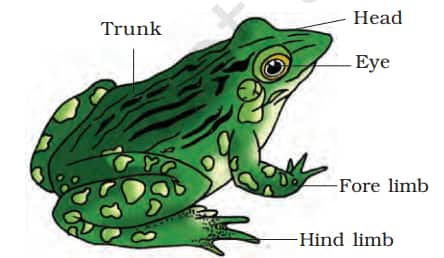
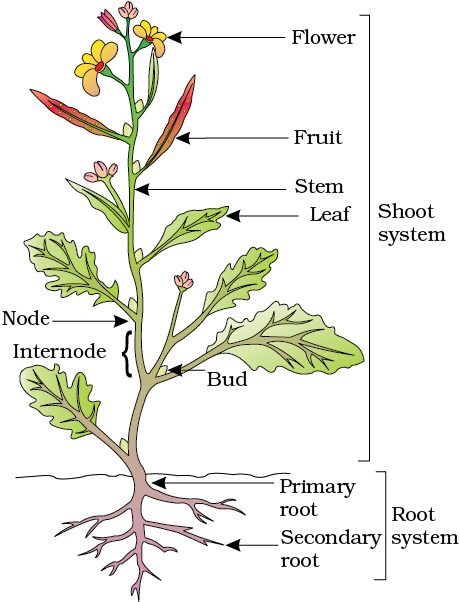
Question 7. Practice drawing various animals and plants.
Answer:
By practising the various plants and animals, you can understand the main characteristics of that species. Students can take the help of teachers and parents to gain more suggestions about the labelled drawings.
A well-labelled diagram of a frog is given below:
A well-labelled diagram of a flowering plant is given below:
Question 8. Describe one example of adaptive radiation.
Answer:
The process of evolution of different species in a given geographical area, starting from a point and radiating to other areas of geography, is called adaptive radiation.
Darwin’s finches represent one of the best examples of this phenomenon. From the original seed-eating features, many other forms with different beak structures and different food habits, such as herbivores and carnivores, have evolved.
Several marsupials, each different from the other, evolved from an ancestral stock, but all within the Australian Island continent.
Question 9. Can we call human evolution adaptive radiation?
Answer:
The evolution of man is an example of directional evolution and not an example of adaptive radiation, as adaptive radiation is the process of diversification of species starting from one point at a particular time and then radiating to other areas of habitats. Darwin’s finches are the best example of adaptive radiation, as is the phenomenon of Australian marsupials. Diversification, which is the main characteristic of adaptive radiation, is not a part of human evolution.
Answer:
There are 5 evolutionary stages of horses, which are given below:
Period | Name of the evolutionary stage | Features of the animal |
Eocene | Eohippus | 4 digits in forelimbs, the size of a fox, lived on soft ground |
Oligocene | Mesohippus | 3 digits in toes, live in dry conditions |
Miocene | Merychippus | It was 100 cm tall with 3 toes on each foot, taller with a longer neck |
Pliocene | Pliohippus | It had a single functional toe and was about 108 cm tall. |
Pleistocene | Equus | They have one toe on each foot. Premolars replaced by molars, well-adapted for running. |
NCERT Solutions for Class 12- Subject-wise
Get your results instantly with our calculator!
Evolution explains the origin of life and the gradual changes in organisms over generations through genetic variations and natural selection. Given below are the main topics of this evolution chapter.
Origin of Life
Evidence of Evolution (Morphological, Anatomical, Embryological, Palaeontological, and Molecular)
Homologous and Analogous Organs
Adaptive Radiation
Darwin’s Theory of Natural Selection
Mechanism of Evolution
Hardy–Weinberg Principle and Equilibrium
Genetic Drift and Founder Effect
Types of Natural Selection (Stabilising, Directional, Disruptive)
Human Evolution
Provided below are a few steps that students can follow to answer the questions of the Evolution chapter easily.
Firstly, it's important to go through the NCERT textbook line by line. Most of the questions directly come from this in the exam.
Understand theories of Lamarckism, Darwinism, natural selection, Genetic Drift, and the Hardy-Weinberg principle.
Try to understand the concepts by taking the help of examples like the giraffe (Lamarck), etc. These are well explained in the Class 12 Biology Chapter 6 Evolution question answer.
Make the flow charts to learn the sequence of the origin of humans and their features. Students can also take help from the Evolution Class 12 question answers.
Also, check the NCERT Books and the NCERT Syllabus here:
Evolution covers some of the most important concepts in understanding how life on Earth has changed over time. Given below are some of the important questions that can guide students. For more such questions, students can rely on the NCERT Solutions for Class 12 Biology Chapter 6 Evolution.
Question 1: The theory of spontaneous generation states that:
1. Life arose from living forms only
2. Life can arise from both living and non-living
3. Life can arise from non-living things only.
4. Life arises spontaneously, neither from living nor from the non-living.
Answer: The correct answer is Option 3. Life can arise from non-living things only.
Explanation:
The theory assumes that life could have formed from non-animated matter. The theory that life could have formed from non-animated matter is known as abiogenesis. It suggests that simple organic compounds, such as amino acids, formed spontaneously under early Earth conditions, eventually leading to the development of complex life forms. Abiogenesis contrasts with the idea of life being created through divine or external intervention.
Question 2: Variations during mutations of meiotic recombination are:
1. random and directionless
2. random and directional
3. small and directional
4. random, small, and directional
Answer: The correct answer is Option 1), random and directionless
Explanation:
Variations arising from mutations and meiotic recombination are indeed random and directionless. Mutations occur due to changes in the DNA sequence, which can result from errors during replication, exposure to mutagens, or spontaneous alterations.
Question 3: Which type of selection explains the industrial melanism observed in the moth, Boston Bulgaria:
1. Stabilising
2. Directional
3. Disruptive
4. Artificial
Answer: The correct answer is Option 2, Directional
Explanation:
One instance of directional selection is the industrial melanism seen in the Biston betularia moth.
Tree trunks darkened as a result of soot deposition brought on by pollution during the Industrial Revolution. In contrast to their lighter counterparts, this gave dark-coloured (melanistic) moths superior concealment, enabling them to avoid predators more successfully. As a result, throughout time, the population began to favour moths with darker hues.
Question 4: The most accepted line of descent in human evolution is:
1. Australopithecus → Ramapithecus → Homo sapiens → Homo habilis
2. Homo erectus → Homo habilis → Homo sapiens
3. Ramapithecus → Homo habilis → Homo erectus → Homo sapiens
4. Australopithecus → Ramapithecus → Homo erectus → Homo habilis → Homo sapiens.
Answer: The correct answer is Option 1, Australopithecus → Ramapithecus → Homo sapiens → Homo habilis
Explanation:
This is the progression of early human ancestors in evolutionary terms. Ramapithecus is considered one of the earliest hominins. It is dated to be 14 to 5 million years old. After that, Homo habilis appeared about 2.8 million years ago and was characterized by the use of stone tools. Then, around 1.9 million years ago, came Homo erectus, which had a larger brain and used fire. So, finally, our species, Homo sapiens, emerged about 300,000 years ago, with developed cognitive abilities and cultural development.
Question 5: Analogous organs arise due to:
1. Divergent evolution
2. Artificial selection
3. Genetic drift
4. Convergent evolution
Answer: The correct answer is Option 4, Convergent evolution
Explanation:
Analogous organs are structures that have evolved in different species from different ancestral origins but perform similar functions. These organs are a result of convergent evolution, where unrelated organisms independently develop similar traits as a response to similar environmental pressures or ecological niches.
Question 6: The forelimbs of whales, bats, and humans are examples of:
Options:
1. Analogous organs
2. Homologous organs
3. Vestigial organs
4. Neoteny
Answer: The correct answer is Option 2, Homologous organs
Explanation:
Homologous organs have the same structural design and origin but may perform different functions. The forelimbs of whales, bats, and humans share a common ancestry, showing divergent evolution.
Question 7: Palaeontological evidence for evolution refers to the:
Options:
1. Development of the embryo
2. Homologous organs
3. Fossils
4. Analogous organs
Answer: The correct answer is Option 3, Fossils
Explanation:
Fossil studies fall under the domain of palaeontology. In scientific nomenclature, "paleo-" means an item of history or ancient things. Therefore, palaeontology refers to the scientific study that specializes in reconstructing the history of life on Earth based on the fossilised remains under investigation. These organisms offer crucial information regarding how extinct organisms behaved, their habitat, and evolved.
NCERT Exemplar Class 12 Solutions
The chapter on evolution helps students understand how life originated over millions of years. It explains the evidence, mechanisms, and theories that form the foundation of evolutionary biology.
Students learn about the process of evolution and key experiments like Miller’s that explained the origin of life.
The Class 12 Biology Evolution question answer explains Darwin’s theory of natural selection, Lamarckism, and the mutation theory in simple steps.
Learners explore different evidence of evolution, including homologous organs, analogous organs, fossils, and embryological studies, which are asked in the board exams and competitive exams like NEET.
Through the Class 12 Biology Evolution question answer, students get a clear idea of concepts like adaptive radiation, speciation, genetic drift, and Hardy-Weinberg equilibrium.
The solutions also help students understand the evolutionary history of humans and how modern humans evolved through different stages.
Students will understand how life evolved on the Earth billions of years ago, with the help of the Evolution chapter. Different processes like natural selection, genetic drift, and adaptive radiation are also included in the chapter.
Going beyond the NCERT syllabus can provide you with extra help in NEET. It helps students cover areas that may not be included in the textbook but are still important for the exam. To practice diagrams, students can use the NCERT Solutions for Class 12 Biology Chapter 6 Evolution.
Given below are the chapter-wise links:
Frequently Asked Questions (FAQs)
Darwin’s theory of natural selection is based on the following five fundamental principles:
Enormous fertility in living beings
Struggle for existence
Variations under nature
Natural selection or survival of the fittest
Origin of species
The Hardy-Weinberg principle provides a simple mathematical model of how genetic equilibrium is maintained in a gene pool.
Fossils are relics of former living plants or animals that are embedded in the dugout of rock in past geological periods. They are mostly found in sedimentary rocks.
Fossil records provide a complete history of certain organisms that indicate that evolution has taken place for several years.
Genetic drift describes changes in gene frequency, and these changes are due to events that are unrelated to the inherited traits. Genetic drift tends to reduce the amount of genetic variation within the population, mainly as a result of the loss of alleles, and thus plays an important role in evolution.
Speciation is the evolutionary process by which populations evolve to become distinct species. It occurs when populations of the same species become genetically isolated from each other and undergo different evolutionary changes.

On Question asked by student community
Hello Gilla
You can download the question paper from the link given below:
https://school.careers360.com/boards/cbse/cbse-previous-year-question-papers-class-10-maths
Hope it helps.
Hello Student,
Check the article given below to access and download the CBSE question paper for classes 10 and 12.
Link:
https://school.careers360.com/boards/cbse/cbse-previous-year-question-papers
Dear Student,
You can appear for improvement exams in other passed subjects after clearning compartment exams. The Central Board of Secondary Education (CBSE) conducts the CBSE Class 12 improvement exams for students who are not satisfied with their scores in the Class 10 and Class 12 board examinations.
You can
Hi Madhuri,
For CBSE Class 12 Maths preparation, especially if your basics are weak, please refer to the link given below:
https://school.careers360.com/boards/cbse/cbse-class-12-maths-preparation-tips
Hi Jatin!
Given below is the link to access CBSE Class 12 English Previous Year Questions:
https://school.careers360.com/download/ebooks/cbse-class-12-english-previous-year-question-papers
For subjectwise previous year question papers, you might find this link useful:
https://school.careers360.com/boards/cbse/cbse-previous-year-question-papers-class-12
A block of mass 0.50 kg is moving with a speed of 2.00 ms-1 on a smooth surface. It strikes another mass of 1.00 kg and then they move together as a single body. The energy loss during the collision is
| Option 1)
|
Option 2)
|
| Option 3)
|
Option 4)
|
An athlete in the olympic games covers a distance of 100 m in 10 s. His kinetic energy can be estimated to be in the range
| Option 1)
|
Option 2)
|
| Option 3)
|
Option 4)
|
A particle is projected at 600 to the horizontal with a kinetic energy . The kinetic energy at the highest point
| Option 1)
|
Option 2)
|
| Option 3)
|
Option 4)
|
In the reaction,
| Option 1)
|
Option 2)
|
| Option 3)
|
Option 4)
|
How many moles of magnesium phosphate, will contain 0.25 mole of oxygen atoms?
| Option 1)
0.02 |
Option 2)
3.125 × 10⁻² |
| Option 3)
1.25 × 10⁻² |
Option 4)
2.5 × 10⁻² |

Enrol for Aakash Re-NEET 2026 Victory Batch at Rs. 99 only. Batch start 16th May.
Study at a world-renowned UK university in India | Admissions open for UG & PG programs.
Apply for UG & PG programmes from Victoria University, Delhi NCR Campus
Admissions open for UG & PG programs at Illinois Tech Mumbai
Apply for UG & PG courses at University of Aberdeen, Mumbai Campus
UG & PG Admissions open for CS/AI/Business/Economics & other programmes.