


CBSE Percentage Calculation Method Class 12: How to Check Percentage of Marks 12th Class
The Central Board of Secondary Education (CBSE) has announced the CBSE Class 12 result 2026 on May 13, 2026. Students can access their subject-wise marks through the CBSE's official website at cbseresults.nic.in or results.digilocker.gov.in. To calculate the CBSE Class 12 percentage, students need to add up the marks obtained in their five main subjects and then divide the total by 5. The CBSE follows a nine-point grading system, assigning grades from A1 (highest) to E (lowest). This system is used to evaluate a student's performance comprehensively.
This Story also Contains
- Steps to Calculating Your Percentage CBSE Class 12 :
- CBSE Class 12 Evaluation Criteria
- Difference Between Percentage and Percentile

Students can calculate their CBSE 12th percentage using online percentage calculators or manually with pen and paper. The CBSE Class 12 percentage will play an important role in the undergraduate admission process for certain universities.
Steps to Calculating Your Percentage CBSE Class 12 :
Identify the Main Subjects: The CBSE board calculates percentages based on marks in five main subjects. These subjects exclude additional subjects like Physical Education or elective courses. The CBSE 12th marksheet will indicate which subjects are considered for the percentage calculation.
Add Up the Marks: Once students have identified five main subjects, simply add together the marks received in each subject.
Divide by the Total Marks: The total marks possible for all five subjects combined is usually 500 (assuming each subject has a maximum of 100 marks). Divide the sum of marks in all five subjects by 500.
Multiply by 100 to Get the Percentage: Finally, multiply the result from step 3 by 100 to convert it into a percentage. This will be the overall CBSE Class 12 percentage.
Example:
Let's say you scored the following marks in your five main subjects:
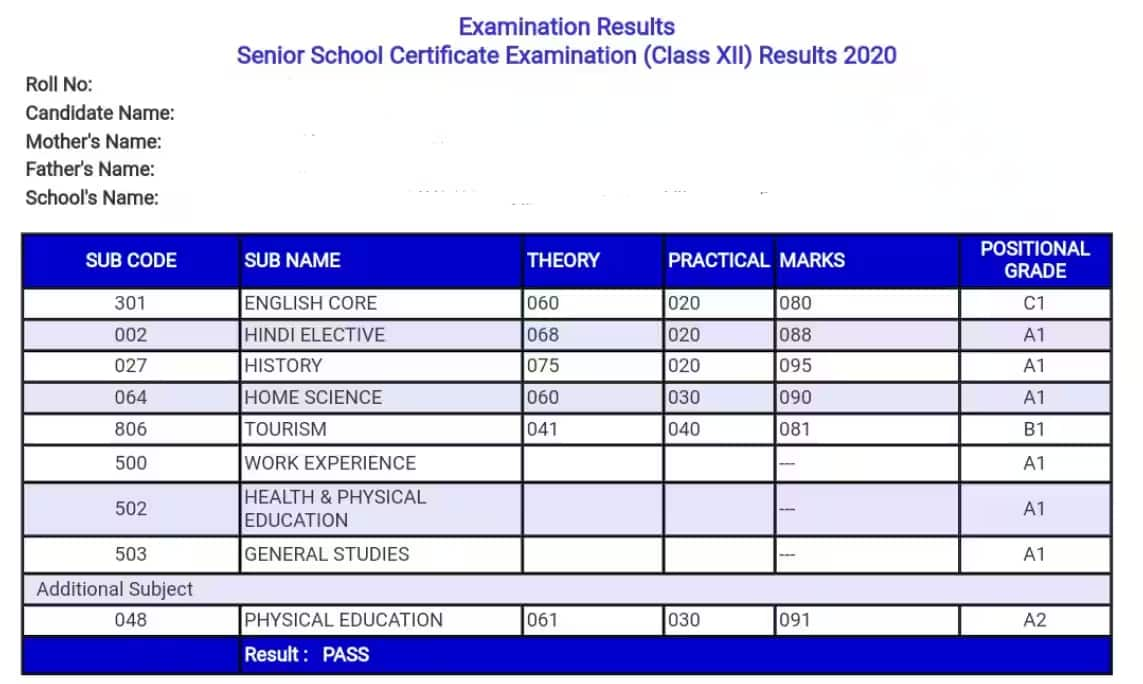
- English Core: 80
- Hindi Elective: 88
- History: 95
- Home Science: 90
- Tourism: 81
Calculation:
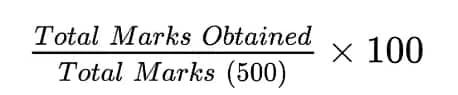
- Total of Marks = 80 + 88 + 95 + 90 + 81 = 434
- Result (after division): 434 ÷ 500 = 0.868
- Percentage: 0.866 × 100 = 86.8%
Therefore, the CBSE Class 12 percentage in this example would be 86.8%. There are several online percentage calculator tools, including percentagecalculator.net and calculator.net. Moreover, if a candidate has presented more than five subjects, the responsibility of selecting the top five subjects may lie with the admitting institution or employer.
Also, it should be noted that the Board does not compute, announce, or disclose the percentage of marks. If the percentage of marks is necessary for further education or employment purposes, any calculations required may be carried out by the admitting institution or employer.
Also, check:
CBSE Class 12 Evaluation Criteria
The CBSE Class 12 board exams in 2026 will have a question paper format comprising:
- 20% Multiple Choice Questions (MCQs) or objective questions
- 30% Competency-based questions
- 50% Subjective or short/long answer questions
CBSE 12th Class Grading System
| Marks Range | Grade | Grade Point |
| 91-100 | A1 | 10.0 |
| 81-90 | A2 | 9.0 |
| 71-80 | B1 | 8.0 |
| 61-70 | B2 | 7.0 |
| 51-60 | C1 | 6.0 |
| 41-50 | C2 | 5.0 |
| 33-40 | D | 4.0 |
| 21-32 | E1 | C |
| 00-20 | E2 | C |
Confused between CGPA and Percentage?
Get your results instantly with our calculator!
Difference Between Percentage and Percentile
While both terms are related to numbers and comparisons, they have distinct meanings:
Percentage: It is a numerical value expressed as a fraction of 100. It's used to compare quantities. If a candidate scores 80 out of 100 on a test, they've scored 80%.
Percentile: It measure used in statistics that indicates the value below which a given percentage of observations in a group of observations fall. It's used to rank values within a dataset. If they're in the 90th percentile, it means they scored better than 90% of the people who took the test.
A percentage expresses a fraction of a whole as a number out of 100. For instance, scoring 80 out of 100 on a test means they've achieved 80%. In contrast, a percentile indicates a rank within a group. If they're in the 90th percentile, they've performed better than 90% of the individuals in that group. Essentially, a percentage quantifies a portion, while a percentile ranks the position relative to others.
Frequently Asked Questions (FAQs)
To calculate your CBSE Class 12 percentage, add the marks obtained in your five main subjects and divide the total by 500. Multiply the result by 100 to get the percentage. Additional subjects are usually not included unless specified by the admitting institution.
No, CBSE does not calculate or announce the Class 12 percentage. The Board only provides subject-wise marks and grades. If a percentage is required for admission or employment, it must be calculated by the student or by the concerned university or employer.
No, CBSE does not calculate or announce the Class 12 percentage. The Board only provides subject-wise marks and grades. If a percentage is required for admission or employment, it must be calculated by the student or by the concerned university or employer.
To calculate your CBSE Class 12 percentage, add the marks obtained in your five main subjects and divide the total by 500. Multiply the result by 100 to get the percentage. Additional subjects are usually not included unless specified by the admitting institution.

Questions related to CBSE Class 12th
On Question asked by student community
Hello Student,
Check the useful resources given below:
https://school.careers360.com/articles/most-repeated-questions-in-physics-class-12-cbse
https://school.careers360.com/boards/cbse/cbse-12th-exam-pattern
Hope it helps!
Hi Teena,
You can check the Hindi class 12th question paper .
if you need more resources please let us know.
Hi Lalit,
Here you can check the question paper.
https://school.careers360.com/boards/cbse/cbse-class-12-economics-question-paper-2026
if you need any other resources please let us know.
Hi Kanha,
You can download all subjects class 12th question paper from the given link .
https://school.careers360.com/boards/cbse/cbse-class-12-question-paper-2026
if you need any other resources please let us know.
Dear Student,
Please refer to the link provided below for the question papers in Hindi :|
https://school.careers360.com/hi/articles/cbse-previous-year-question-papers-class-12
If you need any other resource, do let us know.