


NCERT Solutions for Class 9 Maths Chapter 10 Exercise 10.1 - Heron's Formula
It is tough to determine the area of a triangle whose height is unknown through conventional means. Using Heron’s Formula gives a separate method to determine area measurements when have information about all three sides of the triangle. The math principle applies semiperimeter concepts through a particular formula to find precise areas without requiring height measurements. The formula enables to resolve practical problems that include summations of triangle components even when we lack information about their height value.
This Story also Contains
- NCERT Solutions Class 9 Maths Chapter 10: Exercise 10.1
- Access Solution of Number Systems Class 9 Chapter 10 Exercise: 10.1
- Topics Covered in Chapter 10, Heron's Formula: Exercise 10.1
- NCERT Solutions of Class 9 Subject Wise
- NCERT Exemplar Solutions of Class 9 Subject Wise
Matter experts at our institution developed NCERT Solutions for Class 9 Maths Chapter 10 Exercise 10.1, which provide students with stepwise solutions for understanding and implementing the formula easily. The solutions provide exam success benefits and show students how mathematical operations apply to real-life situations. Also, along with this, you'll find NCERT Books to study all the chapters and other subjects in a comprehensive manner.
Access Solution of Number Systems Class 9 Chapter 10 Exercise: 10.1
Answer:
Given: Perimeter of the equilateral triangle is 180 cm.
Therefore each side of triangle is:
a = 1803 = 60 cm
Now, Calculate the semi-perimeter:
s = Perimeter2=1802 = 90 cm
Use Heron’s Formula to find the area, that is:
Area = s(s−a)(s−b)(s−c)
Thus,
Area = 90(90−60)(90−60)(90−60)=90×30×30×30
Area = 90×27000=2430000=9003 cm2.
 Answer:
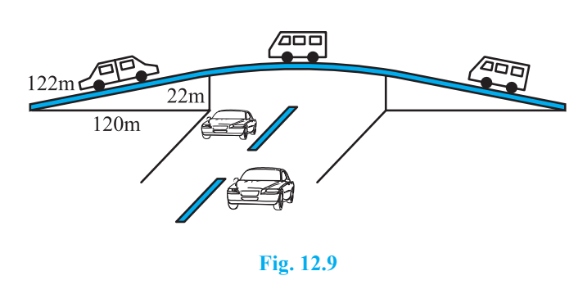
From the figure,
Let, the sides of the triangle be:
a = 122m, b = 120m and c = 22m
Therefore, the semi-perimeter, s, will be
s=a+b+c2=122+120+222=2642=132m
Thus, Area ( using Heron’s formula ):
A=s(s−a)(s−b)(s−c)
=132(132−122)(132−120)(132−22) m2
=132(10)(12)(110) m2
=(12×11)(10)(12)(11×10) m2=1320 m2
Given, the rent for 1 year (i.e., 12 months) per square meter is Rs. 5000.
Thus, rent for 3 months per square meter will be:
Rs. 5000×312
Therefore, for 3 months for 1320 m2:
Rs. 5000×312×1320=Rs. 16,50,000.
 Answer:
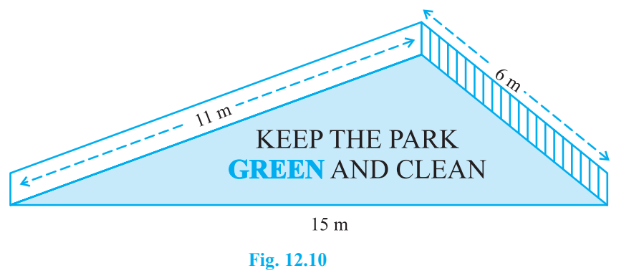
We are given the sides of the triangle, that are:
a = 15 m, b = 11m and c = 6m
So, the semi-perimeter of the triangle will be:
s=a+b+c2=15+11+62=322=16m
Therefore, area painted in colour is:
A=s(s−a)(s−b)(s−c)
=16(16−15)(16−11)(16−6)
=16(1)(5)(10)
=(4×4)(1)(5)(5×2)
=4×52=202 m2
Q4 Find the area of a triangle two sides of which are 18cm and 10cm and the perimeter is 42cm.
Answer:
Given the perimeter of the triangle is 42cm and the lengths of two sides, a = 18 cm and b = 10 cm.
So, a+b+c=42cm
Or, c=42−18−10=14cm
Thus, the semi-perimeter of the triangle will be:
s=Perimeter2=42cm2=21cm
Therefore, the area given by the Heron's Formula will be,
A=s(s−a)(s−b)(s−c)
=21(21−18)(21−10)(21−14)
=(7×3)(3)(11)(7)
=2111 cm2
Q5 Sides of a triangle are in the ratio of 12 : 17 : 25 and its perimeter is 540cm. Find its area.
Answer:
Given the sides of a triangle are in the ratio of 12 : 17 : 25 and its perimeter is 540 cm.
Let, the length of one side of the triangle to be a=12x
Then, the remaining two sides be b=17x and c=25x.
Thus, by the given perimeter,
Perimeter = a + b + c = 12x + 17x + 25x = 540cm
⟹54x=540cm
⟹x=10
Therefore, the sides of the triangle are:
a=12×10=120cm
b=17×10=170cm
c=25×10=250cm
The semi-perimeter of the triangle is:
s=540cm2=270cm
Therefore, using Heron's Formula, the area of the triangle is:
A=s(s−a)(s−b)(s−c)
=270(270−120)(270−170)(270−250)
=270(150)(100)(20)
=81000000=9000cm2
Answer:
Given, the perimeter of an isosceles triangle is 30 cm and the length of the sides which are equal is 12 cm.
Let the third side length be 'a cm'.
Then, Perimeter=a+b+c
⇒30=a+12+12
⇒a=6cm
So, the semi-perimeter of the triangle is:
s=Perimeter2=12×30cm=15cm
Therefore, using Heron's Formula, the area of the triangle is:
A=s(s−a)(s−b)(s−c)
=15(15−6)(15−12)(15−12)
=15(9)(3)(3)
=915 cm2
Confused between CGPA and Percentage?
Get your results instantly with our calculator!
Topics Covered in Chapter 10, Heron's Formula: Exercise 10.1
- Heron’s Formula: Heron’s Formula is used to find the area of a triangle when the lengths of all three sides are known. It is especially useful when the height is not given.
- Area of a Triangle using side lengths: The calculation of area begins with finding the semi-perimeter which allows you to use Heron’s Formula. The formula: Area = s(s−a)(s−b)(s−c) and consists of sides a, b, c and semi-perimeters.
- Application of Heron’s Formula in real-life contexts: The area of unidentified land plots and building designs and triangular garden beds depends on applying Heron’s Formula using only measurements of the sides.
- Cost and earnings-based problem-solving.
Also see-
NCERT Solutions of Class 9 Subject Wise
Students must check the NCERT solutions for class 9 of the Mathematics and Science Subjects.
NCERT Exemplar Solutions of Class 9 Subject Wise
Students must check the NCERT solutions for class 9 of the Mathematics and Science Subjects.
Frequently Asked Questions (FAQs)
There are three types of triangle
Right-angled triangle
Isosceles triangle
Scalene triangle
When the triangle is right-angled, we may use two sides containing the right angle as the base and height to apply the formula directly. these two sides are base and perpendicular
Area of a right-angled triangle = 0.5 × perpendicular × base
As two sides of an isosceles triangle are equal, we find the midpoint of the non-equal side of the triangle. Then we connect that midpoint to the vertex above it, and the isosceles triangle is divided into two right-angle triangles. We can then get the area of each right-angle triangle and sum them to get the area of the isosceles triangle.
As the equilateral triangle has all sides equal so it is easy to find the midpoint of the base side. Then we join that midpoint with the vertex above and this is how equilateral triangles get separated into two right-angle triangles then we can find the area of both right-angle triangles and then add them so as to get the area of an equilateral triangle
Making the traffic board
Creating posters for advertisement
Area of a slide to get the quantity of paint required
The metre (m) or centimetre (cm) are the units of measurement for length and width, respectively.
The area of any flat figure is measured in square metres (m^2), square centimetres (cm^2)
Exercise 10.1 Class 9 Maths covers all types of basic questions in which we have to apply the heron formula on triangles making real-life examples out of the question that make them interesting to solve but basic premise to apply formula only.

Popular Questions
A block of mass 0.50 kg is moving with a speed of 2.00 ms-1 on a smooth surface. It strikes another mass of 1.00 kg and then they move together as a single body. The energy loss during the collision is
| Option 1)
|
Option 2)
|
| Option 3)
|
Option 4)
|
An athlete in the olympic games covers a distance of 100 m in 10 s. His kinetic energy can be estimated to be in the range
| Option 1)
|
Option 2)
|
| Option 3)
|
Option 4)
|
A particle is projected at 600 to the horizontal with a kinetic energy . The kinetic energy at the highest point
| Option 1)
|
Option 2)
|
| Option 3)
|
Option 4)
|
In the reaction,
| Option 1)
|
Option 2)
|
| Option 3)
|
Option 4)
|
How many moles of magnesium phosphate, will contain 0.25 mole of oxygen atoms?
| Option 1)
0.02 |
Option 2)
3.125 × 10⁻² |
| Option 3)
1.25 × 10⁻² |
Option 4)
2.5 × 10⁻² |