Do you know why the boiling point of water increases by adding a pinch of salt, or how the molar mass of a substance can be determined by scientists easily just by observing a change in temperature? The answer to all these interesting facts lies in NCERT Solutions for Class 12 Chemistry Chapter 1 Solutions. These solutions explain how solutes and solvents interact, give basic knowledge about key concentration terms, and important laws.
Live | May 14, 2026 | 11:36 AM IST
This Story also Contains
NCERT Solutions for Class 12 Chemistry Chapter 1: Download PDF
NCERT Solution for Class 12 Chapter 1 (Intext Questions)
NCERT Solutions for Class 12 Chemistry Chapter 1 (Exercise Questions)
Class 12 Chemistry NCERT Chapter 1: Higher Order Thinking Skills (HOTS) Questions
Approaches to Solve Problems of Chapter 1 Chemistry Class 12
Topics of NCERT Syllabus Class 12 Chemistry Solutions
What Extra Should Students Study Beyond the NCERT for JEE/NEET?
What Students Learn from NCERT Solutions for Class 12 Chemistry Chapter 1 Solutions
Importance of Class 12 Chemistry Chapter 1 – Solutions
NCERT solutions for class 12 chemistry
NCERT Solutions for Class 12 Other Subjects
NCERT Solutions for Class 12 Chemistry Chapter 1 Solutions
In this article, we have provided class 12 chemistry chapter 1 solutions question answers that covers all exercise and in-text questions. NCERT Solutions for Class 12 Chemistry are designed by subject experts to help students develop analytical and critical thinking skills. To further enhance logical reasoning and problem-solving ability, carefully selected HOTS questions are also included. Step by step solutions for all exercises are provided below, students can scroll down to access them.
NCERT Solutions for Class 12 Chemistry Chapter 1: Download PDF
Students can download the class 12 chemistry chapter 1 solutions question answer pdf for free. These solutions are designed to help you understand the fundamental concepts and solve textbook questions with ease. They give simple, easy answers that help you understand tough topics.
NCERT Solution for Class 12 Chapter 1 (Intext Questions)
Here are detailed and accurate solutions class 12 question answer for Intext Questions.They help students understand the concepts and make it easier to revise important topics for exams. These NCERT Solutions for Class 12 will help in better concept clarity and exam preparation.
NCERT Solutions for Class 12 Chemistry Chapter 1 (Exercise Questions)
Here are detailed and accurate NCERT solutions for Exercise Questions of Class 12 Chemistry Chapter 1. These solutions will help in better concept clarity and exam preparation.
It is clear that for 1 mol of $\mathrm{Na}_2 \mathrm{CO}_3$ 2 mol of HCl is required, similarly for 1 mol of $\mathrm{NaHCO}_3$ 1 mol of HCl is required.
So number of moles required of HCl = 2(0.00526) + 0.0053 = 0.01578 mol
It is given that molarity of HCl is 0.1 which means 0.1 mol of HCl in 1 L of solution.
Both alcohol and water individually have strong hydrogen bonds as their force of attraction. When we mix alcohol with water they form solution due to the formation of hydrogen bonds but they are weaker as compared to hydrogen bonds of pure water or pure alcohol.
Thus this solution shows a positive deviation from the ideal behaviour.
It is known that dissolution of gas in a liquid is an exothermic process. So, by Le Chatelier principle we know that equilibrium shifts backwards as we increase temperature in case of exothermic process. Thus gases always tend to be less soluble in liquids as the temperature is raised.
According to Henry's law at a constant temperature, the solubility of a gas in a liquid is directly proportional to the partial pressure of the gas present above the surface of the solution or liquid.
i.e., p = kh.x, Here kh is Henry’s law constant.
Some of its applications are as follows:-
(a) We can increase the solubility of CO2 in soft drinks, the bottle is sealed under high pressure.
(b) To avoid bends (due to blockage of capillaries) and the toxic effects of high concentrations of nitrogen in the blood, the tanks used by scuba divers are filled with air diluted with helium (11.7% helium, 56.2% nitrogen and 32.1% oxygen).
(c) The partial pressure of oxygen is less at high altitudes than at ground level. This leads to low concentrations of oxygen in the blood and tissues, climbers. Due to low blood oxygen, climbers become weak and unable to think clearly, which are symptoms of a condition known as anoxia.
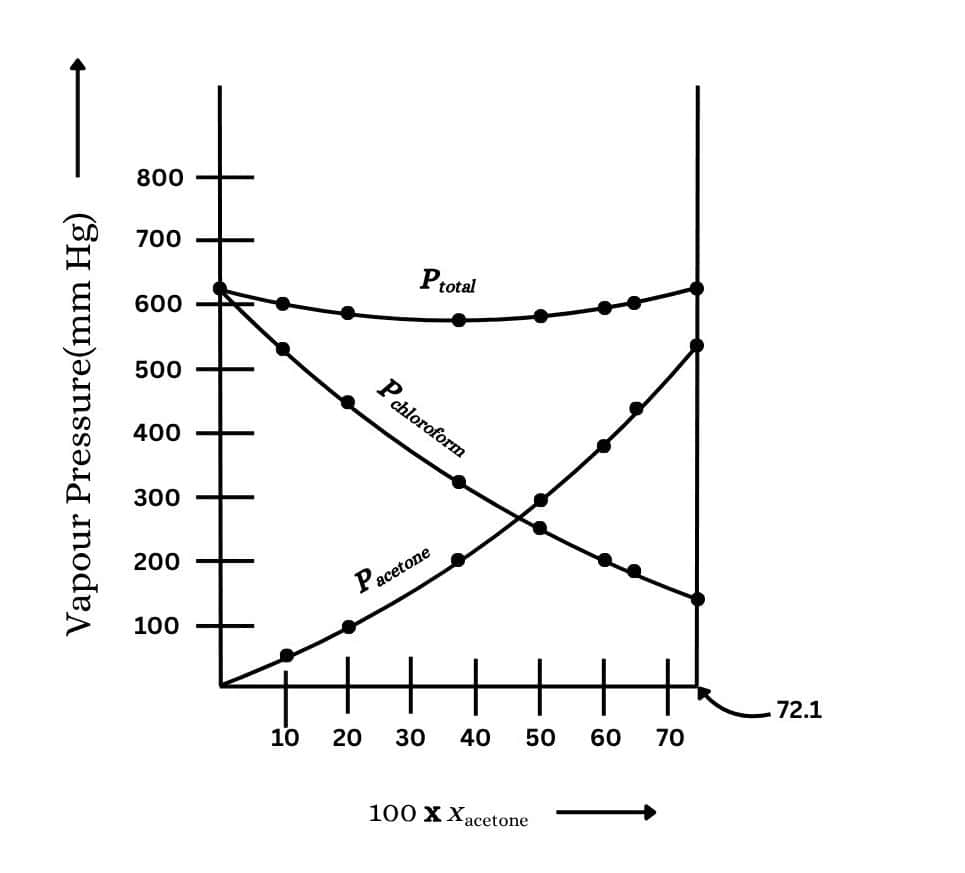
Positive and negative deviation: - A non-ideal solution is defined as a solution which does not obey Raoult’s law over the entire range of concentration i.e., $\Delta _{Mix}H \neq 0$ and $\Delta _{Mix}V \neq 0$ . The vapour pressure of these solutions is either higher or lower than that expected by Raoult’s law. If vapour pressure is higher, the solution shows a positive deviation and if it is lower, it shows a negative deviation from Raoult’s law.
Enthalpy relation to positive and negative deviation can be understood from the following example:-
Consider a solution made up of two components - A and B. In the pure state the intermolecular force of attraction between them are A-A and B-B. But when we mix the two, we get a binary solution with molecular interaction A-B.
If A-B interaction is weak than A-A and B-B then enthalpy of reaction will be positive thus reaction will tend to move in a backward direction. Hence molecules in binary solution will have a higher tendency to escape. Thus vapour pressure increases and shows positive deviation from the ideal behaviour.
Similarly, for negative deviation, A-B interaction is stronger than that of A-A and B-B.
$\mathrm{K}_2 \mathrm{SO}_{4(\mathrm{~s})} \rightarrow 2 \mathrm{~K}_{(\mathrm{aq})}^{+}+\mathrm{SO}_4{ }^{2-}{ }_{(\mathrm{aq})}$ It is clear that 3 ions are produced, so the value of i will be 3.
Molecular weight of K 2 SO 4 = 2(39) + 1(32) + 4(16) = 174u.
💡 Conversion Formula used is: Percentage = CGPA × 9.5
Class 12 Chemistry NCERT Chapter 1: Higher Order Thinking Skills (HOTS) Questions
These HOTS class 12 chemistry chapter 1 solutions question answer are designed to test students understanding and application of concepts. These NCERT Solutions help in developing critical thinking skills and prepare students for complex questions in competitive exams.
The freezing point depression of a 0.1 m aqueous solution of a monobasic weak acid HA is $0.20^{\circ} \mathrm{C}$. The dissociation constant for the acid is
Given :
$\mathrm{K}_{\mathrm{f}}\left(\mathrm{H}_2 \mathrm{O}\right)=1.8 \mathrm{~K} \mathrm{~kg} \mathrm{~mol}^{-1}$, molality $\equiv$ molarity
The solution showing positive deviation from Raoult's law will form a minimum boiling azeotrope. Phenol + Aniline shows negative deviation, so they will not form a minimum boiling azeotrope.
A binary mixture of $\mathrm{C}_6 \mathrm{H}_5 \mathrm{OH}$ and $\mathrm{C}_6 \mathrm{H}_5 \mathrm{NH}_2$ exhibits negative deviation from Raoult's law. This means that the vapor pressure of the solution is lower than the vapor pressures of the pure components, $\mathrm{C}_6 \mathrm{H}_5 \mathrm{OH}$ and $\mathrm{C}_6 \mathrm{H}_5 \mathrm{NH}_2$. Consequently, the boiling point of the solution is higher than the boiling points of the pure substances. Therefore, this mixture forms a maximum boiling azeotrope.
Hence, the correct answer is option (2).
Question 3. Given below are two statements : Statement (I) : Molal depression constant $\mathrm{K}_{\mathrm{f}}$ is given by $\frac{M_1 R T_f}{\Delta S_{f u s}}$, where symbols have their usual meaning. Statement (II) : $\mathrm{K}_{\mathrm{f}}$ for benzene is less than the $\mathrm{K}_f$ for water.
In the light of the above statements, choose the most appropriate answer from the options given below :
(1) Statement I is incorrect but Statement II is correct
(2) Both Statement I and Statement II are incorrect
(3) Both Statement I and Statement II are correct
(4) Statement I is correct but Statement II is incorrect
Hence statement-I is correct
but $\mathrm{k}_{\mathrm{f}}$ for benzene $=5.12 \frac{{ }^{\circ} \mathrm{C}}{\text { molal }}$
$\mathrm{k}_{\mathrm{f}}$ for water $=1.86 \frac{{ }^{\circ} \mathrm{C}}{\text { molal }}$ Hence statement- II is incorrect
Hence, the correct answer is option (4).
Question 4. 20 mL of sodium iodide solution gave 4.74 g silver iodide when treated with excess of silver nitrate solution. The molarity of the sodium iodide solution is ________ M. (Nearest Integer value)
(Given : $\mathrm{Na}=23, \mathrm{I}=127, \mathrm{Ag}=108, \mathrm{~N}=14$, $\left.\mathrm{O}=16 \mathrm{~g} \mathrm{~mol}^{-1}\right)$
Question 5. Liquid A and B form an ideal solution. The vapour pressure of pure liquids A and B are 350 and 750 mm Hg respectively at the same temperature. If $\mathrm{x}_{\mathrm{A}}$ and $x_B$ are the mole fraction of $A$ and $B$ in solution while $y_A$ and $y_B$ are the mole fraction of $A$ and $B$ in vapour phase then :
Choose the correct answer from the options given below :
(1) (A)-(III), (B)-(I), (C)-(IV), (D)-(II)
(2) (A)-(II), (B)-(IV), (C)-(I), (D)-(III)
(3) (A)-(III), (B)-(IV), (C)-(I), (D)-(II)
(4) (A)-(II), (B)-(I), (C)-(IV), (D)-(III)
Answer:
Acetone + chloroform shows negative deviation and forms maximum boiling point azeotrope. Ethanol and water show positive deviation and form minimum boiling point azeotrope.
Benzene + toluene $\Rightarrow$ Ideal solution
Hence, $\Delta \mathrm{V}_{\text {mix }}=0$
Acetic acid will dimerise in benzene.
Hence, the correct answer is option (1).
Question 7: The vapour pressure of an aqueous solution is found to be 720 torr at a temperature $T$ . The same solution shows an elevation in boiling point of 0.78 K . If $T$ is the boiling point of pure water, calculate the atmospheric pressure at which the solution boils. $\mathrm{K}_{\mathrm{b}}$ (water) $=0.52 \mathrm{~K} \mathrm{~kg} \mathrm{~mol}^{-1}$
Answer:
Vapour pressure of solution at $T=720$ torr
$T=$ boiling point of pure water
Elevation in boiling point:
$\Delta T_b=0.78 \mathrm{KK}_b=0.52 \mathrm{~K} \mathrm{~kg} \mathrm{~mol}^{-1} 0.78=0.52 \times m \Rightarrow m=1.5 \mathrm{~mol} \mathrm{~kg}^{-1}$
For dilute solution:
$\frac{\Delta P}{P^0} \approx \frac{n_2}{n_1}$
Take 1 kg water:
Question 8: A solution is prepared by dissolving 0.10 mol of KSO in sufficient water to make 1 L of solution. It is found experimentally that the freezing point depression of the solution corresponds to a van’t Hoff factor of 2.4. Which of the following is the most appropriate conclusion?
(1) $\mathrm{K}_2 \mathrm{SO}_4$ is completely dissociated in the solution
(2) $\mathrm{K}_2 \mathrm{SO}_4$ is partially dissociated in the solution
(3) $\mathrm{K}_2 \mathrm{SO}_4$ is partially dissociated in the solution
(4) $\mathrm{K}_2 \mathrm{SO}_4$ undergoes association in the solution
Hence dissociation is incomplete
No association (which would give $i<1$ )
- $i=1 \rightarrow$ no dissociation
- $i>1 \rightarrow$ dissociation
- $i<1 \rightarrow$ association
- Actual $i<$ theoretical $i \rightarrow$ partial dissociation
Approaches to Solve Problems of Chapter 1 Chemistry Class 12
Sometimes, problems related to class 12 chemistry chapter 1 solutions seem difficult, but once we understand the basic formulas, it becomes very easy to solve all the questions related to Solutions. We can follow the steps given below to solve the questions based on the Solutions:
1. The first step is to identify the solute and solvent and learn to classify the solution based on the states of components like solid in liquid, gas in liquid, etc. Also, learn to apply the concentration formulas
Molarity (M), Molality (m), Mole fraction (χ), Mass %, Volume %
(i). Molarity
$M=\frac{\text { moles of solute }}{\text { volume of solution in liters }}$
(ii). Molality
$m=\frac{\text { moles of solute }}{\text { mass of solvent in } \mathrm{kg}}$
(iii). Mole Fraction
$X_A=\frac{\text { moles of component } A}{\text { total moles of solution }}$
2. Important formulas from chapter 1 solutions class 12 chemistry are given below. These formulas help students to solve questions easily.
Henry's Law: $P=k_H \cdot x$ for gas solubility.
Raoult's Law- For ideal solutions, use $p_A=x_A \cdot p_A^0$.
Apply to vapor pressure problems.
3. Identify which property is involved ( $\Delta \mathrm{Tf}, \Delta \mathrm{Tb}, \pi, \Delta \mathrm{P}$ ).
Use-
(i). Elevation in Boiling Point : $\Delta T_b=i \cdot K_b \cdot m$
(iii). Osmotic Pressure: $\pi=i \cdot C \cdot R \cdot T$
4. Learn to determine if solute dissociates or associates. Adjust formulas using ? for non-ideal cases.
5. While solving questions from class 12 chemistry chapter 1 solutions the numericals, keep units consistent and understand what each symbol represents. You can also draw diagrams for clarity also focus on ideal vs non-ideal solutions, positive/negative deviations, and azeotropes. Students can also access the NCERT exemplar solutions for better understanding.
Topics of NCERT Syllabus Class 12 Chemistry Solutions
The NCERT Solutions for Class 12 Chemistry Chapter 1 Solutions cover all the important topics included in the syllabus in a well structured manner. They help students understand each concept clearly and practise questions topic-wise for better exam preparation. Topics covered in NCERT are given below:
1.4.2 Raoult's Law as a special case of Henry's Law
1.4.3 Vapour Pressure of Solutions of Solids in Liquids
1.5 Ideal and Non-ideal Solutions
1.5.1 Ideal Solutions
1.5.2 Non-ideal Solutions
1.6 Colligative Properties and Determination of Molar Mass
1.6.1 Relative Lowering of Vapour Pressure
1.6.2 Elevation of Boiling Point
1.6.3 Depression of Freezing Point
1.6.4 Osmosis and Osmotic Pressure
1.6.5 Reverse Osmosis and Water Purification
1.7 Abnormal Molar Masses
What Extra Should Students Study Beyond the NCERT for JEE/NEET?
Here a comparison table highlighting what to study beyond NCERT for JEE. While NCERT books build a strong foundation, students should also refer to advanced reference books and practice materials. Solving class 12 chemistry chapter 1 solutions question answer can help strengthen problem-solving skills and improve exam performance.
What Students Learn from NCERT Solutions for Class 12 Chemistry Chapter 1 Solutions
These class 12 chemistry chapter 1 solutions help students understand the key concepts of the solid state in a simple and structured way. Given below some points on key learning from this chapter
Using these solutions students can understand the fundamental concepts of the solid state.
Here they can learn about types of solids and their properties.
Properties like unit cells, crystal lattices, and packing efficiency are explained very well in these solutions class 12 question answer
These solutions help students to calculate the density and voids in crystals
Imperfections in solids, coordination number and geometrical arrangements are explained in these solutions very well.
Importance of Class 12 Chemistry Chapter 1 – Solutions
The class 12 chemistry chapter 1 solutions question answer develops the base for understanding the behaviour of mixtures in both laboratory and industrial applications.
The chapter develops the basic understanding of homogeneous and heterogeneous mixtures.
Students will learn about concentration terms and their calculations.
The class 12 chemistry solutions question answer explains how temperature, pressure, and the nature of solute and solvent affect solubility.
Colligative Properties like relative lowering of vapour pressure, elevation in boiling point, depression in freezing point, and osmotic pressure are discussed here.
NCERT solutions for class 12 chemistry
Along with NCERT Solutions for Class 12 Chemistry Chapter 1 Solutions also refer to chapter-wise solutions for the entire Class 12 Chemistry syllabus:
NCERT Solutions for Class 12 Chemistry Chapter 1 Solutions
Along with NCERT Solutions for Class 12 Chemistry, students can also check solutions for other subjects that are equally important for board exams and competitive exams like JEE and NEET.
Q: What are NCERT Solutions for Class 12 Chemistry Chapter 1?
A:
NCERT Solutions for Class 12 Chemistry Chapter 1 are detailed answers to all questions provided in the textbook. They explain concepts of the solutes and solvents and related numerical problems in a simple manner to help students understand and practise for exams.
Q: How to get NCERT solutions for Class 12 chemistry Ch 1?
A:
You can get NCERT solutions for Class 12 Chemistry Chapter 1 from various educational websites and online learning platforms. They are also available as free downloadable PDFs, which can be accessed anytime for easy study and revision.
Q: What is Raoult's Law?
A:
Raoult's Law states that the vapor pressure of a solvent in a solution is directly proportional to the mole fraction of the solvent in that solution.
Q: What is the difference between molarity and molality?
A:
Molarity (M) refers to the number of moles of solute per liter of solution, whereas molality (m) is the number of moles of solute per kilogram of solvent. The key difference is that molarity uses the total volume of the solution, while molality considers only the mass of the solvent, making molality independent of temperature.
Q: What is meant by concentration of a solution?
A:
Concentration of a solution indicates how much solute is present in a given amount of solvent or solution. It can be expressed in various ways, such as molarity, molality, mass percentage, or parts per million.
Q: What is Solution?
A:
A solution is a homogeneous mixture composed of two or more substances. In a solution, a solute is dissolved in a solvent. The solute is typically present in a smaller amount, while the solvent is present in a larger amount.
Q: What are NCERT Solutions?
A:
NCERT Solutions are detailed answers to all questions provided in the textbook. They explain concepts and related numerical problems in a simple, step-by-step manner.
Q: What are the different types of solutions discussed in class 12 chemistry chapter 1 solutions ?
A:
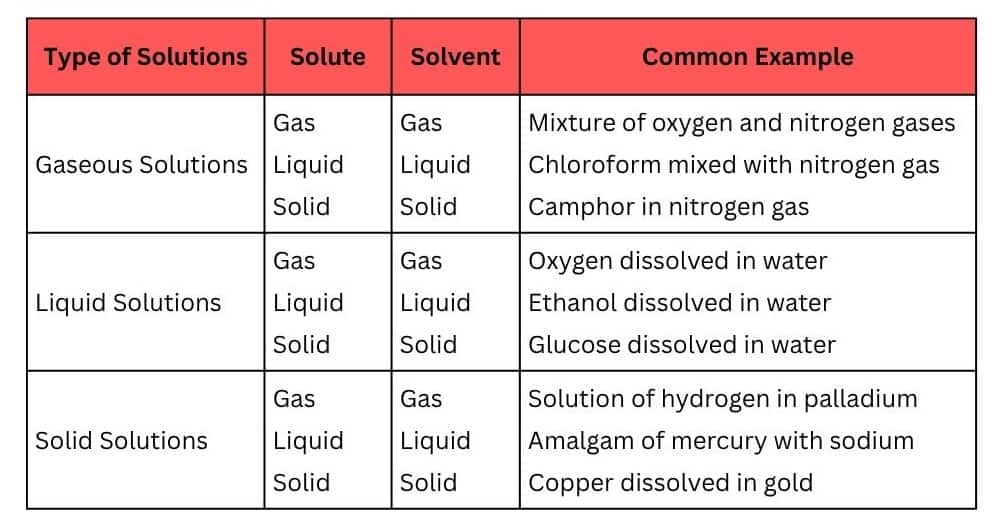
The chapter discusses various types of solutions, including solid solutions, liquid solutions, and gaseous solutions. It also differentiates between saturated, unsaturated, and supersaturated solutions, providing a comprehensive understanding of how solutes dissolve in solvents.
Q: What are colligative properties, and why are they important?
A:
Colligative properties are properties of solutions that depend on the number of solute particles in a given amount of solvent, rather than the identity of the solute. These properties include boiling point elevation, freezing point depression, vapor pressure lowering, and osmotic pressure.
Q: How does temperature affect solubility, as discussed in chapter 1 solutions class 12 chemistry ?
A:
The class 12 chemistry solutions question answer explains that temperature can have a significant impact on the solubility of solids and gases. Generally, the solubility of solids in liquids increases with an increase in temperature, while the solubility of gases decreases.
You can appear for improvement exams in other passed subjects after clearning compartment exams. The Central Board of Secondary Education (CBSE) conducts the CBSE Class 12 improvement exams for students who are not satisfied with their scores in the Class 10 and Class 12 board examinations.
A block of mass 0.50 kg is moving with a speed of 2.00 ms-1 on a smooth surface. It strikes another mass of 1.00 kg and then they move together as a single body. The energy loss during the collision is
A person trying to lose weight by burning fat lifts a mass of 10 kg upto a height of 1 m 1000 times. Assume that the potential energy lost each time he lowers the mass is dissipated. How much fat will he use up considering the work done only when
A pulley of radius 2 m is rotated about its axis by a force F = (20t - 5t2) newton (where t is measured in seconds) applied tangentially. If the moment of inertia of the pulley about its axis of rotation is 10 kg m2 , the