Emversity
Get Job Ready in Healthcare | Employability-Focused Programs


The Navodaya Vidyalaya Samiti has released the NVS Class 9 exam syllabus. Students can check the JNV Class 9 Syllabus on the official website of JNV, navodaya.gov.in. The subjects from which questions are asked are English, Hindi, Science, and Maths, and the NVS Class syllabus of these subjects is provided below.
This Story also Contains

The JNVST exam for the 9th Class will be conducted on April 10, 2027. With the announcement of the Navodaya exam date, students should start preparing with a focused approach. Students must focus on obtaining the latest NVS Class 9 syllabus, as this will aid them in effectively targeting their studies and prioritising important topics. Read the complete article to learn about the JNVST Class 9 syllabus 2027-28.
The NVS Class 9 syllabus is instrumental to students in preparing well for the upcoming JNVST exam and obtain a high score. Students can check the details about the NVS Class 9 exam here.
Particulars | Details |
|---|---|
Name of the examination | Jawahar Navodaya Vidyalaya Selection Test (JNVST) |
Exam type | NVS entrance exam |
Conducting authority | Navodaya Vidyalaya Samiti |
Navodaya Vidyalaya admission 2027-28 | |
Mode of examination | Offline (OMR-based) |
Date of examination | April 10, 2027 |
April 2027 | |
April 2027 | |
Examination centre | Pan India |
Medium of examination | Hindi & English |
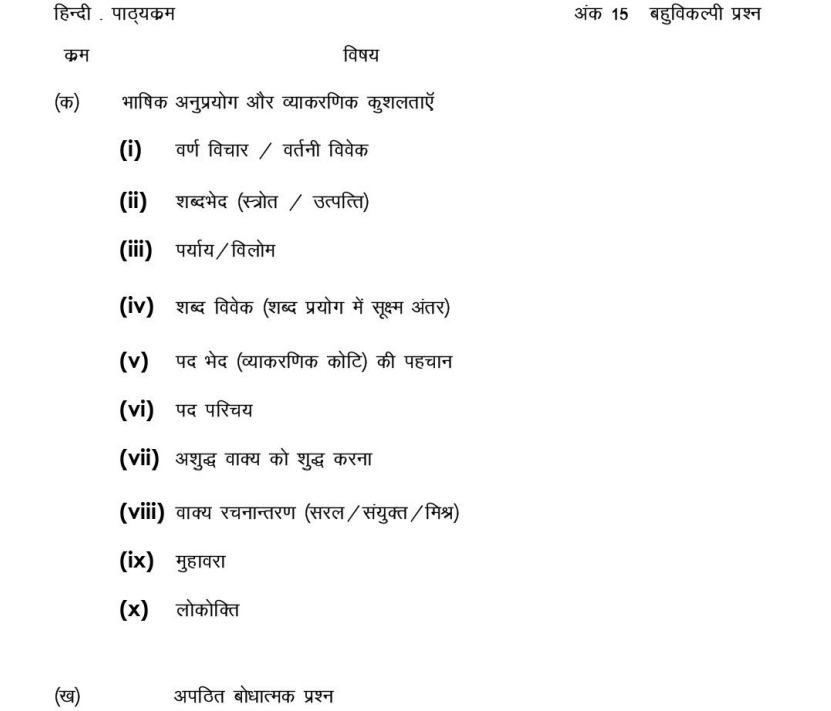
The JNVST Class 9 exam contains Mathematics, Science, Hindi & English questions. Check the complete NVS Class 9 syllabus here for these subjects.
1. Comprehension (Unseen Passage)
2. Words and Sentences
3. Structure and Spelling
4. Rearranging jumbled words
5. Passivation
6. Use of degrees of comparison
7. Modal auxiliaries
8. Use of prepositions
9. Tense forms
10. Reported speech
Chapter No. | Chapters & Solution Links | Topics |
|---|---|---|
Chapter 1 | Crop Production and Management | Agricultural Practices, Basic Practices of Crop Production, Preparation of Soil, Agricultural Implements, Sowing, Adding Manures and Fertilisers, Irrigation, Protection from Weeds, Harvesting, Storage, Food from Animals |
Chapter 2 | Microorganisms: Friend and Foe | Microorganisms, Where Do Microorganisms Live, Microorganisms and Us, Harmful Microorganisms, Food Preservation, Nitrogen Fixation, Nitrogen Cycle |
Chapter 3 | Coal and Petroleum | Coal, Petroleum, Natural Gas, and some natural resources are Limited |
Chapter 4 | Combustion and Flame | What is Combustion?, How do We Control Fire?, Types of Combustion, Flame, Structure of Flame, What is a Fuel, Fuel Efficiency |
Chapter 5 | Conservation of Plants and Animals | Deforestation and its Causes, Consequences of Deforestation, Conservation of Forest and Wildlife, Biosphere Reserve, Flora and Fauna, Endemic Species, Wildlife Sanctuary, National Park, Red Data Book, Migration, Recycling of Paper, Reforestation |
Chapter 6 | Reproduction in Animals | Modes of Reproduction, Sexual Reproduction, Asexual Reproduction |
Chapter 7 | Reaching the Age of Adolescence | Adolescence and Puberty, Changes at Puberty, Secondary Sexual Characters, Role of Hormones in Initiating Reproductive Function, Reproductive Phase of Life in Humans, How is the Sex of the Baby Determined?, Hormones Other than Sex Hormones, Role of Hormones in Completing the Life History of Insects and Frogs, Reproductive Health |
Chapter 8 | Force and Pressure | Force – A Push or a Pull, Forces are due to an Interaction, Exploring Forces. A Force can Change the State of Motion, Force can Change the Shape of an Object, Contact Forces, Non-contact Forces, Pressure, Pressure Exerted by Liquids and Gases; Atmospheric Pressure |
Chapter 9 | Friction | Force of Friction, Factors Affecting Friction, Friction: A Necessary Evil, Increasing and Reducing Friction, Wheels Reduce Friction, Fluid Friction |
Chapter 10 | Sound | Sound is produced by a Vibrating Body. Sound Produced by Humans, Sound Needs a Medium for Propagation, We Hear Sound Through Our Ears, Amplitude, Time Period and Frequency of a Vibration, Audible and Inaudible Sounds, Noise and Music, Noise Pollution |
Chapter 11 | Chemical Effects of Electric Current | Do Liquids Conduct Electricity?, Chemical Effects of Electric Current. Electroplating |
Chapter 12 | Some Natural Phenomena | Lightning, Charging by Rubbing, Types of Charges and their Interaction, Transfer of Charge, The Story of Lightning, Lightning Safety, Earthquakes |
Chapter 13 | Light | What Makes Things Visible, Laws of Reflection, Regular and Diffused Reflection, Reflected Light Can Be Reflected Again, Multiple Images, Sunlight - White or Coloured? What is Inside Our Eyes, Care of the Eyes, Visually Impaired Persons Can Read and Write, What is the Braille System? |
Rational Numbers
Cubes and Cube Roots
Direct and Inverse Proportions
Exponents and Powers
Squares and Square Roots
Linear Equations in One Variable
Algebraic Expressions and Identities, including Factorisation
Comparing Quantities (Percentage, Profit and Loss, Discount, Simple and Compound Interest)
Data Handling (Bar graph, pie chart, organising data, probability).
Understanding Quadrilaterals (Parallelogram, rhombus, rectangle, square, kite)
Mensuration: a)Area of plane figures b)Surface area and volume of cube, cuboids, and cylinders
Get Job Ready in Healthcare | Employability-Focused Programs
Get your results instantly with our calculator!
Candidates are required to access the official website and obtain the Navodaya Vidyalaya Class 9 syllabus 2027-28 for future reference. The following steps will assist candidates in retrieving the JNV Class 9 syllabus 2027-28.
Visit the official website of Navodaya Vidyalaya, navodaya.gov.in.
Navigate to the designated section for the ‘Prospectus Cum Application Form’ section on the homepage
On the next page, the candidate will find the ‘CLASS IX PROSPECTUS 2027-28 ’; click on it
Next, a PDF will open on the screen. Check the syllabus section in this PDF
Keep a printed or digital copy of the downloaded syllabus for easy reference.
Frequently Asked Questions (FAQs)
The Navodaya Class 9 curriculum will encompass Hindi, General Science, English, and Mathematics. A comprehensive syllabus has been provided for students to reference.
Yes, this NVS Class 9 exam will be of the objective type or MCQ type.
Navodaya's Class 9 exam is conducted in English and Hindi.
The Navodaya Vidyalaya Class 9 syllabus includes four sections: English, Hindi, Math, and Science.

On Question asked by student community
Hi Vaibhavi
You can download previous years’ Jawaharlal Navodaya Vidyalaya Selection Test (JNVST) question papers with answers using the links below.
For Class 6:
https://school.careers360.com/download/jnvst-ebooks-and-sample-papers
For Class 9:
https://school.careers360.com/articles/jnvst-class-9-question-paper
https://school.careers360.com/articles/jnvst-class-9-answer-key
Please specify whether you need the Class 6 or Class 9 question papers so I can guide you to the
Hello, JNV Class 6 admission ke forms ki dates har admission cycle ke according change hoti hain. Agar aap Navodaya Class 6 admission ke next session ke liye form bharna chahte hain, to student ki current Class aur date of birth bata dijiye. Main aapko eligibility aur form bharne ka
Hello Student,
The Jawahar Navodaya Vidyalaya Selection Test (JNVST) for Class 6 is scheduled to be held on November 28, 2026.
Hello Student,
Refer to the relevant link provided below:
https://school.careers360.com/articles/jnvst-class-6-mock-test-2027-pdf
Hello there,
If you are asking for the JNVST Class 11 2027 PDF, please clarify whether you want the official notification or prospectus PDF, the application form, or the list of JNV schools for Class 11 admission. I can then provide the correct information.
Best wishes!

Get Job Ready in Healthcare | Employability-Focused Programs