
Search Colleges, Exams, Schools & more


Login
CBSE Class 12 Chemistry Lab Manual 2026: Experiments, Practicals (Free PDF Download)
Laboratory work is a significant part of the CBSE Class 12 Chemistry curriculum. The CBSE Class 12 Chemistry lab manual 2026 helps students move beyond theoretical concepts by conducting hands-on experiments in organic, inorganic, and physical chemistry. Every experiment in the CBSE 12th Chemistry lab manual builds practical skills that prepare students for the final CBSE 12th board exams 2026 as well as higher studies in science and engineering. In this article, students can find the complete list of unit-wise lab manuals, free PDF download links, and a few preparation tips to help students organise the lab work.
Live | Oct 9, 2026 | 1:30 AM IST
This Story also Contains
- Download CBSE Class 12 Chemistry Lab Manual 2026 PDFs
- What is Included in the CBSE 12th Chemistry Lab Manual 2026?
- How to Prepare for CBSE Class 12 Chemistry Practical Exams 2026?
- Example of Experiments for CBSE 12th Chemistry (Lab Work)
Download CBSE Class 12 Chemistry Lab Manual 2026 PDFs
The table below lists all the units and experiments in the CBSE Class 12 Chemistry lab manual 2026. Students can click on the free PDF download links to access the same:
Particulars | PDF Download Link |
|---|---|
Unit 1 (Colloids) | |
Unit 2 (Chemical Kinetics) | |
Unit 3 (Thermochemical Measurement) | |
Unit 4 (Electrochemistry) | |
Unit 5 (Chromatography) | |
Unit 6 (Titrimetric Analysis – Redox Reaction) | |
Unit 7 (Systematic Qualitative Analysis) | |
Unit 8 (Tests for Functional Groups in Organic Compounds) | |
Unit 9 (Preparation of Inorganic Compounds) | |
Unit 10 (Preparation of Organic Compounds) | |
Unit 11 (Tests for Carbohydrates, Fats and Proteins) | |
Projects |
What is Included in the CBSE 12th Chemistry Lab Manual 2026?
The CBSE Class 12 Chemistry lab manual 2026 covers all major branches of the subject. Some of the activities include:
Determining the rate of a reaction and the effect of concentration (Chemical Kinetics).
Measuring enthalpy changes during chemical reactions (Thermochemical Measurements).
Performing electrochemical cell experiments to study cell potential.
Conducting chromatography to separate components of a mixture.
Performing redox titrations for volumetric analysis.
Identifying functional groups in organic compounds such as alcohols, aldehydes, and carboxylic acids.
Testing for carbohydrates, fats, and proteins in food samples.
Confused between CGPA and Percentage?
Get your results instantly with our calculator!
💡 Conversion Formula used is: CGPA = Percentage / 9.5
How to Prepare for CBSE Class 12 Chemistry Practical Exams 2026?
The practicals carry significant weightage for the CBSE 12th Chemistry subject. Students must prepare properly for the Chemistry practicals to get a good score in the subject. Some useful tips to prepare for the CBSE 12th practical exam are listed below:
Go through each experiment’s aim, principle, and procedure carefully.
Maintain a neat and updated practical record book with diagrams, etc.
Revise important precautions, observation tables, and inference steps.
Perform mock titrations and qualitative analyses to boost confidence before exams.
Example of Experiments for CBSE 12th Chemistry (Lab Work)
Aim:
To prepare acetanilide.
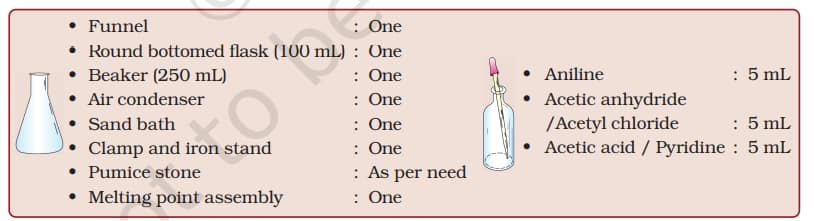
Materials Required:
Process:
Step 1: Take 5 mL of aniline in a 100 mL round-bottom flask and add the acetylating mixture containing 5 mL acetic anhydride and 5 mL glacial acetic acid. Alternatively, you can use 5 mL of acetyl chloride and 5 mL of dry pyridine as the acctylating mixture.
Step 2: Fit an air condenser on the mouth of the round-bottom flask after adding a few pumice stones and reflux the mixture gently for 10-15 minutes on a sand bath.
Step 3: Cool the reaction mixture and pour it slowly into 150-200 mL of ice-cold water with stirring.
Step 4: Filter the solid, wash it with cold water and recrystallise a small amount of sample from hot water containing a few drops of methanol or ethanol.
Step 5: Report the yield and the melting point of the compound.
50+ Entrance Exams after 12th
Download this ebook to explore 50+ entrance exams after Class 12 for admission into top undergraduate colleges across engineering, management, law & more.
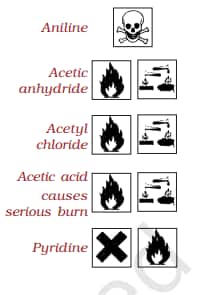
Download NowPrecautions:
Also, Check: CBSE 12th Chemistry Syllabus 2026
CBSE Class 12th Syllabus: Subjects & Chapters
Select your preferred subject to view the chapters
Frequently Asked Questions (FAQs)
Q: How can I score full marks in the CBSE 12th Chemistry practical exam 2026?
A:
Focus on neat lab records, accurate titrations, clear observations, and confident viva answers. Also, revise the theory portion for each experiment properly.
Q: Where can I download the official Class 12 Chemistry lab manual PDFs?
A:
Students can use the free PDF download links provided in the article above.
Q: Are practical experiments mandatory for board exams?
A:
Students must perform all listed experiments and submit the record book for internal evaluation. For CBSE 12th Chemistry, the practicals and IA carry 30 marks out of a total of 100 marks.
Articles
Related Stories
|
Upcoming School Exams

Certifications By Top Providers
Explore Top Universities Across Globe
Questions related to CBSE Class 12th
On Question asked by student community
Have a question related to CBSE Class 12th ?
Hi Teena,
You can check the Hindi class 12th question paper .
if you need more resources please let us know.
Hi Lalit,
Here you can check the question paper.
https://school.careers360.com/boards/cbse/cbse-class-12-economics-question-paper-2026
if you need any other resources please let us know.
Hi Kanha,
You can download all subjects class 12th question paper from the given link .
https://school.careers360.com/boards/cbse/cbse-class-12-question-paper-2026
if you need any other resources please let us know.
Dear Student,
You can download the previous CBSE Class 12 marksheet through DigiLocker. You can also access your digital marksheet through platforms such as DigiLocker and UMANG.
Dear Student,
Please refer to the link provided below for the question papers in Hindi :|
https://school.careers360.com/hi/articles/cbse-previous-year-question-papers-class-12
If you need any other resource, do let us know.

Applications for Admissions are open.
Get Job Ready in Healthcare | Employability-Focused Programs
CBSE Class 12th Notifications
Never miss CBSE Class 12th update
Get timely CBSE Class 12th updates directly to your inbox. Stay informed!