
Search Colleges, Exams, Schools & more


Login
TS Intermediate Syllabus 2026-27 Out - Download Subject-Wise PDF Here
The Telangana Board of Intermediate Education (TGBIE) has released the TS Intermediate syllabus 2026-27 for both 1st year and 2nd year students on its official website, tgbie.cgg.gov.in. The latest Telangana Board 2027 syllabus includes subject-wise chapters, topics, and the prescribed curriculum for the TS Inter Public Examinations 2027. Students should thoroughly review the updated syllabus to understand the exam pattern, prioritise important topics, and plan their preparation effectively. In this article, students can get the direct download links to the TGBIE syllabus PDF 2026-27 for all subjects.
This Story also Contains
- Download TS Intermediate Syllabus 2026-27 PDF (1st and 2nd Year)
- Previous Year’s TS Intermediate 1st Year Syllabus 2025-26
- Previous Year’s TS Intermediate 2nd Year Syllabus 2025-26
- How to Download TS Inter Syllabus 2026-27 Online?
- TS Intermediate Exam 2027 Tips
Download TS Intermediate Syllabus 2026-27 PDF (1st and 2nd Year)
The Telangana Board 2026-27 syllabus is now available on the official website for first and second year students. Students can visit tgbie.cgg.gov.in to download syllabus PDFs for all subjects. They can also refer to the subsequent tables to get direct download links to previous year's TGBIE syllabus.
Download TS Inter 1st Year Syllabus 2026-27 PDFs (All Subjects)
| Subject | Download Link |
|---|---|
TS Inter 1st Year Zoology Syllabus 2026-27 | |
TS Inter 1st Year Urdu Syllabus 2026-27 | |
TS Inter 1st Year Telugu Syllabus 2026-27 | |
TS Inter 1st Year Sanskrit Syllabus 2026-27 | |
TS Inter 1st Year Political Science Syllabus 2026-27 | |
TS Inter 1st Year Physics Syllabus 2026-27 | |
TS Inter 1st Year Mathematics IB Syllabus 2026-27 | |
TS Inter 1st Year Mathematics IA Syllabus 2026-27 | |
TS Inter 1st Year History Syllabus 2026-27 | |
TS Inter 1st Year Hindi Syllabus 2026-27 | |
TS Inter 1st Year Economics Syllabus 2026-27 | |
TS Inter 1st Year Chemistry Syllabus 2026-27 | |
TS Inter 1st Year Commerce Syllabus 2026-27 | |
TS Inter 1st Year Accountancy Syllabus 2026-27 | |
TS Inter 1st Year Botany Syllabus 2026-27 | |
TS Inter 1st Year Arabic Syllabus 2026-27 |
Download TS Inter 2nd Year Syllabus 2026-27 PDFs (All Subjects)
| Subject | Download Link |
|---|---|
TS Inter 2nd Year History Syllabus 2026-27 | |
TS Inter 2nd Year Political Science Syllabus 2026-27 | |
TS Inter 2nd Year Commerce and Accountancy Syllabus 2026-27 | |
TS Inter 2nd Year Chemistry Syllabus 2026-27 | |
TS Inter 2nd Year Zoology Syllabus 2026-27 | |
TS Inter 2nd Year Physics Syllabus 2026-27 | |
TS Inter 2nd Year Botany Syllabus 2026-27 | |
TS Inter 2nd Year Mathematics IIB Syllabus 2026-27 | |
TS Inter 2nd Year Mathematics IIA Syllabus 2026-27 | |
TS Inter 2nd Year English Syllabus 2026-27 | |
TS Inter 2nd Year Urdu Syllabus 2026-27 | |
TS Inter 2nd Year Telugu Syllabus 2026-27 | |
TS Inter 2nd Year Sanskrit Syllabus 2026-27 | |
TS Inter 2nd Year Hindi Syllabus 2026-27 | |
TS Inter 2nd Year Arabic Syllabus 2026-27 |
Previous Year’s TS Intermediate 1st Year Syllabus 2025-26
| Subjects | Syllabus PDF links |
|---|---|
TS Class 11 Accountancy syllabus | |
TS Class 11 Botany syllabus | |
TS Class 11 Arabic syllabus | |
TS Class 11 Economics syllabus | |
TS Class 11 Mathematics IB syllabus | |
TS Class 11 Political Science syllabus | |
TS Class 11 Sanskrit syllabus | |
TS Class 11 Telugu syllabus | |
TS Class 11 Urdu syllabus | |
TS Class 11 Zoology syllabus |
Confused between CGPA and Percentage?
Get your results instantly with our calculator!
💡 Conversion Formula used is: CGPA = Percentage / 9.5
Previous Year’s TS Intermediate 2nd Year Syllabus 2025-26
| Particulars | Download Link |
|---|---|
TS Intermediate 2nd Year Commerce & Accountancy Syllabus 2025-26 | |
TS Intermediate 2nd Year Botany Syllabus 2025-26 | |
TS Intermediate 2nd Year Chemistry Syllabus 2025-26 | |
TS Intermediate 2nd Year Mathematics II(A) Syllabus 2025-26 | |
TS Intermediate 2nd Year Mathematics II(B) Syllabus 2025-26 | |
TS Intermediate 2nd Year Physics Syllabus 2025-26 | |
TS Intermediate 2nd Year Political Science Syllabus 2025-26 | |
TS Intermediate 2nd Year Zoology Syllabus 2025-26 | |
TS Intermediate 2nd Year Telugu Syllabus 2025-26 |
Previous Year's TS Syllabus 2nd Year 2024-25 PDF (Other Subjects)
How to Download TS Inter Syllabus 2026-27 Online?
Follow the pointers given below to download PDF files of the TSBIE syllabus:
Open the website at tgbie.cgg.gov.in.
On the homepage, click on ‘Syllabus’ as shown below in the sample image:
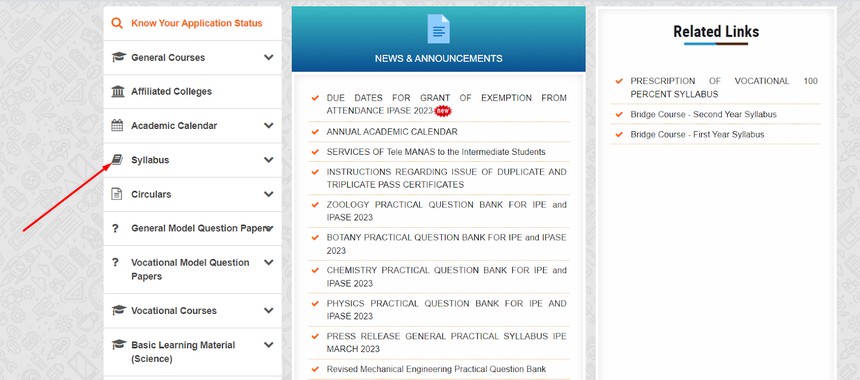
Now, click on the respective subject links to download their syllabus PDF.
Save the PDF file of the Telangana board syllabus 2nd year on your device for future reference.
50+ Entrance Exams after 12th
Download this ebook to explore 50+ entrance exams after Class 12 for admission into top undergraduate colleges across engineering, management, law & more.
Download NowTS Intermediate 2nd year English Syllabus Telangana 2026-27
| Section | Topics |
|---|---|
| Prose | Introduction – Importance of English Language, How to Avoid Foolish Opinions, Solution to Plastic Pollution, Guilt |
| Poetry | Fear, Awake, On the Grasshopper and Cricket, Goodbye Party for Ms Pushpa T.S. |
| Short Stories | The Woman on Platform No. 8, A Gift for Christmas, The Doctor's Word, An Interview |
| Composition & Language Activities | Introduction & Punctuation, Vocabulary (One-word Substitutions), Note Making, Reading Comprehension Passages, Understanding Non-verbal Data, Understanding Advertisements, Filling Forms, Letter Writing, Word Stress, Dialogue Writing, Study Skills (Idioms), Verb Patterns |
| Practicals | Communicative English, Describing Things, Listening Comprehension, Presentation Skills, Group Discussion |
TS Intermediate 2nd Year Syllabus 2026-27 for Mathematics II A
| Chapters | Topics |
|---|---|
Complex Numbers | Complex numbers as an ordered pair of real numbers and fundamental operations, Representation of complex numbers in the form a+ib, Modulus and Amplitude of complex numbers, illustrations, geometrical and polar representation of complex numbers in the Argand plane, Argand diagram. |
De Moivre's Theorem | De Moivre's theorem, integral and rational indices, nth roots of unity, geometrical interpretations, and illustrations. |
Quadratic Expressions | Quadratic expressions, equations in one variable, sign of quadratic expressions, change in signs, maximum and minimum values, quadratic inequalities. |
Theory Of Equations | Relation between the roots and coefficients in an equation, solving equations when two or more roots of it are connected by certain relations, equation with real coefficients, occurrence of complex roots in conjugate pairs and its consequences, transformation of equations, and reciprocal equations. |
Permutations And Combinations | The fundamental principle of counting - linear and circular permutations, permutations of 'n' dissimilar things taken 'r' at a time, permutations when repetitions allowed, circular permutations, permutations with constraint repetitions, combinations-definitions and certain theorems. |
Binomial Theorem | Binomial theorem for positive integral index, binomial theorem for rational index (without proof), approximations using binomial theorem. |
Partial Fractions | Partial fractions of f(x) / g(x) when g(x) contains non-repeated linear factors, partial fractions of f(x)/g(x) when g(x) contains repeated and/or non-repeated linear factors, partial fractions of f(x)/g(x) when g(x) contains irreducible factors. |
Measures Of Dispersion | Mean deviation, variance and standard deviation of ungrouped/grouped data, coefficient of variation, analysis of frequency distributions with equal means but different variances. |
Probability | Random experiments and events, the classical definition of probability, axiomatic approach and addition theorem of probability, independent and dependent events, conditional probability, multiplication theorem, Bayes ' theorem, random variables and probability distributions, random variables, theoretical discrete distributions, binomial and Poisson distributions. |
TS Intermediate 2nd Year Syllabus 2026-27 for Mathematics- II B
| Chapters | Topics |
|---|---|
Circle | Circle in standard form centre and radius of a circle length of a tangent, conditions for a line to be tangent, chord joining two points on a circle, equation of the tangent at a point on the circle, point of contact, etc |
System Of Circles | The angle between two intersecting circles, the radical axis of two circles, properties of common chord and common tangent of two circles, the radical centre, and the intersection of a line and a circle. |
Parabola | Conic sections, parabola, equation of the parabola in standard form, different forms of parabola, parametric equations, equations of tangent and normal at a point on the parabola ( cartesian and parametric), conditions for a straight line to be a tangent. |
Ellipse | Equation of ellipse in standard form, parametric equations, equation of tangent and normal at a point on the ellipse (cartesian and parametric), condition for a straight line to be a tangent. |
Hyperbola | Equation of hyperbola in standard form, parametric equations, equations of tangent and normal at a point on the hyperbola (cartesian and parametric), conditions for a straight line to be a tangent, asymptotes. |
Integration | Integration as the inverse process of differentiation, standard forms, properties of integrals, method of substitution, integration of algebraic expressions, exponential, logarithmic, trigonometric and inverse trigonometric functions, integration by parts, integration by partial fractions method, reduction formulae. |
Definite Integrals | Definite integral as the limit of a sum, interpretation of the definite integral as an area, fundamental theorem of integral calculus, reduction formulae, application of the definite integral to areas. |
Differential Equations | Formation of a differential equation, degree and order of an ordinary differential equation, solving differential equations by various methods. |
Telangana Intermediate Board 2026-27 Physics Syllabus
While studying Physics, students should understand the laws and concepts, practise the numericals, learn to derive formulas, and more. They can make the process of learning interesting by conducting experiments to understand the application of laws and phenomena. Students can refer to the table given below to know about the Intermediate 2nd year syllabus Telangana.
Chapters | Topics |
Waves | Transverse and longitudinal waves, Displacement relation in a progressive wave, The speed of a travelling wave, the principle of superposition of waves, the Reflection of waves, Beats, Doppler effect. |
Ray Optics and Optical Instruments | Reflection of Light by Spherical Mirrors, Refraction, Total Internal Reflection, Refraction at Spherical Surfaces and Lenses, Refraction through a Prism, Dispersion by a Prism, Some Natural Phenomena due to Sunlight, Optical Instruments. |
Wave Optics | Huygens Principle, Refraction and reflection of plane waves using Huygens Principle, Coherent and Incoherent Addition of Waves, Interference of Light Waves and Young's Experiment, Diffraction, Polarisation. |
Electric Charges and Fields | Electric Charges, Conductors and Insulators, Charging by Induction, Basic Properties of Electric Charge, Coulomb's Law, Forces between Multiple Charges, Electric Field, Electric Field Lines, Electric Flux, Electric Dipole, Dipole in a Uniform External Field, Continuous Charge Distribution, Gauss's Law, Application of Gauss's Law. |
Electrostatic Potential and Capacitance | Electrostatic Potential, Potential due to a Point Charge, Potential due to an Electric Dipole, Potential due to a System of Charges, Equipotential Surfaces, Potential Energy of a System of Charges, Potential Energy in an External Field, Electrostatics of Conductors, Dielectrics and Polarisation, Capacitors and Capacitance, The Parallel Plate Capacitor, Effect of Dielectric on Capacitance, Combination of Capacitors, Energy Stored in a Capacitor, Van de Graaff Generator. |
Current Electricity | Electric Current, Electric Currents in Conductors, Ohm's law, Drift of Electrons and the Origin of Resistivity, Limitations of Ohm's Law, Resistivity of various Materials, Temperature Dependence of Resistivity, Electrical Energy, Power, Combination of Resistors, Cells, emf, Internal Resistance, Cells in Series and in Parallel, Kirchhoff's Laws, Wheatstone Bridge, Meter Bridge. |
Moving Charges and Magnetism | Magnetic Force, Motion in a Magnetic Field, Motion in Combined Electric and Magnetic Field, Magnetic Field due to a Current Element, Biot-Savart Law, Magnetic Field on the Axis of a Circular Current Loop, Ampere's Circuital Law, The Solenoid and the Toroid, Force between Two Parallel Currents, the Ampere, Torque on Current Loop, Magnetic Dipole, The Moving Coil Galvanometer. |
Magnetism and Matter | The Bar Magnet, Magnetism and Gauss's Law, The Earth's Magnetism, Magnetisation and Magnetic Intensity, Magnetic Properties of Materials, Permanent Magnets and Electromagnets. |
Electromagnetic Induction | The Experiments of Faraday and Henry, Magnetic Flux, Faraday's Law of Induction, Lenz's Law and Conservation of Energy, Motional Electromotive Force, Energy Consideration: A Quantitative Study, Eddy Currents, Inductance, AC Generator. |
Alternating Current | AC Voltage Applied to a Resistor, Representation of AC Current and Voltage by Rotating Vectors, AC Voltage Applied to an Inductor, AC Voltage Applied to a Capacitor, AC Voltage Applied to a Series LCR Circuit, Power in AC Circuit: The Power Factor, LC Oscillations, Transformers. |
Electromagnetic Wave | Displacement Current, Electromagnetic Waves, Electromagnetic Spectrum. |
Dual Nature of Radiation and Matter | Electron Emission, Photoelectric Effect, Experimental Study of Photoelectric Effect, Photoelectric Effect and Wave Theory of Light, Einstein's Photoelectric Equation: Energy Quantum of Radiation, Particle Nature of Light: The Photon, Wave Nature of Matter. |
Atoms | Alpha-particle Scattering, Rutherford's Nuclear Model of Atom, Atomic Spectra and Bohr Model of the Hydrogen Atom, The Line Spectra of the Hydrogen Atom. |
Nuclei | Atomic Masses and Composition of Nucleus, Size of the Nucleus, Mass-Energy and Nuclear Binding Energy, Nuclear Force, Radioactivity, Nuclear Energy. |
Semiconductor Electronics: Materials, Devices And Simple Circuit | Classification of Metals, Conductors and Semiconductors, Intrinsic Semiconductor, Extrinsic Semiconductor, p-n Junction, Semiconductor diode, Application of Junction Diode as a Rectifier. |
Communication System | Elements of a Communication System, Basic Terminology Used in Electronic Communication Systems, Bandwidth of Signals, Bandwidth of Transmission Medium, Propagation of Electromagnetic Waves, Modulation and its Necessity, Amplitude Modulation, Production of Amplitude Modulated Wave, Detection of Amplitude Modulated Waves. |
Telangana Intermediate Board 2026-27 Geography Syllabus
Chapters | Topics |
Human Geography | Meaning, Nature, scope and relevance of Human Geography; Man - Environment relationships ; Branches of Human Geography - their general characteristics |
World Population | Distribution, density of population, Growth of population in the world. Composition of population: Age and Sex. Factors affecting/influencing the distribution of population Migration: Internal and international; Causes and consequences Human Development: concepts, Indicators and world patterns |
Economic Geography | Economic Geography: Definition, Scope and Significance ; Sectors of Economic activity: Concepts, changing trends. Primary Activities: Concepts, changing trends. Food gathering, pastoral, mining and subsistence agriculture. In modern agriculture, people engage in agricultural and allied activities. Fisheries - factors and important fishing grounds; agricultural regions of the world. Secondary Activities: Concepts. Manufacturing industries: Locational factors, types - distribution and production - Agro-based: Textile (cotton), forest-based (paper), Mineral-based (Iron and steel): Petrochemical. Small-scale manufacturing industries: locational factors, distribution and production. People engaged in secondary activities: examples Tertiary Economic activities: Concepts, Trade, Transport and tourism; services, people engaged in the tertiary activities with some examples Quaternary economic activities: Concepts, people engaged in the quaternary with some examples. |
World Transport and Trade | Relative significance of different means of transport - Land transport, Railways - transcontinental railways, Airways and Waterways. Factors affecting land, water and air transport ; World oceanic routes; important inland waterways and important canals ; International trade - Impact of globalisation and economic development. Role of WTO in International trade (World Trade Organization) |
Environment and Resources | Resources: Definition, Classification - Resource depletion Environment: Meaning, definition and components; Environmental conservation and management; sustainable development |
Human Settlements Settlement | Settlement types - rural and urban; urbanization trends and consequences |
Physiography | Locational characteristics; Physical setting; Physiographic divisions; Geology, Drainage system: The Himalayan and Peninsular System |
Climate | Origin of monsoon, climatic regions in India; distribution of temperature and rainfall Soils: Types and distribution, characteristics; Soil degradation and conservation Vegetation: Types and distribution Wildlife conservation, Biosphere reserves |
Population | Population: Size, Growth, Distribution and Density from 1901-2011; demographic characteristics: literacy, sex ratio; regional variations in population growth, Trends of Urbanization, population problems. Migration: International, National, causes and consequences. Human Development: Introduction and Regional Pattern |
Resources | Mineral and Energy Resource Base: distribution and production Minerals - Iron ore, Manganese and Bauxite; Power resources - Coal, Petroleum and natural gas, hydroelectric power; Non - conventional sources of energy (Solar, Wind and Biogas), Conservation of Resources. |
Land Resources | Agriculture: General Land Use, Land Use Classification Distribution and production of Major Crops - wheat, rice, sugarcane, cotton, caster and ground nut, Coffee and tea - their distribution, production and trade; Impacts of Green Revolution on Indian agriculture; Problems of Indian agriculture. Land Degradation |
Water Resources | Irrigation and Power: Types of Irrigation, Wells, canals and tanks; Major multipurpose projects: Bakra Nangal, Nagarjuna Sagar, Narmada and Damodar Valley Corporation. Rain Water Harvesting and Watershed Management. |
Industries | Location factors, growth, distribution and trade Iron and Steel, Petro Chemicals, Pharmaceuticals and Knowledge-based industries (IT), Globalization and Economic Development, SEZs |
Transport and Trade | Means of transport; roadways, railways, airways and waterways, Major ports of India’s International trade. |
Telangana | Administrative regions; physiography, Geology, Drainage |
Climate | Distribution of climate, temperature and rainfall. Soils: Types and distribution, characteristics; Soil degradation and conservation Vegetation: Types and distribution |
Population | Size, Growth, Distribution and Density from 1961-2011; demographic characteristics: literacy, sex ratio; Rural and Urban populations. |
Telangana Intermediate Board 2026-27 - 2nd Year Political Science Syllabus
Chapters | Topics |
Indian Constitution – Historical Content | a) Indian National Movement; Phases of National Movement, b) The Government of India Acts 1909, 1919, 1935 c) Constituent Assembly and framing of Indian Constitution d) Philosophy and basic features of the Constitution |
Fundamental Rights & Directive Principles of State Policy |
|
Union Government |
|
State Government | a) Governor b) Chief Minister c) Council of Ministers in the state d) Legislative: Legislative Assembly e) Legislative Council f) High Court |
Centre-State Relations | a) Centre-State Legislative, Administrative, Financial Relations b) Centre-State Conflicts: Sarkaria Commission, M.M.Punchhi Commission c) Centre Finance Commission d) Inter–State Council e) NITI Aayog |
Local Governments | a) Rural Development & Panchayat Raj Institutions b) Grassroot democracy: 73rd Amendment c) 74th Amendment d) Panchayat Raj and Urban Local bodies in Telangana |
Election System in India | a) Central Election Commission b) Powers and functions of the Election Commission c) Electoral Reforms in India d) Political Parties in India e) Anti-Defection Law |
Contemporary Issues in Indian Politics | a) Dynamic nature of Indian Politics b) Regionalism c) Coalition Politics d) Corruption e) Terrorism |
Emergence of Telangana State | a) Formation of Hyderabad State b) Political development c) Gentlemen's Agreement d) Emergency of Andhra Pradesh e) Violation of Safeguards f) 1969 Agitation – Telangana Praja Samithi g) Reaction of Mulki Judgment h) Telangana Movement i) Role of JACs in Telangana Movement j) A.P. Reorganisation Act, formation of Telangana state |
SMART Governance |
b) Good Governance c) E-Governance d) Right to Information Act e) Lokpal, Lokayutha Act - 2013 f) Transparency and Accountability |
India and the World | a) Determinants of Foreign Policy b) Basic Features of India’s Foreign Policy c) India and Non-Aligned Movement d) India and BRICS e) India and BIMSTEC f) SAARC g) UNO |
TS Intermediate Exam 2027 Tips
Making a strategic study plan and implementing it from the very first day is an important factor in acing the TS board exams 2027. This will help students gain an edge. The following tips can be followed by the students to prepare for the TS Intermediate Exam:
Students should analyse the TS Intermediate syllabus 2026-27 properly and study the exam pattern before starting with their exam preparation. It will give them an idea of important chapters and topics, and other details, etc.
It is recommended to complete the TS Intermediate syllabus by December so that there is sufficient time for revision later on.
Students should utilise the months of January and February to practise solving TS Intermediate question papers and make proper revision schedules. This will enable them to work on their areas of weakness and understand their strengths.
Students should prioritise self-care as well. They should take sufficient relaxation time as well. This will help them concentrate better, increase their attention span, and retain what they have learned.
Students must refer to the TS Intermediate timetable to make a study schedule so that the complete Telangana inter syllabus 2026-27 can be covered on time.
Also, read:
Articles
Related Stories
|
Upcoming School Exams

Certifications By Top Providers
Explore Top Universities Across Globe
Questions related to Telangana Intermediate Board
On Question asked by student community
Have a question related to Telangana Intermediate Board ?
Hi Arya,
Generally, Class 9 Biology model question papers are not officially released. Most schools prepare their Class 9 annual examination papers based on the Class 10 exam pattern, following the same question format and marking scheme.o help you with your preparation, I've shared a Class 10 Biology question paper.
Hi T Jeshwanth Reddy,
Here is the link of FA1 question paper
https://school.careers360.com/boards/bse-telangana/ts-fa-1-exam-questions-paper-2026
If you need any other question paper please let us know.
Hello Kastala,
The TS SSC Betterment/Supplementary Mathematics 2B examination helps students improve their scores and clear subjects they were unable to pass in the regular board exams.
Here are the links to the TS SSC Mathematics 2B Betterment/Supplementary Question Paper held on 16 May 2026:
- https://school.careers360.com/boards/tsbie/ts-inter-2nd-year-maths-iib-supplementary-question-paper-answer-2026
- https://school.careers360.com/download/ebooks/telangana-intermediate-2nd-year-maths-iib-question-paper-2026
- https://school.careers360.com/boards/tsbie/ts-inter-supplementary-question-papers-2026
Hi Student
You can get the answer key papers for the Telangana Intermediate Board examination by clicking on the links below.
Hi Student
As you studied in Maharashtra till the 7th standard, 8th to 10th in Andhra Pradesh, and 11th to 12th in Telangana state, you may be considered a non-local candidate for both Telangana and AP states. You need to complete 4 consecutive years of study in a state to

Applications for Admissions are open.
Get Job Ready in Healthcare | Employability-Focused Programs
Telangana Intermediate Board Notifications
Never miss Telangana Intermediate Board update
Get timely Telangana Intermediate Board updates directly to your inbox. Stay informed!