Careers360 Logo
ask-icon
share
    CBSE Class 9 Social Science Syllabus 2026-27 - Download PDF Here

    CBSE Class 9 Social Science Syllabus 2026-27 - Download PDF Here

    Mayank MishraUpdated on 31 Jul 2026, 12:37 PM IST

    The Central Board of Secondary Education has released the latest CBSE Class 9 Social Science syllabus 2026-27. The updated CBSE 9th Social Science syllabus is available on the official websites: cbseacademic.nic.in and ncert.nic.in. The revised syllabus introduces a new course structure, new textbooks, competency-based learning and several new themes across History, Political Science, Economics and Geography.
    CBSE Class 9 Social Science Syllabus 2026-27 - Download PDF Here
    CBSE Class 9 Syllabus 2026-27

    Students are advised to review the latest syllabus carefully, as it has major changes from the last academic session. By referring to the updated CBSE Class 9 Social Science syllabus 2026-27 PDF, students can also understand the marking scheme, exam pattern, and complete curriculum. Read the article to know the latest CBSE Class 9 Social Science syllabus 2026-27, chapter-wise topics, internal assessment pattern and the latest syllabus PDF.

    Download CBSE Class 9 Social Science Syllabus PDF 2026-27

    • CBSE Class 9th Social Science Syllabus 2026-27 PDF - Download Here

    CBSE Class 9 Social Science Syllabus 2026-27: Course Structure

    The Class 9 Social Science Syllabus 2026-27 has been divided into Part 1 and Part 2, with each part covering themes from History, Geography, Economics and Political Science. The detailed chapter-wise syllabus for both Part I and Part 2 is provided below.

    CBSE Class 9 Social Science Syllabus 2026-27 Part 1

    Part 1 of the Social Science syllabus has been designed to develop conceptual understanding, enquiry-based learning and real-life applications.

    Themes

    Concepts

    Understanding Social Science

    • Meaning, scope and relevance of Social Science

    • Understanding Social Science from an Indian perspective

    Shaping of the Earth’s Surface

    • Theory of plate tectonics

    • Interior of the Earth

    • Role of weathering and erosion; agents of gradation — river, waves and currents, wind, glaciers, and underground water

    • Landforms and disasters: earthquakes, landslides, avalanches, Glacial Lake Outburst Flood (GLOF) and duststorms

    Atmosphere and Climate

    • Structure and composition; elements of weather and climate

    • Seasons of India and monsoons

    • Climate change

    • Floods Carbon footprint


    Early Humans and Beginning of Civilisation

    • Cultural development from 2 million years ago

    • Early human history, periodisation: Archaeological ages

    • Who are human ancestors?

    • Palaeolithic hunter-gatherers and use of stone tools

    • Mesolithic transition to food production: Mesolithic sites and tools

    • Neolithic and the beginning of farming: Neolithic revolution, domestication of plants and animals

    • Harappan and contemporary cultures

    • Mesopotamian, Egyptian, and Chinese civilisation

    State and Society

    • Vedic Age — geography; texts; rituals; political institutions, and social order

    • Administrative structure of early empires

    • Quest for knowledge — educational heritage, institutions, knowledge traditions, and cultural practices

    • Traders and trade routes, guilds and merchants, crafts and industries

    Democracy

    • Meaning, features and types of democracy

    • Roots of democracy in India

    • Challenges to democracy in India

    • Democratic systems in the world

    Elections

    • Factors of importance of elections

    • Electoral systems

    • Delimitation Commission

    • Election Commission of India and its role

    • Constituency, electoral rolls, enumerators

    • Party system in India

    Building Blocks in Economics

    • Scarcity of resources, opportunity cost and the need for making choices. What do economists do?

    • What to produce, how to produce, and for whom to produce?

    • Difference between market, centrally planned, and mixed economic systems

    • Welfare economy

    The Price Puzzle: What Drives the Market

    • Laws of demand and supply

    • Real-world deviations from textbook theory, such as in the case of necessities, luxury goods, perishable items, and expectations

    • Some related concepts — price ceilings and market failures (externalities, information asymmetry, public goods)

    CBSE Class 9 Social Science Syllabus 2026-27 Part 2

    The second part of the Social Science syllabus introduces themes related to oceans, biodiversity, Indian history, governance and entrepreneurship.

    Themes

    Concepts

    Oceans and Life

    • Introduction to ocean relief, movement of ocean water- waves, tides and currents

    • Marine resources and their significance; open seas, navigation, fishing, and livelihood concerns and challenges

    • Cyclones and Tsunamis — early warning systems

    • International maritime rules and regulations

    Life on Earth

    • Biomes: Distribution and characteristics; biosphere reserves in India

    • Forest and ecotourism; forest dwellers, their livelihoods, and challenges

    • Forest and wildlife conservation

    • Government efforts to support forest dwellers

    Resistance and Resilience (1000 CE– 1700 CE)

    • Safeguarding sovereignty: resistance, alliances and confederacies

    • Development of art and architecture, languages and literature

    • The Bhakti tradition

    • Forts and fortifications

    • Expansion of Indian economy and state

    India and the World-I (1900 BCE1200 CE)

    • Trade and commerce — trade with Mesopotamia, Greece, Roman Empire, China and Southeast Asia

    • Cultural Connections — Interactions with Greece and Rome, Central Asia, China, and Influence on Southeast Asia

    • Indian Knowledge Systems — Medicine, Mathematics and Astronomy, Religion

    Authority

    • The Roots of Authority: in Kautilya and Shukraniti- danda and relationship with nyaya and bala; the types of nyaya and bala

    • Constitutional status of justice and security since ancient times

    • Links the role of citizens with the elections and the democratic institutions

    • Types of authority — functional, sensitive, and welfare-oriented

    From Ideas to Startups

    • What is entrepreneurship, and explain the resources required to start a business

    • Case studies of successful entrepreneurs

    • Creative destruction with examples

    • Start-up ecosystem in India

    • Make in India initiative, role of MSMEs and the unorganised sector in India’s economic growth

    • Stages of starting and executing a business idea through a business plan

    • Some basic accounting concepts

    Smart Ways to Manage Your Finances

    • Relevance of personal financial management in daily life

    • Inflation and its impact on purchasing power

    • Simple vs. compound interest rate

    • Budgeting

    • Various savings and investment options like fixed deposit, stocks, bonds, mutual funds, etc.

    • Risk and insurance

    • Personal income tax

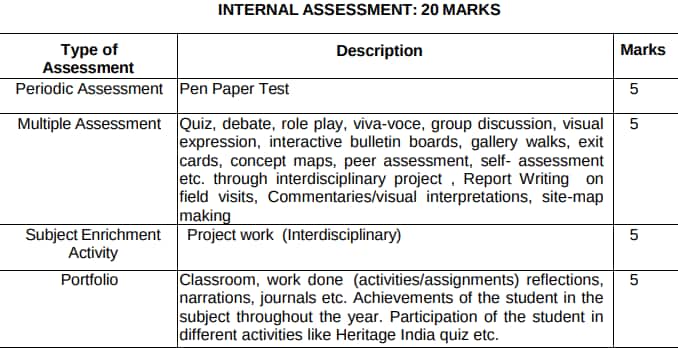
    CBSE Class 9 Social Science Syllabus 2026-27 - Internal Assessment
    1784878472963

    How to Download the CBSE Class 9 Social Science Syllabus 2026-27?

    • Visit the official website of the CBSE, cbseacademic.nic.in.

    • Click on ‘Curriculum’ and select ‘Curriculum 2026-27’ from the drop-down menu.

    • On the new page, click on ‘Secondary Curriculum: Part - 1 (Class IX)'.

    • Further, select the option of ‘Main Subjects’.

    • Now, click on ‘Social Science.’

    • Download the CBSE Class 9 SST syllabus 2026-27 PDF.

    JEE Main Important Chemistry formulas

    As per latest syllabus. Chemistry formulas, equations, & laws of class 11 & 12th chapters

    JEE Main Important Physics formulas

    As per latest syllabus. Physics formulas, equations, & laws of class 11 & 12th chapters

    Confused between CGPA and Percentage?

    Get your results instantly with our calculator!

    💡 Conversion Formula used is: CGPA = Percentage / 9.5

    Recommended Books for CBSE Class 9 Social Science 2026-27

    Students must follow the latest NCERT Class 9 Social Science textbooks prescribed by the CBSE to complete the revised syllabus based on the 2026-27 curriculum.

    Name of the book

    Publisher

    Social Science-Part 1

    NCERT

    Social Science-Part 2

    NCERT

    Also Read:

    Best Courses After 10th Class
    Explore the best courses after 10th across science, commerce, arts, and vocational streams. Find the right path based on your interests and build a strong career foundation.
    Download EBook

    Frequently Asked Questions (FAQs)

    Q: Is NCERT syllabus sufficient for the CBSE Class 9 exam preparation?
    A:

    Yes, NCERT syllabus is sufficient for the CBSE Class 9 Board exam preparation. However, students can also refer to some reference books to understand concepts and a variety of questions.

    Q: Is the CBSE syllabus for Class 9 useful for competitive exam preparation?
    A:

    Yes, the CBSE syllabus for Class 9 is designed in a way that students can also refer to the same for preparing for the competitive exams.

    Q: Is the NCERT book available in any other language as well?
    A:

    Yes, other than English NCERT books are also available in Hindi and Urdu language.

    Articles
    |
    Upcoming School Exams
    Ongoing Dates
    BBOSE 10th Application Date

    23 Jun'26 - 17 Aug'26 (Online)

    Ongoing Dates
    BBOSE 12th Application Date

    23 Jun'26 - 17 Aug'26 (Online)

    Certifications By Top Providers
    Basic 3D Modeling using Blender
    Via Indian Institute of Technology Bombay
    Brand Management
    Via Indian Institute of Management Bangalore
    Economic Evaluation for Health Technology Assessment
    Via Postgraduate Institute of Medical Education and Research Chandigarh
    Yoga Practices 1
    Via Swami Vivekananda Yoga Anusandhana Samsthana, Bangalore
    Dentistry and Human Life
    Via Seoul National University, Seoul
    Endocrine Renal and Gastrointestinal Systems
    Via The University of Queensland, Brisbane
    Explore Top Universities Across Globe

    Questions related to CBSE Class 10th

    On Question asked by student community

    Have a question related to CBSE Class 10th ?

    Hey there,

    For +1 Medical (PCB) admission, your son should apply to government or private senior secondary schools after the Class 10 CBSE results are declared. Admission is usually based on Class 10 marks, though some schools may conduct an entrance test or interview. Please mention your city/state for suitable

    Hello Student,

    If you are asking how to download the migration certificate for Class 10 Karnataka Board, here is how to do it -

    You will have to log in to the DigiLocker app or website using your Aadhaar card number and the registered mobile number for the OTP.

    You