


93,000 Schools Closed in 10 Years, One Uncomfortable Question
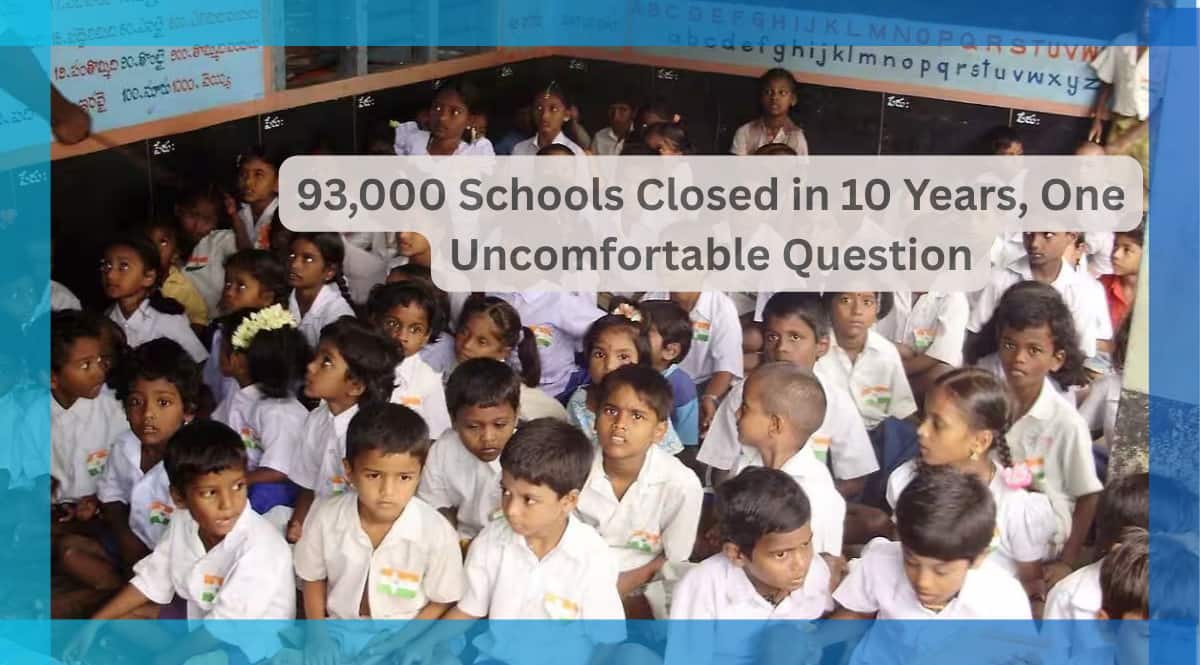
India has closed down 93,779 schools in the last 10 years. This number is almost 9 per cent of the country’s total schools, as per the Ministry of Education data presented in the Lok Sabha and reported by Careers360. This is not a correction; it is a structural fault, and school closures are not slowing down.
This Story also Contains
- 70,000 Schools Closed in Six Years. Did It Stop There? No!
- Madhya Pradesh, Uttar Pradesh Lead School Closures
- Population Increases, Government Schools Are Decreasing.
- Government Schools Take The Hit
- Polling Booth for One Voter, Why Not One School for One Student?
- Efficiency, Or Something More Alarming?
- A Question To Be Asked
70,000 Schools Closed in Six Years. Did It Stop There? No!
According to data, in the first six years, over 70,000 schools were closed. Did the trend stop there? No! Another 19,000 schools were closed down in the subsequent years. This means that the process did not reverse; it continued. This means that India has been closing down around 25 schools on a daily basis for the past 10 years. The question is no longer regarding school closure, but about why such a situation continues and why it is not taken more seriously.
Madhya Pradesh, Uttar Pradesh Lead School Closures
The closures are not the same throughout the country. If we observe the state-wise data, there is an acute regional concentration of school closures, where a handful of large northern and eastern states have a significant number. The scale of school closure is not minor. In certain states the thousands of schools have been closed down.
State-wise data reveals sharp regional concentration:
Madhya Pradesh: Nearly 30,000 schools closed
Uttar Pradesh: Over 25,000 schools closed
Odisha: Around 10,000 schools closed
Assam: Over 8,000 schools closed
Jharkhand: More than 5,500 schools closed
This pattern is more prevalent in northern and eastern states. On the other hand, southern states have shown less volatility. Is this change due to a separate governance model, or is school consolidation being handled differently across the states? These questions require policy scrutiny.
Confused between CGPA and Percentage?
Get your results instantly with our calculator!
Population Increases, Government Schools Are Decreasing.
Over the past decade, the population increased by 15.4 crore (11.77 per cent). In the same period, the total number of schools declined while student enrolment dropped by 2.41 crore (8.9 per cent). This clear gap highlights a structural shift in school education, raising serious questions about access, consolidation, migration patterns, and long-term planning.
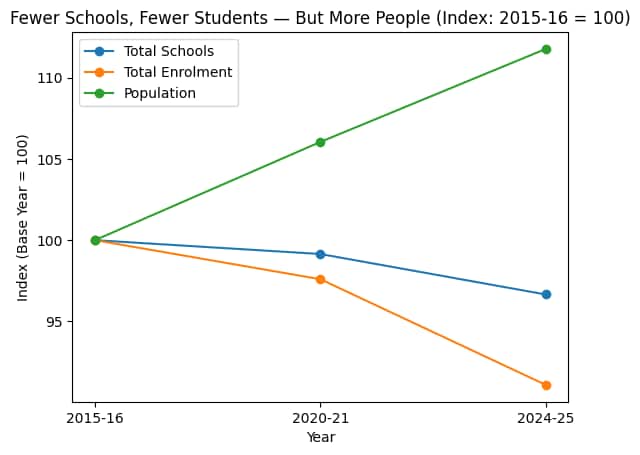
India is the world’s most populous country. We keep talking about our demographic dividend. It can be used to its advantage only through education, productivity, and skill development. If children are not in schools and learning, then the dividend becomes a liability!
Government Schools Take The Hit
The number of government and aided schools in India fell by 9.1 per cent in the past 10 years. During the same time, the number of private schools increased by 14.9 per cent. The difference indicates a gradual shift in India’s school system, where public institutions' numbers dwindle and private schools increase.
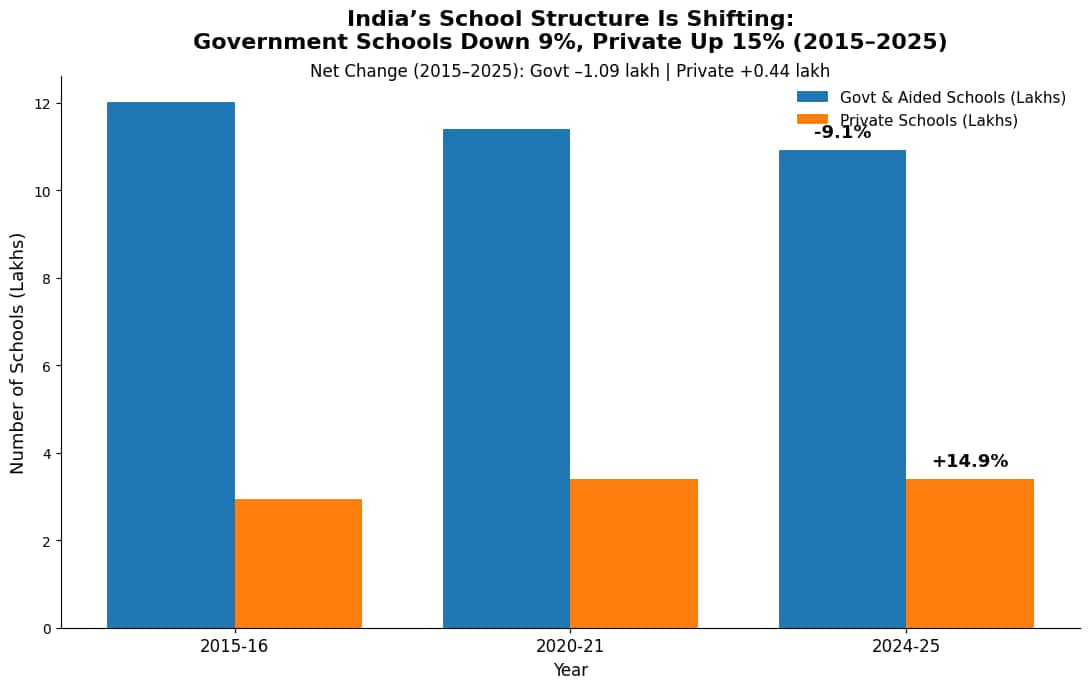
The sharpest decline has been in government and aided schools. Meanwhile, private schools increased by nearly 15 per cent over the decade. This is not just closure. It is an unspoken shift from public to private education. But what about the families who cannot afford private schools?
Polling Booth for One Voter, Why Not One School for One Student?
India has quite often exemplified that it can set up a polling booth for a single voter in a remote location, why the same happens for a school, or at least a functioning education system for a handful of children in a remote village?
Why must low enrolment automatically mean closure? Why can there not be:
Multi-grade teaching models?
Cluster school transport systems?
Digital hybrid solutions?
Special retention grants for sparsely populated regions?
If the authorities can protect one vote, can it not secure a child’s right to education?
Efficiency, Or Something More Alarming?
Officials and administrators may argue that closures are part of “school consolidation” to improve efficiency. Merging under-enrolled schools into larger ones may, on paper, optimise resources.
But consolidation comes at a cost:
Increased travel distance
Higher dropout risk in rural and remote areas
Greater financial burden on families
Loss of community-level educational access
As the scale is too large, it might lead to inequality. The question is not about infrastructure; it is about accessibility.
A Question To Be Asked
93,000 schools closed, and when the trend shows no sign of stopping, a difficult question crops up: are we helping the education system or weakening it? The demographic dividend we talk about does not come from being the most populous nation; it comes from being a productive one, and productivity begins in classrooms. If school closures keep happening, we risk losing the advantage of the ‘demographic dividend’.
That is a question the country and its policymakers must answer!
