
Search Colleges, Exams, Schools & more


Login
How Many Perfect Cubes Are There Between 1 And 1000?
There are 8 perfect cubes between 1 and 1000.
The result of multiplying three numbers together is a perfect cube. When multiplied three times, we examine whether an integer, when multiplied three times, equals the number "N" to determine whether the number "N" is a perfect cube. If so, the cube is perfect. A few instances of perfect cubes are 1, 8, 27, and 64. You can make a perfect square by multiplying a number by itself. It is not the same as a perfect cube. Positive and negative numbers are both acceptable for perfect cubes. For instance, since it results from multiplying -4 three times, -64 is a perfect cube.
Trick To Find If The Number Is Perfect Cube Or Not
Let's say we are given a number, but we are still determining whether or not it is a perfect cube. Therefore, we calculate the number's digit sum and decide whether it is 0, 1, 8, or 9. We don't need to calculate the number to see if it is a perfect cube if it is not one of these four values. In other words, if the sum is not equal to 0, 1, 8, or 9, this method stops the process of prime factorisation.
Perfect Cubes Between 1 And 1000
2\times 2 \times 2=8 \\
3\times 3\times 3=27 \\
4\times 4\times 4=64 \\
5\times 5\times 5=125 \\
6\times 6\times 6=216 \\
7\times 7\times 7=343 \\
8\times 8\times 8=512\\
9\times 9\times 9=729 \\
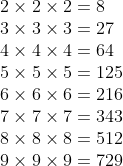
8, 27, 64, 125, 216, 342, 512 and 729 are the perfect cubes from 1 to 1000. 1 and 1000 are also perfect cube, but it is not included in the list because the question says between 1 and 1000.
Confused between CGPA and Percentage?
Get your results instantly with our calculator!
💡 Conversion Formula used is: CGPA = Percentage / 9.5

Study Resources, Applications and Opportunities
Law Admissions 2026 Open | Avail Merit-Based Scholarships
Global Institute of Business Studies, Bengaluru
ApplyBBA/MBA/PGDM Early Bird Applications Deadline 06th Nov'26. Apply now using coupon code CAREER250 and get ₹250 off the application fee
School of Business, UPES, Dehradun
ApplyRanked #36 amongst institutions in Management by NIRF | 100% Placement
Great Lakes Institute of Management, Chennai
ApplyGlobally Recognized by AACSB (US) & AMBA (UK) | 18 LPA Avg. CTC for PGPM 2026
NEET PG College Predictor
ExploreNEET PG All India & State College Predictor with Admission Process Guide
Management Development Institute, Gurgaon
ApplyTop B-School: Ranked #9 in NIRF Management Rankings 2025.